

 English
 русский
 Español
 Français
 Português
 عربى
عربى




+86-13588556918
Content
- 1 1. The Role of Truck Dumpers in Modern Bulk Material Handling
- 2 2. What Makes the Shallow Foundation Design Different?
- 3 3. Main Product Advantages
- 4 4. Technical Configuration and Model Selection
- 5 5. Material Compatibility and Unloading Performance
- 6 6. Wear-Resistant and Special-Material Options
- 7 7. Safety Engineering and Operational Control
- 8 8. Manufacturing Strengths and Engineering Capability
- 9 9. Comparison with Conventional Deep-Pit Dumpers
- 10 10. Installation and Project Planning
- 11 11. Maintenance and Service Life
- 12 12. Applications Across Different Industries
- 13 13. Automation, Integration, and Data Management
- 14 14. Economic Value and Total Cost of Ownership
- 15 15. Engineering Considerations for Competitor Comparison
- 16 16. Recommended Operating Procedure
- 17 17. Frequently Asked Questions
- 17.1 Q1: What is a shallow foundation truck dumper?
- 17.2 Q2: How much can civil construction cost be reduced?
- 17.3 Q3: What materials can the equipment handle?
- 17.4 Q4: Can it unload wet or sticky materials?
- 17.5 Q5: What is the maximum particle size?
- 17.6 Q6: Are food-grade configurations available?
- 17.7 Q7: Does the shallow design reduce unloading efficiency?
- 17.8 Q8: Can the driver operate the dumper without a professional operator?
- 17.9 Q9: What maintenance is required for abrasive materials?
- 17.10 Q10: What information is needed for a quotation?
- 18 18. Why Choose a Site-Specific Solution?
- 19 19. Conclusion
- 20 References
- 21 Product: Shallow Foundation Truck Dumpers
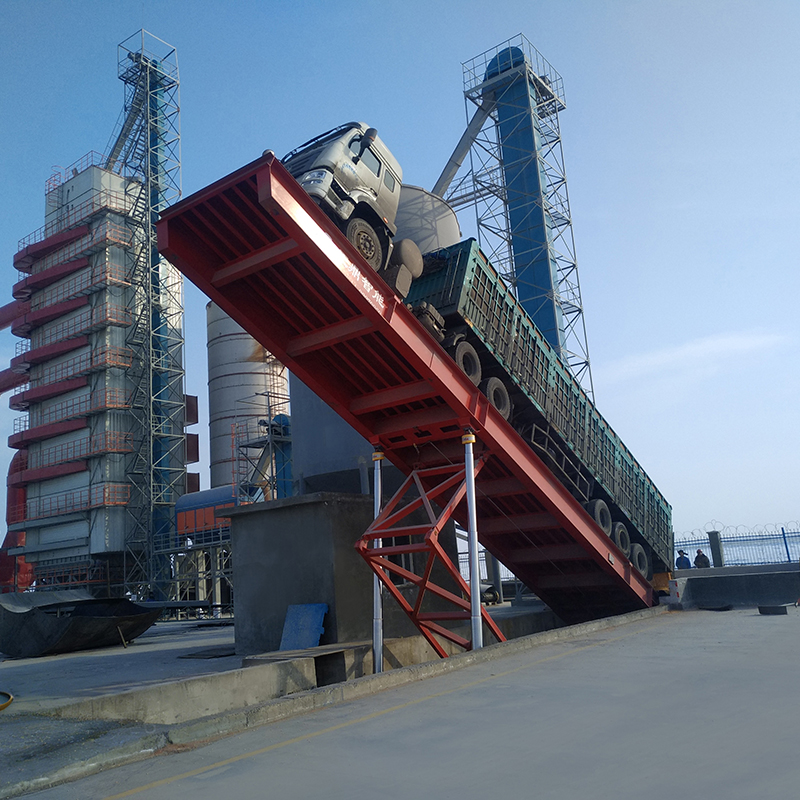
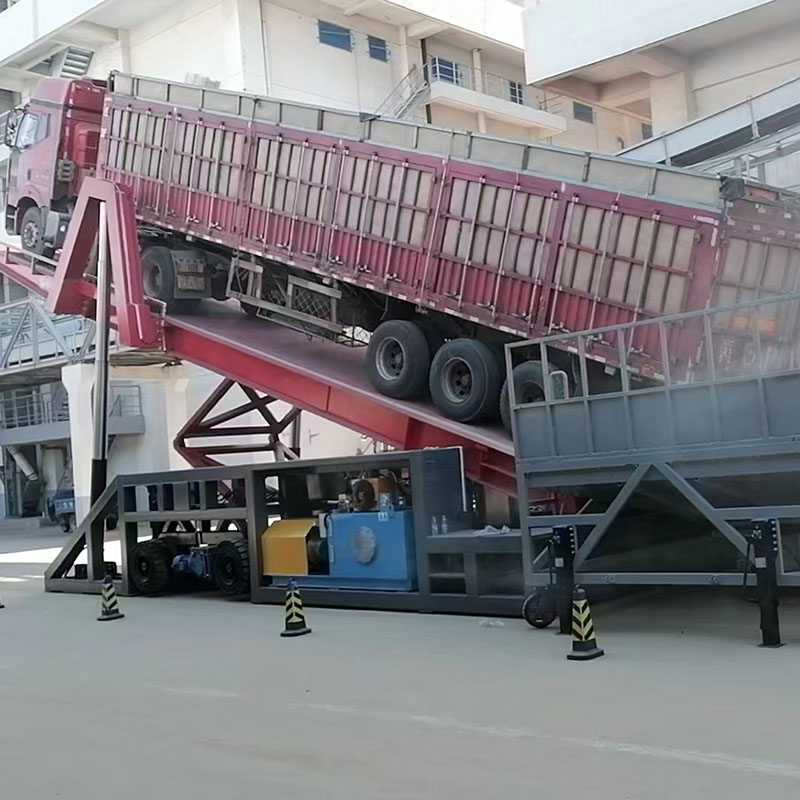
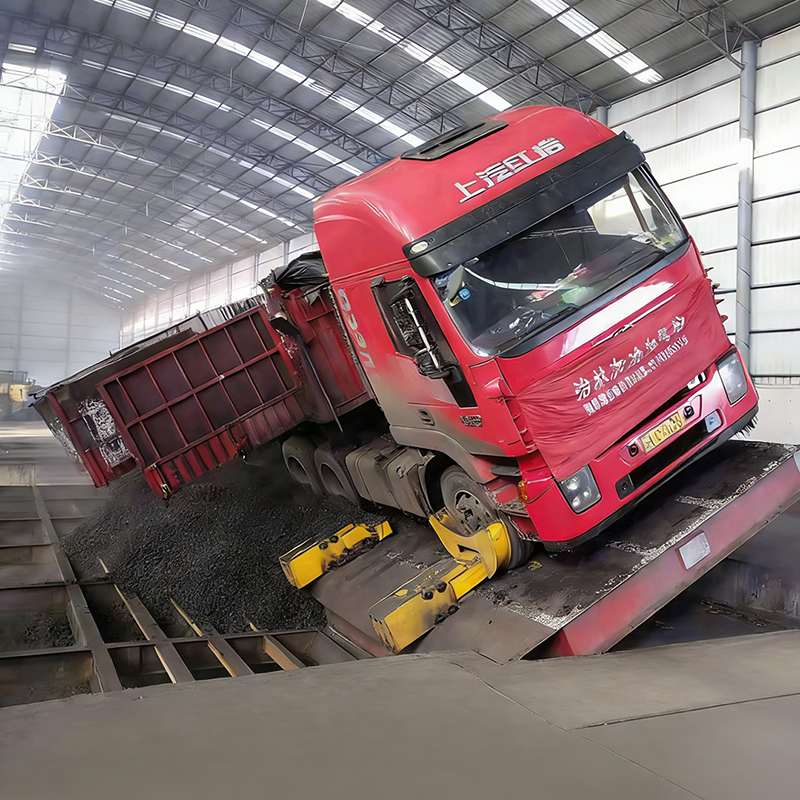
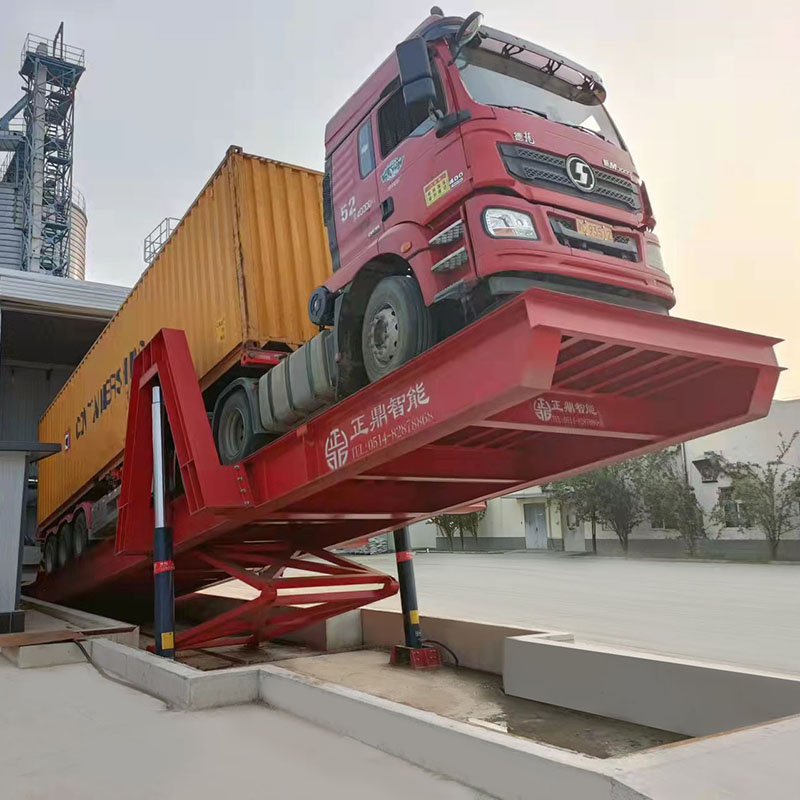
Shallow foundation truck dumpers are designed for industrial sites that need reliable truck unloading without the expense, disruption, and construction complexity associated with a deep receiving pit. By combining a low-profile foundation with synchronized hydraulic lifting, automatic wheel restraint, imported hydraulic components, and unmanned operating functions, this type of dumper provides a practical solution for grain terminals, feed mills, cement plants, coal facilities, chemical factories, ports, and other bulk-material handling operations.
Jiangsu Zhengding Intelligent Equipment Co., Ltd. manufactures shallow foundation truck dumpers as part of a broader portfolio of automated loading and unloading equipment. The company develops and produces equipment for trucks, containers, ships, and integrated logistics systems. Its product range includes rear dumpers, side-turn truck dumpers, truck loading equipment, container flippers, and related automatic handling machinery.
The central advantage of the shallow foundation design is its reduced civil engineering requirement. The pit is typically formed to approximately the thickness of the unloading platform rather than requiring a deep excavation. Depending on the site and project conditions, this can reduce civil construction costs by more than 60 percent, with the supplied product information indicating potential reductions of up to 70 percent compared with conventional deep-pit arrangements.
Lower construction cost is only one benefit. A shallow pit can simplify drainage, reduce excavation risk, shorten installation time, improve access for inspection, and make future maintenance more convenient. When these benefits are combined with high-precision hydraulic synchronization and automatic retaining-wheel fixation, the result is a truck dumper that emphasizes safety, operational consistency, and long service life.
Shallow Foundation Truck Dumpers
1. The Role of Truck Dumpers in Modern Bulk Material Handling
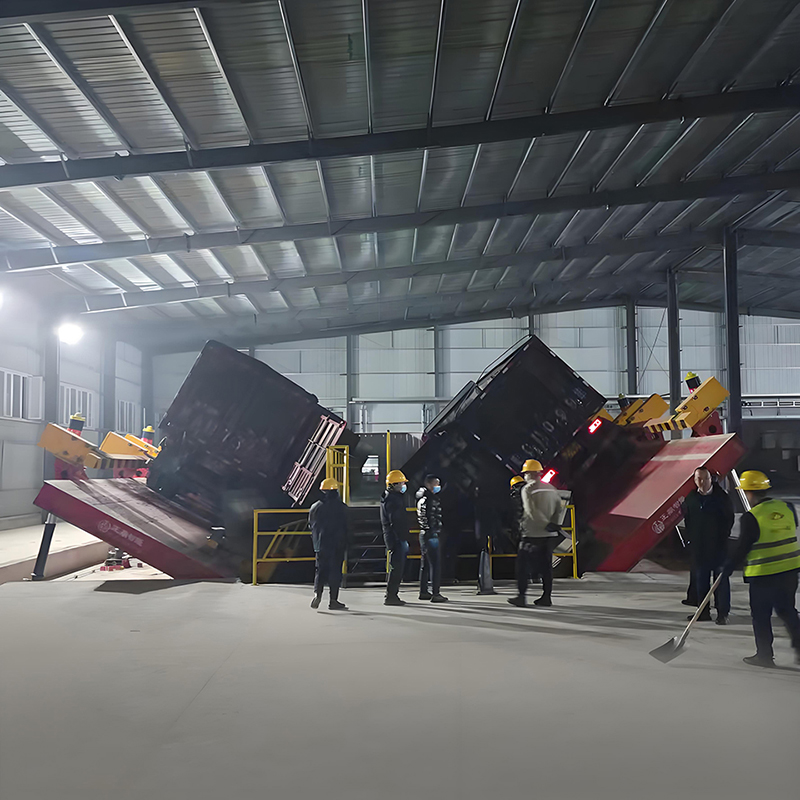
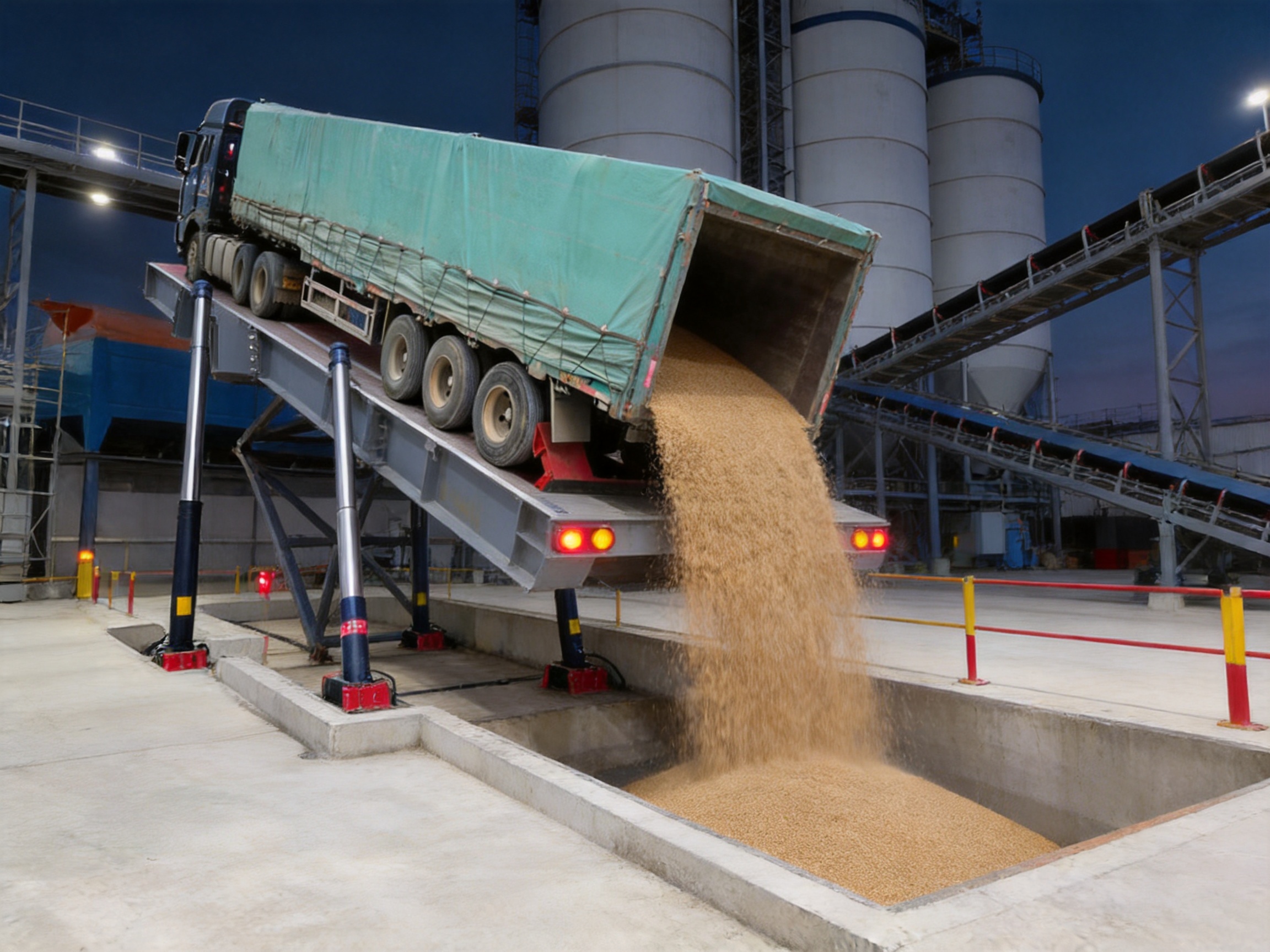
Truck dumpers are essential at facilities where bulk materials arrive by road and must be transferred quickly into hoppers, conveyors, storage bins, silos, or processing systems. Instead of requiring a truck to discharge through its own tipping mechanism, a truck dumper raises the entire vehicle or trailer at a controlled angle. Gravity then moves the load toward a receiving hopper or conveyor.
This process is particularly valuable when trucks have different body designs, when material must be discharged completely, or when high throughput is required. A properly designed dumper can reduce waiting time, minimize manual intervention, and provide a consistent unloading cycle regardless of the truck model or driver experience.
Typical applications include the unloading of corn, wheat, soybeans, rice, oilseeds, coal, petroleum coke, sand, gravel, crushed stone, cement, fly ash, lime, fertilizers, plastic pellets, biomass, and other free-flowing bulk solids. With appropriate liners, vibration systems, heating, or reinforced wear plates, the equipment can also handle more difficult materials such as wet clay, sticky concentrates, construction rubble, and abrasive minerals.
For an industrial user, the dumper is not an isolated machine. It forms part of a complete receiving system that may include traffic control, weighing equipment, sampling stations, dust collection, receiving hoppers, feeders, conveyors, magnets, screens, storage systems, and process controls. The performance of the dumper directly affects the capacity and reliability of the entire material-handling chain.
A dumper that unloads rapidly but leaves excessive residue may create bottlenecks at the receiving hopper. A unit that requires frequent manual wheel blocking can increase safety risks and cycle time. A platform with poor hydraulic synchronization may generate vibration, uneven loading, and premature wear. The shallow foundation truck dumper addresses these concerns through a combination of structural, hydraulic, and control-system features.
2. What Makes the Shallow Foundation Design Different?
Conventional truck dumpers commonly require a deep pit below the unloading platform. The pit provides space for the lifting structure, hydraulic cylinders, mechanical components, and truck clearance. However, deep excavation may be difficult or expensive where groundwater is high, the soil is unstable, underground utilities are present, existing buildings must remain in service, or the available construction period is limited.
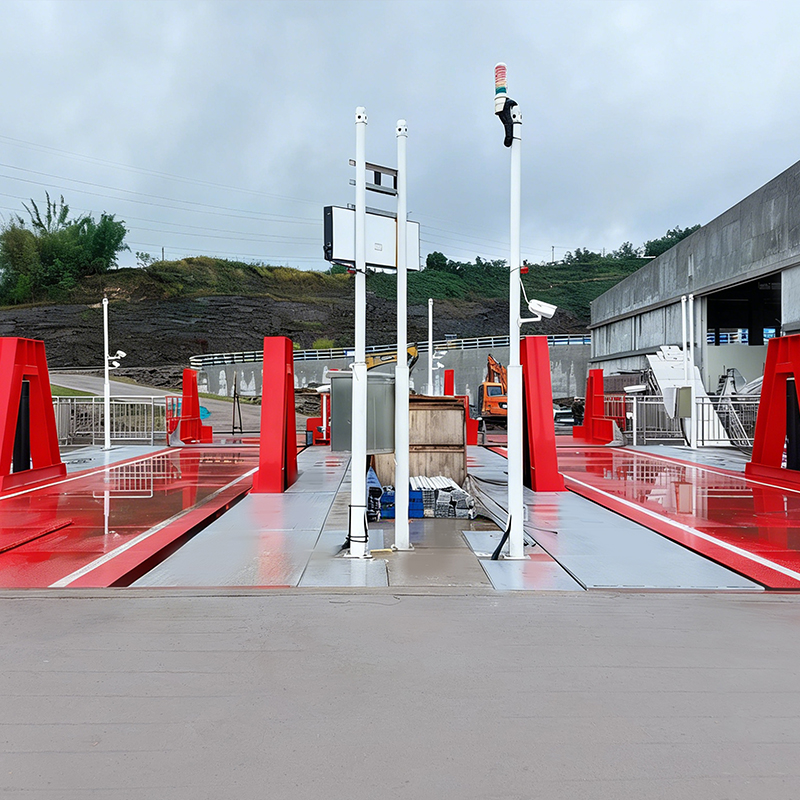
A shallow foundation truck dumper uses a low-profile configuration. The pit depth is generally about 0.5 to 1.2 meters, although the final dimension depends on the selected model, platform arrangement, truck geometry, and project requirements. Because the foundation is shallow, the installation may require substantially less excavation, concrete, reinforcement, waterproofing, backfilling, and soil removal.
The shallow design is suitable for both new construction and renovation projects. A site may be able to install the dumper without rebuilding a large section of the plant or creating a long approach ramp. In some cases, the reduced excavation allows the equipment to be positioned close to existing buildings, storage silos, roadways, or production lines.
Another advantage is improved visibility of the main mechanical and hydraulic components. Maintenance personnel can often access the cylinder connections, pumps, controls, retaining devices, and structural members more easily than they can in a deep and restricted pit. Easier access can reduce inspection time and support preventive maintenance.
The shallow foundation does not mean that the dumper is a light-duty machine. The platform, lifting frame, hydraulic cylinders, hinges, wheel restraints, and foundations are engineered for heavy vehicles and high cyclic loads. Depending on the selected configuration, the supplied models include rated lifting capacities of 80, 100, and 150 tons, with platform lengths and widths designed for different truck and trailer combinations.
Compared with deep-pit equipment, the shallow model may have a slightly different unloading geometry. The tilt axis and receiving-hopper arrangement must be carefully coordinated so that the vehicle reaches an appropriate angle for material flow. With suitable platform length, hopper design, liner selection, and control settings, the lower pit depth does not prevent efficient unloading.
3. Main Product Advantages
3.1 Reduced Civil Engineering Cost
The strongest competitive advantage of this product is its shallow foundation. Conventional deep-pit truck dumpers may require extensive excavation and large reinforced concrete structures. These works can represent a significant portion of the total project budget, particularly in areas with difficult soil, groundwater, frost conditions, or expensive construction labor.
By limiting the pit to a low-profile arrangement, the shallow foundation dumper can reduce excavation volume and concrete consumption. The supplied information indicates civil construction savings of more than 60 percent in comparison with conventional truck dumpers and cites reductions of approximately 70 percent for the shallow foundation design.
The actual saving depends on local site conditions, but the economic principle is clear: reducing the depth and volume of the foundation can lower material, labor, drainage, waterproofing, and soil-disposal costs. The customer may also benefit from reduced project risk because fewer underground construction activities are required.
3.2 Easier Installation and Site Adaptation
A deep pit often requires a carefully engineered drainage system and substantial protection against groundwater. It may also interfere with buried utilities or require a long ramp for trucks to reach the unloading position. A shallow structure gives project designers greater freedom when integrating the dumper into an existing plant.
The low-profile arrangement is especially useful for plant upgrades, temporary receiving stations, seasonal grain operations, and facilities where construction must take place while production continues. The reduced foundation work can shorten the installation schedule and make it easier to coordinate civil, electrical, hydraulic, and conveying contractors.
3.3 High-Precision Hydraulic Synchronization
The dumper uses a high-precision oil-cylinder synchronous stability system developed by the manufacturer. Synchronization is important because the lifting platform must rise evenly on both sides. Uneven extension can produce torsion, vibration, impact loads, and stress on the platform, truck chassis, hinges, and hydraulic components.
The synchronous stability system is designed to maintain balanced movement during lifting and lowering. According to the supplied product information, it reduces vibration during operation, reduces impact on the oil cylinders, improves operational safety, and helps extend cylinder service life.
Stable movement is also important for the driver. A smooth lift reduces sudden movement and helps keep the vehicle positioned securely on the platform. This is particularly valuable when handling heavy loads or when the dumper is operated repeatedly throughout the day.
3.4 Automatic Retaining-Wheel Fixing
The full automatic retaining-wheel fixing device prevents the truck or trailer from moving during the tipping cycle. In manual systems, an operator may need to position wheel blocks or use a remote control in a dusty, noisy, or visually difficult environment. Automatic fixation reduces the need for this intervention.
Once the vehicle is correctly positioned, the retaining device can be engaged as part of the operating sequence. This supports more consistent cycle times and reduces the possibility of human error. It also allows the driver to complete the operation without requiring a separate professional dumper operator, provided that the site has implemented the appropriate operating procedures and safety interlocks.
Automatic wheel restraint does not replace safety management. The vehicle must still stop in the correct position, the driver must follow the site procedure, and the control system must verify that the platform, restraints, gates, and receiving equipment are ready. However, automatic fixation is a significant improvement over systems that depend entirely on manual blocking and remote-control operation.
3.5 Imported Hydraulic Components
The hydraulic cylinders and pumps are specified as imported-brand components selected for safety, reliability, and long service life. Hydraulic equipment is one of the most important parts of a truck dumper because it carries the load during lifting, holding, and lowering.
High-quality pumps can provide stable flow and pressure, while reliable cylinders help reduce leakage and unexpected downtime. Using proven hydraulic components also makes it easier to establish maintenance procedures, replacement schedules, and spare-parts planning.
3.6 Unmanned and Driver-Operated Functionality
The control system can support unmanned operation. In practical terms, this means that a driver can complete the unloading cycle without a dedicated operator standing beside the machine. Automated sequencing can include vehicle positioning, wheel restraint, platform lifting, unloading, lowering, and release.
Reducing the number of personnel required at the dumper can improve labor efficiency and lower exposure to dust, vehicle movement, noise, and heavy machinery. It can also make the process more repeatable because the system follows defined operating parameters rather than relying on individual operator habits.
3.7 Broad Material Compatibility
The dumper is suitable for a wide range of bulk solids with bulk densities approximately from 0.4 to 2.5 tons per cubic meter, subject to the selected model, platform, loading method, and material characteristics. Common applications include grain, coal, sand, cement, fertilizers, plastic pellets, aggregates, and minerals.
Material compatibility depends on more than density. Moisture, particle size, cohesiveness, temperature, abrasiveness, corrosiveness, and flowability all influence unloading performance. The manufacturer can select platform surfaces, liners, angles, vibration systems, and other options to match the material.
4. Technical Configuration and Model Selection
Model selection should begin with the truck and trailer fleet rather than with the dumper nameplate alone. The designer must consider vehicle length, wheelbase, axle arrangement, body height, gross vehicle weight, material density, expected throughput, unloading frequency, and the dimensions of the receiving hopper.
| Model | Available Size L × W (m) | Maximum Lifting Weight (t) | Maximum Lifting Angle |
|---|---|---|---|
| TQXHC 50 | 14 × 3, 16 × 3, or 17 × 3 | 80 | 45° or 55° |
| TQXHC 80 | 16 × 3, 17 × 3, or 18 × 3 | 80 | 45° or 55° |
| TQXHC 100 | 17 × 3, 18 × 3, or 20 × 3 | 100 | 45° or 55° |
| TQXHC 150 | 17 × 3, 18 × 3, or 20 × 3 | 150 | 45° or 55° |
The model information shows platform widths of approximately three meters and available lengths from 14 to 20 meters. These dimensions can accommodate many standard semi-trailers and rigid trucks, but the final platform should be confirmed against the customer’s actual fleet.
The maximum lifting angle is listed as 45 or 55 degrees. A 45-degree angle may be suitable for many grains, pellets, fertilizers, and other free-flowing products. A 55-degree angle can improve discharge of heavier aggregates, coal, crushed stone, or materials with poorer flowability.
The rated lifting weight must include the vehicle, trailer, body, and material load. Customers should not select a model based only on the payload. The dumper must be capable of lifting the complete loaded vehicle within the designed safety margin.
Platform length also affects unloading performance. A longer platform may be needed for extended trailers or vehicle combinations. It can also help distribute the load and maintain the correct position relative to the receiving hopper. A shorter platform may be suitable for rigid trucks or space-constrained sites.
5. Material Compatibility and Unloading Performance
Bulk materials behave differently when the platform is tilted. Free-flowing grains and plastic pellets usually discharge rapidly and leave little residue. Aggregates and minerals are heavier and more abrasive, requiring stronger liners and structural protection. Cement, fly ash, and lime may be dusty and cohesive, requiring careful dust control and suitable hopper geometry.
| Material | Typical Bulk Density (t/m³) | Recommended Tilt Angle | Indicative Discharge Efficiency |
|---|---|---|---|
| Corn, soybeans, and wheat | 0.72–0.78 | 40°–45° | Approximately 99.5% |
| Sand, gravel, and crushed stone | 1.4–1.8 | 50°–55° | Approximately 98.2% |
| Cement, fly ash, and lime | 0.9–1.2 | 45°–50° | Approximately 97.8% |
| Granular fertilizers | 0.85–1.1 | 42°–48° | Approximately 99.1% |
| Plastic pellets | 0.55–0.65 | 38°–42° | Approximately 99.7% |
| Coal and petroleum coke | 0.75–0.95 | 48°–53° | Approximately 98.5% |
The efficiency values are indicative performance data provided for different material categories. Actual performance depends on moisture, truck body design, residual material, hopper geometry, operating speed, liner condition, and the quality of the material-flow analysis carried out during engineering.
For grain applications, the main priorities are gentle handling, low residue, dust control, sanitation, and prevention of cross-contamination. Stainless steel surfaces, food-compatible seals, easy-clean areas, and suitable receiving equipment may be specified for facilities that switch between wheat, corn, soybeans, or other food and feed products.
For aggregates, the priorities are wear resistance, structural strength, impact protection, and easy replacement of wear components. AR400 steel liners, with hardness in the approximate range of 360 to 440 HB, can help protect high-contact areas and extend platform service life. Depending on operating conditions, liner life for aggregates may reach several thousand operating hours.
For sticky materials such as wet clay or concentrate, a UHMW-PE liner can reduce friction and support material flow. Vibration assistance may also be used. The supplied information indicates that materials with approximately 12 to 18 percent moisture can achieve improved discharge performance through the use of a vibrator or UHMW-PE liner.
Extremely sticky materials may require additional measures, including controlled platform heating. A heated platform can be thermostatically controlled within an approximate range of 35 to 45 degrees Celsius to reduce adhesion in specific applications. Such options should be selected only after evaluating the material’s moisture, temperature, chemical properties, and safety requirements.
6. Wear-Resistant and Special-Material Options
6.1 AR400 Steel Liners
AR400 liners are intended for abrasive products such as sand, gravel, crushed stone, slag, coal, petroleum coke, and certain mineral concentrates. They provide greater resistance to scratching, gouging, and repeated impact than ordinary structural steel.
Liner thickness and fastening method should be determined according to particle size, drop height, loading frequency, and material abrasiveness. Wear plates should be designed as replaceable components so that maintenance teams can renew high-wear zones without replacing the complete platform.
6.2 UHMW-PE Liners
Ultra-high-molecular-weight polyethylene is useful when low friction is more important than extreme impact resistance. It can help materials slide across the platform and can reduce adhesion from moist or cohesive products. This option is suitable for selected applications involving wet clay, concentrate, fertilizers, or food products.
UHMW-PE should be evaluated against operating temperature, material chemistry, impact conditions, and cleaning procedures. It is not a universal replacement for steel wear plates, but it can be highly effective when material flow is limited by friction and sticking.
6.3 Stainless Steel Platforms
Stainless steel platforms are available for food-grade and corrosive applications. Grade 304 or 316 stainless steel may be selected depending on the material, cleaning chemicals, chloride exposure, and hygiene requirements.
Food-grade arrangements may also include FDA-compliant seals, smooth surfaces, minimized product-retention points, and designs that support regular sanitation. In chemical applications, stainless steel can be combined with appropriate sealing and corrosion-control measures for materials within the expected chemical range.
7. Safety Engineering and Operational Control
Safety is a fundamental requirement for any machine that lifts a loaded truck. The dumper must control vehicle movement, platform motion, access to hazardous areas, and interaction with upstream and downstream equipment.
The high-precision synchronous hydraulic system helps reduce uneven movement and shock loading. Automatic wheel restraint helps prevent vehicle movement during lifting. Control interlocks can be used to confirm that the truck is positioned correctly before the lifting cycle begins and that the platform has returned to its safe position before the vehicle is released.
Other safety provisions may include emergency-stop circuits, hydraulic pressure protection, mechanical supports, access barriers, warning lights, audible alarms, limit switches, and maintenance lockout points. The specific arrangement should follow the applicable local machinery, electrical, occupational-safety, and vehicle-handling requirements.
Driver-operated unloading requires clear instructions. The driver should approach at a controlled speed, stop at the positioning mark, apply the parking brake, confirm that the vehicle is correctly aligned, and follow the control-system prompts. The automatic system should not permit lifting if a restraint is not engaged or if an unsafe condition is detected.
Dust can be a major concern in grain, cement, coal, and mineral operations. The dumper should be integrated with a suitable dust-collection or enclosure system where required. Reducing the need for operators to stand near the platform is an additional benefit, but dust suppression remains a responsibility of the complete receiving system.
Emergency procedures should be established for power failure, hydraulic failure, vehicle misalignment, material blockage, abnormal vibration, and communication loss. Operators and maintenance personnel should receive practical training before commissioning.
8. Manufacturing Strengths and Engineering Capability
Jiangsu Zhengding Intelligent Equipment Co., Ltd. is described as a national high-tech enterprise focused on the research, development, manufacturing, and sale of intelligent logistics equipment. Its experience covers automated loading and unloading systems for automobiles, containers, ships, and related industrial applications.
This broad product background is important because a truck dumper must operate as part of a logistics process rather than as a standalone lifting platform. Experience with rear dumpers, side-turn dumpers, car loading equipment, container flippers, and metering systems enables the manufacturer to understand vehicle positioning, bulk-material flow, transfer interfaces, and automated sequencing.
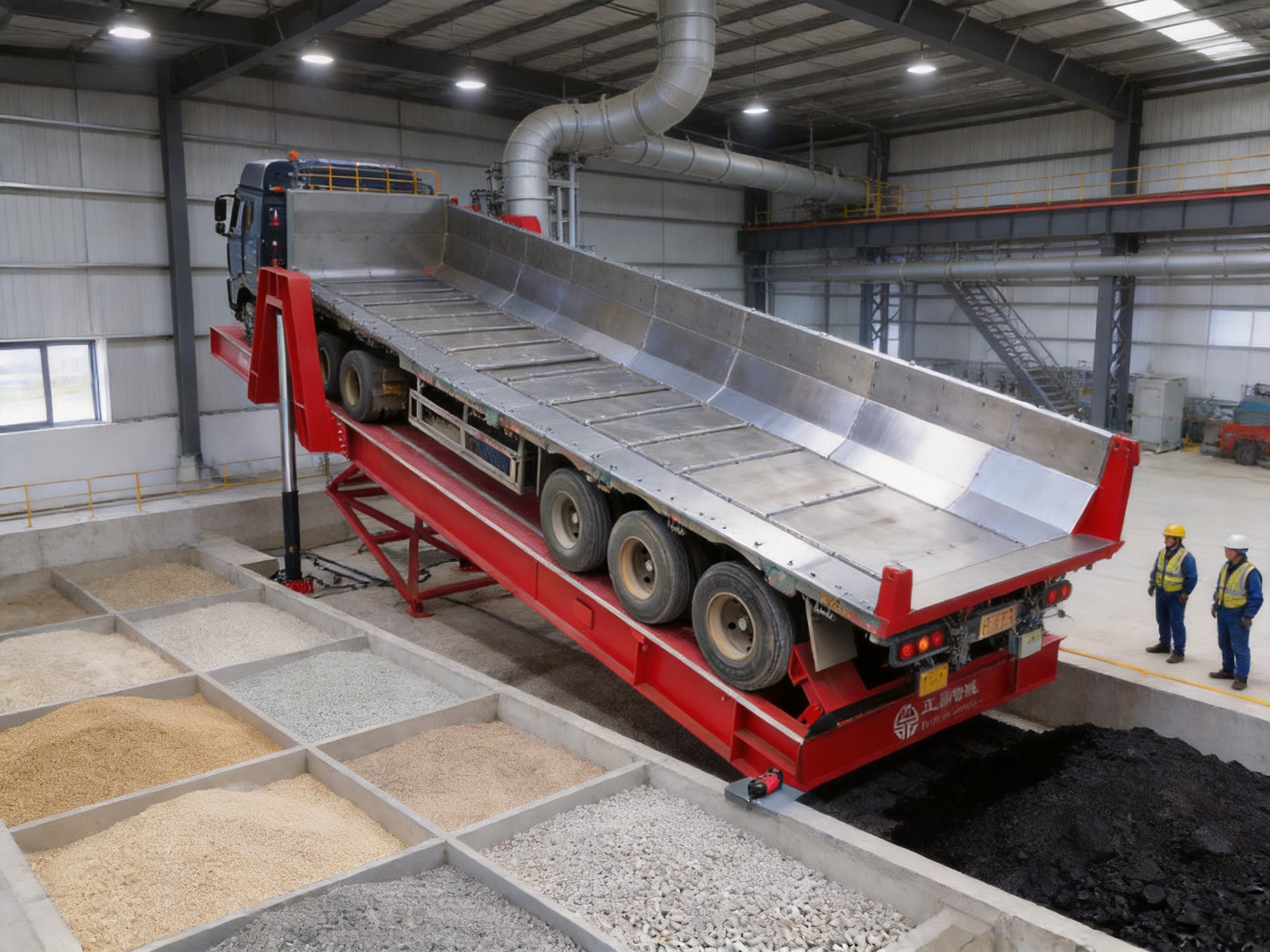
The company provides site-specific engineering rather than relying solely on a standard machine. Its engineering work for shallow foundation dumpers can include foundation assessment, material-flow analysis, platform selection, liner selection, hydraulic configuration, receiving-hopper coordination, and control-system integration.
Foundation assessment is particularly important for shallow installations. Engineers need to evaluate soil bearing capacity, existing concrete, groundwater, drainage, vehicle traffic, frost conditions, and the relationship between the platform and adjacent road surfaces. A shallow pit reduces civil work, but it still requires a stable and accurately prepared foundation.
Material-flow analysis helps determine the correct tilt angle, hopper opening, liner type, vibration requirements, and discharge arrangement. A design optimized for wheat may not be ideal for wet clay or crushed stone. Engineering the equipment around the actual material can improve throughput and reduce residue, wear, and cleaning time.
Manufacturing quality also depends on structural fabrication, welding control, dimensional inspection, hydraulic cleanliness, electrical assembly, and functional testing. The lifting platform must maintain rigidity under repeated loading. Welded structures should be produced according to controlled procedures, and critical dimensions should be verified before delivery.
Hydraulic systems require careful assembly and contamination control. Clean hydraulic lines, correctly rated fittings, pressure testing, and accurate cylinder synchronization are essential to reliable operation. Electrical and control panels should be tested for sequence logic, emergency stops, sensor feedback, interlocks, and communication with conveyors or plant automation systems.
The company’s products are used in steel, chemical, cement, coal, grain, oil, food, feed, ports, papermaking, and new energy industries. Its equipment has also been exported to Japan, Brazil, Egypt, Pakistan, India, the Middle East, and Southeast Asia. This range of markets reflects experience with different climates, material properties, operating practices, and project requirements.
9. Comparison with Conventional Deep-Pit Dumpers
The choice between a shallow and deep foundation dumper should be based on the complete project, not on the purchase price alone. Deep-pit dumpers may be appropriate where a new facility has ample space, favorable soil conditions, and a need for a specific underground hopper configuration. However, they can require more extensive construction and may be more difficult to modify later.
| Evaluation Area | Shallow Foundation Dumper | Conventional Deep-Pit Dumper |
|---|---|---|
| Excavation requirement | Low-profile pit, typically about 0.5–1.2 m | Deep excavation and larger underground structure |
| Civil construction cost | Potential reduction of more than 60 percent, depending on site conditions | Generally higher due to excavation, concrete, drainage, and waterproofing |
| Renovation suitability | Well suited to many existing facilities | May require major reconstruction |
| Maintenance access | Relatively accessible low-profile components | Some components may be located in restricted underground areas |
| Groundwater sensitivity | Reduced excavation exposure | More demanding waterproofing and drainage requirements |
| Automation potential | Automatic restraints and driver-operated cycles available | Automation depends on the selected configuration |
| Material flexibility | Suitable for grains, aggregates, powders, fertilizers, pellets, and other bulk solids with proper options | Broadly suitable, with performance dependent on system design |
The shallow design can be especially competitive when civil engineering represents a large percentage of the project cost. It may also provide a faster path to operation for customers upgrading a receiving station or adding capacity to an existing plant.
There are still design considerations. The receiving hopper must be positioned correctly, the road approach must support safe alignment, and the low-profile configuration must provide adequate clearance for the vehicle and unloading path. A qualified engineering review is required before final selection.
10. Installation and Project Planning
A successful installation begins with a site survey. The survey should document vehicle traffic patterns, truck dimensions, soil conditions, drainage, existing utilities, electrical supply, control-room location, conveyor direction, hopper dimensions, and available maintenance space.
The customer should provide representative vehicle drawings and material data. Important information includes maximum gross vehicle weight, tare weight, payload, overall length, body width, axle configuration, wheelbase, tire position, rear overhang, and body discharge characteristics.
Material samples or laboratory data can help determine bulk density, moisture, particle-size distribution, angle of repose, abrasiveness, corrosiveness, and flowability. These properties influence platform dimensions, lifting angle, liner choice, vibration, heating, and dust-control requirements.
The foundation should be constructed to the approved drawings with suitable reinforcement, embedded parts, drainage, and level tolerances. Even though the foundation is shallow, the platform must be supported uniformly. Uneven settlement can affect hydraulic synchronization, vehicle alignment, and long-term structural performance.
After mechanical installation, the hydraulic system should be filled with the specified fluid and checked for leaks, pressure stability, cylinder synchronization, and smooth movement. Electrical commissioning should verify sensors, emergency stops, retaining-wheel operation, limit positions, alarms, and interfaces with conveyors, gates, scales, and plant-control systems.
Testing should include unloaded cycles, partial-load cycles, and full-load operation using representative vehicles and materials. The commissioning team should record lift and lowering times, platform alignment, residual material, vibration, hydraulic pressure, wheel-restraint performance, and emergency response.
11. Maintenance and Service Life
Preventive maintenance is necessary to protect the hydraulic system, platform structure, wheel restraints, hinges, liners, sensors, and control equipment. A maintenance program should be based on operating hours, unloading cycles, material abrasiveness, weather, and the consequences of downtime.
For abrasive materials such as sand, cement, coal, and crushed stone, liner inspections may be scheduled at approximately 1,000 operating-hour intervals, with more frequent inspections during initial operation. Operators should look for thinning, cracking, loose fasteners, deformation, and wear around impact zones.
For corrosive chemicals, seals, hoses, painted surfaces, and stainless-steel joints should be inspected regularly. The supplied information recommends checking seal integrity every three months for corrosive applications, although the final interval should follow the material’s chemical properties and the site’s risk assessment.
Food and feed applications require a cleaning and sanitation plan. The platform, wheel restraints, receiving hopper, and nearby surfaces should be designed and maintained to prevent accumulation. Weekly sanitation may be appropriate for some operations, while high-hygiene facilities may require cleaning after each product change or production shift.
Hydraulic maintenance includes checking oil level, oil cleanliness, hoses, fittings, pump performance, cylinder rods, seals, and pressure settings. Contaminated hydraulic oil can accelerate wear and cause valve malfunction. Filters should be replaced according to the manufacturer’s maintenance schedule and actual operating conditions.
Electrical maintenance includes inspection of sensors, cables, control cabinets, limit switches, emergency-stop devices, indicator lights, and communication connections. Dust, moisture, vibration, and temperature changes can affect electrical reliability, so panels should remain properly sealed and ventilated.
With suitable maintenance and material-specific protection, the expected service life of the platform and liners can be extended considerably. The supplied application data indicates liner life of approximately 5,000 to 7,000 operating hours for aggregates and more than 15,000 hours for grain applications, although actual life varies by duty cycle and material.
12. Applications Across Different Industries
12.1 Grain and Feed Plants
Grain facilities require rapid unloading, low product loss, cleanliness, and reliable operation during seasonal peaks. The shallow foundation design can help expand receiving capacity without the construction burden of a deep pit. Stainless steel or food-compatible surfaces may be selected where hygiene is important.
The dumper can handle corn, wheat, soybeans, rice, oilseeds, and feed ingredients. High discharge efficiency reduces residual material and helps limit cross-contamination when the facility changes products.
12.2 Cement and Mineral Facilities
Cement, fly ash, lime, sand, gravel, limestone, and crushed stone require durable platforms and suitable dust-control arrangements. AR400 liners and reinforced impact areas can reduce wear. A higher tilt angle may be selected when the material is heavy or does not flow easily.
12.3 Coal and Petroleum Coke
Coal and petroleum coke are abrasive bulk solids that may generate dust and require careful ignition-control procedures. The dumper can be integrated with dust collection, enclosed receiving hoppers, and plant safety systems. Wear-resistant liners help protect the platform during repeated loading.
12.4 Fertilizer and Chemical Plants
Granular fertilizers generally flow well but may be corrosive or sensitive to moisture. Liner and seal selection should reflect the product chemistry. Stainless steel options may be appropriate for certain chemicals, while dust management and wash-down procedures must be considered during design.
12.5 Ports and Logistics Terminals
Ports and transfer terminals benefit from fast vehicle turnaround and the ability to connect road transport with conveyors, storage systems, ships, or containers. The manufacturer’s broader experience with container and ship loading and unloading equipment can support integrated logistics solutions.
12.6 Recycling, Biomass, and New Energy Materials
Recycling materials and biomass may have variable moisture, particle size, and density. The dumper can be configured with reinforced surfaces, vibration, or special receiving arrangements. New energy industries may require customized handling for powders, granules, mineral products, or industrial by-products.
13. Automation, Integration, and Data Management
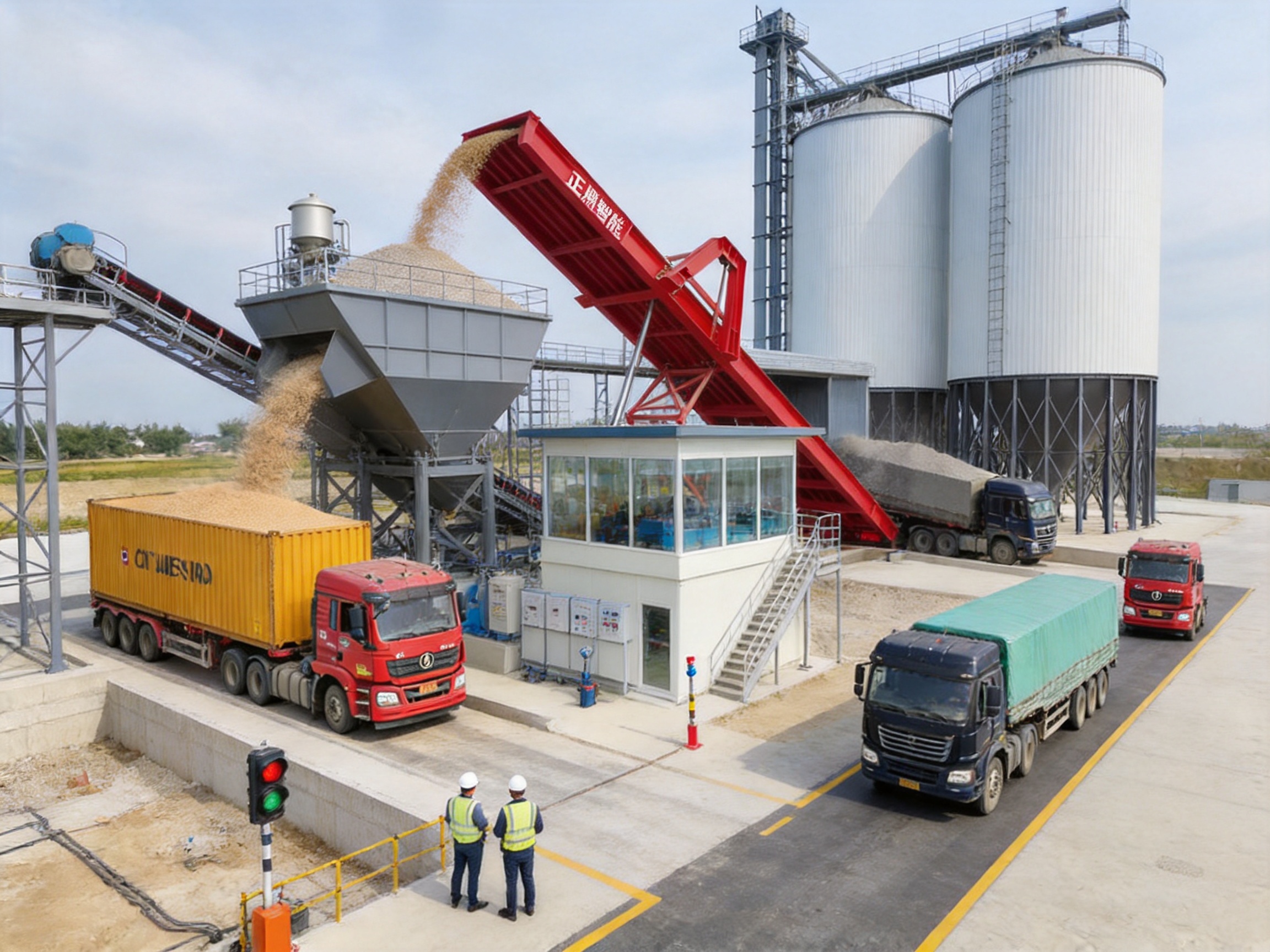
Automation can extend beyond the basic lift cycle. A complete receiving station may use vehicle identification, weighing, sampling, traffic lights, gate control, barcode or card readers, conveyor start confirmation, and production-management software.
The shallow foundation dumper can be integrated into a control sequence in which the truck is authorized to enter, positioned on the platform, weighed, restrained, and lifted only after all downstream equipment is ready. Once unloading is complete, the platform returns to the horizontal position and the retaining device releases only when the control system confirms a safe condition.
Automatic operation can reduce cycle variation and provide more consistent throughput. It may also support production records such as truck identity, material type, gross and tare weight, unloading time, operator or driver identification, and alarm history.
For high-volume operations, data can be used to identify delays, excessive residual material, abnormal lifting times, repeated sensor faults, or maintenance trends. This supports condition-based maintenance and helps plant managers improve equipment availability.
14. Economic Value and Total Cost of Ownership
The economic value of a truck dumper should be assessed over its complete life cycle. Initial equipment cost is only one factor. Civil construction, installation time, labor, energy, maintenance, spare parts, cleaning, product loss, downtime, and future expansion all influence the total cost of ownership.
The shallow foundation can produce immediate savings by reducing excavation and concrete work. The automatic wheel-restraint system can lower labor requirements and improve cycle consistency. Driver-operated control can reduce the need for a separate operator at every unloading station.
High discharge efficiency can reduce product loss and manual cleanup. For a facility handling large annual tonnage, even a small reduction in residual material can produce meaningful savings. Lower vibration and reduced hydraulic impact can also support longer component life and fewer unscheduled repairs.
The most appropriate comparison is therefore between complete installed systems rather than between equipment purchase prices. A low-cost dumper that requires major civil work or frequent manual intervention may be less economical than a well-engineered shallow system with a higher initial equipment price but lower project and operating costs.
15. Engineering Considerations for Competitor Comparison
When comparing shallow foundation dumpers from different manufacturers, buyers should examine the complete technical solution. Important questions include whether the quoted capacity includes the truck tare weight, whether the platform is designed for the customer’s fleet, how hydraulic synchronization is achieved, and what safety interlocks are included.
The civil scope should be clearly defined. Customers should compare pit depth, excavation volume, reinforcement, drainage, waterproofing, embedded parts, approach-road requirements, and installation responsibility. A claimed shallow design should be evaluated against actual construction drawings rather than general marketing language.
Hydraulic components should be identified by manufacturer, rating, service availability, and replacement procedure. Control systems should be reviewed for automatic wheel restraint, emergency stopping, fault indication, manual override, sensor redundancy, and communication with plant automation.
Material compatibility should be supported by a clear engineering recommendation. The buyer should ask which liner is proposed, how impact areas are protected, what maximum particle size is permitted, how sticky materials are handled, and how food-grade or corrosive applications are treated.
Service capability is equally important. A manufacturer with experience across truck, container, and ship loading systems may be better positioned to coordinate the dumper with conveyors, storage, weighing, and transfer equipment. Documentation, commissioning, training, spare parts, remote support, and local service arrangements should be included in the project evaluation.
16. Recommended Operating Procedure
Before operation, the driver or operator should confirm that the platform is level, the receiving hopper is ready, the unloading route is clear, and no person is inside the restricted area. The truck should approach at low speed and stop at the designated position.
The vehicle should be aligned with the platform centerline. The parking brake should be applied, and the system should confirm the correct position. The automatic retaining-wheel device should then engage. The driver should not begin lifting if the control system indicates an incomplete restraint or other abnormal condition.
During lifting, personnel should remain outside the exclusion zone. The platform should rise smoothly without abnormal noise, vibration, leakage, or vehicle movement. If any unusual condition occurs, the emergency-stop procedure should be followed and maintenance personnel should inspect the equipment before restarting.
After the load has discharged, the platform should return fully to the horizontal position. The system should verify that the platform is down and stable before the wheel restraint is released. The driver should then leave slowly and avoid sudden acceleration near the receiving area.
For sticky or difficult materials, the operating angle and speed should follow the approved material-handling settings. Vibration or heating systems should be used only as specified. Operators should never enter the platform or receiving hopper to remove residual material while the equipment is energized.
17. Frequently Asked Questions
Q1: What is a shallow foundation truck dumper?
A shallow foundation truck dumper is a hydraulic unloading platform installed in a low-profile pit, commonly approximately 0.5 to 1.2 meters deep. It raises a loaded truck or trailer to discharge bulk material into a receiving hopper. Its reduced excavation requirement can lower construction cost and simplify installation compared with a conventional deep-pit dumper.
Q2: How much can civil construction cost be reduced?
The supplied product information indicates reductions of more than 60 percent compared with conventional truck dumpers and cites approximately 70 percent for the shallow foundation design. Actual savings depend on soil, groundwater, concrete, drainage, labor, local construction prices, and the configuration of the receiving system.
Q3: What materials can the equipment handle?
The dumper can handle grains, oilseeds, coal, petroleum coke, sand, gravel, crushed stone, cement, fly ash, lime, fertilizers, plastic pellets, biomass, and other bulk solids. Material-specific liners and options may be required for abrasive, sticky, corrosive, wet, or food-grade products.
Q4: Can it unload wet or sticky materials?
Yes, with suitable modifications. A vibrator, UHMW-PE liner, reduced lifting speed, or controlled heating may improve discharge. Wet clay with approximately 15 to 18 percent moisture can be handled under appropriate conditions, but the material should be evaluated before final equipment selection.
Q5: What is the maximum particle size?
Standard configurations can handle particles up to approximately 80 millimeters. For larger aggregates in the range of 100 to 150 millimeters, reinforced platforms and thicker wear plates, approximately 12 to 16 millimeters where required, may be recommended. The final limit depends on impact energy, material density, loading method, and platform construction.
Q6: Are food-grade configurations available?
Yes. Food-grade configurations may include 304 or 316 stainless steel platforms, FDA-compliant seals, smooth surfaces, and designs that reduce product-retention areas. Cleaning and sanitation procedures should be established according to the facility’s hygiene requirements.
Q7: Does the shallow design reduce unloading efficiency?
Not necessarily. The lower pit depth changes the geometry of the installation, but correct platform length, tilt angle, hopper design, and liner selection can maintain high discharge efficiency. The supplied data compares average efficiency of approximately 98.5 percent for shallow installations with 98.9 percent for full-depth installations.
Q8: Can the driver operate the dumper without a professional operator?
The equipment can support unmanned control, allowing the driver to complete the operating sequence. The site must still provide training, clear procedures, safety interlocks, emergency controls, and appropriate supervision during commissioning and normal operation.
Q9: What maintenance is required for abrasive materials?
Inspect wear liners, impact zones, fasteners, platform welds, hinges, hydraulic components, and wheel restraints regularly. For abrasive products, liner inspections may be scheduled at approximately 1,000 operating hours, with the interval adjusted according to actual wear and operating intensity.
Q10: What information is needed for a quotation?
The manufacturer should receive truck and trailer dimensions, gross vehicle weight, payload, wheelbase, axle arrangement, material type, bulk density, moisture, particle size, abrasiveness, expected hourly throughput, daily operating hours, preferred unloading angle, site dimensions, soil information, and required automation interfaces.
18. Why Choose a Site-Specific Solution?
A standard platform may appear suitable from its dimensions and rated capacity, but the best result comes from matching the equipment to the complete operating environment. The truck fleet, material, receiving hopper, conveyors, foundation, control system, weather, and maintenance practices all affect performance.
Jiangsu Zhengding Intelligent Equipment Co., Ltd. provides engineering support that includes foundation assessment, material-flow analysis, and liner selection. This approach helps ensure that the shallow foundation concept produces the intended savings without compromising safety, throughput, or service life.
The company’s broad experience in automated truck, container, and ship loading and unloading equipment supports integrated project delivery. Its products serve industries ranging from steel and chemicals to grain, food, feed, ports, papermaking, and new energy. This industry diversity helps the engineering team address different material properties and production requirements.
19. Conclusion
Shallow foundation truck dumpers offer a strong alternative to conventional deep-pit unloading systems. Their low-profile design can reduce excavation and civil construction costs by more than 60 percent in suitable projects, while also simplifying installation and maintenance. The design is particularly attractive for existing facilities, sites with groundwater or utility limitations, and customers seeking to expand unloading capacity without extensive reconstruction.
The product’s competitive strengths extend beyond the foundation. High-precision hydraulic synchronization supports stable lifting, automatic wheel restraint improves safety and operating consistency, imported hydraulic pumps and cylinders support reliability, and unmanned control allows the driver to complete the unloading cycle.
With platform sizes from approximately 14 to 20 meters, widths of about three meters, lifting capacities from 80 to 150 tons, and lifting angles of 45 or 55 degrees, the model range can serve many truck and trailer applications. Material-specific options such as AR400 wear liners, UHMW-PE coatings, stainless steel platforms, vibration systems, and heated surfaces further expand application flexibility.
For customers purchasing a truck dumper, the most important decision is not simply choosing a lifting capacity. It is selecting a complete engineered system that matches the vehicle fleet, material behavior, site conditions, safety requirements, and future production plans. Through research, manufacturing, automation integration, and project-specific engineering, Jiangsu Zhengding Intelligent Equipment Co., Ltd. provides shallow foundation unloading solutions designed for efficient and dependable bulk-material handling.
References
1. Product technical information for shallow foundation truck dumper models TQXHC 50, TQXHC 80, TQXHC 100, and TQXHC 150.
2. Bulk Material Handling Engineering Principles: Truck Unloading, Hopper Design, and Gravity Flow.
3. Industrial Hydraulic Equipment Maintenance and Safety Practices.
4. Wear-Resistant Steel and Polymer Liner Selection for Abrasive Bulk Materials.
5. Food-Grade Equipment Design and Sanitation Considerations for Grain and Feed Facilities.
6. Industrial Machinery Risk Assessment, Guarding, Interlocking, and Emergency-Stop Practices.
7. Global Dumper Usage Survey 2025, industry application data covering bulk-material terminals and unloading facilities.


