

 English
 русский
 Español
 Français
 Português
 عربى




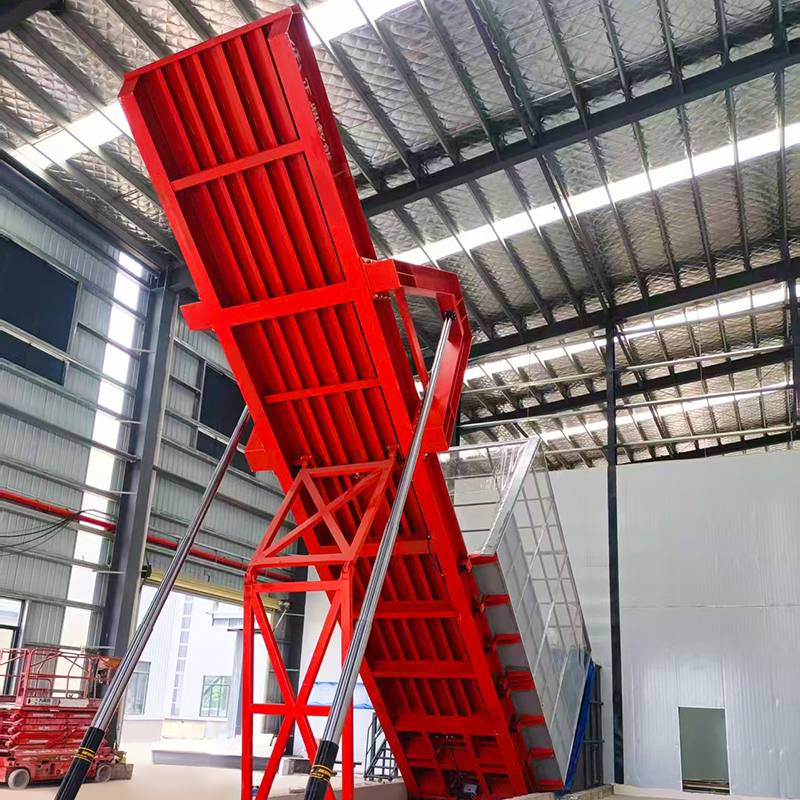

+86-13588556918
Content
- 1 1. What Is a Pitless Truck Dumper?
- 2 2. Main Advantages of the Pitless Design
- 3 3. Hydraulic Lifting and Operational Stability
- 4 4. Automatic Wheel-Retaining and Safety Features
- 5 5. Capacity, Dimensions, and Technical Configuration
- 6 6. Site Planning and Installation Requirements
- 7 7. Manufacturing Strengths and Engineering Capabilities
- 8 8. Automation, Metering, and System Integration
- 9 9. Operating and Maintenance Recommendations
- 10 10. Economic Comparison and Lifecycle Value
- 11 11. Selecting the Right Configuration
- 12 12. Why Work with Jiangsu Zhengding Intelligent Equipment?
- 13 13. Project Implementation Process
- 14 14. Frequently Asked Questions
- 14.1 Q1. What foundation does a pitless truck dumper require?
- 14.2 Q2. Does a pitless dumper need a concrete foundation?
- 14.3 Q3. How does the discharge height compare with a pit-style dumper?
- 14.4 Q4. Can the pitless dumper be relocated later?
- 14.5 Q5. What truck capacities are available?
- 14.6 Q6. What lifting angles are available?
- 14.7 Q7. Is the wheel-retaining system automatic?
- 14.8 Q8. How can dust be controlled during unloading?
- 14.9 Q9. Is a pitless dumper suitable for brownfield facilities?
- 14.10 Q10. What information should be supplied for a quotation?
- 15 15. Conclusion
- 16 References
- 17 Product: Pitless Truck Dumper
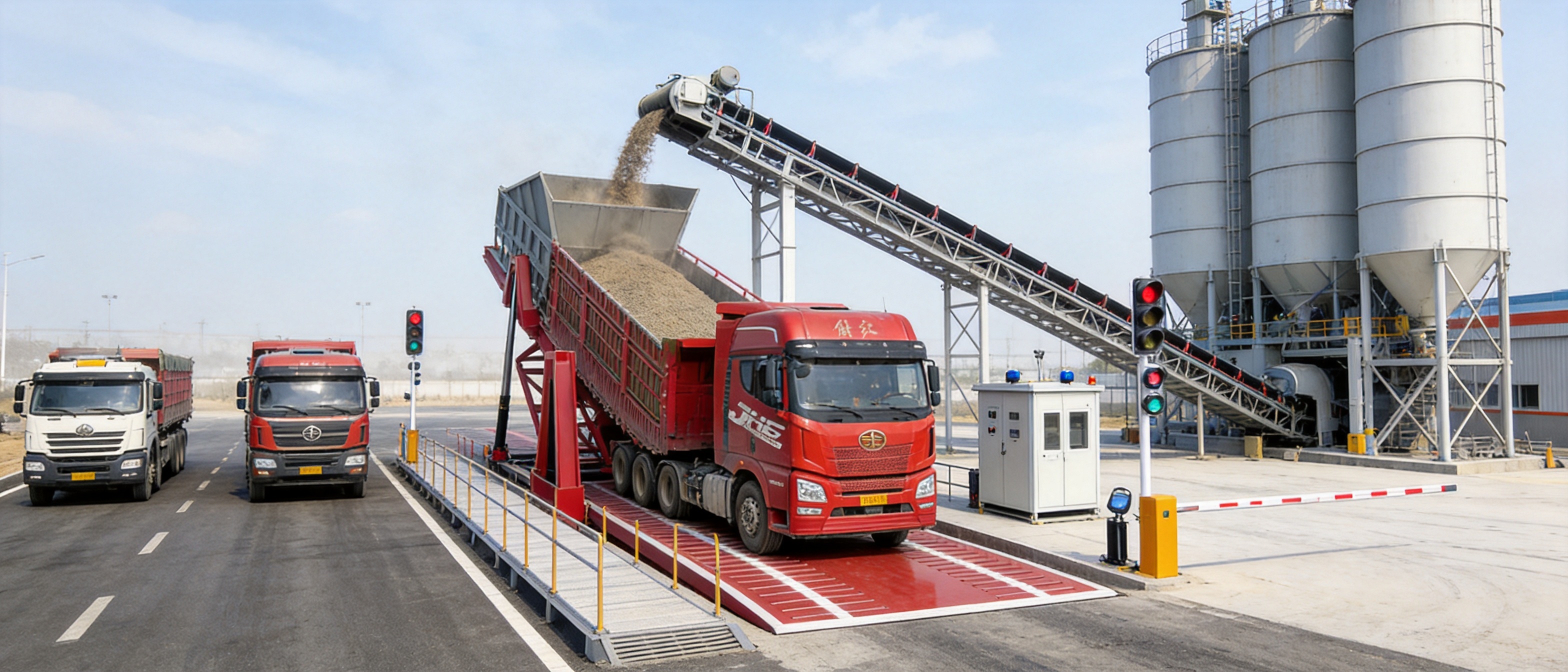
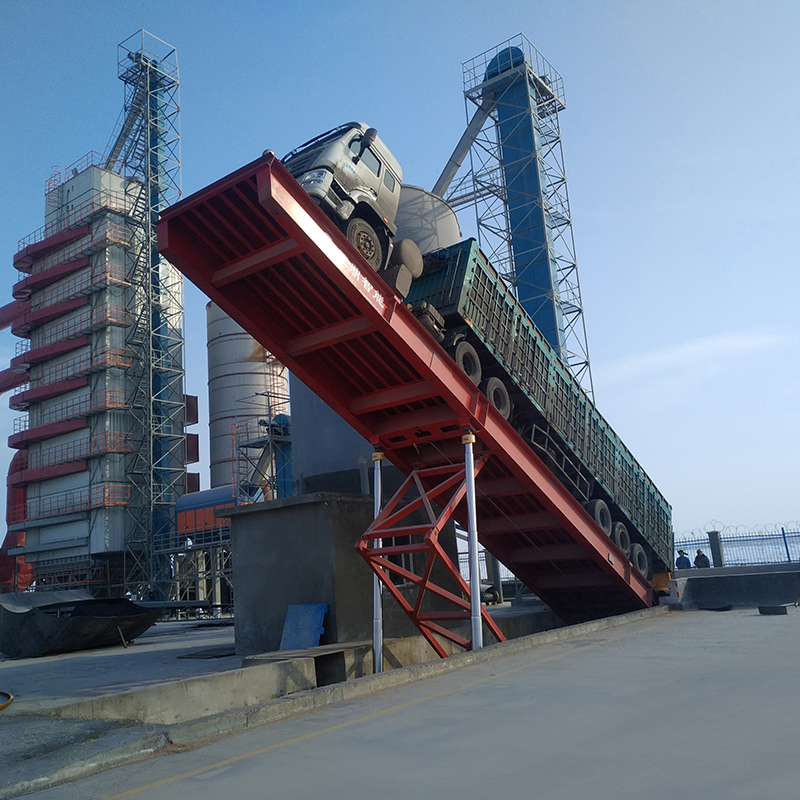
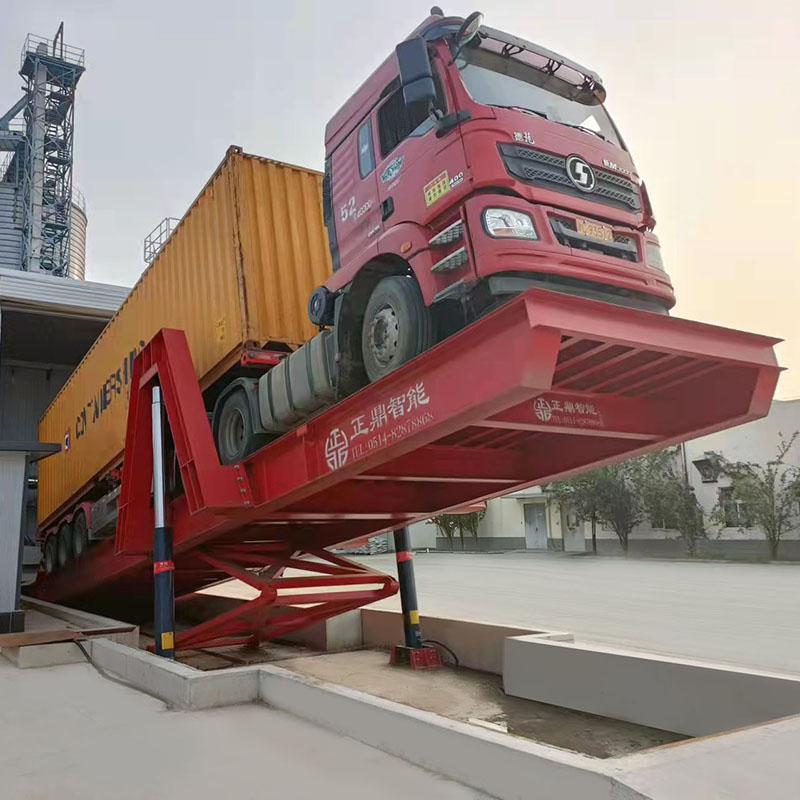
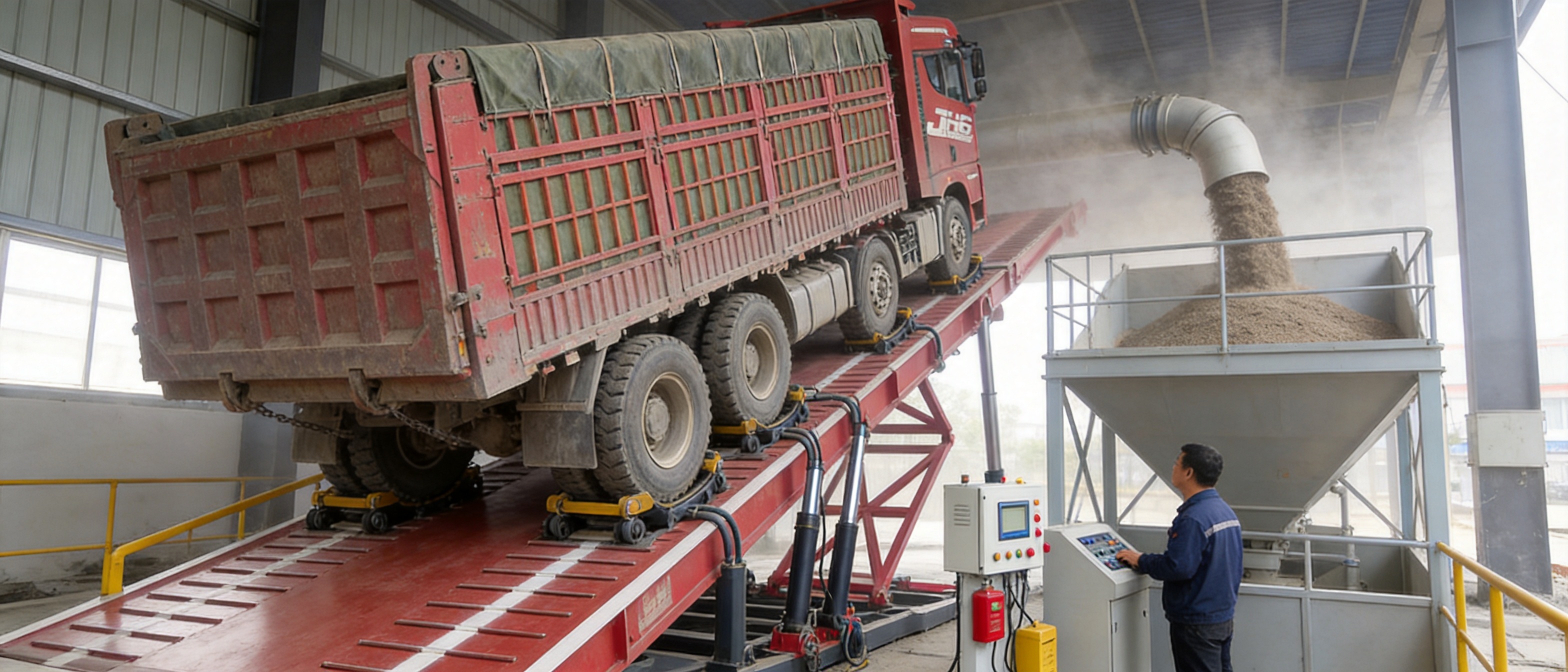
A pitless truck dumper is an above-ground unloading system designed to receive loaded trucks, raise the vehicle body to a controlled angle, and discharge bulk materials into a receiving hopper, conveyor, storage system, or processing line. Unlike traditional pit-style truck dumpers, it does not require a deep excavation, extensive reinforced concrete construction, or a permanent below-ground chamber. This fundamental design difference gives operators greater installation flexibility, shorter project schedules, lower civil engineering costs, and improved suitability for brownfield facilities and sites with difficult soil or groundwater conditions.
The pitless truck dumper developed and manufactured by Jiangsu Zhengding Intelligent Equipment Co., Ltd. combines a modular above-ground structure with a high-precision hydraulic lifting system, automatic wheel-retaining equipment, imported hydraulic components, and configurable platform dimensions. It is intended for demanding unloading applications in grain, feed, coal, cement, chemicals, steel, food, oil, ports, and other industries that require reliable truck-to-process-line material transfer.
In addition to reducing the need for civil works, this design is suitable for facilities that cannot stop production for a long construction project. The equipment can be installed on a prepared base, connected to the plant’s receiving system, commissioned, and placed into operation in a significantly shorter period than many conventional pit installations. Its above-ground configuration also simplifies inspection, maintenance, and future relocation.
For customers comparing truck dumpers from different suppliers, the most important considerations are not limited to lifting capacity. Platform stability, hydraulic synchronization, truck restraint, discharge height, operating safety, installation conditions, service access, manufacturing quality, and lifecycle cost all influence the long-term value of the equipment. This article explains these considerations in detail and presents the main advantages of the pitless truck dumper solution.
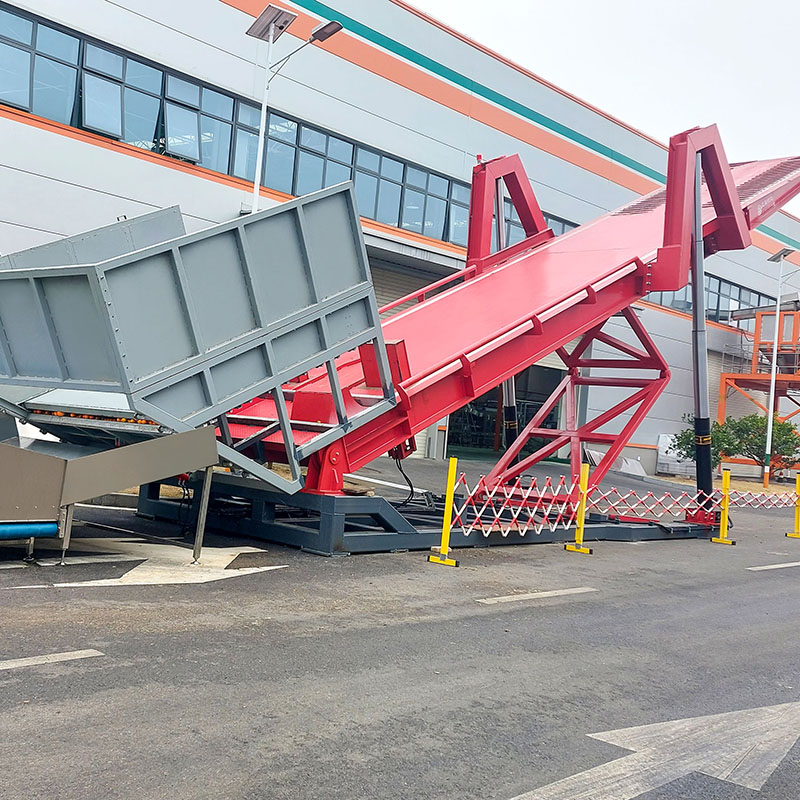
Pitless Truck Dumper
1. What Is a Pitless Truck Dumper?
A truck dumper is a mechanical unloading machine that tilts a truck or trailer to release bulk cargo. Depending on the application, the vehicle may be raised from the front, turned to the side, or positioned over a receiving hopper. A conventional pit dumper is installed inside a recessed excavation. The truck drives onto a platform that is close to ground level, and the platform rises within the pit during the unloading cycle.
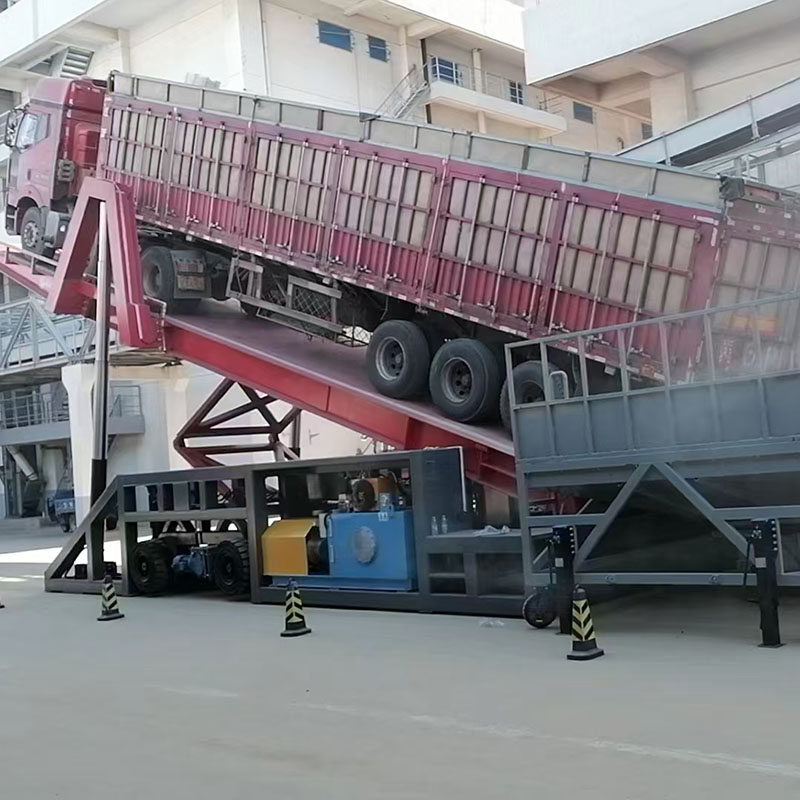
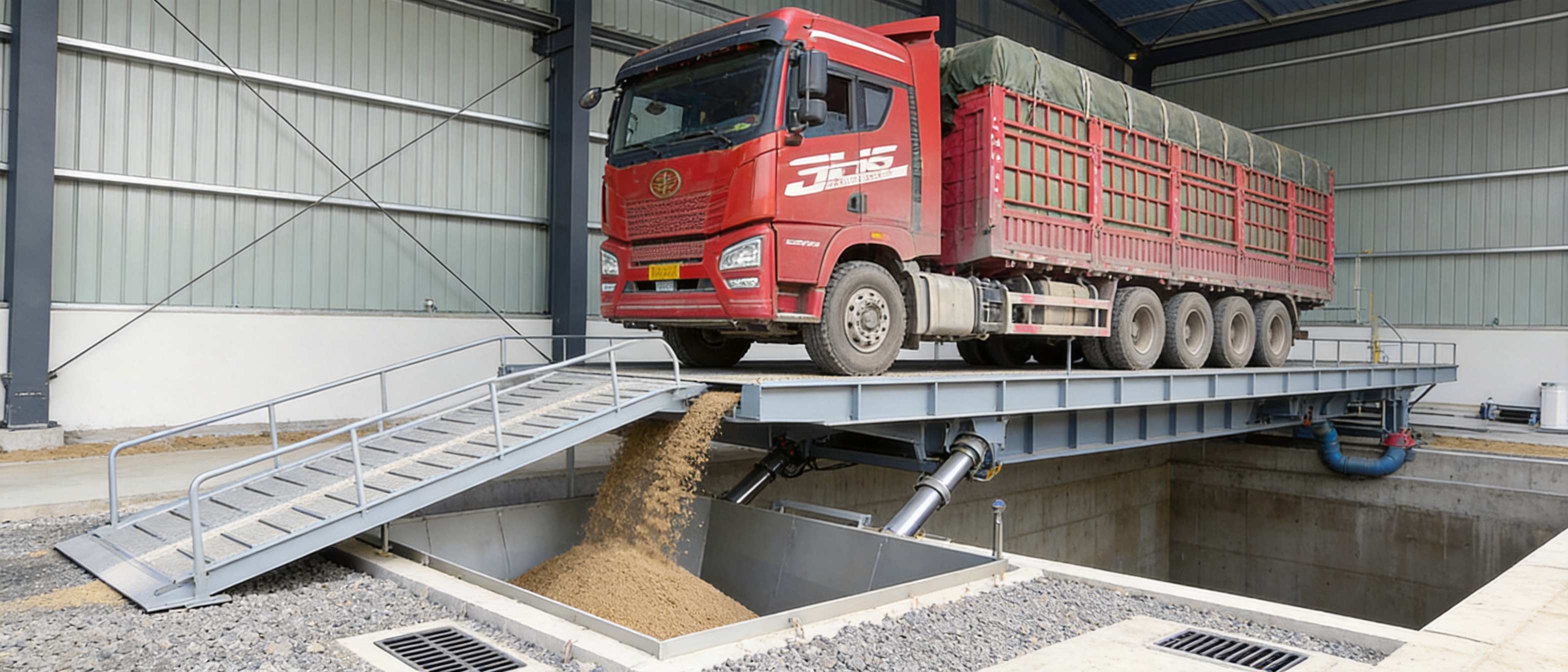
A pitless truck dumper uses a different arrangement. Instead of excavating a deep chamber, the dumper is installed above ground on a specially designed supporting base. The truck reaches the platform through an approach ramp or elevated roadway. Hydraulic cylinders lift the platform and vehicle to the specified dumping angle. The discharged material then falls into a receiving hopper or other downstream equipment positioned beneath or adjacent to the discharge area.
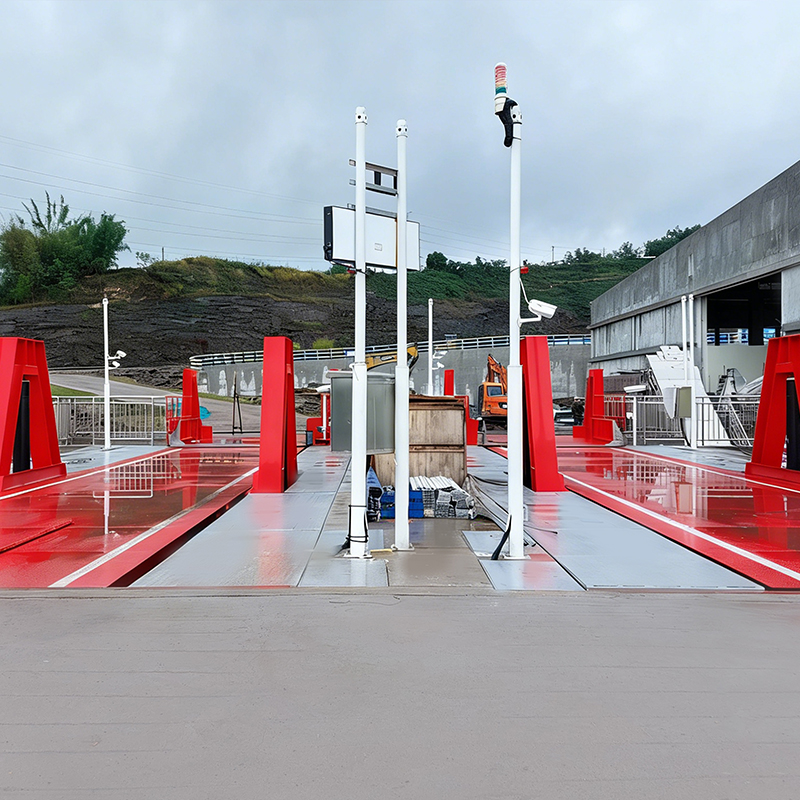
This arrangement eliminates many construction activities associated with pit installations. There is normally no requirement for deep excavation, extensive underground retaining walls, complex drainage systems, or comprehensive waterproofing. Depending on the site conditions and the selected configuration, the support base may consist of compacted granular material, a concrete pad, steel support structures, or a combination of these elements.
The term “pitless” does not mean that the equipment has no foundation requirements. The platform and support structure must still be designed for the combined weight of the truck, payload, dumper, dynamic forces, and local environmental loads. A qualified site assessment is therefore essential. However, the foundation is generally simpler, more accessible, and less expensive than the underground construction required by a pit-style installation.
1.1 Main functions of the equipment
The primary function of the pitless truck dumper is to safely raise a loaded vehicle and discharge its contents in a controlled manner. The complete system may include a driving platform, approach ramps, wheel-retaining devices, hydraulic cylinders, hydraulic power units, control cabinets, remote controls, safety interlocks, discharge hoppers, dust-control equipment, and connection points for conveyors or feeders.
During a normal operating cycle, the truck enters the platform and is positioned according to the operating instructions. The wheel-retaining device is activated to prevent unintended vehicle movement. After confirmation that the truck is correctly positioned, the operator initiates the lifting cycle. The hydraulic system raises the platform smoothly to the selected angle. Once the material has discharged, the platform returns to its horizontal position, the restraint is released, and the truck exits the equipment.
The system can be configured for different types of bulk cargo, including grain, oats, feed ingredients, coal, minerals, fertilizer, cement raw materials, wood products, and industrial powders. The receiving hopper and downstream equipment must be matched to the material’s flowability, moisture content, bulk density, particle size, and dust characteristics.
1.2 Difference between pitless and pit-style dumpers
| Comparison Item | Pitless Truck Dumper | Pit-Style Truck Dumper |
|---|---|---|
| Installation method | Installed above ground on a prepared base, support structure, or concrete pad | Installed inside a recessed excavation |
| Civil engineering | Usually limited to grading, compaction, foundations, ramps, and utility connections | Requires excavation, reinforced concrete, drainage, waterproofing, and underground construction |
| Construction schedule | Generally shorter and less dependent on major civil works | Usually longer because excavation and concrete curing are required |
| Groundwater risk | Reduced because the main structure is not located in a deep pit | Higher, particularly at sites with a shallow water table |
| Relocation potential | Suitable for semi-mobile or future relocation configurations | Normally a permanent installation |
| Maintenance access | Hydraulic and structural components are more accessible from above ground | Access may be restricted by the pit and surrounding structures |
| Space requirement | Requires sufficient approach and ramp space | May be preferable where horizontal approach space is restricted |
| Best application | Brownfield upgrades, seasonal facilities, high-water-table sites, and rapid deployments | Permanent sites with suitable civil infrastructure and limited ramp space |
Neither configuration is universally suitable for every project. A pitless dumper is particularly attractive when installation speed, limited civil works, future relocation, or groundwater avoidance is important. A pit-style dumper may remain appropriate for a new facility that has already been designed around an underground receiving system and has adequate space and budget for major civil construction.
2. Main Advantages of the Pitless Design
2.1 Reduced civil engineering requirements
The most visible advantage of a pitless truck dumper is the substantial reduction in civil engineering work. A conventional pit installation may require excavation, soil removal, shoring, reinforced concrete walls, drainage channels, sump pumps, waterproofing, backfilling, and extensive coordination with underground utilities. These activities add cost and extend the construction schedule.
The pitless configuration replaces much of this work with a prepared above-ground base and an access ramp. The exact foundation depends on soil bearing capacity, equipment capacity, traffic frequency, local building regulations, and seismic or wind requirements. In many applications, the installation can be completed with compacted crushed stone, shallow concrete foundations, or a reinforced concrete pad rather than a deep structural pit.
The supplied product information indicates that the pitless design can reduce civil engineering costs by more than 90 percent in suitable project conditions. Actual savings vary according to local labor rates, soil conditions, groundwater depth, concrete prices, transport requirements, and the existing plant layout. Even when the equipment itself represents a significant capital investment, eliminating major underground work can improve the total project economics.
2.2 Faster project completion
Traditional pit construction often involves several sequential stages. The site must be surveyed, excavation must be completed, soil stability must be verified, reinforcement must be installed, concrete must be poured, waterproofing must be applied, and the structure must be allowed to cure before heavy equipment can be installed. Delays in any one stage can postpone commissioning.
A pitless dumper reduces the number of construction interfaces. Once the site is graded and the base is prepared, the equipment can be positioned and assembled. This is especially valuable for brownfield sites where the plant must continue operating while the new unloading system is installed. It is also beneficial for seasonal businesses, where missing a harvest, shipping, or production season can create substantial commercial losses.
Industry installation experience suggests that pitless systems may be installed within approximately five to ten days under favorable conditions, while pit-style projects may require several weeks or more. The exact schedule depends on equipment size, ramp construction, electrical and hydraulic connections, hopper modifications, local approvals, and commissioning requirements.
2.3 Reduced groundwater and waterproofing concerns
Underground pits are vulnerable to groundwater infiltration, surface runoff, condensation, and leakage from nearby drainage systems. At sites with a shallow water table, a pit may require permanent pumping, waterproof membranes, drainage channels, or reinforced retaining walls. These systems add both initial cost and ongoing maintenance responsibilities.
Because the main structure of a pitless dumper is above ground, the exposure to groundwater pressure is greatly reduced. Rainwater management is still necessary, but the project generally avoids the complex waterproofing and pumping arrangements associated with a deep excavation. This makes the design attractive for coastal areas, flood-prone industrial zones, reclaimed land, and sites with uncertain underground conditions.
2.4 Flexibility for brownfield upgrades
Existing factories often have limited room for construction and cannot easily accommodate major changes to their foundations. Underground utilities, drainage lines, cable trenches, process pipelines, and existing building footings may make excavation risky or impractical. A pitless dumper can often be positioned beside the existing receiving area with less interference.
The above-ground structure also supports phased modernization. A facility can install the dumper first, connect it to a new hopper or conveyor, and gradually upgrade other parts of the material-handling system. This approach may reduce production interruptions and allow the customer to distribute capital expenditure across multiple project stages.
2.5 Relocation and future adaptability
Some businesses operate temporary storage yards, seasonal receiving stations, construction material depots, or leased industrial sites. A permanent pit installation may not be economical in these situations. A semi-mobile pitless dumper can offer a more adaptable alternative.
Depending on the selected design, a semi-mobile unit may be moved by crane and low-bed trailer after the hydraulic system is safely isolated and the supporting components are prepared. Fully mobile configurations may incorporate transport provisions, integrated axles, or modular components. Relocation time depends on the equipment configuration, site access, transport regulations, and receiving-site preparation.
This adaptability is also valuable when a customer expects future expansion or a change in material flow. The dumper can potentially be repositioned to serve a larger hopper, a new production line, or a different storage area without abandoning a deep concrete pit.
3. Hydraulic Lifting and Operational Stability
3.1 High-precision oil-cylinder synchronization
The lifting system is the core mechanical and safety subsystem of a truck dumper. A large truck and its payload create substantial static and dynamic forces. If the lifting cylinders do not move at a controlled and synchronized rate, the platform may experience twisting, uneven loading, vibration, or excessive stress on the frame and hydraulic components.
The pitless truck dumper uses a high-precision oil-cylinder synchronous stability system developed by the manufacturer. The system is intended to coordinate cylinder movement and maintain stable platform motion during raising and lowering. Controlled synchronization reduces uneven loading, minimizes vibration, and limits impact forces transmitted to the cylinders and supporting structure.
Stable hydraulic movement is important for several reasons. First, it improves operator confidence and allows the vehicle to be raised in a predictable manner. Second, it reduces mechanical stress on pins, hinges, cylinder mounts, and platform beams. Third, it helps protect the truck and payload from sudden movement. Finally, smoother operation can contribute to longer service life and lower maintenance requirements.
3.2 Imported hydraulic components
The supplied specifications identify imported oil cylinders and hydraulic pumps as part of the equipment configuration. High-quality cylinders and pumps are important because the hydraulic system must deliver reliable force under high loads and repeated operating cycles.
A cylinder should be selected according to lifting force, stroke length, mounting geometry, buckling resistance, pressure rating, seal performance, and expected duty cycle. The pump must provide sufficient flow to achieve the required lifting time without excessive heat generation or pressure fluctuation. Hydraulic valves, hoses, fittings, filters, and reservoirs must be sized and arranged to support safe operation and service access.
Using recognized component brands can simplify replacement and maintenance, particularly for customers operating in regions where standard hydraulic parts are readily available. However, component quality alone does not determine system performance. The hydraulic circuit, control logic, structural design, installation quality, and maintenance program must work together as an integrated system.
3.3 Smooth lifting and lowering
A well-designed dumper should not simply raise the platform as quickly as possible. Excessive speed can create shock loads, material surges, vehicle instability, and unnecessary wear. The lifting cycle should be controlled so that the platform accelerates and decelerates smoothly.
The control system should provide clear status indications and prevent unauthorized or unsafe actions. Depending on the configuration, safety logic may include confirmation of vehicle position, wheel-retaining status, emergency-stop circuits, hydraulic pressure monitoring, upper and lower limit protection, and interlocks with the receiving hopper or conveyor.
The lowering cycle is equally important. When the platform returns to its horizontal position, uncontrolled descent can damage the structure or create a hazard to personnel. Flow-control valves and synchronized hydraulic movement help regulate the descent and maintain a stable platform throughout the cycle.
4. Automatic Wheel-Retaining and Safety Features
4.1 Automatic retaining-wheel fixing device
Vehicle movement is one of the most serious risks associated with truck-dumping operations. A loaded truck on an inclined platform may move if the parking brake is insufficient, the surface is contaminated, the vehicle is incorrectly positioned, or the driver changes the controls at the wrong time. The pitless dumper addresses this risk with a full automatic retaining-wheel fixing device.
The automatic restraint is designed to secure the vehicle without requiring the operator to continuously hold a remote control in a dusty or difficult operating environment. Once the truck reaches the correct position, the retaining system can be engaged according to the control sequence. This reduces dependence on manual intervention and helps standardize the operating procedure.
Automatic wheel retention also improves operational efficiency. The driver or operator does not need to leave the vehicle repeatedly to position separate blocks or manually confirm temporary restraints. The system can be integrated into the dumper’s operating logic so that lifting is prevented until the required restraint condition is satisfied.
4.2 Safety interlocks and operator control
A complete safety strategy should combine mechanical restraint, hydraulic control, electrical interlocks, visual indicators, audible warnings, emergency stops, and clearly documented procedures. The exact features depend on local regulations and the customer’s risk assessment.
Potential interlock functions include preventing platform lifting when the truck is outside the approved position, preventing vehicle release while the platform is raised, stopping movement when an emergency button is pressed, and requiring the receiving system to be ready before unloading begins. Access areas should be marked clearly, and maintenance personnel should have lockout and isolation procedures for hydraulic, electrical, and mechanical energy.
The control station should be positioned so the operator can observe the platform, truck, retaining device, and discharge area as much as possible. Remote controls may be used when they improve visibility, but the control system must prevent accidental activation and protect the remote from contamination, impact, and unauthorized access.
4.3 Dust and environmental considerations
Many bulk materials produce dust during truck unloading. Dust can affect visibility, contaminate hydraulic components, reduce electrical reliability, and create health or explosion risks depending on the material. A pitless dumper should therefore be considered as part of a complete dust-management system rather than as an isolated machine.
Possible measures include enclosing the receiving hopper, using flexible skirts, installing extraction points, reducing drop heights, controlling discharge speed, and connecting the hopper to a suitable filtration system. The raised platform can sometimes improve material flow and reduce uncontrolled impact when the receiving hopper is correctly designed.
For combustible dusts such as grain, feed, or certain powders, the customer must evaluate applicable explosion-protection requirements. Electrical equipment, grounding, ventilation, inspection, and cleaning procedures should comply with the relevant local standards and plant safety rules.
5. Capacity, Dimensions, and Technical Configuration
Capacity selection must be based on the heaviest loaded vehicle, not merely the average truck entering the facility. The calculation should include the truck’s tare weight, maximum payload, fuel, accessories, and possible future fleet changes. A practical engineering margin is also advisable so that occasional variations do not push the dumper beyond its rated capacity.
The available product models include TQXHC 60, TQXHC 100, and TQXHC 120. Their principal parameters are shown below.
| Model | Available Platform Size, L × W | Maximum Lifting Weight | Maximum Lifting Angle |
|---|---|---|---|
| TQXHC 60 | 14 × 3 m, 16 × 3 m, or 18 × 3 m | 80 t | 45° or 55° |
| TQXHC 100 | 14 × 3 m, 16 × 3 m, or 18 × 3 m | 100 t | 45° or 55° |
| TQXHC 120 | 16 × 3 m, 18 × 3 m, or 20 × 3 m | 120 t | 45° or 55° |
The values above should be treated as principal configuration data. Final specifications must be confirmed against the actual truck wheelbase, axle arrangement, body dimensions, payload density, discharge characteristics, hopper elevation, local standards, and plant layout.
5.1 Choosing the lifting capacity
As a general selection principle, the dumper’s rated capacity should exceed the maximum expected operating load by approximately 15 to 20 percent where practical. This margin can accommodate future fleet upgrades, occasional payload variation, and uncertainty in the vehicle’s operating weight.
| Truck Application | Typical Capacity Range to Consider | Important Selection Concern |
|---|---|---|
| Light-duty two-axle truck | 30 to 35 t | Platform width, wheelbase, and turning access |
| Standard dump truck | 40 to 50 t | Daily truck volume and discharge height |
| Heavy three-axle haul truck | 55 to 70 t | Structural loading, foundation bearing, and hydraulic duty cycle |
| Mining or off-road truck | 80 to 100 t or more | Axle loads, tire dimensions, platform strength, and safety clearance |
The table is a preliminary planning guide rather than a substitute for a detailed engineering calculation. Off-road mining trucks, articulated vehicles, and unusually long trailers may require custom platform geometry and specialized retaining arrangements.
5.2 Platform length and width
Platform length must accommodate the vehicle’s wheelbase, rear overhang, front clearance, and the position of the discharge body. A platform that is too short may create concentrated loads or prevent the truck from reaching the correct dumping position. A platform that is unnecessarily long can increase capital cost and foundation requirements.
A three-meter platform width is indicated for the listed models, but the final width must be checked against tire spacing, side clearances, vehicle mirrors, body width, and operator visibility. The platform should provide adequate tolerance for normal driving variation while preventing the truck from approaching structural edges or safety barriers.
5.3 Lifting angle
The listed configurations provide maximum lifting angles of 45 degrees or 55 degrees. The correct angle depends on material flowability and the truck body design. Free-flowing grain, dry aggregate, and some powders may discharge effectively at a lower angle, while cohesive, moist, or compacted materials may require a greater angle or additional vibration and material-flow assistance.
A higher angle can improve discharge completeness, but it also affects platform geometry, hydraulic loads, vehicle stability, receiving-hopper design, and the center of gravity. The chosen angle should therefore be determined through a complete system review rather than selected only to maximize tipping height.
6. Site Planning and Installation Requirements
6.1 Preliminary site survey
Before ordering a pitless truck dumper, the customer should conduct a site survey covering access roads, turning radii, existing foundations, underground utilities, drainage, soil conditions, elevation differences, power supply, and the location of the receiving hopper. Truck drawings and operating data should be collected at the same time.
The survey should also document the heaviest vehicle, typical payload, daily traffic volume, maximum queue length, operating hours, weather conditions, and any restrictions on construction access. If the facility operates during installation, the project plan should define temporary traffic routes and isolation areas.
6.2 Ground bearing capacity
The foundation or base must support the combined static and dynamic load of the dumper and the truck. A geotechnical evaluation is advisable for heavy-capacity models, weak soils, reclaimed land, slopes, or areas with significant seasonal moisture variation.
Compacted crushed stone in the approximate range of 300 to 450 millimeters may be suitable for some applications, but this is not a universal specification. The required thickness and construction method depend on soil properties, drainage, frost conditions, axle loading, and local engineering requirements. Poor soil may require geotextile reinforcement, ground improvement, reinforced concrete footings, piles, or a deeper structural base.
6.3 Ramp design
Approach ramps allow trucks to reach the elevated platform. Ramp length and slope must be matched to the vehicle’s ground clearance, approach angle, departure angle, wheelbase, and trailer geometry. Longer ramps generally reduce the incline angle and make access easier for low-clearance vehicles.
A facility serving multiple truck types should assess the most demanding vehicle rather than designing only for the most common truck. Sudden transitions at the bottom or top of the ramp can cause underbody contact, tire loading, or loss of traction. Drainage, anti-slip surfaces, edge protection, lighting, and traffic barriers should be included in the design.
6.4 Discharge height and hopper alignment
Pitless equipment usually places the platform above the surrounding ground level. The discharge height may be approximately 0.6 to 1.2 meters higher than a comparable pit-style installation, although the actual value depends on the structure and receiving arrangement. Existing hoppers and conveyors may need to be raised, extended, or modified.
This additional height is not necessarily a disadvantage. In some plants it allows the receiving hopper to be redesigned with a shorter free-fall distance, improved conveyor feeding, or better access for cleaning and inspection. The hopper must nevertheless be checked for adequate volume, sidewall strength, flow angle, dust collection, and compatibility with the truck body.
6.5 Electrical and hydraulic utilities
The installation requires a suitable electrical supply for the hydraulic power unit, controls, sensors, lighting, and safety devices. Cable routing should protect wiring from vehicle impact, dust, water, hydraulic oil, and temperature extremes. Earthing and electrical protection must comply with applicable standards.
Hydraulic equipment should be protected from direct contamination and excessive heat. The hydraulic power unit should have sufficient access for oil-level inspection, filter replacement, pressure testing, and maintenance. Where ambient temperatures are very low or very high, the hydraulic oil grade, reservoir heating or cooling, seal materials, and control settings may require adjustment.
7. Manufacturing Strengths and Engineering Capabilities
Jiangsu Zhengding Intelligent Equipment Co., Ltd. is a national high-tech enterprise engaged in the research, development, manufacturing, and sales of intelligent loading and unloading equipment. Its product portfolio includes rear truck dumpers, side-turn truck dumpers, automobile loading equipment, container flippers, and other systems for vehicles, containers, ships, and industrial logistics applications.
7.1 Integrated product development
A major strength of an experienced equipment manufacturer is the ability to develop the mechanical, hydraulic, electrical, and control elements as one coordinated system. Truck dumpers involve more than a steel platform and a hydraulic cylinder. The equipment must combine load-bearing structures, vehicle restraints, sensors, control logic, hydraulic power, operator interfaces, and integration with upstream and downstream material-handling equipment.
An integrated development process makes it easier to coordinate the lifting geometry with cylinder capacity, confirm structural load paths, manage platform deflection, and maintain stable movement. It also supports customized engineering for different trucks, materials, plant elevations, and operating cycles.
7.2 Structural fabrication and quality control
High-quality fabrication is essential because the platform and support frame are exposed to repeated heavy loads. Manufacturing controls should include material verification, dimensional inspection, weld preparation, welding procedure control, non-destructive testing where required, surface preparation, coating inspection, and final assembly checks.
Critical areas include cylinder mounting points, hinge assemblies, platform beams, wheel-retaining mechanisms, ramp transitions, guardrails, and connection points between the dumper and foundation. Accurate fabrication helps ensure that the hydraulic system works within the intended geometry and that the vehicle platform remains stable during repeated cycles.
Protective coatings should be selected according to the environment. Grain, fertilizer, salt, chemicals, moisture, and outdoor exposure can accelerate corrosion. The coating system may include abrasive preparation, primer, intermediate coating, and finish coating. Customers in corrosive environments should specify coating performance and maintenance expectations before production.
7.3 Hydraulic assembly and testing
Hydraulic cleanliness has a direct effect on equipment reliability. Contaminated oil can damage pumps, valves, cylinder seals, and proportional control components. A disciplined manufacturing process should include clean assembly areas, filtered hydraulic oil, protected hose ends, flushing procedures, pressure testing, and inspection for leakage.
Before shipment, the manufacturer should verify cylinder movement, hydraulic pressure, platform travel, limit protection, emergency-stop function, wheel-retaining operation, and control-system response. Factory testing can identify alignment problems and control issues before the equipment reaches the customer’s site.
7.4 Modular and customized production
The pitless design benefits from modular construction. Ramp sections, platform modules, hydraulic assemblies, control cabinets, and support components can be adapted to project requirements. Modular production can shorten manufacturing time and simplify transport to sites with restricted access.
Customization may involve platform length, capacity, lifting angle, ramp configuration, hopper height, retaining-wheel layout, control method, material-contact surfaces, dust-control provisions, and integration with weighing or metering systems. The ability to customize is especially important for facilities handling mixed vehicle fleets or connecting the dumper to existing equipment.
7.5 Experience across multiple industries
The company’s equipment is used in steel, chemical, cement, coal, grain, oil, food, feed, ports, papermaking, and new energy applications. These industries impose different requirements. Grain and feed operations often emphasize dust control, hygiene, and high seasonal throughput. Coal and minerals demand rugged structures and resistance to abrasive material. Chemical operations may require corrosion-resistant materials and carefully controlled electrical systems. Port applications may involve large vehicles, outdoor exposure, and high traffic volume.
Experience across these sectors allows engineering teams to compare operating conditions and recommend appropriate configurations. The company reports supplying equipment to markets including Japan, Brazil, Egypt, Pakistan, India, the Middle East, and Southeast Asia, where climate, regulations, infrastructure, and operating practices vary considerably.
8. Automation, Metering, and System Integration
A truck dumper is often one part of a larger automated loading and unloading system. The equipment may be connected to weighbridges, license-plate recognition, traffic lights, conveyor controls, sampling systems, level sensors, dust collectors, and plant production-management software.
8.1 Automated operating sequence
A typical automated sequence may begin when a truck is identified and directed to the dumper. The vehicle stops at the correct position, and sensors confirm its presence. The wheel-retaining device engages, and the control system verifies that the receiving hopper and conveyor are ready. The platform then rises to the selected angle. Material discharge is monitored through time, weight, level, or operator confirmation. After unloading, the platform returns to its initial position and the vehicle restraint is released only when the system confirms safe conditions.
Automation can reduce operator workload, improve repeatability, and create a record of each unloading cycle. It can also help prevent common errors, such as lifting before the hopper is ready, releasing the vehicle while the platform is raised, or allowing two conflicting movements to occur simultaneously.
8.2 Integration with weighing systems
Many bulk-material facilities require accurate weighing before or after unloading. A pitless dumper can be integrated into a workflow that combines truck identification, gross and tare weights, material tickets, and unloading data. The exact weighing arrangement depends on whether the customer uses a separate weighbridge, platform load cells, hopper scales, or conveyor scales.
Integrated metering can improve inventory control and support customer billing. It may also help plant managers analyze truck turnaround time, material losses, peak-hour congestion, and equipment utilization.
8.3 Remote monitoring and maintenance data
Modern equipment can support remote status monitoring for hydraulic pressure, motor current, cycle count, oil temperature, emergency stops, sensor status, and alarm history. These functions allow maintenance teams to identify abnormal conditions before they lead to an unplanned shutdown.
Remote monitoring should complement, not replace, physical inspection. Hydraulic leaks, structural cracks, loose fasteners, corrosion, tire damage, and debris accumulation still require on-site checks. A useful maintenance system combines electronic records with scheduled inspections and operator reporting.
9. Operating and Maintenance Recommendations
9.1 Daily inspection
Before operation, personnel should inspect the platform, ramps, retaining-wheel device, hydraulic hoses, cylinders, guards, emergency stops, control indicators, and receiving hopper. The operating area should be free of personnel, tools, loose material, and obstructions. The truck must be positioned according to the manufacturer’s instructions.
Operators should look for oil leakage, unusual sounds, uneven movement, damaged guards, loose bolts, cracks, excessive corrosion, and signs that the platform is not returning fully to its rest position. Any abnormal condition should be reported and corrected before the equipment is placed into service.
9.2 Hydraulic maintenance
Hydraulic oil level and condition should be checked at the intervals specified by the manufacturer. Filters should be replaced according to service recommendations or sooner if contamination is detected. Hoses should be inspected for abrasion, blistering, leakage, exposed reinforcement, and damage at bends or connections.
Pressure settings should not be changed without authorization. Increasing relief-valve pressure to overcome a mechanical problem can create dangerous overloads and damage cylinders, pumps, valves, or the platform structure. Hydraulic maintenance should be performed by trained personnel using appropriate isolation and pressure-release procedures.
9.3 Structural and mechanical maintenance
Hinges, pins, bushings, wheel restraints, ramp connections, platform fasteners, and cylinder mounts require periodic inspection and lubrication where applicable. Wear should be measured against the manufacturer’s limits rather than judged only by appearance.
Material buildup can affect platform balance, interfere with the wheel-retaining device, block drainage, or increase corrosion. Cleaning schedules should be adapted to the material being handled. Facilities processing food, grain, or feed may require more frequent cleaning and hygiene controls than facilities handling coarse aggregate.
9.4 Seasonal and environmental care
Outdoor installations should be checked before periods of heavy rain, freezing temperatures, high winds, or extreme heat. Drainage must remain clear, anti-slip surfaces should be maintained, and hydraulic oil must be suitable for the local temperature range. In regions subject to strong winds or seismic events, the equipment should be designed and anchored according to local engineering requirements.
10. Economic Comparison and Lifecycle Value
The financial value of a pitless truck dumper should be evaluated over the complete project lifecycle rather than by comparing purchase prices alone. Initial equipment cost is only one part of the investment. Civil engineering, construction management, downtime, commissioning, maintenance access, energy consumption, future relocation, and production availability all influence the total cost of ownership.
| Cost or Value Factor | Pitless Dumper Effect | Potential Business Benefit |
|---|---|---|
| Excavation and underground concrete | Reduced or eliminated in suitable applications | Lower civil construction expenditure |
| Waterproofing and dewatering | Reduced because the main structure is above ground | Lower installation risk and maintenance burden |
| Construction duration | Shorter installation sequence | Earlier production or revenue generation |
| Brownfield disruption | Less excavation near existing utilities and structures | Reduced interference with ongoing operations |
| Relocation | Possible with semi-mobile or mobile configurations | Preserves equipment value when the site changes |
| Maintenance access | Above-ground components are generally easier to reach | Shorter inspection and repair activities |
| Ramp and land requirement | May be greater than for a pit installation | Requires careful layout planning and land evaluation |
Illustrative project comparisons indicate that a pit installation may include excavation, concrete, dewatering, and a dumper, with total installation costs potentially reaching approximately 315,000 US dollars in a representative scenario. A comparable pitless project may involve grading, a prepared base, and the dumper, with an illustrative total of approximately 218,000 US dollars. The resulting difference is about 97,000 US dollars, or approximately 31 percent.
These figures are examples rather than universal quotations. Actual savings may be higher or lower. Customers should request a project-specific budget that includes local civil works, transportation, foundations, ramps, electrical installation, hopper modifications, taxes, commissioning, and operator training.
Shorter installation can also create indirect financial benefits. If a facility begins unloading five to nine weeks earlier than it would with a traditional pit project, the earlier availability may improve seasonal sales, reduce truck waiting, prevent material spoilage, or avoid outsourcing. These benefits can be particularly important for grain terminals, feed mills, ports, and other operations with concentrated seasonal demand.
11. Selecting the Right Configuration
11.1 Daily truck volume
Low-volume operations may prioritize simplicity, low initial cost, and manual control. High-volume operations should consider automatic restraints, faster cycle times, traffic management, remote monitoring, and integration with weighing systems. A facility receiving more than 150 trucks per day may benefit substantially from automation because small delays in each cycle accumulate into significant annual losses.
11.2 Groundwater and soil conditions
Sites with groundwater closer than approximately 1.5 meters below grade, flood exposure, or unstable soil should give serious consideration to a pitless design. Sites with a deep water table and strong soil may have more flexibility, but a pitless system can still be advantageous when speed and future relocation are priorities.
11.3 Available approach space
A pitless dumper requires a suitable approach ramp. Where more than 30 meters of approach space is available, a longer, lower-angle ramp may be practical. Where less than 15 meters is available, the ramp may be difficult to fit without affecting vehicle access, and a pit-style solution could be worth evaluating. The final decision should consider the entire site, including truck queueing and turning space.
11.4 Material characteristics
Material flowability affects the required lifting angle, hopper geometry, discharge time, and dust-control method. Cohesive or wet materials may require additional measures such as vibrators, impact plates, liners, heating, or specialized hopper angles. Abrasive materials may require wear-resistant plates and replaceable liners.
11.5 Future expansion
Customers should consider whether truck size, traffic volume, material type, or receiving capacity may change during the equipment’s service life. Selecting a capacity margin, modular ramps, accessible control interfaces, and a flexible discharge arrangement can reduce the cost of later expansion.
12. Why Work with Jiangsu Zhengding Intelligent Equipment?
Jiangsu Zhengding Intelligent Equipment Co., Ltd. provides equipment for automated loading and unloading of automobiles, containers, ships, and bulk logistics systems. Its product range includes truck dumpers, side-turn truck dumpers, car loading equipment, container flippers, and related handling solutions.
The company’s strength lies in combining product manufacturing with application engineering. Rather than offering only a standard machine, it can evaluate the customer’s truck fleet, material characteristics, receiving equipment, site limitations, operating volume, and automation objectives. This approach helps ensure that the selected dumper is compatible with the complete material-flow system.
The company serves industries including steel, chemicals, cement, coal, grain, oil, food, feed, ports, papermaking, and new energy. Its reported international customer base includes major groups in beverage, grain handling, food, chemicals, construction materials, and agricultural trading. Experience with different sectors gives the engineering team a broader understanding of loading conditions, environmental challenges, and safety expectations.
For a pitless truck dumper project, the company can support model selection, capacity analysis, platform sizing, ramp planning, hydraulic configuration, automatic restraint selection, receiving-hopper coordination, factory testing, installation guidance, and commissioning. Customers should provide accurate truck drawings and site information at the beginning of the project to obtain the most reliable proposal.
13. Project Implementation Process
13.1 Application review
The project begins with an application review. The customer supplies vehicle dimensions, maximum loaded weight, material properties, daily truck volume, target discharge height, expected lifting angle, site drawings, soil information, and available utilities. The manufacturer reviews this information to identify the appropriate capacity and configuration.
13.2 Preliminary layout
A preliminary layout defines the dumper position, ramp direction, truck approach, receiving hopper, conveyor connection, operator station, maintenance access, electrical cabinet, and safety zones. This step can reveal space conflicts before fabrication begins.
13.3 Detailed engineering
Detailed engineering covers structural calculations, hydraulic sizing, control logic, foundation loads, safety devices, platform dimensions, access arrangements, and interface points. Local building, electrical, machinery, and occupational-safety regulations should be reviewed at this stage.
13.4 Manufacturing and factory inspection
During manufacturing, the steel structure, hydraulic system, control cabinet, retaining device, and accessories are assembled and inspected. The customer may request factory acceptance testing, documentation, dimensional verification, painting inspection, and review of the operating sequence before shipment.
13.5 Installation and commissioning
Site installation includes base preparation, equipment positioning, ramp assembly, hydraulic and electrical connections, hopper alignment, safety-device testing, and control-system commissioning. The equipment should not enter production service until the lifting cycle, wheel restraint, emergency stops, limit switches, and communication with downstream equipment have been verified.
13.6 Training and after-sales support
Operators should be trained in vehicle positioning, safe lifting, emergency procedures, cleaning, daily inspection, and abnormal-condition reporting. Maintenance personnel should receive instruction on hydraulic isolation, lubrication, filter changes, inspection points, spare parts, and troubleshooting.
14. Frequently Asked Questions
Q1. What foundation does a pitless truck dumper require?
A pitless dumper requires a stable, level, and properly engineered base. Depending on capacity and soil conditions, this may be compacted crushed stone, a concrete pad, shallow reinforced footings, ground improvement, or another engineered foundation. A typical granular base may be approximately 300 to 450 millimeters thick in suitable conditions, but the final design must be confirmed through a site assessment. Heavy units over 60 tons, weak soils, and reclaimed sites generally require detailed geotechnical review.
Q2. Does a pitless dumper need a concrete foundation?
Not always. Some installations can use compacted granular material or a steel support arrangement, while others require reinforced concrete because of soil strength, local regulations, heavy traffic, or structural loading. The decision should be based on engineering calculations rather than a general rule.
Q3. How does the discharge height compare with a pit-style dumper?
A pitless dumper normally places the truck platform above ground level, often approximately 0.6 to 1.2 meters higher than a similar pit installation. This may require hopper or conveyor modifications. However, the additional height can also improve access, simplify drainage, and help reduce uncontrolled material drop when the receiving system is correctly designed.
Q4. Can the pitless dumper be relocated later?
Some pitless configurations are designed for semi-mobile or mobile operation. A semi-mobile unit may be moved with a crane and low-bed trailer after proper preparation, while a fully mobile unit may include transport features. Relocation time depends on equipment design, transport access, foundation conditions, utilities, and the configuration of the receiving site.
Q5. What truck capacities are available?
The listed models include TQXHC 60 with an 80-ton maximum lifting weight, TQXHC 100 with a 100-ton maximum lifting weight, and TQXHC 120 with a 120-ton maximum lifting weight. The correct selection depends on the complete loaded vehicle weight and the required operating margin.
Q6. What lifting angles are available?
The listed configurations provide maximum lifting angles of 45 degrees or 55 degrees. The appropriate angle depends on the material, truck body, discharge requirements, hopper geometry, and safety considerations.
Q7. Is the wheel-retaining system automatic?
The product is equipped with a full automatic retaining-wheel fixing device. It is designed to secure the vehicle during the lifting cycle and reduce the need for continuous manual remote-control operation in dusty operating conditions. The exact sequence and interlocks should be confirmed during project engineering.
Q8. How can dust be controlled during unloading?
Dust control may include enclosed receiving hoppers, flexible seals, extraction points, filters, reduced material drop heights, controlled discharge, and appropriate cleaning procedures. The correct solution depends on the material and applicable environmental or explosion-protection requirements.
Q9. Is a pitless dumper suitable for brownfield facilities?
Yes. Its reduced excavation requirements, shorter construction cycle, and ability to work around existing underground utilities make it particularly suitable for brownfield upgrades and facility modernization. The layout must still allow truck approach, maintenance access, and connection to the receiving system.
Q10. What information should be supplied for a quotation?
Customers should provide the truck make and model, overall dimensions, wheelbase, axle arrangement, tare and loaded weights, body dimensions, material type, bulk density, daily truck volume, required discharge height, target lifting angle, site drawings, soil information, available electrical supply, and photographs of the installation area.
15. Conclusion
The pitless truck dumper is a practical alternative to conventional underground unloading systems when customers need fast installation, reduced civil engineering, lower groundwater risk, and greater future flexibility. Its above-ground configuration is especially valuable for brownfield upgrades, seasonal operations, high-water-table sites, leased facilities, and plants that cannot tolerate lengthy construction interruptions.
The product combines high-precision hydraulic-cylinder synchronization, imported hydraulic pumps and cylinders, automatic wheel-retaining equipment, configurable platform dimensions, lifting capacities up to 120 tons, and maximum lifting angles of 45 or 55 degrees. These features support safe, stable, and efficient unloading when the equipment is correctly selected and integrated with the receiving system.
Its value extends beyond the dumper itself. A complete solution includes site evaluation, foundation planning, ramp design, hopper alignment, automation, dust control, weighing integration, commissioning, operator training, and preventive maintenance. Jiangsu Zhengding Intelligent Equipment Co., Ltd. offers experience in intelligent loading and unloading equipment, modular manufacturing, application engineering, and service to multiple industrial sectors and international markets.
Before making a final decision, customers should compare total project cost, installation duration, site constraints, truck fleet requirements, operating volume, future expansion, and lifecycle maintenance. When these factors favor an above-ground solution, a pitless truck dumper can provide a reliable and economical foundation for modern bulk-material handling.
References
1. Jiangsu Zhengding Intelligent Equipment Co., Ltd., Pitless Truck Dumper Product Information and Technical Parameters.
2. Jiangsu Zhengding Intelligent Equipment Co., Ltd., Intelligent Automobile and Container Loading and Unloading Equipment Company Profile.
3. General engineering principles for truck dumper structural loading, hydraulic lifting systems, vehicle restraint, and bulk-material receiving systems.
4. Industrial guidance on foundation preparation, soil bearing capacity, drainage, groundwater management, and heavy-equipment installation.
5. Good-practice recommendations for hydraulic equipment inspection, contamination control, pressure testing, and preventive maintenance.
6. Industrial safety principles for vehicle immobilization, emergency stops, machinery guarding, lockout procedures, and automated material-handling equipment.
7. Bulk-material handling design references covering hopper geometry, dust control, conveyor integration, weighing, and material-flow characteristics.


