

 English
 русский
 Español
 Français
 Português
 عربى





+86-13588556918
Content
- 1 1. What Is an Enclosed Truck Dumper?
- 2 2. Operating Principle of the Dust Control System
- 3 3. Product Characteristics and Engineering Advantages
- 4 4. Main Technical Parameters
- 5 5. Advantages Compared with Open Truck Dumpers
- 6 6. Manufacturing and Engineering Strengths
- 7 7. Dust Collector Selection and Process Integration
- 8 8. Automation and Control Features
- 9 9. Installation and Site Planning
- 10 10. Operating and Maintenance Recommendations
- 11 11. Commercial and Lifecycle Benefits
- 12 12. Why Choose an Integrated Manufacturer?
- 13 13. Frequently Asked Questions
- 13.1 Q1. What materials are suitable for an enclosed truck dumper?
- 13.2 Q2. Is the equipment available with a fully sealed enclosure?
- 13.3 Q3. How does the system prevent dust from escaping?
- 13.4 Q4. Can the collected dust be recovered?
- 13.5 Q5. What determines the required dumper size?
- 13.6 Q6. What is the difference between a cartridge filter and a baghouse filter?
- 13.7 Q7. Can an existing open truck dumper be upgraded?
- 13.8 Q8. Does an enclosed dumper eliminate the need for personal protective equipment?
- 13.9 Q9. How often does the dust collection system require maintenance?
- 13.10 Q10. What safety features should be considered?
- 13.11 Q11. Can the truck dumper be connected to an automated plant?
- 13.12 Q12. What information should a customer provide for a quotation?
- 14 14. Conclusion
- 15 References
- 16 Product: Enclosed Truck Dumper with Dust Control System
Truck unloading is one of the most demanding operations in bulk-material handling. A single unloading cycle can release large quantities of dust, create noise and vibration, expose workers to airborne particles, and cause product loss around the receiving pit. These challenges become more serious when a facility handles cement, coal, fly ash, lime, grain, feed, minerals, chemicals, or other fine and dry bulk materials.
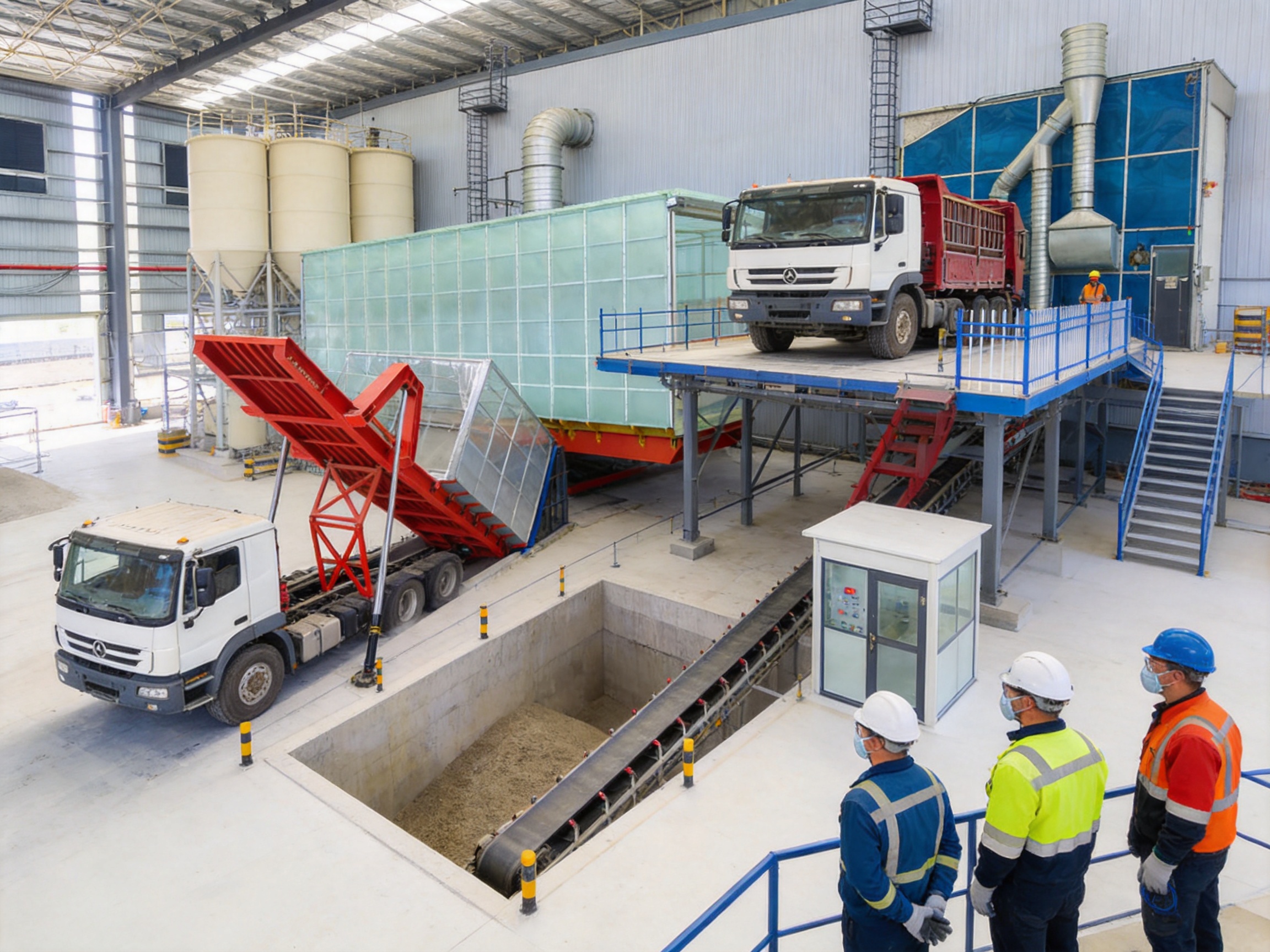
An enclosed truck dumper with a dust control system provides a practical solution by combining controlled vehicle tipping, sealed containment, negative-pressure ventilation, and efficient dust collection. Instead of allowing dust to spread freely around an open unloading platform, the system confines the unloading area and directs airborne material toward a filtration unit. This design improves environmental performance while supporting safer working conditions, more efficient product recovery, and better housekeeping.
The enclosed truck dumper described in this article is designed for industrial users that require reliable, high-capacity, and environmentally responsible unloading equipment. Its core design combines a strong dumper platform, a high-precision hydraulic synchronization system, integrated sealing, and an optional or dedicated dust removal system. The result is a complete unloading solution for plants where dust emissions, operating stability, and long-term equipment life are important considerations.
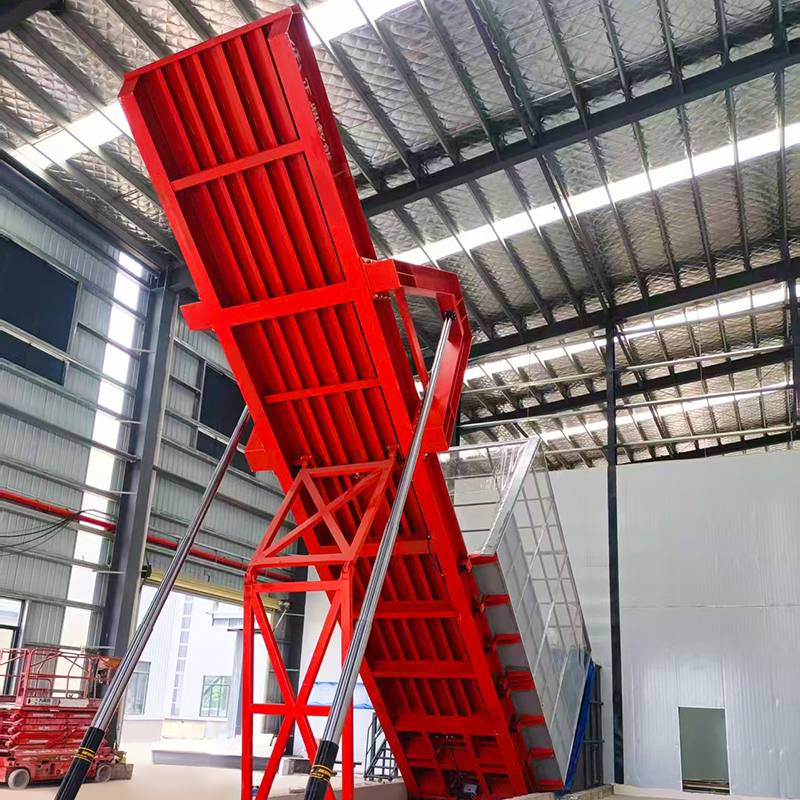
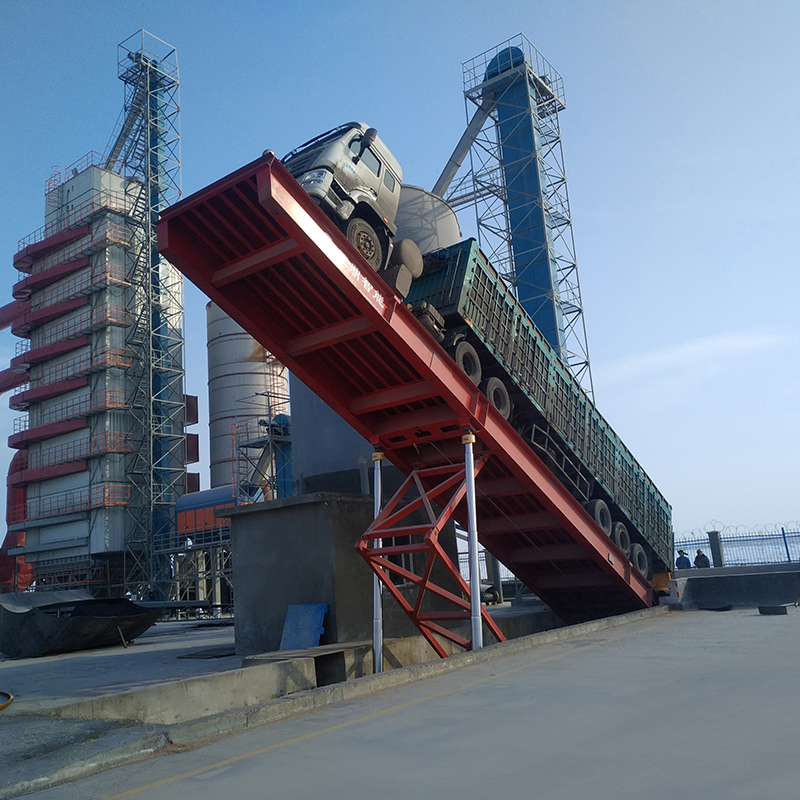
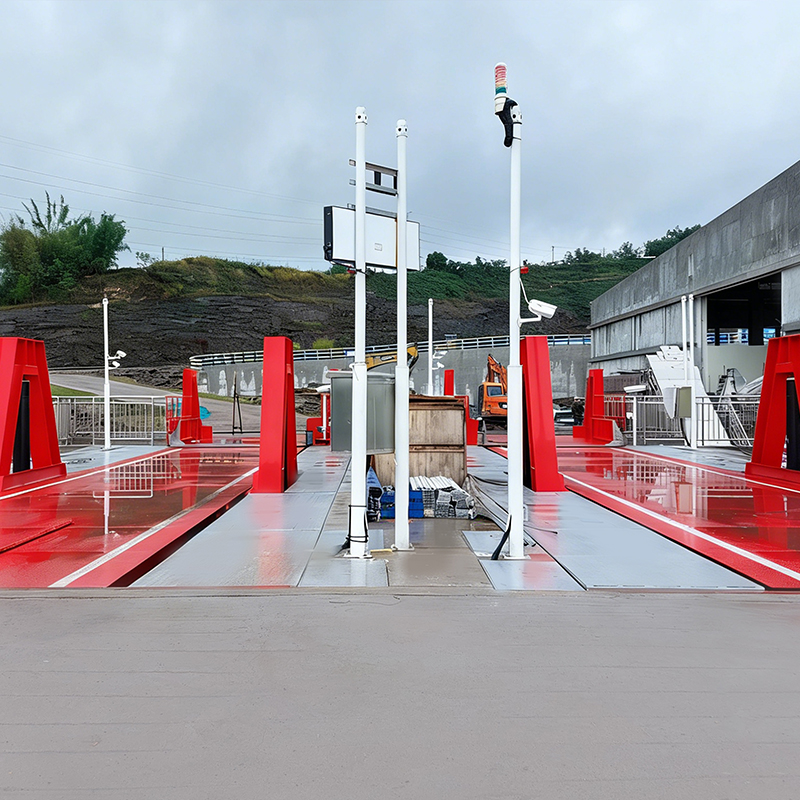
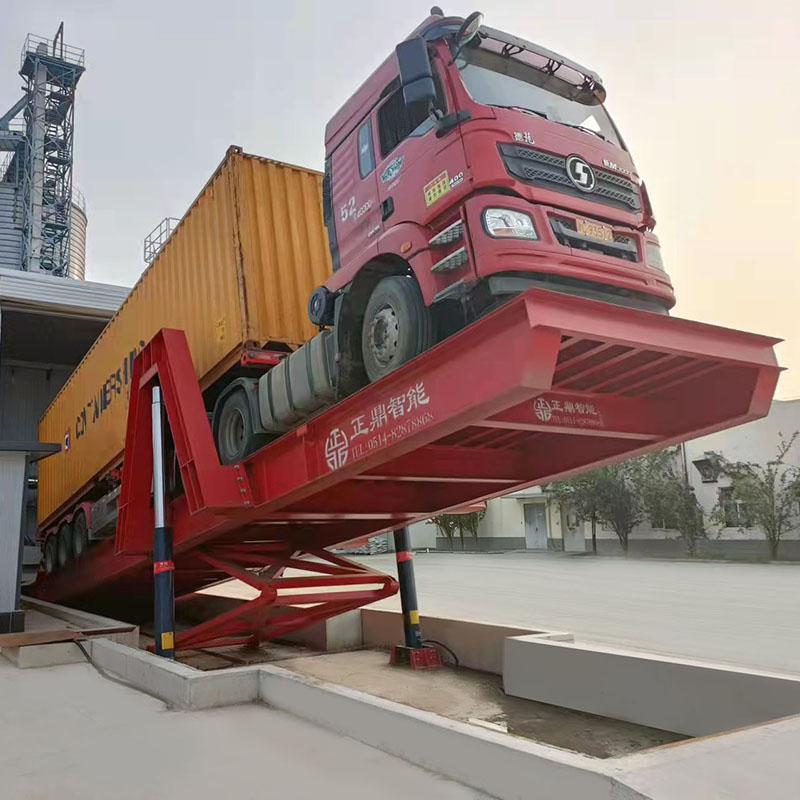
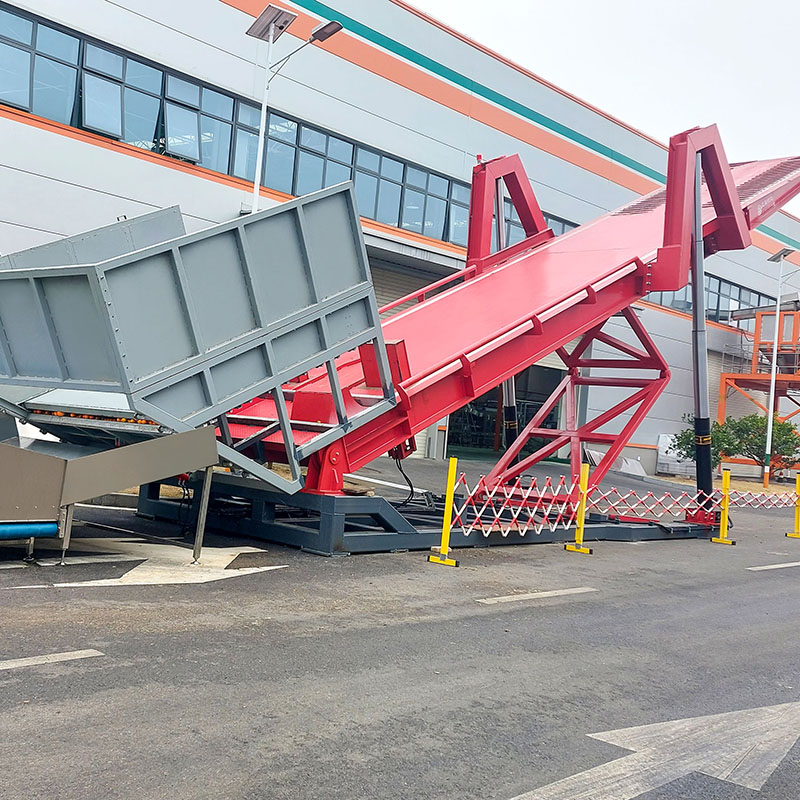
Enclosed Truck Dumper with Dust Control System
1. What Is an Enclosed Truck Dumper?
An enclosed truck dumper is a mechanical unloading system that lifts and tilts a loaded truck inside a partially sealed or fully sealed structure. The tipping action moves bulk material from the truck body into a receiving pit, hopper, conveyor, or downstream processing system. During this operation, the enclosure limits the uncontrolled movement of dust and helps maintain a controlled airflow pattern.
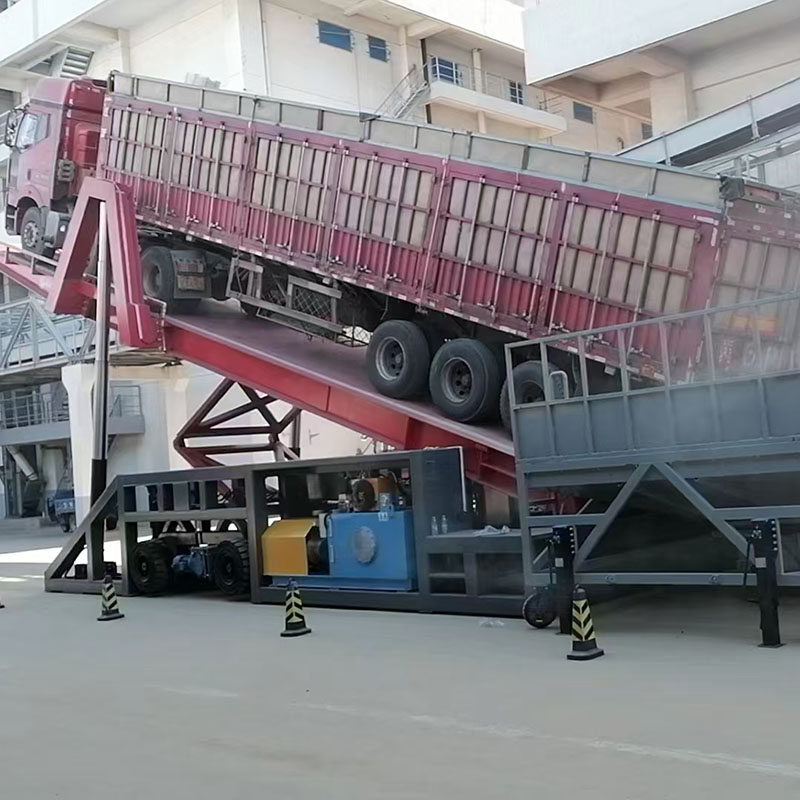
Conventional open truck dumpers usually consist of a lifting platform installed above a pit. Although this arrangement is effective for unloading, the impact of material entering the pit can generate a dust cloud. Wind, vehicle movement, and turbulence may carry the dust beyond the unloading area. Cleanup requirements can increase, product can be lost, and nearby workers may be exposed to elevated concentrations of respirable particles.
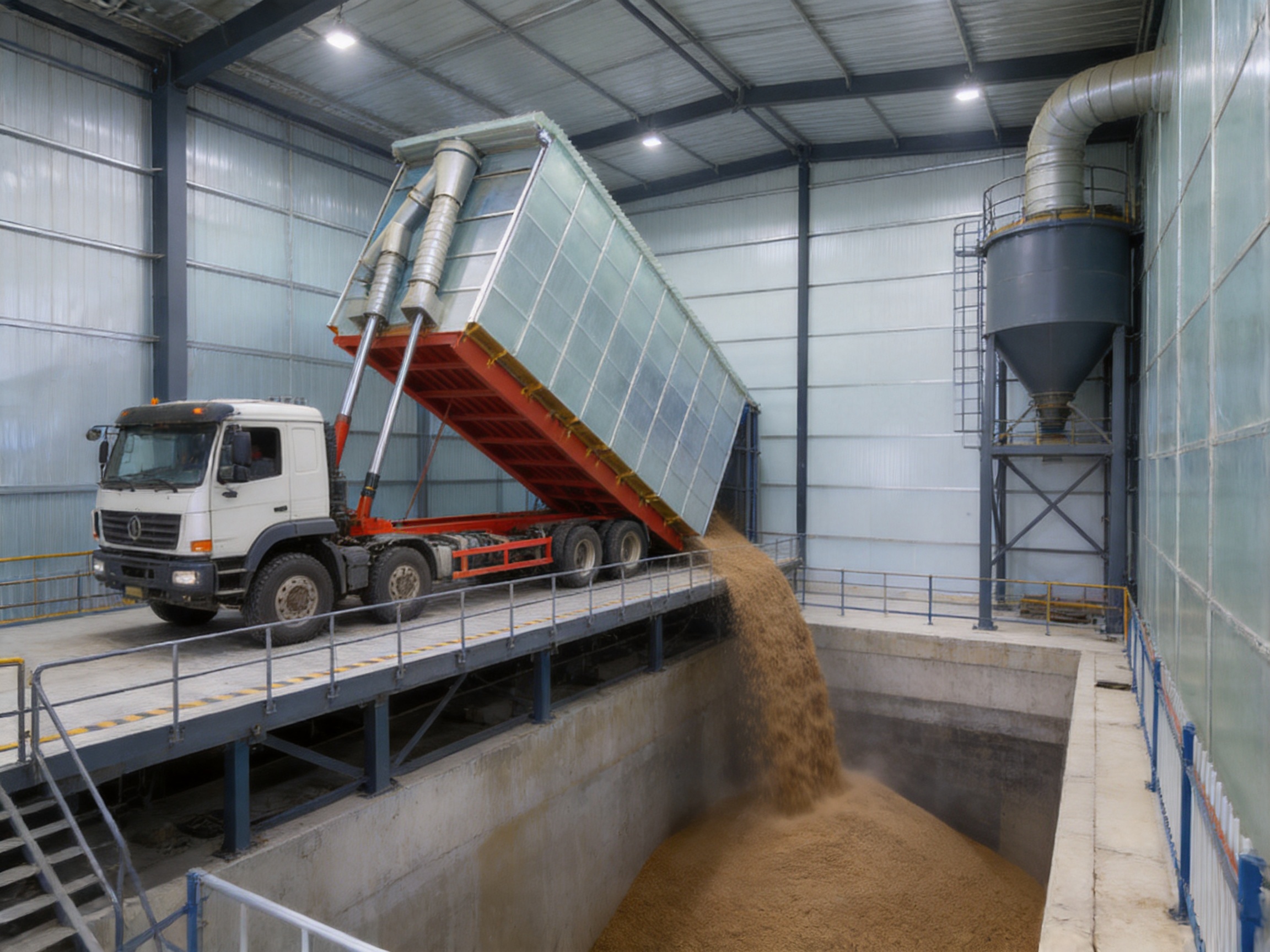
An enclosed design addresses these problems through the coordinated use of structural sealing and dust extraction. The pit enclosure and truck dumper platform enclosure work together to create a combination of dynamic and static sealing. Static sealing is provided by fixed enclosure panels and structural interfaces. Dynamic sealing is achieved around moving equipment and truck contact areas, where flexible components or controlled clearances help restrict air leakage during operation.
The enclosure is not simply a cover placed over an existing dumper. It is an integrated operating environment designed around truck access, platform movement, material discharge, inspection, maintenance, ventilation, and emergency safety. Correctly engineered airflow is essential. The system must allow enough air movement to capture dust while preventing excessive air intake that would increase fan energy consumption or reduce capture efficiency.
1.1 Semi-sealed and fully sealed configurations
The equipment can be supplied in semi-sealed or fully sealed configurations. A semi-sealed truck dumper provides enclosure around the main dust-generating zones while retaining practical openings for vehicle access, inspection, or site-specific operating requirements. This arrangement is often selected where the material has moderate dust potential or where the layout requires frequent vehicle interaction.
A fully sealed configuration provides a higher level of containment. The truck platform, receiving pit, and discharge area are enclosed as a coordinated system. With a suitable dust collector and negative-pressure fan, the enclosure can significantly reduce the escape of airborne particles into the surrounding plant area. This configuration is particularly suitable for cement terminals, grain facilities, chemical plants, mineral processing operations, and locations with strict environmental requirements.
The final configuration should be selected according to the material characteristics, truck dimensions, unloading frequency, local environmental requirements, available space, and the required connection to downstream conveying equipment. A site survey and process review are important before final engineering.
2. Operating Principle of the Dust Control System
The dust control system operates by combining containment and controlled air movement. When a truck enters the dumper, the platform and enclosure are positioned to receive the vehicle safely. After the truck is secured and the unloading sequence begins, the platform rises to the specified angle. Bulk material flows from the truck body into the receiving pit or hopper.
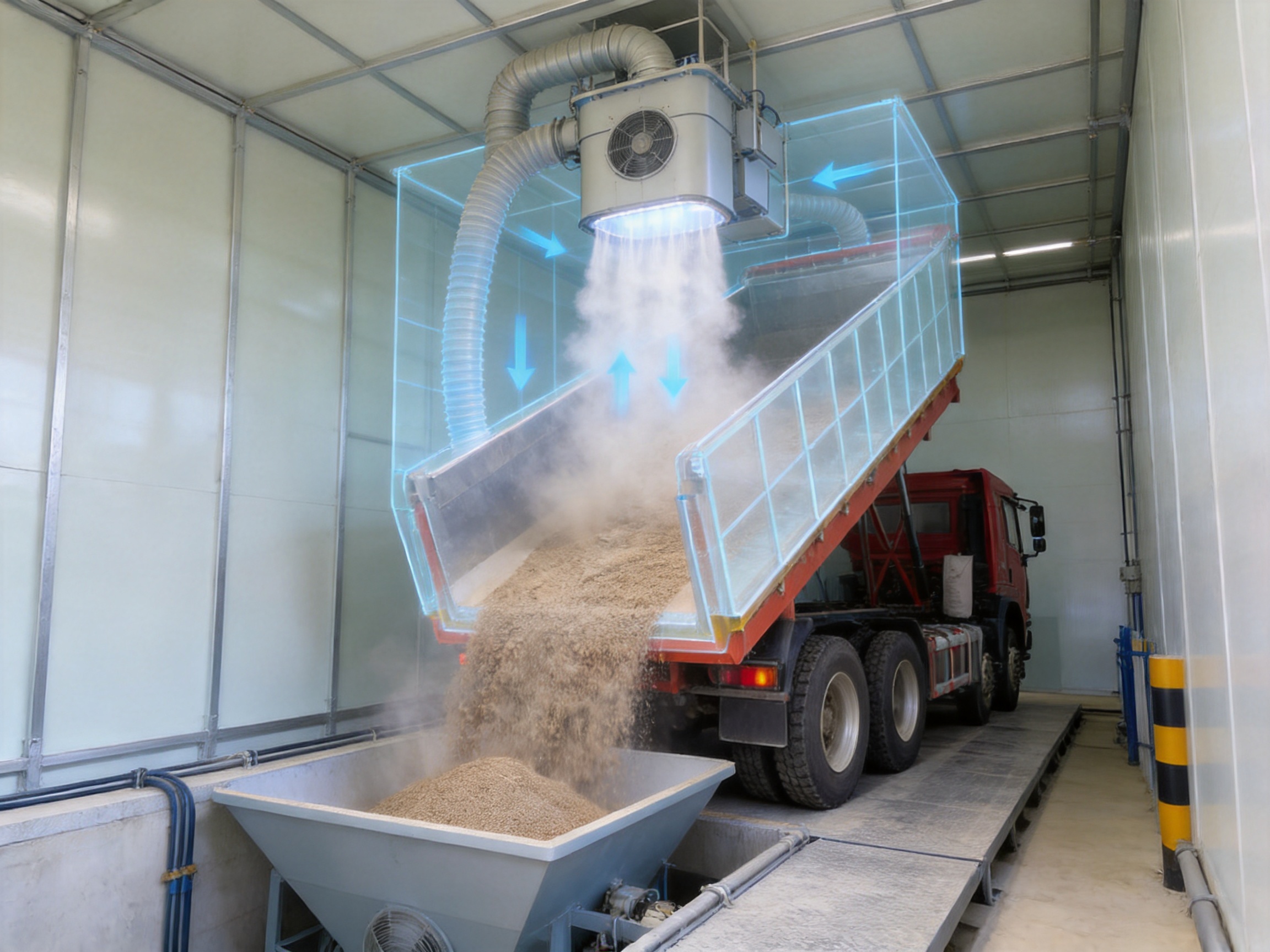
During discharge, dust collection fans draw air from the enclosure. This creates a negative-pressure zone, meaning that air tends to move into the enclosure rather than escape from it. The captured air is conveyed through ductwork to a dust collector. Depending on the material and application, the collector may use cartridge filters, baghouse filters, cyclone pre-separation, or another suitable filtration arrangement.
Filtered air is discharged after the dust has been separated. The collected material is returned to the process, discharged into a collection container, or handled according to the facility’s material-management procedures. This process can reduce visible emissions and recover product that would otherwise settle on the platform, surrounding structures, or outdoor ground surfaces.
The effectiveness of the system depends on several factors, including enclosure integrity, extraction volume, inlet-air control, duct design, filter selection, fan performance, and the location of dust pickup points. An oversized air inlet can dilute the extraction effect and increase energy consumption. An undersized air inlet can create unstable airflow or interfere with truck positioning. The integrated design therefore aims to control both the air inlet area and the air velocity at the inlet.
2.1 Main components
The principal components of an enclosed truck dumper with dust control include the following:
- Heavy-duty dumper platform designed to support the truck and payload during lifting.
- Hydraulic lifting cylinders and a high-precision synchronization system.
- Steel enclosure panels around the pit and platform.
- Flexible sealing elements around moving or variable-contact areas.
- Dust extraction ducts connected to the enclosure.
- High-efficiency cartridge or baghouse filtration equipment.
- Extraction fans that maintain negative pressure.
- Automatic filter-cleaning equipment, such as pulse-jet cleaning.
- Discharge equipment for collected dust or recovered product.
- Safety interlocks, vehicle-positioning controls, and emergency-stop devices.
- Inspection doors, access platforms, and maintenance openings.
These components must work as one system. A high-quality filter cannot compensate for an enclosure with excessive leakage. Similarly, a strong hydraulic platform does not by itself provide dust protection. The value of an enclosed dumper comes from the integration of mechanical lifting, structural containment, airflow management, filtration, and controls.
3. Product Characteristics and Engineering Advantages
3.1 High-precision hydraulic synchronization
The truck dumper uses a high-precision oil-cylinder synchronous stability system. Synchronization is important because the platform must rise evenly when carrying a heavy and sometimes unevenly distributed load. If the cylinders do not move in coordination, the platform may experience twisting, uneven stress, vibration, or impact loading.
The synchronized hydraulic arrangement improves operational safety and reduces vibration during lifting and lowering. Lower vibration reduces the mechanical shock transmitted to the oil cylinders, platform structure, hinges, and foundation. It also helps protect the truck body and limits sudden movement during unloading.
Reduced hydraulic impact can extend cylinder service life and reduce maintenance requirements. In demanding industrial operations, where a dumper may complete many cycles each day, this can contribute to improved availability and lower lifecycle costs. Stable movement also makes it easier to coordinate the dumper with dust extraction, vehicle restraints, discharge gates, and downstream conveying equipment.
3.2 Integrated enclosure and dust removal design
A major advantage of the product is the integration of the dumper enclosure and dust removal system. In many basic installations, a dust collector is added after the mechanical equipment has been designed. This can result in awkward duct routing, excessive leakage, insufficient capture at the dust source, or unnecessary fan energy consumption.
The integrated approach considers the air volume, enclosure geometry, platform movement, truck access, and dust generation points during the equipment design stage. This helps control the air inlet area and the inlet wind speed. By reducing uncontrolled openings, the system can maintain more stable negative pressure and direct contaminated air toward the filtration equipment.
The design is suitable for sites with high environmental protection requirements because it focuses on preventing dust overflow rather than relying only on end-of-pipe filtration. Containment at the source is generally more efficient than allowing dust to disperse throughout a building and attempting to collect it afterward.
3.3 Low energy demand for dust collection
Energy consumption is an important consideration in dust-control equipment. Fans that operate at unnecessarily high airflow rates increase electricity use, noise, filter loading, and operating costs. The sealed enclosure helps reduce uncontrolled air intake, allowing the dust collection system to operate with a more controlled airflow requirement.
The actual energy demand depends on the enclosure volume, duct length, material properties, filter pressure drop, fan selection, and operating schedule. However, a well-sealed system generally provides better conditions for energy-efficient extraction than an open platform with large uncontrolled air volumes.
3.4 Flexible application for different industries
The equipment can be adapted for many bulk-material applications. Industries that may benefit include cement, steel, coal, chemicals, grain, feed, oilseed processing, food ingredients, minerals, ports, papermaking, and new energy materials.
Different industries have different dust characteristics. Cement and mineral dust may be abrasive and fine. Grain and feed dust may require attention to combustible-dust risk. Chemical powders may require material compatibility and specialized containment. Food-related materials may require hygienic design and suitable cleanability. The enclosure, filter, sealing materials, and control strategy should therefore be selected according to the actual product being unloaded.
4. Main Technical Parameters
The product range includes multiple models and platform dimensions to accommodate different truck sizes, payloads, and site conditions. The following table presents the principal parameters supplied for the listed configurations. The dimensions show alternative length and width combinations in meters, while lifting capacity and maximum angle indicate the rated operating range.
| Model | Size, Length × Width (m) | Maximum Lifting Weight (t) | Maximum Lifting Angle |
|---|---|---|---|
| TQXHF 50 | 14 × 3 / 16 × 3 / 17 × 3 | 80 | 45° / 55° |
| TQXHF 80 | 16 × 3 / 17 × 3 / 18 × 3 | 80 | 45° / 55° |
| TQXHF 100 | 17 × 3 / 18 × 3 / 20 × 3 | 100 | 45° / 55° |
| TQXHF 150 | 17 × 3 / 18 × 3 / 20 × 3 | 150 | 45° / 55° |
Final technical parameters should be confirmed during project engineering. Truck wheelbase, overall length, axle arrangement, body height, payload distribution, pit depth, foundation conditions, discharge direction, and local safety requirements can affect the final design. The listed dimensions provide configuration options rather than a substitute for a site-specific equipment drawing.
5. Advantages Compared with Open Truck Dumpers
Open dumpers can be effective where dust generation is low, environmental restrictions are limited, or the unloading area is remote from personnel and neighboring properties. However, they provide little control over airborne material. During unloading, dust can rise from the truck body, fall with the bulk material, rebound from the receiving pit, or be carried away by crosswinds.
An enclosed truck dumper provides several advantages over a conventional open arrangement:
- Better containment of dust at the unloading source.
- Lower visible emissions during normal unloading.
- Improved protection for operators and nearby personnel.
- Reduced dust deposition on buildings, vehicles, and equipment.
- Lower cleaning requirements around the receiving pit.
- Improved recovery of valuable bulk material.
- More consistent environmental performance in changing weather.
- Better suitability for facilities near offices, communities, roads, or property boundaries.
- Improved integration with automated unloading and conveying systems.
Water spraying is sometimes used to suppress dust, but it is not appropriate for every material. Moisture can affect cement, grain, powders, chemicals, and food ingredients. It may also create contaminated runoff, corrosion, material caking, and additional handling problems. Dry dust collection within an enclosed structure avoids adding water to the product and can provide more consistent performance.
Compared with an open dumper using water spray alone, an enclosed system can offer more reliable containment because it captures airborne dust rather than simply wetting the material. The best solution depends on the application, but enclosure plus filtration is generally more compatible with dry-process facilities where product quality must be maintained.
5.1 Environmental performance
Enclosed systems are designed to reduce fugitive emissions around the unloading operation. Depending on the material, enclosure quality, airflow design, and filter performance, source dust reductions can be substantial compared with uncontrolled unloading. The supplied product information indicates that enclosed systems with suitable filtration can capture a very high proportion of airborne particulates and reduce ambient dust around the facility.
Actual emission performance should be verified by application-specific testing and should not be assumed to be identical for every site. Particle size, moisture, truck design, unloading speed, filter condition, wind, and operator procedures all influence results. Nevertheless, source containment provides a strong foundation for meeting the environmental objectives of modern bulk-material facilities.
5.2 Worker health and operating comfort
Dust control is also a worker-protection measure. Operators who work near truck dumpers may be exposed to dust during truck positioning, platform lifting, discharge, and cleanup. A sealed enclosure and controlled ventilation can reduce the amount of airborne material reaching occupied areas.
The system does not eliminate the need for a workplace risk assessment, personal protective equipment, ventilation inspections, or suitable operating procedures. Instead, it supports a layered safety strategy by reducing emissions at the source. Control-room operation, remote monitoring, and automated interlocks can further reduce the time workers spend near the active unloading zone.
5.3 Material recovery and housekeeping
Dust that escapes from an open dumper becomes a combination of product loss and housekeeping work. Fine material may settle on floors, structural steel, electrical equipment, vehicles, and nearby storage areas. Repeated cleaning can interrupt production and expose maintenance personnel to additional dust.
With an enclosed dumper, captured particles can often be returned to the process or collected for controlled disposal. The value of recovered material depends on its composition and the facility’s process design, but even low recovery rates can become financially meaningful at high annual throughput. Better housekeeping also supports safer walking surfaces, improved equipment visibility, and lower maintenance effort.
6. Manufacturing and Engineering Strengths
6.1 Integrated design capability
Jiangsu Zhengding Intelligent Equipment Co., Ltd. focuses on the research, development, manufacturing, and sales of intelligent loading and unloading equipment. Its product scope includes rear dumpers, side-turn truck dumpers, vehicle loading equipment, container flippers, and related automated material-handling systems.
This broad product range is important because truck unloading rarely functions as an isolated machine. A project may require vehicle guidance, weighing, positioning, lifting, pit discharge, conveying, dust collection, control integration, and process coordination. A manufacturer with experience across multiple loading and unloading technologies can evaluate the complete process instead of focusing only on the lifting platform.
The company’s ability to provide systematic solutions supports customized engineering for different industries. Equipment can be designed around truck types, material properties, production capacity, building limitations, and the required connection to conveyors, hoppers, silos, or processing lines.
6.2 Experience across demanding industries
The company’s equipment is used in steel, chemical, cement, coal, grain, oil, food, feed, port, papermaking, and new energy applications. These sectors involve different operating conditions, including abrasive materials, high throughput, fine powders, corrosive environments, food-quality requirements, and strict dust-control expectations.
Experience across these industries helps inform choices related to platform strength, enclosure materials, hydraulic protection, filter selection, access design, and control logic. It also supports the development of solutions for customers that require more than standard equipment dimensions.
6.3 Focus on customized solutions
Truck dumper projects are rarely identical. One facility may need a long platform for multi-axle vehicles, while another may require a shorter installation because of limited space. Some sites unload from both sides, some require a dedicated discharge direction, and others must integrate the dumper into an existing pit or conveyor system.
Customization may include platform dimensions, maximum lifting capacity, lifting angle, enclosure height, access doors, dust collector type, fan capacity, filter arrangement, control panel configuration, vehicle restraints, and downstream discharge equipment. Custom engineering allows the system to match actual site conditions rather than forcing the site to adapt to an unsuitable standard design.
6.4 Emphasis on safety and stability
Safety is supported through stable hydraulic lifting, appropriate structural design, controlled vehicle positioning, interlocking, emergency-stop functions, and access provisions. The synchronized hydraulic system helps limit uneven motion and hydraulic shock. The enclosure helps separate personnel from the dust-generating operation, while automation can reduce the need for manual intervention.
Safety design must be completed according to the application, local regulations, truck type, and site risk assessment. Important considerations include truck restraint, wheel chocks or equivalent positioning measures, platform load distribution, maintenance lockout, inspection access, emergency lowering, and protection from moving components.
6.5 International service and project orientation
The company serves domestic and international markets, with equipment exported to Japan, Brazil, Egypt, Pakistan, India, the Middle East, and Southeast Asia. Its stated users include organizations in brewing, grain handling, food, agriculture, building materials, and industrial manufacturing.
International project experience requires attention to different plant layouts, operating practices, electrical requirements, documentation expectations, shipping conditions, and installation environments. This background supports the development of equipment that can be adapted for a wide range of industrial projects.
7. Dust Collector Selection and Process Integration
Dust collector selection should be based on the material and the unloading process rather than on airflow capacity alone. Fine cement and mineral powders may require high-efficiency cartridge or baghouse filtration. Grain and organic dust may require additional attention to ignition prevention, pressure relief, isolation, and housekeeping. Abrasive materials may require wear-resistant ductwork and suitable filter protection.
7.1 Cartridge filters
Cartridge filters provide a compact filtration arrangement and can be suitable where high filtration efficiency is required within limited space. Pulse-jet cleaning periodically removes dust from the filter surface, allowing the collector to operate continuously when properly designed and maintained.
Cartridge systems are commonly considered for fine, relatively dry dust. Filter media, surface area, air-to-cloth ratio, pulse pressure, and dust-loading characteristics must be matched to the material. High humidity or sticky dust can reduce cleaning effectiveness and increase pressure drop.
7.2 Baghouse filters
Baghouse collectors are widely used for industrial dust control and can handle substantial dust loads. They may be appropriate for cement, minerals, coal, grain, and other bulk materials when the filter bags, cage design, cleaning system, and hopper arrangement are correctly selected.
Baghouse performance depends on regular cleaning, proper hopper discharge, and prevention of dust buildup in the lower section. The collector should be designed so that separated material does not bridge or accumulate in a way that reduces capacity.
7.3 Pre-separation and specialized requirements
For applications with heavy dust loading or larger particles, a cyclone or other pre-separator may be installed upstream of the final filter. Pre-separation can reduce the load on filter elements and improve the operating life of the main collector.
Facilities handling combustible organic dust require a dedicated hazard assessment. Possible measures may include explosion venting, isolation devices, spark detection, grounding, temperature monitoring, and appropriate electrical equipment. These features must be engineered according to the material’s explosibility characteristics and applicable regulations.
7.4 Filter maintenance
Routine maintenance should include filter inspection, compressed-air checks, fan and motor inspection, duct inspection, hopper discharge verification, and monitoring of differential pressure. The supplied guidance recommends filter inspection at approximately 200- to 400-hour intervals, although the correct interval depends on operating conditions.
Filter elements may last thousands of operating hours when the system is correctly designed and maintained. Abrasive dust, moisture, excessive air velocity, poor pulse cleaning, and improper installation can shorten service life. Differential-pressure trends are useful for identifying filter loading, damaged elements, or problems with the cleaning system.
8. Automation and Control Features
An enclosed truck dumper can be integrated into an automated loading and unloading sequence. A typical cycle may include vehicle arrival, identification or manual confirmation, positioning, wheel restraint, platform interlock, dust collector startup, dumper lifting, material discharge, platform lowering, dust settling or continued extraction, and vehicle release.
Automation can improve repeatability and reduce operator exposure. Sensors may monitor platform position, hydraulic pressure, enclosure doors, vehicle location, fan operation, filter differential pressure, and hopper level. The control system can prevent lifting if a safety condition has not been satisfied.
Remote monitoring can provide information about operating cycles, alarms, filter condition, motor status, and maintenance requirements. When connected to a plant control system, the dumper can coordinate with conveyors, hoppers, gates, weighbridges, and storage equipment.
Automation does not eliminate the need for trained operators. Personnel must understand startup and shutdown procedures, abnormal conditions, emergency controls, truck restrictions, and maintenance isolation. Clear procedures are especially important when several truck types or materials use the same dumper.
9. Installation and Site Planning
Site planning should begin with a survey of the truck route, unloading area, foundation, pit, drainage, electrical supply, dust collector location, and maintenance access. The truck approach must allow adequate turning space and safe alignment with the platform. Vehicle dimensions should be confirmed for both current and expected future fleets.
The foundation must support the static and dynamic loads generated by the truck, payload, platform, and lifting mechanism. Soil conditions, groundwater, drainage, seismic considerations, and existing structures may affect civil engineering requirements.
The dust collector should be positioned to minimize duct length and bends while maintaining safe access for filter replacement and inspection. Long or poorly designed ducts can increase pressure losses and reduce extraction efficiency. The fan and filter arrangement should also consider noise, discharge location, weather protection, and maintenance lifting requirements.
Enclosure access doors and inspection panels should be located where technicians can safely examine seals, hydraulic components, duct connections, and structural members. Adequate lighting and platforms improve maintenance quality and reduce the risk of unsafe access.
9.1 Retrofitting an existing open dumper
Many existing open dumpers can be upgraded with modular enclosure panels and a ducted dust collection system. Retrofitting may be appropriate where the platform, foundation, lifting mechanism, and pit remain structurally suitable.
A retrofit assessment should examine platform dimensions, cylinder capacity, structural deflection, truck clearance, enclosure support points, airflow paths, existing electrical systems, and the condition of the receiving pit. The dust collector must be sized for the modified enclosure, and the existing dumper controls may require upgrades to support interlocks and coordinated extraction.
Installation time varies according to site readiness and the extent of modification. The supplied information indicates that a retrofit may typically require several weeks, but the actual schedule depends on fabrication, civil work, access restrictions, production shutdowns, and commissioning requirements.
10. Operating and Maintenance Recommendations
Correct operation is essential for maintaining dust-control performance and equipment life. Before each shift, operators should check the platform, enclosure doors, visible seals, hydraulic hoses, emergency stops, vehicle restraints, fan status, and filter differential pressure.
The truck should be positioned within the approved operating zone before lifting begins. The vehicle body, tailgate, and discharge path must be compatible with the dumper design. Operators should not exceed the rated lifting capacity or use the system for vehicles that have not been evaluated.
During unloading, the dust collector should operate according to the designed sequence. If negative pressure is lost, a door remains open, a filter alarm appears, or excessive dust escapes, the operation should be paused and the cause investigated.
After unloading, the platform should be lowered completely before the vehicle is released. Any material accumulation on the platform, seals, or enclosure floor should be removed according to the site’s cleaning procedure. Compressed-air cleaning should be evaluated carefully because it can re-suspend dust and create a secondary exposure hazard.
Preventive maintenance should cover hydraulic oil condition, cylinder seals, pins and bushings, structural welds, platform rollers or hinges, flexible seals, duct supports, fan bearings, filter elements, pulse valves, compressed-air quality, and control-system alarms. Maintenance records can help identify recurring problems and support planned replacement rather than emergency repair.
11. Commercial and Lifecycle Benefits
The initial investment in an enclosed truck dumper may be higher than that of a basic open platform because it includes enclosure construction, extraction equipment, filtration, controls, and additional safety features. However, purchase price alone does not represent the total economic value of the system.
Lifecycle benefits may include lower cleaning labor, reduced product loss, fewer dust-related interruptions, improved worker protection, better environmental performance, and reduced risk of complaints or non-compliance. The value of these benefits depends on throughput, material cost, labor rates, environmental requirements, and site location.
Energy performance should also be considered. A well-sealed enclosure can reduce unnecessary air intake and support efficient fan selection. Automatic filter cleaning helps maintain stable pressure drop, while differential-pressure monitoring can identify problems before they cause excessive energy use.
Stable hydraulic movement may reduce wear on cylinders and supporting structures. Reduced vibration and impact can help extend service intervals and improve equipment availability. For facilities operating continuously or handling high truck volumes, these factors can have a meaningful effect on total cost of ownership.
12. Why Choose an Integrated Manufacturer?
An integrated manufacturer can coordinate the mechanical dumper, enclosure, dust collector, hydraulic system, control logic, and downstream interface. This reduces the risk that separate suppliers will assign responsibility for performance problems to one another.
Integrated engineering also simplifies communication during design changes. If the customer changes truck dimensions, material type, unloading capacity, or pit arrangement, the manufacturer can evaluate the effect on the full system. This is especially valuable for projects that involve unusual vehicle sizes, restricted buildings, high dust loads, or automated plant control.
Jiangsu Zhengding Intelligent Equipment Co., Ltd. positions itself as a manufacturer and solution provider for automated loading and unloading equipment. Its experience with truck dumpers, side-turn dumpers, container equipment, vehicle loading systems, and related logistics machinery provides a foundation for developing complete material-handling solutions.
The company’s strengths include product variety, customization capability, industrial application experience, hydraulic lifting technology, integrated dust-control design, and international project exposure. These strengths are relevant to customers seeking equipment that must operate reliably within a larger production or logistics system.
13. Frequently Asked Questions
Q1. What materials are suitable for an enclosed truck dumper?
An enclosed truck dumper can be designed for cement, coal, fly ash, lime, grain, feed, minerals, chemicals, food ingredients, oilseed products, and other bulk materials. Filter media, sealing materials, enclosure details, and safety features should be selected according to particle size, moisture, abrasiveness, temperature, and combustible-dust characteristics.
Q2. Is the equipment available with a fully sealed enclosure?
Yes. The product structure can be supplied in semi-sealed and fully sealed configurations. The suitable choice depends on dust potential, truck access requirements, site layout, environmental objectives, and the required level of containment.
Q3. How does the system prevent dust from escaping?
The system combines enclosure panels, flexible or dynamic seals, controlled air inlets, negative-pressure ventilation, and filtration. The extraction fan draws contaminated air toward the dust collector, while the enclosure limits uncontrolled dispersion around the unloading point.
Q4. Can the collected dust be recovered?
In many applications, captured material can be returned to the process or collected for controlled handling. Whether recovery is appropriate depends on the material, product-quality requirements, contamination risk, and facility process design.
Q5. What determines the required dumper size?
Important factors include truck length, width, wheelbase, axle configuration, gross vehicle weight, payload distribution, body design, required unloading angle, daily truck volume, pit dimensions, and available installation space. These details should be confirmed before selecting the final model.
Q6. What is the difference between a cartridge filter and a baghouse filter?
Cartridge filters are compact and can provide high filtration efficiency for suitable fine and dry dusts. Baghouse filters offer a larger filtration area and are widely used in high-volume industrial applications. The correct selection depends on dust loading, particle characteristics, airflow, temperature, humidity, maintenance requirements, and available space.
Q7. Can an existing open truck dumper be upgraded?
Yes, a retrofit may be possible if the existing platform, structure, foundation, hydraulic system, and pit are suitable. A site assessment is needed to determine whether modular enclosure panels, ductwork, extraction equipment, controls, and safety interlocks can be added effectively.
Q8. Does an enclosed dumper eliminate the need for personal protective equipment?
No. The enclosure reduces exposure but does not replace the site’s risk assessment, operating procedures, or personal protective equipment requirements. PPE selection should follow the material hazards, local regulations, and workplace exposure-control program.
Q9. How often does the dust collection system require maintenance?
Inspection intervals depend on operating hours and material characteristics. Typical tasks include filter inspection, compressed-air checks, differential-pressure monitoring, hopper discharge inspection, fan maintenance, duct inspection, and seal replacement. The supplied guidance recommends filter inspections at approximately 200- to 400-hour intervals, subject to site conditions.
Q10. What safety features should be considered?
Important features may include vehicle-positioning controls, wheel restraints, platform-position interlocks, emergency stops, hydraulic protection, access-door switches, maintenance lockout provisions, emergency lowering, overload protection, and safe inspection platforms. The final safety design should reflect the site risk assessment and applicable standards.
Q11. Can the truck dumper be connected to an automated plant?
Yes. The dumper can be integrated with conveyors, receiving hoppers, weighbridges, storage systems, process controls, dust collectors, and plant supervisory systems. Sensors and interlocks can coordinate vehicle positioning, lifting, extraction, discharge, and release.
Q12. What information should a customer provide for a quotation?
Useful information includes material type, bulk density, moisture content, particle size, dust characteristics, truck dimensions, gross weight, payload, unloading frequency, required platform size, lifting angle, pit arrangement, discharge direction, site drawings, local electrical requirements, environmental objectives, and preferred automation level.
14. Conclusion
An enclosed truck dumper with a dust control system is more than a lifting platform. It is an integrated solution for safer, cleaner, and more controlled bulk-material unloading. By combining a sealed enclosure, high-precision hydraulic synchronization, negative-pressure extraction, efficient filtration, and automated control, the system addresses the principal weaknesses of open truck dumping.
The product is especially valuable for facilities handling dusty materials or operating near workers, buildings, roads, neighboring properties, and environmentally sensitive areas. Its advantages include improved dust containment, lower visible emissions, better housekeeping, potential material recovery, reduced uncontrolled air intake, and improved equipment stability.
Jiangsu Zhengding Intelligent Equipment Co., Ltd. supports this type of application with experience in truck dumpers, side-turn dumpers, container equipment, vehicle loading systems, and customized automated loading and unloading solutions. Its manufacturing and engineering strengths allow the equipment to be adapted to different truck sizes, material properties, industries, plant layouts, and automation requirements.
For a successful project, the dumper, enclosure, dust collector, hydraulic system, control system, foundation, and downstream process should be engineered as one coordinated installation. With correct selection, installation, operation, and maintenance, an enclosed truck dumper can provide dependable service while supporting environmental responsibility and long-term industrial productivity.
References
1. Product technical information for enclosed truck dumpers with dust control systems, including hydraulic synchronization, enclosure configurations, and rated operating parameters.
2. Industrial dust collection engineering principles for cartridge filters, baghouse filters, negative-pressure ventilation, and automatic filter cleaning.
3. Bulk-material handling practice for truck unloading, receiving pits, hoppers, conveyors, and material recovery.
4. Occupational exposure-control principles for airborne particulate matter in industrial loading and unloading areas.
5. Preventive maintenance guidance for hydraulic lifting equipment, industrial fans, filtration units, dust ducts, and automated material-handling systems.
6. Jiangsu Zhengding Intelligent Equipment Co., Ltd. company and product information covering automated loading and unloading equipment, truck dumpers, container equipment, and industrial application experience.


