
 English
 русский
 Español
 Français
 Português
 عربى




+86-13588556918
Content
- 1 1. The Development of Continuous Container Handling
- 2 2. Integrated Design for 20-Foot and 40-Foot Containers
- 3 3. Dedicated Container Feeder for Stable Material Flow
- 4 4. Automatic Container Door Opening and Closing
- 5 5. Optional Weighing During Container Circulation
- 6 6. One Production Line for Loading and Unloading
- 7 7. Throughput and Efficiency Compared with Batch Methods
- 8 8. Operational Stability and Product Quality
- 9 9. Safety Features and Human-Machine Coordination
- 10 10. Intelligent Manufacturing Strengths
- 11 11. Advantages Over Conventional Competitors
- 12 12. Applications Across Different Industries
- 13 13. Installation, Maintenance, and Lifecycle Value
- 14 14. Frequently Asked Questions
- 14.1 Q1: What is a continuous container handling system?
- 14.2 Q2: Which container sizes can the system handle?
- 14.3 Q3: Can the same line perform both loading and unloading?
- 14.4 Q4: Is automatic container door operation available?
- 14.5 Q5: Can weighing be integrated into the process?
- 14.6 Q6: What throughput can a continuous system achieve?
- 14.7 Q7: Can existing batch equipment be upgraded?
- 14.8 Q8: Does continuous handling reduce container damage?
- 14.9 Q9: What information is required for a customized quotation?
- 14.10 Q10: Why choose a manufacturer with a broad loading and unloading product range?
- 15 15. Conclusion
- 16 References
- 17 Product: Continuous Container Handling System
Modern logistics facilities are under constant pressure to process more containers in less time while controlling labor costs, reducing equipment idle time, and maintaining safe operating conditions. Railway container central stations, inland ports, large logistics parks, grain terminals, warehouses, and industrial distribution centers increasingly require more than conventional batch loading and unloading equipment. They need a coordinated system that can receive, position, weigh, load, unload, and release containers with minimal interruption.
A continuous container handling system is designed to address this need. Instead of completing every operation from start to finish before the next container enters the work area, the system organizes container movement as a coordinated flow. Containers can be fed, positioned, tilted, loaded, unloaded, weighed, and discharged through connected stages. The result is a more stable operating rhythm, improved equipment utilization, faster container changeover, and better use of valuable site space.
Jiangsu Zhengding Intelligent Equipment Co., Ltd. develops and manufactures integrated loading and unloading equipment for automobiles, containers, ships, and industrial logistics applications. Its continuous container handling system combines dedicated container feeding, automatic door operation, optional weighing, container tilting, and integrated loading and unloading functions. The equipment is available for both 20-foot and 40-foot containers and can be customized for different material characteristics, production capacities, and site conditions.
1. The Development of Continuous Container Handling
Traditional container handling usually follows a batch process. A container is brought into position, secured, opened, loaded or unloaded, closed, released, and removed. Only after the entire cycle is finished can the next container enter the working area. Although this method is familiar and relatively simple, it creates repeated periods of inactivity.
During each changeover, operators may need to wait for a vehicle, crane, feeder, or conveyor. Additional time can be consumed by container alignment, door opening, locking, weighing, inspection, and the removal of the completed container. These intervals may appear short individually, but their cumulative effect can be substantial in a facility processing dozens or hundreds of containers each day.
Continuous container handling changes the operating concept. The system uses coordinated equipment and controlled sequencing so that the next container can be prepared while the current container is being loaded or unloaded. Depending on the configuration, the process may use indexing conveyors, moving platforms, parallel lanes, container tilting equipment, automatic clamping devices, or synchronized infeed and outfeed conveyors.
The objective is not simply to move containers faster. The objective is to maintain a consistent material flow. Each stage is arranged to support the next stage, reducing unnecessary movement and minimizing the idle time between container cycles. This makes the system particularly valuable for facilities where the number of available loading bays, cranes, operators, or site areas is limited.
Industry operating comparisons indicate that facilities changing from traditional batch methods to continuous container handling may achieve throughput increases of approximately 55 to 85 percent while using a similar number of personnel and dock positions. The exact result depends on material type, loading method, container condition, operating schedule, and the degree of automation, but the main improvement usually comes from eliminating nonproductive changeover time.
In a typical comparison, a single-bay batch arrangement may process approximately 4.2 containers per hour. A multi-bay batch arrangement may process around 7.5 containers per hour. A continuous indexing system can reach approximately 11.2 containers per hour, while continuous parallel flow may reach approximately 14.5 containers per hour under suitable operating conditions.
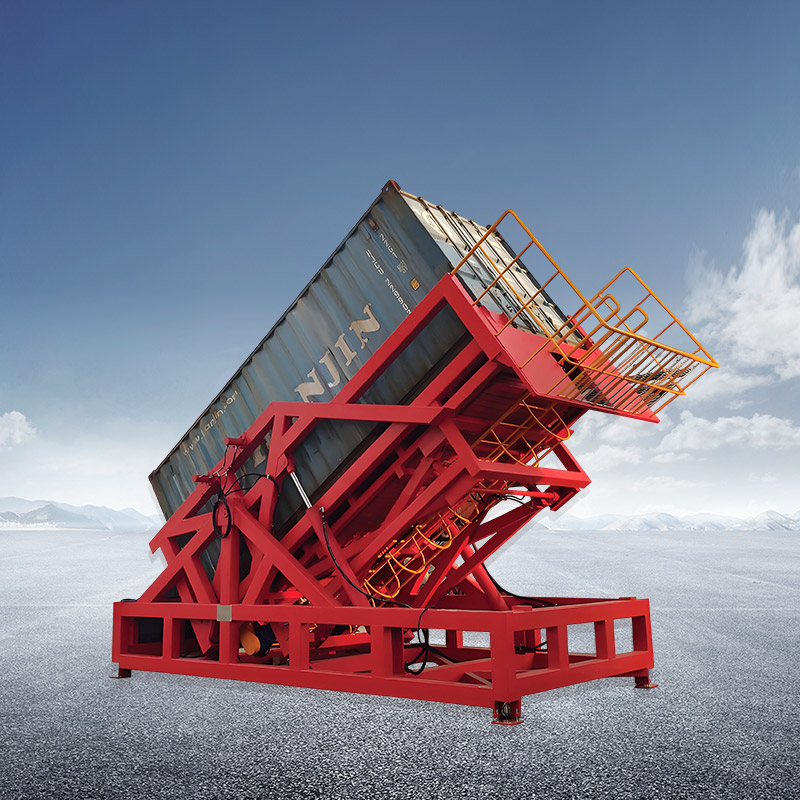
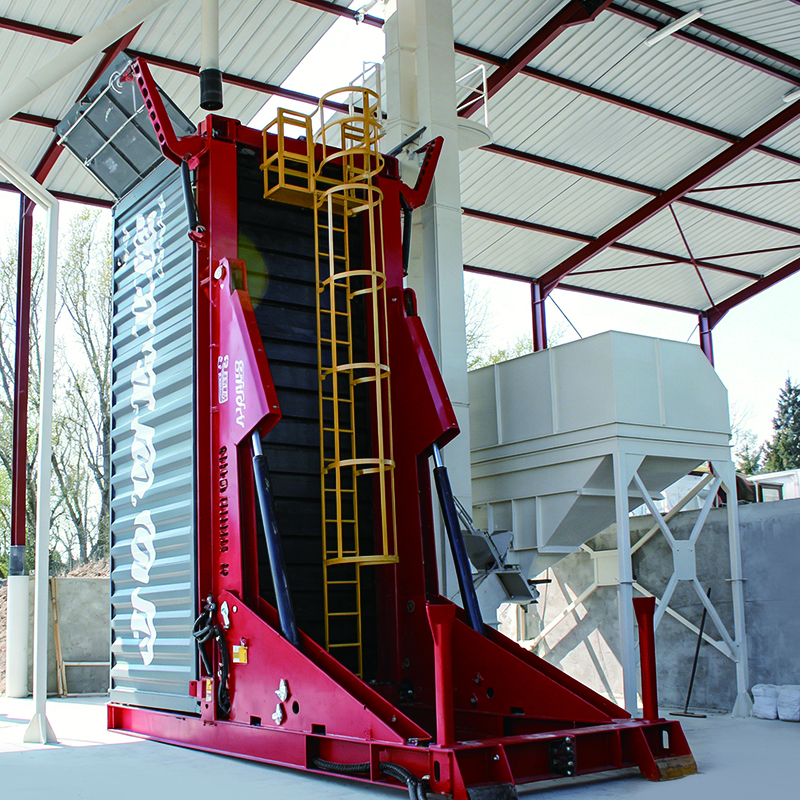
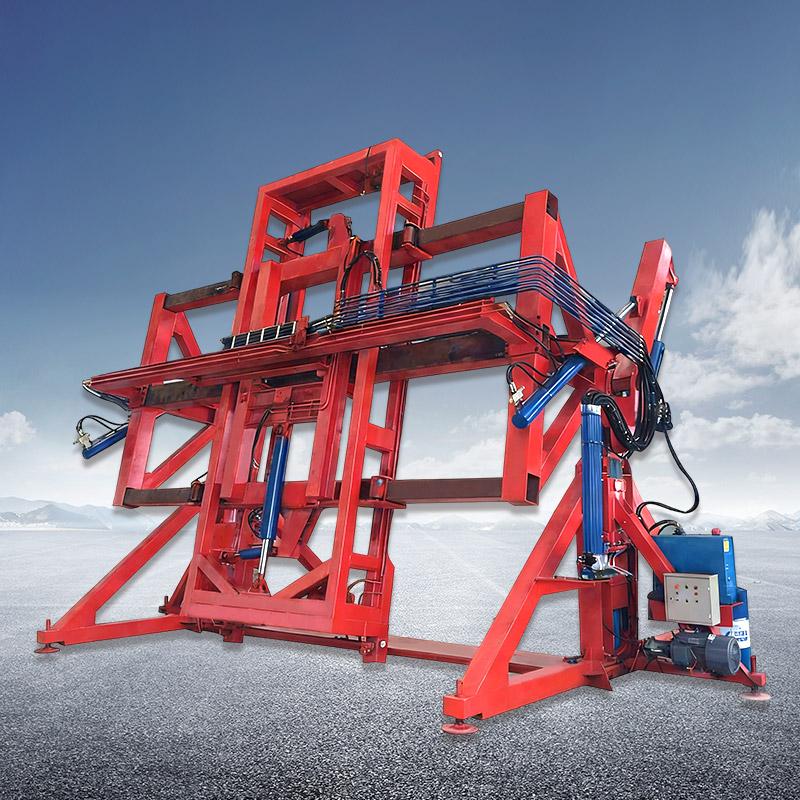
Continuous Container Handling System
2. Integrated Design for 20-Foot and 40-Foot Containers
One of the main strengths of the continuous container handling system is its integrated design for both 20-foot and 40-foot containers. Many logistics facilities handle more than one container length, and changing between separate machines or work areas can create additional handling steps. A system designed around both standard container formats gives users greater operating flexibility.
The TJXH 20 model is designed for 20-foot container applications. It has a listed equipment size of approximately 6 by 3 meters, a maximum lifting weight of 50 tons, and a maximum lifting angle of 45 or 60 degrees depending on the configuration.
The TJXH 40 model is designed for 40-foot container applications. It has a listed equipment size of approximately 12 by 3 meters, a maximum lifting weight of 100 tons, and a maximum lifting angle of 45 or 60 degrees.
| Model | Applicable Container | Approximate Size L × W | Maximum Lifting Weight | Maximum Lifting Angle |
|---|---|---|---|---|
| TJXH 20 | 20-foot container | 6 × 3 meters | 50 tons | 45 or 60 degrees |
| TJXH 40 | 40-foot container | 12 × 3 meters | 100 tons | 45 or 60 degrees |
These parameters provide a foundation for system selection, but the final equipment design should be confirmed through an engineering review. Container tare weight, cargo density, material flow characteristics, loading height, foundation strength, environmental conditions, operating frequency, and local safety requirements all affect the final configuration.
The integrated design also helps simplify plant planning. Rather than allocating separate areas for loading equipment and unloading equipment, a facility can arrange both functions around one coordinated production line. This can reduce the distance that containers must travel and make better use of existing buildings, yards, and transfer zones.
For operations handling different cargoes throughout the day, the ability to support both container sizes is especially useful. The control system and mechanical structure can be configured for the required container format, while optional sensors and positioning devices help confirm that the container is correctly aligned before the lifting or tilting cycle begins.
3. Dedicated Container Feeder for Stable Material Flow
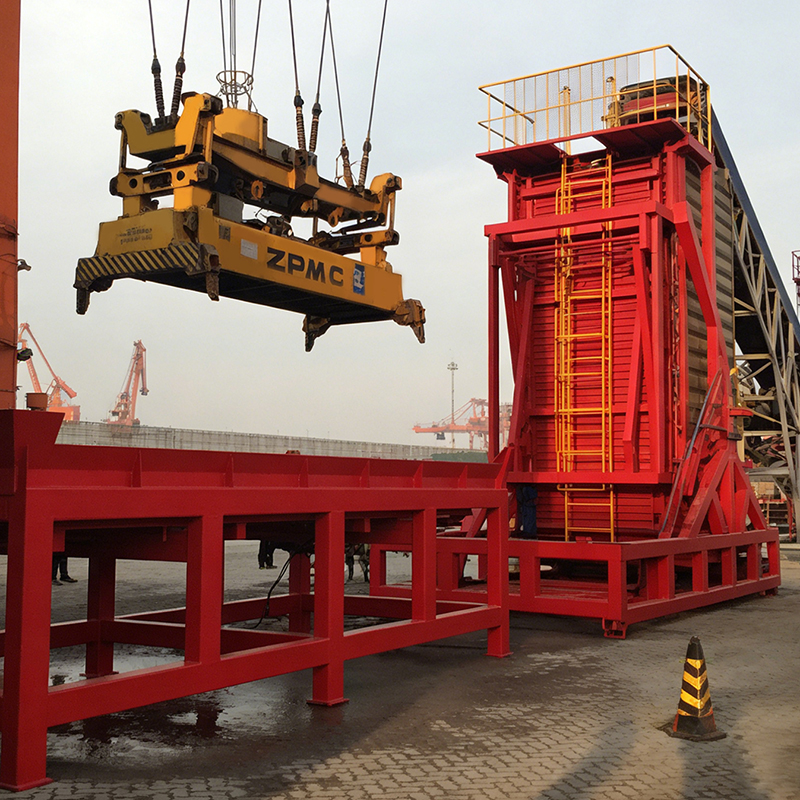
The dedicated container feeder is one of the most important components of the system. Its purpose is to automatically deliver containers to the container tilting platform or the designated processing position. This reduces dependence on repeated manual positioning and helps maintain a predictable sequence between incoming containers.
In a conventional arrangement, the crane may perform several separate tasks: receiving a container, aligning it with the working platform, adjusting its position, waiting for operators to secure it, and then returning to collect another container. When traffic increases, the crane can become a bottleneck. The container feeder reduces this pressure by organizing container delivery as part of the overall process.
The feeder can be integrated with the site’s existing transport arrangement, such as a crane, trailer, transfer vehicle, conveyor, or other container movement equipment. During the engineering stage, the supplier evaluates the container entry direction, available space, operating height, transfer distance, and expected cycle time. The objective is to create smooth handover points between the feeder and the rest of the system.
Automatic feeding also provides operational consistency. Containers enter the system according to a defined sequence rather than depending entirely on operator timing. This can reduce unnecessary stops and help operators focus on monitoring, inspection, and exception handling rather than repetitive positioning work.
When the facility processes a large number of containers each day, the feeder can produce significant cumulative benefits. Even if each individual positioning operation is shortened by only a few minutes, the total time saved across hundreds of cycles can improve daily capacity and reduce congestion around the loading area.
3.1 Advantages of the Dedicated Feeder
The dedicated feeder offers several advantages over an arrangement in which every container is positioned manually or by an independent crane operation.
First, it improves the continuity of the process. The next container can be prepared while another container is completing its loading or unloading cycle. Second, it helps reduce crane waiting time and allows the crane to serve other tasks more effectively. Third, it supports repeatable positioning, which is important for safe clamping, accurate weighing, controlled tilting, and reliable door operation.
The feeder can also support future expansion. A facility may begin with one processing line and later add another feeder, additional conveyors, or a parallel processing lane. Because the system is based on coordinated modules, capacity can often be increased without completely replacing the original equipment.
4. Automatic Container Door Opening and Closing
Container doors can be heavy, awkward to operate, and difficult to access safely when the container is elevated, tilted, or positioned near other machinery. The continuous container handling system can be configured with an automatic container door opening and closing mechanism to reduce manual handling and improve operating efficiency.
Automatic door equipment can be designed around the container position, door type, operating height, and required access area. Sensors may be used to confirm the container location and door status before loading or unloading begins. Interlocking controls can prevent the next movement from taking place until the door is in the correct position.
This feature reduces high-altitude work and heavy physical labor. It also helps create a more standardized operating sequence. Instead of relying on individual operators to open and close doors at different speeds or with different methods, the mechanism performs the task through a controlled cycle.
Automatic door operation is especially valuable in high-throughput facilities where repetitive manual work can cause fatigue. By reducing the number of manual interventions, the system can help improve ergonomics and reduce the possibility of injury caused by awkward posture, unexpected door movement, or unsecured container components.
The door mechanism can also support quality control. If a door is not fully open, not fully closed, or not correctly positioned, the control system can issue an alarm or stop the process. This helps prevent material leakage, incomplete unloading, accidental interference with equipment, and damage to the door assembly.
5. Optional Weighing During Container Circulation
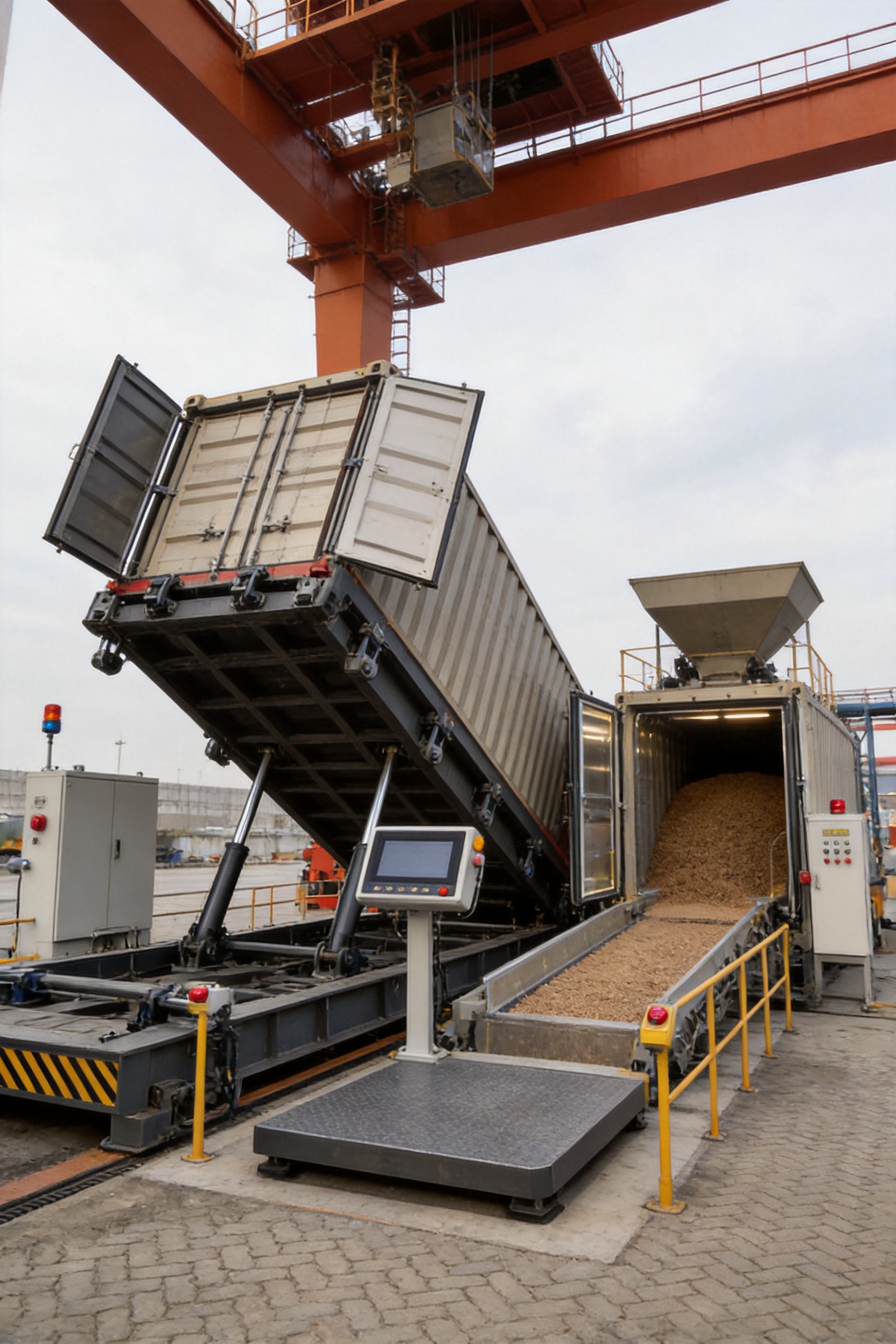
Weighing can be integrated into the container handling process so that the container is measured while it is circulating through the system. This eliminates the need to transfer the container to a separate weighing station in many applications.
Integrated weighing can support several management objectives. It can confirm the gross weight of a loaded container, verify the quantity transferred, assist with shipping documentation, and provide operating data for inventory control. When connected to the facility’s management system, the weight information can also be associated with container numbers, batch numbers, order details, and dispatch records.
The weighing function may be configured according to the required accuracy, weighing position, load distribution, environmental conditions, and certification requirements. The final design should consider dynamic effects caused by container movement, vibration, lifting, tilting, and material discharge. Proper calibration and maintenance are essential for reliable results.
Weighing during circulation provides a clear advantage over disconnected batch procedures. In a traditional process, the container may need to be moved to a separate scale before or after loading. This adds travel distance, requires additional coordination, and can increase the risk of congestion. Integrated weighing keeps the operation within one organized flow.
For grain, feed, chemical, cement, food, and bulk industrial applications, weighing information can be particularly valuable. It supports production control, loading verification, material reconciliation, and the prevention of overloading. If different materials are handled on the same line, the weighing data can also assist in tracking product changeovers and identifying unusual flow conditions.
6. One Production Line for Loading and Unloading
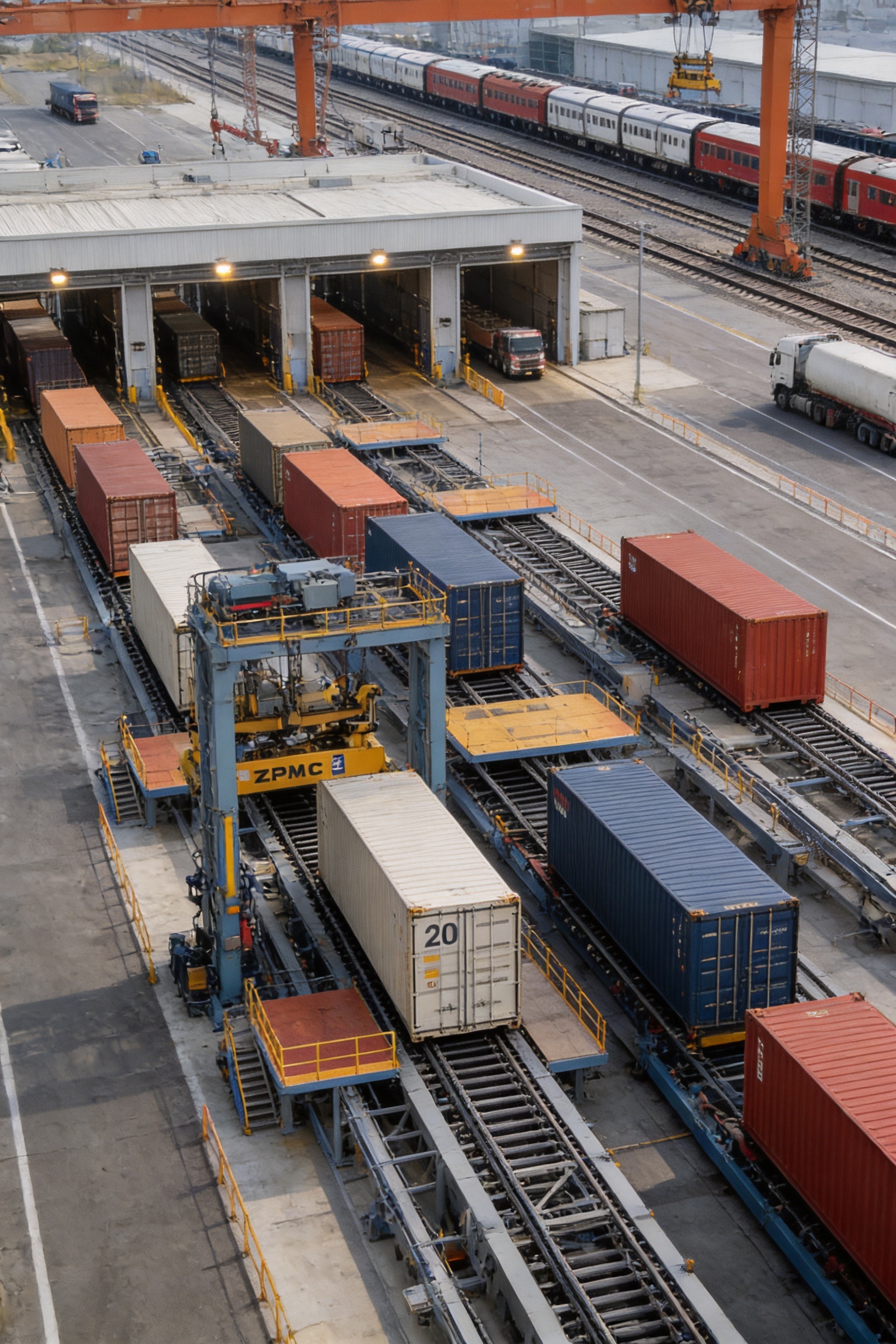
A major competitive advantage of the system is the integration of loading and unloading functions into the same production line. In many traditional facilities, one set of equipment is used to load containers and another set is used to unload them. Containers must then be transferred between areas, increasing the required footprint and adding additional handling steps.
With an integrated line, the same general equipment architecture can support both directions of operation. The system can be configured to receive an empty container for filling or receive a loaded container for discharge. The control system manages the relevant sequence, including positioning, clamping, door operation, weighing, tilting, material transfer, and release.
This dual-function design simplifies plant organization. It can reduce the need for duplicate platforms, separate transfer routes, and additional container parking areas. It also makes it easier to use the available equipment throughout different production periods. For example, a line may unload incoming raw materials during one shift and load finished products during another shift.
Integrated loading and unloading is particularly useful for warehouses, inland terminals, production plants, and distribution centers where site space is limited. The system can be arranged to follow the existing flow of trucks, rail wagons, storage areas, and production lines. This minimizes unnecessary cross-traffic and helps separate people, vehicles, and moving equipment.
Compared with competitors offering separate loading and unloading machines, an integrated line can provide a more complete solution. The customer does not need to coordinate multiple independent systems with different controls, service requirements, and operating procedures. Instead, the equipment can be planned and commissioned as one engineered project.
7. Throughput and Efficiency Compared with Batch Methods
The most visible benefit of continuous container handling is increased throughput. Traditional batch systems lose productive time during container positioning, locking, door operation, release, removal, and replacement. Continuous systems overlap these steps wherever practical.
Operating comparisons commonly show continuous systems achieving 10 to 16 containers per hour, depending on configuration and cargo type. Traditional batch systems may process approximately 4 to 8 containers per hour. The actual result depends on whether the system is handling bulk material, packaged goods, liquid products, or mixed cargo, but the difference can be substantial.
| Performance Metric | Traditional Batch Handling | Continuous Handling | Typical Advantage |
|---|---|---|---|
| Containers processed per hour | 4 to 8 | 10 to 16 | Approximately 80 to 120 percent higher |
| Equipment idle time | 35 to 45 percent | 8 to 15 percent | Approximately 65 to 75 percent lower |
| Container changeover time | 3 to 8 minutes | 20 to 45 seconds | Approximately 85 to 90 percent faster |
| Labor workload | High variation between cycles | More consistent workload | Smoother labor distribution |
| Loading and unloading arrangement | Often separated | Can be integrated | Reduced transfer requirements |
| Site utilization | Requires additional staging areas | Designed for coordinated flow | More efficient use of available space |
For example, a port facility processing 150 containers per day through a traditional batch arrangement may require approximately 14 hours of operation. After introducing a continuous flow arrangement, the same facility may process approximately 240 containers in 12 hours, representing a potential daily capacity increase of about 60 percent.
Continuous operation can also improve schedule reliability. When the amount of idle time between containers is reduced, the facility is better able to maintain a planned production rhythm. This can help reduce truck waiting time, rail loading delays, vessel support delays, and demurrage exposure.
7.1 Equipment Utilization
Traditional batch systems may operate with equipment utilization of approximately 50 to 65 percent because machines remain idle during container exchange and preparation. Continuous systems may reach approximately 85 to 92 percent utilization when the upstream and downstream operations are properly balanced.
Higher utilization does not mean that every component runs continuously without inspection or maintenance. Instead, it means that a greater percentage of the planned operating period is spent performing productive work. The system still requires scheduled maintenance, safety checks, cleaning, lubrication, and component replacement.
Improved utilization can reduce the need to install additional equipment solely to handle peak demand. A facility may increase output by improving the flow of an existing operating area rather than adding an entirely new building or loading bay.
7.2 Reduced Changeover Time
Container changeover time includes the period required to remove one container and position the next. In batch operations, this period can range from approximately three to eight minutes. Continuous systems can reduce the interval to approximately 20 to 45 seconds in suitable configurations.
The reduction is achieved through coordinated movement, prepared container positions, automated clamping, dedicated feeders, and synchronized control logic. The next container is not treated as a completely separate event; it becomes part of the active process before the previous cycle is fully completed.
8. Operational Stability and Product Quality
Throughput is important, but a high-speed system must also be stable and controllable. A continuous container handling system is designed to maintain a repeatable sequence rather than forcing operators to make separate decisions during every container cycle.
Stable sequencing can improve the consistency of loading and unloading. Containers arrive at defined positions, doors are operated through controlled mechanisms, and tilting or lifting is performed according to programmed limits. This reduces unnecessary shocks, abrupt movements, and repeated repositioning.
Controlled movement can help reduce container damage. Traditional batch methods may require several repositioning operations before loading or unloading is complete. Continuous handling can index the container into position once and hold it securely through the main operation. Industry comparisons indicate that continuous flow methods may reduce container damage incidents by approximately 15 to 25 percent, depending on site conditions and operator practices.
Reduced movement can also protect the equipment itself. Container corners, locking devices, doors, platforms, guide rails, and transfer structures are exposed to less uncontrolled contact. Lower mechanical shock can support longer service life and reduce the frequency of unplanned repairs.
Operational stability is also valuable for material quality. For bulk products such as grain, feed, cement, coal, and certain chemical materials, uncontrolled discharge or excessive vibration can cause segregation, spillage, dust generation, or uneven loading. A controlled sequence allows material flow to be monitored and adjusted according to the product.
For food and feed applications, the equipment may be arranged to support cleaning, inspection, material changeover, and contamination control. For chemical and industrial materials, the design may incorporate appropriate sealing, protective components, grounding, dust control, or corrosion-resistant materials according to the project requirements.
9. Safety Features and Human-Machine Coordination
Safety must be considered in every stage of a container handling project. Containers are heavy loads, and lifting or tilting operations create significant mechanical forces. A properly engineered system requires structural verification, load control, secure clamping, guarded moving parts, emergency stops, and clear operating procedures.
The continuous system can reduce unnecessary human exposure by automating repetitive tasks. Automatic door operation reduces high-altitude and heavy manual work. Dedicated feeding reduces the need for operators to stand near moving containers during alignment. Automated clamping and interlocking reduce the risk of starting a lifting or tilting cycle before the container is properly secured.
Typical safety functions may include container presence sensors, position confirmation, overload monitoring, door status detection, hydraulic pressure monitoring, emergency stop circuits, access guarding, warning lights, audible alarms, and controlled restart procedures. The final selection depends on the equipment layout and applicable regulations.
Human-machine coordination remains important even in a highly automated facility. Operators need access to a clear control interface showing container position, cycle status, alarms, weighing information, and maintenance conditions. A good interface allows the operator to identify the cause of a stoppage quickly and take corrective action without bypassing safety functions.
Training should cover normal operation, emergency response, inspection, cleaning, lockout and isolation procedures, container compatibility, and the handling of abnormal loads. Automation improves consistency, but trained personnel remain essential for supervision and maintenance.
10. Intelligent Manufacturing Strengths
The performance of a continuous container handling system depends not only on the final machine but also on the quality of its design and manufacturing process. Jiangsu Zhengding Intelligent Equipment Co., Ltd. is a national high-tech enterprise focused on the research and development, manufacturing, and sales of intelligent loading and unloading equipment.
The company develops equipment for automobiles, containers, ships, and industrial logistics applications. Its product range includes rear dumpers, side-turn truck dumpers, car loading equipment, container flippers, and related automated handling systems. This broad experience is valuable because container handling projects often interact with truck loading, ship unloading, storage, conveying, weighing, and production systems.
A company with experience across several types of handling equipment can evaluate the complete material route rather than viewing the container system as an isolated machine. This makes it easier to identify bottlenecks, coordinate transfer points, and select a suitable combination of mechanical, hydraulic, electrical, and control technologies.
10.1 Engineering and Application Analysis
The manufacturing process begins with an understanding of the customer’s application. Important factors include container size, maximum gross weight, cargo type, bulk density, moisture content, flowability, loading and unloading direction, required cycle time, working temperature, environmental exposure, available foundation, building height, and local safety requirements.
Engineers can then develop a layout showing container entry, feeding, positioning, door operation, lifting or tilting, weighing, loading, unloading, and exit. The layout must also account for truck access, rail interfaces, crane paths, maintenance clearances, operator walkways, and emergency access.
Application analysis helps avoid a common weakness in low-cost equipment projects: selecting a standard machine without considering how it will connect with the existing facility. A continuous handling line must be compatible with upstream and downstream operations. If one stage is much slower than the others, the entire system may fail to achieve its expected throughput.
10.2 Structural and Mechanical Manufacturing
Container handling equipment must support heavy loads and repeated cycles. Structural components therefore require careful material selection, fabrication, welding, dimensional control, and inspection. Platforms, frames, lifting structures, guide systems, locking mechanisms, and container contact points must be designed to withstand the expected static and dynamic forces.
Manufacturing quality affects more than strength. Accurate dimensions help ensure that containers enter the system smoothly and remain aligned during lifting or tilting. Properly fabricated guide rails reduce contact damage. Correctly machined connection points support reliable installation and maintenance.
Welding procedures, surface preparation, corrosion protection, and coating selection are also important. Equipment used outdoors or in coastal, humid, dusty, or chemically aggressive environments may require enhanced protection. The design can be adapted to the application rather than relying on a single coating specification for every project.
10.3 Hydraulic, Electrical, and Control Integration
Continuous container handling requires close coordination between mechanical components, hydraulic actuators, sensors, electrical controls, and software logic. The lifting or tilting system must provide sufficient force and controlled speed. The hydraulic circuit should support stable movement under changing loads. Valves, cylinders, pipelines, and safety components must be selected according to the working pressure and cycle frequency.
The electrical and control system coordinates container feeding, position detection, door operation, clamping, weighing, lifting, tilting, discharge, and release. Interlocks prevent incompatible actions from occurring simultaneously. For example, the system can prevent lifting unless the container is detected, aligned, clamped, and confirmed ready for the next step.
Control integration is a major difference between a complete engineered system and a collection of separate machines. A properly integrated system can display operating status, identify faults, record weighing information, and support manual or automatic modes. It can also be connected to plant-level management systems where required.
10.4 Factory Testing and Commissioning
Before delivery, the equipment should undergo inspection and testing based on the project requirements. Testing may include dimensional checks, no-load movement, simulated container cycles, load testing, sensor verification, door mechanism testing, emergency stop testing, weighing calibration, and control sequence verification.
Factory testing helps identify problems before installation at the customer’s site. It also allows operators and service personnel to review the operating sequence and confirm that the interface is understandable. After installation, on-site commissioning verifies the connection between the equipment and the customer’s foundation, power supply, conveyors, cranes, loading systems, and management controls.
A structured commissioning process reduces the risk of extended start-up delays. It also helps establish a baseline for future maintenance, calibration, and performance evaluation.
11. Advantages Over Conventional Competitors
Customers comparing continuous container handling suppliers should evaluate more than the purchase price. A lower initial price may not represent a lower total cost if the equipment has limited automation, poor integration, difficult maintenance access, or weak after-sales support.
The system offered by Jiangsu Zhengding has several competitive advantages when compared with conventional batch equipment and fragmented multi-supplier solutions.
11.1 Integrated Loading and Unloading
Many conventional systems specialize in only loading or only unloading. An integrated system supports both operations through one coordinated production line. This reduces container transfers and may lower the required site area.
11.2 Support for Multiple Container Sizes
The availability of configurations for both 20-foot and 40-foot containers provides greater flexibility than equipment designed around only one container format. The customer can select the appropriate model or request a customized arrangement based on the expected container mix.
11.3 High Degree of Automation
Dedicated feeding, automatic door operation, optional weighing, controlled clamping, and synchronized transfer reduce manual handling. This supports higher productivity and more consistent operation than systems that depend heavily on manual positioning.
11.4 Custom Engineering
Industrial facilities rarely have identical layouts or material requirements. A custom factory can adapt equipment dimensions, lifting capacity, angle, feeder arrangement, control logic, weighing function, and transfer interface to the project. This is more suitable than forcing a standard machine into an unsuitable site.
11.5 Broad Industry Experience
The company’s equipment is used in steel, chemical, cement, coal, grain, oil, food, feed, ports, papermaking, and new energy applications. Experience across these industries provides knowledge of different materials, operating environments, and production requirements.
11.6 International Application Experience
The equipment has been exported to Japan, Brazil, Egypt, Pakistan, India, the Middle East, and Southeast Asia. International projects require attention to transportation, installation, documentation, electrical standards, safety expectations, and communication across different operating environments.
11.7 Complete Product Range
Experience with rear dumpers, side-turn truck dumpers, vehicle loading systems, container flippers, and related equipment enables the company to support projects involving several forms of automated loading and unloading. This can simplify supplier coordination for customers developing a larger logistics or production system.
12. Applications Across Different Industries
Continuous container handling systems can be applied wherever containers must be loaded, unloaded, tilted, weighed, or transferred at a high frequency.
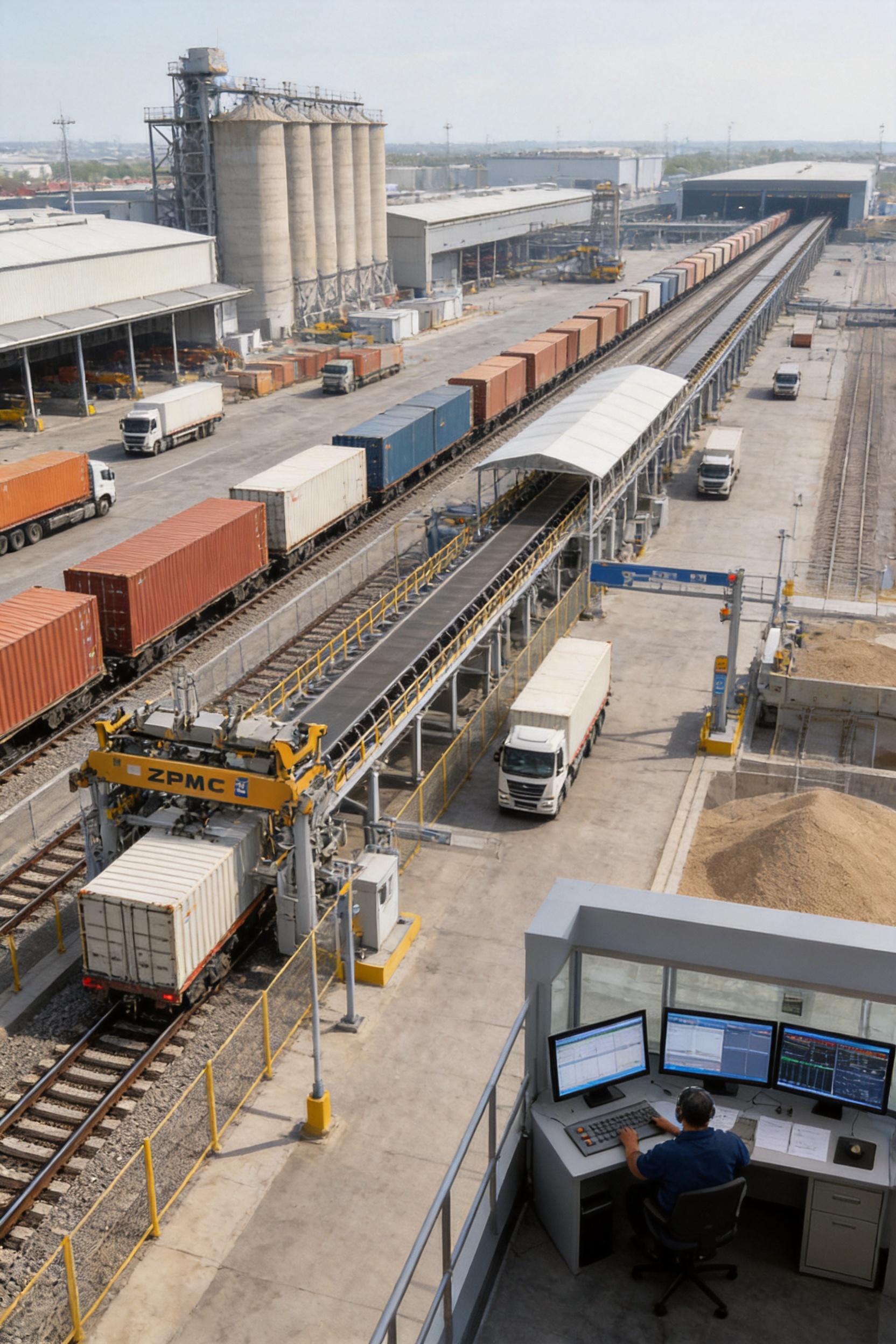
12.1 Railway Container Central Stations
Railway container stations must coordinate train schedules, truck arrivals, container storage, and transfer equipment. A continuous system can help reduce the time required to process each container and support more predictable train and truck movements.
12.2 Inland Ports and Intermodal Terminals
Inland ports often handle containers moving between road, rail, warehouses, and production facilities. Integrated feeding, weighing, and transfer functions can reduce congestion and improve the connection between different transport modes.
12.3 Large Logistics Parks
Large logistics parks may process many containerized materials for different customers. A flexible system that supports both 20-foot and 40-foot containers can adapt to changing cargo requirements while reducing the need for separate handling areas.
12.4 Grain, Feed, and Food Facilities
Bulk agricultural materials require controlled flow, accurate weighing, reliable discharge, and effective cleaning procedures. Continuous handling can improve loading and unloading efficiency while supporting material traceability and production scheduling.
12.5 Cement, Coal, and Mineral Materials
Heavy bulk materials place high demands on structure, lifting capacity, sealing, wear resistance, and dust management. The system can be engineered around the material density, discharge behavior, and required cleaning or maintenance access.
12.6 Chemical and Industrial Plants
Chemical and industrial facilities may require specialized materials, protective equipment, grounding, sealing, and control measures. A custom engineering approach allows the equipment to be adapted to the product and environmental conditions.
12.7 Warehouses and Manufacturing Plants
Manufacturers may use containers for raw materials, intermediate products, packaging materials, and finished goods. An integrated loading and unloading line can connect the warehouse with the production area and reduce unnecessary internal transport.
13. Installation, Maintenance, and Lifecycle Value
Equipment performance depends on proper installation. The foundation must be able to support the static and dynamic loads. The container entry and exit routes must be clear. Power, hydraulic, electrical, and communication connections must be installed according to the approved layout.
During installation, the equipment should be aligned carefully. Misalignment can increase friction, cause uneven loading, accelerate wear, and affect weighing accuracy. Sensors and limit switches should be checked after mechanical alignment is complete.
Routine maintenance typically includes inspection of structural connections, lubrication of moving parts, checking hydraulic hoses and fittings, testing safety devices, cleaning sensors, checking electrical cabinets, verifying door mechanisms, and calibrating weighing equipment where installed.
Preventive maintenance is especially important for continuous systems because a failure at one stage can affect the entire production line. Maintenance planning should identify critical components, recommended inspection intervals, spare parts, and safe isolation procedures.
Lifecycle value should be evaluated through total operating cost rather than purchase price alone. Higher throughput, lower labor demand, reduced idle time, lower container damage, and better site utilization may provide significant financial benefits. Facilities processing more than approximately 50 containers per day may achieve a comparatively short payback period, although the actual result depends on labor rates, demurrage costs, working hours, energy use, and local conditions.
A practical implementation strategy is to begin with one loading or unloading bay as a pilot. The facility can measure throughput, labor hours, changeover time, container damage, and maintenance requirements before expanding to additional bays. This staged approach reduces project risk and allows the operating team to become familiar with the equipment.
14. Frequently Asked Questions
Q1: What is a continuous container handling system?
A continuous container handling system is an integrated arrangement in which containers move through loading or unloading stages with minimal interruption. It may include feeders, conveyors, tilting platforms, automatic door mechanisms, clamping devices, weighing equipment, and synchronized controls. Unlike a traditional batch process, the system prepares or moves the next container while the current operation is still being completed.
Q2: Which container sizes can the system handle?
The system can be configured for 20-foot and 40-foot containers. The TJXH 20 model is intended for 20-foot containers, while the TJXH 40 model is intended for 40-foot containers. The final configuration should be selected according to container weight, cargo type, lifting requirements, and site layout.
Q3: Can the same line perform both loading and unloading?
Yes. The system is designed with integrated dual functionality. It can be arranged to load and unload containers through the same general production line, reducing the need to transfer containers between separate equipment areas.
Q4: Is automatic container door operation available?
Yes. An automatic door opening and closing mechanism can be configured according to the container type, access conditions, and operating sequence. This reduces manual high-altitude work and heavy physical labor while improving process consistency.
Q5: Can weighing be integrated into the process?
Yes. A weighing function can be incorporated so that the container is weighed during circulation. This can support loading verification, inventory control, shipping documentation, and material management. Accuracy requirements and calibration procedures should be confirmed during project design.
Q6: What throughput can a continuous system achieve?
Typical continuous systems may process approximately 10 to 16 containers per hour, while traditional batch systems may process approximately 4 to 8 containers per hour. Actual throughput depends on material characteristics, container size, loading or unloading method, operating sequence, and the configuration of the complete facility.
Q7: Can existing batch equipment be upgraded?
Partial conversion may be possible by adding automated positioning, feeders, conveyors, weighing equipment, or control integration. However, full continuous operation may require equipment designed specifically for overlapping processes. A common approach is to convert one bay as a pilot before expanding.
Q8: Does continuous handling reduce container damage?
It can. Containers are positioned and moved through a controlled sequence, which may reduce unnecessary repositioning and impact. Industry comparisons suggest that damage incidents may decrease by approximately 15 to 25 percent, although results depend on equipment design, operator practices, container condition, and site management.
Q9: What information is required for a customized quotation?
Important information includes container sizes, maximum gross weight, cargo type, loading or unloading direction, required capacity, operating hours, site dimensions, foundation conditions, available power, environmental conditions, weighing requirements, automation level, and the connection points to existing cranes, conveyors, warehouses, trucks, or rail systems.
Q10: Why choose a manufacturer with a broad loading and unloading product range?
A broad product range indicates experience with different material routes and equipment types. It can also simplify project coordination when the facility requires container flippers, rear dumpers, side-turn dumpers, vehicle loading systems, weighing systems, or other automated equipment in addition to the continuous container line.
15. Conclusion
Continuous container handling is an effective solution for facilities that need higher throughput, shorter changeover times, improved equipment utilization, and more efficient use of site space. By combining dedicated container feeding, automatic door operation, optional weighing, controlled lifting and tilting, and integrated loading and unloading, the system transforms container processing from a series of isolated batch operations into a coordinated material flow.
The ability to support both 20-foot and 40-foot containers provides operational flexibility. The dual-function production line can reduce transfer requirements, while automation reduces repetitive manual work and improves safety. Compared with conventional batch equipment, continuous handling can provide higher capacity, more stable operation, lower idle time, and better potential for future expansion.
Jiangsu Zhengding Intelligent Equipment Co., Ltd. combines application engineering, equipment manufacturing, control integration, customization, and international project experience. Its broader range of automated loading and unloading equipment allows customers to develop complete solutions for containers, vehicles, ships, warehouses, and industrial production lines.
For facilities processing high container volumes or operating under strict time and space constraints, a continuous container handling system can provide measurable operational and financial value. The most successful projects begin with a detailed analysis of the material route, container specifications, site conditions, safety requirements, and target throughput, followed by equipment designed specifically for the customer’s process.
References
1. Jiangsu Zhengding Intelligent Equipment Co., Ltd. Product Information for Continuous Container Handling Systems.
2. Jiangsu Zhengding Intelligent Equipment Co., Ltd. Technical Materials for Automated Loading and Unloading Equipment.
3. International Association of Ports and Harbors. General Principles of Port and Container Terminal Efficiency.
4. International Organization for Standardization. Freight Containers: Handling, Safety, and Dimensional Considerations.
5. International Labour Organization. Safety and Health in Ports and Cargo Handling Operations.
6. World Shipping Council. Container Transport and Terminal Operations: Industry Practices.
7. General engineering principles for hydraulic lifting systems, industrial automation, weighing systems, and material handling equipment.
8. Comparative operational data concerning batch and continuous container handling methods supplied in the product application materials.