

 English
 русский
 Español
 Français
 Português
 عربى




+86-13588556918
Content
- 1 1. What Is a Gantry Container Tilter?
- 2 2. Main Advantages of the Gantry Container Tilter
- 3 3. Product Configuration and Technical Parameters
- 4 4. Structural Design and Manufacturing Strengths
- 5 5. Manufacturing Process from Design to Delivery
- 6 6. Applications Across Multiple Industries
- 7 7. Performance Benefits Compared with Conventional Unloading
- 8 8. Safety, Maintenance, and Operator Training
- 9 9. Why Choose an Experienced Intelligent Equipment Manufacturer?
- 10 10. Recommended Project Selection Process
- 11 11. Frequently Asked Questions
- 11.1 Q1. What container sizes can the gantry container tilter handle?
- 11.2 Q2. What is the maximum lifting capacity?
- 11.3 Q3. What is the maximum tilting angle?
- 11.4 Q4. Can the machine open and close container doors automatically?
- 11.5 Q5. Can weighing equipment be integrated?
- 11.6 Q6. Can dust extraction be connected to the unloading area?
- 11.7 Q7. How much space is needed for installation?
- 11.8 Q8. How often does the hydraulic system require maintenance?
- 11.9 Q9. Is operator training necessary?
- 11.10 Q10. Can the equipment be customized for an existing plant?
- 12 12. Conclusion
- 13 References
- 14 Product: Gantry Container Tilter
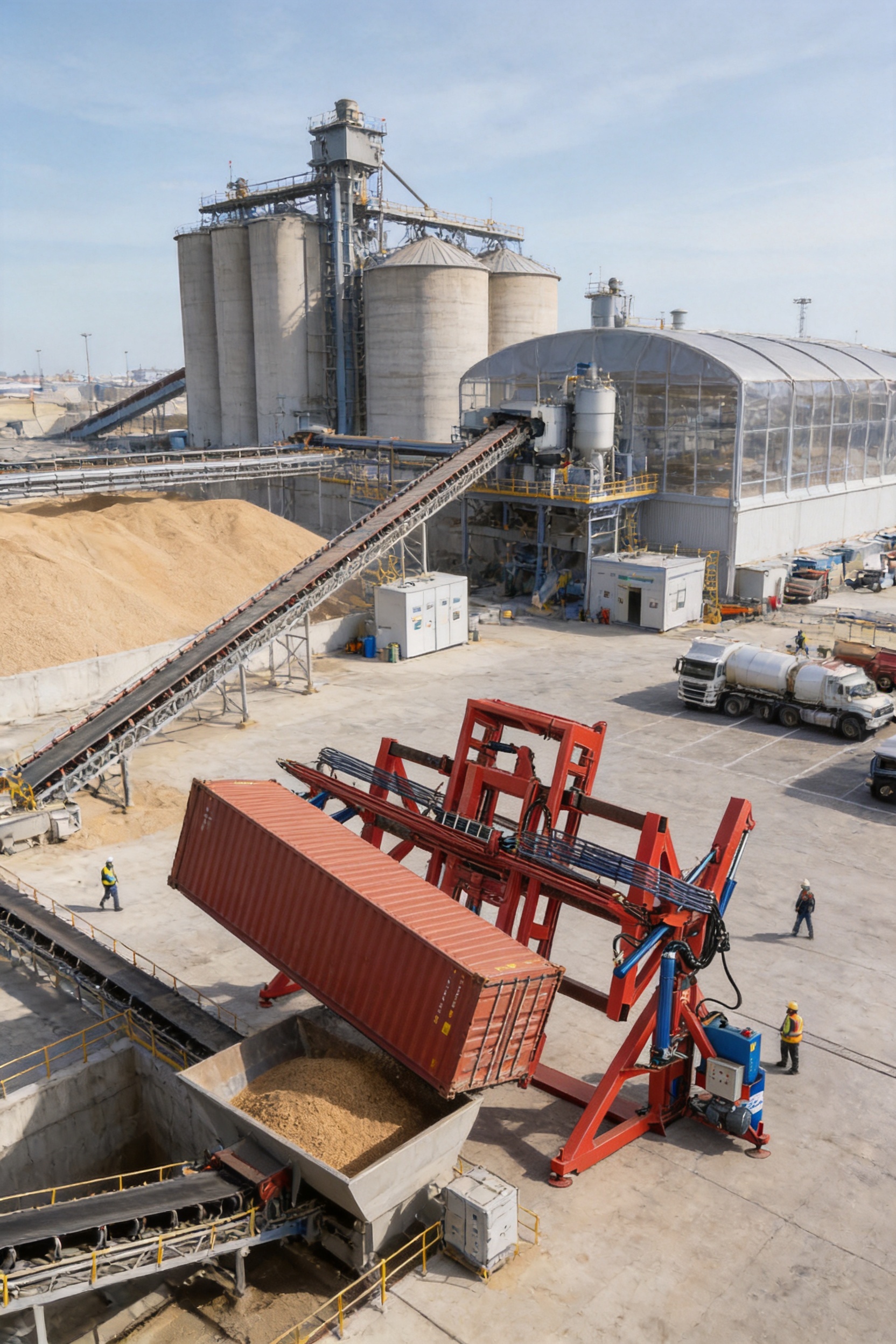
Efficient container handling has become a critical requirement for grain terminals, ports, mining operations, steel plants, chemical facilities, cement works, recycling centers, and other industries that transport bulk materials in standard shipping containers. As containerized logistics continues to expand, companies need unloading equipment that can combine high capacity, precise movement, reliable safety systems, and easy integration with conveyors, hoppers, dust collectors, and warehouse controls.
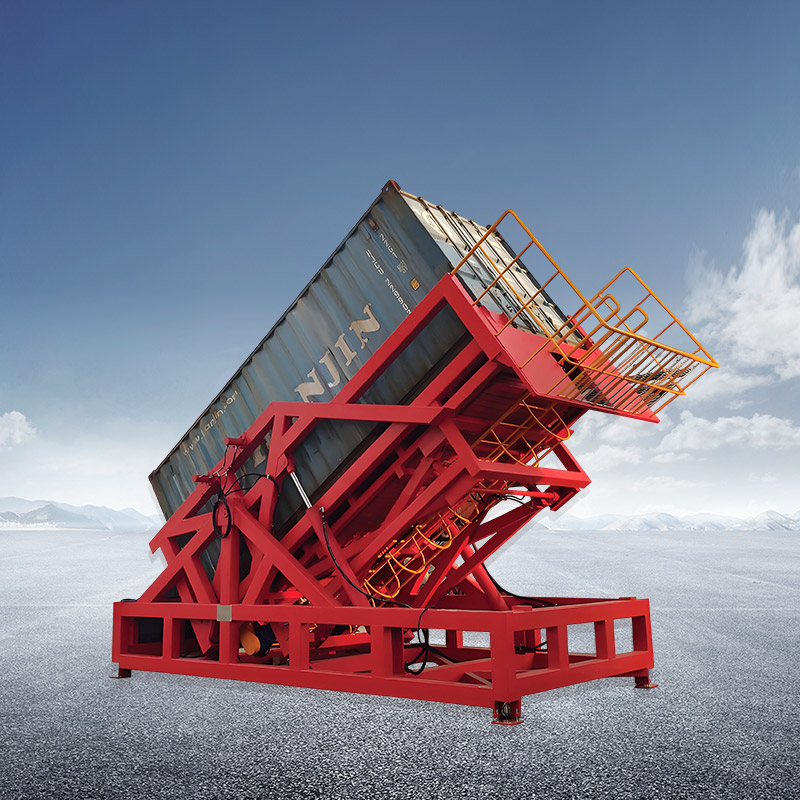
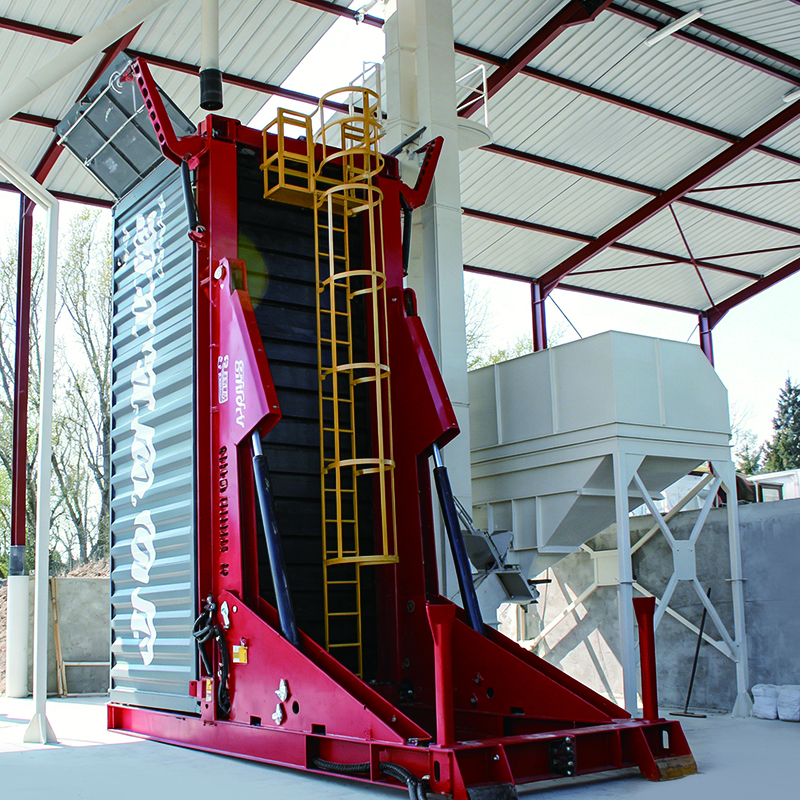
The Gantry Container Tilter is designed to meet these requirements. It is a heavy-duty gantry-type machine developed for the automated loading and unloading of bulk materials in containers. Using a rigid overhead frame, container locking devices, hydraulic lifting mechanisms, and an intelligent control system, the equipment rotates a secured container through a controlled range of angles. This allows grains, minerals, powders, scrap, and other bulk products to discharge efficiently into receiving systems.
Unlike basic forklift tipping methods or manually operated unloading arrangements, a gantry container tilter provides a stable and repeatable process. It can reduce labor requirements, improve unloading consistency, minimize material spillage, and increase the overall safety of container operations. It is also suitable for integration into automated logistics lines where container identification, door operation, weighing, lifting, tilting, and discharge must work as one coordinated system.
1. What Is a Gantry Container Tilter?
A gantry container tilter is an industrial container-handling machine that lifts and rotates a shipping container to discharge its contents. The container is positioned within a heavy-duty gantry frame and secured through its corner castings or other approved locking points. Hydraulic cylinders, mechanical pivots, lifting beams, and control systems then move the container to the required angle.
The equipment is primarily intended for bulk goods that cannot be conveniently unloaded by ordinary container doors or manual handling. Typical products include corn, soybeans, wheat, feed ingredients, cement clinker, minerals, coal-related materials, scrap metal, chemical powders, waste materials, and other dry bulk products.
Depending on the operating process, the container may be tilted gradually to control the discharge rate or rotated to a near-vertical position for complete emptying. The standard product design supports tilting from 0 to 90 degrees. The maximum angle, cycle speed, container size, and lifting capacity can be configured according to the material, container type, plant layout, and required throughput.
The gantry configuration gives the machine several advantages over compact lifting attachments. The load is supported by a stable structural frame rather than relying solely on a mobile vehicle. The container remains securely guided during movement, and the lifting force is distributed through engineered support points. This arrangement is particularly valuable when handling 20-foot and 40-foot containers with high gross weights.
The equipment can be supplied as a semi-automatic or fully automated system. Optional functions include image-based container positioning, automatic container-door opening and closing, weighing, automatic locking, automatic lifting, automatic tilting, discharge monitoring, and connection with a plant-wide control system.
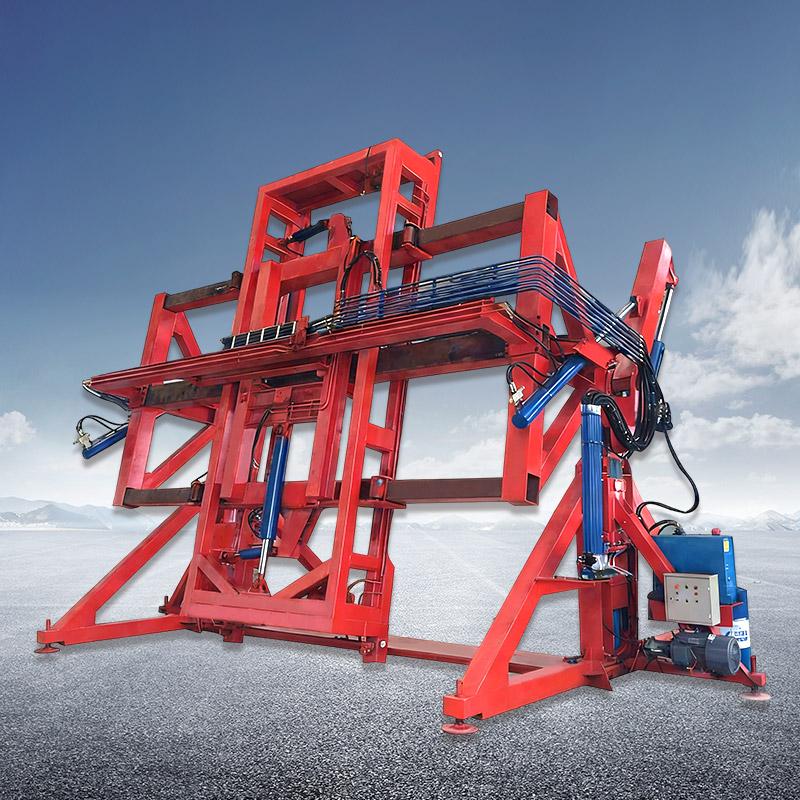
Gantry Container Tilter
2. Main Advantages of the Gantry Container Tilter
2.1 Controlled Full-Range Tilting
One of the most important characteristics of the equipment is its ability to tilt a container through a broad operating range. The machine is designed for movement from the horizontal loading position up to 90 degrees, allowing operators to select an angle suitable for the material being handled.
Free-flowing grains may discharge effectively at a moderate angle, while dense or irregular materials may require a steeper position. Scrap metal, sticky products, and materials with a low flowability often benefit from a larger tilt angle. Controlled movement also reduces sudden load shifts and helps prevent uncontrolled material surges into the receiving hopper.
The full-range design provides greater flexibility than fixed-angle unloading equipment. Operators can adjust the process to different material properties, container conditions, and downstream equipment capacities. This flexibility is particularly useful in facilities that handle multiple products throughout the year.
2.2 Heavy-Duty Lifting Capacity
The gantry frame is engineered for demanding industrial service. Standard configurations can be designed for maximum lifting weights of approximately 30 or 40 tons, depending on the model, container dimensions, structural arrangement, and customer requirements.
A high lifting capacity enables the machine to handle fully loaded containers in sectors such as grain, mining, metallurgy, cement, and recycling. The frame, lifting mechanism, pivots, locking devices, hydraulic cylinders, and foundation interface must all be designed as an integrated load-bearing system. This approach helps maintain stability and reduces structural stress during repeated operating cycles.
Compared with equipment intended only for light containers or occasional unloading, a heavy-duty gantry tilter is better suited to continuous industrial duty. Its structure can be adapted for high-frequency operation, multiple shifts, and integration with high-capacity hoppers or conveyors.
2.3 Reduced Labor Requirements
Traditional container unloading may require several workers to coordinate vehicle positioning, door opening, material flow, cleaning, and equipment operation. A gantry container tilter centralizes these activities into a controlled process. Depending on the level of automation, a single trained operator may supervise container positioning, locking, lifting, tilting, and discharge.
Reducing manual handling improves productivity and allows personnel to focus on supervision, inspection, and maintenance rather than physically managing bulk material. It can also reduce exposure to dust, moving vehicles, unstable loads, and unexpected material release.
Labor savings are especially valuable at high-volume terminals, where unloading operations are repeated throughout the working day. Faster cycles and fewer manual interventions can help increase the number of containers processed per shift without requiring a proportional increase in staffing.
2.4 Better Material Recovery and Less Spillage
Uncontrolled tipping can cause material to scatter around the unloading area. Spillage creates product loss, increases cleanup work, and may create slip, dust, contamination, or environmental problems. The gantry container tilter supports a more predictable discharge process by controlling the tilt angle and movement speed.
The discharge zone can also be fitted with a hopper, skirt, chute, conveyor, or enclosed receiving system. These components guide the product directly into the next process stage. For dusty products, flexible seals and dust extraction connections can be installed around the discharge area to reduce airborne particles.
A controlled unloading process is particularly important for expensive raw materials, food ingredients, chemical powders, and products that must remain separated from foreign matter. Improved containment can also make cleaning and product changeovers more manageable.
2.5 Improved Operational Safety
Safety is a central design consideration in any system that lifts and rotates heavy containers. The gantry container tilter can include mechanical locks, hydraulic overload protection, emergency stop circuits, position sensors, interlocks, and automatic descent protection.
The container is secured before the lifting cycle begins. The control system can be configured so that tilting is not permitted until the locking sequence is confirmed. Similarly, door mechanisms can be interlocked with the machine position to prevent premature opening or unsafe access.
Safety fencing, warning lights, audible alarms, access gates, and emergency stop stations can be added according to the installation environment. These features help separate personnel from the machine’s operating envelope and support safer maintenance procedures.
2.6 Integration with Automated Logistics
Modern bulk logistics systems increasingly rely on automated identification, weighing, conveying, storage, and inventory control. The gantry container tilter can be integrated with these systems through sensors, programmable controllers, industrial communication networks, and customized software.
An automated sequence may include vehicle arrival confirmation, container identification, visual alignment, locking, weighing, door opening, lifting, tilting, discharge monitoring, return to the horizontal position, door closing, and unlocking. The exact sequence can be adapted to the customer’s process and safety requirements.
This integration reduces operating variation and creates useful process data. Weight information, cycle time, container identification, alarm history, and maintenance records can be incorporated into plant management systems. Such information supports production planning, traceability, and equipment performance analysis.
3. Product Configuration and Technical Parameters
The equipment is available in several structural configurations. The principal models include single-channel and dual-channel designs, allowing the system to be matched to the required container flow and site arrangement.
| Model | Tilting Form | Maximum Lifting Weight | Maximum Tilting Angle |
|---|---|---|---|
| TJXDD 20 | Single-channel | 30/40 tons | 90 degrees |
| TJXDS 20 | Single-channel | 30/40 tons | 90 degrees |
| TJXSD 20 | Dual-channel | 30/40 tons | 90 degrees |
| TJXSS 20 | Dual-channel | 30/40 tons | 90 degrees |
The table provides a general reference for the principal configurations. Actual engineering parameters may vary according to the customer’s container standard, load distribution, material characteristics, foundation conditions, discharge height, cycle requirements, and local safety regulations.
A single-channel design can be suitable for a dedicated unloading line or a facility with moderate container traffic. A dual-channel arrangement may support a more complex layout, higher operating flexibility, or the connection of two unloading routes. The final design should be confirmed through a technical review that considers container access, vehicle movement, hopper position, maintenance clearance, and emergency access.
3.1 Container Compatibility
The equipment is primarily intended for standard 20-foot and 40-foot containers. Depending on the locking and support arrangement, special configurations may also be developed for other container lengths. Adjustable clamping or positioning devices can be considered where a facility handles multiple container formats.
Before production, the supplier should verify the container’s external dimensions, corner casting position, gross weight, center of gravity, door arrangement, floor condition, and material loading pattern. These factors influence the required frame dimensions and the safe operating envelope.
3.2 Weighing Function
Weighing can be integrated into the machine when accurate loading and unloading records are needed. A weighing system may be used for receiving control, inventory management, billing, batch verification, or production reporting.
Integrated weighing reduces the need to transfer the container to a separate scale before unloading. The weighing arrangement must account for structural deflection, dynamic loads, vibration, and the selected calibration method. For applications requiring certified trade measurement, the weighing system should be specified and approved according to applicable local requirements.
3.3 Automatic Door Mechanism
Container doors can be difficult to open safely when bulk material is pressing against them. An automatic door mechanism can be added to allow the machine to open and close the doors through a controlled sequence. This reduces the need for personnel to stand directly in front of the container opening.
The door mechanism can be coordinated with the container locking and tilting functions. For example, the system may confirm that the container is fully secured and positioned before door opening begins. After discharge, the doors can be closed before the container returns to the transport position.
3.4 Image Display and Positioning
An image display system can assist with container recognition and positioning. Cameras may provide the operator with a clear view of the container, corner castings, doors, and surrounding area. This is helpful where visibility is restricted by the gantry, hopper, lighting conditions, or dust control enclosure.
Visual positioning can also support automated alignment. The system may identify reference points and confirm whether the container has reached the correct position before locking. This reduces positioning errors and helps maintain a consistent operating cycle.
4. Structural Design and Manufacturing Strengths
The performance of a container tilter depends not only on its hydraulic capacity but also on the quality of its engineering, fabrication, assembly, testing, and control integration. A reliable machine must maintain alignment under heavy loads, withstand repeated cycles, protect its hydraulic components, and remain serviceable over a long operating life.
4.1 Heavy-Duty Gantry Frame
The gantry frame is the primary load-bearing structure. It is manufactured from engineered steel sections and welded assemblies designed to resist bending, torsion, vibration, and repeated dynamic loading. The frame must maintain the relationship between the lifting points, pivots, container locks, hydraulic cylinders, and discharge position.
Advanced fabrication begins with design calculations and three-dimensional modeling. Engineers evaluate the load path, operating angle, center of gravity, maximum container weight, dynamic factors, and foundation reactions. Critical components can be reviewed through engineering analysis before fabrication begins.
Steel preparation, cutting, drilling, fit-up, and welding are completed according to controlled production procedures. Proper dimensional control is essential because even small alignment errors may increase wear on pins, bushings, bearings, locks, and hydraulic components.
4.2 Welding and Dimensional Control
Large welded frames require careful control of heat input and distortion. Qualified welding procedures, suitable filler materials, controlled assembly sequences, and inspection points help improve structural consistency. After welding, critical dimensions are checked against engineering drawings and installation tolerances.
Machined connection points, pivot supports, and locking interfaces require particular attention. These areas transmit concentrated forces and must provide accurate contact surfaces. Where necessary, machining and finishing operations are used to achieve the required fit and alignment.
Surface preparation and protective coating are also important. A properly prepared and coated steel structure is better protected against humidity, dust, chemical exposure, and outdoor operating conditions. The coating specification can be adjusted to the customer’s environment, including coastal, high-humidity, chemical, or high-dust locations.
4.3 Hydraulic System Engineering
Hydraulic cylinders provide the force required for lifting and tilting. The hydraulic system is selected according to the maximum load, movement speed, duty cycle, operating angle, and control precision. Valves, hoses, manifolds, reservoirs, filters, and safety devices are sized as part of a complete hydraulic design.
Hydraulic overload protection helps prevent damage if the load is uneven, the container is obstructed, or an abnormal condition occurs. Controlled flow regulation allows the tilting speed to be adjusted according to the material and discharge system.
Hydraulic systems require clean oil, appropriate filtration, correct pressure settings, and regular inspections. A preventive maintenance plan should include oil condition checks, filter replacement, hose inspection, cylinder seal monitoring, and examination of fittings and connection points.
4.4 Mechanical Locking and Safety Interlocks
Container locking devices are essential to prevent movement between the container and the lifting frame. The locking arrangement should be designed for the container’s corner castings and verified for the expected loads and operating angles.
Mechanical locking can be supported by position sensors that confirm whether each lock is fully engaged. The control system can prevent lifting if the confirmation signal is incomplete. Additional interlocks may monitor access gates, hydraulic pressure, frame position, door position, and emergency stop status.
These systems create multiple layers of protection. Mechanical components provide physical restraint, while sensors and controls prevent the machine from entering an unsafe sequence. Regular inspection remains necessary because no automated system can replace proper maintenance and operator training.
4.5 Electrical and Control System
The automated control system can be designed around an industrial programmable controller, operator interface, sensors, motor control equipment, and safety circuits. The operator interface may display container position, lock status, tilt angle, hydraulic condition, alarms, and cycle progress.
Automatic positioning, locking, lifting, and tilting can be programmed as separate steps. Manual controls may be retained for maintenance, commissioning, and controlled recovery procedures. Access to manual functions should be restricted and managed through appropriate authorization.
Control logic can be adapted to a customer’s existing plant system. Signals may be exchanged with conveyors, dust collectors, hoppers, vehicle handling equipment, weighing systems, and warehouse management software. This supports a smooth transfer of material from container to storage or production.
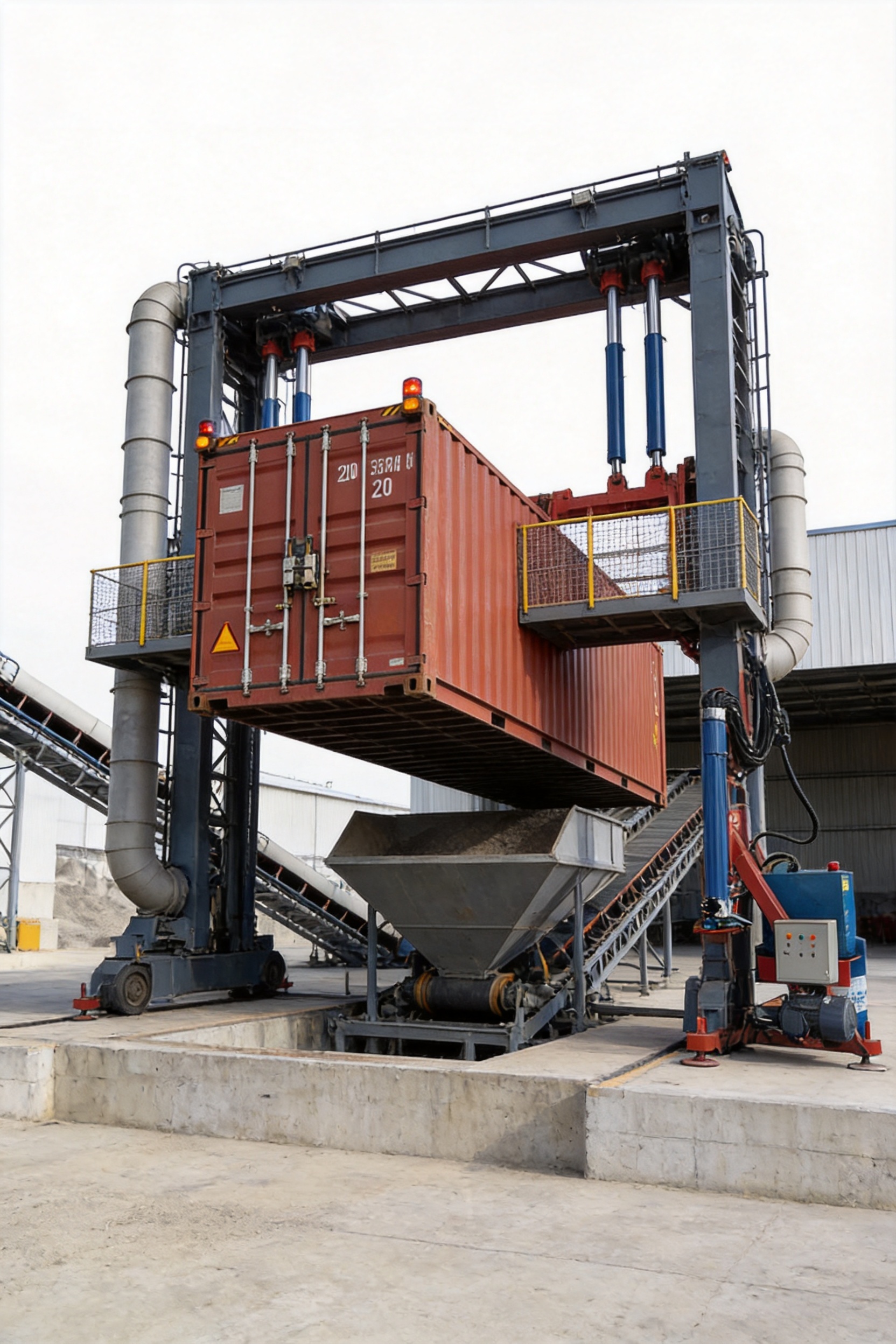
5. Manufacturing Process from Design to Delivery
A strong manufacturing process begins before steel is cut. The supplier first reviews the customer’s operation, including the material, container type, expected throughput, working schedule, installation site, discharge equipment, local climate, and automation requirements.
5.1 Application and Layout Review
Engineers study the material’s bulk density, flowability, moisture content, particle size, abrasiveness, temperature, and dust characteristics. These properties affect the required tilt angle, discharge opening, hopper design, lining materials, dust collection arrangement, and cleaning method.
The layout review considers truck access, rail or terminal interfaces, container staging, maintenance routes, crane or lifting access, foundation requirements, operator visibility, emergency exits, and clearance from buildings or overhead services. A well-planned layout reduces installation difficulties and helps the machine achieve its expected cycle time.
5.2 Customized Engineering
After the application review, the engineering team develops the gantry structure, hydraulic circuit, locking system, control architecture, safety layout, and auxiliary equipment. Three-dimensional models help identify interference between the container, frame, hopper, doors, conveyors, and surrounding structures.
Customized engineering is especially important where the machine must connect to existing equipment. The discharge height, conveyor centerline, dust skirt, chute angle, and weighing system must be coordinated with the rest of the plant. This avoids expensive modifications during installation.
5.3 Component Procurement and Quality Control
Key components are selected according to load, duty cycle, environmental conditions, and serviceability. Hydraulic components, motors, sensors, electrical cabinets, bearings, pins, locking mechanisms, and structural steel should be tracked through procurement and inspection procedures.
Incoming materials can be checked for specifications, dimensions, certificates, and visible defects. Critical purchased components may be inspected before installation. Consistent component control improves reliability and simplifies future maintenance.
5.4 Fabrication, Assembly, and Testing
Frame components are cut, formed, drilled, welded, machined, coated, and assembled according to controlled drawings. Hydraulic and electrical systems are installed after the structural assembly reaches the required dimensional condition.
Factory testing can include no-load movement, simulated load checks, hydraulic pressure testing, locking confirmation, emergency stop testing, sensor verification, control sequence testing, and inspection of the maximum operating angle. Where practical, the system can be preassembled or partially tested before shipment to reduce installation time at the customer’s site.
5.5 Installation and Commissioning
Installation begins with foundation verification and equipment positioning. Anchor points, base plates, guide rails, hydraulic connections, electrical cabinets, safety fencing, hoppers, and conveyors are installed according to the approved layout.
Commissioning includes alignment checks, sensor calibration, hydraulic adjustment, control-system programming, dry-cycle testing, and loaded trial operation. Operators and maintenance personnel should receive training before the equipment enters routine production.
6. Applications Across Multiple Industries
6.1 Grain and Agribulk Terminals
Grain is one of the most suitable materials for a gantry container tilter. Corn, soybeans, wheat, rice, animal feed ingredients, and similar products can be discharged into hoppers and conveyors after the container is positioned and tilted.
The controlled process helps limit spillage and allows the receiving system to manage product flow. Where food-grade requirements apply, the equipment can be specified with suitable coatings, sealed transfer points, cleanable surfaces, and contamination-control procedures.
High-volume grain facilities benefit from the machine’s ability to handle repetitive container cycles. Integration with weighing and automated identification can improve inventory records and support batch traceability.
6.2 Metallurgy and Scrap Handling
Steel plants and recycling centers may receive scrap metal, metal pieces, residues, or other dense materials in containers. These loads can be irregular and may shift during tilting, making secure locking and structural strength particularly important.
A heavy-duty frame, controlled hydraulic movement, reinforced discharge area, and suitable wear protection help the equipment withstand demanding service. The receiving hopper and conveyor should be designed for impact loads and abrasive material where necessary.
6.3 Mining, Cement, and Aggregates
Mining and construction-material operations may handle minerals, clinker, aggregates, powders, and other heavy products. These materials can have high bulk density and may require large discharge openings, wear-resistant liners, and dust extraction.
The gantry container tilter can be integrated with enclosed transfer systems to reduce dust during unloading. Its adjustable angle allows the operator to adapt the discharge process to material flow characteristics and downstream capacity.
6.4 Chemical and Powder Handling
Chemical powders and industrial additives require careful containment and product separation. An enclosed discharge system, dust collector connection, sealed chute, and controlled cleaning procedure can help reduce contamination and airborne exposure.
Material compatibility should be reviewed before manufacturing. Coatings, seals, hoses, liners, and other components must be selected according to the chemical properties and operating temperature of the product.
6.5 Ports, Warehouses, and Distribution Centers
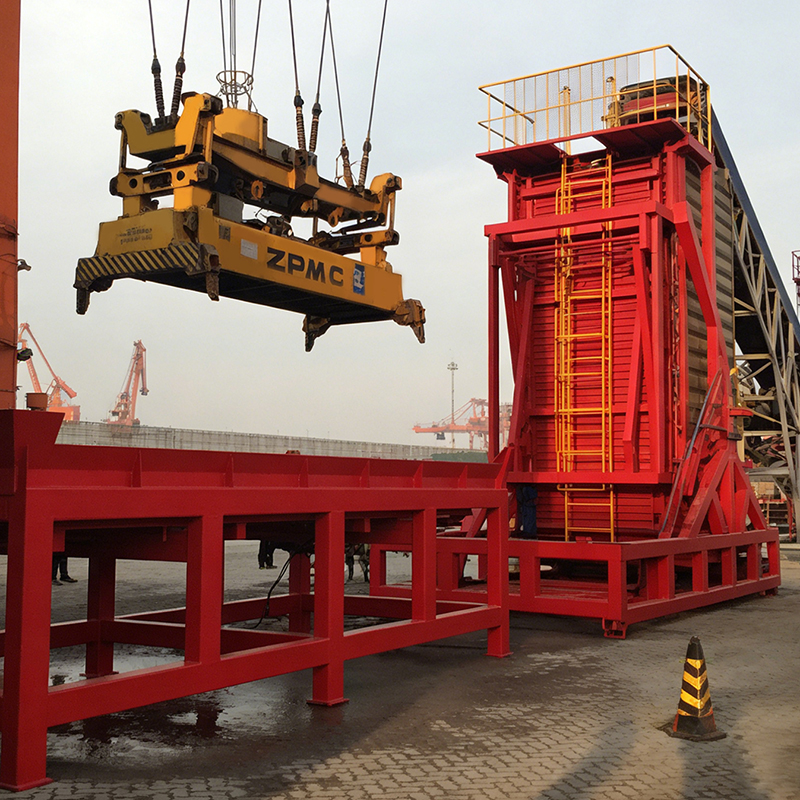
Ports and distribution centers often need to transfer goods quickly from containers into storage or processing systems. A gantry tilter can serve as a dedicated unloading station within a larger material-handling network.
Its automated features can reduce truck waiting time and improve the coordination between container staging, unloading, conveying, and storage. Dual-channel designs may be considered where traffic volume or layout requirements justify multiple operating routes.
6.6 Paper, Food, Feed, and New Energy Industries
Paper mills, food plants, feed manufacturers, and new energy facilities may use bulk raw materials supplied in containers. Each industry has different cleanliness, dust, material-handling, and traceability requirements.
The equipment can be customized with appropriate discharge interfaces, monitoring functions, weighing, dust control, and automated controls. The ability to tailor the system makes it suitable for both general industrial applications and specialized production environments.
7. Performance Benefits Compared with Conventional Unloading
Conventional forklift tipping may appear simple, but it can become inefficient and risky when container volumes increase. Forklifts may require several movements to position and support a container. Visibility can be limited, container stability may be difficult to control, and the unloading angle may not be consistent.
A gantry container tilter provides a dedicated and repeatable process. The container is positioned within a defined operating area, secured before movement, and tilted through a controlled sequence. This can improve cycle consistency and reduce dependence on individual operator technique.
| Evaluation Item | Conventional Forklift Tipping | Gantry Container Tilter |
|---|---|---|
| Load support | Dependent on mobile equipment and operator control | Dedicated heavy-duty gantry frame |
| Tilting control | Less consistent and more dependent on operating skill | Programmable hydraulic movement |
| Container locking | May require additional manual procedures | Integrated mechanical and sensor-based locking |
| Labor requirement | Often requires several personnel | Can be supervised by a smaller trained team |
| Automation potential | Limited | High, including positioning, weighing, doors, and discharge |
| Dust and spillage control | More difficult to contain | Suitable for enclosed hoppers and dust extraction |
| Repeatability | Varies with operator and site conditions | Consistent programmed sequence |
The practical benefits depend on the complete installation, the material, the operator training program, and the downstream process. However, the dedicated gantry design generally provides better control and scalability for facilities that unload containers regularly.
8. Safety, Maintenance, and Operator Training
8.1 Safety Procedures
Only authorized personnel should operate the equipment. Before each shift, operators should inspect the locking devices, hydraulic hoses, cylinders, pins, guards, sensors, emergency stops, and surrounding work area.
The container must be correctly positioned and secured before lifting. Personnel should remain outside the restricted operating zone during automatic movement. No one should stand beneath a suspended container or enter the discharge area while the machine is operating.
Emergency stop devices should be tested according to the site’s safety procedure. Any abnormal noise, hydraulic leakage, structural movement, sensor fault, or unexpected motion should result in an immediate stop and inspection by qualified personnel.
8.2 Preventive Maintenance
Preventive maintenance helps protect the equipment and reduce unplanned downtime. Hydraulic oil should generally be replaced every 2,000 operating hours or once per year, whichever comes first, unless the operating environment or oil supplier requires a different interval.
Hydraulic filters may require replacement approximately every 500 operating hours. Cylinder seals, hoses, fittings, valves, and pressure settings should be inspected regularly. Pivot pins, bushings, bearings, locks, and structural connections should be checked for wear, looseness, corrosion, or deformation.
Dust and bulk materials can accumulate around moving parts and sensors. Cleaning should be performed according to the material’s safety requirements. Electrical cabinets should be kept dry and clean, while cooling and ventilation systems should remain unobstructed.
8.3 Training
Operator training should cover machine functions, container inspection, load balance, locking confirmation, emergency stops, safe distances, abnormal conditions, and daily checks. A structured training session of approximately four hours may be used as a basic introduction, followed by practical instruction and supervised operation.
Maintenance personnel require additional training in hydraulic isolation, electrical lockout, mechanical support, sensor troubleshooting, and safe access to elevated components. Documentation should include operating instructions, maintenance schedules, spare-parts information, and emergency procedures.
9. Why Choose an Experienced Intelligent Equipment Manufacturer?
The success of a gantry container tilter project depends on more than the machine itself. It also depends on the supplier’s ability to understand the customer’s process, design a suitable solution, manufacture reliable equipment, complete system integration, and provide after-sales support.
Jiangsu Zhengding Intelligent Equipment Co., Ltd. is a national high-tech enterprise focused on the research, development, manufacturing, and sales of intelligent automated loading and unloading equipment. Its product range includes rear dumpers, side-turn truck dumpers, car loading equipment, container flippers, gantry container tilters, and related logistics systems.
The company provides systematic solutions for the automatic loading and unloading of automobiles, containers, and ships. This broader product experience is valuable because many projects involve multiple transport modes and connected material-handling stages rather than one isolated machine.
Its equipment is used in steel, chemical, cement, coal, grain, oil, food, feed, ports, papermaking, and new energy applications. The company also serves international markets in Asia, the Middle East, South America, Africa, and other regions. Experience across different climates, materials, regulations, and operating practices supports the development of adaptable engineering solutions.
The company’s customers and international users include major organizations in beverage production, brewing, grain processing, agricultural commodities, chemicals, building materials, and industrial manufacturing. Such project experience demonstrates the importance of engineering coordination, product consistency, commissioning support, and long-term service.
For gantry container tilter projects, the company can provide customized engineering support for container positioning, automatic doors, weighing, conveyors, dust collection, hoppers, electrical controls, and plant integration. This one-stop capability can reduce coordination problems between separate equipment suppliers.
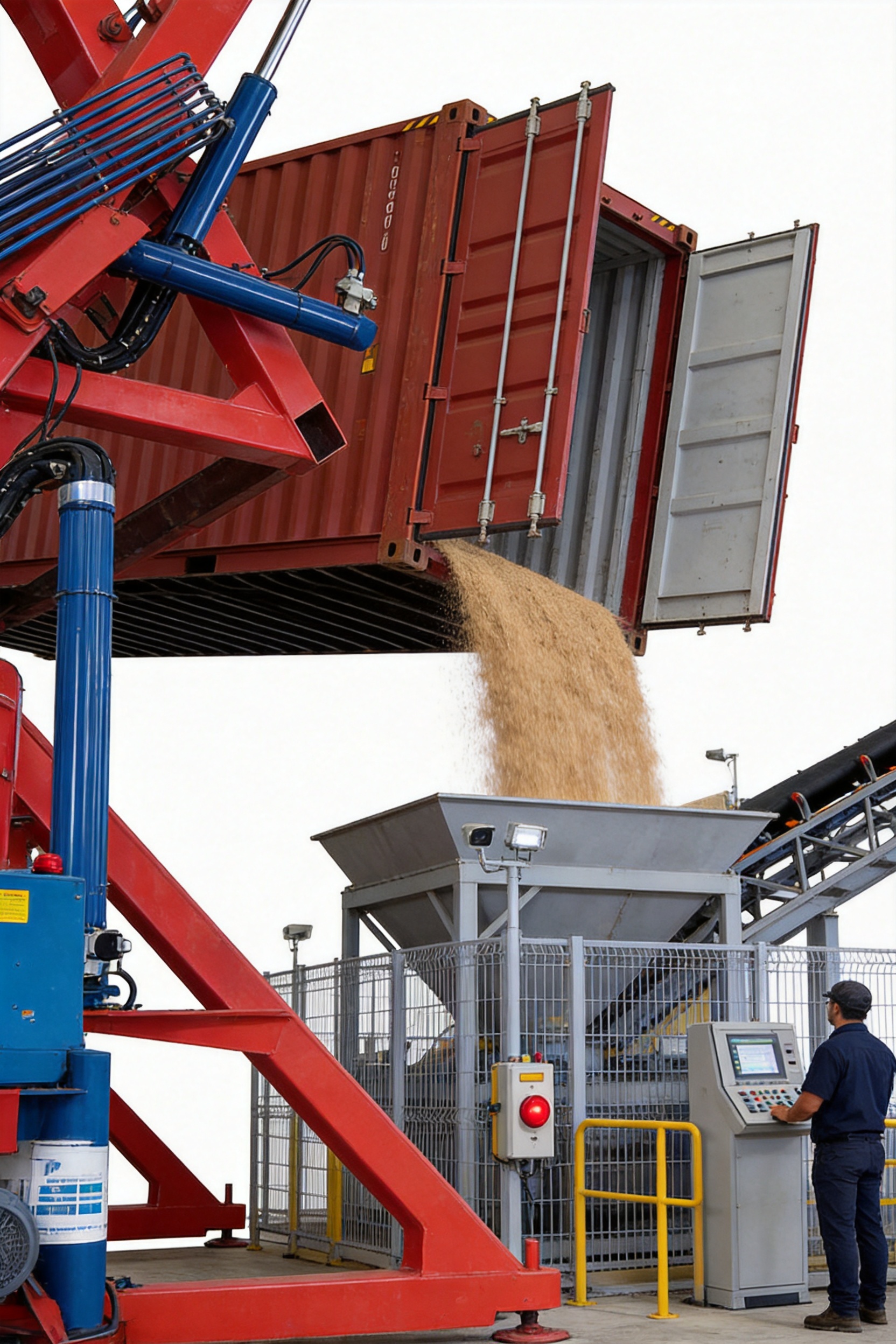
10. Recommended Project Selection Process
Customers considering a gantry container tilter should prepare basic technical information before requesting a quotation. This information allows the manufacturer to make a practical recommendation and avoid under-sizing or unnecessary over-design.
10.1 Material Information
Provide the material name, bulk density, moisture range, temperature, particle size, abrasiveness, flowability, dust characteristics, and any chemical compatibility requirements. If several materials will be handled, provide information for each product.
10.2 Container Information
Specify the container lengths, maximum gross weight, door configuration, corner casting arrangement, internal liner or bag system, and typical filling condition. Photographs or drawings of the containers can help engineers verify the locking and door-opening arrangement.
10.3 Throughput Requirements
State the expected containers per hour, containers per shift, operating hours per day, number of shifts, and required peak capacity. A system designed for occasional unloading may differ substantially from one intended for continuous high-volume operation.
10.4 Site and Integration Information
Provide the available length, width, and height, foundation conditions, discharge elevation, receiving hopper dimensions, conveyor direction, dust collector location, power supply, climate, and access limitations. Existing drawings and photographs can accelerate the layout process.
10.5 Automation Requirements
Clarify whether the project requires image positioning, automatic doors, integrated weighing, barcode or container identification, remote monitoring, data recording, or connection with an existing control system. Early definition of automation requirements reduces later modifications.
11. Frequently Asked Questions
Q1. What container sizes can the gantry container tilter handle?
The standard design is intended primarily for 20-foot and 40-foot ISO containers. Depending on the locking arrangement and structural configuration, special solutions may also be developed for 45-foot or other container formats. The final compatibility must be confirmed from the container dimensions, corner casting locations, gross weight, and center of gravity.
Q2. What is the maximum lifting capacity?
Standard configurations can be designed for maximum lifting weights of approximately 30 or 40 tons. The exact capacity depends on the model, frame design, hydraulic system, container dimensions, load distribution, and customer requirements. A complete technical review is required before the rated capacity is finalized.
Q3. What is the maximum tilting angle?
The product is designed to support tilting from 0 to 90 degrees. The optimum operating angle depends on the bulk material, container condition, flowability, discharge opening, and receiving equipment. Operators should use the angle recommended during commissioning and process testing.
Q4. Can the machine open and close container doors automatically?
Yes. An automatic door mechanism can be configured as an option. It can be linked to the container locking and tilting sequence so that door operation occurs only when the relevant safety conditions have been confirmed.
Q5. Can weighing equipment be integrated?
Yes. A weighing function can be incorporated into the structural and control design. The required accuracy, calibration method, load range, environmental conditions, and local certification requirements should be specified during the project planning stage.
Q6. Can dust extraction be connected to the unloading area?
Yes. The discharge area can be enclosed with flexible skirts, chutes, seals, or other containment components connected to a dust collector. The final dust-control performance depends on the material, enclosure design, airflow, filter system, maintenance, and overall plant arrangement.
Q7. How much space is needed for installation?
A typical installation for 40-foot containers may require an operating area of approximately 12 meters in length, 6 meters in width, and 5 meters in height. The exact footprint depends on the container movement path, discharge hopper, conveyor arrangement, safety clearance, and maintenance access. A detailed layout should be prepared for every project.
Q8. How often does the hydraulic system require maintenance?
Hydraulic oil is commonly changed every 2,000 operating hours or annually, whichever comes first. Filters may be replaced at approximately 500-hour intervals, subject to actual oil cleanliness and manufacturer recommendations. Hoses, fittings, cylinder seals, valves, and pressure settings should be inspected regularly.
Q9. Is operator training necessary?
Yes. Operators should be trained in container positioning, locking confirmation, load balance, emergency stops, inspection, safe distances, and abnormal-condition response. Maintenance personnel require additional instruction in hydraulic, electrical, and mechanical isolation procedures.
Q10. Can the equipment be customized for an existing plant?
Yes. Customization may include frame dimensions, lifting capacity, tilt range, container locks, discharge height, hopper connection, conveyor interface, dust collection, weighing, automatic doors, cameras, controls, and communication with existing automation systems. Site information is required to develop a suitable design.
12. Conclusion
The Gantry Container Tilter is a high-performance solution for facilities that need to unload bulk materials from shipping containers safely, efficiently, and consistently. Its heavy-duty gantry frame, hydraulic lifting system, controlled 0-to-90-degree tilting range, automated locking, optional door operation, weighing capability, and intelligent controls make it suitable for demanding industrial logistics.
Compared with conventional forklift tipping and manual unloading, the equipment offers a more stable load path, better process repeatability, lower labor dependence, improved material containment, and greater automation potential. It can be integrated with conveyors, hoppers, dust extraction systems, weighing equipment, and plant control networks.
The value of the machine depends on the quality of its engineering and manufacturing. Accurate structural design, controlled welding, dimensional inspection, reliable hydraulic components, properly selected safety devices, factory testing, and professional commissioning all contribute to long-term performance.
Jiangsu Zhengding Intelligent Equipment Co., Ltd. combines experience in automated loading and unloading equipment with customized project engineering. Its capabilities cover container handling, vehicle unloading, industrial conveying interfaces, weighing, dust control, and intelligent automation. This makes it a suitable partner for customers seeking a complete bulk-material unloading solution rather than a standard machine without system integration.
With appropriate application analysis, a correctly designed foundation, trained operators, and a preventive maintenance program, a gantry container tilter can become an important part of a modern, safe, and high-efficiency container logistics system.
References
1. International Organization for Standardization. ISO 12100, Safety of Machinery: General Principles for Design, Risk Assessment and Risk Reduction.
2. International Organization for Standardization. ISO container standards and corner fitting requirements for freight containers.
3. Industrial logistics and bulk material handling practices for grain, minerals, cement, chemical powders, recycling materials, and containerized cargo.
4. Hydraulic equipment maintenance principles, including fluid cleanliness, filtration, cylinder inspection, and preventive service scheduling.
5. Jiangsu Zhengding Intelligent Equipment Co., Ltd. Product information for automated loading and unloading systems, container handling equipment, truck dumpers, and intelligent logistics machinery.


