

 English
 русский
 Español
 Français
 Português
 عربى
عربى


+86-13588556918
Content
- 1 1. The Role of Continuous Container Handling in Modern Logistics
- 2 2. Product Overview and Integrated Operating Concept
- 3 3. Main Product Features
- 4 4. Advantages Over Traditional Batch Handling
- 5 5. Engineering and Manufacturing Strengths
- 6 6. Manufacturing Process from Concept to Delivery
- 7 7. Applications in Different Operating Environments
- 8 8. Safety and Control Functions
- 9 9. Maintenance and Lifecycle Management
- 10 10. Comparison with Competing Equipment Approaches
- 11 11. Selecting the Correct System Configuration
- 12 12. Benefits of Working with a Custom Factory
- 13 13. Frequently Asked Questions
- 13.1 Q1: What is a continuous container handling system?
- 13.2 Q2: Can the system handle both 20-foot and 40-foot containers?
- 13.3 Q3: Can loading and unloading be performed on the same production line?
- 13.4 Q4: Is automatic container door operation available?
- 13.5 Q5: Can weighing be integrated into the process?
- 13.6 Q6: What industries can use this equipment?
- 13.7 Q7: How does continuous handling improve throughput?
- 13.8 Q8: Can existing facilities be upgraded?
- 13.9 Q9: What information is needed for a quotation?
- 13.10 Q10: What safety functions should be included?
- 13.11 Q11: How can container damage be reduced?
- 13.12 Q12: Why choose a manufacturer with multiple equipment categories?
- 14 14. Conclusion
- 15 References
- 16 Product: Continuous Container Handling System
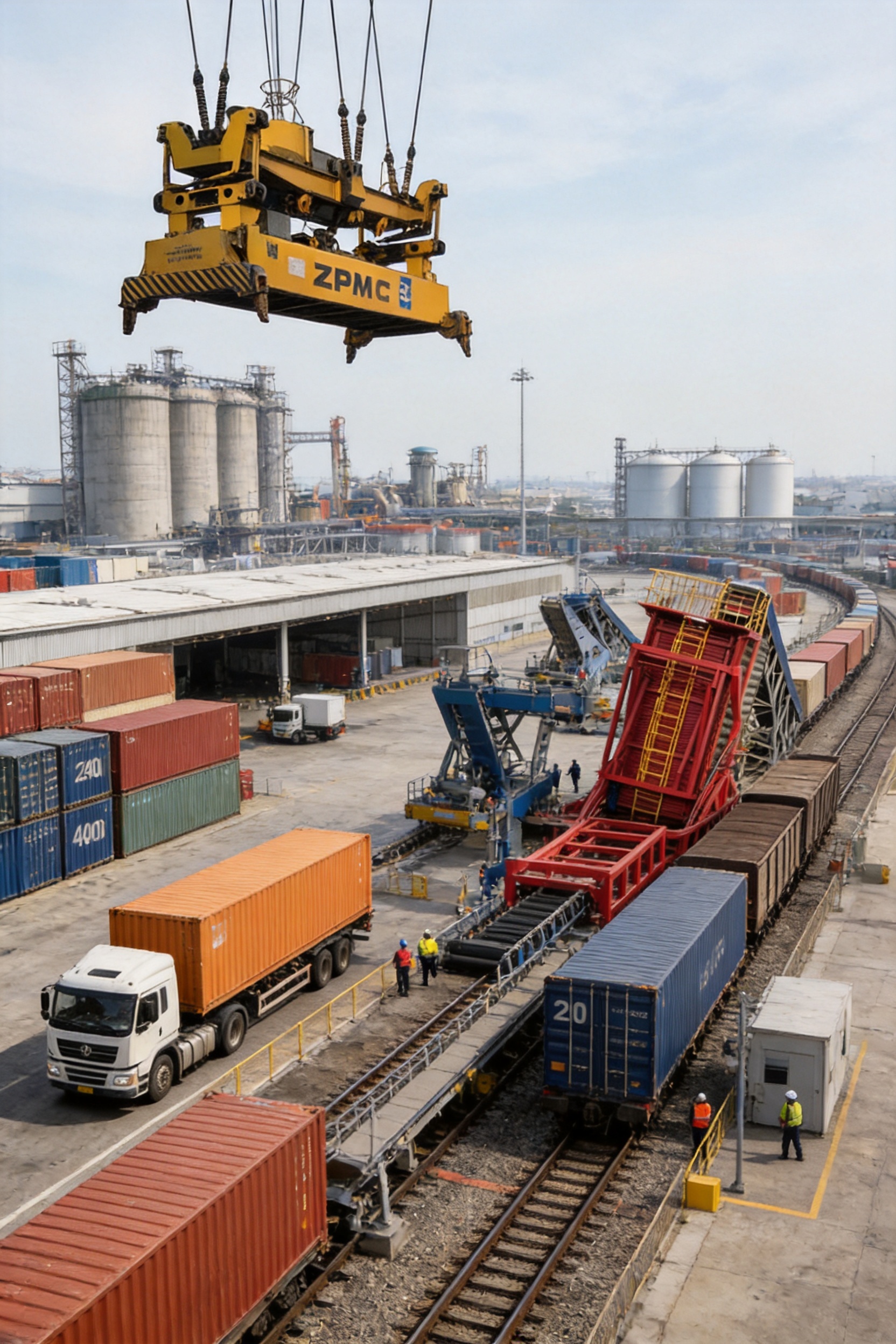
Modern logistics facilities are under increasing pressure to move more containers in less time while maintaining safety, accuracy, and operational consistency. Railway container terminals, inland ports, distribution centers, large warehouses, grain facilities, food-processing plants, chemical plants, and industrial transfer stations all face the same basic challenge: every minute spent waiting, repositioning, securing, or manually handling a container reduces available capacity. A conventional batch-style operation may perform reliably, but it often creates idle periods between containers and requires more labor, more floor space, and more coordination.
A continuous container handling system provides a different operating concept. Instead of treating each container as an isolated loading or unloading task, it connects container feeding, positioning, tilting, loading, unloading, weighing, door operation, and discharge into a coordinated process. Containers can move through the system with shorter changeover intervals and fewer manual interventions. The result is a more stable material flow and a stronger foundation for automated logistics.
The Continuous Container Handling System developed by Jiangsu Zhengding Intelligent Equipment Co., Ltd. is designed for facilities that require both high throughput and flexible container compatibility. Its integrated configuration supports 20-foot and 40-foot containers and combines loading and unloading functions in one production line. This design helps users reduce repeated transfers between separate areas while making better use of available site space.
This article examines the system’s operating principle, key advantages, technical configuration, manufacturing strengths, applications, maintenance requirements, and comparison with traditional container handling methods. It also explains why integrated engineering, custom manufacturing, and automation capability are increasingly important when selecting a supplier for container handling equipment.
1. The Role of Continuous Container Handling in Modern Logistics
Containerized transport has become essential to global supply chains because it standardizes cargo dimensions and simplifies movement between road, rail, water, and warehouse operations. However, standardized containers do not automatically guarantee efficient handling. A container may still need to be delivered to a processing station, aligned accurately, opened, filled or emptied, weighed, closed, and returned to a transport position.
In a traditional batch process, one container normally remains at a station until the complete loading or unloading cycle has finished. The next container cannot begin its operation until the previous container has been released. Delays can occur during crane positioning, container alignment, door opening, cargo preparation, weighing, securing, and removal. Although each individual action may be necessary, the combined waiting period can significantly reduce the number of containers processed during a shift.
A continuous handling system reduces this dependence on strictly sequential operations. Through coordinated feeding equipment, indexing platforms, synchronized conveyors, and automated control, the system allows certain activities to overlap. While one container is being loaded or unloaded, another can be positioned, weighed, or prepared for the next stage. The system does not eliminate the need for safe stopping or controlled positioning; instead, it minimizes unnecessary waiting between productive stages.
For high-volume facilities, this distinction is important. A system that processes more containers per hour can increase capacity without necessarily requiring a larger building, additional loading bays, or a proportional increase in labor. It can also make production planning more predictable because the equipment operates according to a repeatable sequence rather than depending heavily on manual coordination.
Continuous handling is particularly valuable where operation rhythms are demanding. Railway container central stations may need to synchronize with train arrival and departure schedules. Inland ports may experience concentrated peaks caused by truck arrivals. Large warehouses may need to complete loading operations within strict dispatch windows. Industrial plants may require consistent container movement to maintain downstream production. In these environments, delays at the container interface can affect the entire logistics chain.
2. Product Overview and Integrated Operating Concept
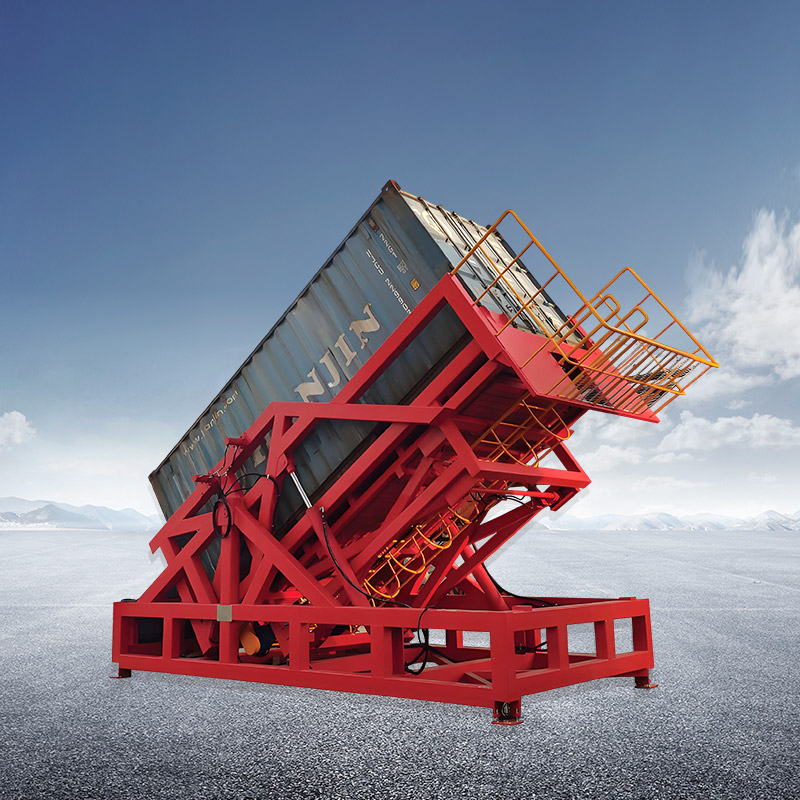
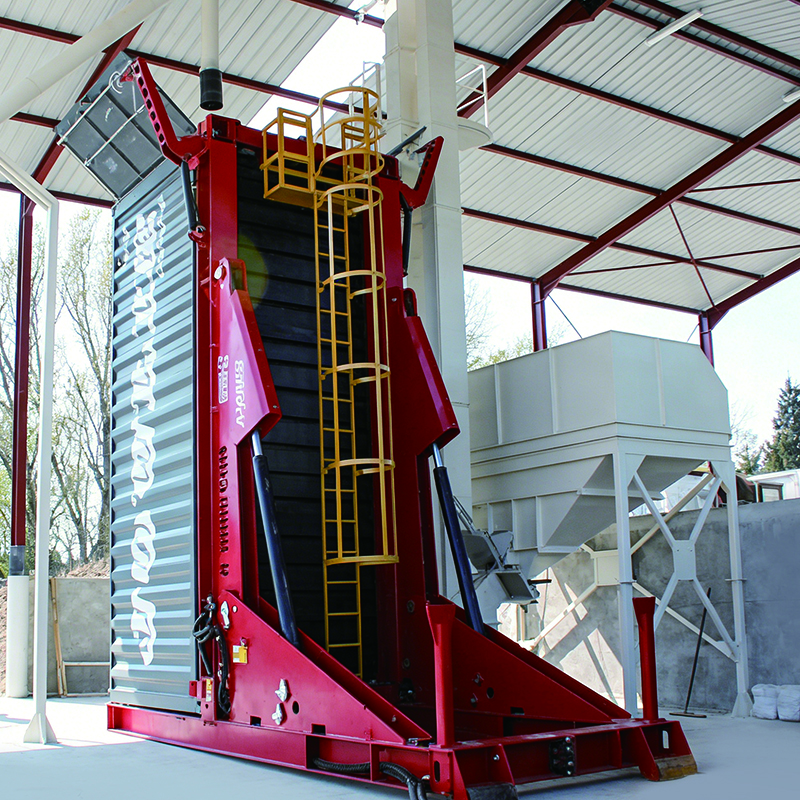
The Continuous Container Handling System is an integrated equipment solution for container loading and unloading. It is designed to accommodate both 20-foot and 40-foot containers, allowing a facility to manage different container lengths without installing entirely separate processing lines.
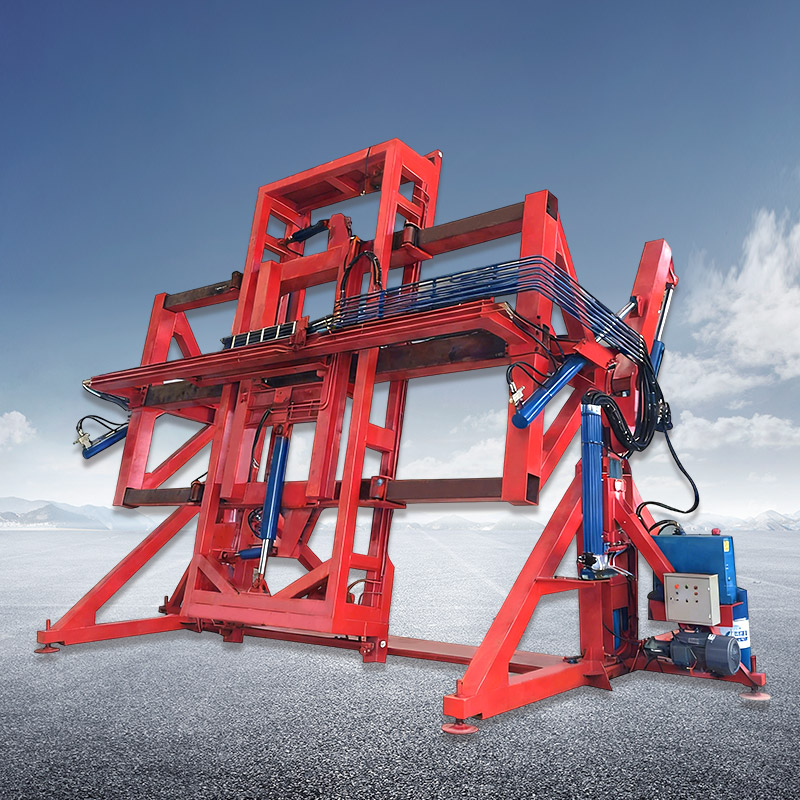
The system combines a dedicated container feeder with a container tilting platform and can be configured with automatic door opening and closing equipment. A weighing function may also be integrated so that container weight is recorded during normal circulation rather than requiring a separate weighing operation. By bringing these functions together, the system reduces unnecessary container movement and creates a more organized process flow.
The integrated operating concept can be summarized as follows:
- Containers are delivered by a dedicated feeder.
- The feeder transfers the container to the tilting or handling platform.
- The platform positions and supports the container according to the required operation.
- Loading or unloading is performed using the connected production equipment.
- Automatic door mechanisms can open and close the container doors when specified.
- Integrated weighing can record container weight during the handling cycle.
- The processed container is transferred onward for dispatch, storage, or another logistics stage.
This arrangement is different from a layout in which containers must be moved from a loading station to a separate weighing station and then to another area for unloading or door operation. Every additional transfer introduces handling time, coordination requirements, and opportunities for misalignment. An integrated line can reduce these repeated movements while simplifying supervision.
The system can be adapted to the user’s site conditions and process requirements. Equipment layout, platform dimensions, lifting capacity, control logic, safety protection, feeding direction, and connection points can be considered during engineering. This is especially important because container handling facilities differ greatly in available space, cargo properties, operating temperature, foundation conditions, and required daily capacity.
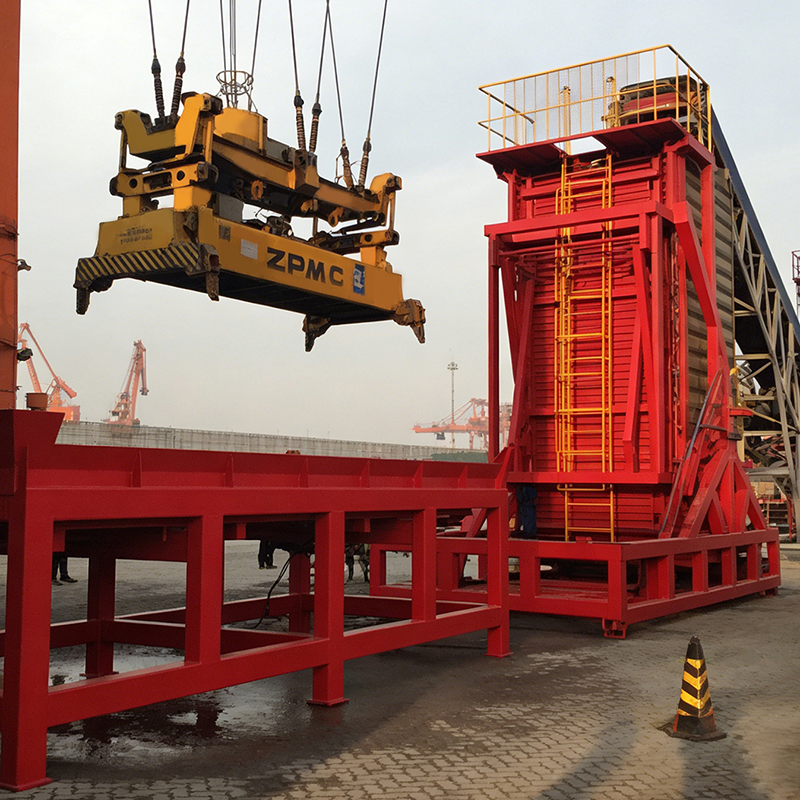
Continuous Container Handling System
3. Main Product Features
3.1 Dedicated Container Feeder
The dedicated container feeder is one of the central elements of the system. Its purpose is to automatically deliver containers to the container tilting platform or the specified handling position. This reduces dependence on repeated crane positioning and provides a more consistent infeed process.
In many traditional facilities, cranes or mobile equipment perform several separate actions to place a container accurately. The operator must coordinate approach speed, alignment, lifting, lowering, and release. These activities require skill and may become slower during busy periods or in difficult weather conditions. A dedicated feeder creates a more defined transfer path and supports a repeatable operating sequence.
Automated feeding can also improve crane utilization. When containers are delivered in a controlled manner, the crane can spend less time performing fine positioning work and more time handling other transport tasks. In a high-throughput terminal, the reduction in crane waiting and repositioning may produce meaningful capacity gains across the complete operation.
The feeder can be engineered according to the container sizes and site arrangement required by the customer. The design may consider the direction from which containers arrive, the distance between transport lanes and the handling platform, the required buffer capacity, and the relationship between upstream and downstream equipment.
3.2 Automatic Container Door Opening and Closing
Container doors are often operated manually, particularly in facilities that have developed incrementally over time. Manual door operation may require workers to work near moving equipment, perform repetitive physical movements, or access elevated areas. These tasks can create safety concerns and can become a bottleneck when container arrival rates increase.
The system can be configured with an automatic door opening and closing mechanism. This function reduces manual intervention and helps standardize the opening and closing sequence. The mechanism can be integrated with the control system so that door operation occurs only when the container is correctly positioned and the relevant safety conditions have been confirmed.
Automatic door operation can provide several benefits. It can reduce the need for high-altitude manual work, lower physical labor requirements, improve operational consistency, and help protect workers from unexpected container movement. It can also reduce the risk of doors being left partially open or improperly secured before the next stage.
The exact configuration should be selected according to container door design, cargo characteristics, environmental conditions, and the customer’s safety procedures. A well-engineered mechanism must provide sufficient force while avoiding excessive impact on the doors, hinges, locks, or container frame.
3.3 Configurable Weighing Function
Accurate weighing is important in logistics, manufacturing, agriculture, food processing, and bulk material handling. Container weight may be needed for transport compliance, inventory control, production records, billing, or process management. If weighing takes place at a separate station, each container must be moved again, increasing travel distance and adding operational steps.
The Continuous Container Handling System can be configured with a weighing function that completes weighing during the container circulation process. This means that weighing is not necessarily treated as a separate activity. Instead, the measurement can be incorporated into the normal movement sequence.
Integrating weighing into the handling line may reduce duplicate handling and improve data continuity. When connected to the control system, weighing data can be associated with a specific container, batch, material type, or dispatch order. The level of data integration depends on the customer’s automation architecture and software requirements.
Weighing performance depends on proper installation, calibration, foundation stability, load distribution, and maintenance. For this reason, weighing equipment should be selected and integrated as part of the complete system rather than added without considering mechanical movement and vibration.
3.4 Integrated Loading and Unloading Functions
The system combines loading and unloading functions within the same production line. This is one of its most important advantages for facilities that handle different materials or need flexible logistics operation.
Separate loading and unloading systems may require containers to be transferred between different bays, platforms, or operating zones. Such transfers consume time and may require additional cranes, vehicles, operators, and floor space. An integrated line allows the same general handling infrastructure to support both directions of operation.
This arrangement simplifies the workflow. A facility can receive an empty container, prepare it, load material, weigh it, close it, and release it through a coordinated process. In reverse operation, a loaded container can be positioned, opened, unloaded, weighed if required, closed, and discharged. The exact sequence can be programmed according to the material and application.
Integration also makes better use of the site. The equipment does not necessarily need separate areas for every handling activity. This can be valuable in existing plants where expansion space is limited or where the cost of building additional loading zones is high.
3.5 Compatibility with 20-Foot and 40-Foot Containers
Container length is a major consideration when designing handling equipment. A facility that handles both 20-foot and 40-foot containers needs a system that can accommodate different support points, load distributions, and overall dimensions while maintaining stable operation.
The system includes models intended for these two common container lengths. The TJXH 20 model is designed for a stated size of approximately 6 by 3 meters, while the TJXH 40 model is designed for a stated size of approximately 12 by 3 meters. The appropriate selection depends on the actual container standard, cargo weight, handling method, and site layout.
| Model | Applicable Container Length | Approximate Size L × W | Maximum Lifting Weight | Maximum Lifting Angle |
|---|---|---|---|---|
| TJXH 20 | 20-foot container | 6 × 3 m | 50 t | 45° or 60° |
| TJXH 40 | 40-foot container | 12 × 3 m | 100 t | 45° or 60° |
The parameters shown above are representative product specifications. Final technical details should be confirmed during engineering because the actual system may be customized for container condition, material density, loading method, foundation design, environmental requirements, and local regulations.
4. Advantages Over Traditional Batch Handling
4.1 Higher Throughput
The main performance advantage of continuous handling is the reduction of non-productive time. Traditional batch operations may spend several minutes between containers on positioning, securing, releasing, inspection, door operation, and removal. Continuous systems coordinate these activities so that the next container can be prepared while the current operation is being completed.
Typical comparisons indicate that traditional batch systems may process approximately 4 to 8 containers per hour, while continuous systems can process approximately 10 to 16 containers per hour, depending on the application. The actual result is influenced by cargo properties, container condition, loading method, operator procedures, and the capacity of connected equipment.
Even when the system does not operate at its maximum theoretical rate, a reduction in changeover time can increase daily capacity. Facilities may process more containers during the same shift, reduce overtime, and respond more effectively to peak demand.
4.2 Reduced Idle Time
Idle time is not always obvious because it may be distributed across many small pauses. A crane may wait for a signal, a worker may wait for a door to be opened, or a container may remain stationary while a separate weighing operation is completed. Each pause appears minor, but the cumulative effect can be substantial.
Continuous equipment is designed to reduce these gaps. The feeder, platform, weighing system, door mechanism, and control system operate as connected stages. When one stage is active, another stage can be prepared where safe and practical. The result is a higher proportion of productive equipment time.
Industry comparisons commonly associate continuous handling with equipment utilization in the range of approximately 85 to 92 percent, compared with approximately 50 to 65 percent for traditional batch operation. These figures should be treated as indicative rather than guaranteed because utilization depends on the complete facility, not only the handling machine.
4.3 Faster Container Changeover
Container changeover includes the actions required to release one container and prepare the next. In a conventional process, this may take several minutes. With automatic feeding, coordinated positioning, and integrated control, the changeover interval can be significantly shortened.
Faster changeover is especially valuable at rail and port facilities, where a delay in one operating area can affect vehicle scheduling, crane availability, and dispatch timing. It is also important in warehouses where trucks arrive in concentrated waves and must be turned around quickly.
Reducing changeover time does not mean removing safety checks. A properly designed system uses sensors, interlocks, position confirmation, and controlled motion to ensure that speed improvements do not compromise safe operation.
4.4 Lower Labor Intensity
Automation can reduce the amount of repetitive physical work required from operators. Instead of manually guiding every container, opening every door, or transferring containers between stations, personnel can supervise equipment, verify process conditions, manage exceptions, and perform planned inspections.
The system does not necessarily eliminate all labor. Skilled operators and maintenance technicians remain important, especially in facilities with diverse cargo or variable container conditions. However, labor can be shifted from physically demanding tasks to higher-value monitoring and control activities.
More stable labor requirements also make shift planning easier. Traditional batch systems often create peaks and valleys in workload, while continuous systems provide a more consistent operating rhythm.
4.5 Better Space Utilization
Combining loading and unloading in one line can reduce the need for separate handling areas. Integrated weighing and door operation can also reduce container travel distances and limit the number of transfer points.
Space efficiency is important in existing facilities where land and building expansion are expensive. A compact arrangement can help users increase capacity without making a major structural extension. It can also simplify traffic management by reducing unnecessary vehicle circulation.
4.6 Improved Process Stability
Process stability is not measured only by maximum throughput. A stable system provides predictable cycle times, repeatable positioning, consistent weighing, and controlled container movement. This predictability helps production managers plan dispatches and identify deviations quickly.
Automated sequence control reduces variation caused by different operator habits. When container feeding, tilting, weighing, and door operation follow programmed logic, the process becomes easier to monitor and improve.
4.7 Reduced Container Damage Risk
Repeated handling can increase the risk of impact, misalignment, and unnecessary stress on the container structure. A continuous system can reduce the number of repositioning movements by indexing the container into its required position and holding it securely during the operation.
Controlled movement, suitable support, and accurate alignment may help reduce damage incidents compared with less coordinated manual handling. The final result depends on container condition, operator practice, cargo distribution, mechanical settings, and maintenance quality. Nevertheless, reducing unnecessary movement is a sound engineering principle for protecting both equipment and containers.
5. Engineering and Manufacturing Strengths
5.1 Integrated Research and Development Capability
Jiangsu Zhengding Intelligent Equipment Co., Ltd. is a national high-tech enterprise engaged in the research, development, manufacturing, and sales of intelligent automated loading and unloading equipment. Its product range includes rear dumpers, side-turn truck dumpers, car loading equipment, container flippers, and related systems for automobiles, containers, ships, and logistics operations.
This product breadth is valuable when developing a continuous container handling project. A supplier that understands only one machine may focus on isolated equipment performance. A supplier with experience across multiple loading and unloading technologies can consider the complete material flow, including vehicle arrival, container positioning, lifting, tilting, loading, unloading, weighing, and discharge.
Research and development capability also supports customization. Different customers may require different lifting angles, platform dimensions, control modes, feeding directions, safety barriers, or integration interfaces. Engineering resources allow the supplier to adapt the equipment instead of forcing every application into a standard configuration.
5.2 Heavy-Duty Mechanical Design
Container handling equipment must withstand repeated dynamic loads. The design must account for container weight, cargo distribution, lifting angle, acceleration, deceleration, impact loads, structural fatigue, and environmental conditions.
A robust system typically includes a reinforced frame, appropriate lifting mechanisms, stable container supports, reliable locking or clamping devices, and protective structures around moving components. Welded assemblies must be designed with attention to load paths and stress concentration. Critical components should be selected according to the required service life and duty cycle.
For heavy-duty applications, design quality is not limited to the maximum lifting weight. The system must also maintain stable motion throughout the operating range. Smooth movement reduces dynamic shock and can improve the service life of hydraulic, mechanical, electrical, and structural components.
5.3 Professional Fabrication and Welding
The manufacturing process has a direct effect on equipment accuracy and durability. Large frames and platforms must maintain their designed geometry after cutting, welding, machining, and surface treatment. Distortion control is therefore important during fabrication.
Professional manufacturing may include material inspection, controlled cutting, staged welding, dimensional verification, weld inspection, machining of connection points, and final assembly checks. Areas exposed to high loads or repeated motion require particular attention because small alignment errors can become larger problems during operation.
Jiangsu Zhengding’s manufacturing scope enables the company to produce complete equipment systems rather than relying solely on unrelated subcontracted assemblies. In-house coordination can improve communication between design, fabrication, assembly, electrical integration, and commissioning teams.
5.4 Hydraulic, Electrical, and Automation Integration
A continuous container handling system depends on the coordination of mechanical, hydraulic, electrical, and software functions. The lifting or tilting mechanism must work together with feeders, sensors, door mechanisms, weighing devices, safety interlocks, and operator controls.
Hydraulic systems are often used for high-load lifting and tilting because they can provide substantial force and controlled movement. Hydraulic circuit design must consider pressure stability, flow control, cylinder synchronization, hose protection, emergency lowering, and maintenance access.
The electrical and automation system manages sequence logic, sensor feedback, motor operation, alarms, safety circuits, and communication with related equipment. A well-designed control system can display operating status, identify abnormal conditions, record important data, and help maintenance personnel locate faults.
Integration is a major differentiator between a complete system supplier and a basic equipment fabricator. The final system must operate as one coordinated unit, not as a collection of machines that are merely installed next to one another.
5.5 Custom Engineering for Different Industries
Jiangsu Zhengding serves industries including steel, chemical, cement, coal, grain, oil, food, feed, ports, papermaking, and new energy. These industries have different requirements for material containment, cleanliness, corrosion resistance, dust control, explosion protection, weighing accuracy, and equipment access.
For example, a grain or food-related application may emphasize hygienic design and easy cleaning. A chemical facility may require corrosion-resistant materials, sealed components, and specialized electrical protection. A coal or cement operation may require high resistance to dust and abrasive material. A port or railway project may prioritize throughput, weather protection, and integration with transport scheduling.
Custom engineering allows the system to be adapted to the real operating environment. This may include selecting suitable finishes, changing the layout, adding protective covers, modifying the control sequence, or integrating with existing conveyors, silos, cranes, and warehouse management systems.
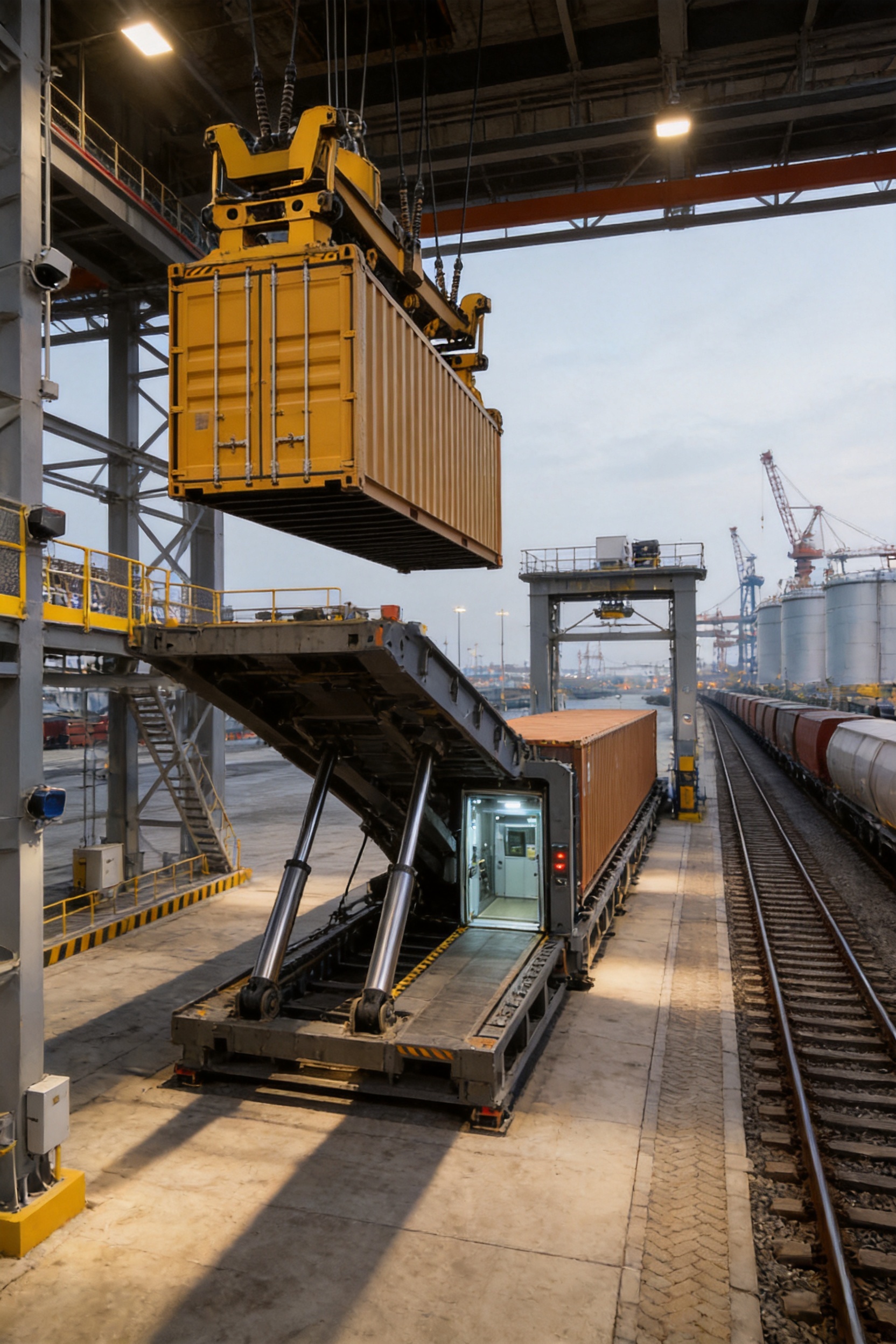
6. Manufacturing Process from Concept to Delivery
6.1 Application Assessment
Before equipment is designed, the supplier should understand the complete application. Important information includes container types, maximum gross weight, cargo density, loading or unloading method, required throughput, daily operating hours, site dimensions, foundation conditions, ambient temperature, dust level, and available utilities.
The customer’s workflow should also be reviewed. Engineers need to understand where containers arrive, how they are moved before entering the system, where processed containers are discharged, and how operators interact with the equipment. This assessment prevents the common mistake of selecting a machine based only on lifting capacity without considering the complete process.
6.2 Layout and Mechanical Design
After collecting application data, engineers develop the system layout and confirm the relationship between the feeder, tilting platform, loading or unloading equipment, weighing function, door mechanism, and discharge route. Three-dimensional design tools can be used to examine clearances, maintenance access, travel paths, and safety zones.
Mechanical calculations should consider static loads, dynamic loads, fatigue, stability, lifting angle, support distribution, and emergency conditions. The design should also provide access to hydraulic components, sensors, electrical cabinets, lubrication points, and wear parts.
6.3 Component Selection
Critical components are selected according to the duty cycle and operating environment. Hydraulic cylinders, pumps, valves, motors, sensors, load cells, gearboxes, bearings, locks, and control devices must be compatible with the expected loads and operating frequency.
Component selection also affects lifecycle cost. A low initial purchase price may not be advantageous if components require frequent replacement or are difficult to service. Reliable parts, standardized interfaces, and accessible maintenance points can reduce downtime over the equipment’s working life.
6.4 Structural Fabrication
Steel materials are cut, formed, welded, and machined according to approved drawings. Large structural members require controlled assembly to maintain alignment. Welding sequences should be planned to reduce distortion, especially around high-load connection areas.
After fabrication, important dimensions and connection points should be inspected. Surface preparation and protective coating are then applied according to the environmental conditions. Where equipment is exposed to moisture, chemicals, salt air, or abrasive dust, the coating system should be selected accordingly.
6.5 Assembly and Electrical Integration
Mechanical components are assembled with hydraulic and electrical systems. The feeder, tilting platform, door mechanism, weighing system, sensors, safety guards, and control cabinet are connected according to the process design.
Electrical integration includes cable routing, grounding, sensor installation, control panel assembly, emergency-stop circuits, and communication with external equipment. Cable protection is important in areas where moving structures, dust, water, or impact may be present.
6.6 Factory Testing
Before shipment, the completed system should undergo functional testing. Testing may include no-load movement, simulated container positioning, lifting and tilting tests, emergency-stop verification, sensor confirmation, door mechanism testing, weighing calibration, control sequence testing, and communication checks.
Where practical, representative loads or test fixtures can be used to verify structural movement and hydraulic performance. Factory testing helps identify problems before installation and reduces the time required for commissioning at the customer’s site.
6.7 Installation and Commissioning
Site installation requires coordination between the equipment supplier, civil contractor, electrical contractor, and customer operations team. Foundation dimensions, anchor positions, utility connections, access routes, and safety clearances must be confirmed before the equipment arrives.
During commissioning, the system is tested under actual site conditions. Engineers verify container alignment, feeding speed, lifting angle, weighing accuracy, door operation, control logic, and interface signals. Operators are trained in normal operation, emergency procedures, inspection, and basic troubleshooting.
7. Applications in Different Operating Environments
7.1 Railway Container Central Stations
Railway container stations require efficient coordination because train schedules create concentrated handling windows. A continuous system can support faster transfer between rail-mounted containers, trucks, storage areas, and processing stations.
The integrated feeder can reduce the time required to position containers for loading or unloading. Automated door operation and weighing can further simplify the process. When connected with dispatch planning, the system may help reduce dwell time and improve the predictability of rail operations.
7.2 Inland Ports and Intermodal Terminals
Inland ports handle containers away from coastal terminals and often serve as connection points between road, rail, and warehouse operations. Their efficiency depends on rapid truck turnaround, accurate container identification, and effective use of limited handling equipment.
A continuous container handling system can help inland terminals manage variable arrival patterns. It can also reduce the need to move containers repeatedly between separate processing areas, supporting a more compact and controlled terminal layout.
7.3 Large Logistics Parks
Large logistics parks may handle containers for multiple customers, product categories, or distribution channels. Flexibility is therefore important. A system that supports both 20-foot and 40-foot containers can serve a broader range of cargo flows.
The ability to combine loading, unloading, weighing, and door operation is particularly useful where many different workflows share the same infrastructure. Automated data collection can also support inventory management and shipment verification.
7.4 Warehouses Requiring Rapid Loading and Unloading
Distribution warehouses often face strict delivery windows. Truck drivers, warehouse teams, and material handling equipment must operate in a coordinated manner. Delays at the container interface can cause congestion at loading docks and increase vehicle waiting time.
Continuous handling can improve dock productivity by reducing the interval between containers. The system can be configured to work with conveyors, storage equipment, loading machines, and warehouse control systems.
7.5 Bulk Material and Industrial Plants
Steel, cement, coal, grain, feed, oil, chemicals, and food products may be transported in containers or processed through container-related logistics systems. These applications can involve heavy loads, dust, moisture, temperature changes, or strict requirements for containment.
Jiangsu Zhengding’s experience with automated loading and unloading equipment across several industries supports the development of application-specific solutions. The design can take into account the material’s flow characteristics, the required loading method, environmental protection, cleaning needs, and operational safety.
8. Safety and Control Functions
Safety must be considered from the earliest design stage. Container handling equipment involves heavy loads, elevated movement, hydraulic power, rotating components, and automatic sequences. A safe system requires physical protection as well as appropriate control logic.
Typical safety provisions may include emergency-stop buttons, guarded moving parts, access doors with interlocks, limit switches, container position sensors, overload protection, hydraulic pressure monitoring, anti-fall measures, warning lights, audible alarms, and controlled restart procedures.
The control system should prevent incompatible actions. For example, the platform should not tilt when the container is incorrectly positioned, the door mechanism should not operate when personnel are inside the restricted area, and the feeder should not move when the discharge route is blocked.
Operator interfaces should present clear information about operating status, alarms, container position, weighing results, and maintenance conditions. Simple and logical controls reduce training time and help operators respond correctly during abnormal situations.
Safety performance also depends on operating procedures. Personnel must receive training on pre-start checks, emergency stops, restricted areas, load limits, container inspection, and lockout procedures. Regular review of safety practices is necessary as the facility’s operating conditions change.
9. Maintenance and Lifecycle Management
Reliable performance depends on preventive maintenance. Continuous operation can increase equipment utilization, but it also means that components may experience more frequent cycles. Maintenance planning should therefore be included in the project from the beginning.
9.1 Daily Inspection
Daily inspections may include checking hydraulic hoses, oil levels, abnormal noise, leakage, structural damage, safety guards, sensor condition, emergency-stop functions, container locks, and platform alignment. Operators should report unusual vibration, delayed movement, or inconsistent weighing immediately.
9.2 Periodic Maintenance
Periodic maintenance may include hydraulic oil inspection, filter replacement, lubrication, bolt tightening, electrical cabinet cleaning, sensor calibration, load-cell verification, wear-part inspection, and examination of welded structures.
The service interval depends on duty cycle, environmental conditions, and manufacturer recommendations. Dusty or abrasive environments may require more frequent cleaning and inspection than clean indoor installations.
9.3 Spare Parts and Technical Support
A supplier with a broad equipment range can often provide more coordinated technical support for mechanical, hydraulic, electrical, and automation components. Spare parts planning should focus on components that directly affect availability, such as seals, sensors, switches, hydraulic valves, filters, bearings, and wear pads.
Maintenance records should include operating hours, faults, replacement parts, calibration results, and inspection findings. This information helps identify recurring problems and supports future improvements.
10. Comparison with Competing Equipment Approaches
When comparing suppliers, customers should look beyond the lifting capacity listed on a specification sheet. Two systems may have similar maximum loads but very different performance in actual operation. Important comparison factors include container feeding, changeover time, control integration, door automation, weighing capability, maintenance access, customization, and service support.
| Evaluation Area | Traditional Batch Equipment | Basic Standalone Handling Machine | Integrated Continuous Container Handling System |
|---|---|---|---|
| Container flow | Sequential, with frequent waiting | Partly coordinated | Coordinated and continuous |
| 20-foot and 40-foot compatibility | May require separate arrangements | Depends on machine design | Designed for flexible container handling |
| Container feeder | Often handled by crane or vehicle | May be external | Dedicated feeder can be integrated |
| Door operation | Usually manual | Optional or separate | Automatic opening and closing can be configured |
| Weighing | Often separate from handling | May require an additional station | Can be integrated into container circulation |
| Loading and unloading | Separate areas may be needed | Usually focused on one function | Both functions can be combined in one line |
| Site utilization | More transfer space required | Moderate | Improved through integrated layout |
| Customization | Often limited by existing equipment | Varies by supplier | Can be engineered around site and process needs |
| Automation potential | Low to moderate | Moderate | High, with sequence and data integration |
The integrated system has an advantage because it addresses the complete handling sequence rather than only one lifting or tilting action. Its competitiveness comes from combining mechanical capacity with automation, process integration, and customization.
Another important advantage is supplier coordination. If the feeder, tilting platform, door mechanism, weighing function, and control system are supplied as one engineered solution, responsibility for system compatibility is clearer. This can reduce the risk of interface problems between unrelated equipment suppliers.
11. Selecting the Correct System Configuration
Customers should define their operating requirements before choosing a model. The following questions are important:
- Will the facility handle 20-foot containers, 40-foot containers, or both?
- What is the maximum gross container weight, including cargo?
- What lifting or tilting angle is required?
- How many containers must be processed per hour and per shift?
- Will the system perform loading, unloading, or both?
- Is automatic door operation required?
- Must weighing be completed during container circulation?
- What type of material will be handled?
- What are the temperature, dust, moisture, and corrosion conditions?
- How will the equipment connect to existing cranes, conveyors, silos, warehouses, or transport systems?
- What safety standards and local regulations apply?
- What level of data recording and remote monitoring is required?
The maximum lifting weight should not be selected solely according to the average container load. A safety margin is necessary, and the design must consider uneven cargo distribution and dynamic effects. Similarly, maximum throughput should be evaluated together with upstream and downstream capacity. A fast handling machine cannot improve total facility output if containers cannot be supplied or removed at the same rate.
12. Benefits of Working with a Custom Factory
A custom factory can provide more than a standard catalog product. It can evaluate the customer’s application, adapt the design, manufacture the main structure, integrate the control system, and support commissioning.
Customization is particularly useful when the facility has unusual dimensions, limited headroom, difficult access, existing equipment, or special material requirements. It can also help customers avoid over-investing in functions they do not need while ensuring that critical requirements are properly addressed.
Jiangsu Zhengding Intelligent Equipment Co., Ltd. focuses on automated loading and unloading equipment for automobiles, containers, ships, and related logistics applications. Its product portfolio and international project experience provide a foundation for developing equipment for different industrial environments.
The company’s products are used in industries such as steel, chemical, cement, coal, grain, oil, food, feed, ports, papermaking, and new energy. Its export markets include Japan, Brazil, Egypt, Pakistan, India, the Middle East, and Southeast Asia. International users associated with its equipment experience include Budweiser, Heineken, Buhler Group, Wilmar International, Cargill, DuPont, Louis Dreyfus, Charoen Pokphand Group, and Saint-Gobain Group.
For customers, this type of manufacturing background can provide several practical benefits: broader application knowledge, stronger project coordination, more flexible engineering, and better access to integrated solutions. The supplier’s experience with rear dumpers, side-turn truck dumpers, car loading equipment, and container flippers also supports cross-equipment integration when a project includes multiple loading and unloading processes.
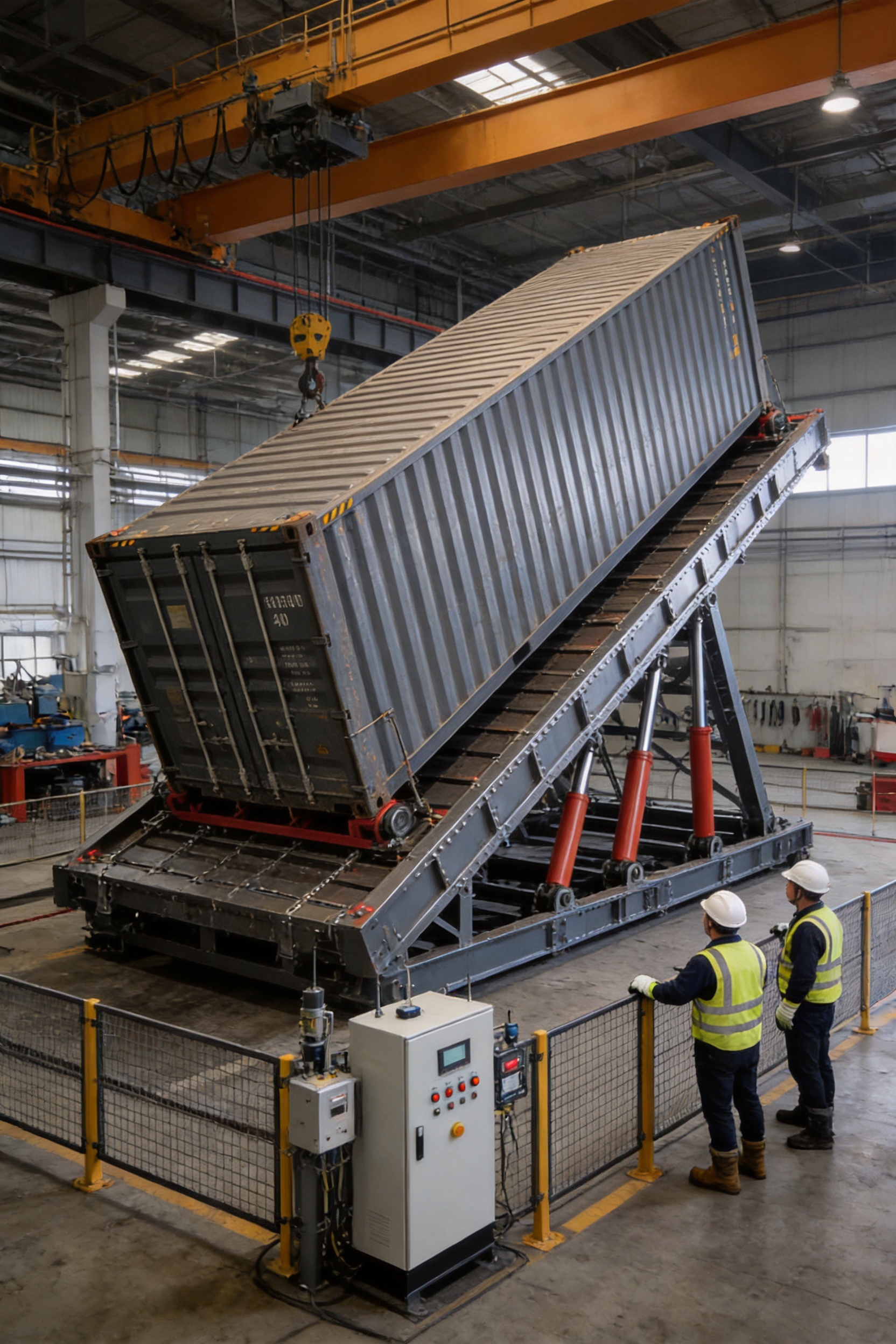
13. Frequently Asked Questions
Q1: What is a continuous container handling system?
A continuous container handling system is an integrated line that moves containers through loading, unloading, positioning, weighing, door operation, and transfer stages with minimal waiting between containers. Unlike a traditional batch system, it coordinates overlapping activities to maintain a more consistent flow.
Q2: Can the system handle both 20-foot and 40-foot containers?
Yes. The system is designed with configurations for both 20-foot and 40-foot containers. The selected model and final design depend on container dimensions, maximum gross weight, lifting angle, cargo distribution, and site layout.
Q3: Can loading and unloading be performed on the same production line?
Yes. The system integrates loading and unloading functions into the same general production line. This can reduce container transfers between separate areas and improve the use of available site space.
Q4: Is automatic container door operation available?
Yes. An automatic door opening and closing mechanism can be configured. This function reduces manual high-altitude work and repetitive physical labor while improving the consistency of the operating sequence.
Q5: Can weighing be integrated into the process?
Yes. A weighing function can be incorporated into container circulation. The final weighing configuration depends on the required accuracy, load range, foundation conditions, control system, and data management requirements.
Q6: What industries can use this equipment?
The system can be applied in railway container stations, inland ports, logistics parks, warehouses, steel plants, chemical facilities, cement plants, coal operations, grain and feed facilities, food-related applications, ports, papermaking, oil, and new energy industries.
Q7: How does continuous handling improve throughput?
It reduces waiting between containers by coordinating feeding, positioning, door operation, weighing, loading, unloading, and discharge. Typical performance depends on the complete process, but continuous systems generally provide higher hourly throughput and lower changeover time than conventional batch handling.
Q8: Can existing facilities be upgraded?
Many existing facilities can be upgraded, although the feasibility depends on foundation conditions, available space, transport routes, utility capacity, and the arrangement of existing equipment. Some customers begin with one pilot handling bay before expanding the system.
Q9: What information is needed for a quotation?
Important information includes container sizes, maximum gross weight, material type, loading or unloading method, required capacity, operating hours, lifting angle, site drawings, environmental conditions, automation requirements, and whether door operation and weighing should be integrated.
Q10: What safety functions should be included?
Safety functions may include emergency stops, overload protection, position sensors, interlocks, guarded moving components, limit switches, hydraulic protection, alarms, warning lights, anti-fall measures, and controlled restart logic. The final configuration should meet the application and applicable local requirements.
Q11: How can container damage be reduced?
Container damage can be reduced through accurate alignment, controlled acceleration and deceleration, secure support, fewer unnecessary transfers, proper locking, and regular maintenance. Operators should also inspect containers and avoid exceeding the equipment’s rated capacity.
Q12: Why choose a manufacturer with multiple equipment categories?
A manufacturer with experience in different loading and unloading equipment can better understand complete logistics processes. This can support the integration of container handling systems with dumpers, car loading equipment, conveyors, ship-loading equipment, and other material handling machinery.
14. Conclusion
The Continuous Container Handling System is designed for facilities that need higher throughput, shorter changeover times, reduced manual intervention, and better use of available space. Its integrated configuration supports 20-foot and 40-foot containers and can combine container feeding, tilting, loading, unloading, weighing, and automatic door operation in one coordinated line.
Compared with traditional batch handling, the system offers a more stable operating rhythm. It reduces unnecessary container transfers, limits idle intervals, supports consistent process control, and creates opportunities for automation and data integration. These advantages are valuable in railway stations, inland ports, logistics parks, warehouses, and industrial plants where container movement directly affects production or dispatch performance.
The system’s competitiveness also depends on the supplier’s engineering and manufacturing capability. Jiangsu Zhengding Intelligent Equipment Co., Ltd. provides research and development, structural fabrication, hydraulic and electrical integration, automation control, customization, commissioning, and technical support for automated loading and unloading equipment. Its experience across multiple industries enables it to design solutions around actual material, container, and site requirements.
For users evaluating a new container handling project, the most effective approach is to assess the complete process rather than focusing on a single machine parameter. Throughput, container compatibility, loading and unloading functions, weighing, door automation, safety, maintenance, integration, and future expansion should all be considered together. When these elements are properly coordinated, continuous container handling can become a reliable foundation for more efficient and intelligent logistics operations.
References
1. Jiangsu Zhengding Intelligent Equipment Co., Ltd., Continuous Container Handling System Product Information and Technical Parameters.
2. Jiangsu Zhengding Intelligent Equipment Co., Ltd., Automated Loading and Unloading Equipment Product and Application Information.
3. International Organization for Standardization, Freight Containers: General Requirements and Handling Considerations.
4. International Labour Organization, Safety and Health in Ports and Cargo Handling Operations.
5. International Maritime Organization, Guidance Related to Safe Container Handling and Cargo Operations.
6. General principles of industrial material handling, process automation, equipment utilization, and preventive maintenance.
7. Comparative operating data supplied for continuous and traditional container handling methods, including throughput, idle time, changeover time, and labor utilization.


