

 English
 русский
 Español
 Français
 Português
 عربى
عربى


+86-13588556918
Content
- 1 1. The Role of Container Flipping in Modern Bulk Logistics
- 2 2. Main Advantages of a Container Flipping Machine
- 3 3. Working Principle and Equipment Structure
- 4 4. Technical Configuration and Performance Parameters
- 5 5. Structural Engineering for Heavy-Duty Service
- 6 6. Automation and Customized Configurations
- 7 7. Advantages Compared with Alternative Unloading Methods
- 8 8. Application Industries
- 9 9. Manufacturing Strengths and Engineering Capability
- 10 10. Installation, Commissioning, and Operator Training
- 11 11. Maintenance and Service Requirements
- 12 12. Environmental and Operational Benefits
- 13 13. Selecting the Right Configuration
- 14 14. Frequently Asked Questions
- 14.1 Q1: What container sizes can the machine handle?
- 14.2 Q2: What is the maximum lifting capacity?
- 14.3 Q3: Can the machine unload powders and sticky materials?
- 14.4 Q4: Does the machine require workers to enter the container?
- 14.5 Q5: Can weighing equipment be integrated?
- 14.6 Q6: Can it be connected to a dust collector?
- 14.7 Q7: Is a mobile version available?
- 14.8 Q8: How often does the hydraulic oil need to be changed?
- 14.9 Q9: How many containers can be processed per hour?
- 14.10 Q10: What makes this equipment suitable for export projects?
- 15 15. Conclusion
- 16 References
- 17 Product: Container Flipping Machine
Containerized bulk-material logistics requires speed, accuracy, safety, and dependable equipment. As industries increasingly move grain, minerals, cement, chemicals, food ingredients, waste, and recyclable materials in standard shipping containers, conventional unloading methods can create serious limitations. Manual handling is labor-intensive, vacuum unloading may require complex auxiliary systems, and horizontal filling often consumes valuable floor space while producing inconsistent loading results.
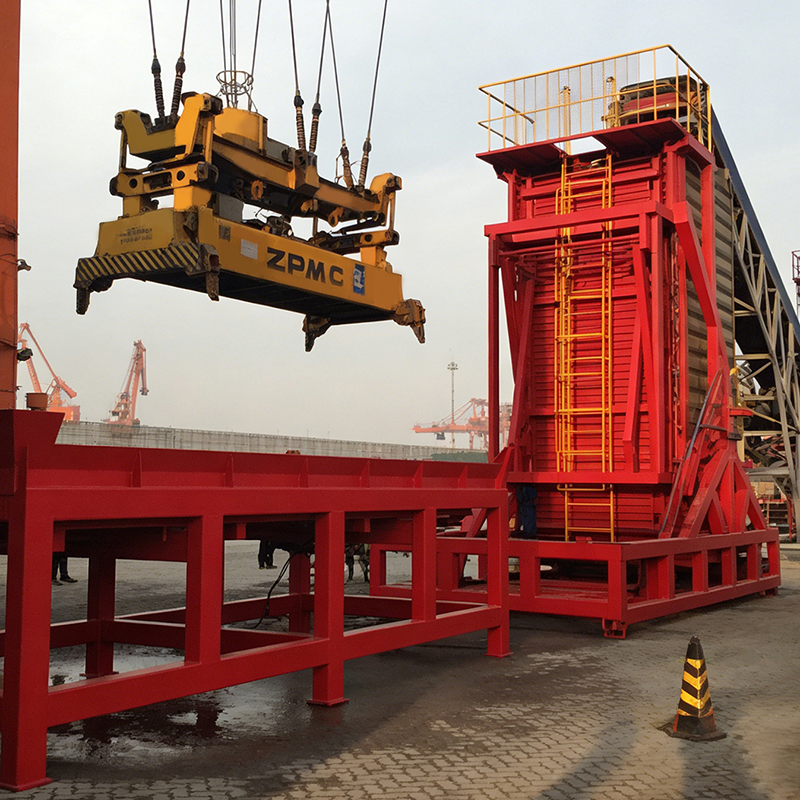
A container flipping machine provides a practical alternative. By securing a container and rotating it through a controlled hydraulic movement, the machine uses gravity to load or discharge bulk materials efficiently. The process can be integrated with conveyors, storage silos, weighing systems, dust-collection equipment, automatic door controls, and plant-level monitoring systems. This makes the equipment suitable not only for individual unloading operations but also for complete automated logistics lines.
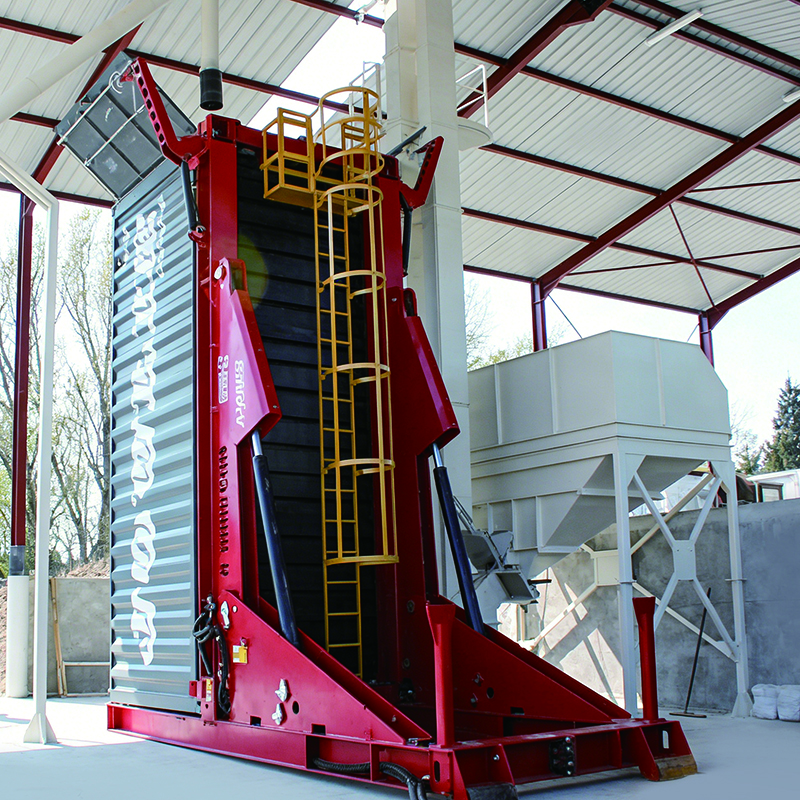
Designed for 20-foot and 40-foot containers, the container flipping machine combines a reinforced steel structure, synchronized hydraulic cylinders, safety locks, emergency protection, and optional automation functions. Its operating range can reach 0–90 degrees in the standard technical configuration, while application-specific systems may be engineered for greater rotation angles when complete discharge is required. The result is a reliable and flexible solution for facilities that need to process large volumes of bulk cargo with fewer manual interventions.
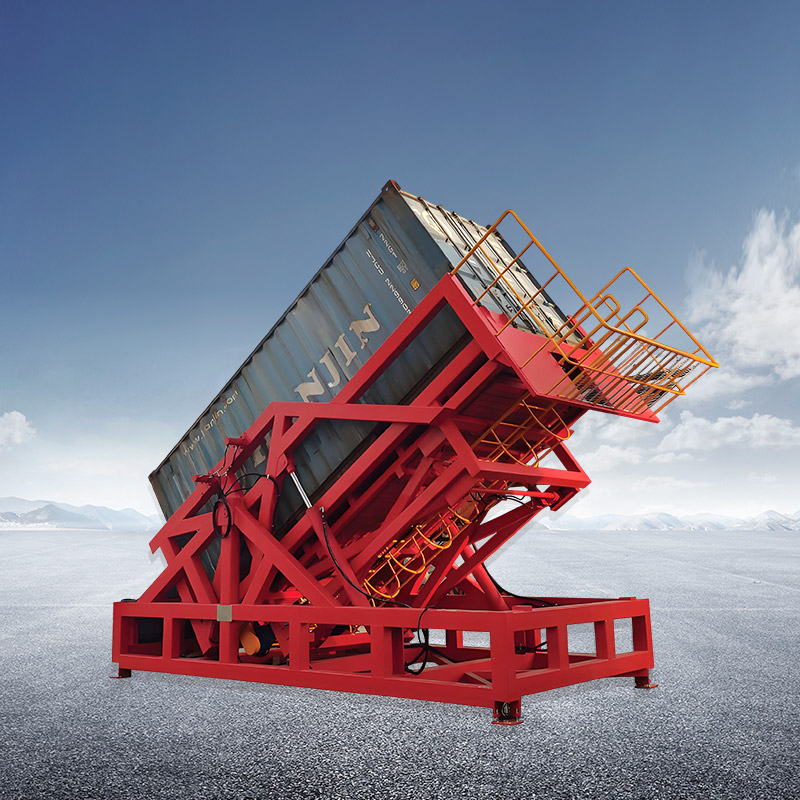
Container Flipping Machine
1. The Role of Container Flipping in Modern Bulk Logistics
Shipping containers were originally developed for standardized transport, not necessarily for efficient bulk-material discharge. When a container is filled with grain, powder, pellets, mineral products, chemical raw materials, or industrial waste, the receiving facility must remove the material quickly and safely. The container may arrive at a terminal, factory, warehouse, silo complex, or production line, where unloading speed directly affects vehicle utilization, storage capacity, and overall plant productivity.
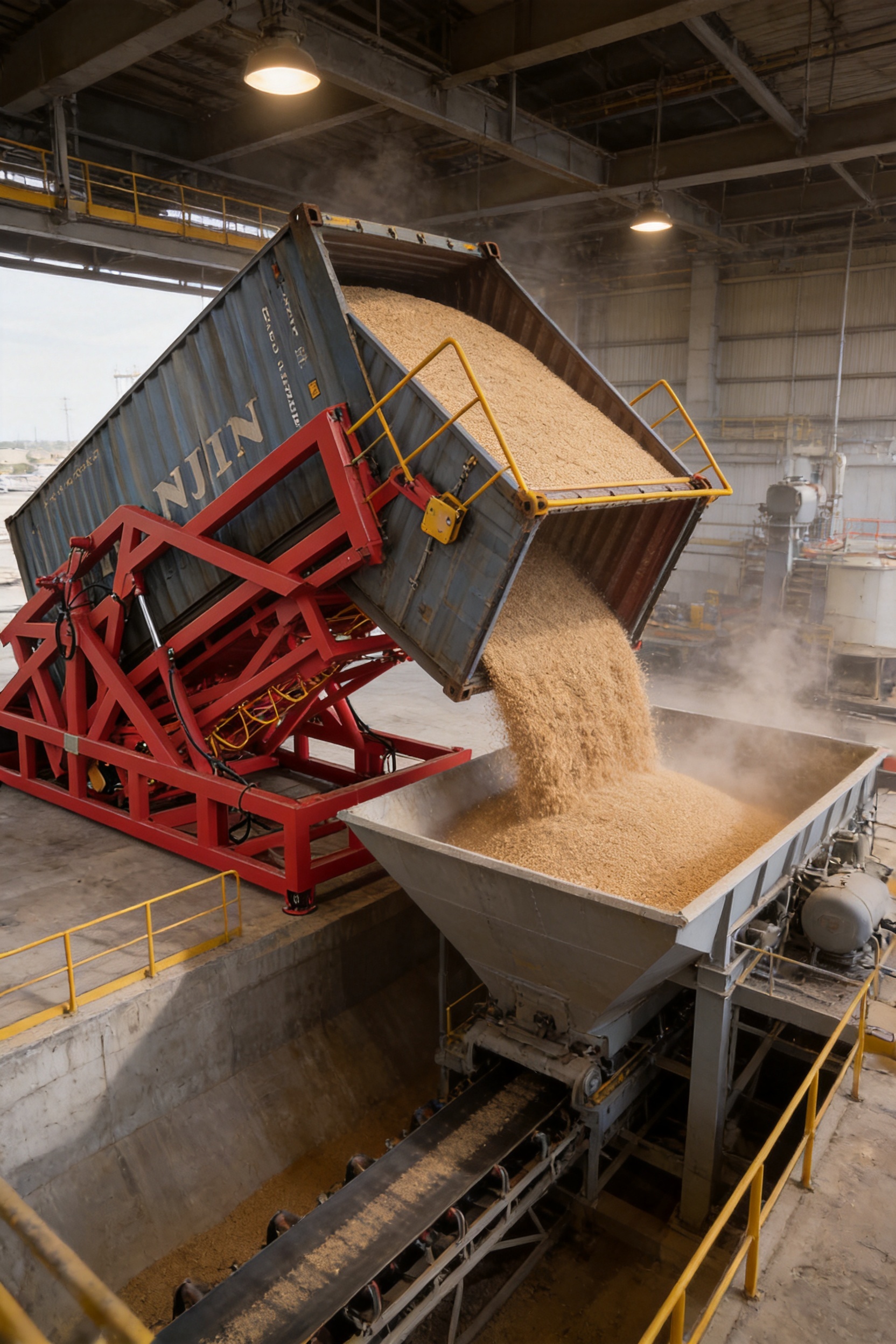
A container flipping machine addresses this challenge by transforming the container itself into a controlled discharge vessel. Instead of transferring material through extensive manual work or relying solely on pneumatic systems, the machine raises and rotates the container. Once the container reaches the required angle, gravity causes the material to flow through the open door into a receiving hopper, conveyor, pit, or enclosed discharge station.
This operating concept is particularly effective for free-flowing materials. Grain, seed, pellets, dry powders, sand, cement, and many other bulk products can be discharged rapidly once the container is positioned correctly. For cohesive or damp materials, the system can be supplemented with vibration devices, air-knife attachments, liner solutions, or specially designed discharge interfaces.
The equipment is also valuable during loading. A container can be positioned vertically or at a controlled incline, allowing bulk material to enter through a dedicated filling system. Compared with traditional horizontal packing, gravity-assisted filling can improve the material packing rate and reduce the amount of time that loading equipment remains idle.
2. Main Advantages of a Container Flipping Machine
2.1 Faster Loading and Unloading Cycles
Cycle time is one of the most important performance indicators in bulk logistics. Every minute spent waiting for a container to be opened, manually cleaned, repositioned, or unloaded reduces the capacity of the entire logistics chain. A container flipping machine shortens this process by combining container positioning, controlled rotation, and gravity discharge in one coordinated operation.
The supplied application information indicates that a single packing cycle is short compared with traditional horizontal packing. In practical installations, unloading cycles commonly depend on material characteristics, container preparation, receiving equipment, and the selected rotation angle. Typical operations may process several containers per hour, with reported application ranges of approximately four to nine containers per hour under suitable conditions.
Faster cycles provide benefits beyond simple time savings. Trucks, trailers, cranes, conveyors, and operators spend less time waiting. Storage silos can be replenished more consistently. Production plants receive raw materials at a more predictable rate. Terminals can handle a larger number of containers without expanding the entire site.
2.2 Improved Material Discharge
Traditional unloading methods may leave material in corners, along container walls, or beneath internal liners. Operators may then need to enter the container, use shovels, or apply additional mechanical or pneumatic equipment. These secondary operations increase labor costs and expose workers to confined-space, dust, and material-handling hazards.
By raising the container and applying a controlled angle, a flipping machine uses gravity over a large portion of the unloading cycle. Free-flowing materials can be directed toward the container doors and into a receiving hopper with limited residual material. Actual discharge performance depends on moisture, particle size, internal friction, packaging, liner design, and material cohesion. For grains and pellets, residual quantities can be very low when the container and discharge system are properly matched.
For difficult materials, the machine can be integrated with supplementary systems. Vibratory devices can loosen compacted material, while air-knife equipment can help separate sticky material from container surfaces. A dust-controlled enclosure can improve visibility and protect the surrounding environment during discharge.
2.3 Reduced Manual Labor
A major advantage over manual unloading is the reduction in close-range intervention. Operators can supervise container placement, verify the load, operate the control system, and monitor the discharge process without repeatedly entering the container. Automatic door systems can also be specified to open and close container doors remotely.
Reduced manual handling lowers labor requirements and improves consistency. The machine performs the principal movement according to a controlled sequence rather than depending on the physical effort and experience of individual workers. This is particularly important in facilities operating multiple shifts or handling materials that create dusty, noisy, or physically demanding working conditions.
2.4 Better Workplace Safety
Container entry is associated with potential risks such as restricted access, poor visibility, dust inhalation, unexpected material movement, and inadequate ventilation. A machine that allows the majority of the operation to be performed from outside the container can substantially reduce these risks.
The container flipping machine uses clamping and locking systems designed to secure the container before rotation. Automatic safety interlocks can prevent movement if the container is not correctly positioned or clamped. Hydraulic locks and explosion-proof valves help maintain stability during operation and can prevent uncontrolled movement in the event of hydraulic or electrical abnormalities.
Safety performance still depends on proper installation, operator training, guarding, inspection, and compliance with applicable local regulations. The equipment is not a substitute for site safety management. However, its automated design provides a stronger foundation for safe operations than repeated manual entry and uncontrolled material handling.
2.5 Flexible Installation and Operation
Different facilities have different site layouts. Some require a fixed unloading station connected to a silo. Others must move equipment between several loading bays, storage areas, or production lines. A mobile chassis design can provide additional flexibility by allowing the machine to transfer between work stations within the same site.
Mobile equipment can be valuable for seasonal grain handling, temporary construction-material storage, port operations, and facilities that process several product types in different areas. Fixed configurations, meanwhile, can be integrated with permanent conveyors, hoppers, dust collectors, and automated control systems for maximum throughput.
The machine can also be customized for different container lengths, lifting capacities, loading arrangements, and discharge interfaces. Standard models include configurations for 20-foot and 40-foot containers, while special projects may require adaptations for other container formats.
3. Working Principle and Equipment Structure
3.1 Container Positioning
The operation begins when a container is placed onto the machine platform. Positioning may be performed by a truck, trailer, crane, reach stacker, or other approved handling equipment, depending on the site design. Guide structures and locating points help the operator align the container with the machine’s clamping system.
Correct positioning is essential. The machine must distribute the load through the intended structural points, particularly the container corner castings. Before rotation, the operator or automated control system verifies the container dimensions, approximate weight, door condition, and clamping status.
3.2 Clamping and Locking
After positioning, the container is secured by a heavy-duty clamping system. The clamping arrangement is designed around the container’s standardized corner castings and may use mechanical locks, hydraulic clamps, or a combination of both. The objective is to prevent sliding, lifting, twisting, or unintended separation during rotation.
Safety interlocks can be connected to the clamping system. If the locks are not fully engaged, the machine control system can prevent the hydraulic cylinders from starting. This sequence helps ensure that the lifting motion is permitted only after the container has reached a verified safe condition.
3.3 Hydraulic Rotation
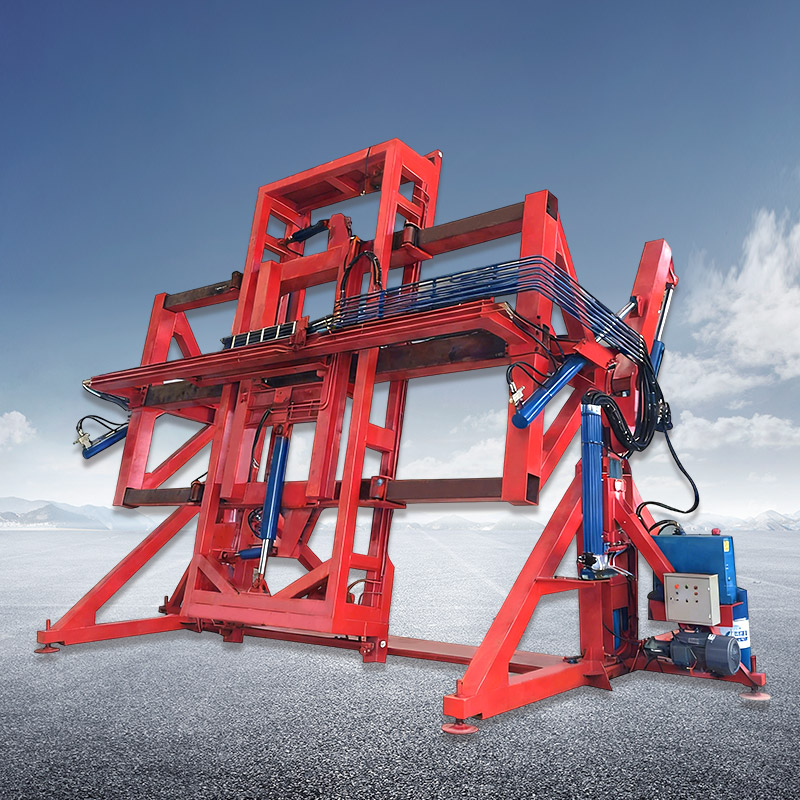
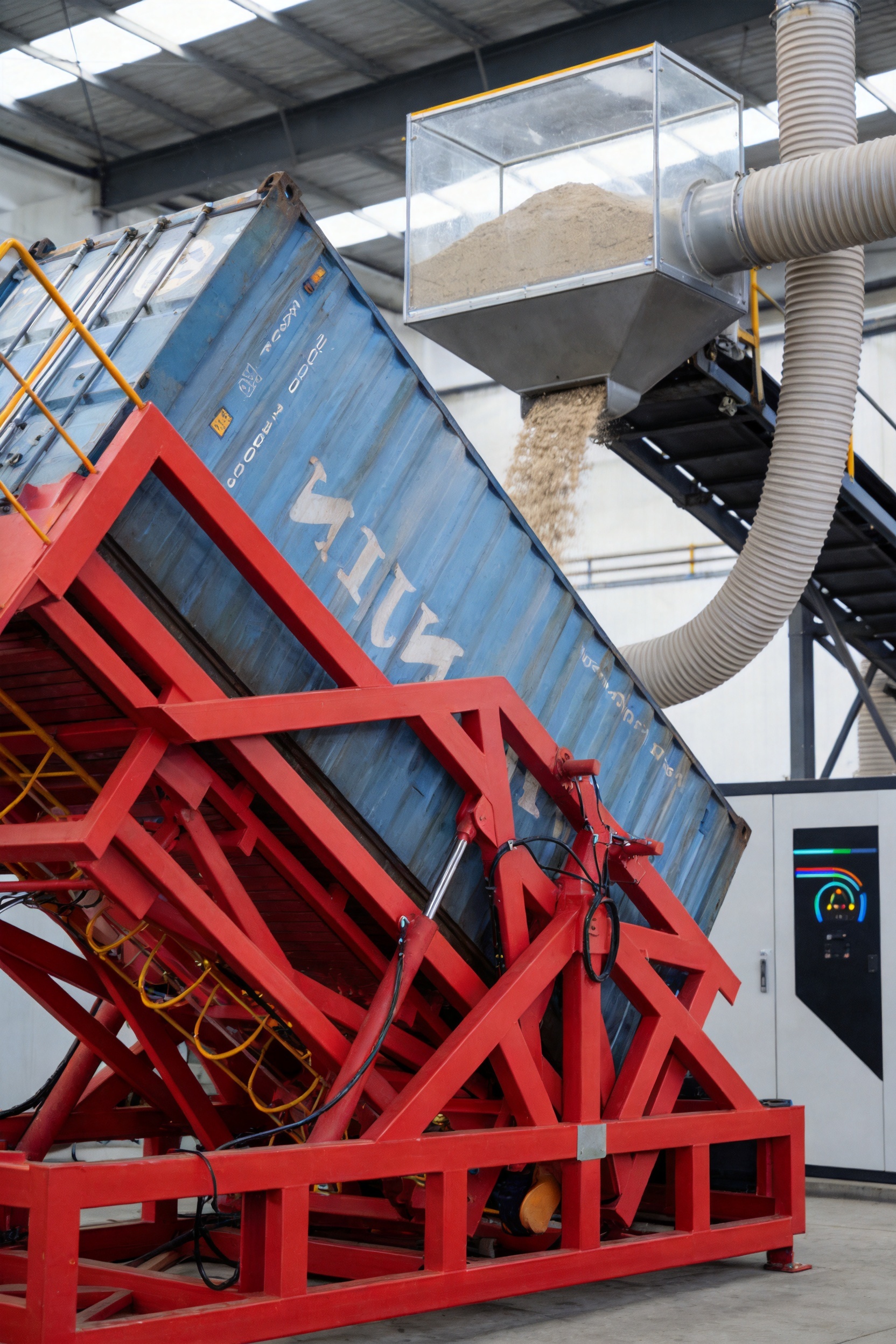
Large-tonnage dual hydraulic cylinders provide the main lifting and rotation force. The cylinders work together to raise the frame and rotate the container around a horizontal axis. Hydraulic control allows the operator to adjust movement smoothly, reduce shock loading, and stop the container at a selected angle.
The supplied technical information specifies a maximum lifting angle of 0–90 degrees for the TJFJ 20 and TJFJ 40 models. Depending on the actual material, container design, receiving hopper, and project requirements, the operating sequence may be adapted to achieve the most effective discharge position. Some industry applications use greater angles for specific free-flowing materials, but the final angle must always be determined by the equipment design and engineering approval.
Hydraulic balancing is important because the container load may not always be perfectly uniform. Synchronized cylinders reduce uneven movement and help maintain stability throughout the rotation. Hydraulic locks and explosion-proof valves are intended to hold the structure securely and reduce the risk of uncontrolled descent.
3.4 Controlled Discharge
When the container reaches the required angle, the doors can be opened manually or through an automatic door control system. Material then flows into a hopper, conveyor, receiving pit, or enclosed transfer point. The discharge system may include flexible seals, dust extraction connections, flow-control gates, and level sensors.
For facilities handling food ingredients, the receiving structure may be designed for hygienic access and simplified cleaning. For cement, fly ash, mineral products, or chemical powders, the discharge area may require abrasion-resistant surfaces, sealed transfer points, and specialized dust-collection equipment.
3.5 Return to the Loading Position
After discharge, the container is returned to its original position. The control system can be programmed with defined rotation and return sequences to reduce operator error. Once the container is lowered and the machine confirms that movement has stopped, the clamps can be released and the empty container removed.
Cycle controls may include emergency-stop buttons, hydraulic pressure monitoring, position sensors, door-status detection, load verification, and fault alarms. These functions help the operator identify abnormal conditions before the next container is processed.
4. Technical Configuration and Performance Parameters
Container flipping machines are engineered according to container size, lifting capacity, material behavior, operating frequency, site conditions, and integration requirements. The following table summarizes the principal supplied model parameters.
| Model | Applicable Container | Maximum Lifting Weight | Maximum Lifting Angle | Typical Use |
|---|---|---|---|---|
| TJFJ 20 | 20-foot container | 30/40 tonnes configuration | 0–90 degrees | Grain, powders, minerals, food ingredients, and general bulk materials |
| TJFJ 40 | 40-foot container | 30/40 tonnes configuration | 0–90 degrees | High-volume industrial and terminal applications |
Maximum lifting weight must be confirmed for the selected machine configuration and container condition. The total operating load includes the container’s tare weight and the material inside it. The weight distribution, container structural condition, and center of gravity must also be considered during project design.
For performance planning, material density is another important factor. Grain products generally have a lower bulk density than cement or mineral products, while shredded plastic may have a low and irregular density. These differences influence the filling level, discharge behavior, rotation angle, and cycle time.
| Material Group | Typical Bulk Density | Indicative Rotation Range | Indicative Throughput | Important Design Considerations |
|---|---|---|---|---|
| Corn, wheat, and soybeans | 0.72–0.78 tonnes per cubic metre | 135–150 degrees in application-specific systems | 5–7 containers per hour | Flowability, dust control, grain cleanliness, and silo transfer |
| Cement and fly ash | 1.1–1.4 tonnes per cubic metre | 160–175 degrees in application-specific systems | 4–6 containers per hour | High density, abrasion, enclosure, and dust extraction |
| Shredded plastic and scrap | 0.3–0.6 tonnes per cubic metre | 150–180 degrees in application-specific systems | 6–8 containers per hour | Irregular flow, bridging, contamination, and fire safety |
| Sugar, flour, and starch | 0.5–0.8 tonnes per cubic metre | 120–140 degrees in application-specific systems | 7–9 containers per hour | Hygiene, powder containment, cleaning, and explosion-risk assessment |
The figures above are indicative planning data rather than a universal guarantee. Actual results depend on container preparation, material moisture, loading pattern, operator training, conveyor capacity, dust-control arrangements, and the number of operating shifts.
5. Structural Engineering for Heavy-Duty Service
5.1 High-Strength Welded Frame
The main frame is manufactured from high-strength structural steel. It must resist the combined effects of container weight, bulk material weight, hydraulic force, impact loading, vibration, and repeated rotation. Frequent lifting cycles can generate significant fatigue stress, especially when the machine is used for large-tonnage containers.
Finite element stress analysis can be used during the design process to identify areas of concentrated stress and optimize reinforcement. This engineering approach supports the selection of plate thickness, beam profiles, pivot structures, cylinder mounting points, and container support members. Properly designed load paths improve structural stability and help extend service life.
5.2 Pivot and Load-Bearing Components
The rotation axis and supporting pivots carry substantial loads during every cycle. These components require accurate machining, correct alignment, suitable bearing selection, and effective lubrication. Misalignment can increase wear, create uneven hydraulic loading, and produce vibration during rotation.
External lubrication points simplify routine maintenance. Maintenance personnel can inspect and lubricate critical areas without entering difficult or dangerous locations. This design feature helps reduce service time and encourages regular preventive maintenance.
5.3 Hydraulic Power System
The hydraulic system is selected according to the container size, maximum load, rotation speed, and duty cycle. Dual hydraulic cylinders distribute the lifting force and support synchronized motion. Hydraulic valves control the speed and direction of movement, while pressure-protection devices help prevent damage caused by overload or abnormal resistance.
Hydraulic locks are particularly important when the container is held at an elevated angle. They are designed to support the position independently of normal hydraulic pressure. Explosion-proof or hose-failure protection valves can help limit uncontrolled movement if a hydraulic line is damaged.
Hydraulic oil quality, temperature, cleanliness, and correct pressure settings influence the reliability of the entire machine. Routine inspection should include hoses, fittings, cylinders, seals, valves, filters, and oil levels. The supplied maintenance guidance recommends hydraulic oil replacement every 3,000 operating hours or every 18 months, subject to actual operating conditions and the equipment manufacturer’s service instructions.
6. Automation and Customized Configurations
6.1 Automatic Container Door Control
Manual opening and closing of container doors can slow the process and require workers to remain close to the discharge area. An automatic door control system can be added to open and close the doors as part of the operating sequence. This supports a more complete automation process and reduces the need for manual close-range contact.
Door control must be synchronized with container clamping, rotation angle, discharge-hopper position, and safety interlocks. The system should not permit the doors to open unless the container is correctly supported and the receiving equipment is ready.
6.2 Integrated Weighing
An optional dynamic weighing module can monitor the loading weight in real time. Weighing data helps prevent overloading, improves shipment accuracy, and provides reliable outbound records. It can also support inventory management and production planning.
Weighing integration may use load cells, hydraulic pressure compensation, or a dedicated weighing structure, depending on the required accuracy and operating sequence. Calibration should be performed at defined intervals, especially when the machine is exposed to vibration, temperature changes, or repeated heavy-duty use.
6.3 Mobile Chassis Design
A mobile chassis allows the machine to be transferred between work stations within a facility. This design is useful where containers arrive at different locations or where a single machine serves several material lines. Mobility can also reduce the need to build a permanent unloading pit at every operating point.
Before choosing a mobile configuration, the site should be evaluated for ground strength, turning radius, access clearance, electrical supply, hydraulic power, conveyor connection, and safe travel routes. A mobile machine still requires a stable operating position and should be secured according to the manufacturer’s procedures before lifting begins.
6.4 Dust-Collection Integration
Bulk material discharge can generate airborne dust. An enclosed discharge zone with flexible seals can be connected to a dust collector, reducing fugitive emissions compared with open tipping. Dust extraction is particularly important for cement, flour, starch, mineral powders, and certain chemical products.
The appropriate dust-control solution depends on particle size, material properties, air volume, temperature, combustible-dust classification, and local environmental regulations. The container flipping machine can be engineered with conveyor interfaces, enclosed hoppers, extraction ducts, inspection doors, and filter-system connections.
6.5 Remote Monitoring and Plant Integration
Modern facilities increasingly require equipment data to be visible from a central control room. A container flipping machine can be configured with sensors and communication functions that report rotation position, hydraulic pressure, container status, cycle count, fault conditions, and weighing information.
Integration with a plant control system can support automatic sequencing. For example, the receiving conveyor can start before the container door opens, the dust collector can activate before discharge, and an alarm can stop the cycle if the receiving hopper reaches a high level.
7. Advantages Compared with Alternative Unloading Methods
7.1 Compared with Manual Unloading
Manual unloading may require workers to enter the container, remove residual material, or operate tools near the discharge opening. It is usually slower and more dependent on labor availability. Results can vary according to the material, worker experience, container condition, and shift organization.
A flipping machine provides consistent mechanical movement and reduces the physical workload. It can process containers according to a repeatable sequence while keeping operators outside the principal material path. The machine also supports improved housekeeping because discharge can occur directly into an enclosed hopper.
7.2 Compared with Vacuum Unloading
Vacuum systems are useful for powders and granular materials, especially where a sealed pneumatic transfer route is required. However, they may involve high energy consumption, complex filters, specialized pipelines, and maintenance of suction equipment. Their performance can be affected by material density, moisture, particle size, and the distance between the container and receiving point.
A container flipping machine uses gravity as its primary unloading force. This can reduce dependence on continuous pneumatic suction and may offer a simpler mechanical route for high-volume discharge. It can also handle a broad range of bulk materials that are not ideal for pneumatic conveying, although the receiving conveyor or hopper must still be properly designed.
7.3 Compared with Horizontal Container Packing
Horizontal loading may require long conveyors, pushing systems, or repeated repositioning of the material. Packing efficiency can be reduced when material settles unevenly or when the loading system cannot reach the far end of the container effectively.
Vertical or inclined container positioning allows material to move under gravity. This can improve filling speed and reduce dead space in suitable applications. The exact result depends on the material’s flow characteristics and the container-loading arrangement, but the basic principle offers an efficient alternative to conventional horizontal packing.
7.4 Compared with Fixed Tilting Platforms
Some facilities use simple tilting platforms with limited locking, control, or automation. These systems may be adequate for light-duty applications but can lack the structural reinforcement, synchronized hydraulic control, weighing integration, and safety interlocks needed for frequent heavy-container handling.
A purpose-built container flipping machine is designed around standardized container corner castings, defined lifting capacities, controlled motion, and repeated industrial duty. This provides a more comprehensive solution for terminals and factories that require long-term reliability rather than occasional tipping.
8. Application Industries
8.1 Grain and Agribulk
Grain terminals, feed mills, oilseed processors, and agricultural warehouses can use container flipping machines for wheat, corn, rice, soybeans, seeds, pellets, and related products. These materials generally flow well when dry and properly loaded. An enclosed discharge area can help control dust and protect product quality.
In grain operations, the machine may be connected to a receiving hopper, bucket elevator, belt conveyor, chain conveyor, or storage silo. Weighing functions can support shipment verification, while automatic sequencing can coordinate container doors, dust extraction, and the transfer system.
8.2 Metallurgy, Mining, and Cement
Mineral products, cement, fly ash, ores, sand, and other heavy materials place high demands on the machine structure. Higher density increases the load on the frame, cylinders, pivots, and container supports. Abrasion-resistant receiving surfaces may also be necessary.
Mining and cement facilities benefit from reduced unloading time and the ability to connect the machine to sealed transfer points. Dust collection is often a central design requirement. Heavy-duty hydraulic systems and reinforced structures help the equipment withstand repetitive industrial cycles.
8.3 Chemical and Food Ingredient Handling
Chemical powders and food ingredients such as sugar, flour, and starch require careful control of contamination, dust, and cleaning. The machine can be configured with enclosed discharge interfaces, suitable surface finishes, accessible inspection points, and specialized receiving equipment.
For combustible powders, the complete installation must be evaluated for dust-explosion risk. Electrical components, ventilation, grounding, and dust-collection equipment should be selected according to the applicable safety standards and the properties of the handled product.
8.4 Recycling and Waste Processing
Recycling facilities may receive plastic scrap, paper products, packaging waste, metal fragments, and mixed materials in containers. These loads can be irregular, loosely packed, or prone to bridging. A flipping machine can provide strong mechanical assistance, while vibration or customized discharge geometry can improve material flow.
Waste-handling applications require special attention to hazardous objects, container damage, load imbalance, and fire risk. Operators should inspect incoming containers and verify that the load is suitable for the machine before clamping and rotation.
8.5 Ports and Terminals
Ports and logistics terminals require equipment that can process containers efficiently without creating bottlenecks in the transport chain. A container flipping machine can be installed near storage silos, warehouses, processing plants, or truck-loading stations.
Terminal applications may require weather-resistant coatings, remote monitoring, high cycle capacity, integration with weighbridges, and coordination with traffic-management systems. Mobile designs can be useful when the equipment must serve multiple bays or seasonal cargo streams.
9. Manufacturing Strengths and Engineering Capability
The manufacturer behind the equipment is a national high-tech enterprise focused on the research, development, manufacturing, and sales of intelligent automated loading and unloading equipment. Its product range includes rear dumpers, side-turn truck dumpers, vehicle loading equipment, container flippers, and related logistics machinery.
This broad product range is important because container handling rarely exists as an isolated operation. A customer may require a container flipping machine together with a truck dumper, loading system, conveyor, weighing module, dust collector, or storage interface. Experience across several types of automated handling equipment allows the manufacturer to develop more coordinated solutions.
9.1 Design and Application Engineering
Engineering begins with an understanding of the customer’s material, container dimensions, operating capacity, site layout, and automation goals. Important project inputs include bulk density, moisture, flowability, abrasiveness, temperature, dust characteristics, container gross weight, daily cycle count, and receiving equipment capacity.
Using these parameters, the machine can be configured with the appropriate frame, hydraulic system, clamping mechanism, rotation range, controls, and discharge interface. This project-based approach is stronger than supplying a generic platform without considering the material or plant process.
9.2 Structural Analysis and Fabrication
The reinforced frame is welded from high-strength structural steel and designed to withstand repeated large-tonnage operations. Finite element stress analysis supports the evaluation of frame deformation, pivot loads, cylinder reactions, and critical weld areas.
Manufacturing quality depends on material traceability, cutting accuracy, welding procedures, dimensional inspection, surface treatment, and assembly control. Large equipment must be fabricated with attention to alignment because small deviations in the frame or pivot structure can affect hydraulic synchronization and long-term wear.
9.3 Hydraulic Assembly and Testing
Hydraulic components must be selected according to the required load and duty cycle. Assembly quality includes correct hose routing, fitting torque, contamination control, cylinder alignment, valve installation, and pressure testing. Hydraulic testing should verify smooth movement, holding performance, emergency stopping, and protection against abnormal pressure.
Factory testing can also confirm the operation of safety interlocks, position sensors, door-control sequences, weighing functions, and emergency systems. A complete commissioning plan helps ensure that the machine performs correctly after installation at the customer’s site.
9.4 Custom Integration
The manufacturer provides customized engineering support for integration with dust-collection systems, conveyors, loading equipment, remote-monitoring systems, and industrial control networks. This capability is important because the machine’s performance depends on the equipment around it.
For example, an unloading cycle cannot achieve high throughput if the receiving conveyor is too slow or the downstream silo cannot accept the incoming material. Likewise, a dust-control system must be correctly matched to the discharge enclosure. Integrated design helps prevent bottlenecks and reduces the risk of incompatible equipment interfaces.
9.5 International Experience
The company’s equipment has been supplied to markets including Japan, Brazil, Egypt, Pakistan, India, the Middle East, and Southeast Asia. Its products serve industries such as steel, chemicals, cement, coal, grain, oil, food, feed, ports, papermaking, and new energy.
International applications require attention to different electrical systems, safety requirements, climate conditions, operating practices, language needs, and installation standards. Export experience can therefore support more effective communication and project preparation for overseas customers.
10. Installation, Commissioning, and Operator Training
Before installation, the site should be surveyed for foundation strength, access dimensions, container approach paths, electrical supply, hydraulic power, drainage, dust extraction, lighting, and emergency access. The machine should be installed on a level and suitably engineered foundation or operating surface.
Commissioning normally includes mechanical inspection, hydraulic filling and testing, electrical connection, sensor verification, control-system testing, empty-cycle operation, and loaded trials. The first loaded trials should use a material and container condition that represent normal operating conditions but remain within the approved design limits.
Operators should be trained to inspect the container, confirm load limits, operate the clamps, recognize alarms, control rotation, respond to emergency conditions, and identify abnormal noise or vibration. The supplied information describes a standard six-hour training and certification program covering emergency procedures, load verification, and visual inspection protocols.
Training should also cover prohibited actions. Operators must not stand beneath a raised container, bypass safety interlocks, exceed the rated load, rotate an unsecured container, enter the container during operation, or attempt repairs while hydraulic energy remains active.
11. Maintenance and Service Requirements
Preventive maintenance protects the machine’s structural integrity and reduces unexpected downtime. Daily inspections should include clamps, locks, hydraulic leaks, hoses, safety guards, emergency-stop devices, position sensors, and visible weld areas. Operators should also check for unusual movement, uneven rotation, excessive vibration, or abnormal hydraulic noise.
Periodic maintenance should include lubrication of designated points, inspection of pivot bearings, verification of cylinder alignment, examination of hydraulic oil condition, filter replacement, electrical terminal checks, and testing of safety interlocks. The maintenance interval should be adjusted according to duty cycle, environmental conditions, and material characteristics.
Hydraulic oil replacement is recommended every 3,000 operating hours or every 18 months in the supplied service guidance. Cylinder seals may last approximately six to eight years under normal duty cycles, although abrasive dust, high temperatures, excessive pressure, contamination, and frequent shock loading can shorten their service life.
Equipment records should document operating hours, container cycles, inspections, repairs, oil changes, calibration results, and safety tests. These records help identify trends and support reliable long-term operation.
12. Environmental and Operational Benefits
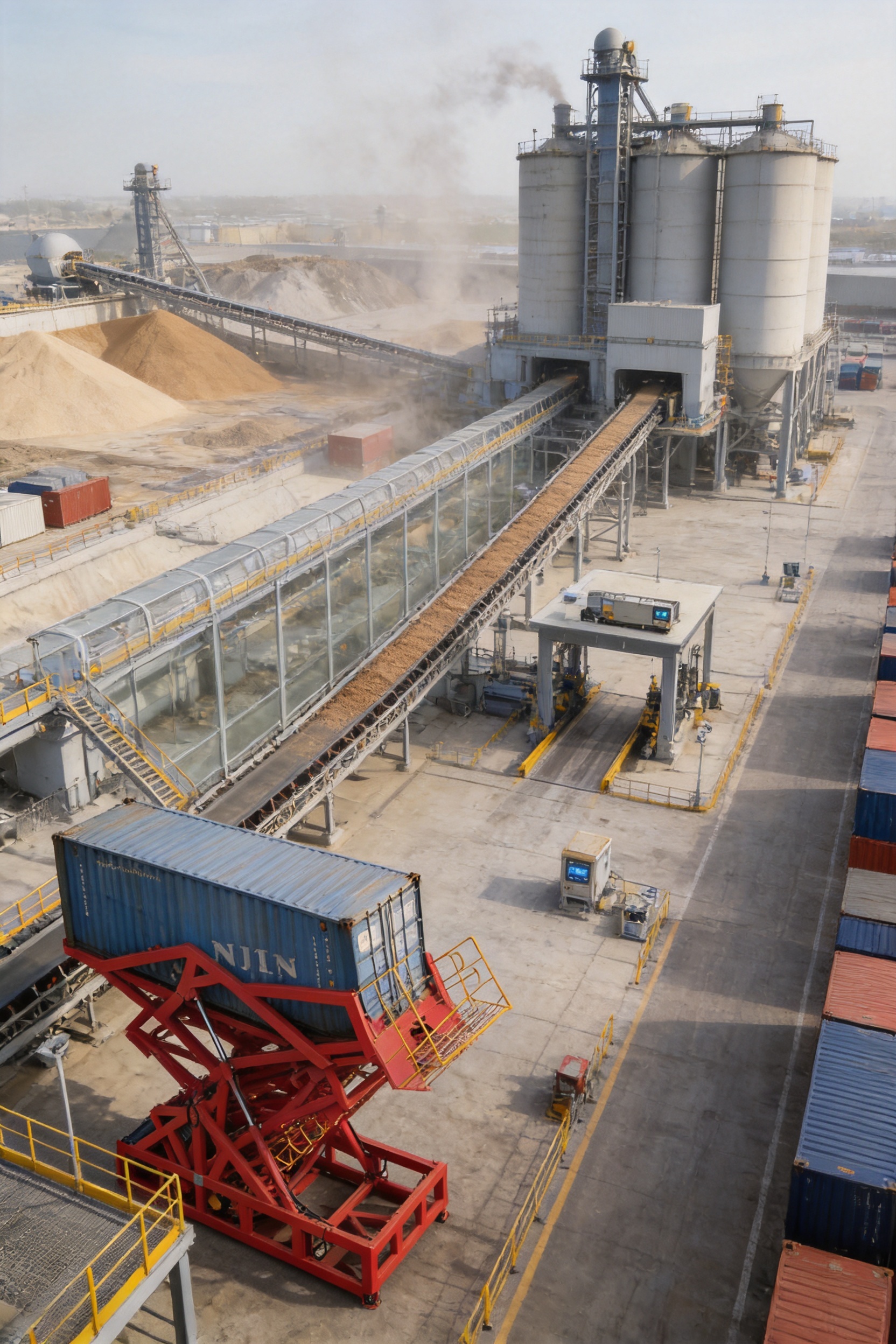
Environmental performance is increasingly important in bulk-material handling. The enclosed loading or unloading method can reduce dust overflow compared with open tipping. When the discharge area is connected to a properly sized dust collector, fugitive emissions can be reduced further.
Gravity-assisted unloading can also reduce the need for extensive pneumatic conveying in suitable applications. Lower reliance on vacuum equipment may reduce energy consumption, although the total energy profile depends on the hydraulic power unit, conveyors, dust collector, operating time, and material transfer distance.
The simple mechanical layout supports maintainability. Key lubrication points can be located externally, and the main hydraulic components can be arranged for inspection and service access. Less complex access reduces the time required for routine maintenance and helps keep the machine available for production.
Environmental protection also depends on correct material containment. Flexible seals, enclosed hoppers, negative-pressure extraction, spill collection, and regular housekeeping should be considered as part of the complete project rather than as optional afterthoughts.
13. Selecting the Right Configuration
The correct machine should be selected according to more than container length. The customer should provide information about the maximum gross load, container tare weight, material type, bulk density, moisture content, flow behavior, temperature, abrasiveness, daily volume, target cycle time, and required rotation angle.
The facility layout is equally important. Engineers must know the available foundation area, truck approach direction, overhead clearance, conveyor elevation, hopper position, dust-collector location, maintenance access, and emergency routes. A machine that fits the container but not the site will not deliver the expected operational value.
Automation requirements should be defined early. Automatic doors, weighing, barcode recognition, remote monitoring, conveyor control, and plant-level data exchange may affect the machine’s electrical design and control architecture. Including these requirements from the beginning is normally more efficient than retrofitting them after installation.
Customers should also evaluate service support, spare-parts availability, documentation, operator training, warranty conditions, and response time. Heavy-duty equipment is a long-term capital investment, so lifecycle support is as important as the initial purchase price.
14. Frequently Asked Questions
Q1: What container sizes can the machine handle?
The standard configurations are designed for 20-foot and 40-foot containers. The TJFJ 20 model is intended for 20-foot containers, while the TJFJ 40 model is intended for 40-foot containers. Customized frames may be developed for other container sizes, provided that the container structure, load, corner castings, and operating requirements are evaluated.
Q2: What is the maximum lifting capacity?
The supplied technical information lists maximum lifting weight configurations of 30 or 40 tonnes. The correct rating depends on the selected model and engineering configuration. The calculation must include the container tare weight, material weight, load distribution, and any additional attachments. The approved rating must never be exceeded.
Q3: Can the machine unload powders and sticky materials?
Yes, but material behavior must be considered during design. Free-flowing powders and granular products are usually the easiest to discharge. Sticky or cohesive materials may require vibration, air-knife attachments, special liners, modified rotation sequences, or a larger discharge opening. Material trials may be recommended before final configuration.
Q4: Does the machine require workers to enter the container?
The machine is designed to minimize manual container entry. Automatic door control and enclosed discharge systems can further reduce close-range intervention. However, inspection and cleaning procedures may still require access under controlled conditions. Any entry must follow the facility’s confined-space and isolation procedures.
Q5: Can weighing equipment be integrated?
Yes. An optional high-precision dynamic weighing module can monitor loading weight in real time. Weighing helps prevent overloading, improve shipment accuracy, and generate outbound records. Calibration and accuracy requirements should be defined during project planning.
Q6: Can it be connected to a dust collector?
Yes. The discharge area can be enclosed with flexible seals and connected to a dust-extraction system. The dust collector must be sized according to the material, discharge rate, enclosure volume, and applicable environmental or combustible-dust requirements.
Q7: Is a mobile version available?
A mobile chassis design can be configured for facilities that need to transfer the machine between work stations. The site must provide suitable ground conditions, access clearance, power arrangements, and safe travel procedures. The machine must be stabilized correctly before lifting or rotating a container.
Q8: How often does the hydraulic oil need to be changed?
The supplied maintenance guidance recommends replacement every 3,000 operating hours or every 18 months. Actual intervals should be confirmed through oil analysis, operating conditions, manufacturer instructions, and local maintenance procedures.
Q9: How many containers can be processed per hour?
Indicative application data shows a range of approximately four to nine containers per hour. The actual rate depends on material type, container size, loading pattern, rotation angle, receiving conveyor speed, door operation, weighing, dust extraction, and operator workflow.
Q10: What makes this equipment suitable for export projects?
The manufacturer has experience supplying automated loading and unloading equipment to several international markets. Its engineering capability covers customized structures, hydraulic systems, electrical controls, weighing, dust collection, conveyor interfaces, and remote monitoring. Export projects should still be reviewed against the customer’s local safety, electrical, environmental, and installation requirements.
15. Conclusion
A container flipping machine provides an efficient way to automate the loading and unloading of bulk materials in shipping containers. Its principal advantages come from the coordinated use of gravity, controlled hydraulic rotation, secure container clamping, and optional automation. Compared with manual labor, it improves consistency and reduces physical handling. Compared with vacuum-based systems, it can offer a simpler gravity-assisted process for many granular and bulk products. Compared with basic tilting platforms, its reinforced structure, hydraulic safety features, weighing options, and integration capability make it better suited to demanding industrial duty.
The equipment is appropriate for grain terminals, mineral and cement plants, chemical factories, food ingredient facilities, recycling centers, ports, warehouses, and other high-volume logistics operations. Models for 20-foot and 40-foot containers can be engineered with 30- or 40-tonne lifting configurations and a maximum standard lifting angle of 0–90 degrees, subject to the approved design.
The manufacturer’s strengths extend beyond the machine itself. Its product range includes several forms of automated loading and unloading equipment, allowing customers to obtain integrated solutions for vehicles, containers, conveyors, storage systems, weighing, and dust control. High-strength structural fabrication, finite element analysis, hydraulic balancing, customized engineering, international project experience, and after-sales support contribute to the machine’s long-term value.
For the best result, the equipment should be selected as part of a complete material-handling system. Careful evaluation of material properties, container weights, site layout, safety requirements, automation objectives, and maintenance resources will help ensure that the container flipping machine delivers reliable throughput, improved working conditions, and efficient long-term operation.
References
1. Jiangsu Zhengding Intelligent Equipment Co., Ltd. Product information for container flipping machines, automated loading and unloading systems, and related logistics equipment.
2. Industrial logistics application data for containerized bulk-material handling, including indicative throughput, material density, and unloading-cycle performance.
3. General engineering principles for hydraulic lifting equipment, container corner-casting engagement, structural fatigue analysis, and industrial machine safety.
4. General maintenance guidance for hydraulic cylinders, hydraulic oil systems, industrial bearings, safety interlocks, and heavy-duty material-handling machinery.
5. General dust-control and enclosed-transfer practices for grain, cement, mineral, food-powder, chemical, recycling, and waste-handling facilities.


