

 English
 русский
 Español
 Français
 Português
 عربى





+86-13588556918
Content
- 1 Introduction
- 2 1. What Is a Container Loader?
- 3 2. Integrated Loading and Unloading Capability
- 4 3. Compatibility with 20-Foot and 40-Foot Containers
- 5 4. Automatic Door Operation and Improved Workplace Safety
- 6 5. Precision Weighing and Load Monitoring
- 7 6. Precision Drive Control for Stable Cargo Movement
- 8 7. Productivity Advantages Compared with Conventional Methods
- 9 8. Manufacturing and Engineering Strengths
- 10 9. Competitive Advantages of the Product
- 10.1 Advantage one: one system for two operations
- 10.2 Advantage two: compatibility with different container lengths
- 10.3 Advantage three: lower manual intervention
- 10.4 Advantage four: integrated weight control
- 10.5 Advantage five: smoother product handling
- 10.6 Advantage six: suitability for industrial applications
- 10.7 Advantage seven: complete project support
- 11 10. Industry Applications
- 12 11. Installation and Layout Considerations
- 13 12. Maintenance and Long-Term Reliability
- 14 13. Frequently Asked Questions
- 14.1 Q1: What types of products can be handled by a container loader?
- 14.2 Q2: Can one machine handle both 20-foot and 40-foot containers?
- 14.3 Q3: Does the equipment include automatic container door operation?
- 14.4 Q4: How does the weighing function work?
- 14.5 Q5: Can automated loading reduce product damage?
- 14.6 Q6: How many operators are required?
- 14.7 Q7: Is the equipment suitable for integration with a warehouse management system?
- 14.8 Q8: What information should be provided before requesting a quotation?
- 14.9 Q9: Can the equipment be customized?
- 14.10 Q10: What training is normally required?
- 15 14. Why Select an Integrated Manufacturer?
- 16 Conclusion
- 17 References
- 18 Product: Container Loaders
Introduction
Container loading and unloading is a critical stage in modern logistics. It directly affects warehouse productivity, transport scheduling, labor costs, cargo safety, container utilization, and the overall reliability of the supply chain. Traditional manual loading methods may be suitable for small-scale operations, but they become increasingly inefficient when a facility must process a high volume of containers every day. Manual handling also creates challenges related to uneven weight distribution, cargo damage, worker fatigue, confined-space risks, and inconsistent loading times.
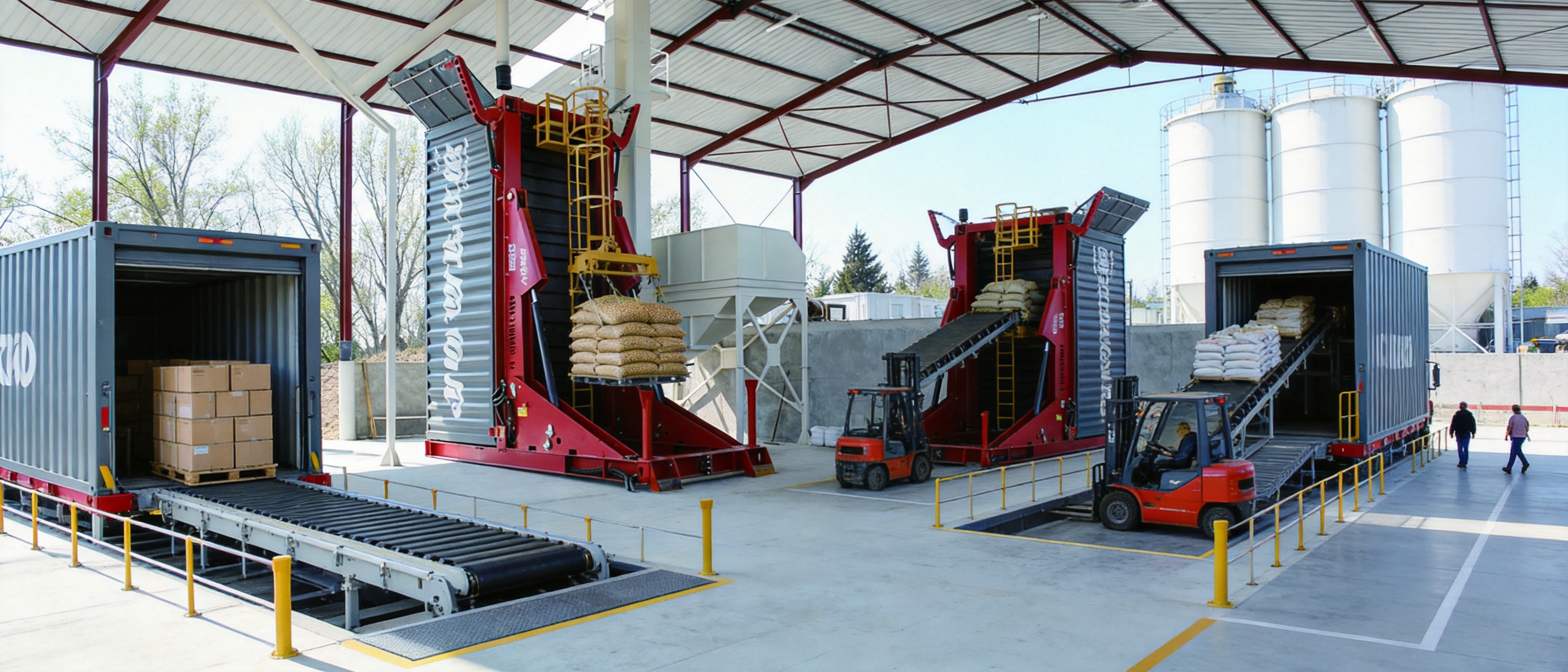
Container loaders provide a more systematic alternative. Designed to combine loading and unloading functions in one integrated system, these machines help operators move products into and out of 20-foot and 40-foot standard containers with substantially less manual intervention. Through the combination of controlled movement, optional automatic door operation, precision weighing, and flexible container adjustment, the equipment supports a safer and more predictable logistics process.
Jiangsu Zhengding Intelligent Equipment Co., Ltd. develops and manufactures automated loading and unloading equipment for automobiles, containers, ships, and industrial logistics applications. Its container loader range is designed for customers that need dependable performance, adaptable configurations, and improved control over loading operations. The equipment is suitable for industries handling packaged products, bulk materials, agricultural goods, food ingredients, chemicals, cement, minerals, grain, feed, and other cargo types.
This article explains the operating principle, technical characteristics, competitive advantages, manufacturing strengths, application value, installation considerations, and maintenance requirements of modern container loaders. It also examines how integrated automation can improve productivity while reducing risks associated with conventional loading methods.
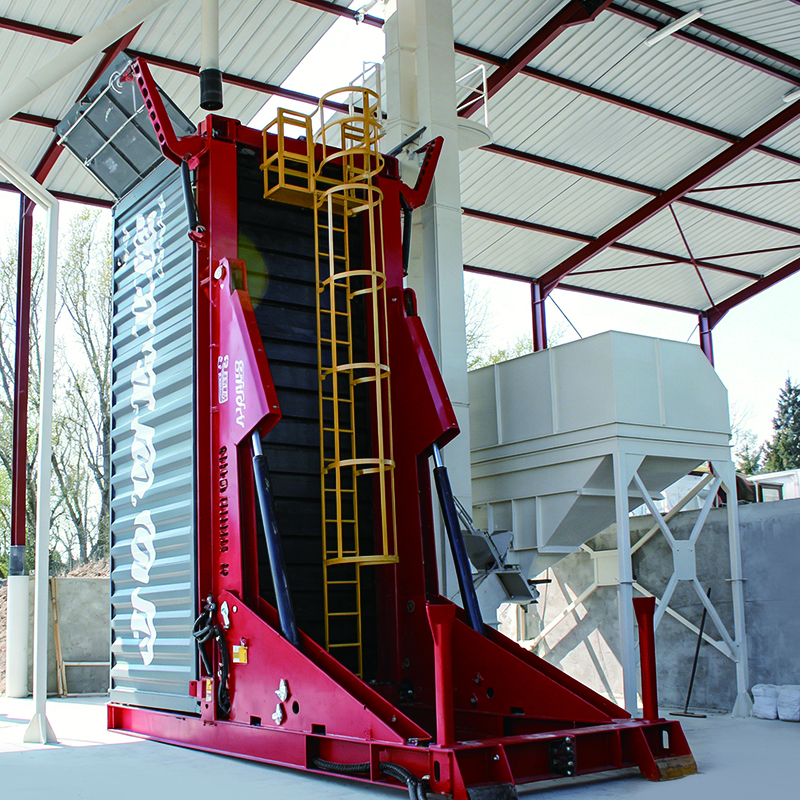
Container Loaders
1. What Is a Container Loader?
A container loader is an industrial machine used to load goods into shipping containers or remove goods from them. Depending on the system configuration, the equipment may use conveying, lifting, pushing, tilting, telescopic, or other controlled movement technologies. The main objective is to transfer cargo efficiently while maintaining stable product movement and making effective use of the available container space.
Unlike a basic conveyor extension, an integrated container loader is designed as a complete loading and unloading solution. The system can coordinate the movement of goods, container positioning, weighing, door operation, and operating controls. This coordinated design reduces the need for separate equipment and helps create a more organized loading station.
The container loaders described in this product range are designed to accommodate both 20-foot and 40-foot containers. A flexible adjustment mechanism allows the equipment to adapt to different standard container lengths. This feature is particularly valuable for warehouses and terminals that handle mixed container fleets and cannot dedicate a separate loading system to each container size.
The equipment can be used in a variety of loading environments. It may be installed at a warehouse dock, industrial transfer station, distribution center, port facility, production plant, or specialized bulk-material handling site. Depending on the cargo and process requirements, the system can be integrated with conveyors, storage systems, weighing equipment, warehouse management platforms, and other automated logistics equipment.
Modern container loaders are not limited to one material type. They can be configured for bagged goods, cartons, sacks, palletized products, bulk granules, powders, agricultural materials, and selected irregular-shaped cargo. The appropriate conveyor surface, loading tool, speed, control system, and protective measures depend on the physical properties of the products being handled.
Core operating functions
The first core function is cargo transfer. The machine moves goods between the warehouse or production line and the container interior. Controlled movement helps reduce unnecessary manual carrying, lifting, and repositioning.
The second function is container adaptation. The system adjusts to the length and position of the container so that the loading mechanism can reach the required operating area. This is essential for both 20-foot and 40-foot containers.
The third function is process control. Operators can use the control system to start, stop, adjust, and monitor the equipment. Precision drive control helps maintain stable movement and reduces sudden acceleration, deceleration, or impact.
The fourth function is optional weighing. When configured with an integrated weighing system, the loader can monitor cargo weight during the loading process. This helps operators prevent overloading and supports more accurate shipment records.
The fifth function is automatic door operation. An optional automatic door-opening and closing mechanism can eliminate the need for workers to manually handle heavy container doors. This reduces labor intensity and lowers the risk of hand injuries, impact injuries, and unsafe working positions.
2. Integrated Loading and Unloading Capability
One of the most important advantages of this equipment is its ability to perform both loading and unloading operations. A single machine can support the movement of goods into a container and the removal of goods from the container, depending on the operating mode and system configuration.
Many conventional facilities use separate tools for loading and unloading. A conveyor may be used for one operation, while forklifts, manual labor, or temporary lifting tools are used for the other. This fragmented arrangement can increase equipment investment, consume more floor space, and complicate operator training. It may also create inconsistent operating procedures from one shift to another.
An integrated loader provides a more unified approach. The same equipment platform can be designed around the customer’s material flow, container access requirements, and warehouse layout. The result is a more organized work area in which loading and unloading functions are managed through a common control concept.
Integrated operation can also reduce transfer time between different pieces of equipment. When cargo is handled by multiple independent machines, every transfer point creates a possibility of delay, product impact, spillage, or misalignment. A coordinated loader helps reduce unnecessary handling stages and supports smoother material movement.
For high-throughput facilities, this integrated design can improve dock utilization. Containers can enter the loading position, be processed, and leave the station with fewer interruptions. Faster turnover is especially valuable where demurrage charges, vehicle waiting time, or limited dock availability affect logistics costs.
Value for mixed logistics operations
Warehouses often process different cargo flows during the same working day. One container may need to be filled with finished products, while another may need to be emptied for inspection, repacking, or internal distribution. A dual-function system gives the facility greater flexibility when priorities change.
The loader can also support different operating patterns without requiring a complete change of infrastructure. For example, the same station may handle outbound shipments during the morning and inbound container unloading during the afternoon. This flexibility improves the utilization of the equipment and the loading bay.
Compared with a manual process, integrated loading and unloading may reduce the number of workers required in the container area. The exact labor saving depends on cargo type, packaging, container configuration, and automation level, but the reduction in manual handling can be significant in repetitive operations.
3. Compatibility with 20-Foot and 40-Foot Containers
Container dimensions are not uniform across every logistics operation. A facility that handles only one container length may optimize its equipment for that specific application. However, many manufacturers, exporters, distributors, and terminals process both 20-foot and 40-foot containers. The ability to adapt to both sizes is therefore a major practical advantage.
The container loader range includes models designed around different loading lengths. The TJXH 20 model has a listed size of approximately 6 meters by 3 meters, while the TJXH 40 model has a listed size of approximately 12 meters by 3 meters. These configurations correspond to the operating requirements of 20-foot and 40-foot standard containers.
The flexible adjustment mechanism allows the equipment to align with the selected container. Proper alignment improves the reach and positioning of the loading system, reduces dead space in the operating area, and helps ensure that cargo is moved to the intended location inside the container.
Container compatibility also supports more efficient use of warehouse space. Instead of installing two unrelated loading stations, a company may be able to organize one adaptable loading area around a flexible machine configuration. Site-specific engineering is still required, but the equipment concept provides a strong foundation for mixed-container operations.
Compatibility should also be evaluated together with the customer’s loading pattern. Some applications require movement from the container entrance toward the rear, while others require more controlled distribution across the container floor. The operating range, conveyor or transfer mechanism, access height, and container support structure must be matched to the actual process.
Container positioning and alignment
Reliable container positioning is essential for safe and efficient loading. The container must be placed correctly relative to the equipment so that the transfer mechanism does not collide with the container structure or create unstable cargo movement.
A well-designed loading station may include positioning guides, mechanical stops, sensors, support structures, and operating interlocks. These components help operators confirm that the container is in the correct location before the loading cycle begins.
Alignment also improves repeatability. When the machine encounters the same container position during each cycle, the control system can use consistent operating parameters. This reduces the need for frequent manual adjustment and makes it easier to train operators.
4. Automatic Door Operation and Improved Workplace Safety
Container doors are heavy, large, and often difficult to handle in confined loading areas. Manual door operation can expose workers to pinch points, sudden movement, awkward postures, and contact with the door edge. In adverse weather or on uneven ground, these risks may increase.
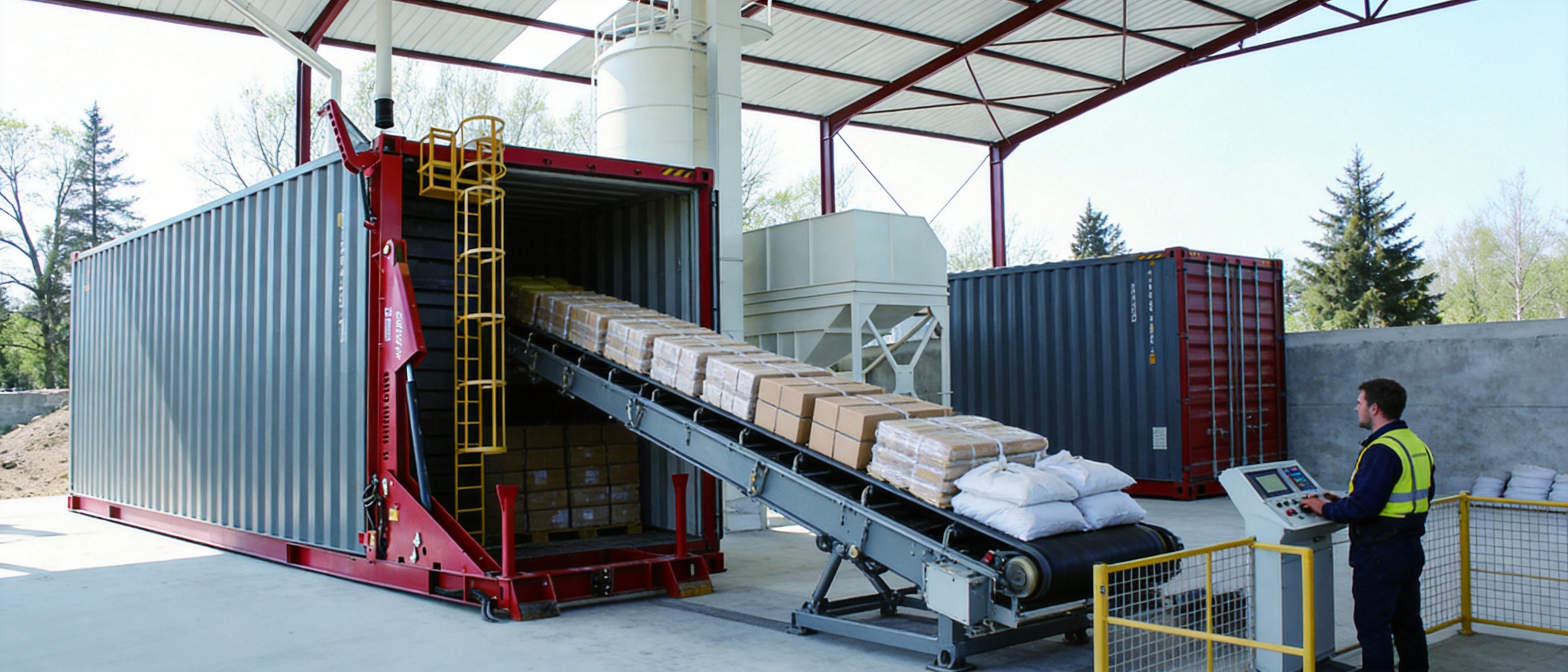
The container loader can be configured with an automatic door-opening and closing mechanism. This option enables the equipment to coordinate door operation with the loading process. By reducing manual interaction with the doors, the system helps lower labor intensity and improve workplace safety.
Automatic door operation also supports process consistency. Manual doors may not be opened to the same position every time, and workers may need to pause the loading process to reposition them. An automated mechanism can provide a defined operating sequence, helping the machine begin its cycle only when the door is in the correct condition.
Safety benefits extend beyond the door itself. Reduced manual intervention means fewer workers need to enter the immediate container loading zone. This can help separate people from moving equipment and create a clearer division between operator areas, vehicle areas, and cargo transfer areas.
Automation does not eliminate the need for safety procedures. Operators must still follow site rules, use emergency stops correctly, inspect the equipment, and confirm that no person is inside a restricted area before movement begins. However, automatic door operation can remove one of the most physically demanding and repetitive manual tasks in the process.
5. Precision Weighing and Load Monitoring
Accurate cargo weight is essential for transport safety, shipping documentation, inventory control, and regulatory compliance. Overloaded containers may create problems during road transport, lifting, stacking, and vessel loading. Underfilled containers may represent inefficient use of transport capacity.
The container loader can be equipped with a high-precision weighing function. During the loading process, the system can monitor cargo weight in real time and display the relevant information to the operator. This makes it easier to stop the process when the required weight has been reached.
Real-time weighing provides several advantages over estimating weight before loading. Product density may vary, packaging may differ, and the actual quantity transferred may not exactly match the planned quantity. Measuring during the operation gives the loading team direct information about the current cargo condition.
When connected to a management system, weighing data can be uploaded in real time. This supports digital records, shipment verification, production planning, and inventory management. It may also reduce paperwork and improve traceability throughout the logistics process.
Weighing integration can be particularly valuable in industries handling grain, feed, chemicals, minerals, cement, food ingredients, and other products that are shipped according to weight. It can also support quality control by creating a record of the quantity loaded into each container.
Preventing overloading
Overloading can result from inaccurate estimates, rushed manual handling, or poor communication between warehouse and transport personnel. An integrated weighing function gives the operator an immediate reference point and helps prevent the loading process from exceeding the planned weight.
The weighing system should be calibrated according to the manufacturer’s instructions and verified at appropriate intervals. Environmental conditions, foundation stability, vibration, product buildup, and incorrect installation can influence weighing accuracy. Proper commissioning and maintenance are therefore important to achieve dependable measurement performance.
Weight data may also be used to improve logistics analysis. By comparing planned and actual cargo quantities, managers can identify recurring discrepancies, improve material planning, and optimize container utilization.
6. Precision Drive Control for Stable Cargo Movement
Cargo damage is often caused not by the main transfer action but by uncontrolled acceleration, sudden stopping, collisions, or poor positioning. Fragile packages, stacked cartons, bags, and irregular products can shift or fall when movement is not properly controlled.
The container loader uses a precision drive control system to support smooth movement during loading and unloading. The control system manages the speed and direction of the equipment so that products move in a more stable and predictable manner.
Smooth drive control can reduce impacts between products and the container interior. It can also help prevent packages from being pushed too aggressively against the rear wall or side walls. For palletized or sensitive goods, this controlled movement may reduce the likelihood of shifting, crushing, tearing, or deformation.
Precise control also improves operator confidence. When equipment responds consistently to commands, operators can manage the process with less hesitation. Repeatable movement makes it easier to establish standard operating procedures and maintain consistent cycle times between shifts.
In automated systems, drive control may be combined with sensors, position feedback, overload protection, emergency stops, and programmable operating sequences. The exact level of automation depends on the selected configuration and the customer’s application requirements.
Protecting products during transfer
Product protection begins with selecting the correct loading method. Powder, granular material, bags, cartons, pallets, and irregular items may require different conveying and positioning solutions. The loader should be configured according to product weight, shape, fragility, flow characteristics, packaging strength, and required loading pattern.
Controlled acceleration is especially important when handling goods in bags or cartons. Excessive speed may cause the products to slide, overturn, or collide. A balanced operating speed can improve the relationship between productivity and cargo protection.
The internal arrangement of the container is also important. Evenly distributed cargo reduces pressure on individual packages and helps maintain vehicle stability. Automated movement can support more consistent placement than a process that depends entirely on manual judgment.
7. Productivity Advantages Compared with Conventional Methods
The most visible benefit of automated container loading is the reduction in loading time. Manual loading with forklifts may require approximately 18 to 25 minutes per container, depending on the cargo and site conditions. A semi-automatic system may reduce this period substantially, while a fully automated loader can achieve typical cycle times in the range of 3 to 6 minutes for suitable applications.
The exact result depends on container size, cargo type, packaging, loading pattern, equipment configuration, operator experience, and material supply. Nevertheless, automation can provide a major improvement in throughput when compared with repetitive manual handling.
Faster loading and unloading can reduce truck waiting time and improve the use of loading bays. When a facility processes many containers per day, even a small reduction in the cycle time of each container can create a significant increase in daily capacity.
Automation may also reduce the number of workers assigned to each loading operation. Manual methods may require several employees to drive forklifts, move packages, position cargo, open doors, check weight, and supervise the container. An automated system can often consolidate these tasks so that one or two trained operators supervise the process, depending on the application.
| Performance Item | Manual Loading | Automated Container Loading | Typical Benefit |
|---|---|---|---|
| Time per container | Approximately 18 to 25 minutes | Approximately 3 to 6 minutes | About 70 to 80 percent faster in suitable applications |
| Workers required per shift | Approximately 4 to 6 people | Approximately 1 to 2 operators | About 60 to 75 percent less direct labor |
| Container fill rate | Approximately 82 to 88 percent | Approximately 92 to 96 percent | About 5 to 8 percent better utilization |
| Product damage rate | Approximately 2.5 to 4.0 percent | Approximately 0.5 to 1.2 percent | Potential reduction of about 60 to 80 percent |
The figures in this comparison are typical industry-oriented values rather than guaranteed results for every installation. Actual performance must be confirmed through application analysis, testing, and commissioning. Even so, the comparison shows why automated loading equipment is increasingly considered for high-volume operations.
Improved container fill rates
Manual loading often leaves empty spaces because workers must balance speed, reach, safety, and physical effort. Products may be placed unevenly, and the rear area of the container may be more difficult to fill effectively.
Automated systems can use planned movement patterns to distribute products more evenly. Depending on the product, the system may adjust the loading position, layer arrangement, transfer speed, and sequence. Better distribution can increase the usable volume of the container and reduce unnecessary voids.
Improved fill rates may reduce the number of containers required for a given shipment volume. This can lower transportation cost, handling cost, and the environmental impact associated with moving partially filled containers.
8. Manufacturing and Engineering Strengths
The performance of a container loader depends not only on its visible mechanical structure but also on the engineering process behind the product. Reliable operation requires coordinated design of the frame, drive system, control system, weighing equipment, safety devices, container interface, and customer-side infrastructure.
Jiangsu Zhengding Intelligent Equipment Co., Ltd. is a national high-tech enterprise engaged in the research, development, manufacturing, and sales of intelligent automated loading and unloading equipment. Its product range includes rear dumpers, side-turn truck dumpers, car loading equipment, container flippers, and other systems for vehicle and container logistics.
The company’s broader product experience is relevant to container loader development because automobile, container, and bulk-material handling systems share many engineering requirements. These include heavy-duty structural design, controlled lifting or movement, accurate positioning, safety interlocking, hydraulic or electric actuation, system integration, and dependable operation in demanding industrial environments.
Application-oriented engineering
A strong manufacturing process begins with understanding the customer’s actual logistics flow. Before equipment is finalized, engineers may evaluate container types, cargo characteristics, daily throughput, available floor space, dock height, transport routes, power supply, environmental conditions, and integration requirements.
This approach helps avoid a common weakness of generic equipment: selecting a machine based only on nominal capacity without considering the full process. A container loader must work with the container, warehouse, transport vehicles, upstream production line, operators, and management system. The equipment is most effective when it is designed as part of the complete logistics solution.
Site assessment is therefore an important part of the engineering process. It helps determine the required dimensions, operating clearances, foundation conditions, access routes, safety zones, and connection points for conveyors, weighing systems, control cabinets, and data networks.
Heavy-duty structural design
Container loading equipment must withstand repetitive operation and substantial dynamic loads. The supporting frame, loading platform, guide structures, and moving components need sufficient strength and stability for the intended application.
Structural design should account for static loads, impact forces, vibration, eccentric loading, repeated cycles, and environmental conditions. Proper fabrication and quality control are essential to ensure that the assembled machine maintains alignment during long-term use.
For customers handling heavy cargo or operating at high frequency, structural reliability is a decisive purchasing factor. A machine that performs well during initial operation but requires frequent repairs can create greater cost than a more robust system with a higher initial investment.
Control system integration
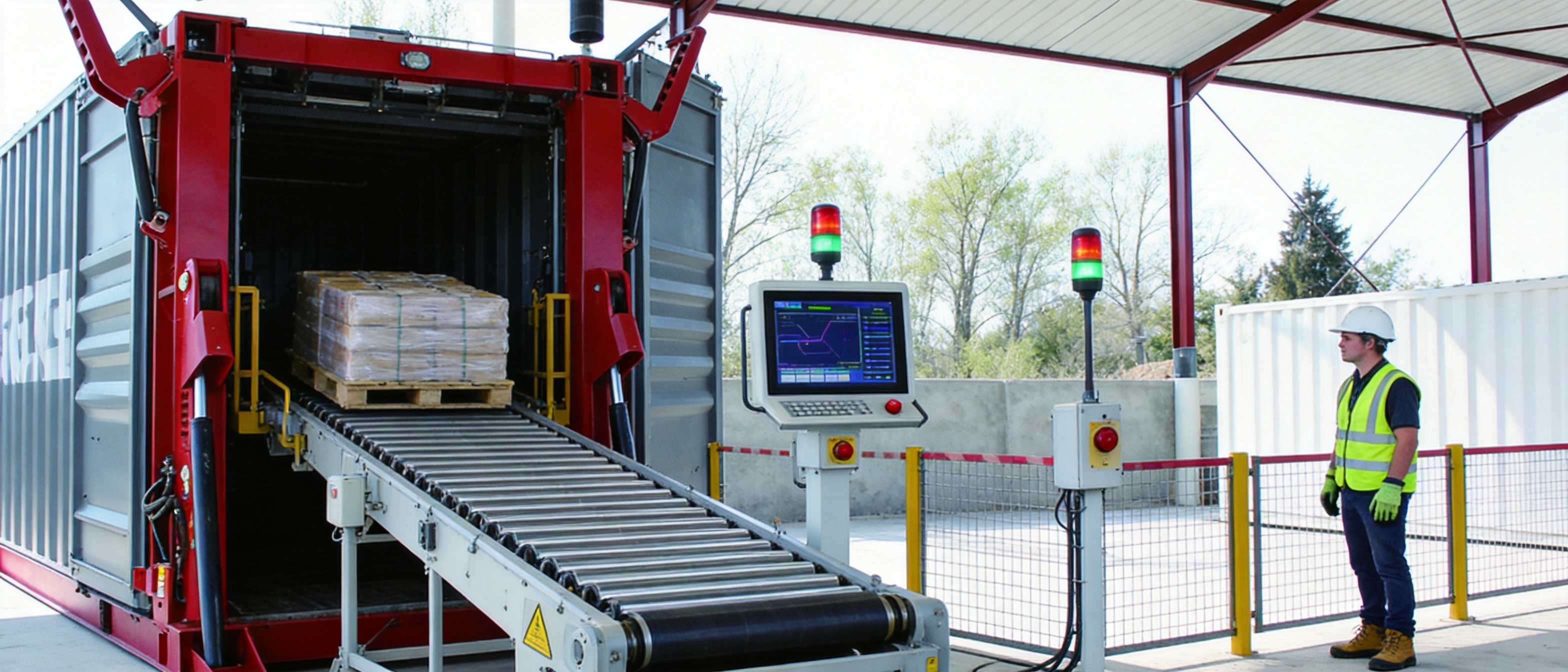
Modern container loaders rely on a control system that coordinates the operating sequence. The control architecture may include programmable logic controllers, sensors, motor controls, weighing modules, safety interlocks, operator interfaces, and communication functions.
Integrated control reduces the need for separate manual decisions during routine operation. It can guide the sequence from container positioning and door opening through cargo transfer, weighing confirmation, stopping, and unloading or departure.
The ability to upload weighing data to a management system is another example of digital integration. Data connectivity can support production records, warehouse management, shipment documentation, and performance analysis.
Quality control and commissioning
Manufacturing quality is not limited to the final assembly stage. It includes material selection, component inspection, fabrication accuracy, electrical assembly, software configuration, testing, and final verification.
Before delivery, equipment should be checked for movement accuracy, load response, emergency stop function, door mechanism operation, weighing performance, sensor feedback, and interface communication. Testing under simulated or actual operating conditions can reveal issues that may not be visible during an unloaded test.
Commissioning at the customer’s site is also important. The equipment must be aligned with the container position, connected to utilities and upstream systems, and adjusted to match the customer’s cargo. Operator training helps ensure that the system is used correctly from the beginning.
9. Competitive Advantages of the Product
Container loaders compete with manual labor, forklifts, conveyor extensions, semi-automatic transfer systems, and separate loading and unloading machines. The integrated product concept offers several advantages over these alternatives.
Advantage one: one system for two operations
The ability to load and unload with one equipment platform simplifies the process and improves asset utilization. Customers do not need to depend entirely on separate equipment for inbound and outbound container work.
Advantage two: compatibility with different container lengths
The adjustment mechanism supports both 20-foot and 40-foot standard containers. This gives the equipment a wider application range than a dedicated system designed for only one container size.
Advantage three: lower manual intervention
Automatic door operation, controlled cargo movement, and optional weighing reduce the number of repetitive manual tasks. This can lower labor requirements and improve workplace safety.
Advantage four: integrated weight control
The optional precision weighing function allows operators to monitor the load in real time. This is more reliable than depending only on pre-calculated quantities or separate weighing steps.
Advantage five: smoother product handling
The precision drive control system helps reduce sudden movement and cargo collision. This is valuable for businesses that must protect packaged goods and maintain consistent loading quality.
Advantage six: suitability for industrial applications
The company’s experience with automatic loading and unloading equipment for vehicles and containers supports the development of equipment for demanding sectors such as steel, chemicals, cement, coal, grain, oil, food, feed, ports, papermaking, and new energy.
Advantage seven: complete project support
Customers can receive support that extends beyond the machine itself. Site assessment, system design, installation supervision, commissioning, operator training, and technical service contribute to a more complete implementation process.
10. Industry Applications
Food and beverage manufacturers can use container loaders to transfer packaged ingredients, finished products, cartons, bags, and palletized goods. Controlled movement and weighing are especially useful where hygiene, traceability, and accurate shipment quantities are important.
Grain and agricultural facilities may use the equipment for sacks, bagged products, feed, seeds, and other agricultural materials. Real-time weight monitoring helps manage shipment quantities, while automated movement can reduce repetitive manual work.
Cement, mineral, and chemical companies often handle heavy bags, powders, granular products, or packaged industrial materials. These operations may benefit from reduced worker exposure to dust, heavy lifting, and confined container spaces. The specific machine configuration must be selected according to product flow characteristics and safety requirements.
Steel and industrial manufacturing companies may use loading equipment for components, packaged raw materials, metal products, or production supplies. Robust structural design and precise movement are important when cargo is heavy or the loading frequency is high.
Ports, distribution centers, and logistics service providers can use container loaders to improve the turnover of loading bays. A faster, more standardized process helps these facilities manage variable shipment volumes and reduce vehicle waiting time.
Oil, food ingredient, feed, and consumer goods businesses may also benefit from automated loading because their operations often involve repeated container cycles and strict shipment documentation requirements.
11. Installation and Layout Considerations
Successful installation begins with a detailed review of the site. The customer should confirm the available length, width, height, access route, container parking area, vehicle movement path, power supply, drainage, lighting, and emergency access.
The foundation must be suitable for the equipment’s static and dynamic loads. An uneven or weak foundation can affect alignment, weighing accuracy, vibration, and long-term structural performance. Foundation requirements should be confirmed during the engineering stage rather than after equipment delivery.
The loading area should provide enough clearance for workers, vehicles, container doors, maintenance access, and emergency evacuation. Safety barriers, warning signs, interlocks, and restricted zones should be planned as part of the complete installation.
The upstream and downstream material flow should also be considered. A high-performance container loader cannot achieve its full capacity if products are supplied inconsistently or if finished containers cannot leave the station promptly. The surrounding conveyor, warehouse, and transport arrangements should support the target cycle time.
For systems with weighing functions, the weighing structure should be isolated from unnecessary vibration and external interference. Calibration access should be provided, and operators should be trained in the correct weighing procedure.
Operator training
Basic operator training typically covers equipment startup, shutdown, loading and unloading sequences, door operation, container positioning, weighing controls, alarm handling, emergency stops, and daily inspection.
Operators should also understand the limits of the machine. They must know the permitted cargo weight, acceptable product dimensions, container requirements, restricted areas, and conditions that require the equipment to be stopped.
Advanced training may include parameter adjustment, fault diagnosis, sensor inspection, weighing calibration procedures, and communication with the management system. Maintenance personnel may require additional instruction on mechanical, electrical, hydraulic, and control-system components.
12. Maintenance and Long-Term Reliability
Routine maintenance helps preserve performance and reduce unplanned downtime. Daily inspections may include checking for abnormal noise, loose fasteners, product buildup, damaged guards, sensor contamination, cable wear, hydraulic leakage, and unusual movement.
Moving components should be inspected according to the manufacturer’s maintenance schedule. Lubrication, tension adjustment, alignment checks, and wear-part replacement should be completed at the recommended intervals.
The automatic door mechanism requires particular attention because it operates in a high-contact area. Door engagement components, sensors, stops, and protective devices should be checked regularly to ensure that the mechanism opens and closes smoothly.
Weighing equipment must be protected from impact, dirt accumulation, and unauthorized adjustment. Periodic verification helps maintain accurate measurement. If the displayed weight changes unexpectedly or differs significantly from an independent check, the system should be inspected before continued operation.
Control cabinets and electrical connections should be kept clean and dry. Cooling systems, terminal connections, sensors, and emergency-stop circuits should be checked by qualified personnel. Software settings should be documented so that approved changes can be identified and reversed if necessary.
Preventive maintenance is generally more economical than emergency repair. A planned maintenance program can coordinate inspections with production schedules and reduce the likelihood of an unexpected shutdown during a high-demand period.
13. Frequently Asked Questions
Q1: What types of products can be handled by a container loader?
Container loaders can be configured for bagged goods, cartons, sacks, palletized units, bulk granules, powders, grain, feed, food ingredients, and selected irregular-shaped products. The appropriate design depends on product weight, shape, packaging strength, flow behavior, dust characteristics, and required loading pattern. Belt conveyors, slat conveyors, telescopic transfer devices, push mechanisms, or other tools may be selected according to the application.
Q2: Can one machine handle both 20-foot and 40-foot containers?
Yes. The equipment range is designed with a flexible adjustment mechanism for both 20-foot and 40-foot standard containers. The selected model and configuration must match the customer’s site, container positioning method, required reach, and cargo transfer process.
Q3: Does the equipment include automatic container door operation?
An automatic door-opening and closing mechanism can be configured as an option. This function reduces manual door handling, lowers labor intensity, and improves the consistency of the loading sequence. The final configuration depends on the container type and customer requirements.
Q4: How does the weighing function work?
When equipped with a precision weighing system, the loader monitors cargo weight during the loading or unloading operation. The information can be displayed to the operator and, where required, uploaded to a management system in real time. Proper calibration and maintenance are necessary to maintain measurement accuracy.
Q5: Can automated loading reduce product damage?
Controlled drive movement, stable transfer speeds, and more consistent loading patterns can reduce damage caused by collisions, sudden stops, uneven stacking, or excessive manual handling. The actual improvement depends on the product and the selected configuration, but automated control generally provides more repeatable movement than purely manual loading.
Q6: How many operators are required?
The number of operators depends on the level of automation, cargo type, safety procedures, and site layout. Many applications can be supervised by one or two trained operators, while additional personnel may be needed for inspection, pallet preparation, packaging, or upstream and downstream logistics tasks.
Q7: Is the equipment suitable for integration with a warehouse management system?
Yes. The system can be configured to support data communication, particularly for weighing information and operating records. Integration details depend on the customer’s management platform, communication protocol, data requirements, and information-security policies.
Q8: What information should be provided before requesting a quotation?
Customers should provide container sizes, cargo type, package dimensions, unit weight, daily container quantity, required cycle time, loading and unloading direction, site drawings, available power supply, weighing requirements, door automation requirements, and any existing conveyor or warehouse system details. This information enables a more accurate technical proposal.
Q9: Can the equipment be customized?
Container loading systems can be engineered according to different cargo characteristics, site layouts, container positions, throughput targets, and automation requirements. Customization may involve dimensions, transfer equipment, control functions, weighing, door mechanisms, data communication, safety devices, and integration with existing logistics equipment.
Q10: What training is normally required?
Basic operation and daily maintenance training commonly requires several days. Advanced programming, troubleshooting, calibration, and technical maintenance may require additional instruction. Suppliers generally provide operating documentation and commissioning support to help the customer establish safe and consistent procedures.
14. Why Select an Integrated Manufacturer?
Purchasing a container loader from an experienced integrated manufacturer provides advantages beyond the individual machine. The manufacturer can evaluate the entire process, coordinate mechanical and electrical design, manage installation requirements, and support the customer after delivery.
Jiangsu Zhengding Intelligent Equipment Co., Ltd. has developed a broad portfolio of automated loading and unloading equipment for vehicles, containers, ships, and related industrial applications. Its products are used in a wide range of sectors and exported to markets including Japan, Brazil, Egypt, Pakistan, India, the Middle East, and Southeast Asia.
The company’s experience serving international industrial users demonstrates the importance of adapting equipment to different operating environments, production standards, and application requirements. Its stated customer base includes companies in the beverage, grain, food, chemical, agricultural, construction-material, and consumer-goods sectors.
For customers planning a new loading station, replacing manual operations, or upgrading an existing facility, the manufacturer’s engineering capabilities can help connect equipment selection with long-term operational goals. The objective is not simply to supply a machine, but to create a safer, more measurable, and more efficient container handling process.
Conclusion
Container loaders are becoming an important solution for companies seeking to improve loading speed, safety, labor efficiency, cargo protection, and container utilization. Their value is particularly clear in operations that process a high number of containers or handle products that require accurate weight control and consistent movement.
The integrated design supports both loading and unloading, while the flexible adjustment mechanism accommodates 20-foot and 40-foot standard containers. Optional automatic door operation reduces manual handling, and precision weighing helps prevent overloading while improving shipment records. Precision drive control supports smoother cargo movement and reduces the risk of damage caused by collisions or unstable handling.
Compared with manual loading, container loaders can provide shorter cycle times, lower direct labor requirements, better fill-rate consistency, improved workplace safety, and more repeatable product quality. Their effectiveness depends on correct application design, suitable installation, operator training, preventive maintenance, and integration with the broader warehouse and transport process.
Jiangsu Zhengding Intelligent Equipment Co., Ltd. combines product development, manufacturing, system integration, installation support, and technical service to provide automated loading and unloading solutions for diverse industries. With experience in heavy-duty logistics equipment and international applications, the company is positioned to support customers looking for a dependable transition from manual container handling to intelligent automated logistics.
References
1. Jiangsu Zhengding Intelligent Equipment Co., Ltd., Container Loaders Product Information and Technical Parameters.
2. Jiangsu Zhengding Intelligent Equipment Co., Ltd., Automated Loading and Unloading Equipment Company Information.
3. International container handling and intermodal logistics operating practices.
4. Industrial conveyor, weighing, and automated material-handling engineering principles.
5. General occupational safety practices for container loading, unloading, and warehouse operations.
6. General preventive maintenance practices for automated logistics equipment.


