

 English
 русский
 Español
 Français
 Português
 عربى
عربى




+86-13588556918
Content
- 1 1. What Is an Automatic Side-Turn Truck Dumper?
- 2 2. Why Side-Turn Unloading Outperforms Conventional Methods
- 3 3. Main Product Advantages
- 3.1 3.1 Fully Automatic and Unmanned Operation
- 3.2 3.2 Selectable 45-Degree and 55-Degree Tilting
- 3.3 3.3 Optional High-Frequency Vibration
- 3.4 3.4 Optional Material Guiding Device
- 3.5 3.5 Optional Dedicated Operation Path
- 3.6 3.6 Reduced Material Residue and Cleanup
- 3.7 3.7 Adaptability to Different Vehicle Types
- 4 4. Technical Parameters and Model Selection
- 5 5. Safety Engineering for Automatic Side-Turn Dumpers
- 6 6. Applications Across Bulk Material Industries
- 7 7. Manufacturing Strengths and Engineering Capabilities
- 8 8. Integration with a Complete Automated Unloading Line
- 9 9. Comparing Side-Turn Dumpers with Competing Unloading Solutions
- 10 10. Return on Investment and Operating Economics
- 11 11. Installation Footprint and Site Planning
- 12 12. Maintenance and Service-Life Considerations
- 13 13. Company Expertise and International Project Experience
- 14 14. Recommended Project Selection Process
- 15 15. Frequently Asked Questions
- 15.1 Q1. Does an automatic side-turn dumper require special truck modifications?
- 15.2 Q2. What types of materials can the dumper handle?
- 15.3 Q3. Is the dumper suitable for food or grain applications?
- 15.4 Q4. Can one operator control the complete unloading process?
- 15.5 Q5. What is the difference between the 45-degree and 55-degree modes?
- 15.6 Q6. What happens if material remains inside the truck body?
- 15.7 Q7. What safety systems are normally included?
- 15.8 Q8. Can the dumper be connected to a conveyor and weighing system?
- 15.9 Q9. How much space does a standard unit require?
- 15.10 Q10. What is the expected payback period?
- 15.11 Q11. How often does the equipment need maintenance?
- 15.12 Q12. Can the equipment be customized?
- 16 16. Conclusion
- 17 References
- 18 Product: Automatic Side-Turn Truck Dumpers
Automatic side-turn truck dumpers are designed to transform the way bulk materials are unloaded from trucks and trailers. By combining a heavy-duty hydraulic lifting platform, automated vehicle positioning, secure clamping, controlled lateral rotation, and intelligent monitoring, these systems enable fast and consistent unloading with significantly less manual intervention than conventional methods.
They are particularly suitable for mining, metallurgy, electric power generation, coal handling, grain processing, cement production, chemical manufacturing, ports, recycling centers, and other industries that transfer large volumes of bulk materials. Instead of relying on manual shoveling, rear tipping, or repeated vehicle repositioning, a side-turn dumper rotates the loaded vehicle laterally and allows the cargo to discharge into a collection pit, hopper, or conveying system.
Jiangsu Zhengding Intelligent Equipment Co., Ltd. develops and manufactures automatic loading and unloading equipment for trucks, containers, ships, and industrial logistics applications. Its side-turn truck dumpers are engineered for high-capacity operation, remote supervision, material compatibility, and integration with weighing, conveying, dust-control, and plant management systems.
Compared with traditional unloading methods, an automatic side-turn truck dumper can reduce unloading time, lower labor requirements, improve workplace safety, reduce material residue, and increase the effective throughput of a bulk-handling facility. Its modular configuration also allows the equipment to be adapted to different truck dimensions, payloads, materials, site layouts, and control requirements.
Automatic Side-Turn Truck Dumpers
1. What Is an Automatic Side-Turn Truck Dumper?
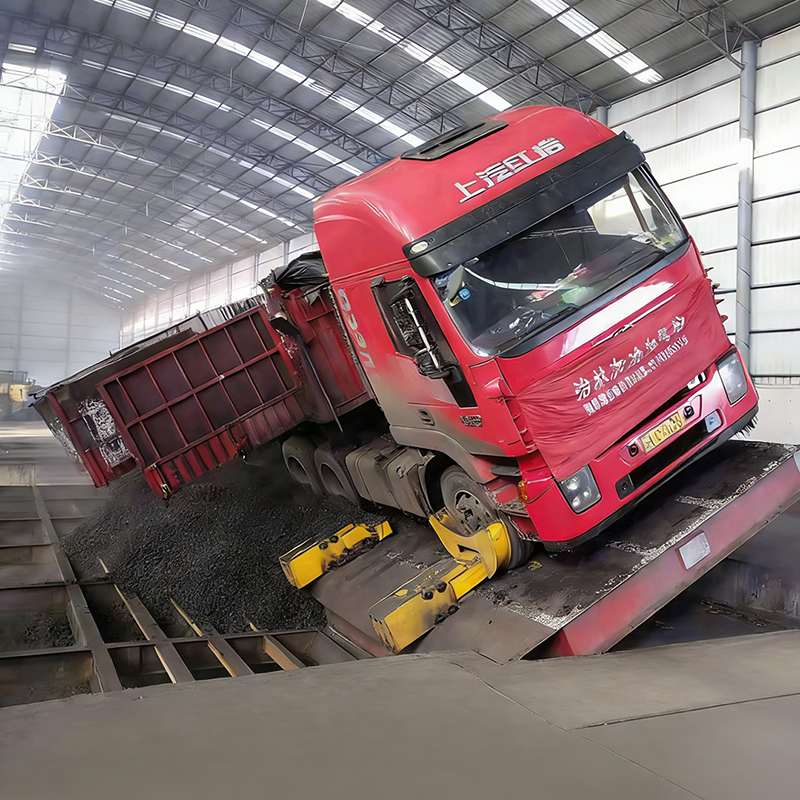
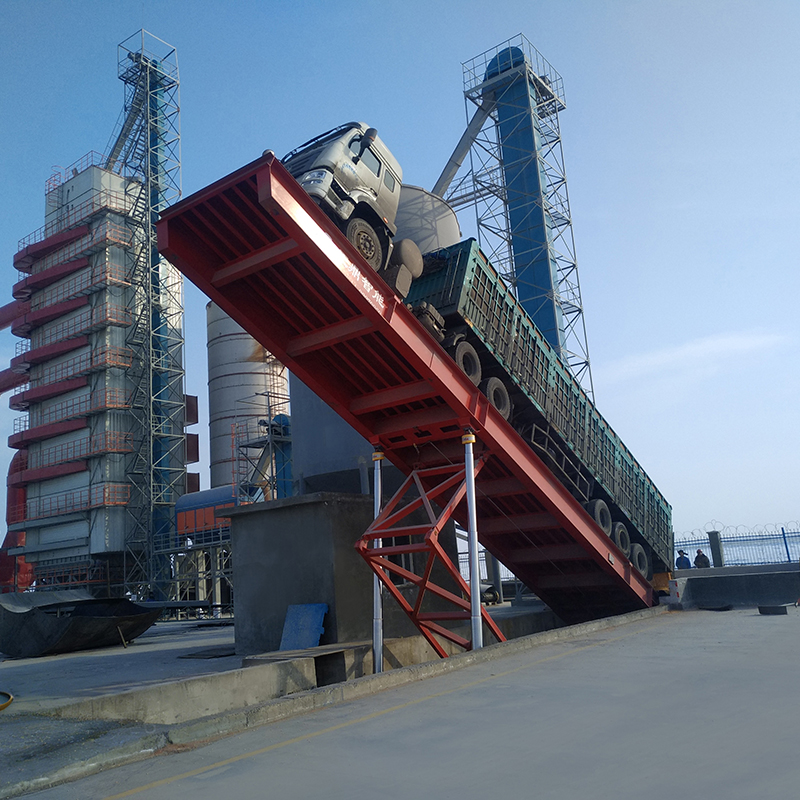
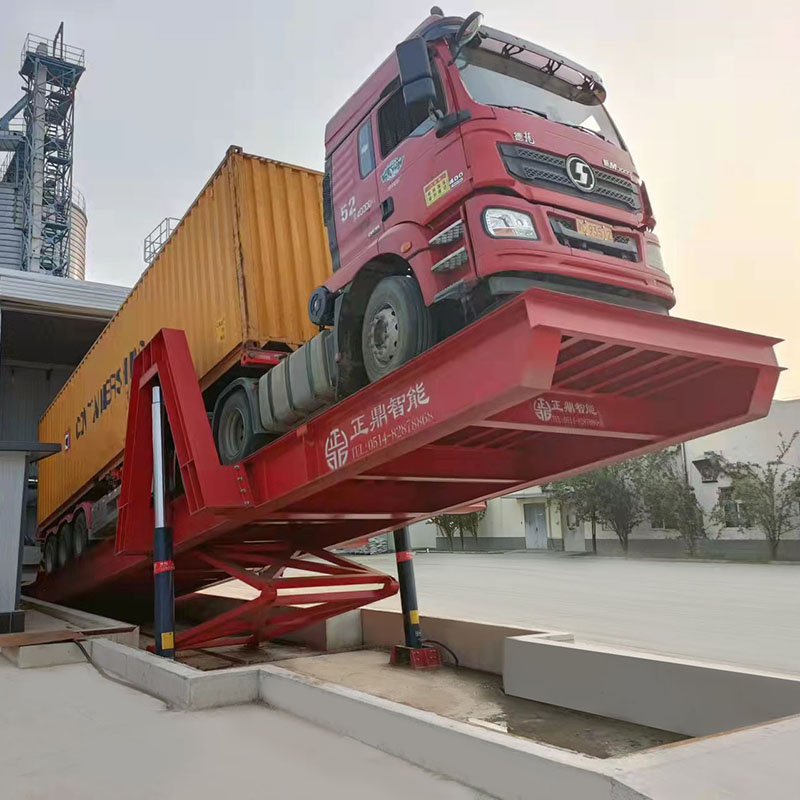
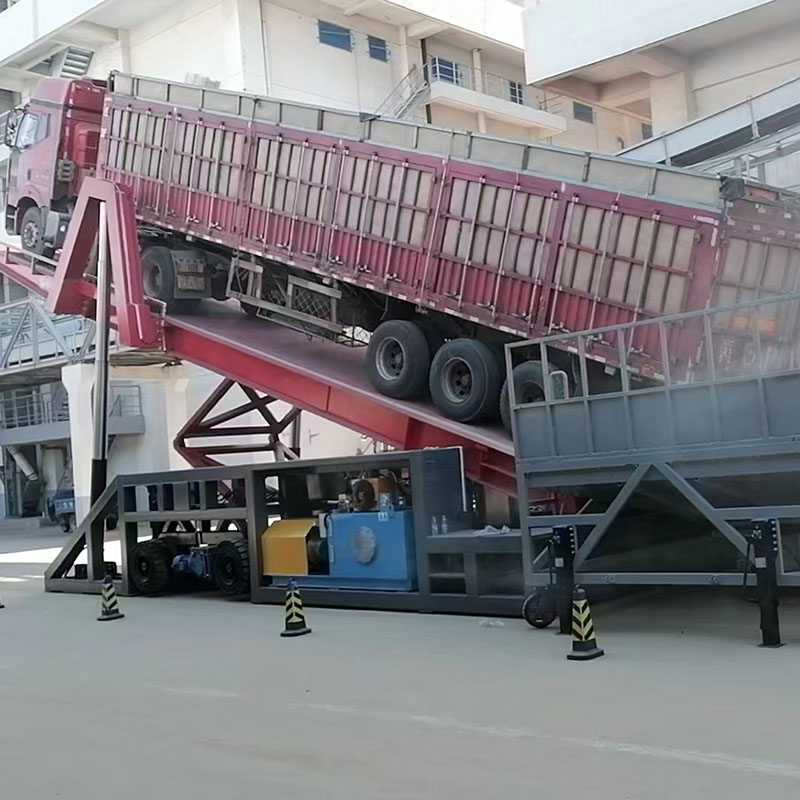
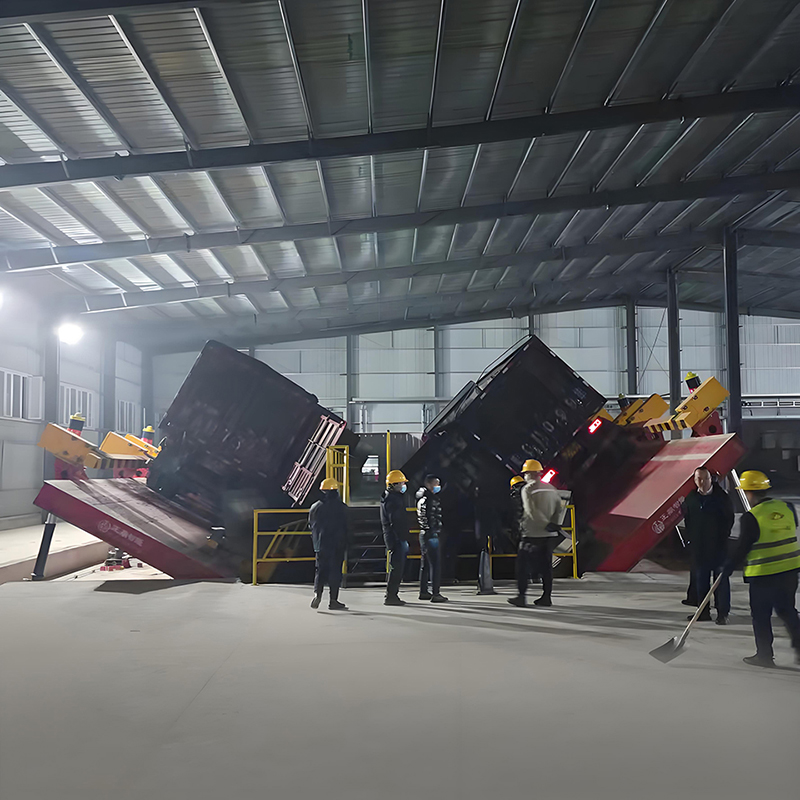
An automatic side-turn truck dumper is a hydraulic unloading machine that lifts and rotates a loaded truck or trailer toward one side. During operation, the vehicle is driven onto the platform and secured by wheel chocks, clamps, or other positioning devices. Once the control system confirms that the vehicle is correctly positioned and the safety conditions are satisfied, hydraulic cylinders raise and tilt the platform.
As the vehicle reaches the selected angle, the bulk material leaves the body through gravity. Depending on the material and the receiving system, the discharged product may flow directly into a receiving pit, hopper, conveyor, crusher, screening system, storage bunker, or processing line. After discharge is complete, the platform returns to its initial position, the vehicle is released, and the next truck can enter.
The side-turn principle is different from a conventional rear-dump truck. A rear-dump vehicle must raise its body vertically or at an inclined rear angle, which may require substantial overhead clearance. It can also create stability concerns when the load is uneven, sticky, or poorly distributed. A side-turn system uses lateral movement, making it suitable for sites where rear clearance is limited or where the unloading point is located alongside the vehicle path.
Automatic operation adds another important advantage. Vehicle positioning, platform locking, hydraulic lifting, rotation, return, and release can be coordinated through an integrated control system. Operators can supervise the complete unloading cycle from a control room instead of remaining beside the machine. This supports safer working conditions and reduces the number of personnel exposed to moving equipment, falling materials, dust, and vehicle traffic.
Basic Operating Sequence
1. The truck approaches the dumper through a designated traffic lane or operation path.
2. Position sensors, cameras, or operator instructions confirm that the vehicle is correctly aligned on the platform.
3. Wheel chocks, hydraulic clamps, or other restraint components secure the vehicle and prevent unintended movement.
4. The control system checks emergency stops, safety gates, light curtains, hydraulic pressure, platform position, and other interlocks.
5. Hydraulic cylinders lift and rotate the platform to the selected unloading angle.
6. The material flows from the vehicle body into the receiving equipment. Optional vibration devices can assist discharge when material remains attached to the walls or floor.
7. The platform returns to its home position under controlled hydraulic movement.
8. The vehicle restraints are released, and the truck exits the unloading area.
This sequence can be programmed according to the facility’s operating requirements. It may also be connected to weighbridges, access control systems, conveyor controls, dust suppression, loading records, and plant-level supervisory control systems.
2. Why Side-Turn Unloading Outperforms Conventional Methods
Bulk material unloading has traditionally depended on manual labor, rear-dump equipment, front-end loaders, or truck drivers who must leave the cab and assist with discharge. These methods may be practical for small operations, but they become inefficient and hazardous when a facility handles dozens or hundreds of vehicles every day.
Manual unloading is slow, labor-intensive, and inconsistent. Workers may need to remove material stuck to the vehicle walls, clear residue from the unloading area, or repeatedly reposition the truck. These activities increase operating costs and expose personnel to dust, unstable loads, vehicle movement, and heavy equipment.
Rear-dump systems are faster than manual methods, but they may require significant overhead space and a stable ground condition. Sticky material can remain in the elevated truck body, while uneven loading can affect stability. Rear tipping may also be unsuitable where the receiving hopper is positioned beside the traffic lane or where the facility cannot provide sufficient vertical clearance.
Automatic side-turn dumpers address these limitations through lateral rotation and integrated control. The vehicle remains on a guided platform while the entire load is discharged toward the receiving side. The system can be configured for multiple angles, high-frequency vibration, guiding devices, remote control, and automatic safety interlocks.
| Performance Factor | Manual Unloading | Rear-Dump Truck System | Automatic Side-Turn Dumper |
|---|---|---|---|
| Typical unloading time for a 35-ton load | 35–45 minutes | 8–12 minutes | Approximately 3.5–5 minutes |
| Typical labor requirement | 4–6 workers per shift | 2–3 workers per shift | One remote operator or supervisor |
| Material residue | Approximately 3–5% | Approximately 1.5–2.5% | Approximately 0.3–0.6% |
| Overhead clearance requirement | Low to moderate | High | Moderate, depending on design |
| Suitability for side-positioned receiving systems | Limited | Limited | Excellent |
| Remote operation capability | Not normally available | May be limited | Standard design feature |
The figures in the table are representative operating ranges based on the product information and comparative industry data supplied for this equipment category. Actual performance depends on vehicle size, material properties, site layout, loading condition, operator settings, and receiving equipment.
For facilities handling coal, sand, gravel, grain, fertilizer, cement clinker, plastic pellets, minerals, or other bulk products, the most important advantage is not simply speed. It is the combination of speed, repeatability, material recovery, safety, and lower dependence on manual intervention.
3. Main Product Advantages
3.1 Fully Automatic and Unmanned Operation
The automatic side-turn truck dumper is built around an integrated control system that coordinates the entire unloading process. Vehicle entry, positioning, clamping, lifting, tilting, unloading, return, and release can be completed through a programmed sequence.
Operators can monitor and control the equipment from a remote control room. This arrangement reduces the need for personnel to enter the unloading zone and allows a single operator to supervise multiple process signals. Cameras, sensors, alarms, position feedback, and hydraulic monitoring can be incorporated into the control architecture.
Remote operation is especially valuable in dusty, noisy, hot, cold, chemically aggressive, or high-traffic environments. It also creates a clearer separation between vehicle movement and human activity. When combined with access gates, warning lights, audible alarms, emergency-stop switches, and safety interlocks, the system supports a more controlled plant environment.
3.2 Selectable 45-Degree and 55-Degree Tilting
The equipment can be configured with different maximum lifting angles according to the material and unloading objective. The 45-degree mode is suitable for conventional free-flowing products such as coal, sand, gravel, and many dry granular materials. These products generally discharge smoothly once the vehicle body reaches the required inclination.
The 55-degree mode is intended for materials that are more difficult to unload. Wet coal, iron ore fines, clay, high-moisture aggregates, and other semi-cohesive products may cling to the vehicle wall or floor. A larger angle increases the gravitational force acting along the body surface and helps the material separate from the vehicle.
The appropriate angle should be selected through a technical review of the material’s moisture content, particle size, cohesion, temperature, bulk density, and tendency to bridge or compact. The objective is to achieve thorough discharge without unnecessary mechanical stress or excessive cycle time.
3.3 Optional High-Frequency Vibration
Some materials do not flow completely under gravity alone. They may adhere to the vehicle body, form compacted sections, or remain in corners and along the sidewalls. An optional high-frequency vibration device can be installed to assist the discharge process.
By transmitting controlled vibration to the platform or vehicle body, the system helps loosen material deposits and reduce residue. This is useful for wet coal, clay-containing products, sticky mineral fines, certain fertilizers, and other materials whose flowability changes with moisture and temperature.
Vibration parameters should be selected carefully. Excessive vibration can increase noise, stress structural components, or affect the receiving equipment. A properly engineered system uses suitable mounting, isolation, frequency control, and operating logic to apply vibration only when it is needed.
3.4 Optional Material Guiding Device
A material guiding device helps direct the falling load into the collection pit or receiving hopper. Without suitable guidance, some bulk material may fall onto the platform, access area, or internal spaces of the unloading structure, creating additional cleaning work.
The guiding system can be adapted to the discharge opening, receiving hopper, material angle of repose, and truck body dimensions. It helps reduce spillage, improve housekeeping, protect nearby components, and minimize product loss. In dusty applications, the guiding arrangement can also be integrated with a dust suppression or extraction interface.
3.5 Optional Dedicated Operation Path
A dedicated operation path can be installed to provide safe access for inspection, maintenance, cleaning, and process supervision. It helps separate personnel movement from vehicle traffic and moving machinery.
The path may include stairs, platforms, handrails, guardrails, inspection areas, and controlled access points. Its final arrangement depends on the site’s civil works, local safety requirements, equipment height, and maintenance strategy.
3.6 Reduced Material Residue and Cleanup
Material residue directly affects productivity. When product remains inside a truck, it may reduce the effective payload and require manual cleaning. Spilled material around the platform can obstruct traffic, damage equipment, increase dust, and create slip or trip hazards.
Side-turn dumpers reduce these problems by combining a large unloading angle, stable platform movement, optional vibration, and material guiding components. The result is a cleaner unloading zone and more predictable material recovery. For high-volume facilities, even a small reduction in residue can create substantial annual savings.
3.7 Adaptability to Different Vehicle Types
The system can be engineered for standard semi-trailers, rigid trucks, and different axle configurations. Adjustable wheel chocks and hydraulic restraints help accommodate variations in wheelbase, tire position, and vehicle body dimensions.
In many applications, the truck does not require structural modification. The dumper is designed to support the vehicle through the platform and restraint system. Nevertheless, the vehicle dimensions, gross weight, center of gravity, body construction, and loading method must be reviewed before final selection.
4. Technical Parameters and Model Selection
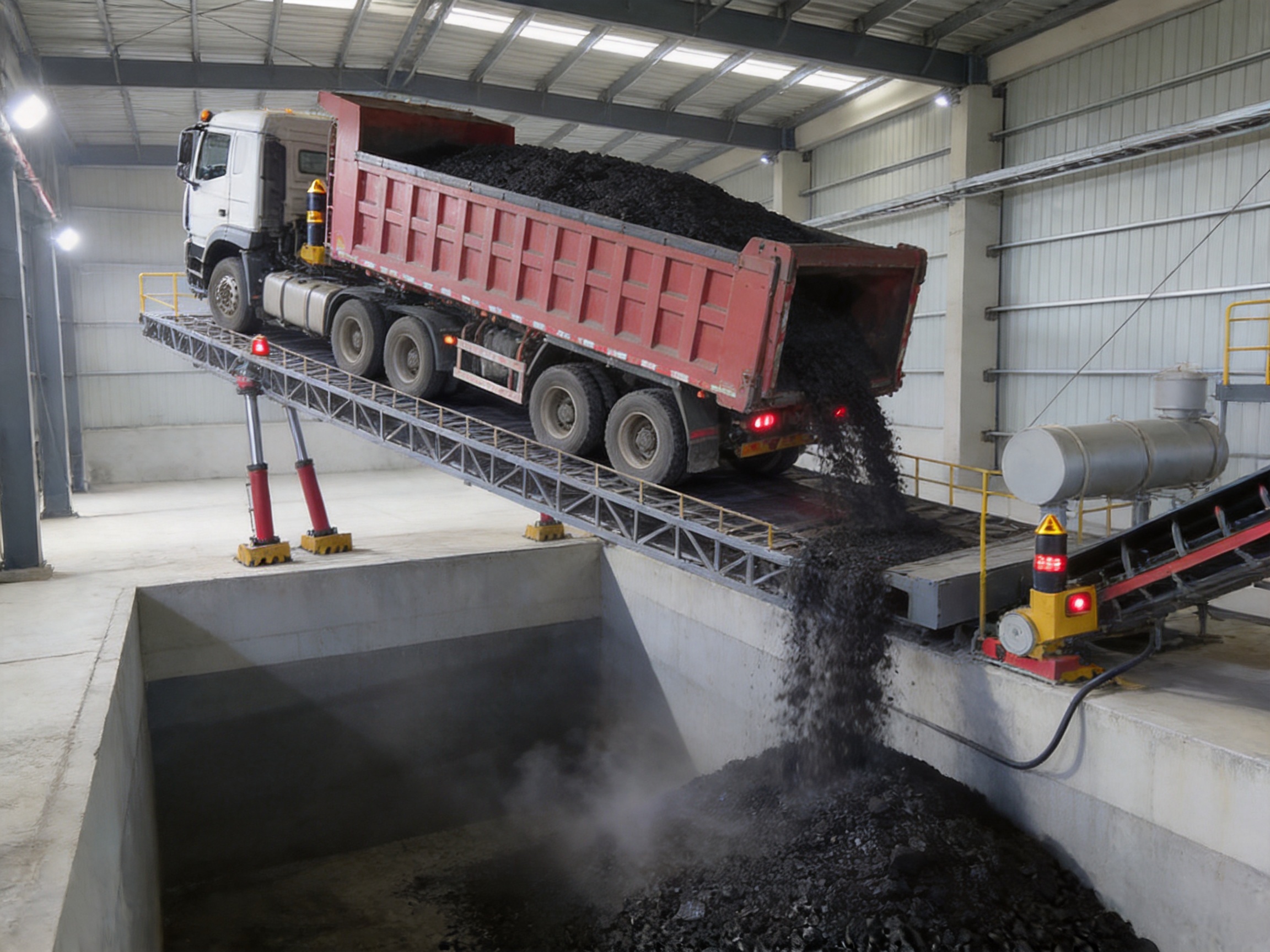
Automatic side-turn truck dumpers are available in different capacities and platform lengths. Jiangsu Zhengding Intelligent Equipment offers models designed for maximum lifting weights of 80, 100, and 150 metric tons. The platform dimensions can be selected according to the vehicle type and unloading arrangement.
| Model | Available Platform Size, Length × Width | Maximum Lifting Weight | Maximum Lifting Angle |
|---|---|---|---|
| TQXCZ 80 | 16 m × 3 m or 18 m × 3 m | 80 metric tons | 45 degrees or 55 degrees |
| TQXCZ 100 | 18 m × 3 m or 20 m × 3 m | 100 metric tons | 45 degrees or 55 degrees |
| TQXCZ 150 | 18 m × 3 m, 20 m × 3 m, or 22 m × 3 m | 150 metric tons | 45 degrees or 55 degrees |
The model should not be selected only by comparing rated lifting weight. A complete engineering review should consider the maximum truck gross weight, tare weight, payload distribution, wheelbase, body length, body width, tire arrangement, material density, discharge volume, cycle time, pit dimensions, foundation conditions, and expected annual operating hours.
For a facility handling standard semi-trailers, a platform length of 16 to 20 meters may be appropriate depending on the vehicle fleet. Longer platforms can accommodate larger trucks or trailers, while compact designs may be more suitable for rigid trucks and restricted sites.
The receiving hopper must also be coordinated with the dumper. Its width, depth, inlet shape, wear lining, dust-control arrangement, and connection to downstream conveyors influence the overall performance. The dumper is only one part of the complete unloading process; reliable operation requires the truck, platform, receiving system, and control system to function as one integrated unit.
Hydraulic System
The hydraulic system provides the lifting and tilting force required to move the loaded platform. Heavy-duty hydraulic cylinders are selected according to rated load, safety factor, stroke, mounting geometry, pressure, speed, and expected duty cycle.
Dual hydraulic cylinders help distribute the lifting force and support stable platform movement. Integrated position sensors can monitor cylinder stroke and platform angle. Hydraulic lock valves help prevent uncontrolled descent if the hydraulic pressure changes or a hose failure occurs.
The hydraulic circuit may include pumps, reservoirs, filters, valves, pressure sensors, synchronization controls, and emergency lowering provisions. Proper filtration and scheduled oil maintenance are important for protecting valves and cylinders in demanding industrial environments.
Control and Monitoring System
The control system coordinates automatic operation and records key operating conditions. It may monitor platform angle, cylinder position, hydraulic pressure, clamp status, vehicle presence, emergency-stop status, gate position, vibration operation, and receiving system readiness.
A self-diagnostic function can identify abnormal cylinder drift, uneven loading, sensor errors, hydraulic pressure loss, or incomplete vehicle positioning. The system can generate an alarm and prevent the next step from starting until the condition has been checked.
Remote monitoring also supports maintenance planning. Operating cycles, alarm history, hydraulic readings, and component status can be recorded for analysis. This helps maintenance personnel identify recurring issues before they cause extended downtime.
5. Safety Engineering for Automatic Side-Turn Dumpers
Safety is a central reason for choosing an automatic dumper. The system handles high loads and involves large moving structures, so it must be designed with multiple layers of protection rather than relying on operator attention alone.
Typical safety features include emergency-stop buttons on both sides of the equipment, hydraulic lock valves, audible rotation alarms, warning lights, access gates, light curtains, safety fences, limit switches, platform position sensors, and control-system interlocks.
The equipment should not begin a lifting cycle when a gate is open, a person is detected in the danger zone, the vehicle is incorrectly positioned, a restraint is not engaged, or the receiving system is unavailable. These conditions can be managed through a combination of electrical, hydraulic, mechanical, and software-based safeguards.
Emergency-stop devices should be clearly visible and accessible from appropriate locations. After an emergency stop, the system should remain in a safe state until the cause has been investigated and authorized reset procedures have been completed.
Hydraulic lock valves are particularly important because they help hold the platform in position and limit uncontrolled movement. Mechanical maintenance supports, locking pins, or other physical devices should also be used when personnel must work beneath or near a raised platform.
The unloading area should be marked as a controlled zone. Vehicle routes, pedestrian paths, inspection platforms, and maintenance access should be separated wherever possible. Adequate lighting, drainage, ventilation, dust control, and signage further improve the working environment.
Safety standards and local regulations vary by country and application. The final design should be reviewed against the applicable machinery, lifting, electrical, structural, and workplace safety requirements. Standards referenced in the supplied product material include EN 1570 and ASME B20.1; the relevant edition and scope should be confirmed during project engineering.
Driver and Operator Protection
One advantage of automatic side-turn unloading is that the driver may remain in the cab during the unloading process when the site’s risk assessment and operating procedures permit this arrangement. The driver should remain seated, use the seat belt, and follow the facility’s traffic and communication rules.
The remote operator supervises the process through a control panel or control room interface. This reduces the need for workers to stand beside the vehicle or enter the unloading zone during rotation. However, automation does not eliminate the need for training, inspection, emergency procedures, and disciplined access control.
6. Applications Across Bulk Material Industries
Mining and Metallurgy
Mining and metallurgical facilities handle iron ore, ore fines, coal, limestone, slag, concentrates, and other heavy materials. These products may have high bulk density and may be abrasive, wet, or difficult to discharge.
A side-turn dumper can be equipped with wear-resistant contact surfaces, reinforced structural members, heavy-duty restraints, and suitable hopper liners. The 55-degree configuration and optional vibration device are useful when wet fines or cohesive mineral products remain in the vehicle body.
Coal-Fired Power Generation
Power plants require reliable coal unloading because interruptions in fuel supply can affect generation. Automatic dumpers can connect truck arrival, weighing, unloading, conveyor transfer, and stockyard management into a coordinated process.
Remote operation reduces exposure to coal dust and vehicle traffic. Material guiding devices and dust suppression interfaces help maintain cleaner conditions around the receiving pit. The unloading system can also be configured for different truck capacities and seasonal changes in coal moisture.
Grain and Oat Processing
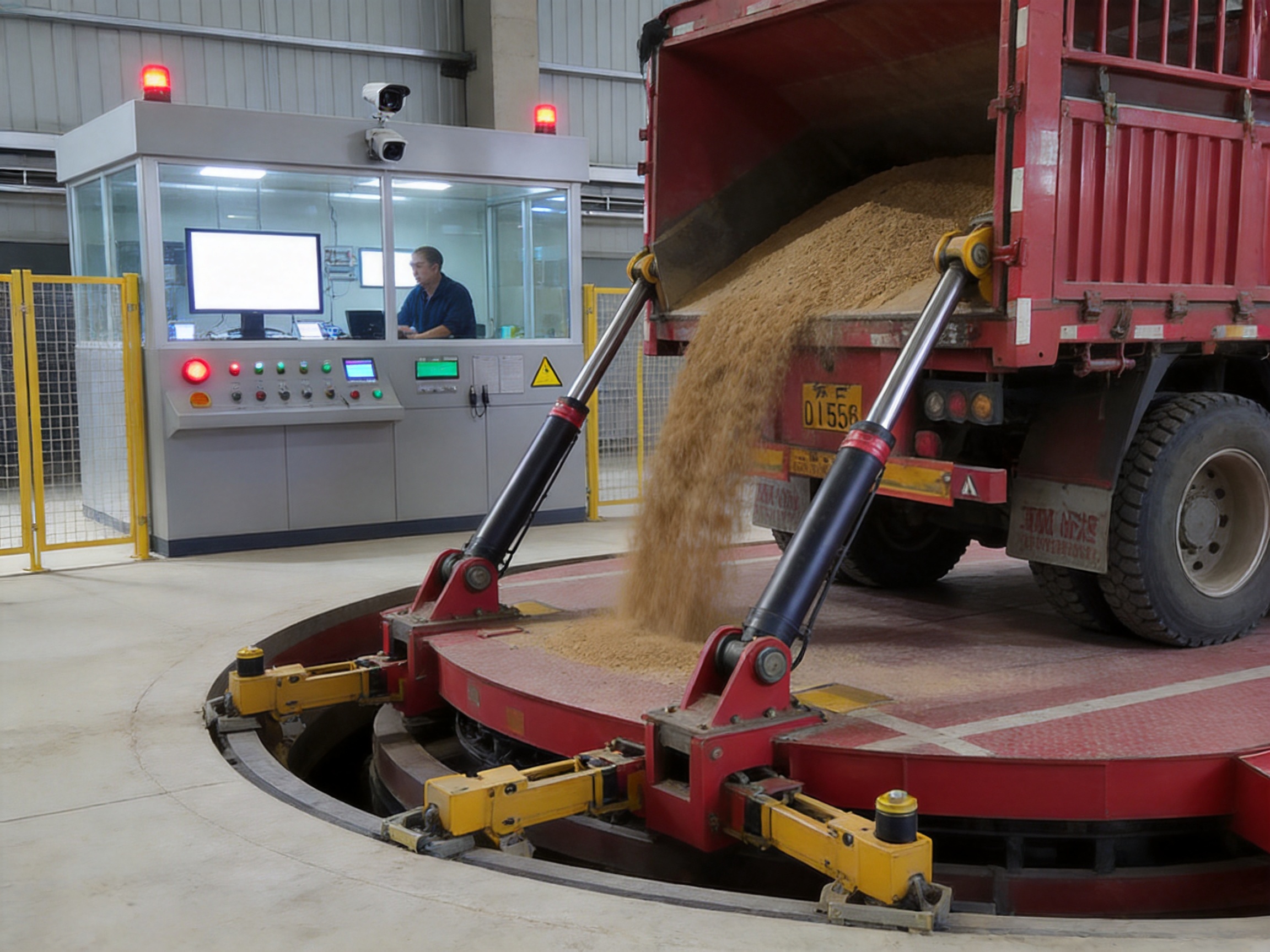
Grain, oats, wheat, corn, and feed materials require careful handling to reduce product loss and contamination. The side-turn dumper can support unloading into a receiving pit connected to conveyors, elevators, cleaners, dryers, or storage silos.
For food and feed applications, the design should consider cleanability, corrosion protection, access for inspection, dust control, and compatibility with hygiene procedures. Controlled discharge helps reduce accumulation around the platform and supports more efficient movement from incoming trucks to the processing line.
Cement and Building Materials
Cement plants and construction-material facilities may receive clinker, limestone, gypsum, sand, aggregate, fly ash, and other bulk products. These materials can be dusty and abrasive, requiring robust structural components and effective dust-management measures.
The dumper can be installed above a receiving hopper and connected to belt conveyors, bucket elevators, crushers, or storage systems. Its automatic operating sequence helps maintain a consistent material flow and reduces the need for manual clearing.
Chemical, Fertilizer, and Plastic Industries
Chemical products, fertilizer, resin, plastic pellets, and related materials may be transported in bulk trucks or trailers. Depending on the product, the system may require corrosion-resistant coatings, special liners, sealing arrangements, explosion-risk assessment, or dust extraction.
Because product properties vary significantly, the material’s flow behavior should be tested before the dumper is finalized. The platform, hopper, vibration system, and guiding device must be designed around the actual product rather than a generic bulk material assumption.
Ports, Terminals, and Recycling Centers
Ports and logistics terminals often need to process large vehicle volumes within limited operating windows. Faster unloading increases truck turnover and reduces congestion at the entrance and weighing areas.
Recycling centers may receive mixed aggregates, construction waste, biomass, recovered fuel, and other irregular materials. These applications require careful attention to oversize objects, impact protection, cleaning access, and load distribution. A customized side-turn dumper can be integrated with sorting, crushing, screening, and storage systems.
7. Manufacturing Strengths and Engineering Capabilities
The performance of a side-turn truck dumper depends on more than its rated capacity. Structural accuracy, hydraulic reliability, control integration, welding quality, surface treatment, assembly procedures, and final testing all influence service life and operating stability.
Jiangsu Zhengding Intelligent Equipment Co., Ltd. is a national high-tech enterprise focused on the research, development, manufacturing, and sales of intelligent logistics equipment. Its product range includes rear dumpers, side-turn truck dumpers, car loading equipment, container flippers, and other automated loading and unloading systems.
The company’s manufacturing strengths are based on system integration rather than the supply of a single machine. It can provide equipment and process solutions for truck unloading, container handling, automobile loading, and related logistics operations. This allows the dumper to be coordinated with weighing, conveying, dust suppression, control, and plant management equipment.
Heavy-Duty Structural Fabrication
A side-turn dumper must support the combined weight of the vehicle, payload, platform, and restraints while resisting repeated dynamic loads. The main frame, platform, pivot assemblies, cylinder mounts, wheel guides, and safety structures must therefore be designed with appropriate strength and stiffness.
Manufacturing begins with project-specific engineering drawings and load calculations. Steel components are cut, formed, fitted, and welded according to the design. Critical joints require controlled welding procedures, dimensional inspection, and appropriate non-destructive or visual examination where specified by the project.
Accurate fabrication is essential for platform alignment and hydraulic synchronization. Misalignment can increase wear on pins, bearings, cylinders, and guides. It can also affect the smoothness of rotation and place additional stress on the vehicle restraints.
Hydraulic Assembly and Testing
Hydraulic components must be correctly selected, assembled, cleaned, and tested. The system should be checked for pressure stability, leakage, cylinder synchronization, return movement, emergency stopping, and controlled lowering.
Position sensors and hydraulic valves are installed to provide feedback to the control system. During factory testing, the equipment can be operated through multiple cycles to confirm that the platform reaches the required angle and returns accurately to its home position.
Testing under simulated load helps verify the performance of the cylinders, platform structure, wheel chocks, clamps, sensors, and control logic. The exact test procedure depends on the project specification and applicable standards.
Intelligent Controls and Remote Diagnostics
Modern unloading equipment is increasingly expected to provide more than simple local start and stop functions. An intelligent control system can display operating status, cycle information, alarms, maintenance reminders, and process interlocks.
Remote diagnostics can help technicians identify cylinder drift, sensor failure, uneven loading, abnormal pressure, or incomplete positioning. This shortens troubleshooting time and supports preventive maintenance. When connected to a broader plant system, the dumper can exchange signals with weighbridges, conveyors, gates, hoppers, dust collectors, and production management software.
Surface Protection and Environmental Adaptation
Industrial unloading equipment may operate outdoors or in environments with moisture, dust, salt, chemicals, and temperature variations. Corrosion-resistant coatings and suitable surface preparation help protect structural components and extend service life.
The final coating system should be selected according to the site environment. Mining, coastal, chemical, and food-processing applications may require different coating specifications. Electrical cabinets, sensors, hydraulic units, and cable routes should also be protected against the expected environmental conditions.
Factory Pre-Assembly and Site Installation
Where site conditions permit, major assemblies can be pre-assembled and tested before shipment. This reduces installation work at the customer’s facility and helps identify interface issues earlier.
Standard units may be delivered in a configuration that supports rapid installation. The supplied product information indicates that many units can be installed on site within approximately five to seven days, although the actual schedule depends on foundation preparation, civil construction, electrical work, hopper installation, commissioning, and local access conditions.
8. Integration with a Complete Automated Unloading Line
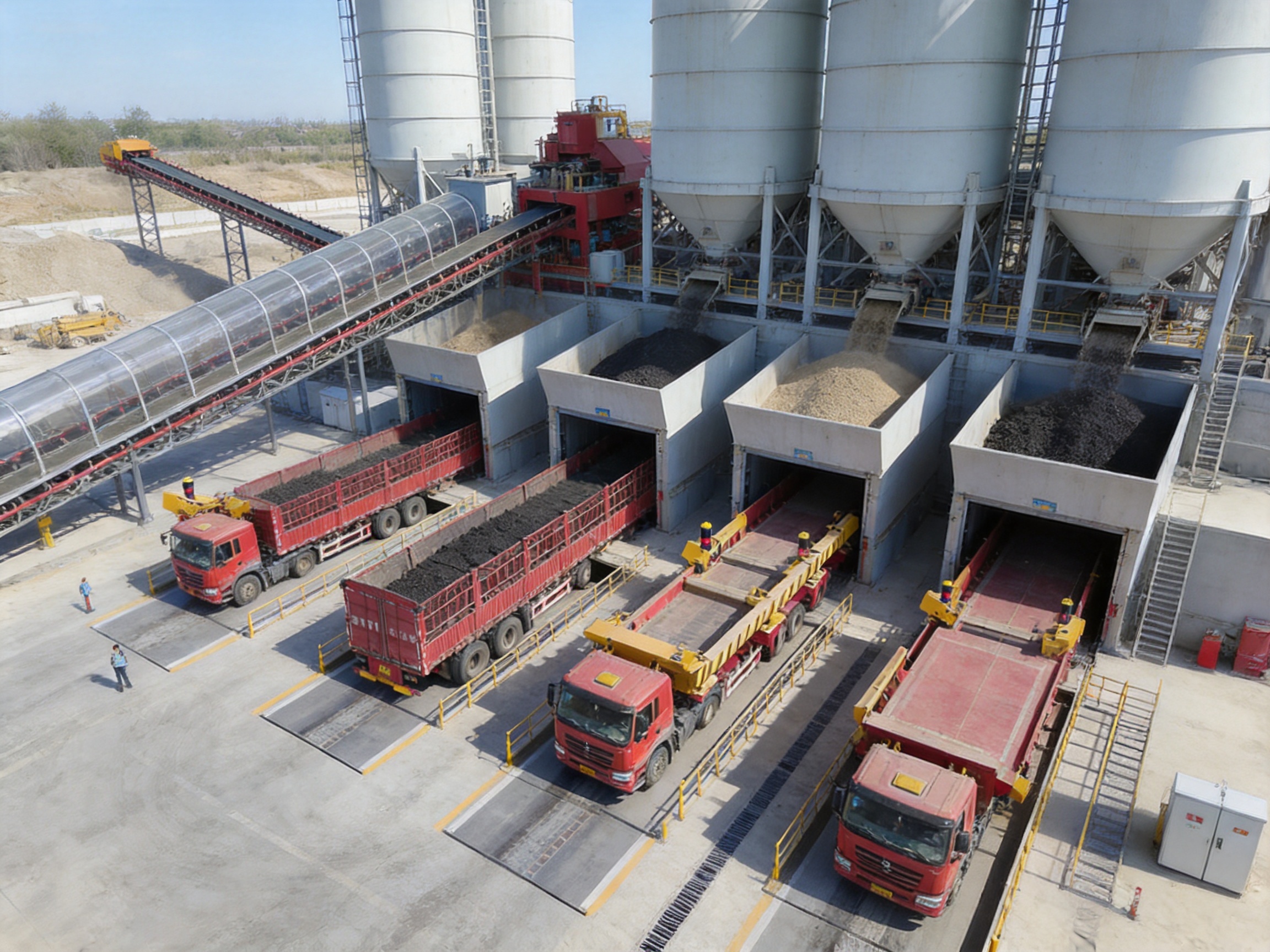
An automatic side-turn truck dumper delivers its greatest value when integrated into a complete material-handling system. The unloading platform can be positioned above a receiving hopper, which transfers material to conveyors, crushers, screens, silos, stockpiles, or processing equipment.
A typical automated line may include an entrance gate, truck identification system, weighbridge, traffic lights, positioning sensors, wheel restraints, side-turn dumper, receiving hopper, belt conveyor, dust collector, control cabinet, and operator workstation.
Before the truck is released, the control system can verify that the receiving conveyor is available and that the material destination has sufficient capacity. This prevents unloading into a blocked or unavailable downstream system.
Weighing integration can provide accurate information about incoming gross weight, tare weight, net payload, and material type. These records support inventory management, production planning, supplier verification, and customer billing.
Dust suppression may include water sprays, mist systems, enclosed transfer points, extraction ducts, filters, and negative-pressure arrangements. The appropriate method depends on the material and environmental requirements. Food, chemical, and powder applications may require special solutions to prevent moisture contamination.
Automation also enables data collection. Each unloading cycle can be associated with a vehicle identification number, time stamp, material type, weight, unloading duration, alarm status, and operator authorization. This information can be used to improve scheduling and identify bottlenecks.
9. Comparing Side-Turn Dumpers with Competing Unloading Solutions
Competition in the unloading-equipment market includes manual labor, rear dumpers, tipping floors, front-end loaders, and specialized truck unloading systems. The most suitable solution depends on the material, capacity, budget, available space, and required level of automation.
Manual unloading has the lowest initial equipment cost but the highest labor demand and the greatest dependence on individual effort. It is difficult to standardize and may become impractical as throughput increases.
Rear dumpers provide effective unloading for many free-flowing materials, but they typically require more overhead clearance. They may also be less suitable for a receiving system positioned to the side of the vehicle or for sites where uneven loads create stability concerns.
Tipping floors can handle a wide range of materials, but they often occupy a large footprint and may require loaders or pushers to move the material into the downstream process. Their cycle time and operating cost can be higher for high-frequency truck unloading.
Front-end loaders offer flexibility and can handle irregular materials, but they require skilled operators, fuel, maintenance, traffic management, and larger working areas. They may also increase dust and spillage.
An automatic side-turn dumper is especially competitive where the facility requires high throughput, limited manual labor, remote operation, lateral discharge, controlled residue, and integration with a receiving hopper or conveyor. Its strength is the combination of mechanical lifting capacity and intelligent process control.
| Evaluation Item | Automatic Side-Turn Dumper | Rear Dumper | Manual or Loader-Based Unloading |
|---|---|---|---|
| Discharge direction | Lateral | Rearward | Flexible but operator dependent |
| Automation level | High | Moderate to high | Low to moderate |
| Labor requirement | Low | Moderate | High |
| Need for overhead clearance | Lower than rear tipping in many layouts | Relatively high | Usually low |
| Performance with cohesive materials | Enhanced by 55-degree tilt and vibration | May require manual clearing | Depends on loader capability |
| Material residue control | High with guiding and vibration options | Moderate | Variable |
| Integration with plant automation | Excellent | Good | Limited |
| Best suited for | High-volume controlled unloading | Rear-access sites with adequate clearance | Small-scale or irregular operations |
10. Return on Investment and Operating Economics
The business case for an automatic side-turn truck dumper is based on more than labor savings. Faster unloading can increase the number of trucks processed per shift, reduce waiting time, improve receiving-line utilization, and support higher annual throughput.
Labor reduction is often one of the most visible benefits. A remote-controlled system can reduce the number of workers assigned to the unloading area and reduce the need for manual residue removal. The actual saving depends on wage levels, shift structure, local regulations, operating hours, and the number of trucks processed.
Throughput improvement may produce an even larger economic effect. If unloading is the bottleneck between inbound transportation and production, shortening the cycle time can allow the facility to receive more material without expanding the entire site.
Reduced spillage also creates savings. Product that remains on the platform or falls outside the receiving hopper represents direct material loss. Cleaning requires labor and may interrupt vehicle movement. Cleaner operation can reduce dust, protect equipment, and lower the frequency of housekeeping activities.
Safety improvements have economic value as well. Fewer personnel in the danger zone can reduce the likelihood of injuries, work stoppages, compensation costs, and regulatory problems. A safer unloading area may also improve employee retention and simplify operational training.
The supplied product information indicates typical payback periods of approximately 12 to 22 months for suitable installations. This range is not universal. A detailed investment analysis should include equipment cost, foundation work, electrical installation, receiving-hopper construction, maintenance, power consumption, labor savings, throughput gains, residue reduction, and expected operating hours.
Factors Affecting Payback
1. Number of trucks unloaded per day.
2. Average payload and material value.
3. Current labor cost and number of unloading workers.
4. Existing unloading cycle time.
5. Available production or storage capacity downstream.
6. Cost of product loss, spillage, and manual cleanup.
7. Site civil-work requirements.
8. Expected service life and maintenance cost.
9. Seasonal changes in material moisture and flowability.
10. Required level of automation and data integration.
11. Installation Footprint and Site Planning
A standard side-turn dumper for semi-trailers may require an installation area of approximately 16 meters in length, 5 meters in width, and 6 meters in height, including approach ramps and the discharge hopper. Compact systems for rigid trucks may require approximately 12 meters in length, 4.5 meters in width, and a lower overall height.
These dimensions are indicative and must be confirmed through project-specific layout drawings. The site plan should include truck approach and departure lanes, turning radius, queue space, drainage, foundations, electrical cabinets, maintenance access, safety fencing, emergency exits, and connection points for conveyors or receiving equipment.
The foundation must support static and dynamic loads and maintain the required alignment over the equipment’s service life. Soil conditions, drainage, frost, vibration, seismic requirements, and local construction regulations should be considered before civil work begins.
Truck traffic flow should be designed to prevent reversing wherever possible. If reversing is unavoidable, cameras, mirrors, traffic signals, wheel guides, trained personnel, and clearly defined procedures should be included.
Maintenance access is another important consideration. Hydraulic cylinders, valves, sensors, pins, bearings, clamps, vibration devices, and electrical components should be accessible for inspection and replacement. A compact layout that prevents safe maintenance may increase long-term operating costs.
12. Maintenance and Service-Life Considerations
Preventive maintenance helps preserve the reliability of an automatic side-turn dumper. Daily inspections may include checking hydraulic leaks, unusual noise, visible structural damage, restraint position, emergency-stop functions, warning alarms, sensor cleanliness, and platform alignment.
Periodic maintenance may include hydraulic oil inspection, filter replacement, cylinder seal checks, lubrication of pins and bearings, torque inspection of fasteners, sensor calibration, electrical cabinet cleaning, cable inspection, and examination of wear liners.
Material buildup should be removed before it interferes with platform movement, sensors, restraints, or drainage. In food, feed, chemical, and fertilizer facilities, cleaning procedures should be documented and matched to the material-handling requirements.
Heavy-duty steel structures with corrosion-resistant coating are intended for long service in demanding environments. The supplied product information states that structural service life can exceed 25 years under daily heavy use when the equipment is correctly operated and maintained. Actual service life depends on loading frequency, environment, material abrasiveness, impact, corrosion control, and maintenance quality.
Spare parts planning should cover hydraulic seals, filters, sensors, valves, limit switches, alarm devices, electrical components, wear plates, and restraint components. Keeping critical parts available can reduce downtime and simplify scheduled maintenance.
13. Company Expertise and International Project Experience
Jiangsu Zhengding Intelligent Equipment Co., Ltd. provides automated loading and unloading solutions for automobiles, containers, ships, and industrial logistics systems. Its product portfolio includes rear dumpers, side-turn truck dumpers, car loading equipment, container flippers, and related equipment.
The company serves industries including steel, chemicals, cement, coal, grain, oil, food, feed, ports, papermaking, recycling, and new energy. This range of applications gives the engineering team experience with different material characteristics, truck configurations, production environments, and automation requirements.
Its equipment has been supplied to markets including Japan, Brazil, Egypt, Pakistan, India, the Middle East, and Southeast Asia. International project experience requires attention to documentation, electrical standards, language requirements, shipping conditions, installation coordination, and after-sales support.
The company’s stated user base includes international groups and industrial organizations such as Budweiser, Heineken, Buhler Group, Wilmar International, Cargill, DuPont, Louis Dreyfus, Charoen Pokphand Group, and Saint-Gobain Group. Customer requirements differ by industry, but common priorities include safe operation, reliable automation, accurate metering, low residue, maintainability, and stable integration with existing production lines.
For side-turn truck dumpers, the company can integrate intelligent weighing systems, remote diagnostics, and dust-suppression interfaces. The supplied information also reports documented uptime of up to 99.6% across installations processing more than two million metric tons annually. Such performance figures should be evaluated against the specific application, maintenance program, material, and operating conditions of each project.
14. Recommended Project Selection Process
A successful dumper project begins with accurate application data. The customer should provide truck drawings, maximum gross weight, payload range, body dimensions, axle configuration, material name, bulk density, moisture range, temperature, particle size, and expected unloading frequency.
The project team should then review the receiving system. The hopper inlet, conveyor capacity, dust-control equipment, discharge direction, foundation level, and downstream process must be compatible with the dumper’s movement and discharge pattern.
Material testing can be valuable for cohesive or difficult-to-flow products. Small-scale tests or operating references may help determine whether the 45-degree or 55-degree configuration is appropriate and whether vibration, liners, or special guiding devices are necessary.
A preliminary layout should show truck approach, platform dimensions, safety zones, maintenance paths, control-room location, electrical equipment, hydraulic equipment, and material flow. This drawing helps identify potential conflicts before construction begins.
The control philosophy should be agreed before manufacturing. It should define automatic and manual modes, alarm handling, emergency operation, vehicle identification, weighing, conveyor interlocks, access control, data recording, and communication with the plant’s supervisory system.
Factory acceptance testing should verify structural dimensions, hydraulic operation, sensor feedback, control sequences, safety interlocks, alarms, emergency stops, vibration operation, and communication interfaces. Site acceptance testing should confirm performance with the actual truck fleet and bulk material.
15. Frequently Asked Questions
Q1. Does an automatic side-turn dumper require special truck modifications?
In many applications, no structural modification is required. The equipment is designed for standard semi-trailers and rigid trucks and uses adjustable wheel chocks, guides, and hydraulic clamps to accommodate different axle configurations. However, the exact vehicle dimensions, gross weight, body construction, wheelbase, and center of gravity must be reviewed before final design approval.
Q2. What types of materials can the dumper handle?
The equipment is suitable for many free-flowing and semi-cohesive materials, including grain, oats, coal, sand, gravel, cement clinker, plastic pellets, fertilizers, minerals, and aggregates. Highly sticky materials such as wet clay or wet coal may require the 55-degree configuration, vibration, special liners, or a material guiding system.
Q3. Is the dumper suitable for food or grain applications?
It can be adapted for grain, oat, feed, and other agricultural products. The design should address cleanability, dust control, corrosion protection, inspection access, and contamination prevention. The receiving hopper and downstream conveyors must also meet the relevant hygiene and material-handling requirements.
Q4. Can one operator control the complete unloading process?
The integrated control system is designed to allow remote supervision of positioning, clamping, lifting, tilting, unloading, return, and release. The number of operators required depends on the facility layout, traffic system, safety procedures, and degree of integration with other equipment.
Q5. What is the difference between the 45-degree and 55-degree modes?
The 45-degree mode is generally suitable for materials with good flowability, such as dry coal, sand, and gravel. The 55-degree mode provides a steeper discharge angle for wet, cohesive, or difficult-to-unload products such as clay, wet coal, and iron ore fines.
Q6. What happens if material remains inside the truck body?
An optional high-frequency vibration device can assist with material release. The effectiveness of vibration depends on the material’s moisture, cohesion, particle size, and body design. In some cases, wear-resistant liners or other surface treatments may also be recommended.
Q7. What safety systems are normally included?
Typical systems include emergency-stop buttons, hydraulic lock valves, audible rotation alarms, warning lights, safety gates, light curtains, safety fencing, position sensors, vehicle restraints, and control-system interlocks. The final arrangement should comply with the applicable local safety requirements and project risk assessment.
Q8. Can the dumper be connected to a conveyor and weighing system?
Yes. The dumper can be integrated with receiving hoppers, conveyors, weighbridges, dust collectors, gates, identification systems, and plant control networks. Integration allows the unloading process to be coordinated with downstream material availability and production records.
Q9. How much space does a standard unit require?
A standard semi-trailer installation may require approximately 16 meters in length, 5 meters in width, and 6 meters in height, including approach and receiving areas. Compact rigid-truck systems may require approximately 12 meters by 4.5 meters. Final dimensions depend on the truck, platform, hopper, safety zones, and site layout.
Q10. What is the expected payback period?
The supplied project information indicates a typical range of approximately 12 to 22 months for suitable installations. The actual payback depends on throughput, labor cost, operating hours, material value, cleanup cost, site construction, equipment price, and the value of additional production capacity.
Q11. How often does the equipment need maintenance?
Daily visual inspection and routine cleaning should be combined with scheduled hydraulic, electrical, structural, and safety-system maintenance. Inspection frequency depends on operating hours, material abrasiveness, environmental conditions, and the manufacturer’s maintenance recommendations.
Q12. Can the equipment be customized?
Customization is available for platform length, lifting capacity, maximum angle, truck type, receiving hopper, guiding devices, vibration, weighing, dust suppression, control interfaces, access paths, surface coating, and site layout. A technical proposal should be prepared from the actual vehicle and material data.
16. Conclusion
Automatic side-turn truck dumpers offer a practical and scalable way to improve bulk material unloading. Their lateral rotation principle makes them suitable for sites where rear tipping is restricted, while their hydraulic structure provides the capacity needed for heavy trucks and trailers.
The most important advantages are automatic operation, remote monitoring, selectable 45-degree and 55-degree tilting, optional vibration, reduced residue, improved material guidance, lower labor requirements, and integration with receiving and conveying systems.
Compared with manual unloading and many conventional rear-dump arrangements, a side-turn dumper can provide faster cycles, greater throughput, improved housekeeping, and a safer separation between people and moving equipment. Its benefits are particularly significant in facilities that operate continuously or handle large truck volumes.
Jiangsu Zhengding Intelligent Equipment Co., Ltd. combines equipment manufacturing with system engineering. Its experience in truck dumpers, container handling, car loading, weighing, remote diagnostics, and automated logistics enables it to develop complete unloading solutions rather than isolated machines.
For a successful installation, the dumper must be selected according to the truck fleet, material behavior, payload, receiving system, site footprint, safety requirements, and expected throughput. With correct engineering, installation, operation, and maintenance, an automatic side-turn truck dumper can become a reliable core component of a modern bulk material handling facility.
References
1. Jiangsu Zhengding Intelligent Equipment Co., Ltd., Automatic Side-Turn Truck Dumper Product Information and Technical Parameters.
2. Industrial Bulk Handling Benchmark Data, Comparative Unloading Performance and Terminal Operations, 2024.
3. General Machinery Safety Principles for Industrial Lifting and Tilting Equipment.
4. EN 1570, Safety Requirements for Lifting Tables and Related Lifting Equipment.
5. ASME B20.1, Safety Standard for Conveyors and Related Material-Handling Equipment.
6. Bulk Solids Handling Engineering Principles, Material Flow, Hopper Design, and Discharge Control.
7. Industrial Hydraulic Systems Maintenance and Reliability Guidelines.


