

 English
 русский
 Español
 Français
 Português
 عربى
عربى




+86-13588556918
Content
- 1 1. What Is a Side-Turn Truck Dumper?
- 2 2. Why Side-Turn Dumpers Are Important for Modern Material Handling
- 3 3. Main Product Features
- 4 4. Technical Specifications and Model Selection
- 5 5. Layout and Space Efficiency
- 6 6. Material Flow, Spillage Control, and Clean Operations
- 7 7. Hydraulic and Structural Engineering
- 8 8. Manufacturing Strengths and Quality Control
- 9 9. Applications Across Multiple Industries
- 10 10. Safety and Maintenance Considerations
- 11 11. Customized Solutions from an Integrated Manufacturer
- 12 12. Installation and Project Implementation
- 13 13. Economic and Operational Benefits
- 14 14. How to Choose the Right Side-Turn Truck Dumper
- 15 15. Frequently Asked Questions
- 15.1 Q1: What materials can a side-turn truck dumper unload?
- 15.2 Q2: Can it unload wet sticky coal and iron ore fines?
- 15.3 Q3: Does the dumper require the driver to reverse?
- 15.4 Q4: What is the difference between the 45-degree and 55-degree modes?
- 15.5 Q5: What maximum lifting capacities are available?
- 15.6 Q6: Can the platform be customized for different trucks?
- 15.7 Q7: Is a vibration system always necessary?
- 15.8 Q8: Why is a material-guiding device useful?
- 15.9 Q9: Can the equipment be installed outdoors?
- 15.10 Q10: What maintenance is required?
- 15.11 Q11: Can the dumper connect with weighing and conveyor systems?
- 15.12 Q12: What information is needed for a quotation?
- 16 16. Conclusion
- 17 References
- 18 Product: Side-Turn Truck Dumpers
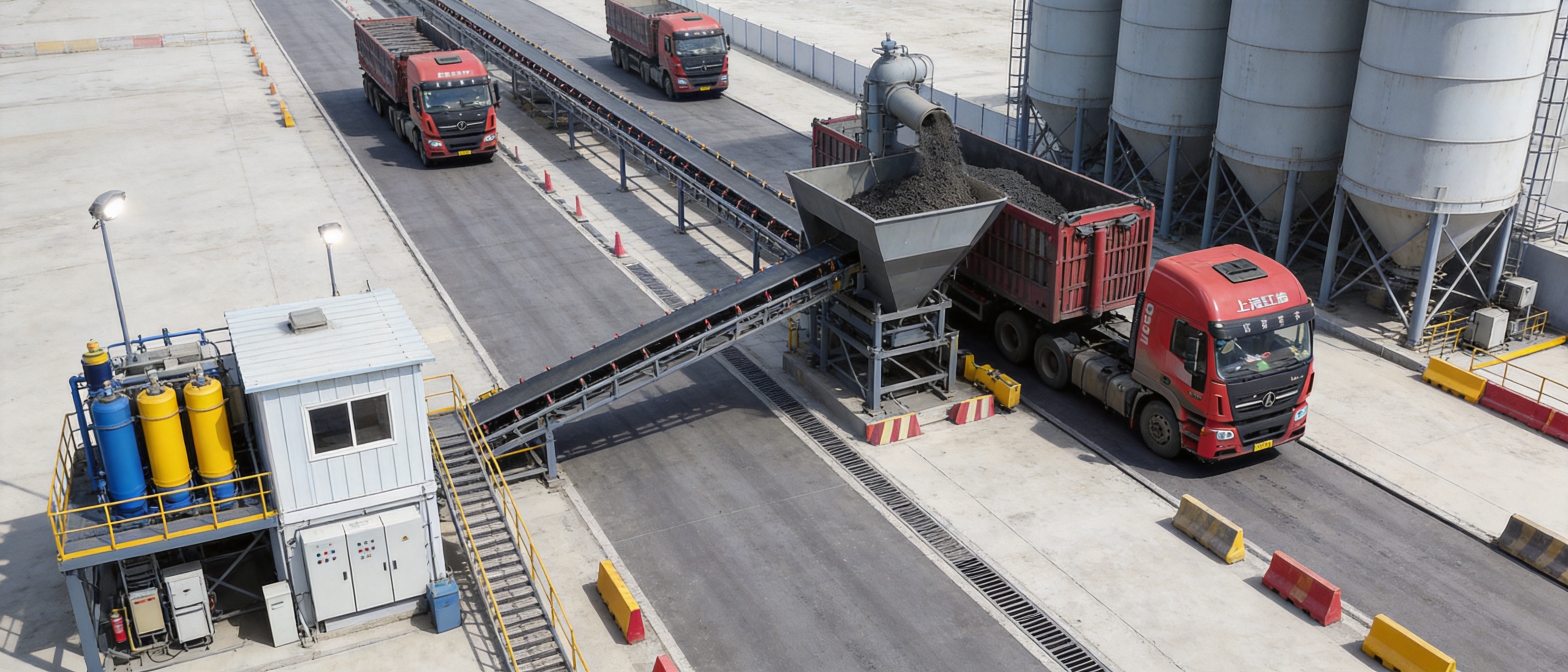
Side-turn truck dumpers are engineered for the rapid and controlled unloading of bulk materials from standard heavy-duty trucks and tipper trailers. By rotating the loaded vehicle platform laterally instead of tipping the truck backward, this equipment provides a practical alternative to conventional rear dumpers in mines, ports, power plants, cement factories, grain terminals, steel mills, and other high-throughput industrial facilities.
The side-turn configuration is especially valuable where site length is limited, truck traffic must remain orderly, or the conveyed material is difficult to discharge. Wet coal, iron ore fines, damp grain products, cementitious materials, and other bulk products may adhere to the truck bed or form compacted layers during transportation. With a maximum lifting angle of up to 55 degrees, optional vibration equipment, and configurable material-guiding systems, a side-turn dumper can improve unloading reliability while reducing manual cleanup.
This article examines the operating principle, technical design, application advantages, safety features, manufacturing strengths, and customization capabilities of side-turn truck dumpers supplied by Jiangsu Zhengding Intelligent Equipment Co., Ltd. It also compares side-turn systems with traditional rear dumpers and explains how an integrated equipment manufacturer can support the complete loading and unloading process.
Side-Turn Truck Dumpers
1. What Is a Side-Turn Truck Dumper?
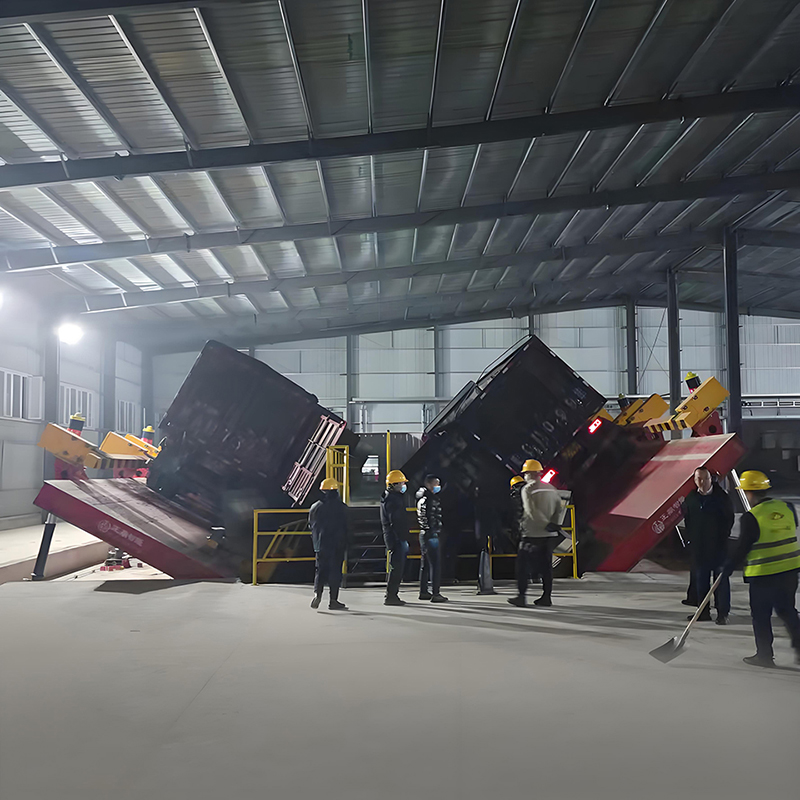
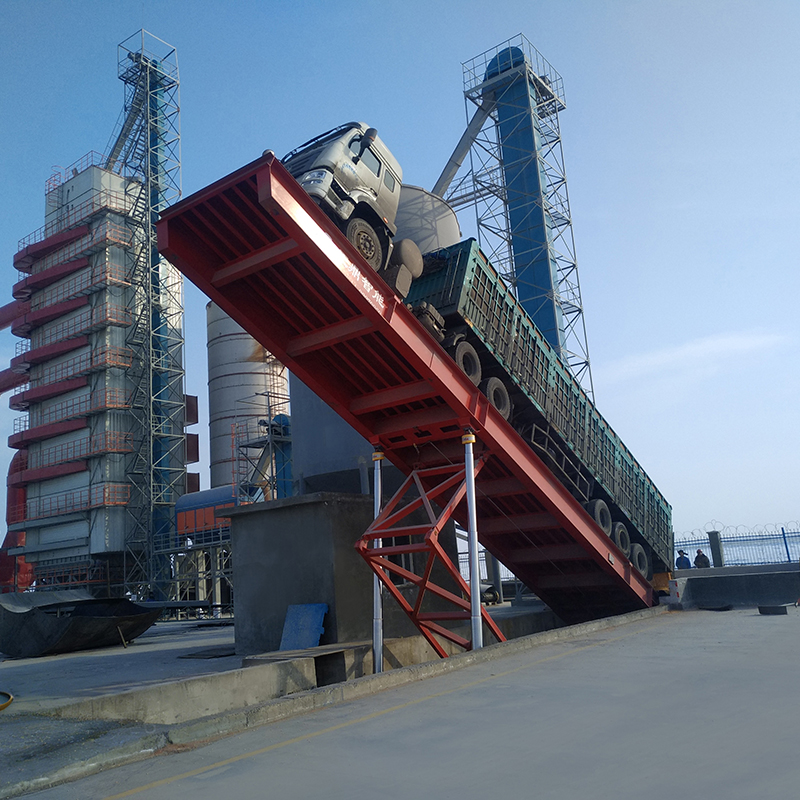
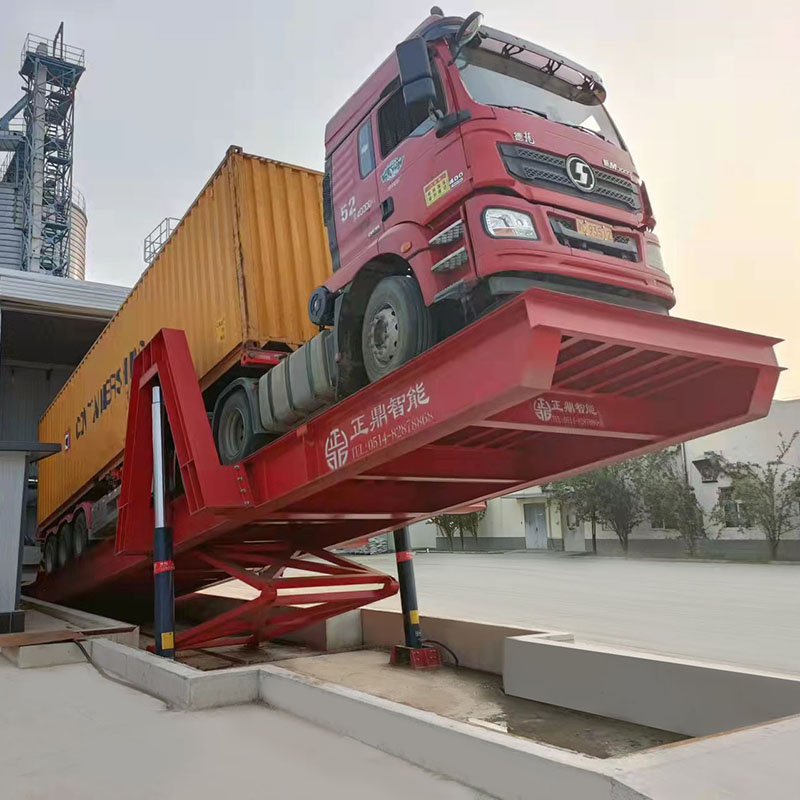
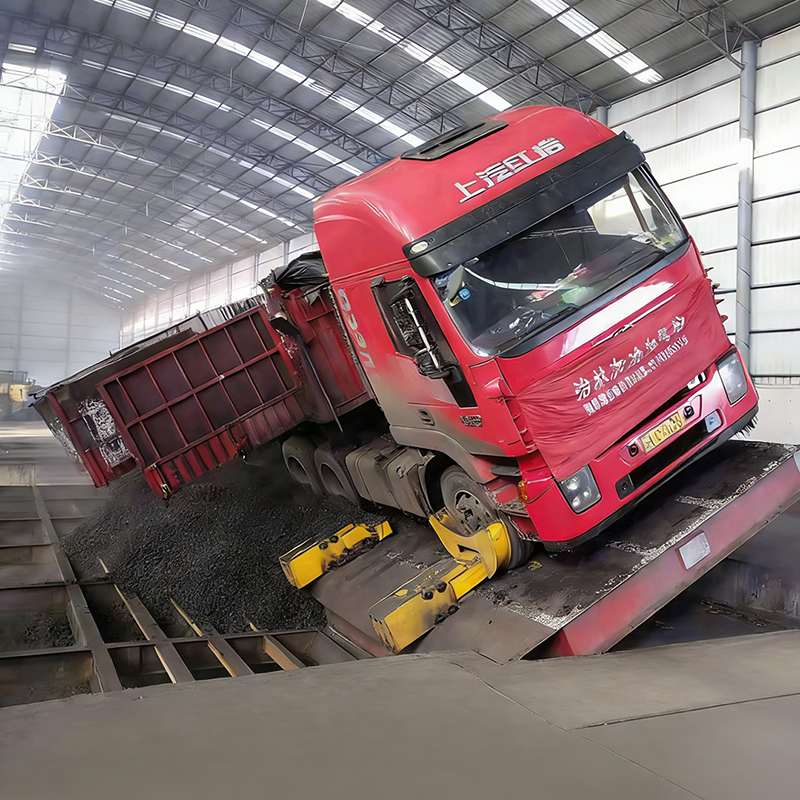
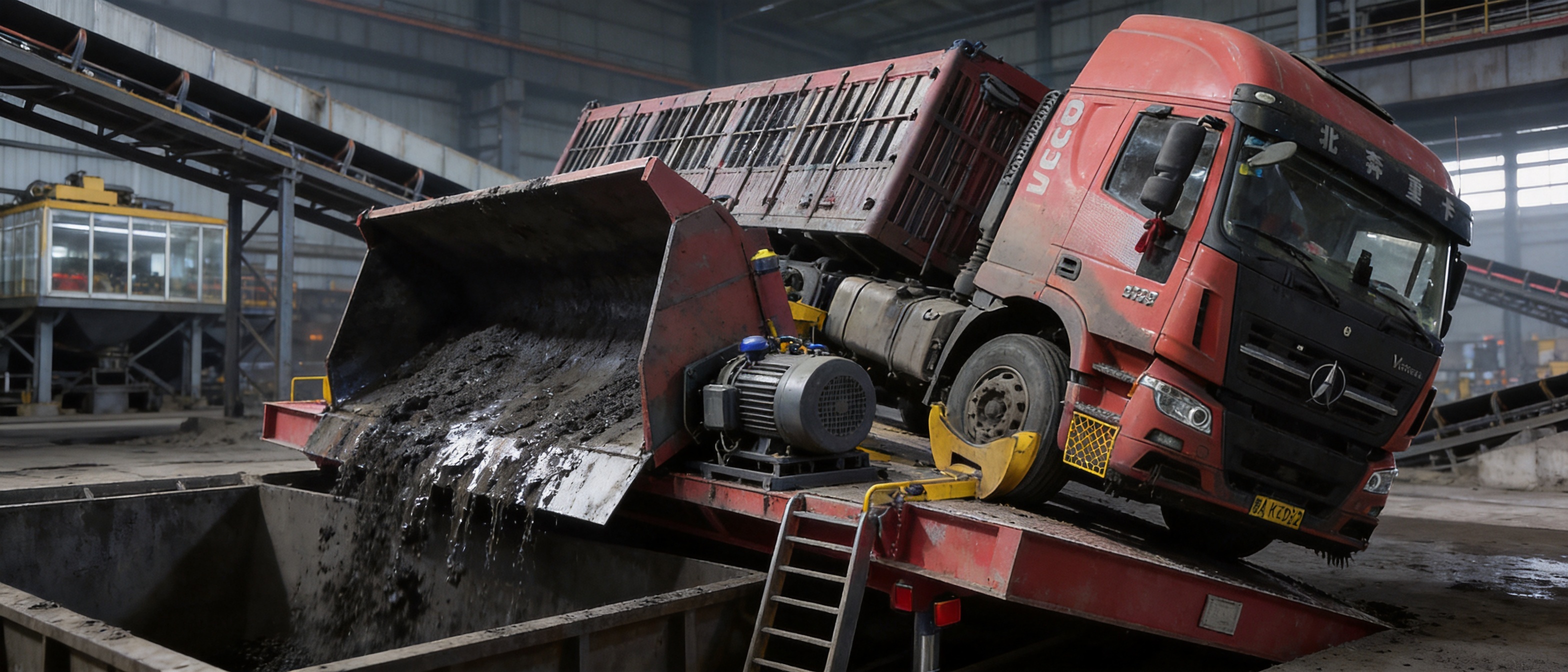
A side-turn truck dumper is a heavy-duty unloading machine that receives a loaded truck on a reinforced platform and tilts the platform sideways. The lateral movement directs bulk cargo into a hopper, receiving pit, conveyor, railcar loading point, or other downstream handling system positioned alongside the dumper.
Unlike a rear dumper, which raises the front of the truck and sends the material behind the vehicle, a side-turn system rotates the truck and platform around a side-oriented axis. This difference changes the entire layout of the unloading station. Trucks can generally enter and leave in a straight-line movement, while the receiving hopper can be positioned beside the platform rather than at its rear.
The equipment is designed for standard heavy-duty trucks carrying bulk products such as coal, ore, grain, cement, limestone, fertilizer, feed, and other granular or powdery materials. Its structural design allows the platform to support substantial vehicle weights while maintaining controlled movement during lifting and return.
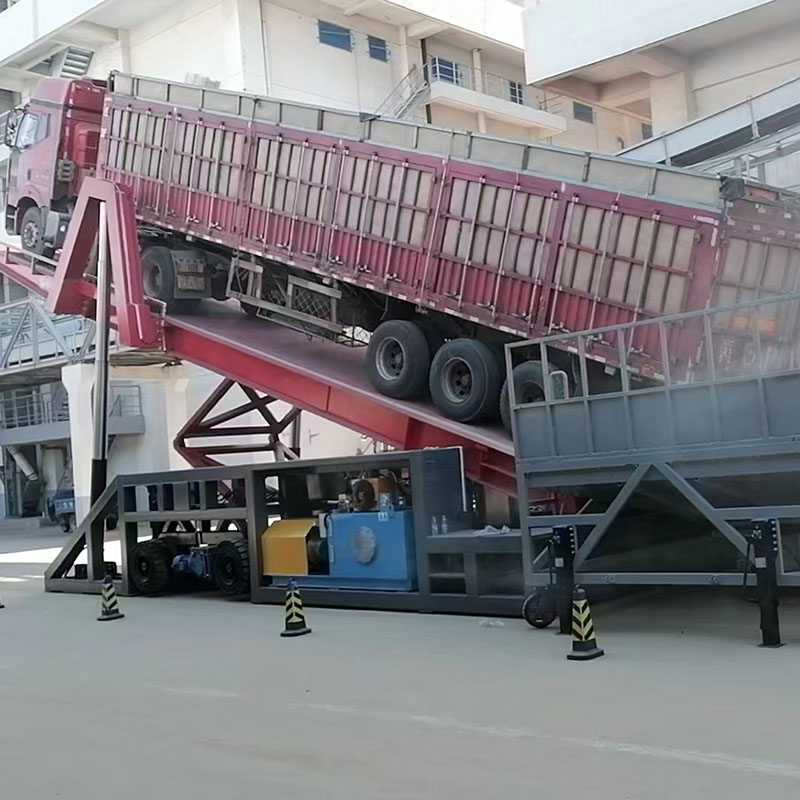
A typical side-turn truck dumper includes a steel platform, vehicle positioning and restraint components, hydraulic lifting cylinders, a hydraulic power unit, control panels, safety interlocks, structural supports, and optional auxiliary devices. Depending on the project, the system may also include vibration equipment, an operation passage, a material guide, dust-control provisions, weighing equipment, truck detection sensors, and an automated control system.
Basic Operating Sequence
The truck enters the platform and is positioned according to the equipment layout. The operator confirms that the vehicle is correctly placed, activates the safety devices, and starts the unloading cycle from the control station. The hydraulic system gradually raises and rotates the platform to the selected angle. Bulk material moves laterally into the receiving hopper or transfer area. When unloading is complete, the platform returns to its horizontal position, the safety devices are released according to the operating procedure, and the empty truck drives away.
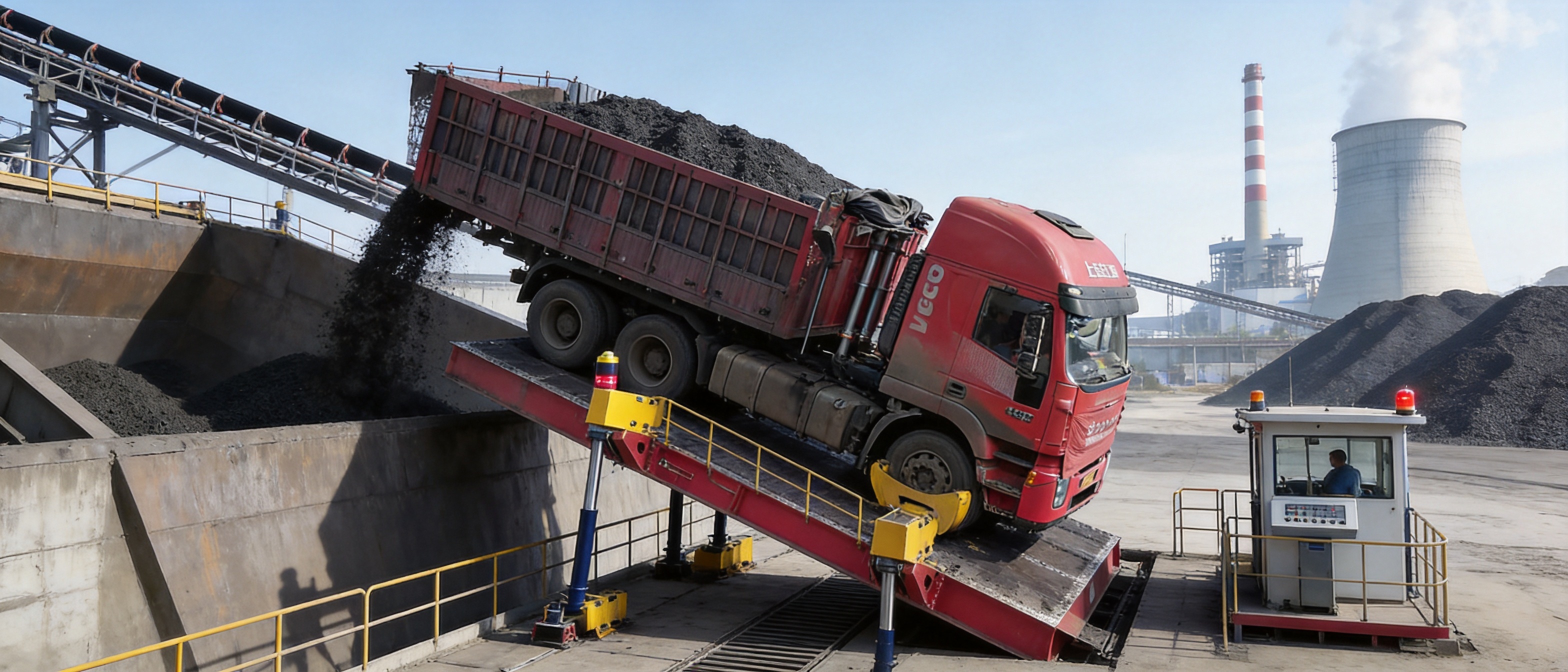
The supplied equipment uses two principal tilting modes. The standard mode reaches approximately 45 degrees and is suitable for materials with normal flow characteristics. The large-angle mode reaches approximately 55 degrees and is intended for products with poor fluidity, high moisture content, or a tendency to adhere to the truck bed.
Because the machine is semi-automatic, the operator remains involved in the suspension or release of specified safety devices. This design combines powered movement with direct operator confirmation at important stages of the cycle. For projects requiring a higher level of automation, additional sensors, interlocks, control logic, and integrated plant communication can be specified.
2. Why Side-Turn Dumpers Are Important for Modern Material Handling
Bulk material facilities are under continual pressure to process more trucks in less space while controlling dust, spillage, labor requirements, and safety risks. A truck unloading station may be constrained by an existing building, a railway line, a storage yard, a conveyor route, or neighboring production equipment. In such situations, the long approach and exit lanes required by a conventional rear dumper can make installation difficult or impossible.
Side-turn dumpers address this challenge by using the width of the site rather than requiring an extended unloading lane behind the platform. The truck can often drive into position, unload, and continue forward without backing into a rear tipping station. This can simplify traffic planning and reduce congestion in busy yards.
The lateral discharge direction also offers flexibility when several hoppers, conveyors, or processing lines are located along one side of the unloading bay. A side-turn platform can be configured to direct material toward a selected receiving point, subject to the project design and material flow requirements.
Another important advantage is the ability to handle difficult materials. Some products do not flow freely when the truck bed is raised. Wet sticky coal may remain attached to the floor, iron ore fines may form a compacted mass, and damp agricultural products may bridge or cake. The 55-degree tilting mode and optional vibration device help release residual material and reduce the amount left in the vehicle.
Comparison with Traditional Rear Dumpers
A traditional rear dumper tips a truck longitudinally. The truck normally reverses into the platform, the front of the vehicle is lifted, and the material falls into a hopper behind the truck. This arrangement remains suitable for many installations, particularly where ample length is available and the material flows easily.
A side-turn dumper tips laterally. It generally requires additional space on the discharge side, but it can substantially reduce the length of the unloading station. For existing plants, this may eliminate building extensions or major changes to traffic lanes.
| Comparison Item | Traditional Rear Dumper | Side-Turn Truck Dumper | Practical Benefit |
|---|---|---|---|
| Discharge direction | Behind the truck | Alongside the truck | Flexible hopper and conveyor positioning |
| Truck movement | Usually requires backing into position | Can support straight-line drive-through operation | Simpler traffic flow and fewer reversing movements |
| Primary space requirement | Greater site length | Greater discharge-side width | Better suitability for short or irregular sites |
| Typical unloading angle | Varies by machine design | 45 degrees or 55 degrees | Large-angle mode assists difficult materials |
| Hopper location | At the rear of the platform | Along the side of the platform | Improved integration with side conveyors and pits |
| Material containment | Depends on rear hopper and sealing design | Can use side material-guiding devices | Lower cleanup demand when properly configured |
In many facilities, the selection should not be based on machine type alone. The correct solution depends on truck dimensions, gross vehicle weight, material properties, discharge height, receiving equipment, available width and length, local safety rules, and the desired degree of automation. An experienced manufacturer can evaluate these conditions before recommending a configuration.
3. Main Product Features
3.1 Semi-Automatic Operating Design
The side-turn truck dumper uses a semi-automatic operating concept. Hydraulic movement, platform control, and the main unloading cycle are powered, while the operator manually suspends or confirms selected safety devices. This arrangement provides a balance between operating efficiency and direct human supervision.
Manual confirmation can be useful in facilities where truck conditions vary. Drivers may arrive with different body designs, sideboards, suspension systems, or load distributions. An operator can visually confirm that the vehicle is correctly positioned before the lifting sequence begins.
The control system can be configured with operating buttons, indicator lights, emergency-stop stations, limit switches, position sensors, and safety interlocks. For more advanced installations, the dumper can be connected with truck identification, weighing, conveyor control, plant supervisory systems, or automatic cycle records.
3.2 Dual Tilting Angles
The standard 45-degree tilting mode provides a practical unloading angle for materials with normal flowability. It supports routine operation while maintaining a balanced relationship between lifting height, unloading speed, and structural load.
The 55-degree large-angle mode provides additional assistance when cargo is wet, sticky, compacted, or otherwise difficult to remove from the truck body. The greater angle increases the gravitational force acting along the truck bed and helps separate material from the floor and side surfaces.
Angle selection should be based on the material, truck body, moisture content, ambient temperature, and receiving hopper geometry. A project engineer can determine the appropriate hydraulic stroke, platform dimensions, clearance, and hopper design to ensure safe operation at both angles.
3.3 Optional Vibration Device
A vibration device can be added when the material is likely to cake at the bottom of the truck or remain attached after the platform reaches its maximum angle. Controlled vibration helps loosen material and improve discharge completeness.
This option is particularly relevant to wet sticky coal, iron ore fines, damp mineral products, clay-bearing materials, and selected agricultural commodities. The vibration system must be selected carefully because excessive vibration may increase structural stress, noise, or dust. Proper engineering considers the truck body, load characteristics, support points, vibration frequency, and operating sequence.
Vibration should be used as an unloading aid rather than as a substitute for correct material preparation. Moisture control, particle size management, and suitable truck body design remain important factors in achieving reliable discharge.
3.4 Operation Passage
An operation passage can be configured to improve access for inspections, lubrication, cleaning, troubleshooting, and routine maintenance. The passage provides a safer and more organized way for authorized personnel to reach designated equipment areas without walking across unsafe surfaces or climbing on the truck platform.
Access arrangements may include handrails, steps, anti-slip flooring, protective guards, maintenance platforms, and properly positioned lighting. The exact design depends on the site layout, local regulations, platform height, hopper depth, and the locations of hydraulic and electrical components.
3.5 Material-Guiding Device
A material-guiding device helps direct bulk cargo into the intended receiving hopper or transfer point. Without adequate guidance, material may fall onto the platform, surrounding floor, or structural components, increasing cleanup work and creating slip, dust, and equipment-maintenance concerns.
Guides can be designed for the material’s angle of repose, particle size, moisture content, and discharge trajectory. They may also be coordinated with dust-control covers, flexible skirts, hopper liners, impact plates, and downstream conveyors.
The guiding device is especially valuable where the unloading station is located inside an existing building or near sensitive machinery. Containing the product at the point of discharge supports cleaner operations and helps protect nearby equipment.
4. Technical Specifications and Model Selection
The standard model range includes equipment suitable for maximum lifting weights of approximately 80, 100, and 150 metric tons. The appropriate model is selected according to the fully loaded vehicle weight, truck wheelbase, body dimensions, load distribution, platform size, and required lifting angle.
| Model | Available Platform Size, Length × Width | Maximum Lifting Weight | Maximum Lifting Angle |
|---|---|---|---|
| TQXCB 80 | 16 × 3 m or 18 × 3 m | 80 metric tons | 45 degrees / 55 degrees |
| TQXCB 100 | 18 × 3 m or 20 × 3 m | 100 metric tons | 45 degrees / 55 degrees |
| TQXCB 150 | 18 × 3 m, 20 × 3 m, or 22 × 3 m | 150 metric tons | 45 degrees / 55 degrees |
The figures above provide reference configurations. Final dimensions and capacities must be confirmed through technical design because truck types, axle arrangements, local foundation conditions, and receiving equipment can vary significantly from one site to another.
Important Selection Factors
Vehicle weight: The rated lifting weight must include the truck and the maximum cargo load, not merely the nominal material payload. A suitable safety margin is required during engineering and approval.
Truck dimensions: Platform length and width should accommodate the longest and widest vehicles expected to use the station. Additional clearances may be needed for mirrors, sideboards, wheel movement, tailgates, and safety barriers.
Material properties: Bulk density, moisture content, particle size, temperature, abrasiveness, cohesiveness, and flowability all influence the required tilting angle and receiving hopper design.
Discharge elevation: The height and location of the receiving hopper or conveyor determine platform geometry, foundation depth, side clearances, and the required hydraulic stroke.
Throughput: The expected number of trucks per hour or per shift affects the selection of controls, hydraulic cycle time, traffic arrangement, dust suppression, and downstream conveying capacity.
Environmental conditions: Outdoor systems may require corrosion-resistant coatings, weather-protected hydraulic power units, protected control cabinets, drainage, lighting, and wind monitoring.
5. Layout and Space Efficiency
One of the most compelling reasons to choose a side-turn truck dumper is the reduction in required site length. A rear unloading station may require a long approach, reversing zone, tipping platform, hopper, and forward exit. Depending on the vehicle and plant layout, the total length can become a major construction constraint.
A side-turn installation typically uses a shorter longitudinal footprint and allocates more space along the discharge side. Reference layouts may require approximately 12 to 18 meters of installation length, with an additional discharge-side width of approximately 6 to 8 meters. Actual dimensions depend on the truck, platform, hopper, maintenance access, and safety clearances.
This arrangement can be advantageous in the following situations:
Existing loading bays where the building cannot be extended.
Ports and terminals where traffic lanes are restricted by quay structures or storage areas.
Cement and steel plants with established conveyor corridors beside the truck route.
Grain receiving stations where multiple storage or processing lines are positioned laterally.
Coal-fired power plants where truck unloading must connect efficiently with coal yards and conveying systems.
Mining facilities where the road approach is long but lateral space is available near the crusher or stockpile.
Shorter site length can also improve traffic organization. A truck may enter from one end, align on the platform, unload toward the side, and leave through the opposite end. This reduces the need for turning circles and minimizes interaction between arriving and departing vehicles.
Drive-Through Operation
Backing maneuvers are among the more demanding activities in a busy industrial yard. They require driver attention, clear communication, adequate visibility, and sufficient space. A straight drive-through arrangement can simplify the movement pattern and reduce the number of reversing events.
The drive-through concept does not eliminate the need for traffic controls. Wheel stops, positioning indicators, signals, interlocks, cameras, warning lights, audible alarms, and trained personnel may still be required. However, it can make the overall route more predictable and easier to supervise.
Shorter truck cycles may also increase practical throughput. The exact improvement depends on traffic conditions, driver behavior, loading records, material flow, and the capacity of the receiving system. Facilities should validate performance using actual operating data rather than relying only on theoretical cycle times.
6. Material Flow, Spillage Control, and Clean Operations
Uncontrolled material discharge creates several operational problems. Product falling outside the receiving hopper may require manual cleanup, interrupt conveyor operation, contaminate drainage systems, generate airborne dust, or damage nearby equipment. In addition, spilled material can create slip hazards and reduce the effective recovery of valuable products.
A side-turn dumper can be designed to improve material containment through the coordinated use of platform geometry, side skirts, guiding plates, hopper lips, impact surfaces, and flexible seals. The goal is to control the material trajectory from the truck body to the receiving point.
Material behavior varies considerably. Dry coal can produce dust and rebound from hard surfaces. Wet coal may form lumps and discharge unevenly. Iron ore fines can compact and fall in dense masses. Grain may flow quickly but can create dust and bridging under certain conditions. Cement and other powders require careful sealing and dust extraction.
For this reason, the side-turn dumper should be treated as part of a complete material-handling system. The hopper volume, conveyor speed, dust collector, chute angle, liner material, and downstream equipment must be coordinated with the dumper cycle.
Reducing Residual Material
Residual material left in a truck body reduces payload recovery and increases cleaning time. The large-angle mode assists gravity-driven discharge, while optional vibration helps release material that has bonded to the truck floor. The effectiveness of these features depends on product moisture, truck-body surface condition, body angle, material temperature, and load compaction during transport.
A project may also benefit from truck-body inspections, suitable internal coatings, improved load distribution, and operational guidelines for moisture-sensitive products. The dumper manufacturer can use information about the material to recommend whether vibration, additional side guides, liners, or a modified hopper should be included.
7. Hydraulic and Structural Engineering
A truck dumper must support a heavy and sometimes unevenly distributed load while moving through a controlled lifting cycle. Structural engineering is therefore central to performance and service life. The platform, support frame, pivot points, hydraulic cylinders, pins, welds, and foundation interfaces must work together under static and dynamic loads.
The hydraulic system provides the force required to raise and rotate the platform. A properly designed system controls acceleration, lifting speed, stopping, and return movement. Hydraulic cylinders must be selected according to capacity, stroke, mounting geometry, pressure, buckling resistance, sealing requirements, and expected duty cycle.
The hydraulic power unit may include pumps, motors, valves, manifolds, oil tanks, filters, pressure protection, cooling components, and instrumentation. For outdoor installations, the power unit and control cabinet require suitable weather protection. In cold or hot climates, hydraulic oil selection and temperature management may also be important.
Structural components should be fabricated to maintain dimensional accuracy and reliable alignment. Welding procedures, material traceability, non-destructive inspection, surface preparation, and coating quality all contribute to the long-term durability of the dumper.
Platform and Foundation Interface
The platform must provide sufficient support for the truck wheels and body while preventing unwanted movement during the tilt. Wheel positioning elements and vehicle restraints should be arranged according to truck type and the direction of platform rotation.
The foundation transfers operational loads into the ground. Foundation design should consider the machine weight, truck loading, dynamic effects, soil conditions, drainage, seismic conditions where applicable, and access for inspection. Accurate interface drawings are essential for civil construction and installation.
A manufacturer with integrated engineering capability can coordinate the platform, hydraulic system, electrical control, foundation requirements, hopper, and conveyor interface. This reduces the risk of mismatched dimensions between separately sourced components.
8. Manufacturing Strengths and Quality Control
Jiangsu Zhengding Intelligent Equipment Co., Ltd. is a national high-tech enterprise focused on the research, development, manufacturing, and sales of intelligent logistics equipment. Its product range includes rear dumpers, side-turn truck dumpers, vehicle loading equipment, container flippers, and other automated loading and unloading systems for industrial applications.
The company’s manufacturing strength is based on combining equipment design with project-oriented engineering. A truck dumper is not treated as an isolated machine. It is developed as part of a system that may include vehicle positioning, metering, loading, unloading, conveying, storage, dust control, and operational management.
Engineering and Design Process
The first stage is application analysis. Engineers review the customer’s product, truck fleet, target throughput, available site, building limitations, receiving equipment, safety requirements, and environmental conditions. This information is used to determine the dumper capacity, platform dimensions, tilting angle, hopper arrangement, control method, and optional devices.
The second stage is mechanical and hydraulic design. The structural frame, rotating or tilting mechanism, hydraulic cylinders, supports, guards, and maintenance access are developed around the actual load conditions. Where difficult materials are involved, the design may include vibration equipment or specialized guiding components.
The third stage is integration design. Electrical controls, sensors, hydraulic systems, conveyor interfaces, weighing devices, dust-control equipment, and plant communication are coordinated. This stage is especially important in automated loading and unloading projects because the dumper must respond correctly to upstream and downstream equipment.
The fourth stage is manufacturing and inspection. Steel parts are cut, formed, machined, welded, assembled, coated, and tested according to the approved design. Critical components and interfaces are inspected before shipment or installation.
The fifth stage is commissioning. After installation, technicians check the foundation interface, hydraulic pressure, platform movement, limit positions, safety devices, control logic, emergency-stop functions, and communication with related equipment. Test cycles are performed with representative vehicles or controlled loads before regular operation begins.
Fabrication and Assembly Advantages
Heavy-duty equipment requires production facilities capable of handling large steel structures and hydraulic assemblies. Manufacturing control is important because small deviations in platform alignment, cylinder mounting, or pivot geometry can affect lifting smoothness and component stress.
Integrated fabrication allows the manufacturer to maintain closer control over structural dimensions, welding quality, hydraulic routing, and assembly fit. It also helps the engineering team respond to customer-specific requirements such as non-standard truck widths, special discharge heights, additional maintenance access, or unusual conveyor arrangements.
Surface treatment is another important consideration. Industrial unloading areas may expose equipment to moisture, dust, salt air, chemicals, or abrasive particles. Appropriate surface preparation and corrosion-resistant coatings can extend service life and reduce maintenance demand. The exact coating system should be selected according to the installation environment.
Quality control should continue after mechanical assembly. Hydraulic lines must be checked for cleanliness, leakage, pressure stability, and correct valve operation. Electrical cabinets should be inspected for wiring accuracy, protection, grounding, labeling, and environmental suitability. Safety devices must be tested under realistic operating conditions.
9. Applications Across Multiple Industries
Thermal Power Plants
Coal-fired power plants receive large volumes of coal by road. A side-turn dumper can connect truck unloading with coal hoppers, belt conveyors, crushers, or stockyard systems. The optional vibration device is useful when wet coal adheres to truck bodies during rainy or cold conditions.
Power plant installations also benefit from controlled material guidance and dust-management interfaces. Reliable unloading helps maintain fuel supply continuity and reduces the labor required to clear coal from the platform and surrounding floor.
Ports and Terminals
Ports and terminals often have limited land, complex traffic patterns, and strict requirements for throughput. A side-turn dumper can be positioned beside a receiving hopper or conveyor while allowing trucks to maintain a relatively direct route through the unloading zone.
Its modular configuration can support different cargoes and operational schedules. Equipment selection should consider salt-laden air, drainage, wind, dust, vehicle identification, and integration with storage or ship-loading systems.
Iron and Steel Enterprises
Steel plants handle ore, fines, coal, limestone, coke-related materials, and other bulk products. Iron ore fines and wet mineral products may have poor flowability, making the 55-degree mode and vibration option particularly useful.
The dumper can be integrated with hoppers, belt conveyors, screens, crushers, stockpiles, and weighing systems. Robust wear protection may be specified for areas exposed to abrasive material impact.
Cement Plants
Cement and raw-material plants frequently operate in confined industrial compounds where the expansion of roads and buildings is difficult. Side discharge can help position the receiving hopper close to an existing conveyor or storage route.
For cement-related materials, dust containment, sealing, extraction, and cleaning access should be considered during the design stage. The material-guiding device can reduce the amount of product falling onto the platform.
Grain Processing and Storage
Grain receiving stations require efficient truck turnover, clean handling, and reliable integration with weighing and storage systems. Side-turn dumpers can be adapted for grain, feed, and agricultural products when the truck body, hopper, grate, dust control, and downstream conveying system are properly matched.
Food and feed applications may require special attention to cleanability, corrosion resistance, product contamination control, and access for inspection. These requirements should be defined before fabrication.
Chemical, Oil, Food, and New Energy Industries
Bulk raw materials are used in many chemical, food, oil, feed, and new energy processes. The side-turn dumper can be developed for the specific material and operating environment, provided that all relevant hazards are addressed. Material temperature, flammability, corrosiveness, dust explosibility, and hygiene requirements may influence the design of electrical and mechanical components.
10. Safety and Maintenance Considerations
Safety is a combined responsibility involving equipment design, installation, operating procedures, training, inspection, and site management. The dumper should be operated only by trained personnel who understand the permitted truck types, load limits, platform positions, emergency procedures, and communication signals.
Before each unloading cycle, the operator should confirm that the vehicle is correctly positioned, the load is within the permitted limit, no personnel are inside restricted areas, and the receiving system is ready. Safety devices must be engaged according to the operating procedure before lifting begins.
Emergency-stop controls should be accessible from appropriate operating and inspection locations. Limit switches and position sensors should be checked periodically. Warning lights, audible alarms, guardrails, wheel stops, and access gates should remain visible and functional.
Routine Maintenance
Routine maintenance generally includes inspection of hydraulic hoses, cylinders, valves, pumps, oil levels, filters, electrical connections, sensors, pivot pins, welds, wheel stops, guards, and platform surfaces. Lubrication points should be serviced according to the manufacturer’s instructions and operating frequency.
Particular attention should be paid to areas exposed to abrasive material, vibration, impact, moisture, and repeated load cycles. Unusual noise, jerky movement, hydraulic leakage, delayed return, uneven lifting, or changes in operating pressure should be investigated promptly.
An operation passage makes many inspection and service tasks easier. Safe access reduces the temptation for personnel to climb on unprotected structures or work near moving parts without proper controls.
Outdoor Installation
Side-turn dumpers can be installed outdoors when the system is designed for the local climate. Outdoor installations may require protective covers for hydraulic power units and control panels, corrosion-resistant coatings, drainage, weatherproof electrical enclosures, lighting, and wind monitoring.
High wind can affect truck stability and the safe operation of a raised platform. Where required by the project risk assessment, wind-speed monitoring can trigger warnings or automatic shutdown functions. The specific protection strategy should comply with applicable local standards and site procedures.
11. Customized Solutions from an Integrated Manufacturer
Truck fleets and industrial sites are rarely identical. One customer may operate 80-ton trucks on a short platform, while another may require a 150-ton system for long vehicles with specialized bodies. Some facilities discharge into deep hoppers, while others feed conveyors positioned at platform level.
Jiangsu Zhengding Intelligent Equipment Co., Ltd. provides customized engineering based on the customer’s operating conditions. Platform dimensions, lifting capacity, discharge angle, hopper interface, hydraulic power, control system, access arrangements, material guides, vibration devices, and safety equipment can be coordinated as one project.
The company’s broader portfolio includes automated loading and unloading equipment for automobiles, containers, ships, and related logistics applications. This product coverage allows the engineering team to consider the customer’s complete logistics route rather than focusing on a single unloading point.
Its equipment is used in steel, chemical, cement, coal, grain, oil, food, feed, port, papermaking, and new energy applications. The company also serves international markets including Japan, Brazil, Egypt, Pakistan, India, the Middle East, and Southeast Asia. International project experience can be valuable when equipment must be adapted to different truck standards, climates, electrical systems, safety practices, and installation conditions.
The company reports experience serving international users and groups such as Budweiser, Heineken, Buhler Group, Wilmar International, Cargill, DuPont, Louis Dreyfus, Charoen Pokphand Group, and Saint-Gobain Group. Such project exposure reflects the need to meet varied requirements for production reliability, automation, maintainability, and material handling.
12. Installation and Project Implementation
A successful side-turn dumper project begins with a site survey. Engineers should verify road alignment, available length and width, foundation conditions, drainage, building clearances, overhead restrictions, hopper location, conveyor route, maintenance access, and utility connections.
Truck data should be collected in detail. Important information includes overall length and width, wheelbase, axle arrangement, gross vehicle weight, body height, sideboard design, tailgate configuration, suspension type, turning radius, and the expected range of truck models.
Material testing may also be valuable. Bulk density, moisture content, particle size distribution, angle of repose, cohesive behavior, temperature, and abrasiveness can influence the design of the platform, hopper, guide, liner, and vibration system.
During installation, the foundation and embedded parts must match the approved drawings. The platform should be aligned correctly, hydraulic cylinders installed without binding, and electrical and hydraulic lines protected from traffic and material impact. Before production operation, no-load and loaded tests should be completed.
Commissioning should verify the full system rather than the dumper alone. The test should include truck positioning, safety-device operation, lifting and return movement, discharge trajectory, hopper capacity, conveyor coordination, emergency stops, alarms, interlocks, and recovery procedures for abnormal conditions.
13. Economic and Operational Benefits
The economic value of a side-turn dumper comes from the combined effects of site utilization, truck cycle management, unloading reliability, reduced cleanup, and integration with existing infrastructure. The best return is usually achieved where the facility has limited length, high truck frequency, difficult materials, or expensive manual cleanup.
Using an existing building or yard without major extension can reduce civil construction costs and shorten the project schedule. A shorter traffic route may also reduce congestion and simplify future expansion.
Improved discharge completeness can reduce the time trucks spend waiting for manual removal of residual material. When optional vibration and material-guiding systems are properly selected, they may also reduce cleanup labor and help keep the transfer area operational.
Lower spillage supports more efficient product recovery. This is particularly important for valuable ores, specialty raw materials, food products, and materials whose contamination or loss affects downstream production.
However, a proper economic evaluation should include the complete installed cost. Civil works, receiving hoppers, conveyors, dust control, electrical systems, access platforms, commissioning, maintenance, and operator training all influence the final investment. A professional manufacturer should help the customer compare the total lifecycle cost rather than only the purchase price of the dumper.
14. How to Choose the Right Side-Turn Truck Dumper
Customers should begin by defining the operating objective. Is the main requirement to save space, improve difficult-material discharge, increase truck throughput, reduce manual cleanup, or integrate unloading with an automated plant control system? Clarifying the primary objective helps determine the appropriate options.
The next step is to establish the vehicle envelope. The dumper should be designed around the largest and heaviest truck expected during normal operation, while also accommodating smaller vehicles without creating positioning problems.
Material characteristics should be documented. A free-flowing dry product may need only the standard tilting mode, while wet, sticky, or compacted material may require 55-degree lifting, vibration, special liners, or a modified receiving hopper.
Site conditions should be measured accurately. A small difference in available width may affect whether the hopper, maintenance passage, truck lane, safety barrier, and conveyor can all be installed correctly. The manufacturer should receive a layout drawing, photographs, survey information, and details of existing equipment.
Finally, customers should assess after-sales support. Technical documentation, spare parts, remote assistance, commissioning, operator training, inspection programs, and response time can have a significant effect on long-term equipment availability.
15. Frequently Asked Questions
Q1: What materials can a side-turn truck dumper unload?
A side-turn truck dumper can be used for many bulk materials, including coal, iron ore, mineral fines, cement, limestone, grain, feed, fertilizer, and other granular or powdery products. Final suitability depends on bulk density, moisture, temperature, abrasiveness, cohesion, and flowability. Material information should be provided during the design stage.
Q2: Can it unload wet sticky coal and iron ore fines?
Yes. The large-angle mode of approximately 55 degrees is designed to assist materials with poor flowability, including wet sticky coal and iron ore fines. A vibration device can also be added to help loosen material that remains caked on the bottom of the truck body.
Q3: Does the dumper require the driver to reverse?
The side-turn layout can support straight-line drive-through operation, which generally reduces or eliminates the need for backing into the unloading position. The exact traffic arrangement depends on the site design. Positioning signals, wheel stops, cameras, and trained operators may still be required.
Q4: What is the difference between the 45-degree and 55-degree modes?
The 45-degree mode is the standard setting for materials that discharge readily. The 55-degree mode provides a steeper platform angle for materials that are sticky, damp, compacted, or otherwise difficult to release. The selected angle must match the receiving hopper and safety design.
Q5: What maximum lifting capacities are available?
Reference models include capacities of 80, 100, and 150 metric tons. The final rated capacity depends on the complete truck and cargo weight, platform dimensions, load distribution, hydraulic design, and project safety requirements.
Q6: Can the platform be customized for different trucks?
Yes. Platform length and width can be adapted to the customer’s truck fleet. The design should consider overall truck dimensions, wheelbase, axle spacing, body configuration, sideboard height, tailgate design, and vehicle positioning requirements.
Q7: Is a vibration system always necessary?
No. Vibration is an optional configuration. It is most useful for materials that cake or adhere to the truck body. For free-flowing products, the standard platform and tilting system may be sufficient.
Q8: Why is a material-guiding device useful?
A material-guiding device directs the discharged product toward the receiving hopper and helps prevent it from falling onto the platform or surrounding floor. This can reduce cleanup, material loss, dust generation, and interference with nearby equipment.
Q9: Can the equipment be installed outdoors?
Yes. Outdoor installation is possible when the hydraulic power unit, control cabinet, electrical components, drainage, coatings, and access arrangements are designed for local weather conditions. Wind monitoring and automatic shutdown functions may be included where necessary.
Q10: What maintenance is required?
Maintenance includes checking hydraulic oil, hoses, cylinders, valves, pumps, filters, electrical connections, sensors, pivot points, structural welds, guards, wheel stops, and platform surfaces. Lubrication and inspection intervals depend on the duty cycle and operating environment.
Q11: Can the dumper connect with weighing and conveyor systems?
Yes. The dumper can be engineered as part of an integrated loading and unloading system. Possible interfaces include weighing systems, truck identification, hopper gates, conveyors, dust collectors, plant control systems, alarms, and operational data recording.
Q12: What information is needed for a quotation?
Useful information includes the material name and characteristics, maximum truck weight, truck dimensions, required throughput, platform location, available site dimensions, discharge direction, receiving hopper or conveyor details, indoor or outdoor installation conditions, and the desired automation level.
16. Conclusion
Side-turn truck dumpers provide an efficient solution for unloading bulk materials where conventional rear tipping equipment is limited by site length, traffic movement, or difficult material flow. Their lateral discharge arrangement can simplify truck handling, improve space utilization, and support more flexible hopper and conveyor placement.
The combination of 45-degree and 55-degree tilting modes allows the equipment to serve both free-flowing and difficult-to-unload materials. Optional vibration devices, operation passages, and material-guiding systems further improve unloading completeness, maintenance access, safety, and cleanliness.
Jiangsu Zhengding Intelligent Equipment Co., Ltd. strengthens this product through integrated engineering, heavy-duty fabrication, hydraulic and electrical coordination, customized design, and experience in automated loading and unloading applications. Its wider equipment portfolio supports complete solutions for vehicles, containers, ships, and industrial logistics systems.
For facilities handling coal, ore, grain, cement, minerals, feed, or other bulk materials, the correct side-turn dumper should be selected through a detailed evaluation of trucks, materials, site conditions, throughput, safety requirements, and downstream equipment. When these factors are coordinated from the beginning, a side-turn truck dumper can become a reliable foundation for safer, cleaner, and more productive bulk material handling.
References
1. Jiangsu Zhengding Intelligent Equipment Co., Ltd., Side-Turn Truck Dumper Product Information and Technical Parameters.
2. Jiangsu Zhengding Intelligent Equipment Co., Ltd., Automated Loading and Unloading Equipment Product Portfolio.
3. Bulk Materials Handling Engineering Principles, Guidance on Hopper Design, Flowability, Chute Geometry, and Material Containment.
4. Industrial Hydraulic Equipment Design Practice, Guidance on Cylinders, Power Units, Pressure Control, and Maintenance.
5. Heavy-Duty Industrial Machinery Safety Practice, Guidance on Interlocks, Emergency Stops, Access Protection, and Operator Training.
6. Industrial Plant Layout and Logistics Planning References, Guidance on Vehicle Traffic Flow, Drive-Through Stations, and Space Utilization.
7. Bulk Solid Materials Characterization References, Guidance on Moisture, Density, Cohesion, Abrasiveness, and Angle of Repose.


