
 English
 русский
 Español
 Français
 Português
 عربى
عربى



+86-13588556918
Content
- 1 1. The Role of Continuous Container Handling in Modern Logistics
- 2 2. Product Design and Main Operating Functions
- 3 3. Technical Parameters and Model Selection
- 4 4. Throughput and Efficiency Advantages
- 5 5. Comparison with Traditional Batch Handling
- 6 6. Safety, Stability, and Quality Control
- 7 7. Advanced Manufacturing Processes and Engineering Strengths
- 8 8. Customization Capabilities for Different Industries
- 9 9. Why Select an Experienced Equipment Manufacturer?
- 10 10. Installation, Operation, and Maintenance Considerations
- 11 11. Return on Investment and Business Value
- 12 12. Implementation Strategy for a New Project
- 13 13. Frequently Asked Questions
- 13.1 Q1: What is a continuous container handling system?
- 13.2 Q2: Can the system handle both 20-foot and 40-foot containers?
- 13.3 Q3: What is the maximum lifting capacity?
- 13.4 Q4: What lifting angles are available?
- 13.5 Q5: Can container doors be opened automatically?
- 13.6 Q6: Is weighing included as standard equipment?
- 13.7 Q7: Can one line perform both loading and unloading?
- 13.8 Q8: Can existing batch equipment be converted to continuous operation?
- 13.9 Q9: What industries can use this equipment?
- 13.10 Q10: Does continuous handling reduce container damage?
- 13.11 Q11: What information is needed for a quotation?
- 13.12 Q12: Does the manufacturer provide customized solutions?
- 14 14. Conclusion
- 15 References
- 16 Product: Continuous Container Handling System
Modern logistics facilities are under constant pressure to move more cargo through the same amount of space, equipment, and labor. Ports, railway container terminals, inland distribution centers, industrial warehouses, and bulk-material handling sites must process containers quickly while maintaining safety, weighing accuracy, equipment reliability, and operational flexibility. Traditional batch handling methods can complete these tasks, but they often create waiting periods between containers, repeated repositioning movements, uneven labor demand, and unnecessary use of valuable yard space.
A continuous container handling system is designed to solve these challenges by integrating container feeding, positioning, loading, unloading, weighing, and transfer functions into a coordinated production line. Instead of treating every container as an isolated handling task, the system creates a more consistent flow in which one container can be prepared, loaded, unloaded, weighed, or discharged while another container is being positioned for the next operation.
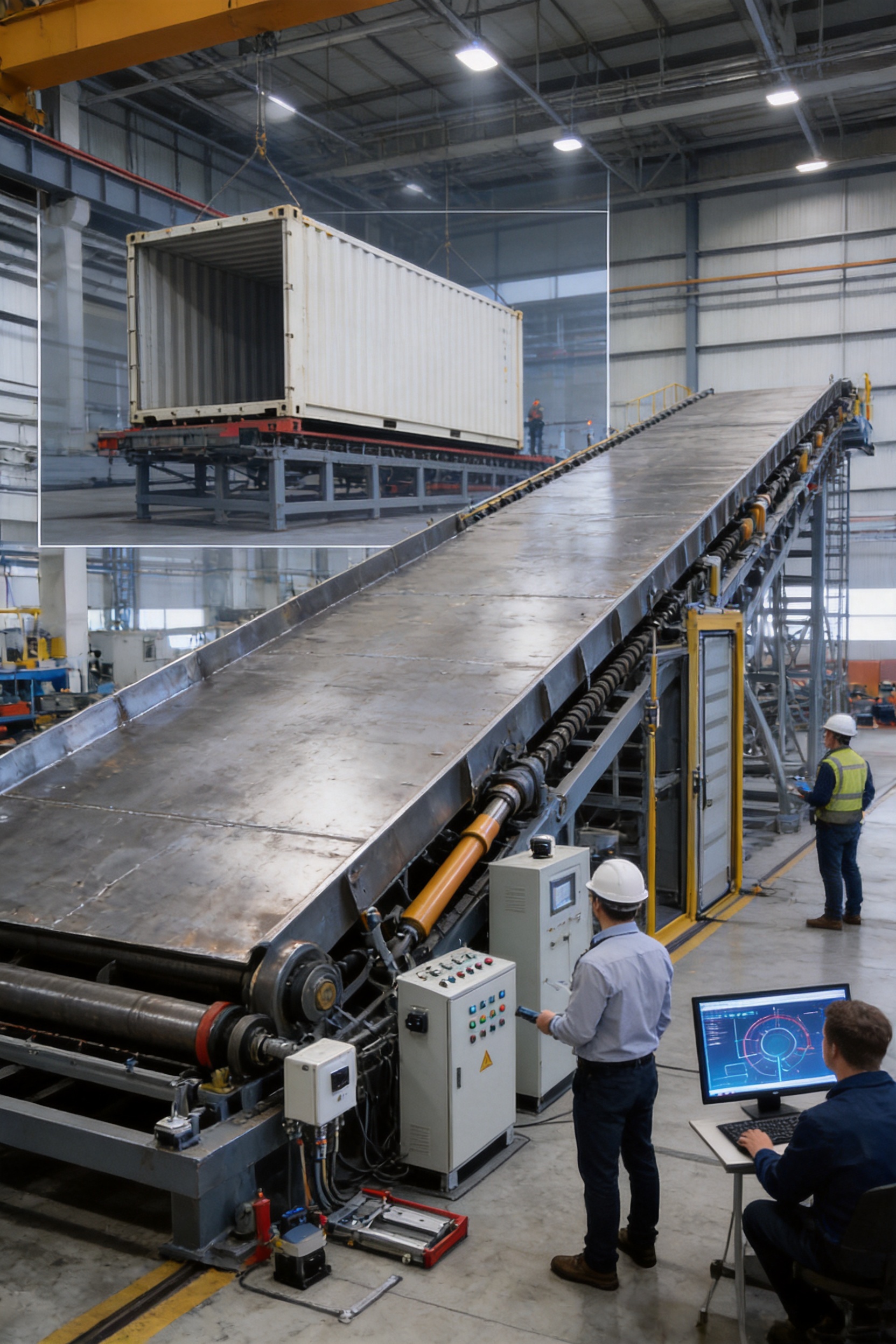
The continuous container handling system supplied by Jiangsu Zhengding Intelligent Equipment Co., Ltd. adopts an integrated design suitable for both 20-foot and 40-foot containers. It is developed for demanding applications where throughput, repeatability, safety, and efficient use of space are essential. Its configuration can include a dedicated container feeder, automatic door opening and closing, container tilting, integrated weighing, and synchronized loading and unloading functions.
By combining these functions within one coordinated system, the equipment reduces the need to transfer containers between separate operating zones. This makes the complete material flow simpler and more controllable. It also enables facilities to improve the utilization of cranes, conveyors, loading bays, operators, and supporting infrastructure.
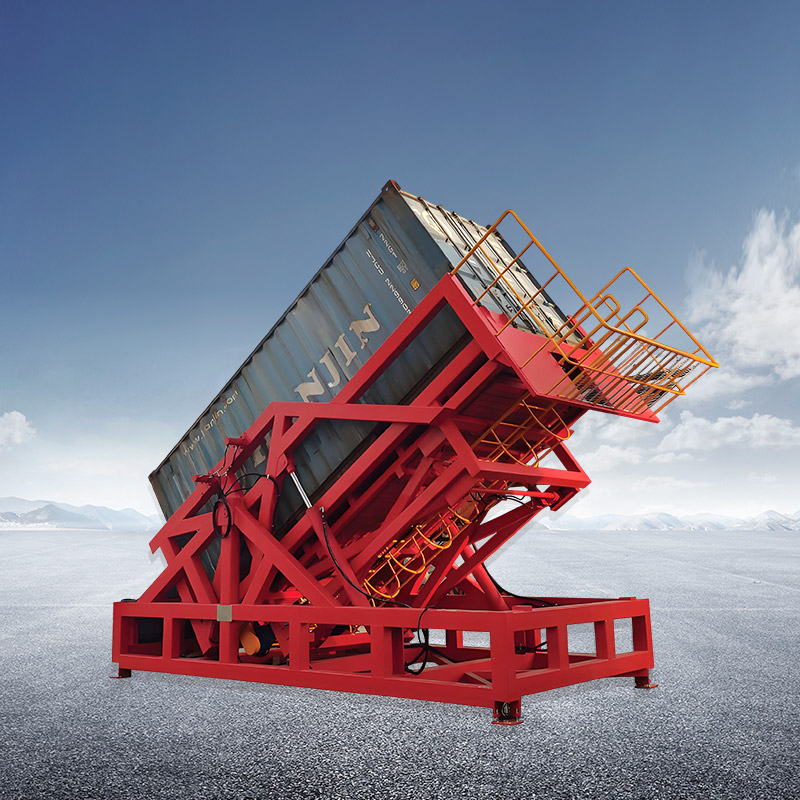
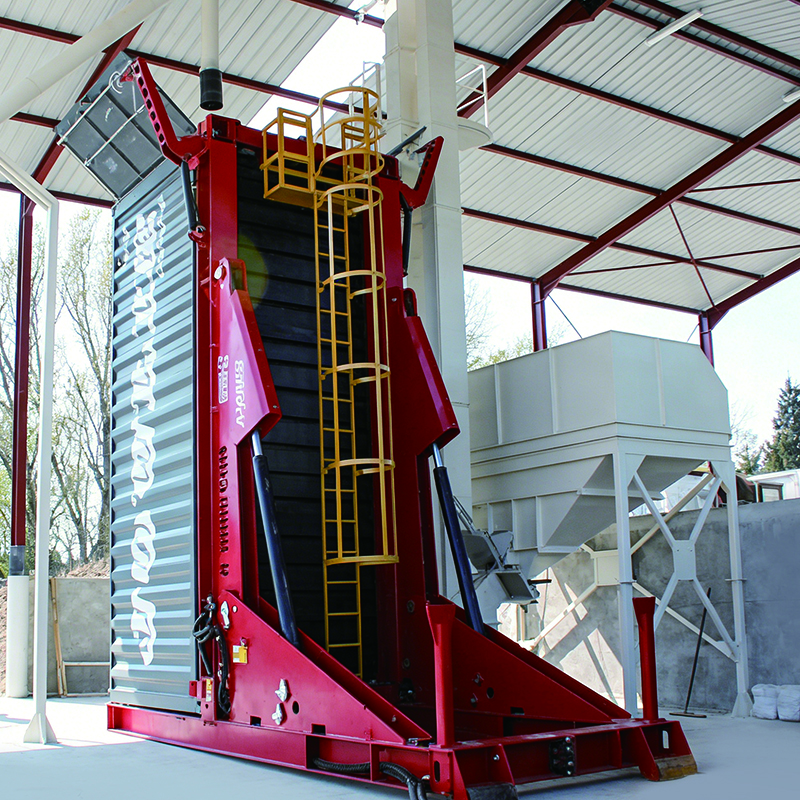
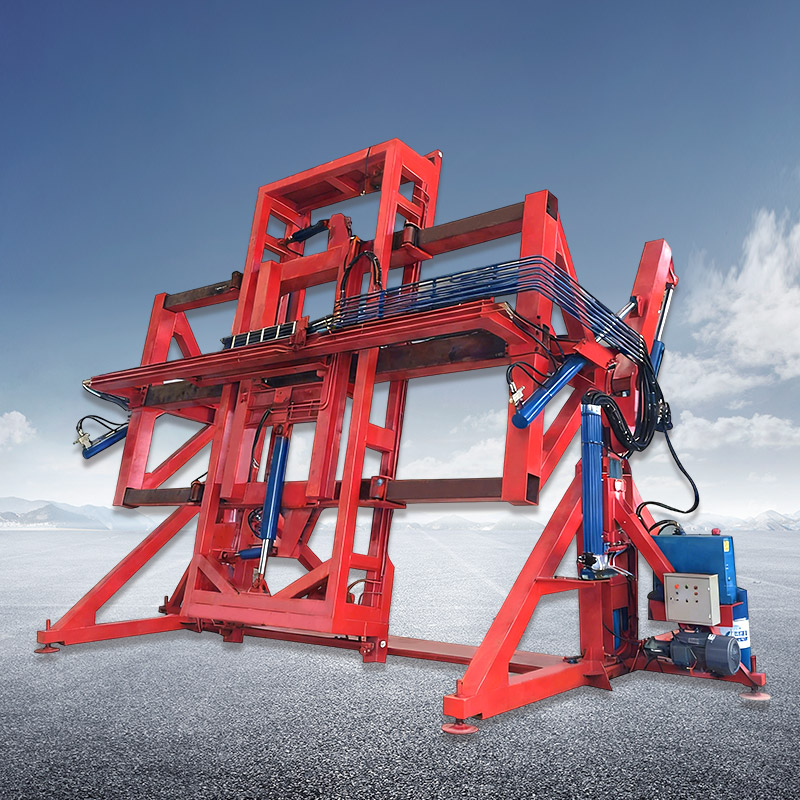
Continuous Container Handling System
1. The Role of Continuous Container Handling in Modern Logistics
Container handling is often described as a lifting or transportation activity, but the actual process includes many separate steps. A container must be delivered to the operating position, aligned correctly, secured, opened when required, loaded or unloaded, weighed if necessary, closed, released, and transferred to the next location. If these activities are performed sequentially with long gaps between them, the system can lose a considerable amount of productive time.
Traditional batch handling normally requires one container to complete an entire cycle before the next container enters the same work area. The crane or handling machine may wait while a container is positioned, while doors are opened, while operators verify the load, or while the finished container is removed. These delays may only last several minutes at a time, but over a full shift they can significantly reduce capacity.
Continuous handling changes the operating principle. The system organizes containers in a controlled sequence and allows compatible operations to overlap. A feeder can deliver a new container to the tilting platform while another container is being processed. A weighing function can record the container mass during circulation rather than requiring a separate weighing station. Automated door mechanisms can reduce the time and physical effort needed before and after material transfer.
This approach is especially valuable in facilities with high daily container volumes, strict train or vessel schedules, limited dock positions, high labor costs, or restricted site space. It is also useful in industries where the same loading and unloading line must accommodate different products, container sizes, and operating conditions.
1.1 From isolated handling tasks to integrated flow
The main difference between an isolated handling process and an integrated continuous system is the way resources are coordinated. In an isolated process, each machine may work correctly but still create delays for the next machine. In an integrated system, the feeder, tilting platform, weighing equipment, door mechanism, conveyor, control system, and safety devices are designed to work as one operating unit.
This integration allows the equipment to reduce unnecessary transfers. Instead of moving a container from a loading area to a separate weighing area and then to an unloading area, the container can pass through connected functions in a planned sequence. Fewer transfers mean fewer handling movements, less risk of misalignment, and improved control over the container cycle.
The system is also designed to support both loading and unloading on the same production line. This dual-function design provides more flexibility than equipment dedicated to only one direction of material flow. Depending on the application, the line can be configured for loading goods into containers, removing bulk materials from containers, or handling different product streams during separate production periods.
1.2 Suitable application environments
Continuous container handling is suitable for railway container central stations, inland ports, large logistics parks, bulk-material warehouses, industrial production plants, and distribution centers that require rapid container turnover. It may also be applied in sectors such as grain, feed, cement, coal, chemical products, food ingredients, and other industries where containers must be filled or emptied efficiently.
Railway and intermodal facilities benefit from predictable cycle times because trains often operate according to fixed departure schedules. Inland ports and logistics parks can use the system to reduce congestion at loading bays. Large warehouses can improve the movement of containers between storage, loading, and dispatch areas. Industrial plants can integrate the equipment with conveyors, silos, hoppers, storage systems, and production lines.
The system can be adapted to different site layouts and material flows. A project may require a straight-through arrangement, a side-fed configuration, a pit-mounted structure, or integration with existing cranes and conveyors. The final design depends on the container type, material characteristics, required capacity, available foundation space, safety requirements, and the degree of automation desired by the customer.
2. Product Design and Main Operating Functions
The continuous container handling system is built around a coordinated series of mechanical and electrical functions. Each function contributes to the reduction of idle time and the improvement of operating consistency. The integrated design also allows the system to be engineered around the customer's actual workflow rather than forcing the facility to adapt to a standard machine arrangement.
2.1 Dedicated container feeder
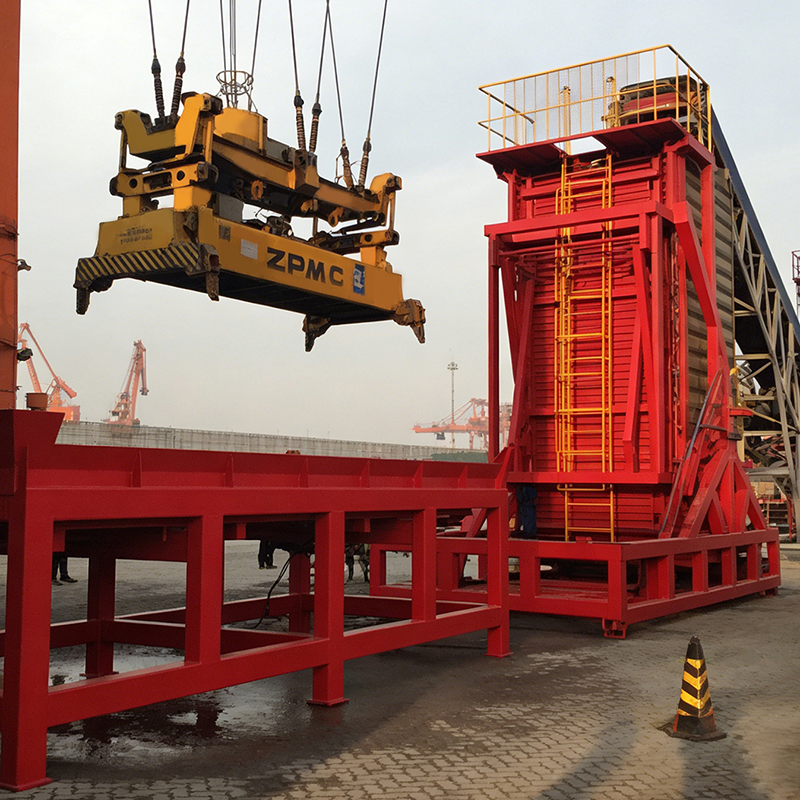
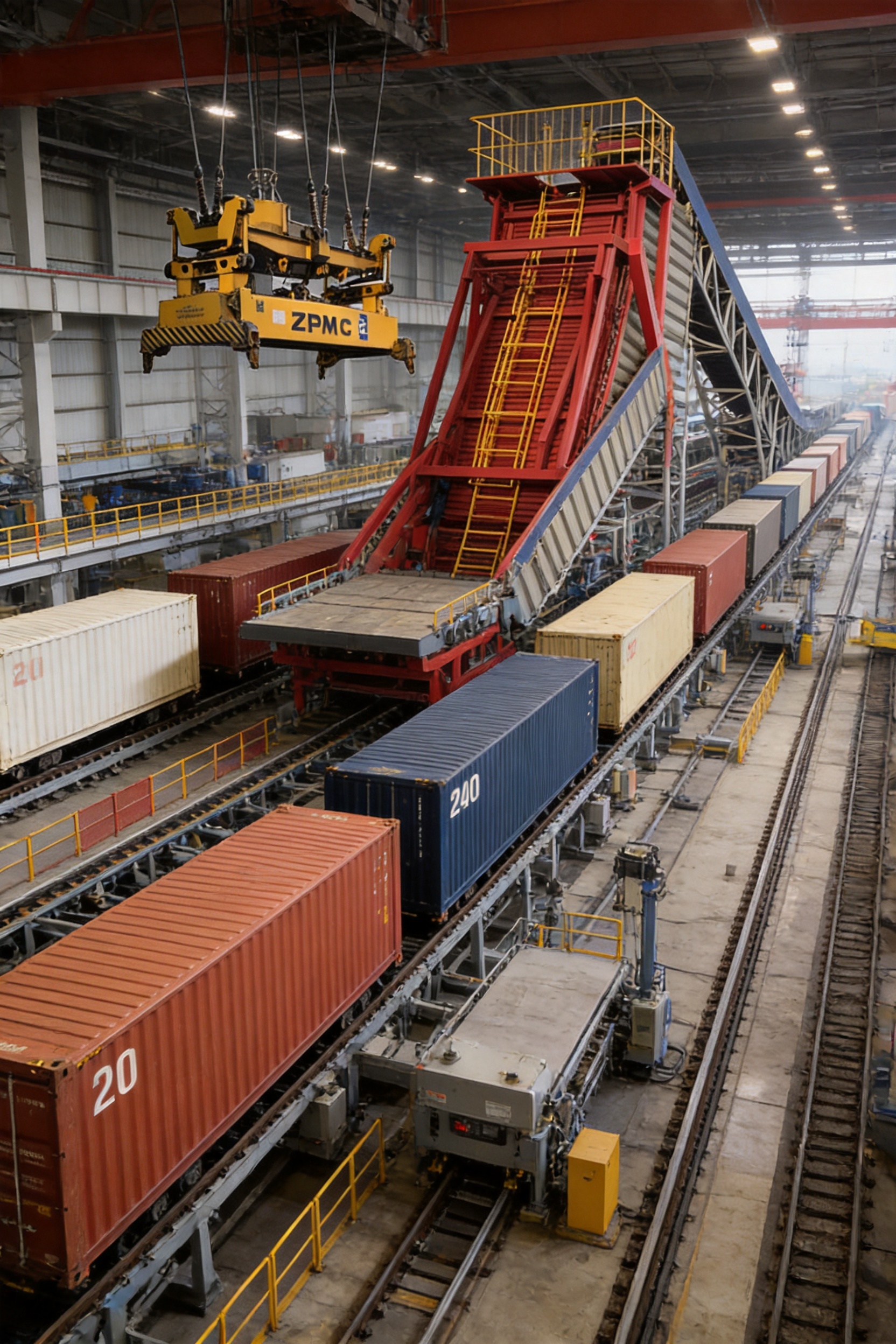
A dedicated container feeder automatically delivers containers onto the container tilting platform. This is one of the most important features of the system because it improves the continuity of container supply to the main operating position. The feeder can be synchronized with upstream transport equipment and with the operating status of the tilting platform.
In a conventional arrangement, a crane or forklift may need to position every container individually. This can reduce crane productivity because the crane performs not only lifting work but also repeated alignment and placement tasks. With a dedicated feeder, containers can be introduced in a more controlled sequence, allowing the crane or other lifting equipment to concentrate on its primary duties.
The feeder can also help maintain a consistent container orientation. Correct alignment is essential for safe clamping, door operation, weighing, and material transfer. By reducing positioning errors, the feeder supports smoother automatic operation and helps lower the likelihood of delays caused by manual correction.
2.2 Container tilting platform
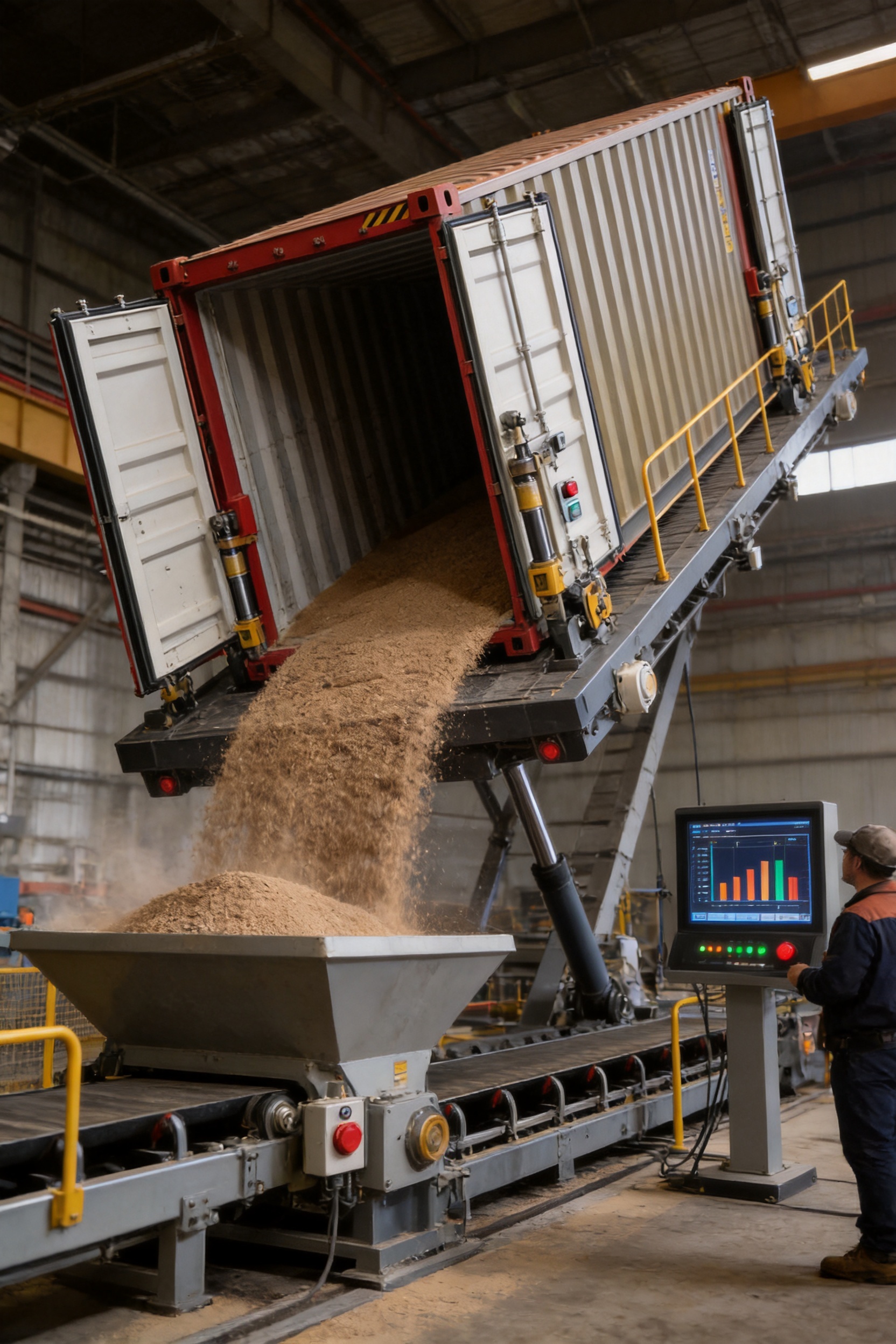
The container tilting platform is designed to lift and tilt the container to the angle required for loading or unloading. The available maximum lifting angles are 45 degrees and 60 degrees, depending on the model and application configuration. Tilting can assist the movement of bulk materials and can reduce the need for additional handling equipment inside or around the container.
The platform must provide stable support throughout the movement cycle. Its structure, hydraulic or mechanical lifting components, locking devices, and control logic must work together to prevent sudden movement or instability. The system can be engineered according to the container size, maximum lifting weight, material behavior, and required operating frequency.
Tilting equipment is particularly useful when gravity can assist material discharge. It may improve unloading performance for products that do not flow easily on a level surface. For loading applications, the platform and connected equipment can be coordinated to maintain a suitable position for material distribution and controlled filling.
2.3 Automatic door opening and closing
The system can be configured with an automatic container door opening and closing mechanism. This option reduces manual intervention and improves the overall rhythm of the operation. It is especially valuable where container doors are heavy, positioned at height, difficult to access, or opened and closed many times during a shift.
Manual door handling can create several problems. Operators may need to climb, bend, pull, or work close to moving equipment. Weather conditions and product residue may make the doors difficult to operate. Different container conditions may also produce inconsistent opening times. An automatic mechanism can provide a more repeatable sequence and reduce exposure to unnecessary physical work.
The door system can be integrated with safety interlocks so that loading, unloading, tilting, or container movement cannot begin unless the door position is confirmed. Sensors and control logic can help verify whether the doors are fully open, fully closed, or in an abnormal position. Such functions support safer operation and reduce the possibility of starting a cycle in an unsuitable condition.
2.4 Optional weighing function
A weighing function can be integrated into the continuous circulation process. This allows the system to automatically record container weight without requiring the container to be diverted to a separate weighing station. Integrated weighing can improve process visibility, support loading control, and reduce the number of additional handling steps.
Weight data may be used for production records, inventory management, dispatch verification, loading compliance, and material usage analysis. Depending on the project requirements, the weighing equipment can be connected to the central control system or a plant management system. The customer can define the desired data format, reporting method, accuracy requirements, and communication interface during the engineering stage.
Integrated weighing is especially helpful for bulk products and industries where the quantity loaded into every container must be controlled. It can also assist operators in identifying abnormal conditions, such as underloading, overloading, incomplete discharge, or material remaining inside the container.
2.5 Combined loading and unloading functions
The system integrates the dual functions of loading and unloading into the same production line. This eliminates the need to transfer containers between different machines or operating areas when the facility needs both capabilities. As a result, the layout can be more compact and the overall operating process can be easier to manage.
A combined line can provide greater utilization throughout the day. For example, one operating period may be used for receiving material from containers, while another period may be used for filling containers with finished products. The system can also be configured for different material routes, provided that the product characteristics and cleaning requirements are properly evaluated.
Integrating both functions requires careful engineering. The system must account for the direction of material flow, conveyor elevations, dust control, cleaning access, inspection points, electrical interlocks, and container positioning. Jiangsu Zhengding's experience with automated loading and unloading equipment enables the project design to consider these factors as a complete solution rather than as isolated components.
3. Technical Parameters and Model Selection
The equipment is available in configurations for 20-foot and 40-foot containers. The main reference models are TJXH 20 and TJXH 40. These models provide a starting point for project evaluation, while the final design may be customized according to the required layout, material, throughput, and automation level.
| Model | Applicable Container Length | Reference Size L × W | Maximum Lifting Weight | Maximum Lifting Angle |
|---|---|---|---|---|
| TJXH 20 | 20-foot container | 6 × 3 m | 50 t | 45° / 60° |
| TJXH 40 | 40-foot container | 12 × 3 m | 100 t | 45° / 60° |
The TJXH 20 configuration is intended for 20-foot container handling applications and has a reference size of 6 meters by 3 meters. Its maximum lifting weight is 50 tons, with a maximum lifting angle of 45 degrees or 60 degrees depending on the selected arrangement.
The TJXH 40 configuration is intended for 40-foot container handling applications and has a reference size of 12 meters by 3 meters. Its maximum lifting weight is 100 tons, with the same available maximum lifting angle options of 45 degrees or 60 degrees.
These values should be treated as reference technical parameters rather than a substitute for project-specific engineering confirmation. Container tare weight, product density, uneven load distribution, dynamic forces, local regulations, foundation conditions, and operating frequency can all affect the final equipment design. A professional technical review should be completed before production begins.
3.1 Factors affecting model selection
The first selection factor is container length. A facility that handles only 20-foot containers may use a TJXH 20 configuration, while a facility handling 40-foot containers requires the longer TJXH 40 arrangement. If both sizes are used, the system can be designed with suitable positioning and control functions to accommodate the required container fleet.
The second factor is the maximum operating load. The total load includes not only the material inside the container but also the container itself and any dynamic forces created during movement. The engineering team must evaluate the worst operating case instead of relying only on average cargo weight.
The third factor is the material being handled. Grain, feed, cement, coal, minerals, chemicals, and food products can have different flow characteristics, moisture levels, bulk densities, dust behavior, and cleaning requirements. These characteristics influence the design of hoppers, chutes, seals, conveyors, extraction systems, and contact surfaces.
The fourth factor is the desired throughput. A facility processing a modest number of containers may require a simpler configuration, while a high-volume terminal may need parallel lanes, automated accumulation, faster indexing, redundant sensors, and more advanced production scheduling.
The fifth factor is site integration. Existing rails, roads, cranes, conveyors, foundations, storage silos, control rooms, and maintenance areas must be considered. A successful installation is not only a matter of selecting a lifting platform; it is a matter of fitting the complete system into the customer's operating environment.
4. Throughput and Efficiency Advantages
The key advantage of continuous handling is the reduction of nonproductive time. Traditional batch systems may spend three to eight minutes changing from one container to the next. A properly engineered continuous system can reduce the container changeover interval to approximately 20 to 45 seconds, depending on the product, equipment arrangement, and operating conditions.
When these intervals are repeated throughout a shift, the capacity improvement can be substantial. Industry comparisons commonly place traditional single-bay batch handling at approximately four to eight containers per hour. Continuous indexing systems may process around ten to sixteen containers per hour, depending on the degree of automation and the time required for loading or unloading.
Continuous parallel-flow arrangements can provide even higher theoretical throughput when several compatible activities are performed simultaneously. A facility may use separate preparation and processing positions, allowing a finished container to leave while the next container is already being prepared. This reduces the time during which the primary handling equipment is waiting.
4.1 Improved equipment utilization
Traditional batch equipment may have an effective utilization rate of approximately 50 to 65 percent because of waiting, repositioning, securing, releasing, and transfer activities. Continuous equipment can achieve a higher operating utilization, often in the range of 85 to 92 percent when properly matched to the required production rhythm.
Improved utilization means that the facility can obtain more output from the same crane, loading bay, or handling line. It may also reduce the need for additional equipment during peak periods. However, the benefit depends on balanced system design. If the feeder, conveyor, weighing system, or material supply line cannot match the capacity of the container handling equipment, a bottleneck will simply move to another part of the process.
4.2 Reduced labor fluctuations
Batch systems often create peaks and valleys in the operator workload. Several workers may be needed during container positioning, door opening, and transfer, followed by periods of waiting. Continuous systems create a more consistent workflow in which tasks are distributed over the operating cycle.
This does not mean that labor is eliminated. Skilled personnel are still required for supervision, maintenance, quality control, safety checks, and exception handling. The difference is that workers spend less time performing repetitive heavy operations and more time managing the process. Automatic door operation, container feeding, weighing, and synchronized controls can reduce unnecessary physical effort.
4.3 Better use of site space
When loading and unloading functions are placed in separate areas, containers may need to travel between stations. This increases the required footprint and creates additional traffic routes. An integrated line can shorten the material path and reduce the need for intermediate storage or transfer positions.
Compact design is particularly important in urban logistics sites, inland terminals with limited land, existing factories, and warehouses where expansion is expensive. The ability to use one line for multiple container operations may allow the customer to increase capacity without building a completely new facility.
4.4 Consistent production rhythm
A continuous system is designed to maintain a stable operating rhythm. Stable rhythm makes it easier to plan labor, schedule trucks and trains, estimate dispatch times, and identify abnormal conditions. When the cycle is controlled by an automated system, the operator can monitor the status of every step instead of relying solely on manual timing.
Consistency also supports maintenance planning. If the system records operating cycles, motor status, hydraulic pressure, weighing data, door movements, and alarm conditions, maintenance personnel can use the information to identify trends. This supports preventive maintenance and may reduce unexpected downtime.
5. Comparison with Traditional Batch Handling
| Performance Metric | Traditional Batch Handling | Continuous Container Handling | Typical Benefit |
|---|---|---|---|
| Containers per hour | 4 to 8 containers | 10 to 16 containers | Higher capacity |
| Equipment idle time | 35% to 45% | 8% to 15% | Reduced idle periods |
| Container changeover | 3 to 8 minutes | 20 to 45 seconds | Faster changeover |
| Container positioning | Frequently manual | Automated or synchronized | Improved repeatability |
| Door operation | Often manual | Automatic option available | Reduced physical labor |
| Weighing process | Separate station may be required | Integrated weighing option | Fewer transfers |
| Loading and unloading | Often separated | Combined line configuration | Better space utilization |
The comparison shows why continuous equipment is attractive to high-throughput operators. Its advantage is not based on a single component. The overall improvement comes from the coordinated effect of container feeding, controlled positioning, automatic door operation, integrated weighing, and reduced transfer distance.
Traditional batch equipment may remain suitable for low-volume applications, flexible occasional use, or facilities where the existing layout cannot support a continuous line. However, when a site handles containers throughout most of the working day, the cost of repeated delays can exceed the investment required for an integrated system.
Continuous handling also provides a stronger foundation for future automation. A facility that later adds warehouse management software, production scheduling, automated identification, or remote monitoring can connect these functions more easily when the basic equipment already uses a central control architecture.
6. Safety, Stability, and Quality Control
Safety is a central consideration in the design of any system that lifts and tilts heavy containers. The equipment must be engineered to control movement, secure the container, prevent unauthorized access, and stop the operation when an unsafe condition is detected.
6.1 Container securing and position verification
Before lifting or tilting begins, the system should confirm that the container is correctly positioned and secured. Sensors can verify the presence of the container, the position of locking devices, the status of doors, and the readiness of the platform. Interlocks can prevent movement if one of the required conditions has not been satisfied.
Position verification reduces the risk of starting a cycle with a misaligned container. It also supports repeatable automation because the control system receives clear information about the physical condition of the equipment.
6.2 Controlled lifting and lowering
Controlled lifting and lowering are essential for protecting the container, the platform, the material, and nearby personnel. The motion system should be selected according to the load, lifting angle, cycle frequency, and required smoothness. Emergency stop devices, limit switches, overload protection, and mechanical safety provisions should be included as required by the project and applicable standards.
Smooth movement can also help reduce material segregation, sudden impact, and unnecessary structural stress. For bulk products, a controlled tilt can improve discharge while avoiding abrupt movement that may cause bridging, spillage, or uneven flow.
6.3 Reduced manual exposure
Automatic container door opening and closing can reduce the need for operators to work at height or near heavy doors. Automated feeding and positioning can also reduce the frequency with which personnel enter the active equipment area. These improvements do not replace safety procedures, but they can reduce exposure to repetitive physical hazards.
Clear access routes, guarding, warning systems, maintenance isolation procedures, and operator training remain necessary. The safest equipment is one that combines sound mechanical design with disciplined operating practices.
6.4 Protection of product quality
Product quality can be affected by contamination, moisture, spillage, inaccurate weighing, and excessive handling. A well-designed continuous system can reduce unnecessary container movement and provide a more predictable material route. Enclosed transfer points, suitable sealing, dust collection, and cleanable surfaces may be incorporated according to the product.
For food, feed, grain, and chemical applications, the system should be designed with the necessary hygiene, material compatibility, and contamination-control requirements in mind. The customer's product characteristics should be reviewed before selecting contact materials, surface treatments, access doors, and cleaning procedures.
7. Advanced Manufacturing Processes and Engineering Strengths
The performance of a continuous container handling system depends not only on the design concept but also on the quality of manufacturing. Heavy-duty equipment must maintain dimensional accuracy, structural strength, reliable movement, and stable control performance over many operating cycles. Jiangsu Zhengding Intelligent Equipment Co., Ltd. combines equipment research and development with manufacturing and system integration to support these requirements.
7.1 Engineering design based on actual operating conditions
The manufacturing process begins with a technical review of the customer's application. Engineers evaluate container dimensions, maximum load, material properties, daily throughput, operating hours, required lifting angle, available space, foundation conditions, environmental factors, and upstream and downstream equipment.
This application-based approach is important because a container handling system cannot be selected solely by nominal lifting capacity. A project may require high cycle frequency, dust-resistant components, corrosion protection, explosion-related design considerations, food-grade surfaces, cold-weather operation, or communication with existing control systems. Each factor can influence the mechanical and electrical configuration.
7.2 Heavy structural fabrication
The container tilting platform and supporting frame must withstand static loads, dynamic forces, repeated motion, and uneven load distribution. Manufacturing therefore requires careful preparation of structural components, accurate cutting, controlled welding, dimensional inspection, and suitable surface treatment.
Structural members should be manufactured according to approved drawings and process specifications. Welding procedures must be selected for the steel grades and thicknesses used in the project. Critical welds may require visual inspection, dimensional verification, and additional nondestructive testing when specified by the engineering standard or customer requirements.
Accurate fabrication contributes directly to installation quality. If the platform, guide rails, supports, and locking devices are not aligned correctly, the system may experience excessive wear, vibration, or uneven loading. Manufacturing control at this stage helps reduce adjustment work during commissioning.
7.3 Hydraulic and mechanical assembly
The lifting mechanism must be assembled with attention to cylinder alignment, pivot points, pins, bearings, lubrication points, hoses, valves, and protective devices. Hydraulic systems require clean installation and careful testing because contamination, leakage, or incorrect hose routing can affect reliability.
Mechanical components such as feeders, rollers, guides, locks, and transfer devices must be assembled so that containers can move smoothly and remain correctly supported. Wear parts should be accessible for inspection and replacement. The equipment should also include suitable maintenance platforms or access points where required by the site layout.
7.4 Electrical control and automation integration
The electrical system coordinates the feeder, tilting platform, door mechanism, weighing function, conveyors, sensors, alarms, and safety interlocks. A programmable control system can manage automatic sequences while allowing operators to select operating modes, monitor status, and respond to abnormal conditions.
Control logic is developed around the actual process sequence. Typical checks may include container presence, correct position, locking status, door status, platform angle, weighing readiness, conveyor availability, and emergency-stop condition. If any critical signal is missing, the system can pause the cycle and display an alarm for investigation.
The control system can also support manual, semi-automatic, and automatic modes. Manual mode may be used during maintenance or troubleshooting. Semi-automatic mode can allow the operator to confirm certain steps. Automatic mode can manage the normal production cycle after all safety conditions have been verified.
7.5 Factory testing and commissioning preparation
Before shipment, the system can undergo assembly checks, unloaded movement tests, control sequence verification, sensor checks, hydraulic testing, and simulated operating cycles. Factory testing helps identify design or assembly issues before installation at the customer's site.
For customized projects, factory acceptance testing can be organized around agreed technical criteria. These criteria may include movement accuracy, lifting angle, container positioning, door operation, weighing response, emergency stop performance, alarm functions, and communication with external equipment.
After installation, site commissioning verifies foundation conditions, electrical connections, conveyor interfaces, container flow, material behavior, and operator procedures. The commissioning process may include empty-container tests followed by controlled product tests and performance optimization.
8. Customization Capabilities for Different Industries
One of the major strengths of an experienced equipment manufacturer is the ability to adapt the system to different industries. Container handling requirements vary widely between steel plants, chemical facilities, grain terminals, cement plants, food factories, ports, and logistics warehouses.
8.1 Grain, feed, and food applications
Grain, feed, and food products may require controlled dust management, easy cleaning, smooth material transfer, and protection against cross-contamination. The loading route may include hoppers, elevators, conveyors, gates, and weighing systems. The equipment can be configured to support accurate filling and reduce material loss.
Where hygiene is important, the design should consider accessible inspection points, suitable surface finishes, enclosed transfer areas, and cleaning procedures. The material's flowability and moisture content should be evaluated to reduce the risk of bridging or incomplete discharge during tilting.
8.2 Cement, coal, and mineral products
Cement, coal, and mineral products can generate dust and may impose high wear on chutes, hoppers, and transfer components. The system may require reinforced wear surfaces, dust extraction, sealed transfer points, and components selected for abrasive service.
Heavy bulk materials also make load distribution important. The container platform and lifting system must be designed for the expected maximum mass and the possibility of an unevenly distributed load. Proper control of tilt speed and discharge flow can help reduce shock loading and spillage.
8.3 Chemical and industrial materials
Chemical and industrial materials require careful attention to compatibility, containment, ventilation, and operating procedures. Depending on the product, the system may need corrosion-resistant materials, sealed transfer points, special electrical components, or integration with plant safety systems.
The equipment configuration should be developed after reviewing the material safety data, operating temperature, dust or vapor characteristics, cleaning chemicals, and local regulations. A customized engineering process allows these issues to be addressed before fabrication.
8.4 Ports, rail terminals, and logistics parks
Ports and rail terminals prioritize rapid cycle times, reliable scheduling, and the ability to manage high container volumes. A continuous system can be connected to cranes, transfer vehicles, conveyors, rail-side equipment, and dispatch control systems.
In these environments, weather exposure, corrosion protection, traffic management, and remote monitoring may also be important. The system can be designed with suitable guarding, drainage, protective coatings, lighting, and access arrangements for outdoor or semi-outdoor use.
9. Why Select an Experienced Equipment Manufacturer?
A continuous container handling project involves more than the purchase of a single machine. It includes process analysis, structural engineering, material-flow design, electrical control, safety integration, installation, commissioning, and after-sales support. Working with a manufacturer that can coordinate these elements reduces the risk of incompatibility between different suppliers.
Jiangsu Zhengding Intelligent Equipment Co., Ltd. is a national high-tech enterprise engaged in the research, development, manufacturing, and sales of intelligent automated loading and unloading equipment. Its product range includes rear dumpers, side-turn truck dumpers, car loading equipment, container flippers, and related systems for automobiles, containers, ships, and industrial logistics applications.
The company serves a broad range of industries, including steel, chemical products, cement, coal, grain, oil, food, feed, ports, papermaking, and new energy. This industry experience gives the engineering team exposure to different load conditions, material behaviors, site restrictions, and automation requirements.
The company also has experience serving international markets in Japan, Brazil, Egypt, Pakistan, India, the Middle East, and Southeast Asia. International project experience can be valuable because it requires attention to different technical specifications, documentation requirements, installation conditions, electrical standards, and customer expectations.
Its international users include companies such as Budweiser, Heineken, Buhler Group, Wilmar International, Cargill, DuPont, Louis Dreyfus, Charoen Pokphand Group, and Saint-Gobain Group. These references reflect the company's participation in demanding industrial and logistics applications.
The company's strengths include customized equipment design, integrated loading and unloading solutions, automation, safety-focused engineering, and the ability to connect container handling equipment with broader material-flow systems. Rather than offering only a standard platform, the manufacturer can evaluate the complete process and develop a configuration suited to the customer's production objectives.
10. Installation, Operation, and Maintenance Considerations
Proper installation is essential to achieving the expected performance of a continuous container handling system. The foundation must meet the required strength and dimensional tolerances. Power supply, control cables, hydraulic lines, drainage, access platforms, and upstream and downstream equipment must be prepared according to the approved layout.
Before commissioning, all safety devices should be checked. Operators should understand the normal sequence, manual override procedures, emergency stop functions, alarm messages, inspection points, and safe access routes. The first production tests should be performed with controlled loads and close monitoring of movement, alignment, weighing, and material flow.
10.1 Routine inspection
Routine inspection should cover container guides, locking devices, hinges, pins, bearings, hydraulic hoses, cylinders, valves, sensors, electrical cabinets, emergency stops, and protective guards. Any abnormal vibration, noise, leakage, delayed movement, or inaccurate position signal should be investigated before it develops into a larger failure.
Wear components should be inspected according to the operating cycle and material characteristics. Abrasive materials may require more frequent inspection of chutes, liners, transfer points, and seals. Outdoor installations may require additional attention to corrosion protection, drainage, and electrical enclosure condition.
10.2 Lubrication and hydraulic care
Lubrication should follow the manufacturer's recommended intervals and use compatible products. Insufficient lubrication can increase friction and wear, while excessive or unsuitable lubrication can attract dust or damage seals.
Hydraulic systems should be checked for oil level, pressure, leakage, hose condition, filter status, and abnormal temperature. Hydraulic oil cleanliness is important for protecting valves and cylinders. Maintenance personnel should use appropriate isolation procedures before working on pressurized components.
10.3 Control system maintenance
Control cabinets should be kept clean, dry, and adequately ventilated. Sensors should be checked for correct alignment and protected from material accumulation. Alarm records can provide useful information about repeated interruptions or developing equipment problems.
Where the system is connected to a plant information network, communication status should also be monitored. Backup procedures for control programs, parameter settings, weighing data, and production records should be established to reduce recovery time after a control-system fault.
11. Return on Investment and Business Value
The economic value of continuous handling comes from several sources. Higher throughput can increase daily capacity without requiring an equal increase in dock positions or labor. Lower idle time improves the use of existing cranes, conveyors, and supporting infrastructure. Faster container turnover can reduce waiting, demurrage exposure, and schedule disruption.
Labor savings may result from reduced manual door operation, fewer positioning tasks, and a more stable workload. The facility may not need to remove personnel entirely; instead, existing workers can be reassigned to supervision, quality control, maintenance, or other productive activities.
Space savings can also have a financial effect. By integrating loading and unloading functions and reducing intermediate transfer areas, the customer may avoid purchasing additional land or constructing another building. In a restricted industrial site, this can be one of the most important benefits.
Facilities processing approximately 15 to 20 containers per day per loading bay may begin to find continuous equipment economically attractive, depending on labor rates, container waiting costs, available space, and equipment utilization. Sites handling more than 50 containers per day may achieve a relatively fast payback when the system is properly integrated and consistently utilized. Actual return on investment must be calculated from the customer's real operating data.
12. Implementation Strategy for a New Project
A successful project normally begins with a detailed information-gathering stage. The customer should provide container dimensions, product types, average and maximum loads, target throughput, operating hours, site drawings, existing equipment information, and required automation functions.
The supplier can then prepare a preliminary process layout showing container entry, positioning, loading or unloading, weighing, door operation, discharge, and exit. This layout should identify interfaces with cranes, trucks, rail equipment, conveyors, silos, storage areas, and control systems.
The next stage is technical clarification. At this point, the customer and manufacturer confirm the maximum lifting weight, lifting angle, cycle time, safety requirements, weighing accuracy, control philosophy, materials of construction, surface treatment, environmental conditions, and maintenance access.
After technical approval, detailed design and manufacturing can begin. Factory testing should be planned before production so that acceptance criteria are clear. Installation and commissioning schedules should account for foundation preparation, equipment delivery, assembly, electrical connection, control integration, operator training, and performance testing.
For facilities that are uncertain about a complete conversion, a pilot installation can be considered. One loading bay or one operating line can be converted to continuous handling first. The customer can then compare throughput, labor use, container changeover time, maintenance needs, and product loss before expanding the system.
13. Frequently Asked Questions
Q1: What is a continuous container handling system?
A continuous container handling system is an integrated line that moves containers through loading, unloading, positioning, weighing, door operation, and transfer activities with minimal interruption. Unlike a traditional batch method, it allows compatible operations to overlap so that the next container can be prepared while the current container is being processed.
Q2: Can the system handle both 20-foot and 40-foot containers?
Yes. The equipment is designed in configurations for both 20-foot and 40-foot containers. The reference models are TJXH 20 and TJXH 40. A project-specific design should confirm container dimensions, total load, positioning requirements, and whether both container sizes must be handled on the same production line.
Q3: What is the maximum lifting capacity?
The reference maximum lifting weight is 50 tons for the TJXH 20 model and 100 tons for the TJXH 40 model. The final permissible load must be confirmed through engineering because container tare weight, cargo distribution, dynamic forces, cycle frequency, and local design requirements affect the equipment selection.
Q4: What lifting angles are available?
The reference maximum lifting angles are 45 degrees and 60 degrees. The appropriate angle depends on the material flow characteristics, required unloading performance, container condition, equipment layout, and safety requirements.
Q5: Can container doors be opened automatically?
Yes. An automatic container door opening and closing mechanism can be configured as part of the system. It can reduce manual labor, improve operating consistency, and help limit high-altitude or heavy physical work. Door-position sensors and interlocks can also be integrated into the control sequence.
Q6: Is weighing included as standard equipment?
Weighing can be configured according to the customer's needs. An integrated weighing function can automatically record container weight during the circulation process, reducing the need for a separate weighing station. Accuracy, data recording, communication, and calibration requirements should be agreed during technical design.
Q7: Can one line perform both loading and unloading?
Yes. The system integrates loading and unloading functions into one production line. This can reduce container transfers, simplify the layout, and save site space. The final arrangement must consider material routing, cleaning, product compatibility, and the operating schedule.
Q8: Can existing batch equipment be converted to continuous operation?
Partial conversion may be possible through automated positioning, conveyor integration, and control upgrades. However, full continuous flow generally requires equipment designed for overlapping operations. A pilot conversion of one bay can help the customer evaluate the technical and economic benefits before expanding.
Q9: What industries can use this equipment?
The system can be used in logistics, ports, railway terminals, inland ports, steel, chemical, cement, coal, grain, feed, oil, food, papermaking, and new energy applications. The correct configuration depends on the material characteristics, container type, throughput, environmental conditions, and required level of automation.
Q10: Does continuous handling reduce container damage?
It can reduce the risk of damage by limiting unnecessary repositioning and using controlled, repeatable movements. Automated indexing, stable support, and secure clamping can help protect the container. Actual results depend on container condition, operator procedures, maintenance, load distribution, and the quality of system integration.
Q11: What information is needed for a quotation?
Useful information includes container size, maximum gross weight, material type, material density, required throughput, loading or unloading direction, operating hours, site drawings, available power, environmental conditions, weighing requirements, door automation requirements, and connections to existing equipment.
Q12: Does the manufacturer provide customized solutions?
Yes. Jiangsu Zhengding specializes in customized automated loading and unloading equipment and can design systems for different industries, container sizes, materials, layouts, and production requirements. The project can include mechanical equipment, control systems, weighing, safety functions, conveyors, and integration with existing plant equipment.
14. Conclusion
Continuous container handling is an effective solution for facilities that need higher throughput, shorter container changeover times, better equipment utilization, and more stable logistics operations. By integrating container feeding, tilting, automatic door operation, weighing, loading, and unloading, the system reduces unnecessary transfers and creates a more efficient flow through the facility.
The equipment is suitable for both 20-foot and 40-foot containers and can be configured for a wide range of industrial materials and operating environments. Its strongest advantages over traditional batch methods include reduced idle time, faster changeover, more consistent production, lower manual exposure, improved use of site space, and stronger potential for future automation.
Jiangsu Zhengding Intelligent Equipment Co., Ltd. supports this product with experience in research and development, structural fabrication, hydraulic and electrical integration, customized engineering, factory testing, installation, and commissioning. Its broad product range and international project experience enable it to provide complete loading and unloading solutions rather than isolated equipment.
For railway terminals, inland ports, logistics parks, warehouses, and industrial plants seeking to increase container capacity, a continuous handling system can provide a practical path toward more efficient and intelligent operations. The best results are achieved when the system is designed around the customer's real material flow, site conditions, safety requirements, and long-term production goals.
References
1. Jiangsu Zhengding Intelligent Equipment Co., Ltd., Product Information for Continuous Container Handling Systems.
2. Jiangsu Zhengding Intelligent Equipment Co., Ltd., Technical Parameters for TJXH 20 and TJXH 40 Container Tilting Equipment.
3. International Organization for Standardization, Freight Containers: General Design and Safety Considerations.
4. International Labour Organization, Guidelines for Occupational Safety in Material Handling and Logistics Operations.
5. International Maritime Organization, Recommendations on Safe Container Handling and Cargo Transport Practices.
6. Industry studies on continuous-flow material handling, container terminal productivity, equipment utilization, and logistics automation published through 2025.
7. Industrial engineering references concerning conveyor integration, automated weighing, bulk-material flow, hydraulic lifting systems, and preventive maintenance.


