

 English
 русский
 Español
 Français
 Português
 عربى
عربى



+86-13588556918
Content
- 1 Product Overview and Core Purpose
- 2 Why Dust Control Is Critical in Truck Unloading
- 3 Engineering Advantages Over Conventional Open Truck Dumpers
- 4 Sealing Design: Dynamic and Static Containment
- 5 Dust Collection System and Airflow Strategy
- 6 Hydraulic Lifting Stability and Safety
- 7 Main Technical Parameters and Model Selection
- 8 Advanced Manufacturing Process and Quality Strengths
- 9 Company Strengths in System Integration
- 10 Applications in Key Industries
- 11 Operational Efficiency and Lifecycle Cost
- 12 Installation and Integration Considerations
- 13 Maintenance Strategy for Reliable Operation
- 14 Q&A Section
- 14.1 Q1: What is the main purpose of an enclosed truck dumper with dust control?
- 14.2 Q2: How is it different from a conventional open truck dumper?
- 14.3 Q3: Why does sealing reduce energy consumption?
- 14.4 Q4: What materials can be handled by this equipment?
- 14.5 Q5: What are the available lifting capacities?
- 14.6 Q6: When should a fully sealed structure be selected?
- 14.7 Q7: Can the dust removal system be integrated with the dumper?
- 14.8 Q8: What makes the hydraulic system reliable?
- 14.9 Q9: Is the system suitable for existing facilities?
- 14.10 Q10: What industries benefit most from this equipment?
- 15 Conclusion
- 16 References
- 17 Product: Enclosed Truck Dumper with Dust Control System
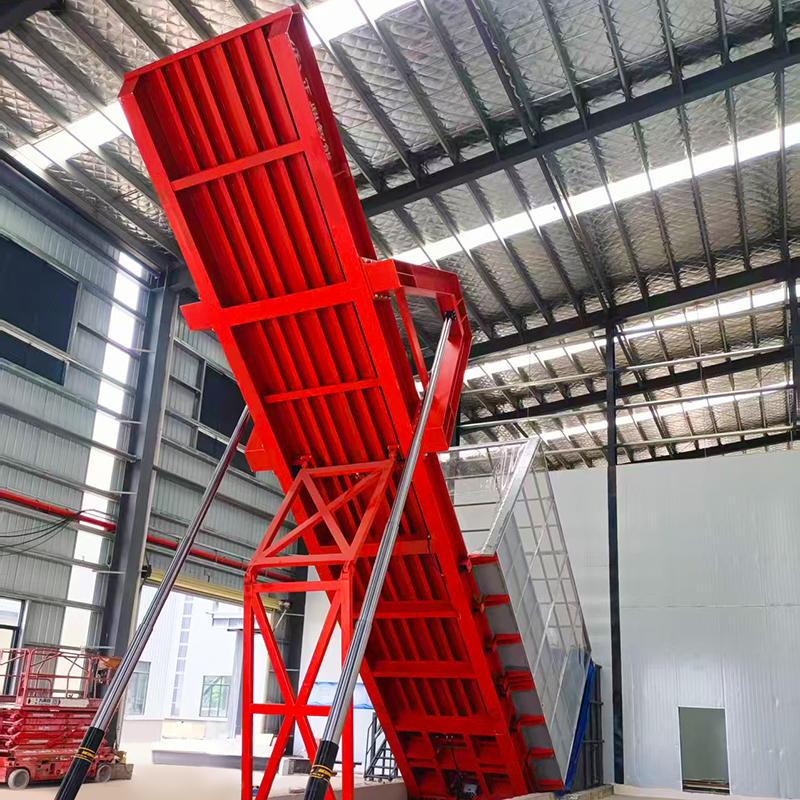
Bulk material unloading is no longer judged only by speed and lifting capacity. Modern terminals, grain depots, cement plants, chemical facilities, ports, food processing plants, and industrial logistics centers must also control dust, reduce product loss, protect workers, and meet increasingly strict environmental requirements. The enclosed truck dumper with dust control system is designed for this new operating reality. It combines a heavy-duty truck tipping platform, a sealed or semi-sealed enclosure, synchronized hydraulic lifting, controlled air intake, and integrated dust collection to create a safer and cleaner unloading process.
This equipment is especially valuable for facilities handling dusty bulk materials such as cement, fly ash, lime, coal powder, grain, feed ingredients, oilseed meal, minerals, chemical powders, and other granular or powdered products. During conventional truck unloading, airborne dust can escape from the pit area, platform edge, hopper inlet, and truck body opening. The enclosed truck dumper addresses these problems by using a sealed containment structure and a coordinated dust removal system that captures dust at the source before it spreads into the surrounding workspace.
Compared with open truck dumpers, the enclosed design offers major advantages in environmental protection, operator comfort, housekeeping, product recovery, and long-term compliance. The platform enclosure and pit enclosure work together through dynamic and static sealing. This approach reduces uncontrolled air intake, stabilizes the airflow inside the unloading zone, and allows the dust collection system to operate with lower energy consumption. Instead of relying on oversized ventilation fans to compensate for leakage, the system uses sealing efficiency to improve dust capture performance.
Jiangsu Zhengding Intelligent Equipment Co., Ltd. develops and manufactures this type of enclosed truck dumper as part of its intelligent automated loading and unloading equipment portfolio. As a national high-tech enterprise, the company focuses on systematic solutions for automatic loading and unloading of automobiles, containers, ships, and related logistics applications. Its products are used in steel, chemical, cement, coal, grain, oil, food, feed, ports, papermaking, and new energy industries, and are exported to many international markets.
Enclosed Truck Dumper with Dust Control System
Product Overview and Core Purpose
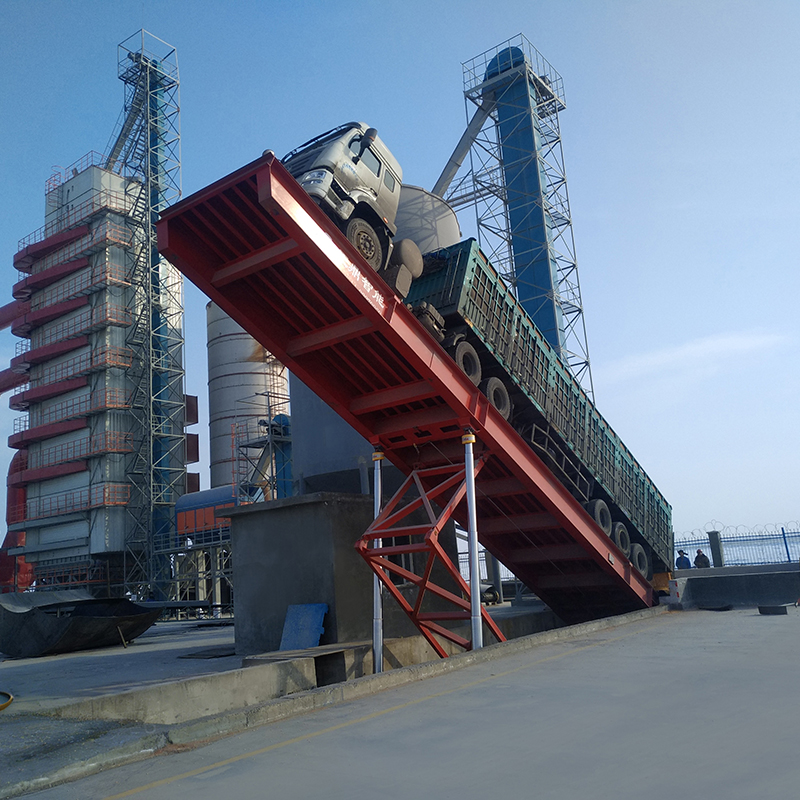
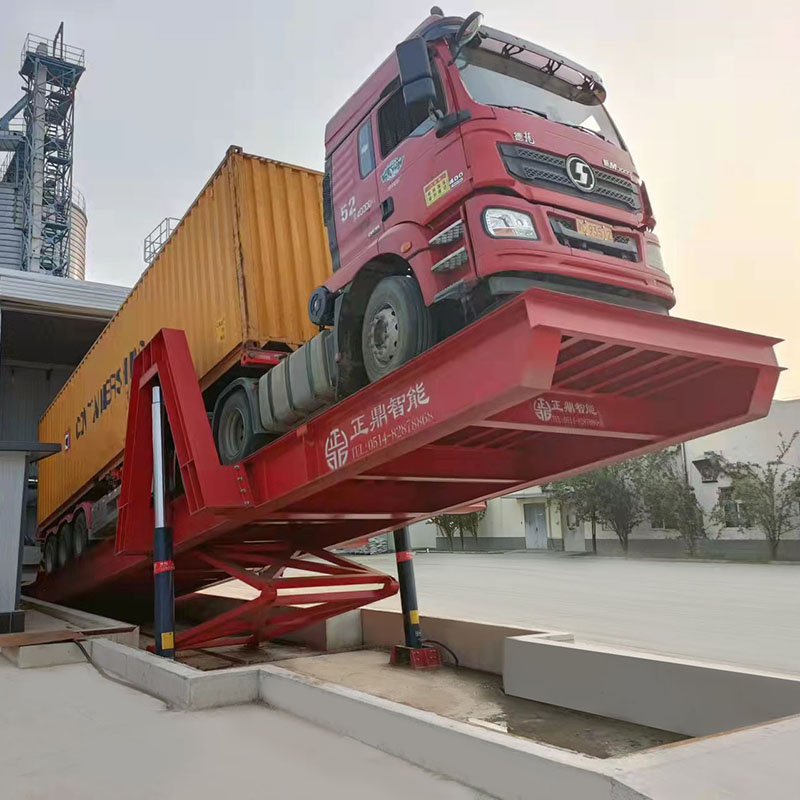
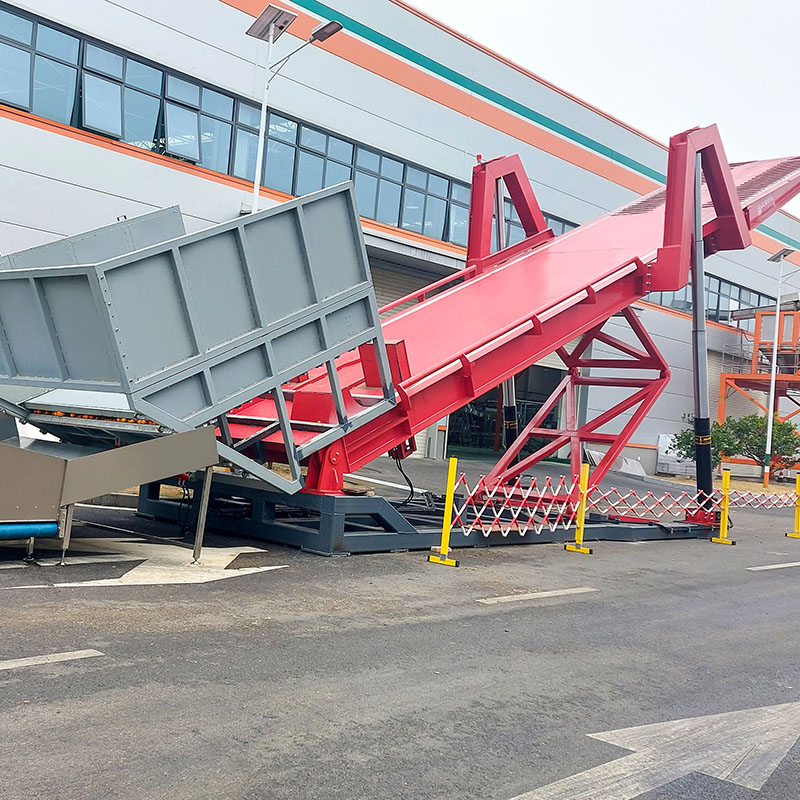
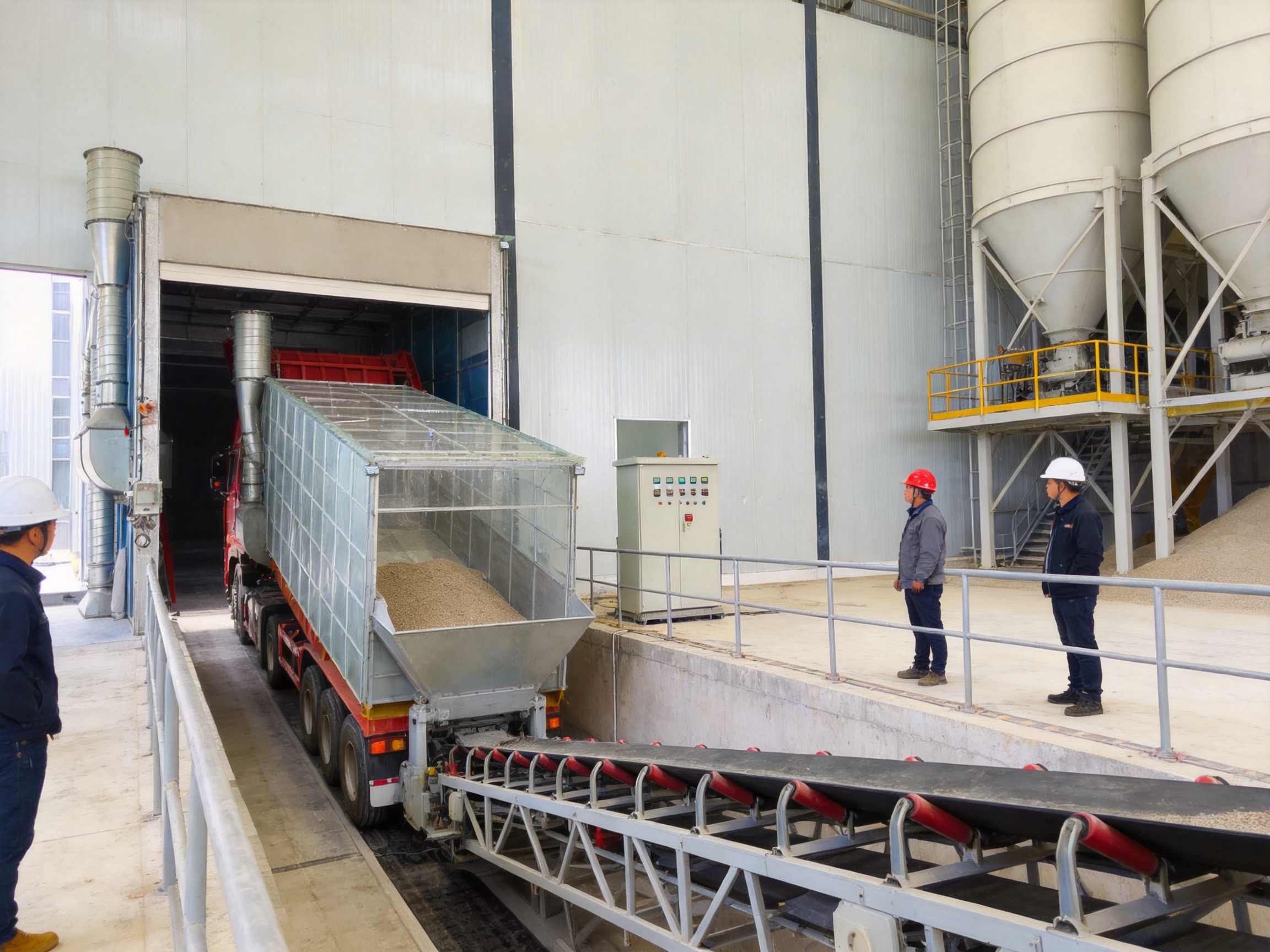
The enclosed truck dumper with dust control system is a specialized unloading machine that tilts an entire truck or trailer to discharge bulk material into a receiving pit, hopper, conveyor, or downstream processing system. Its key distinction is the use of a sealed enclosure around the unloading area. This enclosure prevents dust overflow during the lifting, tipping, discharge, and lowering stages of operation.
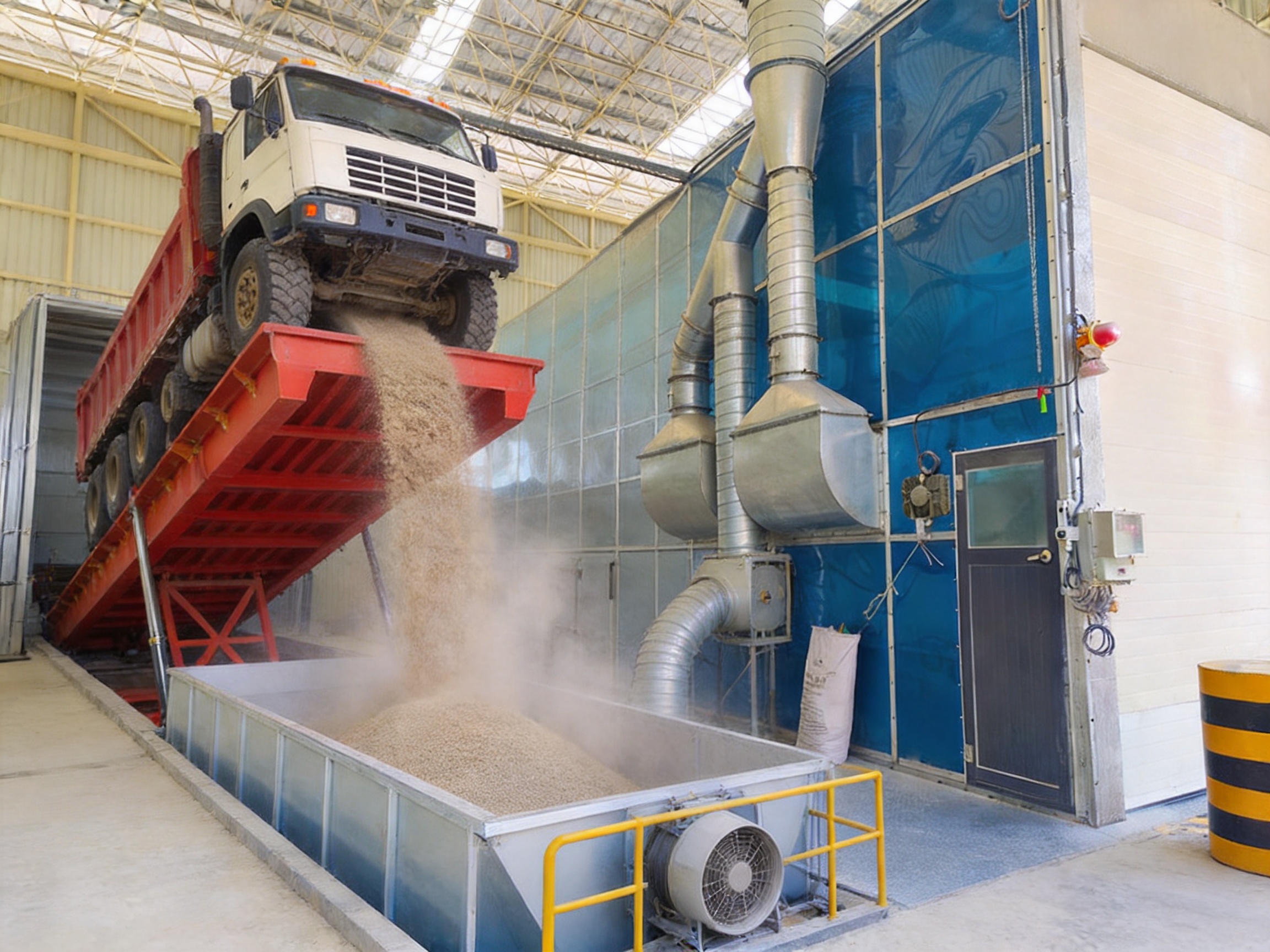
In a typical unloading cycle, the truck enters the dumper platform and is positioned according to the required operating procedure. The platform secures the vehicle, the hydraulic lifting system raises the platform to the specified angle, and the bulk material flows out by gravity. At the same time, the dust control system draws air from strategic points inside the enclosure, captures dust-laden air, and filters it through high-efficiency dust collection equipment. Clean air is discharged according to plant requirements, while captured material can be returned to the process or collected for disposal.
The product is suitable for operations where environmental protection requirements are high. This includes urban facilities, export terminals, factories near residential areas, food and feed plants that require cleanliness, and industrial sites that must comply with strict air quality or occupational health standards. The sealed design is not simply an accessory; it is an engineered system in which the enclosure, airflow, hydraulic movement, and receiving pit are coordinated.
The equipment can be configured as semi-sealed or fully sealed. A semi-sealed structure may be selected when the material has moderate dust generation, when the site has space limitations, or when partial containment is sufficient. A fully sealed structure is recommended for highly dusty materials, strict environmental control, or facilities requiring maximum dust suppression. The system can also be equipped with its own dust removal unit, making it suitable for both new projects and upgrades to existing unloading lines.
The product uses a high-precision oil cylinder synchronous stability system developed by the manufacturer. This system supports stable lifting, reduces vibration during operation, decreases impact on the oil cylinders, and extends the service life of the hydraulic components. For heavy-duty truck dumper applications, cylinder synchronization is critical because uneven lifting can cause structural stress, unstable vehicle movement, premature component wear, and safety risks. The integrated synchronization approach improves both performance and reliability.
Why Dust Control Is Critical in Truck Unloading
Dust generation during bulk material unloading is caused by several physical mechanisms. When material falls from the truck body into a receiving pit or hopper, air is displaced rapidly. Fine particles are lifted by this air movement and become suspended. Additional dust may escape through gaps around the platform, from the open discharge zone, or from turbulent airflow caused by crosswinds. In open truck dumpers, these particles can spread across the unloading bay, nearby roads, equipment surfaces, and operator areas.
Dust is not only a housekeeping problem. It can reduce visibility, increase maintenance requirements, contaminate nearby products, create complaints from surrounding communities, and expose personnel to respirable particulate matter. In certain industries, dust may also present fire or explosion risks, especially when handling organic materials such as grain, feed, starch, flour, or oilseed products. Therefore, dust control is an essential component of modern unloading system design.
Traditional approaches, such as water spraying, simple curtains, or local ventilation, may reduce visible dust but often fail to capture fine particulates effectively. Water spraying may not be suitable for cement, certain chemicals, food ingredients, or materials that must remain dry. Open ventilation without proper enclosure often requires high airflow volume, which increases energy consumption and still may not capture dust at the source. The enclosed truck dumper offers a more systematic solution by reducing leakage, controlling air inlet area, and creating predictable airflow paths.
The core concept is containment first and extraction second. By enclosing the dust generation zone, the system prevents dust from freely escaping. By controlling the air intake area and inlet wind speed, it allows the dust collector to work efficiently. This is an important competitive advantage because many conventional dust control systems rely only on fan capacity. A larger fan may consume more power, generate more noise, and require larger ducts and filters. In contrast, a well-sealed enclosure can achieve better results with lower energy demand.
For facilities handling fine powder, fugitive dust emission reduction may directly support compliance with environmental regulations. It also improves worker comfort because operators and nearby maintenance personnel are less exposed to dusty air. Cleaner unloading zones reduce cleanup labor, improve equipment appearance, and decrease the risk of dust accumulation on motors, sensors, hydraulic systems, electrical cabinets, and structural surfaces.
Engineering Advantages Over Conventional Open Truck Dumpers
The enclosed truck dumper provides several clear advantages compared with traditional open dumpers. The first advantage is dust containment. Open dumpers allow material dust to spread into the atmosphere during every unloading cycle. Enclosed systems isolate the discharge area and guide dust-laden air toward the dust collector. This significantly reduces visible emissions and improves the surrounding working environment.
The second advantage is energy efficiency. A poorly sealed dust control system must move large amounts of air because leakage points dilute the extraction flow. The enclosed dumper reduces uncontrolled air intake through dynamic and static sealing between the platform enclosure and pit enclosure. As a result, the dust collection system can maintain effective negative pressure with lower airflow volume. This reduces fan power consumption and can lower operating costs over the life of the equipment.
The third advantage is improved material recovery. Dust that escapes from an open dumper is lost product. In cement, grain, minerals, chemicals, and feed applications, recovered dust may represent valuable material. Capturing particles inside a dust collector reduces product loss and may allow collected material to be returned to the process depending on quality and plant standards. Even small percentage reductions in loss become meaningful when annual throughput is high.
The fourth advantage is safer and smoother lifting. The high-precision synchronous oil cylinder stability system helps the platform rise evenly. This reduces vibration, lessens cylinder impact, and improves operating stability. A stable lifting process is important because truck dumpers handle heavy vehicles and large material loads. Smooth operation contributes to longer equipment life and lower maintenance risk.
The fifth advantage is adaptability. The equipment can be supplied in different platform lengths, lifting capacities, lifting angles, and enclosure types. This allows the system to be matched to vehicle size, material properties, receiving pit design, and throughput requirements. Models include options suitable for maximum lifting weights of 80 tons, 100 tons, and 150 tons, with lifting angles of 45 degrees or 55 degrees depending on unloading requirements.
The sixth advantage is regulatory readiness. Many facilities now require equipment that can support environmental audits, occupational safety programs, and community impact reduction. An enclosed dumper with integrated dust collection provides a more defensible engineering control than relying only on administrative controls or personal protective equipment. It demonstrates that the facility has addressed dust at the source.
| Comparison Item | Conventional Open Truck Dumper | Enclosed Truck Dumper with Dust Control | Practical Advantage |
|---|---|---|---|
| Dust containment | Dust can escape from the discharge area, platform edges, and pit | Sealed or semi-sealed structure contains dust and directs it to filtration | Cleaner site and reduced visible emissions |
| Airflow control | Uncontrolled air intake and crosswinds affect dust capture | Controlled air inlet area and negative pressure improve capture efficiency | More stable dust removal performance |
| Energy consumption | Often requires larger fans to compensate for leakage | Better sealing reduces required air volume | Lower operating energy demand |
| Worker environment | Operators may be exposed to airborne dust near the unloading area | Dust is contained and extracted away from personnel | Improved occupational health conditions |
| Material recovery | Fine material may be lost as fugitive dust | Captured dust can be collected or returned according to process needs | Reduced product loss and cleanup burden |
| Hydraulic stability | Depends on basic lifting synchronization | High-precision synchronous oil cylinder stability system | Smoother lifting, lower vibration, and longer cylinder service life |
Sealing Design: Dynamic and Static Containment
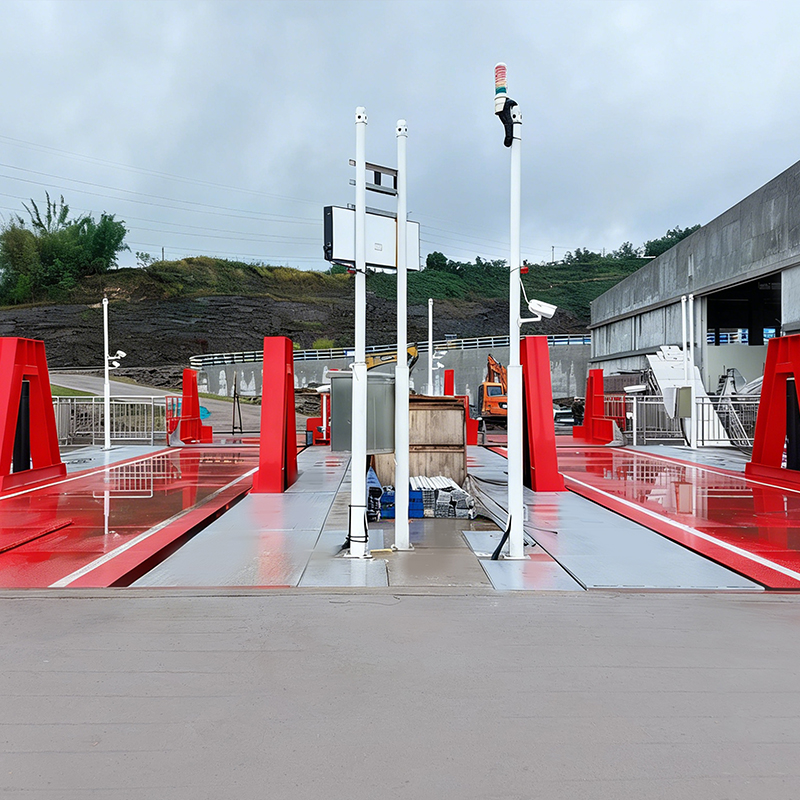
The sealing system is one of the most important technical features of the enclosed truck dumper. In bulk material unloading, dust leakage often occurs at interfaces where moving and fixed structures meet. The truck dumper platform moves during lifting, while the pit enclosure and surrounding civil structure remain fixed. This creates a difficult engineering challenge: the system must allow the platform to move freely while still limiting air leakage and dust escape.
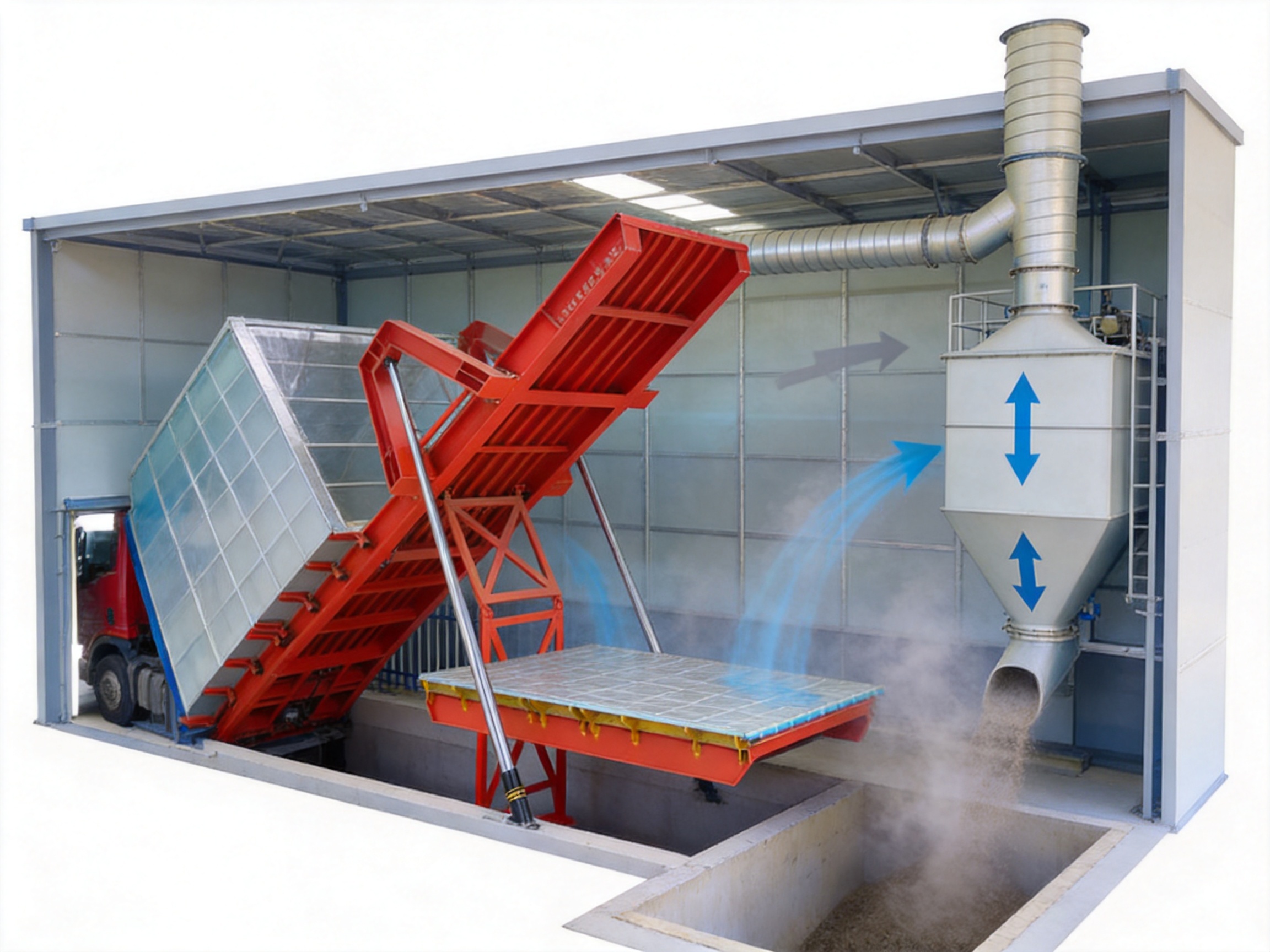
The product addresses this challenge through a combination of dynamic and static sealing. Static sealing is used around fixed enclosure panels, pit walls, structural joints, and stationary interfaces. Dynamic sealing is used where the moving platform enclosure interacts with the fixed pit enclosure. The goal is not only to block dust physically but also to control the effective air intake area. When the intake area is controlled, the dust extraction fan can maintain the required airflow velocity at critical points.
This design approach is more advanced than simply placing a large cover over the unloading zone. A basic cover may reduce some visible dust, but if gaps are large or airflow is not controlled, dust can still escape through openings. The enclosed truck dumper is engineered so that the enclosure and dust collector function as one system. The air path is planned, the dust generation zone is isolated, and the extraction points are positioned to capture airborne particles efficiently.
Dynamic sealing also contributes to energy savings. In an open or poorly sealed installation, the dust collector may draw large volumes of clean air from outside the dust zone. This wastes energy and reduces the effectiveness of capture at the source. With better sealing, more of the fan’s capacity is used to capture dust-laden air rather than unnecessary leakage air. Over thousands of unloading cycles, this efficiency can create meaningful operating cost benefits.
The system can be designed as semi-sealed or fully sealed depending on site requirements. Semi-sealed structures are often appropriate for facilities seeking a balance between dust reduction, investment cost, and operational access. Fully sealed structures are preferred when dust must be strictly contained, when the plant is located near sensitive surroundings, or when material characteristics require maximum isolation. Both forms can be integrated with dust removal equipment and downstream receiving systems.
Dust Collection System and Airflow Strategy
The dust control system works by creating controlled negative pressure inside the enclosure and drawing dust-laden air toward filtration equipment. The dust collector may use bag filters, cartridge filters, cyclone pre-separation, pulse jet cleaning, or other configurations depending on the material. For fine mineral powders, high-efficiency cartridge or baghouse filtration is often preferred. For grain and organic dust, system design must consider dust explosibility, moisture, particle size, and fire prevention requirements.
The key to dust collection is not only filter efficiency but also capture efficiency. A filter may remove a high percentage of particles from the air that reaches it, but if dust escapes before entering the ductwork, overall performance is poor. The enclosed truck dumper improves capture efficiency by limiting escape paths and guiding airflow from the enclosure toward the dust collector. This is particularly important during the initial discharge moment, when material begins to fall and dust generation is often strongest.
Air inlet velocity must be controlled carefully. If airflow is too weak, dust may drift out of the enclosure. If airflow is too strong, it may disturb material flow, pull excessive product into the dust collector, or increase energy consumption. The integrated design controls the inlet area and wind speed to maintain effective dust capture without unnecessary airflow volume. This is one reason the equipment is suitable for applications with high environmental protection requirements.
Automatic filter cleaning may be used to maintain airflow during continuous operation. Pulse jet cleaning systems periodically release compressed air to remove dust cake from filter elements. This helps keep resistance within the required range and reduces manual maintenance. Dust collected in the filter hopper can be discharged through valves, screw conveyors, or other discharge mechanisms according to site layout.
For food, feed, and grain industries, hygiene and contamination control are important. The dust collection system should be designed to avoid dead zones, uncontrolled accumulation, and cross-contamination. For cement, coal, and minerals, abrasion resistance and robust construction are important. For chemical applications, corrosion resistance, material compatibility, and safety classification may be required. The enclosed truck dumper can be customized according to these industry-specific demands.
Hydraulic Lifting Stability and Safety
A truck dumper must lift heavy vehicles and bulk material loads repeatedly and safely. Hydraulic performance is therefore central to overall equipment reliability. The enclosed truck dumper uses a high-precision oil cylinder synchronous stability system. This system helps maintain uniform platform movement during lifting and lowering. Stable synchronization prevents twisting and reduces uneven stress on the frame, hinge points, cylinders, and foundation.
Small vibration during operation is a significant advantage. Excessive vibration can cause structural fatigue, loosen fasteners, disturb vehicle positioning, and reduce operator confidence. By reducing vibration and impact on the oil cylinders, the system helps extend hydraulic component life. Longer cylinder service life reduces replacement costs and lowers downtime risk.
The hydraulic system must also support controlled acceleration and deceleration. Sudden motion at the beginning or end of lifting can create impact forces. A well-designed hydraulic control system allows the platform to move smoothly through the lifting arc and stop at the required angle. The available maximum lifting angles of 45 degrees and 55 degrees allow the dumper to be selected according to material flow characteristics. Materials with poor flowability may require a higher angle, while free-flowing materials may unload effectively at a lower angle.
Safety features are typically considered throughout the machine design. These may include vehicle positioning systems, wheel stops, platform locking, emergency stop controls, warning signals, hydraulic pressure monitoring, mechanical safety supports, and interlocks between enclosure doors and operating functions. The specific configuration depends on project requirements and applicable standards. The objective is to protect personnel, equipment, and vehicles throughout the unloading cycle.
The enclosed design can also improve safety by keeping personnel away from the dust generation zone. Operators can monitor the unloading process from a safer position, and the dust collector reduces airborne material in the work area. Cleaner floors and platforms also reduce slipping hazards and improve maintenance access.
Main Technical Parameters and Model Selection
Model selection should be based on truck size, gross vehicle weight, material density, required discharge angle, pit design, site space, throughput targets, and dust control requirements. The enclosed truck dumper series includes multiple specifications to support different applications. Platform lengths and widths can accommodate common truck and trailer sizes, while lifting capacities range up to heavy-duty industrial requirements.
| Model | Platform Size L x W / m | Maximum Lifting Weight / t | Maximum Lifting Angle | Typical Application Direction |
|---|---|---|---|---|
| TQXHF 50 | 14 x 3 / 16 x 3 / 17 x 3 | 80 | 45° / 55° | Medium truck unloading for grain, feed, cement, and general bulk materials |
| TQXHF 80 | 16 x 3 / 17 x 3 / 18 x 3 | 80 | 45° / 55° | Longer vehicle unloading where moderate lifting capacity is required |
| TQXHF 100 | 17 x 3 / 18 x 3 / 20 x 3 | 100 | 45° / 55° | Heavy-duty industrial unloading for dense or high-volume materials |
| TQXHF 150 | 17 x 3 / 18 x 3 / 20 x 3 | 150 | 45° / 55° | High-capacity facilities requiring robust lifting and strong structural design |
The platform length should match the vehicle wheelbase and body length. A platform that is too short may not support the vehicle properly, while an unnecessarily long platform may increase civil construction cost. The lifting weight should include the vehicle, payload, and reasonable safety margin. The unloading angle should be chosen according to material flowability, truck body geometry, and receiving hopper design.
The enclosure configuration should be selected after evaluating dust characteristics. Fine, dry, low-density powders usually require stronger sealing and more carefully designed airflow. Granular materials with limited dust may require a semi-sealed structure. If the site is located near residential areas, public roads, or other sensitive boundaries, a fully sealed solution can reduce complaints and support compliance.
Dust collector capacity should be matched to the enclosure volume, leakage allowance, dust generation rate, and required negative pressure. Oversizing the dust collector can increase cost and energy use, while undersizing can reduce capture performance. The manufacturer’s experience in integrated unloading systems is valuable because the dumper, enclosure, pit, hopper, conveyor, and dust collector must be designed as a coordinated process line rather than separate machines.
Advanced Manufacturing Process and Quality Strengths
The performance of an enclosed truck dumper depends heavily on manufacturing quality. Large structural equipment must resist repeated loading, hydraulic forces, vibration, and environmental exposure. Precision is also important because the platform, hinge system, cylinders, enclosure panels, and sealing components must align correctly. Jiangsu Zhengding Intelligent Equipment Co., Ltd. applies its experience in automated loading and unloading equipment to manufacture stable, durable, and customized systems for industrial use.
The manufacturing process begins with engineering design. Engineers evaluate customer requirements, including vehicle type, unloading capacity, material characteristics, site layout, foundation conditions, dust control targets, and downstream conveying equipment. Three-dimensional design and structural analysis may be used to optimize the frame, lifting points, and enclosure layout. This stage ensures that the dumper is not treated as an isolated device but as part of a complete material handling solution.
Steel structure fabrication is a major step. The platform and main frame must be strong enough to support heavy trucks while maintaining dimensional accuracy. Cutting, forming, welding, machining, and assembly processes must be controlled carefully. Good welding quality reduces the risk of fatigue cracking and structural deformation. Proper surface treatment helps protect the equipment from corrosion, especially in outdoor yards, ports, cement plants, coal facilities, and chemical environments.
Hydraulic system assembly requires precision and cleanliness. Oil cylinders, pipelines, valves, pumps, seals, and control components must be installed correctly to ensure stable lifting and long service life. The synchronous cylinder stability system is a key differentiator. Its manufacturing and commissioning require accurate alignment, hydraulic balancing, and control adjustment. This system helps the platform move smoothly and reduces impact on the cylinders.
Enclosure manufacturing requires attention to panel fit, sealing surfaces, access openings, inspection points, and connection to the dust collection system. If enclosure panels are poorly fitted, dust leakage can reduce system performance. If maintenance access is not considered, operators may have difficulty inspecting filters, seals, ducts, and structural components. A professional manufacturer balances sealing performance with practical maintenance needs.
Electrical and control systems are integrated to support safe automated operation. The control cabinet, sensors, limit switches, hydraulic controls, dust collector controls, alarms, and emergency stop functions must work together. For intelligent logistics equipment, automation improves repeatability and reduces operator workload. Interlocks can prevent incorrect operation, such as lifting before the truck is properly positioned or operating the dumper while access doors are open.
Factory testing and commissioning are essential. Before delivery, major components can be inspected for dimensional accuracy, welding quality, hydraulic function, electrical continuity, and system response. After installation at the customer site, commissioning verifies lifting action, unloading angle, sealing performance, dust collector airflow, safety devices, and operator interface. This reduces startup risk and helps the customer reach stable production more quickly.
Company Strengths in System Integration
Jiangsu Zhengding Intelligent Equipment Co., Ltd. is not limited to a single product category. The company provides automatic loading and unloading equipment such as rear dumpers, side-turn truck dumpers, car loading equipment, and container flippers. This broad product range gives the company practical knowledge of different vehicle types, container handling methods, and bulk material flow patterns. For customers, this means the enclosed truck dumper can be integrated into wider logistics systems rather than delivered as a standalone machine.
The company serves industries including steel, chemical, cement, coal, grain, oil, food, feed, ports, papermaking, and new energy. Each of these industries has different requirements. Cement plants need robust dust suppression and abrasion resistance. Grain and food plants require cleanliness and attention to organic dust safety. Coal operations require heavy-duty construction and efficient unloading throughput. Chemical facilities may require special materials, corrosion protection, or process-specific dust handling. Experience across these industries helps the manufacturer provide practical customized solutions.
The company’s products are exported to markets including Japan, Brazil, Egypt, Pakistan, India, the Middle East, and Southeast Asia. International project experience is important because customers in different regions may have different site standards, vehicle dimensions, climate conditions, environmental rules, and operating habits. Export experience also requires attention to packaging, documentation, installation guidance, spare parts support, and long-term service.
The company has served well-known international users in beer, grain, food, agribusiness, industrial materials, and chemical sectors. This reflects the need for equipment that can support demanding production environments. Large users typically evaluate reliability, safety, lifecycle cost, and after-sales support before selecting automated unloading equipment. The enclosed truck dumper aligns with these priorities by combining robust lifting capacity with environmental control.
Another strength is customization. Bulk unloading projects are rarely identical. Pit depth, truck route, plant building height, material receiving system, dust collector location, and civil foundation design vary from site to site. The ability to customize platform size, lifting capacity, enclosure style, dust collector configuration, and control logic allows customers to obtain a solution matched to their real operating conditions.
Applications in Key Industries
In cement and building materials plants, truck unloading often involves powdery or granular materials that can generate intense dust clouds. Cement, fly ash, slag powder, lime, gypsum, and mineral additives require efficient containment. The enclosed truck dumper reduces dust escape during discharge and can connect to a receiving hopper, screw conveyor, belt conveyor, bucket elevator, or pneumatic conveying system. Cleaner unloading supports environmental compliance and reduces material accumulation on equipment.
In grain, oilseed, and feed industries, unloading efficiency and dust control are both important. Corn, wheat, soybean meal, rapeseed meal, feed ingredients, and other agricultural materials may generate dust during tipping. Dust control improves air quality and housekeeping. For organic dust applications, the system should be designed with appropriate safety considerations, including dust collection configuration, grounding, ventilation, and maintenance practices.
In chemical plants, material properties can vary widely. Some powders are fine and dusty, some are corrosive, and some require contamination prevention. An enclosed truck dumper can be configured with suitable sealing, corrosion-resistant surfaces, and dust collection components. By containing dust at the unloading point, the system helps protect personnel and nearby equipment.
In coal and mining operations, the dumper may handle dense, abrasive, or high-volume materials. Heavy-duty platform structure and high lifting capacity are essential. Dust control reduces airborne coal dust and helps maintain a cleaner unloading area. For coal applications, fire and explosion safety considerations should be included in the dust collection design.
In port and logistics facilities, rapid truck turnaround is important. Open unloading can create environmental complaints, especially near waterways or urban port zones. Enclosed dumpers support cleaner operations and can improve relations with regulators and neighboring communities. Their ability to reduce visible dust is especially valuable in public-facing or high-traffic logistics environments.
In food and beverage supply chains, cleanliness and reliability are important. Large international users often require equipment that supports consistent unloading, material protection, and safe operation. Enclosed truck dumpers can reduce external contamination and airborne dust while supporting efficient receiving operations for raw materials.
Operational Efficiency and Lifecycle Cost
When evaluating a truck dumper, customers often compare purchase price first. However, lifecycle cost is usually more important. Dust cleanup labor, filter maintenance, product loss, energy consumption, downtime, environmental penalties, and worker protection requirements can all influence total cost. The enclosed truck dumper is designed to reduce several of these hidden costs.
Energy savings come from efficient sealing and controlled airflow. A dust collector does not need to compensate for excessive leakage if the enclosure is designed properly. Over long operating hours, lower fan power can reduce electricity cost. Additionally, stable filter operation reduces pressure drop and helps maintain efficient airflow.
Product recovery can also be valuable. Fine material that escapes as dust is not only a nuisance but also lost inventory. Capturing dust through filtration can reduce loss. In high-throughput facilities, even small improvements in recovery can produce meaningful annual savings.
Maintenance savings may result from cleaner surroundings. Dust accumulation can shorten the life of motors, sensors, bearings, hydraulic components, electrical cabinets, and structural mechanisms. By reducing airborne dust, the enclosed dumper helps protect surrounding equipment. The hydraulic synchronization system also reduces mechanical stress, which can extend cylinder and structural component life.
Regulatory risk reduction is another lifecycle benefit. Facilities operating open dust-generating equipment may face complaints, inspections, restrictions, or required upgrades. Installing an enclosed dumper from the beginning can reduce future retrofit costs. For existing plants, replacing or upgrading an open dumper with an enclosed system can support long-term compliance planning.
Installation and Integration Considerations
Successful installation requires coordination between equipment manufacturer, civil engineering team, electrical contractor, dust collection supplier, and plant operations personnel. The truck dumper foundation must support the full load of the truck, payload, platform, hydraulic forces, and dynamic operating conditions. Pit dimensions must match the receiving system and allow proper material discharge.
The layout should allow safe truck entry and exit. Turning radius, approach slope, wheel positioning, traffic flow, and waiting area must be considered. If the dumper is inside a building, roof height and ventilation must be evaluated. If the dumper is outdoors, weather protection, drainage, wind effects, and corrosion protection become important.
The receiving hopper must be sized to avoid material backup during discharge. If downstream conveyors cannot remove material fast enough, unloading efficiency will decrease. The hopper and conveyor should be integrated with the dumper control system when necessary. For example, the dumper may be interlocked so it cannot begin unloading unless the conveyor is running and the receiving system is ready.
The dust collector should be located for efficient duct routing, maintenance access, and safe discharge of collected dust. Long or poorly designed ducts can increase pressure loss and reduce performance. The enclosure extraction points should be positioned according to dust generation patterns. Access doors and inspection platforms should be included so maintenance personnel can clean, inspect, and replace components safely.
Electrical integration should include power supply, control cabinet location, operator station, emergency stop points, sensors, alarms, and communication with plant systems if required. Automation can be configured according to customer preference, from basic local control to more advanced integrated operation.
Maintenance Strategy for Reliable Operation
Regular maintenance helps preserve the performance of the enclosed truck dumper. Structural components should be inspected for wear, deformation, corrosion, and fastener looseness. Welded areas and high-stress points should be checked periodically, especially in high-throughput facilities. Platform surface condition should be maintained to ensure safe vehicle movement.
The hydraulic system requires inspection of oil level, oil quality, cylinder seals, hoses, pipelines, valves, pumps, and pressure settings. Clean hydraulic oil is essential for reliable operation. Leaks should be repaired promptly to prevent performance loss and safety hazards. The synchronous lifting system should be checked according to the manufacturer’s maintenance guidance.
Seals and enclosure panels should be inspected because dust control performance depends on containment. Damaged seals, loose panels, or unclosed access doors can increase air leakage. Routine inspection ensures that the dust collector can maintain the designed negative pressure.
The dust collection system requires filter inspection, dust hopper discharge checks, compressed air system maintenance, fan inspection, and duct cleaning if needed. Filter elements should be replaced when pressure drop remains high after cleaning or when physical damage occurs. Pulse jet systems require stable compressed air pressure to clean filters effectively.
Operators should be trained to follow correct unloading procedures. Proper truck positioning, safe entry and exit, correct control operation, and awareness of alarms all contribute to safe production. Maintenance personnel should understand lockout procedures before working on hydraulic, electrical, or dust collection components.
Q&A Section
Q1: What is the main purpose of an enclosed truck dumper with dust control?
The main purpose is to unload bulk materials from trucks efficiently while preventing dust from escaping into the surrounding environment. The system combines a tipping platform, sealed enclosure, controlled airflow, and dust collection equipment to capture airborne particles during discharge.
Q2: How is it different from a conventional open truck dumper?
A conventional open truck dumper focuses mainly on lifting and unloading. Dust can escape freely from the pit and discharge area. An enclosed truck dumper adds semi-sealed or fully sealed containment, dynamic and static sealing, negative pressure ventilation, and filtration. This improves dust control, reduces material loss, lowers cleanup work, and supports environmental compliance.
Q3: Why does sealing reduce energy consumption?
Good sealing reduces uncontrolled air leakage. When leakage is reduced, the dust collector does not need to move excessive air volume to maintain capture performance. The fan can focus on extracting dust-laden air from the unloading zone, which improves efficiency and can reduce energy use.
Q4: What materials can be handled by this equipment?
The equipment is suitable for many dusty bulk materials, including cement, fly ash, lime, coal, grain, feed ingredients, oilseed meal, mineral powder, chemical powders, and other granular or powdered products. The exact configuration should be selected according to material density, flowability, moisture, abrasiveness, and dust characteristics.
Q5: What are the available lifting capacities?
The product series includes models with maximum lifting weights of 80 tons, 100 tons, and 150 tons. Platform sizes include options such as 14 x 3 m, 16 x 3 m, 17 x 3 m, 18 x 3 m, and 20 x 3 m depending on model. Maximum lifting angles are available at 45 degrees or 55 degrees.
Q6: When should a fully sealed structure be selected?
A fully sealed structure is recommended for highly dusty materials, strict environmental requirements, facilities near sensitive boundaries, or operations where worker exposure must be minimized. It is also suitable when the customer wants maximum dust capture and cleaner surrounding conditions.
Q7: Can the dust removal system be integrated with the dumper?
Yes. The enclosed truck dumper can be equipped with its own dust removal system. Integrated design is recommended because the enclosure, air inlet area, ductwork, fan, filters, and discharge points must work together for efficient dust capture.
Q8: What makes the hydraulic system reliable?
The equipment adopts a high-precision oil cylinder synchronous stability system. This improves lifting synchronization, reduces vibration, decreases impact on oil cylinders, and extends cylinder service life. Smooth lifting also reduces stress on the platform and frame.
Q9: Is the system suitable for existing facilities?
In many cases, enclosed truck dumper solutions can be adapted to existing facilities, but a site assessment is necessary. Engineers must evaluate foundation conditions, pit dimensions, vehicle routes, available space, downstream conveying equipment, and dust collector location before determining the best upgrade plan.
Q10: What industries benefit most from this equipment?
Industries that handle dusty bulk materials benefit the most. These include cement, chemicals, coal, grain, oil, food, feed, ports, steel, papermaking, and new energy material logistics. Any facility seeking cleaner unloading, lower dust emissions, and improved operating efficiency can benefit from the enclosed design.
Conclusion
The enclosed truck dumper with dust control system represents a modern approach to bulk material unloading. It does more than lift a truck and discharge material. It controls dust at the source, reduces uncontrolled air intake, supports environmental compliance, improves worker conditions, and helps recover valuable product. Its combination of sealed enclosure, dynamic and static sealing, integrated dust collection, and high-precision hydraulic synchronization gives it strong advantages over conventional open dumpers.
For facilities facing stricter environmental expectations, higher throughput demands, and growing attention to occupational health, this equipment provides a practical and future-oriented solution. The availability of semi-sealed and fully sealed structures, multiple platform sizes, lifting capacities up to 150 tons, and lifting angles of 45 degrees or 55 degrees allows the system to be matched to diverse applications.
Jiangsu Zhengding Intelligent Equipment Co., Ltd. strengthens the value of the product through its manufacturing capability, system integration experience, industry coverage, and customized engineering approach. As a supplier of automated loading and unloading equipment for automobiles, containers, ships, and logistics applications, the company can support customers from solution planning through manufacturing, installation, commissioning, and service.
In competitive terms, the enclosed truck dumper stands out because it combines heavy-duty unloading performance with advanced dust containment. It helps customers move beyond basic unloading and toward cleaner, safer, more efficient, and more compliant bulk material handling.
References
1. Industrial Ventilation: A Manual of Recommended Practice for Design, American Conference of Governmental Industrial Hygienists.
2. Dust Control Handbook for Industrial Minerals Mining and Processing, National Institute for Occupational Safety and Health.
3. Bulk Solids Handling: Equipment Selection and Operation, specialist engineering literature on material flow and unloading systems.
4. Air Pollution Engineering Manual, technical references on particulate capture, filtration, and industrial emission control.
5. Hydraulic Machinery Design and Maintenance Guidelines, engineering references on synchronized lifting systems and heavy-duty hydraulic equipment.
6. Bulk Material Handling Plant Design Standards, industry guidance for receiving hoppers, conveyors, dust collection, and truck unloading systems.


