

 English
 русский
 Español
 Français
 Português
 عربى
عربى



+86-13588556918
Content
- 1 1. What Is a Mobile Truck Dumper?
- 2 2. Main Product Characteristics
- 3 3. Technical Parameters and Configuration Considerations
- 4 4. Efficiency Advantages Compared with Fixed Dumpers
- 5 5. Safety and Operating Reliability
- 6 6. Manufacturing Technology and Engineering Strength
- 7 7. Advantages Over Conventional Competitor Solutions
- 8 8. Applications by Industry
- 9 9. Installation, Relocation, and Commissioning
- 10 10. Maintenance and Service-Life Management
- 11 11. Intelligent Loading and Unloading Solutions
- 12 12. Frequently Asked Questions
- 12.1 Q1: How quickly can a mobile truck dumper be relocated?
- 12.2 Q2: Does the equipment require a concrete foundation?
- 12.3 Q3: What truck sizes can the dumper accommodate?
- 12.4 Q4: What is the maximum lifting angle?
- 12.5 Q5: Can the dumper move under its own power?
- 12.6 Q6: How does the automatic wheel-retaining device improve safety?
- 12.7 Q7: Can the equipment handle different materials?
- 12.8 Q8: Can one mobile dumper serve several sites?
- 12.9 Q9: Is remote control included?
- 12.10 Q10: What information is needed for a quotation?
- 12.11 Q11: Can the mobile dumper operate as backup equipment?
- 12.12 Q12: How does the manufacturer support customized projects?
- 13 13. Why Choose a Specialized Manufacturer?
- 14 14. Conclusion
- 15 References
- 16 Product: Mobile Truck Dumpers
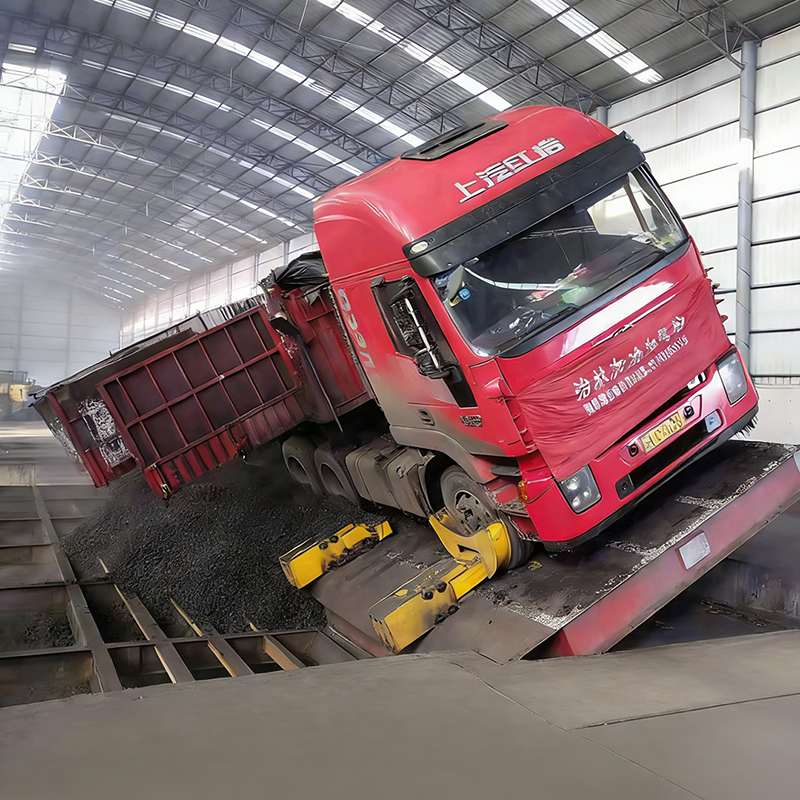
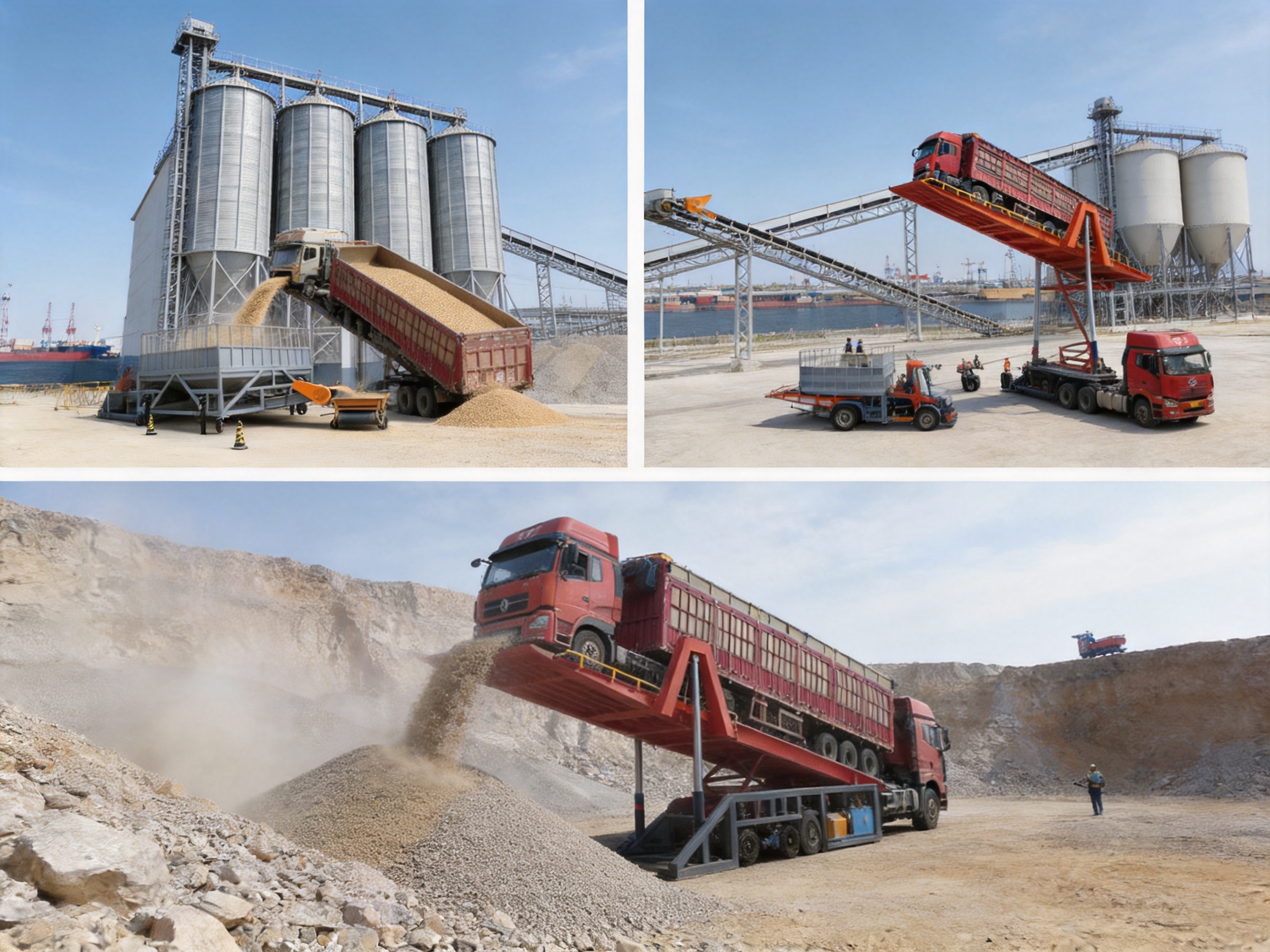
Mobile truck dumpers are transforming the way bulk materials are unloaded at construction sites, mines, agricultural facilities, industrial plants, ports, and temporary logistics locations. Unlike conventional fixed unloading stations, a mobile truck dumper can be repositioned as production zones, stockpiles, transport routes, and project requirements change. This flexibility reduces truck travel, shortens waiting times, improves utilization of hauling equipment, and allows one unloading system to serve several operational areas.
Designed for demanding material-handling applications, the mobile truck dumper described in this article combines a transportable structure, hydraulic lifting technology, automatic wheel retention, centralized support, remote operation, and high-capacity performance. It can move under its own power or be towed by a forklift or other suitable traction equipment. Its central drive arrangement also enables on-the-spot 360-degree turning, significantly reducing the turning radius required at a job site.
These features make mobile truck dumpers an important type of automated loading and unloading equipment. They are particularly valuable for companies that need to maintain high unloading capacity without committing to a permanent civil-engineering project. A mobile unit can be deployed at a temporary work zone, moved to a seasonal facility, or used as additional capacity while a fixed dumper is being repaired, expanded, or upgraded.
Jiangsu Zhengding Intelligent Equipment Co., Ltd. develops and manufactures truck and container loading and unloading equipment for multiple industries. Its product range includes rear truck dumpers, side-turn truck dumpers, mobile truck dumpers, car loading equipment, container flippers, and related intelligent logistics systems. The company emphasizes safe operation, automated control, hydraulic stability, customized engineering, and integrated solutions for industrial customers.
1. What Is a Mobile Truck Dumper?
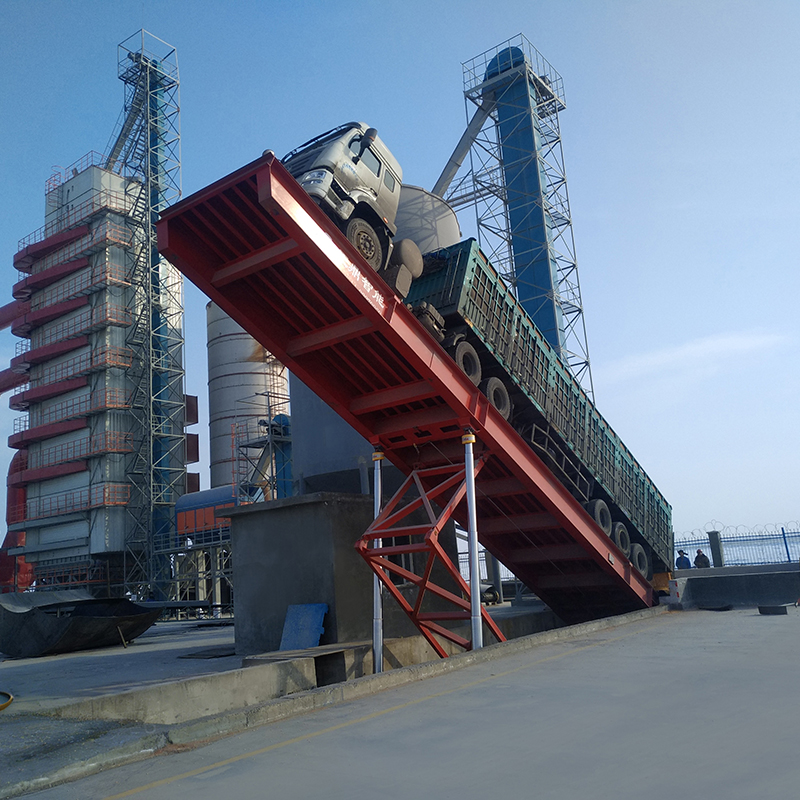
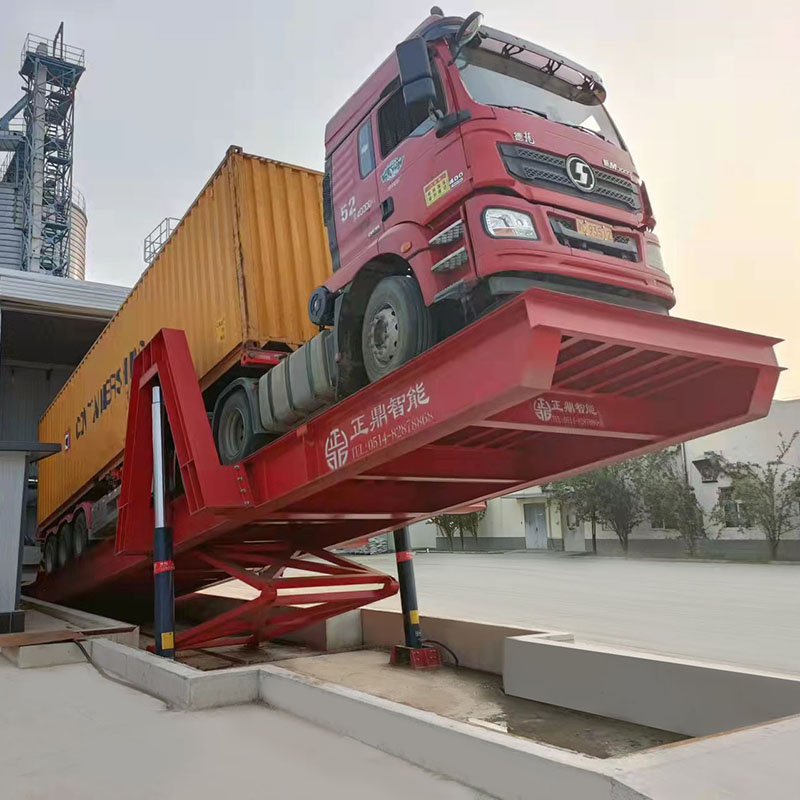
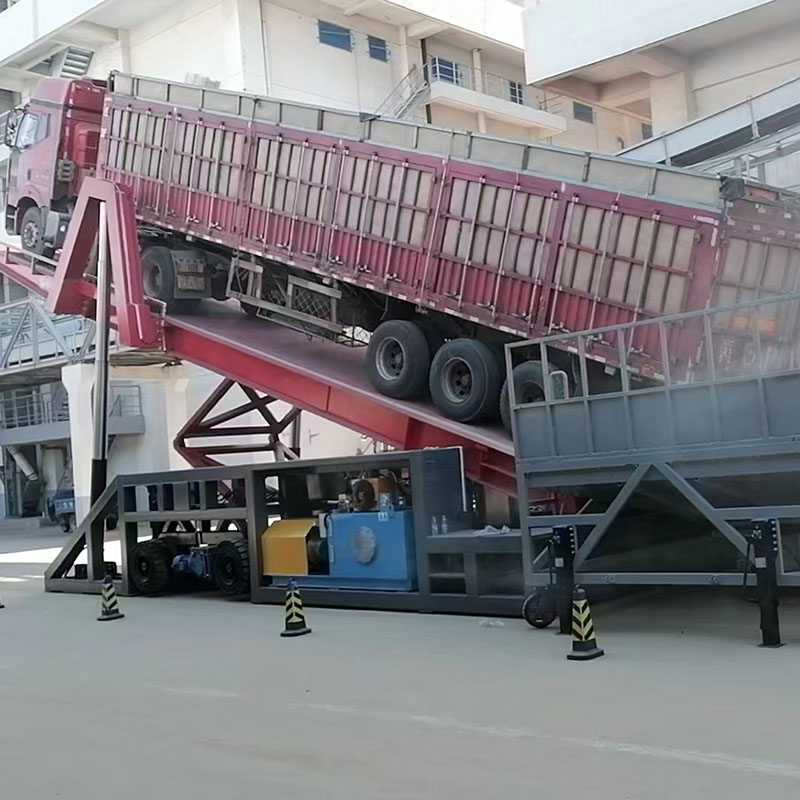
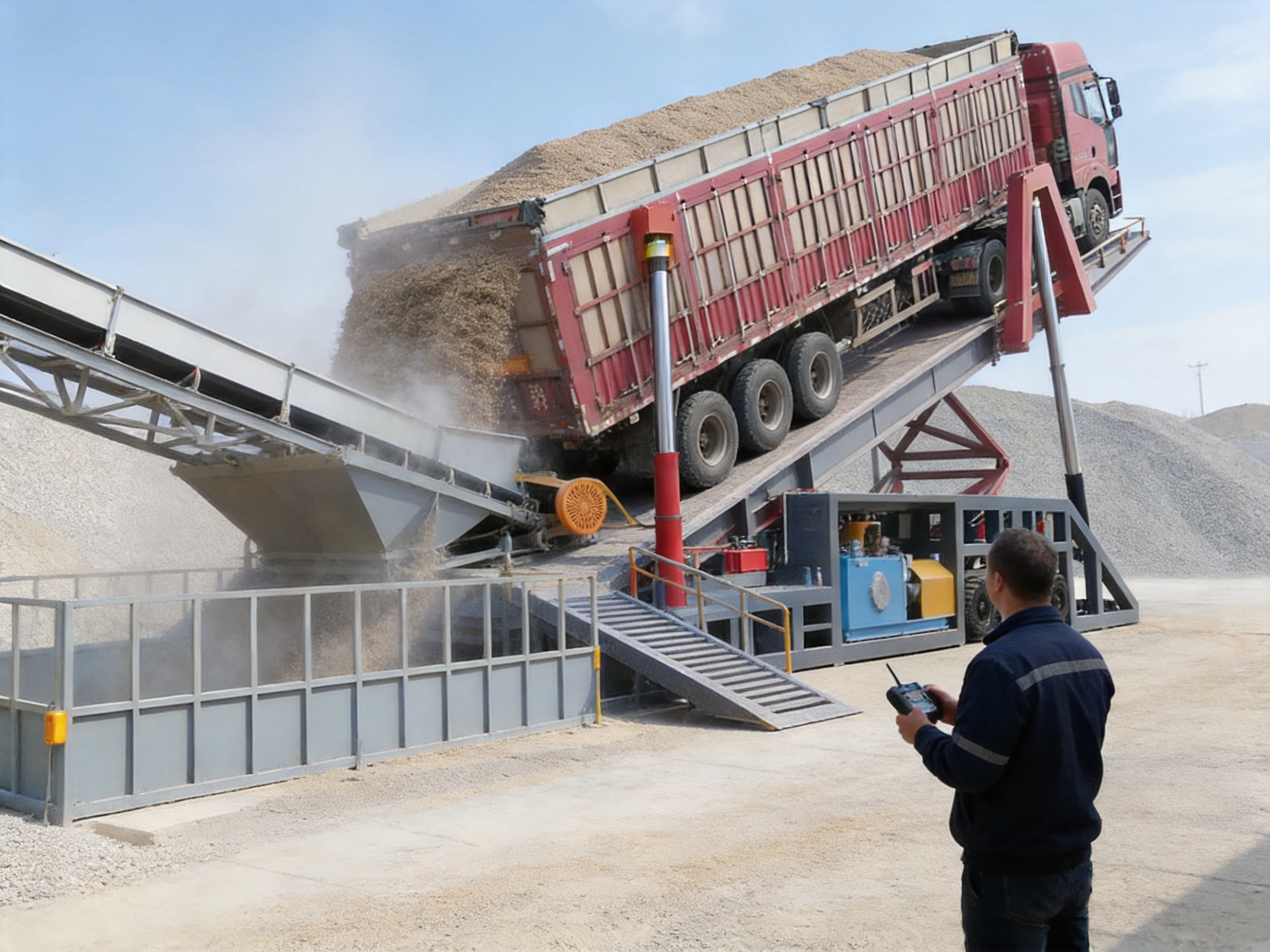
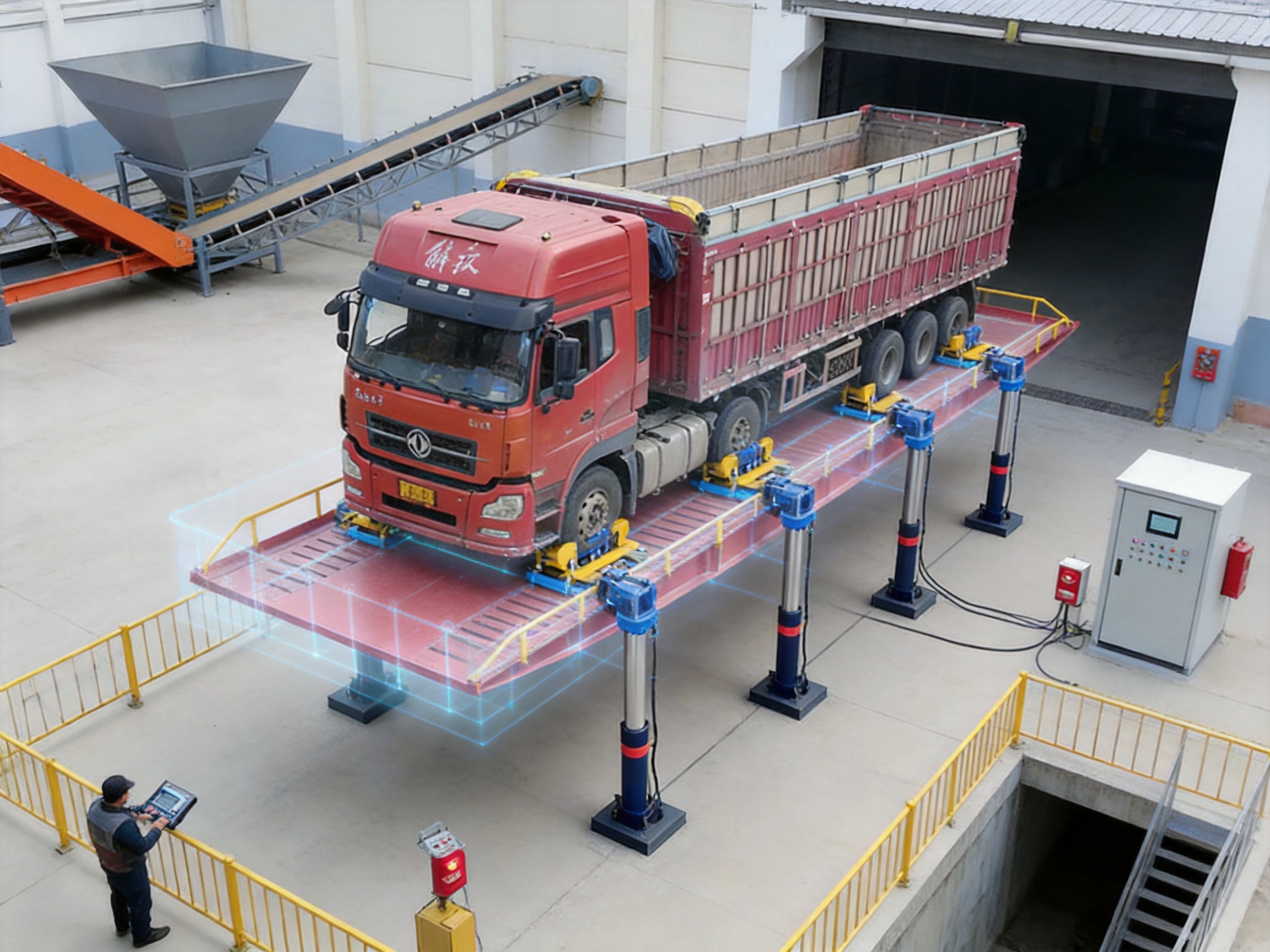
A mobile truck dumper is a transportable unloading platform that lifts and tilts a truck or trailer so that bulk materials can discharge efficiently into a receiving hopper, conveyor, storage area, processing line, or stockpile. The complete system normally includes a lifting platform, hydraulic cylinders, a hydraulic power unit, wheel guides or retaining devices, a chassis, ramps, control equipment, and safety systems.
In a fixed dumper installation, the unloading platform is permanently installed on a concrete foundation. Trucks must travel to that specific location, regardless of where materials are being excavated, stored, processed, or transferred. A mobile truck dumper removes this limitation. The machine can be positioned close to the active work zone, reducing unnecessary vehicle movement inside the facility.
The mobile design supports two primary movement methods. First, the equipment may use its own drive system for powered movement. Second, it can be moved by a forklift or other towing equipment when site conditions or transport requirements make external traction more suitable. This combination allows operators to select the safest and most economical relocation method for each application.
The central drive and support arrangement is another important design feature. By placing the drive unit in the middle of the structure, the machine can perform a 360-degree turn in place. This capability is especially useful in narrow yards, temporary construction zones, grain handling areas, mining operations, and facilities where large turning circles are not available.
Mobile truck dumpers are suitable for a broad range of bulk materials, including aggregates, coal, grain, feed, cement, chemical raw materials, industrial minerals, waste materials, and other products transported by tipper trucks or trailers. The correct configuration depends on vehicle dimensions, gross loading weight, material characteristics, unloading destination, operating frequency, and local safety requirements.
2. Main Product Characteristics
The equipment incorporates several features intended to improve safety, stability, operating efficiency, and service life. These characteristics distinguish a purpose-built mobile dumper from a basic lifting platform or a manually positioned unloading ramp.
2.1 High-Precision Hydraulic Synchronization
The mobile truck dumper uses a high-precision oil-cylinder synchronous stability system developed by the manufacturer. Hydraulic synchronization is essential when a long platform is raised by multiple cylinders. If the cylinders do not move together, the platform may experience uneven loading, twisting, vibration, or excessive stress on the cylinder assemblies and structural components.
The synchronous stability system coordinates cylinder movement during lifting and lowering. This helps maintain a balanced platform position and provides smoother operation. Lower vibration reduces mechanical shock, while reduced impact on the cylinders helps extend their service life. More stable movement also benefits the truck, the platform structure, and the receiving equipment positioned below the unloading area.
Hydraulic stability is particularly important when the truck is loaded unevenly or when material begins to discharge before the load has fully shifted. A controlled lifting motion helps reduce sudden changes in the center of gravity. The result is a more predictable unloading cycle and improved operating confidence for personnel supervising the process.
2.2 Automatic Wheel-Retention Device
The product is equipped with a fully automatic wheel-retaining and fixing device. This system helps secure the truck during the lifting and tipping operation. Proper wheel retention is a fundamental safety requirement because a truck must remain correctly positioned while its center of gravity changes.
Manual wheel fixation can require an operator to work close to the vehicle, sometimes while holding a remote control or operating in a dusty environment. The automatic device reduces the need for these repetitive manual actions. Once the vehicle is correctly positioned, the retaining mechanism can be engaged as part of the operating sequence, improving simplicity, safety, and efficiency.
Automatic wheel retention also supports more consistent operation between different shifts and operators. By reducing dependence on manual positioning habits, the system helps standardize the unloading procedure. The control logic can be integrated with other safety interlocks so that lifting is permitted only when the truck is correctly located and secured.
2.3 Central Support and Small Turning Radius
The middle-support design allows the mobile dumper to turn in place and substantially reduce its turning radius. Conventional transportable equipment may require a large open area for repositioning, which can limit its usefulness on crowded sites. A central support and drive arrangement gives the equipment greater maneuverability.
Operators can reposition the unit more effectively between stockpiles, receiving hoppers, temporary roads, loading zones, and processing equipment. This is particularly useful when a project layout changes frequently. It also reduces the amount of preparation needed before relocation, because the equipment can be turned within a compact operating area instead of being moved through a long sweeping arc.
The turning function must always be used in accordance with the manufacturer’s operating instructions and site safety procedures. Ground conditions, clearance, overhead obstructions, nearby personnel, and connected equipment should be checked before any movement is started.
2.4 Self-Propelled or Towed Mobility
The mobile design supports self-powered movement as well as relocation by forklift or other traction equipment. Self-propelled travel is useful when the unit must be repositioned frequently within a prepared site. External towing can be convenient when moving the dumper over a longer distance or when the machine is being transported between work areas.
This dual-mode mobility gives users more flexibility than a fixed unloading station. A contractor can deploy one mobile dumper at an excavation area during one phase of a project and later move it to a crushing, screening, or stockpiling zone. An agricultural facility can position the equipment near a seasonal receiving area and relocate it when crop-handling patterns change.
The mobility system also helps protect production continuity. If a fixed unloading system requires maintenance, a mobile unit can provide temporary unloading capacity. Similarly, when demand increases during a peak season, a mobile dumper can be introduced without waiting for a permanent foundation and construction project.
Mobile Truck Dumpers
3. Technical Parameters and Configuration Considerations
The listed model is TQXHC100. Its stated maximum lifting weight is 100 tons, with maximum lifting angles of 45 degrees or 55 degrees depending on the selected configuration. The platform size options are listed as 14 by 3 meters, 16 by 3 meters, and 18 by 3 meters.
| Parameter | Specification |
|---|---|
| Model | TQXHC100 |
| Platform length options | 14 meters, 16 meters, or 18 meters |
| Platform width | 3 meters |
| Maximum lifting weight | 100 tons |
| Maximum lifting angle | 45 degrees or 55 degrees |
| Movement methods | Self-powered movement or towing by forklift and other suitable equipment |
| Turning capability | Central-drive design for turning in place |
| Control and safety features | Remote operation, automatic wheel-retaining device, and hydraulic synchronization |
Actual selection should be based on the complete operating profile rather than lifting weight alone. Important factors include the truck’s wheelbase, axle arrangement, body dimensions, material density, loading pattern, unloading frequency, receiving equipment height, available ground bearing capacity, and required movement route.
The platform length should provide adequate support for the truck while maintaining correct wheel positioning. A platform that is too short may restrict vehicle compatibility, while an unnecessarily long platform can increase the equipment footprint and relocation requirements. The appropriate width should provide safe wheel-guide clearance without creating excessive unused space.
The lifting angle should be selected according to the material being discharged and the truck body design. Free-flowing grain, coal, and aggregates may require a different angle from cohesive or damp materials. The receiving hopper should also be designed to accept the material flow without blockage, excessive dust generation, or uncontrolled accumulation.
The stated 100-ton capacity applies to the specified TQXHC100 model. Mobile dumper capacities vary by model and engineering configuration. Some applications may require a lower-capacity unit, while heavy-duty mining or industrial operations may require a higher-rated system. A technical review with the manufacturer is recommended before final selection.
4. Efficiency Advantages Compared with Fixed Dumpers
The main competitive advantage of a mobile truck dumper is that it brings unloading capacity to the work zone. A fixed dumper may be technically efficient at its permanent location, but trucks must travel to it. In a large yard, mine, construction project, or agricultural facility, that travel can become a major component of the truck cycle.
When the dumper is positioned near the active stockpile or processing area, truck travel distance can be reduced substantially. Shorter routes lower fuel consumption, reduce tire wear, minimize congestion, and decrease the time each vehicle spends inside the facility. These benefits can increase the number of loads completed during a shift without adding trucks or drivers.
Mobile equipment also supports more efficient site planning. A project manager can place the dumper near the current excavation zone at the beginning of a project, move it closer to a temporary processing plant during the next phase, and later relocate it to a stockpiling area. The unloading system follows the material flow instead of forcing the material flow to follow a permanent installation.
4.1 Reduced Truck Cycle Time
A truck cycle includes arrival, queuing, positioning, unloading, departure, and travel within the site. A fixed dumper located far from the active stockpile may produce a total cycle time of approximately 32 minutes in a representative operating scenario. A well-positioned fixed dumper may reduce the cycle to approximately 18 minutes.
A mobile dumper positioned directly at the active zone can reduce the representative cycle to approximately 11 minutes. When multiple mobile units are deployed at suitable locations, the cycle may be reduced further, in some operating conditions, to approximately 8 minutes. These figures are illustrative operating comparisons rather than universal guarantees. Actual results depend on site layout, truck type, material, traffic control, and operator procedures.
Even a modest reduction in cycle time can create a significant annual benefit. If a fleet of 15 trucks saves several minutes per load, the fleet may complete additional loads during each shift. The same number of vehicles can therefore transport more material, improving the return on existing investment.
4.2 Reduced Waiting and Queuing
Truck queues often result from a combination of limited unloading capacity, long approach routes, poor positioning, and coordination problems. A mobile truck dumper can be placed at a location where trucks arrive naturally, reducing approach time and allowing the unloading sequence to be organized around the active work area.
A representative comparison may show average waiting time decreasing from 14.5 minutes at a fixed dumper to 9.3 minutes when unnecessary travel is reduced, then to 5.5 minutes when the dumper is positioned at the active zone, and finally to approximately 3.3 minutes after flow optimization. This represents a potential total reduction of about 77 percent under the stated operating conditions.
Lower waiting time improves driver productivity and helps prevent vehicle congestion. It also reduces engine idling, which can lower fuel use and emissions. In facilities where trucks are hired by the hour or where production depends on continuous material delivery, reduced queuing can provide a direct economic benefit.
4.3 Multi-Site and Multi-Zone Operation
One fixed dumper generally serves one permanent location. A mobile dumper can serve different zones sequentially or operate as part of a fleet distributed across several sites. This is valuable for contractors, mining companies, agricultural processors, infrastructure projects, and logistics operators with variable demand.
For example, a contractor may operate one unit at Site A during the morning, move it to Site B during a later project phase, and eventually transfer it to Site C. Alternatively, several mobile dumpers may be deployed at the same time during a peak production period. This creates an asset-sharing model that can improve equipment utilization across the organization.
In a representative three-site scenario, a fixed system may support 42 loads per day at Site A while Site B operates without a dedicated dumper and handles 28 loads per day. After mobile deployment, Site A may reach 58 loads per day, Site B 54 loads per day, and Site C 52 loads per day. The stated total output improvement of 78 percent demonstrates the potential of simultaneous or coordinated mobile unloading, although actual results depend on the capacity of the entire logistics chain.
4.4 Seasonal and Temporary Capacity
Many industries do not operate at a constant volume throughout the year. Grain receiving increases during harvest seasons, construction activity changes by project phase, and mining operations may shift as extraction areas develop. A fixed dumper must be sized for a permanent location and cannot easily be expanded or moved.
Mobile dumpers offer a more scalable alternative. Additional units can be introduced during high-demand periods and removed when demand decreases. This approach may reduce the need to overbuild permanent infrastructure for a short peak season. It can also help companies respond to new contracts, temporary material flows, emergency recovery work, and short-term storage requirements.
5. Safety and Operating Reliability
Safety is central to the design of any equipment that lifts a loaded truck. A mobile truck dumper must manage heavy loads, changing centers of gravity, hydraulic forces, vehicle movement, material discharge, and interaction with other site equipment. The product’s hydraulic synchronization and automatic wheel-retaining device are intended to address two of the most important operating risks: uneven lifting and vehicle movement.
Before operation, the unit should be positioned on suitable ground with adequate load-bearing capacity. The site should be checked for slope, soft soil, water accumulation, underground services, overhead obstructions, and nearby traffic. Stabilizing components should be correctly deployed, and the truck should be aligned with the wheel guides before the lifting cycle begins.
The automatic wheel-retaining system should be verified as part of the operating sequence. Operators should never bypass safety interlocks or attempt to reposition the vehicle while the platform is raised. The truck body, tailgate, hydraulic system, and load should be inspected before lifting.
Remote control operation allows the operator to control the dumper from a safer distance. This is especially useful in dusty environments, where standing close to the vehicle or receiving hopper may expose personnel to reduced visibility and airborne material. Remote operation also gives the operator a better view of the complete lifting and unloading process.
Remote controls do not eliminate the need for trained personnel. Operators must understand emergency-stop procedures, communication requirements, exclusion zones, hydraulic warnings, and the correct response to abnormal movement. A designated area should be kept clear during lifting, tipping, and relocation.
Reliable operation also depends on preventive maintenance. Hydraulic hoses, cylinder connections, seals, pins, wheel guides, drive components, control devices, structural welds, and safety interlocks should be inspected according to a documented schedule. Dust, moisture, corrosive materials, and frequent relocation can affect maintenance intervals, so the service plan should reflect actual operating conditions.
6. Manufacturing Technology and Engineering Strength
The performance of a mobile truck dumper depends not only on its visible platform and hydraulic cylinders but also on the quality of engineering, fabrication, assembly, testing, and commissioning behind the product. Jiangsu Zhengding Intelligent Equipment Co., Ltd. positions itself as a national high-tech enterprise focused on research and development, manufacturing, and sales of intelligent automated loading and unloading equipment.
The company’s engineering scope covers equipment for automobiles, containers, ships, and related logistics applications. This broad product experience is valuable because truck unloading systems must often be integrated with conveyors, hoppers, storage systems, metering equipment, dust-control systems, and plant automation. A manufacturer familiar with complete loading and unloading processes can design beyond the individual machine.
6.1 Application-Oriented Product Development
Product development begins with an understanding of the customer’s material flow. Engineers need to evaluate the truck fleet, vehicle dimensions, material properties, daily throughput, unloading destination, site conditions, operating temperature, dust levels, and automation requirements. This information guides the choice of platform size, lifting capacity, angle, hydraulic configuration, wheel-retention method, drive system, and control architecture.
Application-oriented design helps avoid the limitations of a standardized machine that may not fit a specific fleet or facility. A grain processor may require different feeding and dust-control arrangements from a cement plant. A mining operation may prioritize rugged structure and high capacity, while a temporary construction project may place greater importance on rapid relocation.
6.2 Structural and Hydraulic Integration
A truck dumper must balance structural strength with mobility. The platform needs to carry heavy loads without excessive deflection, while the chassis and drive system must support movement and turning. The hydraulic cylinders must provide sufficient lifting force and controlled motion, even when the load is distributed unevenly.
The company’s high-precision oil-cylinder synchronous stability system reflects an integrated approach to hydraulic engineering. Instead of treating each cylinder as an independent actuator, the system coordinates the lifting process to produce a more stable platform movement. This reduces shock loading and helps protect the mechanical structure.
Hydraulic component selection is also important. The power unit must match the required lifting speed, duty cycle, ambient conditions, and control response. Hoses and fittings should be selected for the working pressure and expected movement. Cylinder mounting points must be engineered to manage changing angles and forces throughout the lifting cycle.
6.3 Automated Control and Interlocks
Automation improves repeatability and reduces dependence on manual intervention. A modern mobile dumper can use sensors, control logic, remote operation, and safety interlocks to coordinate positioning, wheel retention, lifting, lowering, and emergency stopping.
The automatic retaining-wheel device is one example of this approach. It helps ensure that the truck is held in a defined position before lifting. Additional interlocks may be configured according to the project requirements, including platform-position confirmation, stabilizer confirmation, emergency-stop circuits, hydraulic pressure monitoring, and communication with upstream or downstream equipment.
Control systems can also support operational records and maintenance planning. Depending on the selected configuration, operating data may include cycle counts, lifting duration, alarm history, hydraulic pressure, and equipment status. Such information helps maintenance teams identify abnormal conditions before they become major failures.
6.4 Manufacturing Quality and Testing
Manufacturing quality affects the safety and service life of heavy lifting equipment. Important quality-control activities include material verification, dimensional inspection, structural welding inspection, hydraulic pressure testing, electrical testing, control-system validation, and complete no-load and loaded functional testing.
Before delivery, the manufacturer should confirm that the platform operates smoothly, cylinders remain synchronized, wheel-retaining devices engage correctly, remote commands respond as intended, emergency stops function, and the mobile drive system performs properly. Site commissioning then verifies performance under the customer’s actual operating conditions.
Testing is especially important for customized equipment. A dumper integrated with a receiving hopper or conveyor must be checked for alignment and material flow. Vehicle trials should include the largest and most representative truck configurations. If several material types are handled, the commissioning process should evaluate discharge behavior for each important product.
6.5 Experience Across Multiple Industries
Jiangsu Zhengding’s equipment is used in steel, chemical, cement, coal, grain, oil, food, feed, ports, papermaking, and new energy applications. This industry coverage gives the company experience with different levels of dust, corrosion, hygiene requirements, material flow behavior, temperature, and operating intensity.
The company reports exports to Japan, Brazil, Egypt, Pakistan, India, the Middle East, and Southeast Asia. International project experience requires attention to different site layouts, technical standards, climate conditions, electrical requirements, logistics arrangements, and customer operating practices.
Reported international users include Budweiser, Heineken, Bühler Group, Wilmar International, Cargill, DuPont, Louis Dreyfus, Charoen Pokphand Group, and Saint-Gobain Group. Such references indicate experience in supplying equipment for large industrial and multinational operating environments, where reliability, documentation, integration, and after-sales support are important purchasing criteria.
7. Advantages Over Conventional Competitor Solutions
Mobile truck dumpers compete with fixed dumpers, temporary ramps, manually operated unloading platforms, and other transportable lifting systems. Their advantages are most apparent when a facility has changing material flows, several operating locations, limited construction time, or a need for emergency capacity.
| Comparison Attribute | Fixed Truck Dumper | Mobile Truck Dumper | Operational Benefit |
|---|---|---|---|
| Deployment time | Typically requires civil works and several months of planning | Can be delivered, positioned, and commissioned much faster | Earlier production and shorter project schedule |
| Site flexibility | Restricted to one permanent location | Can be repositioned within or between work areas | Follows changing material flows |
| Infrastructure requirement | Usually requires a permanent foundation and dedicated services | Designed for mobile deployment with integrated systems | Lower temporary-site complexity |
| Truck travel distance | Can be long when the work zone changes | Can be reduced by positioning near the active zone | Lower cycle time, fuel use, and congestion |
| Seasonal capacity | Difficult to expand or relocate | Can be added, removed, or reassigned | Better response to variable demand |
| Maintenance backup | Limited redundancy if the dumper is unavailable | Can serve as temporary or supplemental capacity | Improved operational continuity |
| Vehicle security | May use fixed wheel stops or manual systems | Can incorporate automatic wheel retention | More consistent lifting preparation |
| Control method | May depend on local manual operation | Remote operation and automated sequences are available | Improved operator positioning and repeatability |
Temporary ramps may have a lower initial purchase price, but they generally do not provide the same lifting capacity, controlled tipping angle, hydraulic synchronization, automatic wheel retention, or integrated safety functions. Manual systems may also require more personnel and expose workers to closer interaction with moving vehicles and bulk material.
Compared with some mobile competitors, the product’s central support and in-place turning capability can provide an important maneuverability advantage. A smaller turning radius may reduce site preparation and make the equipment easier to reposition in confined yards. The ability to use self-powered movement or towing equipment also gives users more relocation options.
The company’s advantage is not limited to the machine itself. Its broader range of automated loading and unloading equipment enables customers to seek a coordinated solution from one engineering source. A project may involve a side-turn truck dumper, rear dumper, container flipper, truck loading machine, conveyor, metering system, or control integration. A manufacturer with experience across these systems can help reduce interface problems between suppliers.
8. Applications by Industry
8.1 Construction and Infrastructure
Construction projects frequently change location as excavation, road building, bridge work, and earthmoving progress. A mobile dumper can be moved closer to the current fill area, aggregate stockpile, screening plant, or temporary transfer point. This reduces truck travel within the project boundary and helps maintain productivity as the site layout develops.
For contractors working on several projects, the same unit can be transferred between sites. This can improve asset utilization and avoid purchasing a separate fixed installation for every temporary project. The mobile system is also useful when a project must begin quickly and permanent civil works are not practical.
8.2 Mining and Quarrying
Mining and quarrying operations handle large quantities of overburden, ore, coal, stone, and aggregates. Extraction zones and stockpiles can change over time, making mobility valuable. A mobile dumper can be positioned close to the active haulage route or integrated with a temporary crushing and screening arrangement.
Heavy-duty capacity, stable lifting, reliable wheel retention, and robust structural design are essential in this environment. Dust protection, ground assessment, maintenance access, and operator visibility should be included in the project design. A complete unloading system may also require conveyors, feeders, dust suppression, and material measurement.
8.3 Agriculture, Grain, and Feed
Grain and feed facilities often experience seasonal peaks. During harvest, trucks may arrive continuously and waiting time can affect the entire supply chain. A mobile truck dumper can provide additional receiving capacity near temporary storage, field collection points, or seasonal stockpiles.
For agricultural use, the receiving system should be designed to limit contamination, manage dust, and protect product quality. The unloading angle and hopper configuration should match the grain characteristics and truck body. Mobile deployment can also help facilities adapt to changing storage arrangements from one harvest to the next.
8.4 Cement, Chemical, and Industrial Materials
Cement plants, chemical facilities, and industrial raw-material operations may handle products that require controlled discharge and careful environmental management. A mobile dumper can support temporary receiving operations, maintenance activities, expansion projects, or material transfer at different plant locations.
Material compatibility is essential. Surfaces, seals, hydraulic components, electrical cabinets, and protective coatings may need to be selected for corrosive, abrasive, dusty, or high-temperature conditions. The unloading zone may also require enclosure, dust collection, grounding, and specialized access controls.
8.5 Ports and Logistics Facilities
Ports and logistics yards may need to handle different cargoes at different berths, storage zones, or transfer areas. A mobile dumper can provide flexibility when cargo flows change or when a permanent unloading point is occupied. Its compact turning capability can be useful in yards where vehicle routes are tightly organized.
Integration with conveyors, hoppers, weighing systems, and warehouse automation can further improve throughput. The manufacturer’s experience with container loading and unloading equipment is relevant to logistics operators seeking coordinated cargo-handling solutions.
8.6 Waste Management and Recycling
Waste and recycling facilities often process materials from multiple collection routes and may reorganize their yards as volumes change. A mobile dumper can support temporary transfer stations, sorting operations, construction-waste processing, and emergency capacity requirements.
In these environments, the equipment should be selected for abrasion resistance, contamination control, easy cleaning, and safe access. The operating area should be designed to prevent personnel from entering the lifting zone and to manage irregular loads that may not discharge as easily as free-flowing materials.
9. Installation, Relocation, and Commissioning
One of the most important benefits of a mobile truck dumper is rapid deployment. Unlike a fixed installation, the mobile unit does not normally require a large permanent concrete foundation for temporary operation. However, this does not mean that site preparation can be ignored.
The selected location should be level or within the permitted operating tolerance, sufficiently compacted, and capable of supporting the combined equipment and vehicle loads. Drainage should prevent water accumulation beneath the chassis. The route for delivery and relocation should be checked for width, turning clearance, overhead height, ground conditions, and interaction with other vehicles.
A typical relocation procedure includes disconnecting the dumper from associated equipment, securing movable components, selecting the towing or self-propelled method, moving the equipment to the new position, deploying stabilizing components, aligning the platform, reconnecting auxiliary systems, and completing a safety inspection.
Commissioning should verify wheel-guide alignment, automatic retaining-device operation, hydraulic synchronization, lifting and lowering performance, remote-control response, emergency stops, and communication with connected equipment. A trial truck should be used to confirm that the platform accommodates the customer’s vehicle fleet.
Operators should receive training covering normal operation, relocation, emergency shutdown, inspection, maintenance, load restrictions, and abnormal conditions. Written procedures should define who is authorized to control the equipment and how truck drivers communicate with the dumper operator.
10. Maintenance and Service-Life Management
Preventive maintenance is essential for preserving the performance of a mobile truck dumper. Frequent movement exposes the machine to vibration, impact, dust, water, and changing ground conditions. A structured maintenance program helps identify wear before it affects safety or production.
Daily inspections should include the platform, wheel guides, retaining device, hydraulic hoses, visible cylinder surfaces, tires or drive components, control devices, emergency stops, structural connections, and signs of leakage. Operators should also check for material buildup that could interfere with moving parts or prevent correct wheel positioning.
Periodic maintenance should include hydraulic oil inspection, filter replacement, lubrication of pins and pivots, tightening of mechanical fasteners, inspection of welds, testing of safety interlocks, and verification of remote-control batteries and communication range. The inspection interval should be adjusted for operating frequency and material conditions.
The hydraulic synchronization system can contribute to longer cylinder life by reducing uneven movement and shock. Nevertheless, cylinders remain wear components and should be checked for seal damage, rod scoring, abnormal temperature, and inconsistent travel. Any difference in cylinder movement should be investigated before continued heavy operation.
When the dumper handles abrasive or corrosive materials, additional attention may be required for platform surfaces, protective coatings, seals, electrical enclosures, and exposed fasteners. Spare parts planning should focus on high-use components such as hydraulic seals, filters, hoses, sensors, retaining-device components, and control accessories.
Good maintenance records should document inspections, repairs, cycle counts, hydraulic work, safety tests, and operator observations. This information allows the service team to identify recurring problems and plan maintenance during low-demand periods instead of waiting for unplanned downtime.
11. Intelligent Loading and Unloading Solutions
A mobile truck dumper can function as an individual unloading machine, but its greatest value may be achieved when it is integrated into a complete automated loading and unloading system. Such a system may include truck identification, weighing, traffic signals, automatic positioning, wheel retention, hydraulic lifting, receiving hoppers, conveyors, metering, dust collection, and plant-level control.
Integrated metering and unloading systems can help companies connect material receipt with inventory and production management. When truck weight, material type, unloading time, and destination are recorded consistently, managers gain better visibility into operational performance.
Automation can also reduce variation between unloading cycles. A defined sequence can guide the operator through truck positioning, retention, lifting, discharge, lowering, and release. This may improve throughput and help prevent mistakes caused by inconsistent manual procedures.
The correct degree of automation depends on the customer’s budget, production volume, labor model, safety policy, and existing control system. Some sites may require only remote hydraulic control, while others may need a fully integrated solution connected to a supervisory control and data acquisition system.
Jiangsu Zhengding Intelligent Equipment Co., Ltd. focuses on systematic solutions rather than a single equipment category. Its product portfolio includes car unloading, side-turn dumping, rear dumping, container handling, vehicle loading, and related logistics equipment. This enables the company to support projects that require several connected operations.
12. Frequently Asked Questions
Q1: How quickly can a mobile truck dumper be relocated?
Relocation time depends on the distance, site conditions, connected equipment, transport method, and required safety checks. In a typical temporary installation, the unit can be disconnected, towed to a new position, stabilized, and prepared for operation within several hours. The relocation plan should be prepared in advance, and the new site must be inspected before the equipment is moved.
Q2: Does the equipment require a concrete foundation?
A mobile dumper is designed to reduce dependence on permanent civil works, particularly for temporary installations. It still requires a suitable, stable, and adequately compacted operating surface. Ground bearing capacity, levelness, drainage, vehicle access, and stabilizer support must be confirmed before operation.
Q3: What truck sizes can the dumper accommodate?
Compatibility depends on platform length, width, wheel-guide arrangement, axle configuration, truck body design, and total loaded weight. The listed TQXHC100 model has platform length options of 14, 16, and 18 meters, a width of 3 meters, and a maximum lifting weight of 100 tons. Customers should provide complete truck dimensions and loading information for final confirmation.
Q4: What is the maximum lifting angle?
The listed model provides maximum lifting angles of 45 degrees or 55 degrees depending on the configuration. The appropriate angle depends on the material, truck body, receiving hopper, and required discharge behavior. A higher angle is not automatically better for every material, so the complete unloading process should be evaluated.
Q5: Can the dumper move under its own power?
Yes. The mobile design supports self-powered movement. It can also be moved by a forklift or other suitable towing equipment. The selected movement method should reflect the distance, ground conditions, site traffic, and manufacturer’s operating instructions.
Q6: How does the automatic wheel-retaining device improve safety?
The automatic device helps secure the truck before the lifting cycle. It reduces dependence on manual wheel placement and minimizes the need for operators to work close to the vehicle in dusty or demanding conditions. It also supports a more consistent operating sequence when integrated with safety interlocks.
Q7: Can the equipment handle different materials?
Mobile truck dumpers can be configured for materials such as aggregates, coal, grain, feed, cement, industrial minerals, chemical raw materials, and waste. Material density, moisture, abrasiveness, corrosiveness, flow behavior, and contamination requirements must be considered when selecting the platform, hopper, lining, seals, and control settings.
Q8: Can one mobile dumper serve several sites?
Yes. One of the principal advantages of mobile equipment is asset sharing. The dumper can be moved between project sites or scheduled across several operating zones. Multiple units can also be deployed during periods of high demand to provide simultaneous unloading capacity.
Q9: Is remote control included?
The product characteristics include remote-control operation. Remote control allows the operator to manage the lifting process from a safer position with improved visibility. The exact control functions, range, communication method, and integration options should be confirmed during technical specification.
Q10: What information is needed for a quotation?
Important information includes the truck and trailer dimensions, wheelbase, axle arrangement, maximum loaded weight, material type, bulk density, required lifting angle, unloading rate, platform length, receiving hopper dimensions, site ground conditions, movement frequency, power supply, automation requirements, and local safety standards.
Q11: Can the mobile dumper operate as backup equipment?
Yes. A mobile dumper can provide temporary capacity during maintenance, construction, expansion, or unexpected downtime at a fixed installation. It can also be deployed when production increases beyond the capacity of an existing unloading station.
Q12: How does the manufacturer support customized projects?
Jiangsu Zhengding Intelligent Equipment Co., Ltd. provides equipment and systematic solutions for vehicle and container loading and unloading. Its engineering process can consider different industries, truck types, materials, platform dimensions, control requirements, and integration needs. Customers should discuss the complete process flow with the technical team before ordering.
13. Why Choose a Specialized Manufacturer?
Choosing a specialized manufacturer is important when the equipment must lift heavy vehicles, operate safely in demanding environments, and integrate with other material-handling systems. A supplier with experience in only one component may not fully understand the interaction between truck positioning, hydraulic lifting, receiving equipment, control logic, and plant throughput.
Jiangsu Zhengding Intelligent Equipment Co., Ltd. has developed a broad portfolio covering automated loading and unloading equipment for cars, containers, and ships. This product knowledge supports more complete engineering evaluations. It also allows the company to identify opportunities for automation beyond the initial truck dumper purchase.
The company’s strengths include research and development capability, high-precision hydraulic synchronization, automated wheel retention, mobile equipment engineering, remote-control operation, product customization, and experience across multiple industries. Its international export activity demonstrates familiarity with projects outside its domestic market.
For customers, the most important benefit is the ability to evaluate the unloading machine as part of a complete logistics process. The objective is not merely to lift a truck but to reduce cycle time, improve safety, increase throughput, and maintain reliable material flow from arrival through storage or processing.
14. Conclusion
Mobile truck dumpers provide a practical alternative to permanent unloading installations when flexibility, rapid deployment, and efficient site utilization are important. Their ability to move under their own power or be towed by external equipment allows them to follow changing work zones. The central drive arrangement supports in-place turning, while the mobile structure reduces the space and infrastructure required for relocation.
The TQXHC100 model offers a maximum lifting weight of 100 tons, platform length options of 14, 16, and 18 meters, a 3-meter platform width, and maximum lifting angles of 45 degrees or 55 degrees. Its high-precision hydraulic cylinder synchronization system is designed to improve lifting stability, reduce vibration, and extend cylinder service life. The automatic wheel-retaining device improves operating consistency and reduces manual intervention.
Compared with fixed dumpers, mobile units can reduce truck travel, waiting time, congestion, fuel consumption, and deployment time. They can support temporary projects, seasonal capacity, multiple work zones, maintenance backup, and changing industrial layouts. When integrated with conveyors, hoppers, weighing systems, and plant controls, they become part of a complete automated loading and unloading solution.
Jiangsu Zhengding Intelligent Equipment Co., Ltd. combines equipment manufacturing with application engineering for automobile, container, ship, and logistics operations. Its experience in steel, chemical, cement, coal, grain, oil, food, feed, port, papermaking, waste, and new energy applications supports the development of customized solutions.
For companies seeking a transportable, safe, and high-capacity unloading system, a mobile truck dumper can improve operational adaptability while avoiding the limitations of a single permanent installation. A detailed technical evaluation of vehicle dimensions, material characteristics, site conditions, capacity, and automation requirements will ensure that the selected configuration delivers the expected performance.
References
1. Jiangsu Zhengding Intelligent Equipment Co., Ltd., Mobile Truck Dumper Product Characteristics and Main Technical Parameters.
2. Jiangsu Zhengding Intelligent Equipment Co., Ltd., Product Information for Automated Automobile and Container Loading and Unloading Equipment.
3. International material-handling engineering principles for truck unloading platforms, hydraulic lifting systems, and bulk-material transfer equipment.
4. Industrial safety practices for vehicle positioning, hydraulic lifting machinery, remote operation, and bulk-material unloading.
5. Preventive maintenance principles for hydraulic cylinders, mobile heavy equipment, wheel-retention systems, and automated industrial machinery.
6. Bulk-material logistics planning methods for truck-cycle optimization, seasonal capacity management, and multi-site equipment deployment.


