

 English
 русский
 Español
 Français
 Português
 عربى
عربى



+86-13588556918
Content
- 1 1. What Is a Pitless Truck Dumper?
- 2 2. Main Product Advantages Over Traditional Pit Dumpers
- 3 3. Hydraulic Stability and Safe Lifting Performance
- 4 4. Automatic Wheel-Retaining Technology
- 5 5. Technical Parameters and Configuration Options
- 6 6. Installation Without a Deep Foundation Pit
- 7 7. Automation and Integration With Plant Operations
- 8 8. Manufacturing Strengths and Engineering Capabilities
- 9 9. Applications Across Multiple Industries
- 10 10. Maintenance and Service Considerations
- 11 11. Selection Guide for Buyers
- 12 12. Q&A: Frequently Asked Questions
- 12.1 Q1: What foundation does a pitless truck dumper require?
- 12.2 Q2: Does pitless mean that no civil work is required?
- 12.3 Q3: How does discharge height compare with a pit dumper?
- 12.4 Q4: Can the dumper handle different truck sizes?
- 12.5 Q5: Can a pitless dumper be relocated?
- 12.6 Q6: What materials can be unloaded?
- 12.7 Q7: Is automatic wheel retention necessary?
- 12.8 Q8: What capacity should be selected?
- 12.9 Q9: How long does installation take?
- 12.10 Q10: What maintenance is required?
- 12.11 Q11: Can the system be integrated with weighing equipment?
- 12.12 Q12: Why choose a pitless design for a brownfield upgrade?
- 13 13. Why Work With Jiangsu Zhengding Intelligent Equipment Co., Ltd.?
- 14 14. Conclusion
- 15 References
- 16 Product: Pitless Truck Dumper
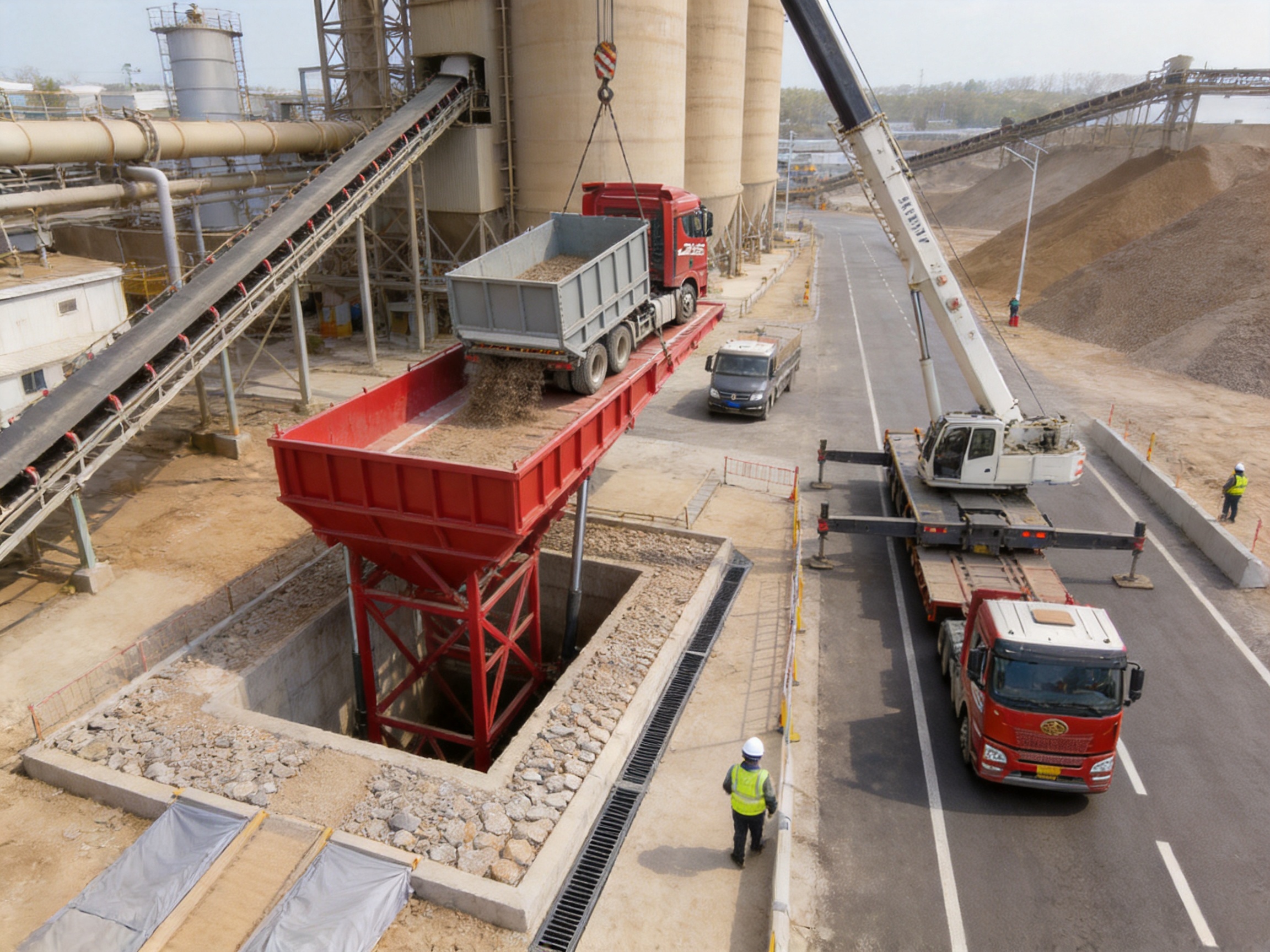
Modern bulk-material handling facilities must unload trucks quickly, safely, and consistently while controlling construction costs and minimizing production interruptions. Traditional truck dumpers installed inside excavated pits can provide effective unloading performance, but they often require extensive civil engineering, groundwater protection, concrete construction, drainage systems, and lengthy site preparation. These requirements become especially difficult for brownfield projects, facilities with high water tables, leased sites, seasonal operations, and plants that cannot afford a long shutdown.
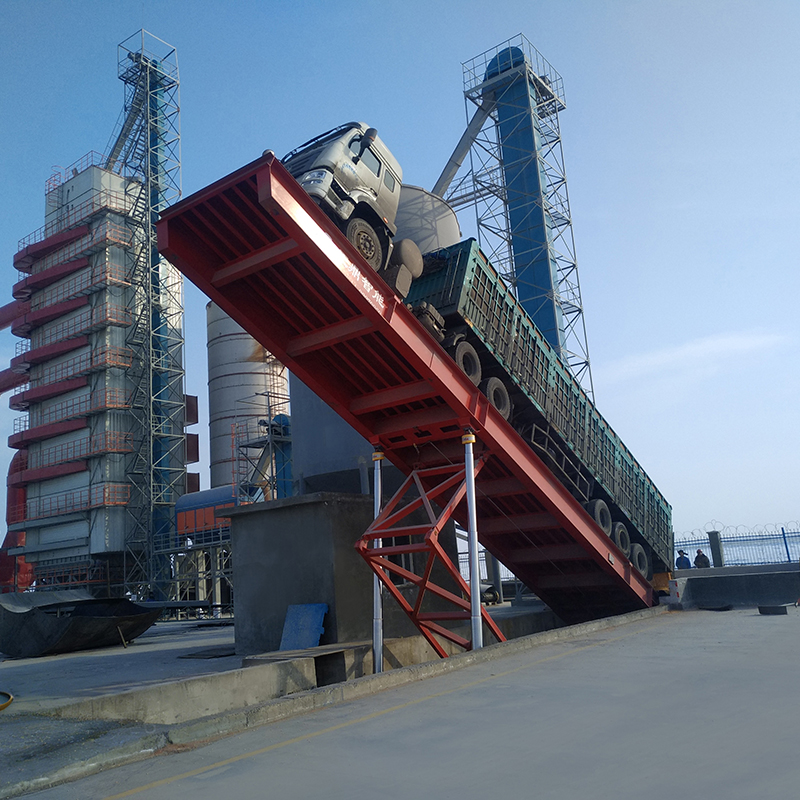
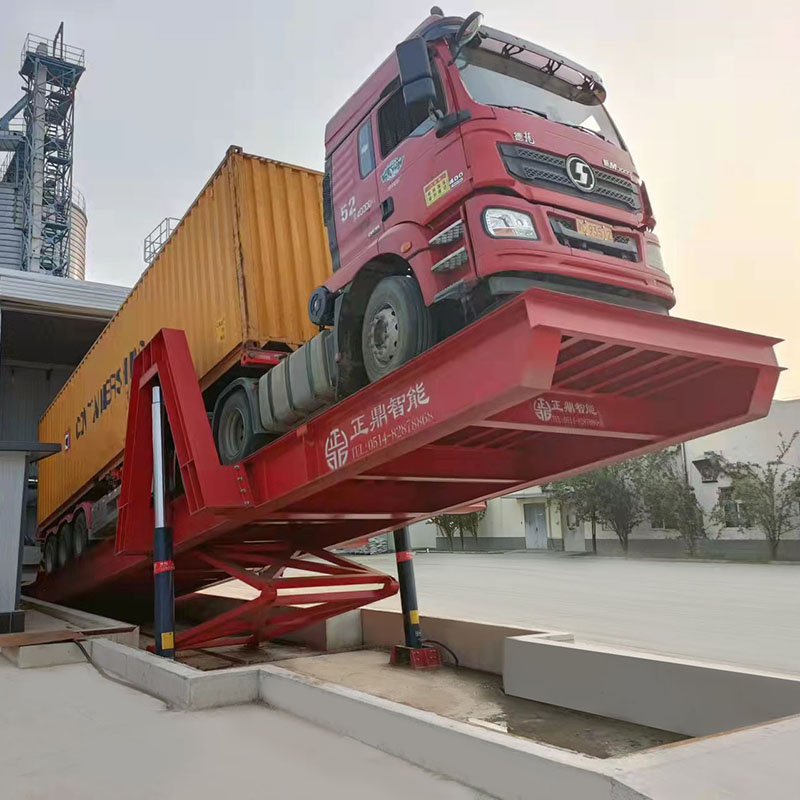
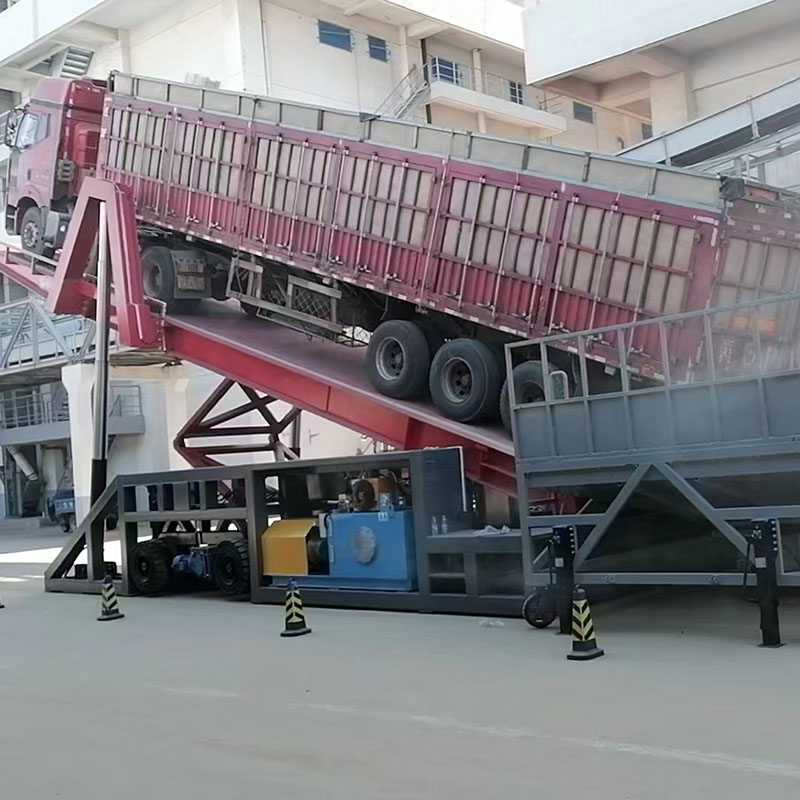
A pitless truck dumper offers a practical alternative. Instead of placing the unloading platform below ground level, the system uses an above-ground structure, approach ramps, hydraulic lifting equipment, and a discharge arrangement designed to transfer bulk material into a receiving hopper, conveyor, or processing line. By eliminating the deep foundation pit, the design can significantly reduce civil works, shorten installation time, and simplify future relocation or modification.
The pitless truck dumper described in this article is designed for high-capacity truck unloading in industries such as grain, feed, coal, cement, chemical products, steel, food processing, oil, recycling, and general logistics. Its main strengths include a pit-free installation concept, a high-precision oil-cylinder synchronous stability system, automatic wheel-retaining equipment, imported hydraulic components, modular site adaptation, and lifting capacities of up to 120 tons in the listed configurations.
Developed and manufactured by Jiangsu Zhengding Intelligent Equipment Co., Ltd., the equipment reflects the company’s broader expertise in automated loading and unloading systems for automobiles, containers, ships, and industrial logistics applications. Its engineering approach combines mechanical design, hydraulic control, automation, safety protection, and site-specific configuration rather than treating the dumper as an isolated machine.
1. What Is a Pitless Truck Dumper?
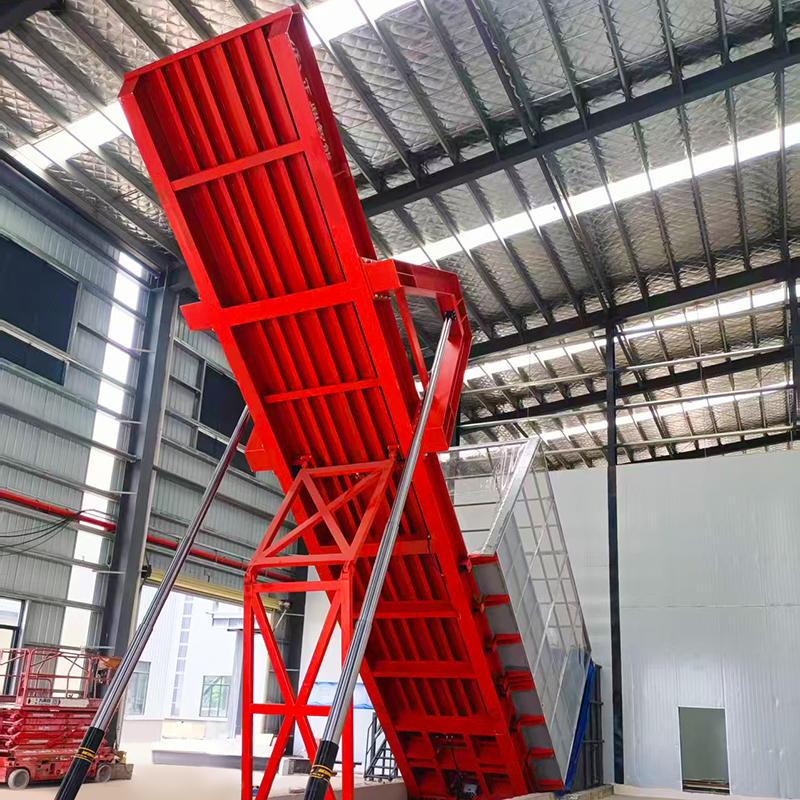
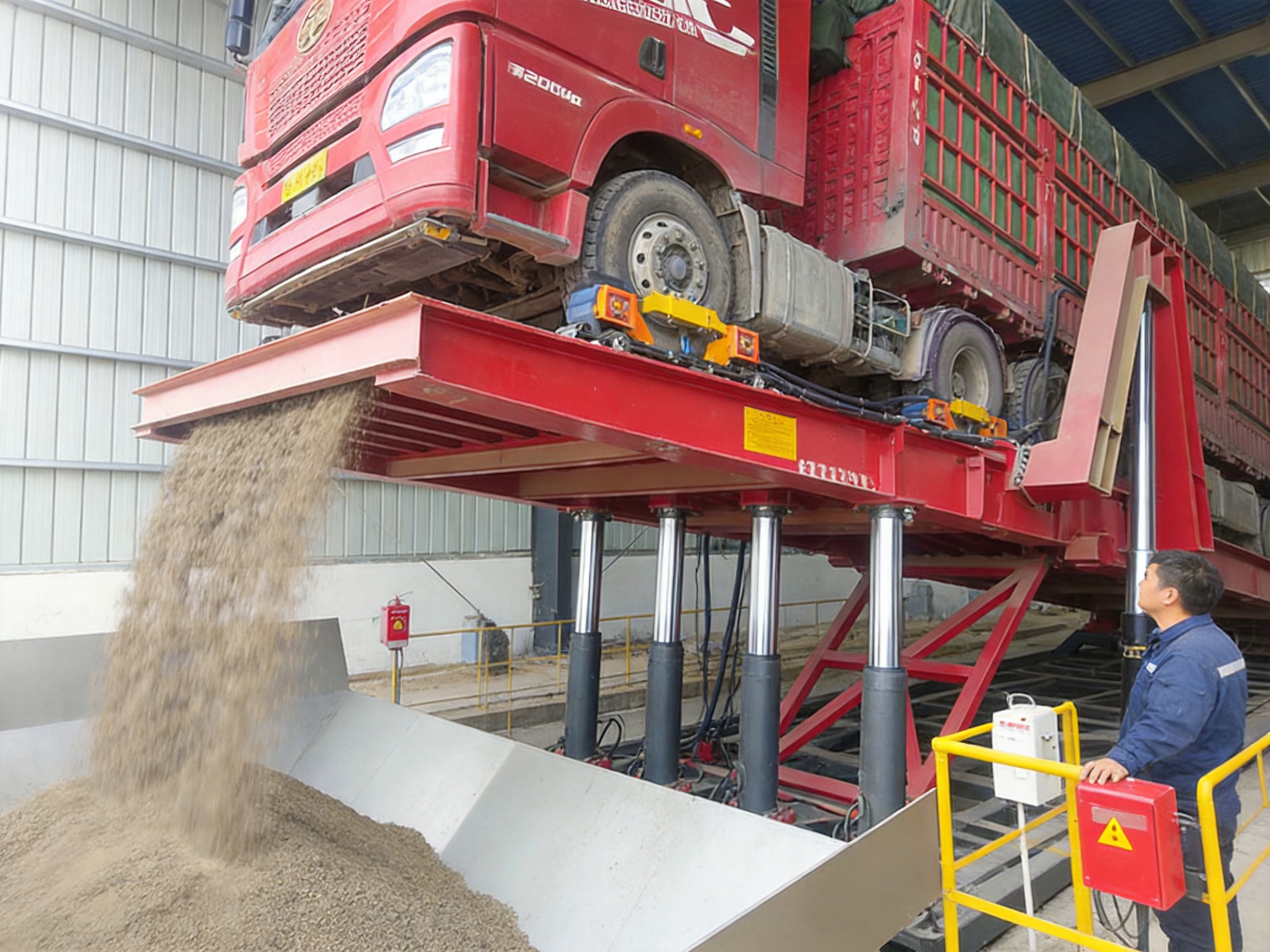
A pitless truck dumper is an above-ground truck unloading system that raises or tilts a loaded vehicle so that its cargo can discharge into a receiving hopper or downstream conveying system. Traditional pit dumpers normally require a recessed concrete structure. The truck drives onto a platform positioned close to ground level, and the platform is raised inside the pit to create the required discharge angle.
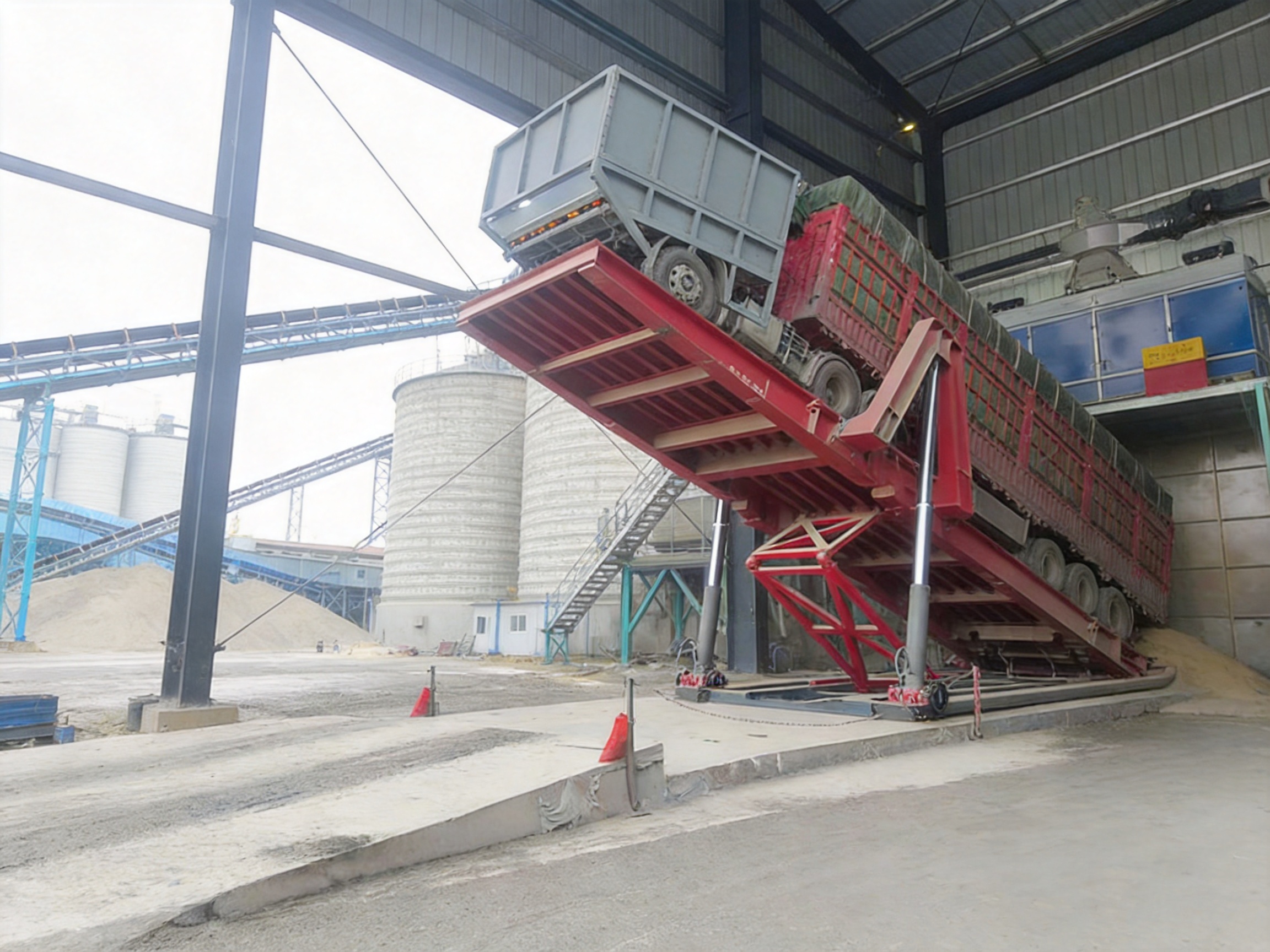
In a pitless configuration, the supporting structure is installed above the surrounding ground. Ramps or approach platforms guide the vehicle onto the dumper. The platform and hydraulic system then lift the truck body or the complete vehicle platform to the specified angle. After the material has discharged, the dumper returns to its horizontal position and the truck exits through the designated route.
This arrangement changes the construction requirements of the project. Excavation, deep retaining walls, extensive below-grade concrete, permanent drainage, and large-scale waterproofing are usually reduced or avoided. The base can be designed according to the terrain, soil conditions, equipment capacity, and discharge elevation at the selected installation site.
The pitless concept is especially valuable where excavation is undesirable or impractical. Examples include an operating plant that cannot stop production for weeks, a site built on reclaimed land, an area with a shallow groundwater table, a facility with buried utilities, or a rented location where a permanent underground structure would have limited value.
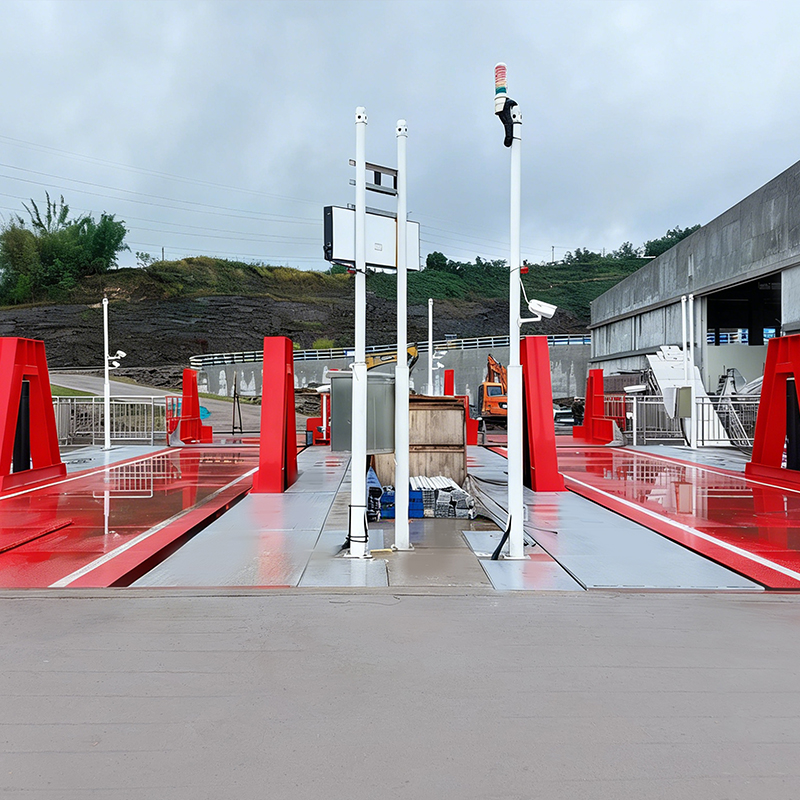
The equipment can be configured for different vehicle sizes and operating patterns. Depending on the project, the system may use fixed ramps, modular ramp sections, custom discharge heights, automatic retaining devices, dust-control arrangements, weighing integration, or semi-mobile construction that permits future relocation.
Key functions of the equipment
The primary function is to receive a loaded truck, secure it safely, raise the platform or vehicle body, discharge the material, and return the truck to the exit position. However, industrial performance depends on more than lifting force. The dumper must also control movement, maintain structural stability, prevent vehicle movement, protect the hydraulic system, coordinate with downstream equipment, and operate reliably in dusty and demanding environments.
Accepting loaded trucks within the rated capacity and dimensional limits.
Positioning and retaining the vehicle before lifting begins.
Raising the platform smoothly to the required discharge angle.
Maintaining synchronized hydraulic-cylinder movement.
Discharging material into a hopper, conveyor, or processing line.
Returning the platform to its safe loading position.
Reducing operator exposure to dust through remote or automated controls.
Supporting future plant modifications through modular and adaptable construction.
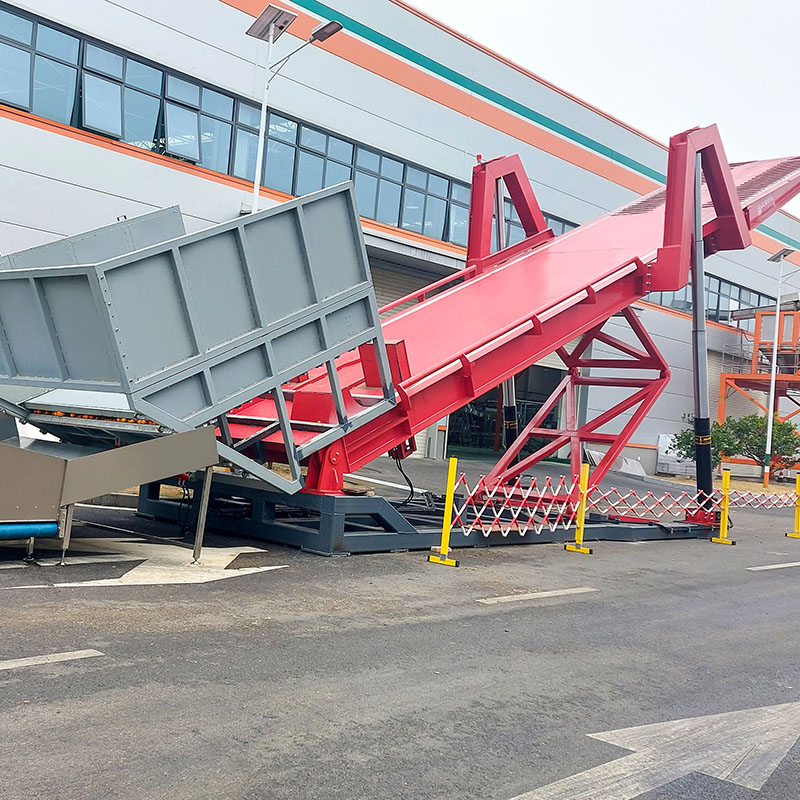
Pitless Truck Dumper
2. Main Product Advantages Over Traditional Pit Dumpers
The most important advantage of a pitless truck dumper is that it reduces dependence on deep civil construction. This does not mean that the equipment requires no foundation or site preparation. The installation still needs a properly engineered base, adequate ground bearing capacity, suitable access routes, drainage, and alignment with the receiving system. However, the scope is generally simpler than constructing a deep underground pit.
Reduced civil engineering requirements
A conventional pit installation may involve excavation, soil removal, shoring, reinforced concrete walls, waterproofing, drainage pumps, underground utilities relocation, and backfilling. These works can represent a major portion of the project cost and schedule. At sites with groundwater, dewatering may continue throughout construction and may require permanent pumping infrastructure.
The pitless design replaces much of this work with an above-ground support structure and a prepared base. The supplied product information states that civil engineering costs can be reduced by over 90 percent in suitable applications. Actual savings depend on soil conditions, local construction prices, capacity, discharge height, and the amount of existing infrastructure that can be reused. Even when the exact percentage varies, eliminating deep excavation can produce a substantial economic advantage.
Faster installation and shorter construction cycles
Because the equipment does not depend on a large underground pit, site preparation and installation can proceed more quickly. The product is intended for rapid deployment and is particularly suitable for brownfield retrofits and facility upgrades. The equipment base can be designed to match the terrain, and the system can be prepared for operation soon after arrival when the required civil and electrical work has been completed.
Industry comparisons commonly place pitless installation at approximately five to ten days for suitable projects, while pit-style construction may require six to twelve weeks or longer. The actual schedule depends on equipment size, local permitting, foundation requirements, delivery conditions, electrical work, and integration with hoppers or conveyors. Nevertheless, the reduced construction sequence can allow a facility to resume or begin unloading operations substantially sooner.
Shorter installation is particularly important for seasonal businesses. Grain terminals, feed mills, agricultural processors, and construction-material suppliers may have narrow periods of peak demand. A system that becomes operational several weeks earlier can help a facility receive more material during the critical operating season and avoid losing revenue while construction continues.
Suitability for brownfield projects
Brownfield facilities often contain complicated underground utilities, existing foundations, restricted working areas, and operating production lines. Excavating a deep pit may interfere with vehicle circulation, drainage, foundations, cables, pipelines, or neighboring equipment. An above-ground dumper can often be positioned with fewer changes to the existing site.
The pitless arrangement also allows the engineering team to adapt the base and ramp geometry to the available land. Where space is limited, the design may require careful traffic planning or a shorter approach arrangement. Where space is available, longer ramps can reduce the incline angle and improve access for low-clearance vehicles.
Lower groundwater and leakage risk
Deep pits are vulnerable to water infiltration, especially where the water table is high or seasonal groundwater levels fluctuate. Waterproofing failures, drainage blockages, and pump breakdowns can interrupt operations and damage electrical or hydraulic components. A pitless design does not eliminate all water-management responsibilities, but it avoids placing a large operating chamber below ground level.
The above-ground structure simplifies inspection and maintenance. Rainwater still needs to be directed away from the foundation, and the site should be designed with appropriate slopes, drains, and protective covers. However, the project does not normally require the same level of underground waterproofing and permanent dewatering associated with a deep pit.
Greater relocation flexibility
Many industrial operations change location, capacity, or material flow over time. A permanent concrete pit has limited reuse value if the facility is relocated or substantially redesigned. A semi-mobile pitless dumper can be dismantled or moved with lifting equipment and a low-bed trailer, subject to the equipment configuration and local transport requirements.
The supplied product information indicates that semi-mobile units may be relocated by crane and low-bed trailer within approximately one to two days under suitable conditions. Fully mobile configurations may include integrated transport features. Relocation time depends on disconnection, access, lifting capacity, road conditions, and preparation at the new site, but the basic principle remains important: an above-ground machine is generally easier to reuse than a buried structure.
Lower disruption to production
Facility upgrades often need to be completed while existing production continues. Deep excavation creates vibration, dust, noise, traffic restrictions, and safety risks around an active plant. It may also require a long shutdown of the existing unloading line. A pitless dumper can reduce the duration and scope of disruptive works, allowing the customer to plan installation around normal production windows.
The final project still requires a detailed construction and safety plan. Truck traffic, lifting operations, electrical installation, and commissioning must be controlled. However, a shorter construction cycle makes it easier to isolate the work area and return the facility to service quickly.
3. Hydraulic Stability and Safe Lifting Performance
The hydraulic system is the core of a truck dumper’s lifting performance. A loaded truck creates a large and changing force as the platform rises. The system must generate sufficient lifting capacity, maintain structural stability, control the movement speed, and stop safely if an abnormal condition occurs.
This product uses a high-precision oil-cylinder synchronous stability system developed by the manufacturer. The purpose of synchronization is to ensure that the hydraulic cylinders move together and that the platform remains balanced throughout the lifting cycle. Poor synchronization can cause twisting, uneven loading, excessive vibration, structural stress, and accelerated wear on cylinder seals and mounting points.
Synchronized cylinder movement
In a multi-cylinder dumper, each cylinder must contribute correctly to the lifting movement. The control system and hydraulic circuit are designed to coordinate the cylinders so that the platform rises evenly. Stable movement reduces sudden impacts and helps maintain the designed load path through the structure.
The supplied specifications emphasize high safety, small vibration during operation, and reduced impact on the oil cylinders. These characteristics can extend cylinder service life and improve operator confidence. Smooth movement is also valuable for materials that may shift during unloading, because abrupt acceleration can increase dynamic loads and destabilize the truck or platform.
Imported hydraulic components
The oil cylinders and pumps are specified as imported brands. The use of established hydraulic components can support reliability, parts availability, consistent performance, and longer service life when the components are correctly selected and maintained. The final hydraulic configuration should be matched to lifting capacity, cycle time, ambient temperature, dust conditions, oil cleanliness, and expected operating hours.
Component selection is only one part of hydraulic reliability. Proper filtration, oil inspection, hose protection, seal replacement, pressure testing, and preventive maintenance are equally important. The manufacturer’s engineering and service teams can define the recommended maintenance intervals according to the actual duty cycle and material environment.
Controlled movement instead of shock loading
Hydraulic systems should raise and lower the platform in a controlled manner. Reducing shock loads protects the cylinders, pins, hinges, frame, retaining devices, and vehicle. It also lowers vibration transmitted to the base and nearby equipment. A stable lifting cycle supports repeatable unloading times and reduces the likelihood of operators stopping the platform unnecessarily during normal operation.
Safety features should include mechanical and hydraulic protection against unintended descent, emergency stop functions, operating-status indicators, and interlocks that prevent lifting when the vehicle is incorrectly positioned. The exact safety configuration should be confirmed during technical specification and risk assessment.
4. Automatic Wheel-Retaining Technology
Vehicle movement is one of the most important safety concerns during truck-dumper operation. As the platform rises, the truck must remain in the correct position. The product uses a fully automatic wheel-retaining device to help secure the vehicle without requiring the operator to hold a remote control in a dusty environment while manually controlling the retaining function.
Automatic retaining improves the operating sequence. Once the truck reaches the correct position, sensors or control logic can confirm the location and activate the wheel-retaining mechanism. The system can then allow the lifting cycle to begin only when the required safety conditions are satisfied. After unloading and returning to the safe position, the retaining device can release according to the programmed sequence.
Advantages for the operator
Dust is common in grain, feed, cement, coal, mineral, and powder-material handling. Holding a remote control close to the operating area can expose the operator to dust and may make it difficult to observe the vehicle and equipment at the same time. An automatic retaining system reduces the number of manual actions and helps the operator concentrate on positioning, safety observation, and the overall unloading cycle.
Automation does not replace operator responsibility. The driver and operator must still follow traffic instructions, confirm that people are clear of the equipment, inspect the vehicle position, and stop the system if an abnormal condition occurs. Automatic devices should be inspected regularly for sensor contamination, mechanical wear, hydraulic leakage, and correct interlock operation.
Improved repeatability
Manual retaining procedures can vary from one operator or shift to another. Automatic positioning and retaining create a more consistent cycle. Repeatability is especially valuable in high-volume operations where many trucks are unloaded every day. Consistent positioning also helps protect the dumper from off-center loading and reduces unnecessary strain on the platform.
5. Technical Parameters and Configuration Options
The listed models cover lifting capacities from 80 to 120 tons. The dimensional options are designed for different truck lengths and site arrangements. The maximum lifting angle is available at either 45 degrees or 55 degrees, depending on the model configuration and project requirements.
| Model | Available Size Options, Length by Width | Maximum Lifting Weight | Maximum Lifting Angle |
|---|---|---|---|
| TQXHC 60 | 14 by 3 meters, 16 by 3 meters, or 18 by 3 meters | 80 tons | 45 degrees or 55 degrees |
| TQXHC 100 | 14 by 3 meters, 16 by 3 meters, or 18 by 3 meters | 100 tons | 45 degrees or 55 degrees |
| TQXHC 120 | 16 by 3 meters, 18 by 3 meters, or 20 by 3 meters | 120 tons | 45 degrees or 55 degrees |
The table provides a starting point for equipment selection rather than a substitute for project engineering. The correct model depends on the maximum gross vehicle weight, axle configuration, truck dimensions, body geometry, material properties, required unloading speed, receiving-hopper elevation, traffic pattern, and local environmental conditions.
Capacity selection with a safety margin
The dumper’s rated capacity should exceed the heaviest expected loaded vehicle. A practical selection approach is to include a margin of approximately 15 to 20 percent above the maximum normal operating load, provided that the manufacturer confirms the selected configuration. This margin helps accommodate changes in fleet composition, occasional variations in payload, and future vehicle upgrades.
Capacity should be evaluated as a complete load case. Engineers need to consider the vehicle’s gross weight, load distribution, wheelbase, axle loads, center of gravity, braking condition, and the dynamic forces generated during lifting. A dumper rated for a particular tonnage should not be used beyond its approved vehicle dimensions or operating envelope.
Discharge angle and material flow
The maximum lifting angle affects how easily material flows from the truck body. Free-flowing grain, aggregate, coal, and some powders may discharge effectively at moderate angles. Wet, cohesive, sticky, or frozen materials may require a greater angle, vibration assistance, liner selection, or other measures. The material’s moisture, particle size, temperature, bulk density, and tendency to bridge should be considered before finalizing the angle.
A higher angle is not automatically better. It may increase the center-of-gravity movement, structural loads, required clearance, and discharge height. The engineering team should select the angle that provides reliable material flow while maintaining vehicle and equipment stability.
Ramp length and access geometry
Ramp length affects vehicle access. A longer ramp produces a lower incline for the same platform height, which benefits low-clearance vehicles, long chassis trucks, and trailers with sensitive approach angles. A shorter ramp occupies less space but may create a steeper grade.
Site planning should include the approach road, turning radius, queue area, truck alignment, exit route, pedestrian separation, emergency access, and space for maintenance. The ramp surface should provide adequate traction in wet, dusty, or icy conditions. Edge protection and visual guidance can further improve driver accuracy.
6. Installation Without a Deep Foundation Pit
The foundation design of a pitless truck dumper is determined by the equipment load, soil bearing capacity, local climate, seismic requirements, drainage conditions, and traffic frequency. The absence of a deep pit does not mean that the base can be treated casually. A loaded truck and elevated platform impose significant static and dynamic forces on the ground.
Ground assessment
A site assessment should identify soil type, bearing capacity, settlement risk, groundwater level, frost conditions, slope, existing underground utilities, and access for cranes or delivery vehicles. Heavy-capacity units, particularly those above 60 tons, may require a geotechnical evaluation. Weak or uneven ground can lead to settlement, frame misalignment, ramp deformation, or excessive stress on the hydraulic system.
Base construction
Depending on the site, the base may consist of compacted granular material, reinforced concrete, shallow footings, steel support structures, or a combination of these systems. The supplied guidance indicates that approximately 300 to 450 millimeters of compacted crushed stone may be adequate for many applications, while poor soil may require geotextile reinforcement or shallow concrete foundations.
The exact thickness and structure must be calculated rather than assumed. Compaction testing, level control, drainage design, and edge restraint are important for long-term performance. The base should also provide a stable surface for hydraulic equipment, electrical cabinets, safety barriers, and access platforms.
Drainage and weather protection
An above-ground installation is less exposed to underground water, but it remains exposed to rain, snow, dust, and temperature changes. The site should prevent water from collecting around the foundation or flowing toward electrical equipment. Drainage channels, surface slopes, weather covers, and corrosion-resistant finishes may be used according to the climate.
In cold regions, hydraulic oil selection, heater systems, control-cabinet protection, and frost-resistant construction may be required. In hot or dusty regions, cooling, filtration, sealing, and cleaning procedures become more important. Coastal or chemically aggressive environments may require enhanced corrosion protection.
Connection to the receiving system
The discharge end of the dumper must align with a receiving hopper, conveyor, feeder, or processing machine. The elevated position of a pitless dumper may require a raised hopper or a redesigned intake arrangement. This modification should be addressed at the beginning of the project, not after the dumper has arrived.
The transfer point should be designed to control dust, reduce material impact, prevent blockage, and provide safe access for cleaning. Where the material is dusty, the project may include covers, extraction, sealing skirts, filters, or a controlled transfer chute. A well-designed discharge interface is essential for achieving the full benefit of fast truck unloading.
7. Automation and Integration With Plant Operations
A pitless truck dumper can be used as a standalone machine or integrated into a broader automated loading and unloading system. Integration may include traffic lights, vehicle identification, weighing equipment, barcode or card readers, moisture measurement, material verification, gate controls, conveyor interlocks, dust extraction, and plant-level supervisory systems.
The company’s wider product range includes rear dumpers, side-turn truck dumpers, car loading equipment, container flippers, and other automated equipment for vehicles and containers. This portfolio supports a system-level approach in which truck reception, unloading, transfer, weighing, and process control can be coordinated as one material flow.
Typical automated operating sequence
The truck enters the designated approach lane and receives permission to proceed.
The vehicle is guided onto the platform and positioned according to the equipment alignment marks or sensors.
The control system confirms that the vehicle is within the permitted position and that the safety zone is clear.
The automatic wheel-retaining device engages.
The hydraulic system raises the platform using synchronized cylinders.
Material flows into the receiving hopper or downstream conveying system.
The platform returns to the horizontal position under controlled hydraulic movement.
The retaining device releases after the system confirms the safe exit condition.
The truck leaves the platform and the dumper prepares for the next cycle.
Automation can reduce operator workload and improve cycle consistency. It can also generate operating records such as cycle counts, alarm histories, lifting times, maintenance alerts, and truck identification data. These records help managers identify bottlenecks and schedule preventive maintenance.
Manual and remote control options
Remote control can allow the operator to observe the truck and platform from a safer position. A local control station may be provided for commissioning, maintenance, or emergency operation. The final arrangement should ensure that emergency stops are accessible and that the operator has a clear view of the truck, wheel retainers, platform, discharge point, and surrounding personnel.
Control interfaces should be simple enough for daily operation in a dusty industrial environment. Clear status indicators, audible or visual alarms, permissive logic, and fault messages help operators respond correctly. Training should cover normal operation, emergency stopping, abnormal truck positioning, hydraulic faults, power failure, and recovery procedures.
8. Manufacturing Strengths and Engineering Capabilities
Jiangsu Zhengding Intelligent Equipment Co., Ltd. is described as a national high-tech enterprise focused on the research, development, manufacturing, and sales of intelligent logistics equipment. Its product scope covers automated loading and unloading systems for automobiles, containers, ships, and related industrial applications.
The company’s manufacturing strength is supported by its ability to combine several engineering disciplines. A truck dumper is not simply a welded steel platform with a hydraulic cylinder. It requires structural analysis, hydraulic design, electrical control, safety engineering, fabrication accuracy, surface treatment, commissioning, and application-specific integration.
Research and development
Research and development work for pitless dumpers includes improving hydraulic synchronization, optimizing structural load paths, reducing vibration, designing automatic retaining systems, and adapting the machine to different truck fleets. Product development also considers maintainability, installation speed, operating environment, and compatibility with downstream equipment.
A high-precision synchronous stability system is one example of this application-oriented development. By focusing on coordinated cylinder movement and reduced impact, the design addresses a common source of mechanical stress in large lifting equipment. Continuous development can also support improved automation, diagnostics, energy efficiency, and remote service capabilities.
Structural manufacturing
The main frame and platform must withstand repeated loading, lifting, vibration, and environmental exposure. Manufacturing quality depends on material selection, cutting accuracy, welding procedure control, dimensional inspection, alignment, and appropriate surface protection. Reinforcement must be placed according to calculated stress concentrations rather than added inconsistently.
For large equipment, fabrication accuracy is especially important at cylinder mounts, hinges, wheel-retaining assemblies, ramp interfaces, and platform alignment points. Accurate assembly reduces unwanted side loads and helps the hydraulic system operate smoothly. Quality inspection should include weld checks, dimensional verification, hydraulic pressure testing, and functional testing before shipment.
Hydraulic and electrical assembly
Hydraulic components must be installed with correct cleanliness controls. Contamination can damage pumps, valves, and cylinder seals. Hoses should be routed to prevent abrasion, sharp bending, excessive heat exposure, or interference with moving parts. Pressure settings and synchronization controls should be tested under representative loads.
Electrical cabinets and sensors should be protected against dust and moisture according to the site environment. The control system should be tested for interlocks, emergency stops, retaining-device operation, overload protection, position confirmation, and communication with upstream and downstream equipment.
Customization and system integration
The company provides systematic solutions for different industries rather than relying only on standard equipment. Customization may include platform dimensions, lifting capacity, ramp length, discharge height, material-contact surfaces, dust-control provisions, automation level, weighing integration, and layout adaptation.
This capability is important because truck fleets and plant conditions vary widely. A dumper for grain trucks may require different discharge and cleaning features from a unit handling coal, cement, chemical raw materials, or recycled material. The design should reflect the actual material and operating environment.
9. Applications Across Multiple Industries
Pitless truck dumpers are suitable for facilities where bulk material arrives by road and must be transferred rapidly into storage or processing equipment. The above-ground design is valuable in both new construction and retrofit projects.
Grain and feed processing
Grain and feed facilities often experience seasonal peaks and high truck volumes. Rapid unloading reduces truck queues and helps prevent delays during harvest or delivery surges. Dust-control features, easy-clean surfaces, reliable wheel retention, and integration with weighing and sampling systems are important in these applications.
Coal, mineral, and aggregate handling
Coal, mineral, and aggregate operations may handle heavy vehicles and abrasive materials. The dumper must be selected for the gross vehicle weight, material density, impact conditions, and expected cycle frequency. Wear-resistant liners, reinforced transfer points, dust suppression, and robust hydraulic protection can improve service life.
Cement and chemical materials
Cement and chemical raw materials can generate dust or require special corrosion protection. Enclosed transfer arrangements, extraction systems, suitable coatings, sealed electrical cabinets, and carefully selected materials may be required. The receiving system must prevent uncontrolled dust release and maintain safe conditions for personnel.
Food, oil, and industrial raw materials
Food and oil-related applications may place additional emphasis on cleanliness, contamination control, spill prevention, and material traceability. The dumper can be integrated with controlled receiving and conveying systems to support consistent product handling.
Recycling and waste processing
Recycling facilities often receive mixed truck types and variable loads. A pitless dumper can simplify expansion or relocation as the facility changes its process layout. The engineering design must account for unexpected objects, uneven loads, corrosive materials, and more demanding cleaning requirements.
10. Maintenance and Service Considerations
Preventive maintenance is essential for any heavy lifting system. The inspection program should be based on operating cycles, load level, material environment, climate, and manufacturer recommendations. A maintenance plan helps identify wear before it causes an unplanned shutdown.
Hydraulic maintenance
Operators should check hydraulic oil level, oil condition, hose integrity, cylinder seals, pump noise, abnormal temperature, pressure stability, and visible leakage. Filters should be replaced at the recommended intervals, and the oil should be kept clean. Any difference in cylinder movement should be investigated immediately because it may indicate synchronization, valve, seal, or mechanical alignment problems.
Structural and mechanical inspection
Welds, pins, hinges, platform supports, ramp connections, wheel retainers, bolts, guards, and access platforms should be inspected regularly. Cracks, deformation, unusual wear, loose fasteners, or abnormal movement require corrective action before the equipment is returned to full service.
Control and safety inspection
Emergency stops, limit switches, position sensors, alarms, interlocks, warning lights, remote controls, and automatic retaining devices should be tested according to a documented schedule. Dust and material buildup around sensors should be removed. Safety devices must never be bypassed during normal operation.
Cleaning and environmental protection
Material buildup can interfere with moving components, sensors, wheel retainers, and discharge points. Regular cleaning supports reliable operation and reduces dust accumulation. In corrosive or wet environments, damaged coatings should be repaired and drainage paths should remain clear.
11. Selection Guide for Buyers
Before ordering a pitless truck dumper, the buyer should prepare accurate information about the site and operating requirements. This information allows the manufacturer to recommend the correct capacity, dimensions, ramp arrangement, hydraulic configuration, and control system.
| Selection Item | Information to Confirm | Why It Matters |
|---|---|---|
| Truck fleet | Gross weight, wheelbase, width, length, axle arrangement, body type | Determines platform size, capacity, retaining arrangement, and access geometry |
| Material | Bulk density, moisture, particle size, flowability, temperature, abrasiveness | Influences discharge angle, liners, hopper design, and dust control |
| Operating volume | Trucks per day, peak-hour arrivals, seasonal changes | Determines cycle requirements and the appropriate automation level |
| Site conditions | Soil bearing capacity, groundwater, slope, utilities, available space | Guides foundation, drainage, ramp, and installation planning |
| Receiving system | Hopper elevation, conveyor capacity, inlet dimensions, transfer arrangement | Ensures correct discharge alignment and material-flow performance |
| Future plans | Fleet expansion, relocation, new materials, increased throughput | Supports a flexible and economical long-term configuration |
The buyer should also ask for the rated capacity under the proposed vehicle configuration, the required foundation specification, the hydraulic component list, the safety functions, the commissioning scope, spare-parts recommendations, and operator training arrangements.
12. Q&A: Frequently Asked Questions
Q1: What foundation does a pitless truck dumper require?
A pitless dumper normally requires a compacted granular base, a concrete pad, shallow footings, or a combination selected according to soil conditions and equipment loading. For many applications, approximately 300 to 450 millimeters of compacted crushed stone may be considered, but the final foundation must be confirmed by engineering analysis. Heavy units and weak soils may require geotextile reinforcement or concrete foundations.
Q2: Does pitless mean that no civil work is required?
No. Pitless means that a deep underground dumper pit is not required. The project still needs site grading, a stable base, drainage, access ramps, electrical connections, safety barriers, and alignment with the receiving hopper or conveyor. The civil work is generally simpler and faster than deep pit construction, but it must still be designed correctly.
Q3: How does discharge height compare with a pit dumper?
A pitless dumper typically places the truck platform approximately 0.6 to 1.2 meters above ground level, depending on the configuration. This may require the receiving hopper or conveyor intake to be raised. The extra height can also help reduce the material drop distance into a receiving system when the complete transfer arrangement is designed properly.
Q4: Can the dumper handle different truck sizes?
Yes, provided that the vehicles fall within the approved capacity, dimensions, axle loads, and center-of-gravity limits. The platform length, width, ramp arrangement, wheel-retaining system, and controls should be selected according to the actual fleet. A facility handling several truck types should provide complete vehicle data before final design.
Q5: Can a pitless dumper be relocated?
Many pitless configurations can be relocated more easily than buried pit systems. Semi-mobile units may be moved with a crane and low-bed trailer after hydraulic, electrical, and process connections are disconnected. Some configurations can be designed with additional mobility features. Relocation requirements should be discussed during the initial order because the frame, transport points, and site connections may need to reflect that objective.
Q6: What materials can be unloaded?
The dumper can be used for many bulk materials, including grain, feed, coal, aggregate, cement, minerals, chemical raw materials, food products, oil-related materials, and recyclable goods. Material density, moisture, flowability, abrasiveness, temperature, and dust behavior must be evaluated to determine the appropriate discharge angle, hopper arrangement, liners, and dust-control system.
Q7: Is automatic wheel retention necessary?
Automatic wheel retention is strongly beneficial for safety and repeatability, especially in dusty or high-volume operations. It reduces manual actions and helps ensure that the truck is secured before lifting. The system should be combined with position confirmation, interlocks, emergency stops, and regular inspection. Automatic operation does not remove the need for trained personnel and safe traffic procedures.
Q8: What capacity should be selected?
The selected capacity should exceed the maximum gross weight of the loaded vehicles that will use the dumper. A safety margin of approximately 15 to 20 percent above the highest expected normal load is commonly considered, subject to the manufacturer’s approval. Future fleet changes and occasional payload variations should also be included in the selection process.
Q9: How long does installation take?
Suitable pitless projects may be installed in approximately five to ten days for the equipment and basic site works, while the complete project schedule may be longer because of foundation preparation, electrical connections, receiving-system modifications, commissioning, and local approvals. The schedule is normally shorter than a deep pit installation, which may require several weeks of excavation and concrete construction.
Q10: What maintenance is required?
Maintenance includes hydraulic oil and filter inspection, cylinder and hose checks, structural and weld inspections, hinge and pin lubrication, wheel-retaining-device checks, sensor cleaning, electrical testing, emergency-stop verification, and regular cleaning of material buildup. The exact intervals depend on operating frequency, load, material, climate, and manufacturer recommendations.
Q11: Can the system be integrated with weighing equipment?
Integration with weighing, vehicle identification, conveyor controls, dust extraction, traffic lights, and plant supervisory systems may be possible. The required signals and control logic should be defined during the engineering stage so that the dumper and surrounding equipment operate as one coordinated system.
Q12: Why choose a pitless design for a brownfield upgrade?
A pitless design reduces excavation near existing structures and utilities, shortens construction time, limits production disruption, and offers more flexibility when the site layout changes. It is particularly useful where the groundwater table is high, the facility operates continuously, or the customer expects future relocation or expansion.
13. Why Work With Jiangsu Zhengding Intelligent Equipment Co., Ltd.?
Jiangsu Zhengding Intelligent Equipment Co., Ltd. provides intelligent loading and unloading equipment for automobiles, containers, ships, and industrial logistics applications. Its product range includes rear dumpers, side-turn truck dumpers, car loading equipment, container flippers, and related systems.
The company serves industries including steel, chemical products, cement, coal, grain, oil, food, feed, ports, papermaking, and new energy. Its equipment has been supplied to markets such as Japan, Brazil, Egypt, Pakistan, India, the Middle East, and Southeast Asia. The company also identifies international users from the beverage, grain, food, chemical, materials, and industrial sectors.
For a pitless truck dumper project, the company’s value extends beyond equipment fabrication. The engineering process can include site assessment, truck-fleet analysis, material-flow evaluation, capacity selection, ramp planning, foundation recommendations, hydraulic and electrical configuration, system integration, commissioning, and operator guidance.
This approach helps the customer avoid a common purchasing mistake: selecting a dumper solely by lifting tonnage. The correct solution must also match the vehicle geometry, discharge point, approach space, material behavior, traffic plan, automation needs, and future operating strategy.
The company’s ability to manufacture different types of vehicle and container handling equipment can also support customers that need more than one loading or unloading solution. A facility may require a pitless dumper for bulk material reception, a side-turn dumper for another material stream, or container handling equipment for packaged goods. A supplier with a broad technical range can coordinate these systems more effectively.
14. Conclusion
The pitless truck dumper is a strong alternative to traditional pit-mounted unloading equipment when installation speed, construction cost, groundwater avoidance, operating continuity, and future flexibility are important. Its above-ground design reduces dependence on deep excavation and permanent underground construction while allowing the equipment to be adapted to different terrains and receiving-system elevations.
The product’s principal technical advantages include a high-precision oil-cylinder synchronous stability system, low-vibration hydraulic lifting, automatic wheel-retaining equipment, imported pumps and cylinders, configurable platform dimensions, lifting capacities up to 120 tons, and maximum lifting angles of 45 or 55 degrees in the listed models.
Its strongest competitive advantage is not one isolated component. It is the combination of rapid installation, reduced civil engineering, safer vehicle retention, controlled hydraulic movement, modular site adaptation, and potential relocation. These characteristics make the equipment suitable for brownfield upgrades, seasonal plants, high-water-table sites, industrial expansions, and facilities that need reliable truck unloading without a long construction shutdown.
Jiangsu Zhengding Intelligent Equipment Co., Ltd. strengthens this product proposition through research and development, heavy equipment manufacturing, hydraulic and automation integration, customized engineering, and experience across multiple loading and unloading applications. By evaluating the site, truck fleet, materials, operating volume, and future requirements together, the company can help customers select a pitless dumper that provides dependable performance throughout its service life.
Before purchase, customers should request a complete technical proposal covering capacity, platform dimensions, lifting angle, ramp geometry, foundation requirements, receiving-system interface, hydraulic components, safety functions, automation scope, installation schedule, commissioning, maintenance, and spare parts. With proper engineering and operation, a pitless truck dumper can become a high-value part of an efficient, safe, and adaptable bulk-material handling system.
References
1. Jiangsu Zhengding Intelligent Equipment Co., Ltd. Product information for pitless truck dumpers, including model capacities, lifting angles, hydraulic features, automatic wheel-retaining equipment, and installation characteristics.
2. Jiangsu Zhengding Intelligent Equipment Co., Ltd. Company profile and product portfolio information for automated loading and unloading equipment used in automobile, container, ship, and industrial logistics applications.
3. General engineering principles for truck dumper selection, including vehicle gross weight, axle loading, ramp geometry, discharge height, material flow, foundation design, and hydraulic safety.
4. General industrial practice for bulk-material handling system design, transfer-point integration, dust control, preventive maintenance, and automated vehicle unloading.
5. General site-planning considerations for brownfield equipment upgrades, high-groundwater locations, seasonal operations, modular installation, and semi-mobile industrial machinery.


