

 English
 русский
 Español
 Français
 Português
 عربى
عربى



+86-13588556918
Content
- 1 1. The Role of Automated Container Loading in Modern Logistics
- 2 2. Product Overview and Operating Concept
- 3 3. Core Product Features
- 4 4. Performance Advantages Compared with Competing Methods
- 5 5. Advanced Manufacturing and Engineering Strengths
- 6 6. Quality Control from Fabrication to Commissioning
- 7 7. Applications in Different Industries
- 8 8. Complete Project Solutions Rather Than Standalone Equipment
- 9 9. Maintenance, Reliability, and Operating Management
- 10 10. Selecting the Right Container Loader
- 11 11. Frequently Asked Questions
- 11.1 Q1: What types of products can be handled by an automated container loader?
- 11.2 Q2: Can one machine handle both loading and unloading?
- 11.3 Q3: Is the system compatible with both 20-foot and 40-foot containers?
- 11.4 Q4: Can the container doors be opened and closed automatically?
- 11.5 Q5: How does integrated weighing help the loading process?
- 11.6 Q6: Does automation eliminate the need for operators?
- 11.7 Q7: How quickly can a container be loaded?
- 11.8 Q8: How can automated loading improve container fill rates?
- 11.9 Q9: What training is required?
- 11.10 Q10: Can the equipment be connected to an existing warehouse or production system?
- 11.11 Q11: What industries use this type of equipment?
- 11.12 Q12: What support is available after purchase?
- 12 12. Why Choose an Experienced Intelligent Equipment Manufacturer
- 13 13. Conclusion
- 14 References
- 15 Product: Container Loaders
Container loading is one of the most important operations in modern logistics. Although it is often treated as a routine warehouse activity, the loading process directly affects labor costs, shipment speed, cargo safety, container utilization, weighing accuracy, and the overall reliability of the supply chain. Delays or errors during loading can result in damaged goods, uneven weight distribution, overloading, demurrage charges, workplace injuries, and inefficient use of transport capacity.
Automated container loaders provide a practical solution to these challenges. By combining mechanical loading and unloading functions, controlled movement, optional automatic door operation, precision weighing, and adaptable container positioning, they transform a traditionally labor-intensive process into a coordinated and measurable operation. The equipment described in this article is designed for both 20-foot and 40-foot standard containers and can support a wide range of industrial and commercial logistics applications.
Jiangsu Zhengding Intelligent Equipment Co., Ltd. develops and manufactures automated loading and unloading systems for vehicles, containers, ships, and related logistics applications. Its container loader solutions are intended to improve loading speed, reduce manual intervention, protect cargo, and provide a more consistent operating environment for warehouses, factories, ports, and distribution centers.
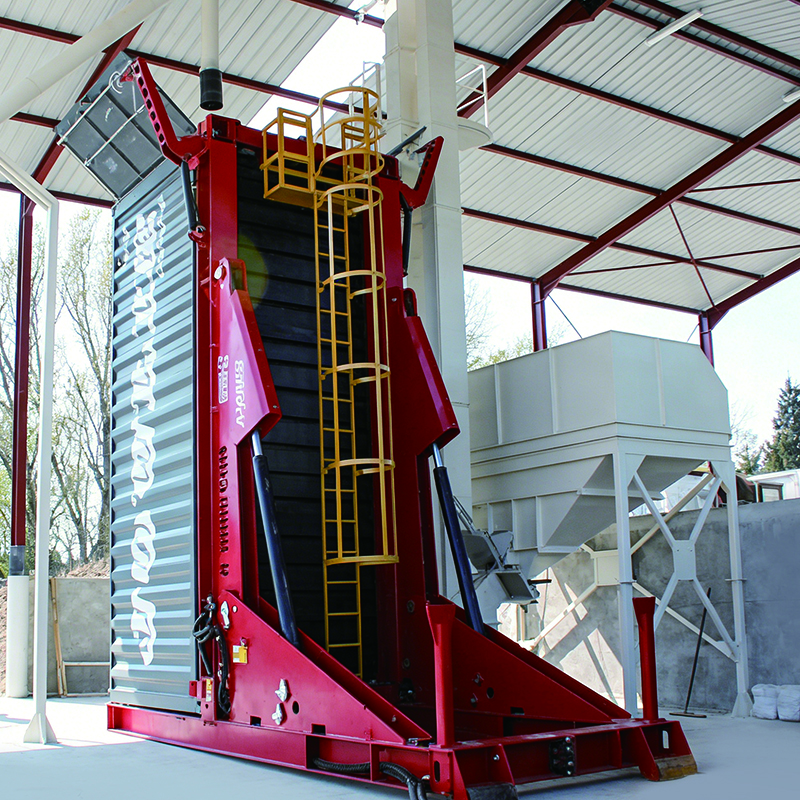
Container Loaders
1. The Role of Automated Container Loading in Modern Logistics
Container loading connects production, warehousing, transportation, and delivery. A container may be loaded at a manufacturing facility, distribution center, grain terminal, chemical plant, food-processing site, or port. Regardless of the industry, the basic requirements remain similar: products must enter the container efficiently, be distributed appropriately, remain within safe weight limits, and be ready for dispatch with minimal delay.
Manual loading methods commonly rely on workers, forklifts, pallet trucks, conveyors, or a combination of these tools. While manual systems can be suitable for low-volume operations, they become increasingly difficult to manage as shipment volume increases. Workers may need to enter the container repeatedly, reposition cargo by hand, adjust loading patterns, and monitor the process under difficult lighting, temperature, or space conditions.
An automated container loader reduces these limitations by creating a dedicated interface between the warehouse and the container. The system can be configured to move goods into or out of the container while maintaining controlled speed and positioning. Depending on the product and application, the loading arrangement may be integrated with conveyors, lifting mechanisms, telescopic equipment, weighing devices, container door systems, or warehouse management controls.
The result is not simply a faster machine. It is a complete loading process in which equipment design, control logic, safety protection, and operational data work together. This integrated approach helps companies improve throughput while reducing the variability associated with manual handling.
1.1 Common problems with conventional loading
Conventional loading methods may create several operational difficulties:
First, labor requirements can be high. Manual loading often requires several workers per shift, particularly when products are bagged, irregularly shaped, heavy, or difficult to position. Labor shortages and rising personnel costs make this arrangement less sustainable for many companies.
Second, loading speed can vary significantly. The actual cycle time depends on worker experience, product conditions, container access, weather, equipment availability, and the need to rearrange cargo. This makes it difficult to plan dispatch schedules accurately.
Third, workers may be exposed to avoidable safety hazards. Entering confined container spaces, working around forklifts, handling heavy products, and operating near moving equipment can increase the likelihood of injury.
Fourth, manual loading can produce uneven weight distribution or unused space. Poor distribution may affect vehicle stability, increase the possibility of cargo movement, and reduce the amount of product that can be shipped in each container.
Finally, conventional processes often provide limited real-time information. If weighing is performed separately from loading, operators may discover an overloading condition only after the container has been filled or nearly filled. Automated weighing and control systems address this problem by making weight information available during the operation.
2. Product Overview and Operating Concept
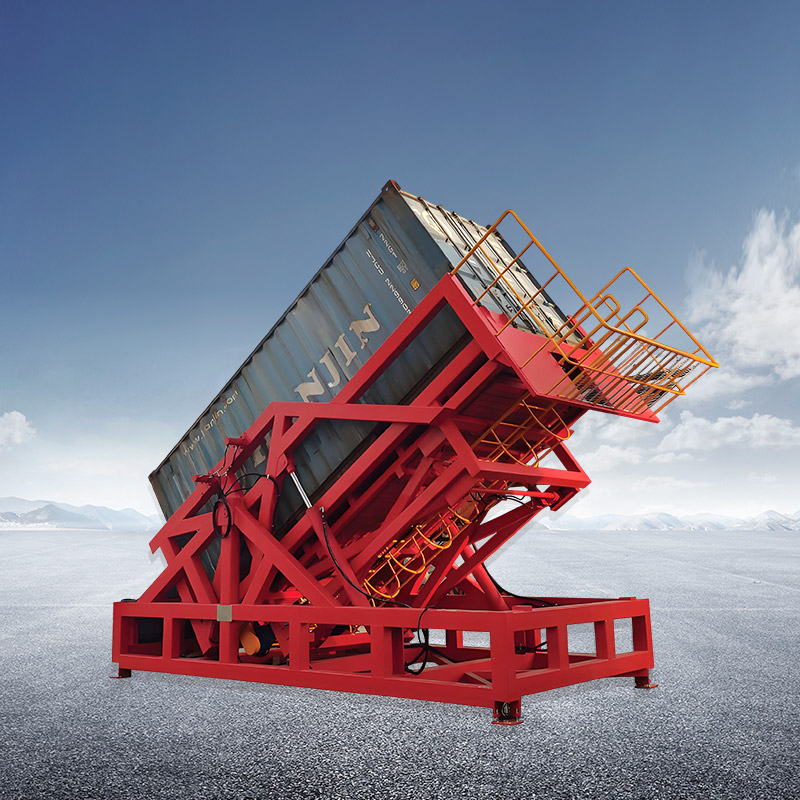
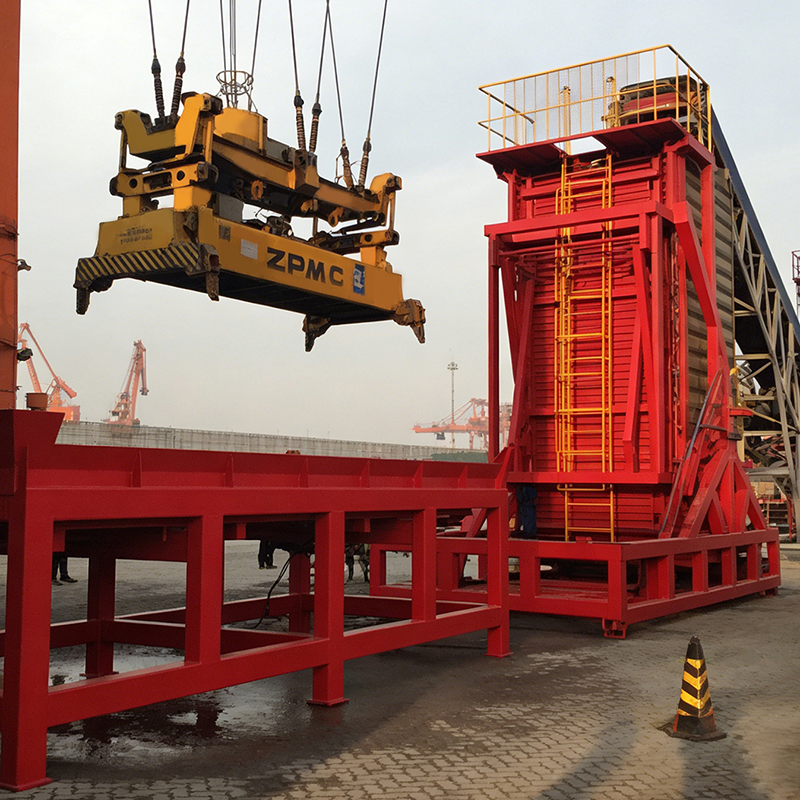
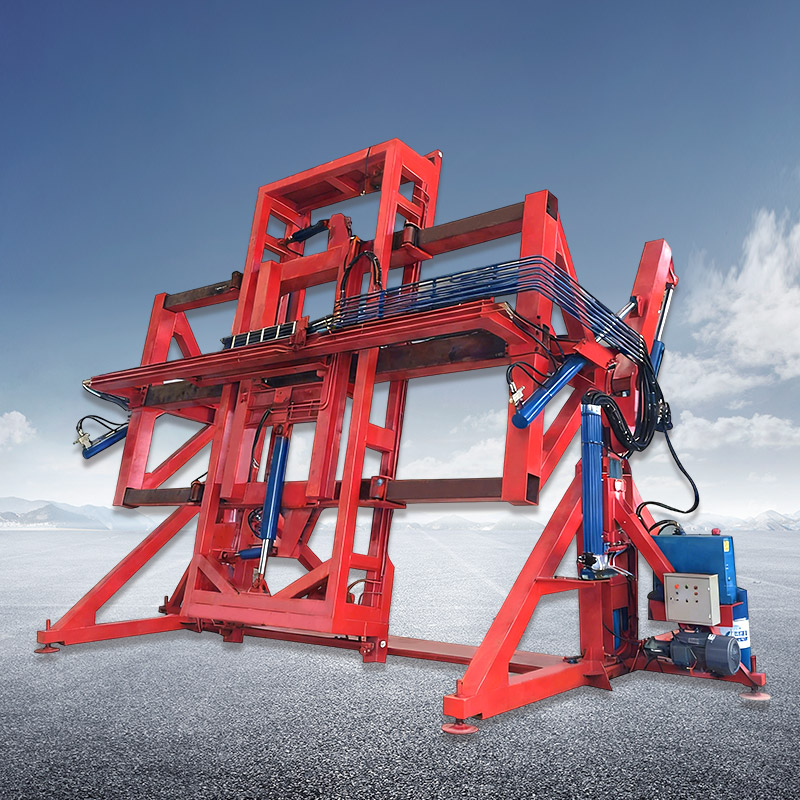
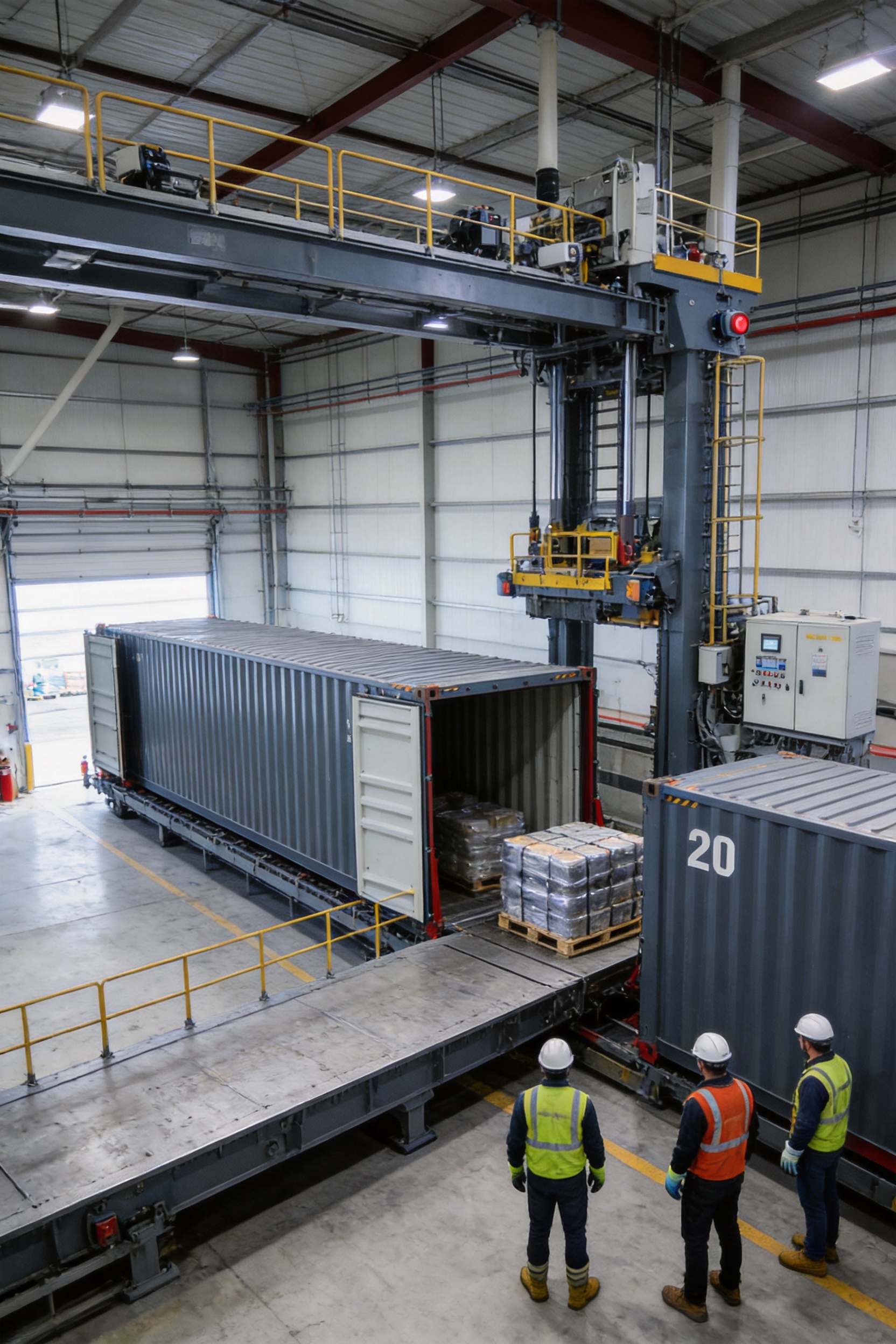
The container loader is an integrated piece of equipment designed to handle both container loading and unloading operations. It is suitable for standard 20-foot and 40-foot containers and can be configured to meet the requirements of different cargo types, production capacities, and site layouts.
The equipment provides one-click rapid entry and exit of goods through a coordinated mechanical and control system. Instead of depending on multiple disconnected handling steps, the operator can initiate a programmed sequence that moves products into or out of the container in a controlled manner.
Automatic door-opening and door-closing functions can be incorporated into the system. This reduces the need for workers to manually open or close container doors, especially when the container is positioned at a loading bay or within a production environment. The door mechanism can be coordinated with the loading sequence so that the system does not begin operation until the container is correctly positioned and the required safety conditions are confirmed.
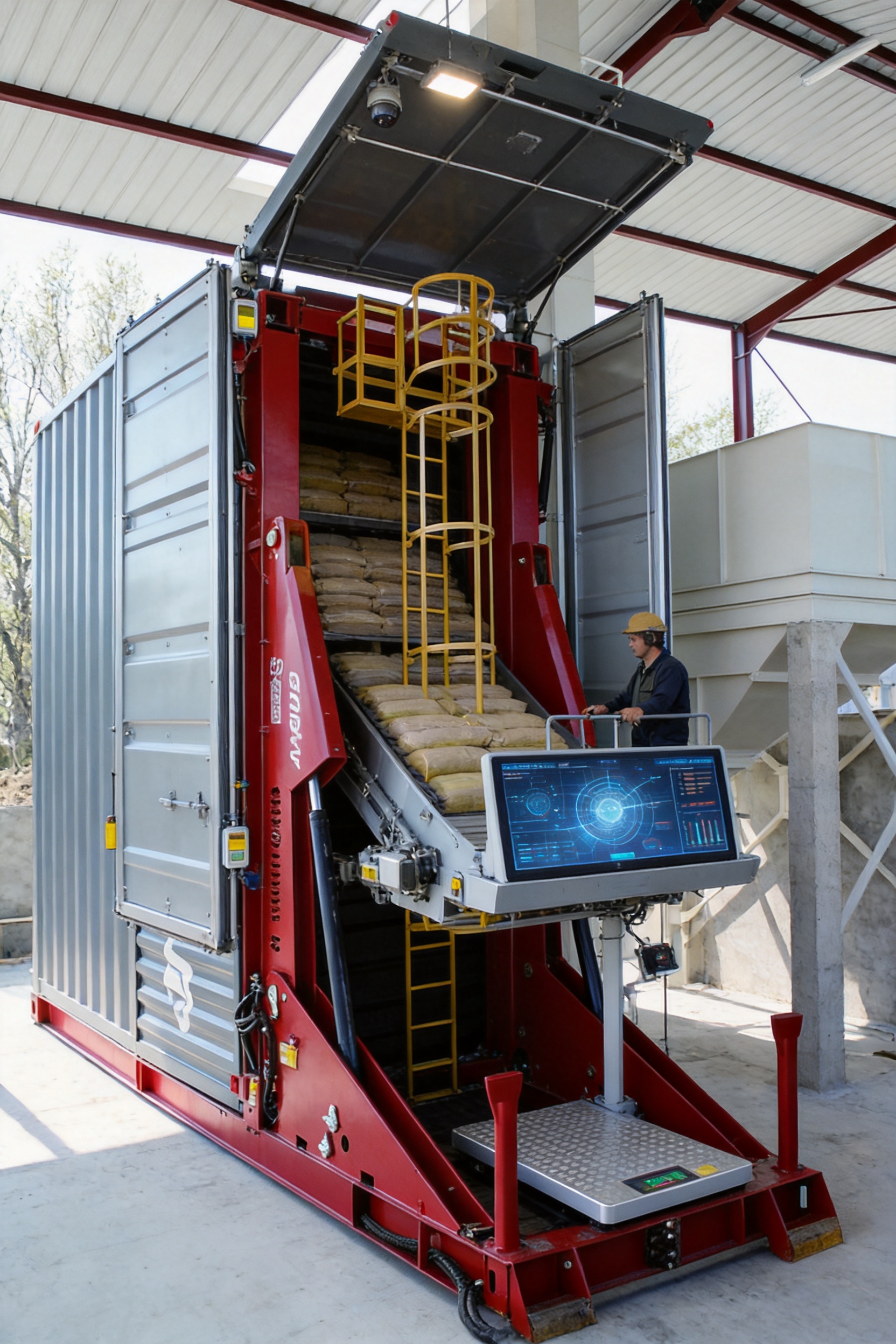
A precision weighing function is also available as a configurable option. During loading or unloading, the equipment can monitor cargo weight in real time. This supports the prevention of overloading and helps operators maintain better control over the planned shipment quantity. Where required, weighing data can be transmitted to a management system for production records, inventory control, transport documentation, or remote supervision.
The system uses an adjustment mechanism to accommodate both 20-foot and 40-foot standard containers. This flexibility allows one equipment platform to serve multiple container lengths rather than requiring separate loading equipment for each size.
Movement is controlled by a precision drive system. The drive arrangement is designed to provide smooth acceleration, deceleration, positioning, and transfer of goods. Controlled movement reduces sudden impacts and helps prevent damage caused by cargo collision, excessive vibration, or unstable handling.
2.1 Main technical parameters
| Model | Overall Size L × W | Maximum Lifting Weight | Maximum Lifting Angle | Applicable Container Length |
|---|---|---|---|---|
| TJXH 20 | 6 × 3 m | 50 tons | 45° / 60° | 20-foot container |
| TJXH 40 | 12 × 3 m | 100 tons | 45° / 60° | 40-foot container |
The technical parameters provide a basic reference for equipment selection. The final configuration should be determined according to the container type, cargo characteristics, loading method, site foundation, operating cycle, required automation level, and applicable safety standards.
3. Core Product Features
3.1 Integrated loading and unloading
The most important feature of the system is its ability to perform both loading and unloading with one integrated machine. This design reduces the need for separate equipment and simplifies plant layout. A single system can support outbound shipments as well as the receipt of imported materials, returned goods, packaging materials, or production inputs.
Using one machine for both directions also improves equipment utilization. When a dedicated loading machine is used only during dispatch periods, its operating hours may be limited. A combined loading and unloading system can be scheduled more flexibly throughout the day, increasing the value of the investment.
Integrated design also helps reduce transfer points. Every additional transfer between conveyors, vehicles, forklifts, and workers can create a possibility of product damage or delay. By shortening the handling route, the equipment can support a more stable and predictable process.
3.2 Automatic container door mechanism
The container door mechanism can be configured to automatically open and close the doors. This is particularly valuable in high-volume facilities where workers would otherwise repeat the same door-handling task for many containers each day.
Automatic door operation improves convenience, but its most important benefit is coordination. Door status can be incorporated into the control logic. The loading cycle can be prevented from starting if the doors are not fully open, incorrectly positioned, or affected by an abnormal condition. After loading, the system can complete the required sequence before the doors are closed.
Reducing manual door handling also lowers labor intensity and limits exposure to pinch points, heavy door movement, awkward postures, and vehicle traffic around the container. The exact door mechanism and safety arrangement can be selected according to the container design and customer requirements.
3.3 Configurable precision weighing
Weight control is essential in container logistics. A container may be limited by its legal gross weight, the capacity of the transport vehicle, the distribution requirements of the route, or the loading plan for a specific customer. An integrated weighing function gives operators immediate visibility into the cargo weight during the process.
Real-time weighing helps prevent overloading before the container leaves the facility. It can also improve inventory accuracy by comparing the actual loaded amount with the production order or shipping plan. When the weighing system is connected to a management platform, data can be uploaded for traceability, reporting, and operational analysis.
Precision weighing is especially useful for grain, feed, powders, minerals, chemicals, food ingredients, bagged materials, and other products that must be loaded according to a target quantity. The weighing configuration may vary depending on whether the system weighs individual packages, batches, accumulated cargo, or the container and its contents.
3.4 Flexible adjustment for different containers
A logistics operation may use multiple container sizes depending on the destination, cargo volume, freight rate, or customer requirements. The flexible adjustment mechanism allows the equipment to adapt to both 20-foot and 40-foot standard containers.
This adaptability reduces the need for manual modification between loading cycles. It also helps companies manage changes in shipping plans without purchasing separate machines for every container length. The adjustment system can be coordinated with positioning sensors and control logic to improve repeatability during container alignment.
For facilities that use a combination of container sizes, the ability to switch between formats is a major practical advantage. It improves scheduling flexibility and allows the same loading bay to support a broader range of shipping tasks.
3.5 Precision drive control
Smooth movement is critical when handling products inside a confined container. Sudden starts, stops, or directional changes can cause goods to shift, fall, collide, or become difficult to arrange. The precision drive control system is designed to manage movement more accurately than basic mechanical handling methods.
Controlled drive performance supports gradual acceleration and deceleration, stable positioning, and repeatable movement patterns. This is beneficial for fragile packaged goods, stacked products, bags, cartons, and products that may be damaged by impact.
Precision drive control also contributes to operator confidence. When the equipment behaves consistently, operators can learn the system more quickly and identify abnormal conditions more easily. Predictable motion is therefore relevant to productivity, product protection, and maintenance.
4. Performance Advantages Compared with Competing Methods
Automated container loaders compete with several conventional alternatives, including manual labor, forklifts, extended conveyors, semi-automatic loaders, and multiple separate handling machines. Each alternative has a place in certain applications, but an integrated system offers a broader combination of advantages.
4.1 Faster container turnaround
Manual loading with forklifts may require approximately 18 to 25 minutes per container, depending on product type and the number of workers involved. Manual loading supported by a conveyor extension may reduce the time to approximately 15 to 18 minutes, but workers may still need to enter the container to arrange cargo.
Semi-automatic loading systems can reduce the cycle time further, often to approximately 6 to 10 minutes. Fully automated loading systems may achieve typical loading cycles of approximately 3 to 6 minutes when the product, site layout, and operating conditions are suitable.
These figures are general operating ranges rather than guaranteed results. Actual performance depends on product flow, container preparation, loading pattern, equipment configuration, operator procedures, and the required weighing or door sequence. Nevertheless, automation provides a strong foundation for reducing container turnaround time.
4.2 Lower labor requirements
Manual loading often requires four to six workers per shift, particularly where products must be carried, stacked, or repositioned. An automated container loader may reduce the requirement to one or two operators for system control, supervision, inspection, and routine adjustment.
This does not mean that human workers are eliminated from the process. Instead, their roles shift from repetitive physical handling to monitoring, coordination, quality control, and exception management. This can make better use of skilled personnel while reducing exposure to heavy lifting and confined-space work.
4.3 Improved container utilization
Unplanned voids inside a container represent lost transport capacity. Products that are loaded without a consistent pattern may leave unused areas, create unstable stacks, or make it difficult to close the doors safely.
Automated equipment can follow programmed loading patterns and controlled movement sequences. Depending on the product, these may include layer-by-layer placement, longitudinal distribution, transverse adjustment, batch positioning, or controlled discharge. By improving consistency, the system can help achieve better use of available container volume.
Typical industry comparisons indicate that automated loading may improve container fill rates by approximately 5 to 8 percent compared with less controlled manual methods. The actual benefit depends on product shape, packaging strength, pallet configuration, and the acceptable loading pattern.
4.4 Reduced cargo damage
Cargo damage may occur when products are dropped, struck, dragged, crushed, or positioned against container walls with excessive force. Damage may also result from uneven stacking or movement during transport caused by poor distribution.
The controlled drive system helps reduce collision risks during loading and unloading. A more consistent loading pattern can also support better stability. When the system is configured for a particular product, the movement speed, discharge position, and sequence can be adjusted to suit the cargo.
Reduced damage can produce benefits beyond the direct value of the product. Companies may also experience fewer customer complaints, lower claims costs, less repacking, improved delivery quality, and stronger supply chain reliability.
4.5 Better workplace safety
Automated loading reduces the need for workers to enter containers or operate forklifts in confined areas. It can also reduce interaction between pedestrians and mobile vehicles at the loading bay.
Safety benefits are strongest when automation is supported by proper guarding, emergency stops, interlocking devices, warning signals, access controls, and operating procedures. The equipment should be integrated into a complete safety plan that includes site traffic management, inspection routines, worker training, and maintenance controls.
4.6 More consistent operation
Manual processes are influenced by worker fatigue, experience, staffing levels, and changing site conditions. Automated systems repeat programmed sequences with greater consistency. This supports more reliable scheduling and makes performance easier to measure.
Consistency is especially important for companies with multiple shifts or multiple facilities. A standardized loading sequence can reduce differences between operators and provide a repeatable basis for training and quality control.
4.7 Comparative performance table
| Performance Metric | Manual Loading | Forklift and Conveyor Support | Automated Container Loader | Typical Benefit of Automation |
|---|---|---|---|---|
| Time per container | 18–25 minutes | 15–18 minutes | 3–6 minutes | Approximately 70–80% faster than manual loading |
| Workers required per shift | 4–6 people | 3–5 people | 1–2 operators | Approximately 60–75% labor reduction |
| Container fill rate | 82–88% | 86–91% | 92–96% | Approximately 5–8% better utilization |
| Product damage rate | 2.5–4.0% | 1.5–3.0% | 0.5–1.2% | Approximately 60–80% reduction |
| Weight monitoring | Usually separate | May be separate | Can be integrated | Real-time control and improved traceability |
| Container compatibility | Highly dependent on workers | Moderate flexibility | Designed for 20-foot and 40-foot containers | Broader operating range |
The table illustrates why integrated automation can outperform individual handling tools. A conveyor may improve product movement but still require manual arrangement. A forklift may provide flexibility but can increase traffic, labor, and collision risks. An integrated loader combines movement, positioning, weighing, and control in one coordinated solution.
5. Advanced Manufacturing and Engineering Strengths
The performance of an automated container loader depends not only on its visible structure but also on the quality of its engineering, fabrication, control system, assembly, testing, and commissioning. Jiangsu Zhengding Intelligent Equipment Co., Ltd. focuses on the development and manufacture of intelligent logistics equipment and provides complete loading and unloading solutions for different industries.
5.1 Product-oriented engineering design
Container loading systems must operate under demanding conditions. They may handle high loads, repeated cycles, varying cargo weights, different container lengths, dust, vibration, temperature changes, and uneven operating habits. Engineering must therefore consider structural strength, fatigue resistance, alignment accuracy, drive performance, safety access, and maintainability.
The equipment platform is designed around the actual logistics task rather than around a single isolated machine function. Loading, unloading, container positioning, weighing, door operation, operator control, and data management can be evaluated as one process. This systems-based approach helps reduce compatibility problems during installation.
5.2 Structural manufacturing capability
The supporting structure must withstand repeated lifting and handling forces. For the TJXH 20 model, the stated maximum lifting weight is 50 tons. For the TJXH 40 model, the stated maximum lifting weight is 100 tons. These capacities require careful structural design and quality control during material preparation, welding, machining, assembly, and inspection.
Manufacturing quality is affected by many details, including plate and profile selection, cutting accuracy, welding sequence, dimensional control, surface preparation, connection quality, and final alignment. A robust manufacturing process helps maintain the accuracy required for stable container positioning and reliable equipment movement.
Structural components should be produced with consideration for load distribution and service conditions. Areas subject to repeated stress require particular attention during design review and inspection. Proper fabrication also reduces the possibility of deformation that could affect adjustment mechanisms or container alignment over time.
5.3 Intelligent control integration
The control system is the operating center of the equipment. It coordinates drive motors, sensors, door mechanisms, weighing devices, positioning functions, safety interlocks, alarms, and operator commands.
A well-designed control system allows the machine to execute defined sequences while maintaining suitable flexibility for different products and containers. Operators can select or confirm the required operating mode, verify container status, start the cycle, and monitor the process through the control interface.
Control integration also supports fault diagnosis. If a sensor detects an abnormal position, an overload, an open access gate, or an unexpected movement condition, the system can stop or restrict operation and alert the operator. Such functions improve safety and reduce the possibility that a small abnormality will develop into major equipment damage.
5.4 Precision weighing and data connectivity
The integration of weighing technology demonstrates the company’s focus on complete logistics automation rather than simple mechanical transport. Real-time weight information can be used by the control system to limit loading, confirm the target quantity, or generate a record for management review.
When connected to a factory or warehouse management system, weighing data can support inventory accounting, batch traceability, dispatch verification, and performance analysis. Data connectivity is particularly useful in industries where shipments must be documented accurately, such as food, grain, chemicals, minerals, feed, and packaged consumer goods.
The weighing function should be calibrated and maintained according to the application. Environmental factors, load distribution, vibration, and installation conditions can affect measurement performance. Proper commissioning and periodic verification are therefore important parts of the complete solution.
5.5 Modular adaptation and customization
Every facility has different conditions. Some sites have limited space, while others require connection to existing conveyors, silos, production lines, warehouses, or truck loading stations. Product characteristics can also vary substantially, from cartons and bags to powders, granules, bulk materials, and palletized goods.
A modular and configurable design allows the equipment to be adapted to these differences. The company can evaluate container dimensions, cargo flow, required capacity, operating angle, access conditions, and management-system requirements before determining the final configuration.
Customization can include equipment dimensions, container adjustment functions, automatic door systems, weighing devices, conveyor interfaces, control logic, remote monitoring, dust-control arrangements, and operator access features. This approach is more effective than attempting to use an identical standard machine in every environment.
5.6 Manufacturing experience across industries
Jiangsu Zhengding’s equipment is intended for a broad range of industries, including steel, chemical, cement, coal, grain, oil, food, feed, ports, papermaking, and new energy. Each sector presents different handling requirements.
Food and grain applications may emphasize cleanliness, weighing accuracy, gentle movement, and protection against contamination. Chemical applications may require careful consideration of dust, corrosion, sealing, and operating procedures. Cement, minerals, coal, and steel-related applications may involve heavy loads, abrasive materials, and demanding working environments. Port operations may prioritize high throughput and integration with wider material-handling networks.
Experience across these sectors helps an equipment manufacturer understand how to balance capacity, safety, reliability, maintenance, and automation. It also supports the development of practical solutions for facilities that cannot be redesigned completely from the beginning.
6. Quality Control from Fabrication to Commissioning
Reliable equipment requires quality control throughout the manufacturing process. Inspection should not be limited to the final appearance of the machine. It should cover materials, dimensions, welding, mechanical components, electrical installation, control logic, safety functions, and operating performance.
6.1 Design verification
Before production, the equipment design should be reviewed against the required container size, lifting capacity, operating angle, loading sequence, and site conditions. This helps identify potential interference between moving parts, access areas, container doors, conveyors, and surrounding structures.
Design verification also considers maintenance access. Components that require inspection or replacement should be accessible without unnecessary dismantling. Good maintainability reduces downtime and helps operators complete preventive maintenance more consistently.
6.2 Component inspection
Drive components, bearings, sensors, hydraulic or electrical elements, weighing devices, fasteners, and safety components should be checked according to their function. Correct component selection is important because the loading environment may include dust, moisture, vibration, and repetitive movement.
Inspection records can help establish traceability and support later service work. When replacement is required, accurate equipment documentation allows maintenance personnel to identify the correct part more efficiently.
6.3 Assembly and alignment
Assembly accuracy affects the performance of adjustment mechanisms and moving equipment. Incorrect alignment may increase wear, noise, vibration, or drive load. It may also make it more difficult to position a container correctly.
During assembly, mechanical clearances, connection torque, cable routing, sensor locations, and protective devices should be checked. Final alignment should be verified under conditions that represent actual operation as closely as possible.
6.4 Factory testing
Factory testing may include no-load movement, loaded movement, emergency-stop verification, limit-switch testing, sensor response, door mechanism operation, weighing checks, control sequence verification, and abnormal-condition simulation.
Testing before shipment reduces the risk of discovering basic problems only after installation. It also gives the commissioning team a reference for expected performance and operating behavior.
6.5 Site commissioning and training
Installation and commissioning are essential because the equipment must operate in combination with the customer’s container handling area, conveyor system, electrical supply, control network, and safety procedures.
Jiangsu Zhengding provides site assessment, system design, installation supervision, and operator training as part of its engineering support. Training can cover normal operation, container positioning, weighing procedures, emergency stops, daily inspections, cleaning, lubrication, troubleshooting, and communication with maintenance personnel.
Operators typically need only a short period to learn basic operation when the control interface is designed clearly. More advanced training may be required for programming, parameter adjustment, fault diagnosis, and system integration.
7. Applications in Different Industries
7.1 Food and beverage
Food and beverage manufacturers often ship bagged ingredients, cartons, packaged products, cans, bottles, and palletized goods. Loading systems must support product protection, accurate quantities, cleanliness, and reliable shipment scheduling.
An automated loader can reduce unnecessary manual contact with products while providing more repeatable loading patterns. Integrated weighing is useful for ingredients and bulk food materials, while controlled movement helps protect packaged consumer goods.
7.2 Grain, feed, and agricultural products
Grain and feed facilities may handle large quantities of bulk or bagged materials. Their operations often require high throughput and accurate measurement. A container loader connected to silos, hoppers, conveyors, or weighing equipment can create a more continuous loading process.
In these applications, dust management, equipment cleaning, access for inspection, and protection of weighing components should be considered during system design.
7.3 Chemical materials
Chemical plants may load powders, granules, bags, drums, or other packaged products. Safe handling procedures are essential, particularly where materials may create dust or require controlled exposure.
Automation can reduce the number of workers in the immediate loading area. The final equipment configuration should account for product properties, environmental conditions, corrosion risks, grounding requirements, and the customer’s applicable safety regulations.
7.4 Cement, minerals, coal, and steel
Heavy industries often require strong equipment capable of handling high loads and repetitive cycles. The stated lifting capacities of up to 50 tons for the TJXH 20 model and 100 tons for the TJXH 40 model provide a basis for demanding applications, subject to final engineering confirmation.
For abrasive or dusty materials, protection of moving components and regular cleaning are important. The structure, drive system, and weighing function should be selected according to the material characteristics and expected operating frequency.
7.5 Ports and distribution centers
Ports and distribution centers depend on rapid container turnover. A delay at one loading station can affect truck scheduling, yard capacity, labor planning, and vessel or warehouse coordination.
Automated container loaders can help standardize the loading process and provide a clearer relationship between loading time and dispatch planning. Remote monitoring and management-system connectivity can further improve visibility across multiple loading bays.
7.6 New energy and specialized manufacturing
New energy facilities may handle components, packaged materials, powders, chemicals, or equipment modules that require careful movement and documented handling. Automated loading can support controlled transfer while reducing the risk of collision or inconsistent positioning.
Specialized manufacturing sites may also benefit from customized interfaces that connect the loader to production lines, storage systems, testing areas, and dispatch operations.
8. Complete Project Solutions Rather Than Standalone Equipment
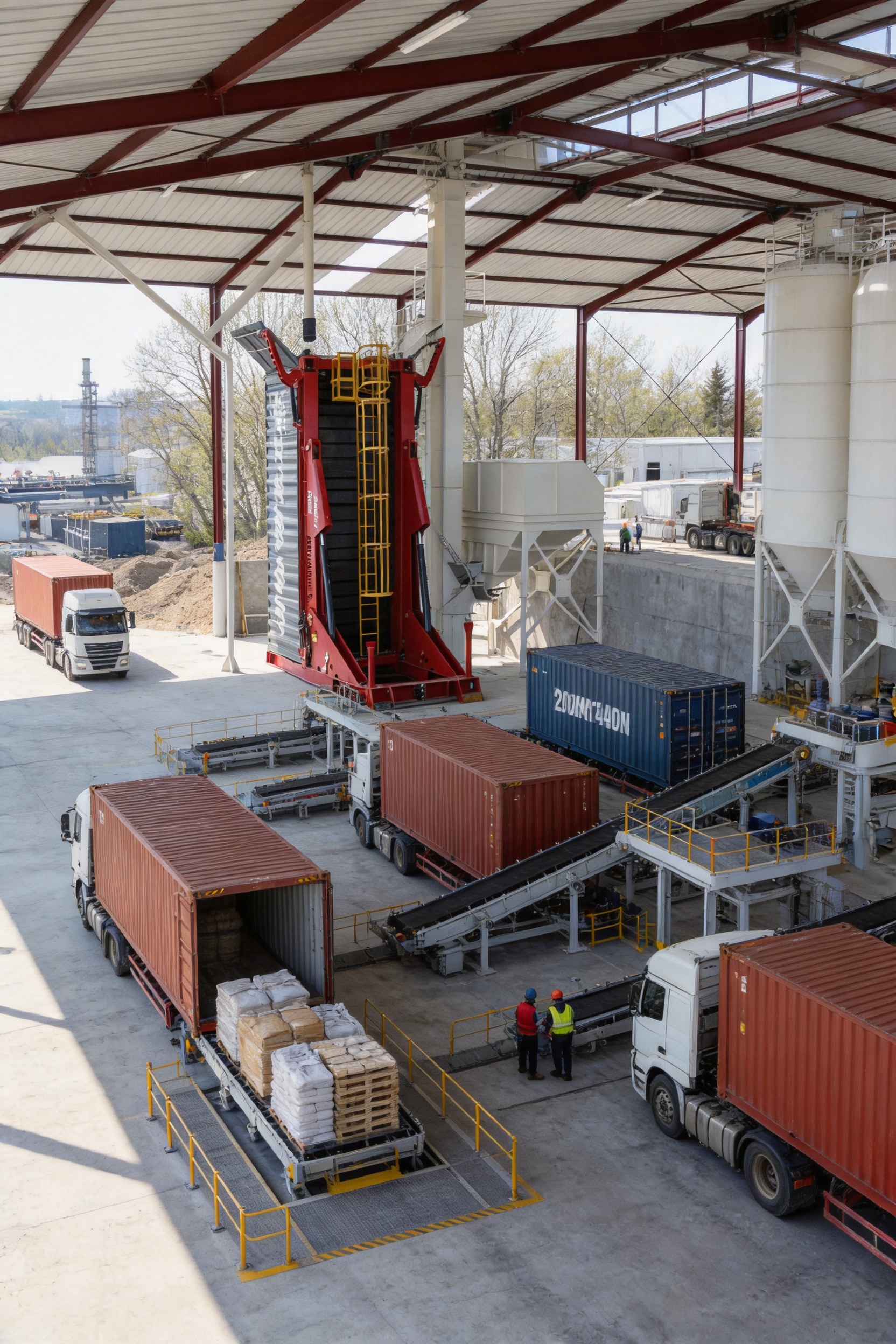
A major advantage of working with an experienced engineering manufacturer is the ability to obtain a complete project solution. A container loader must fit the customer’s physical space, production rhythm, container flow, electrical system, warehouse process, and safety management structure.
The project process generally begins with a site assessment. Engineers review available space, floor conditions, container access, traffic routes, loading height, upstream and downstream equipment, operator positions, and maintenance requirements.
The next stage is system design. This may include determining the correct model, loading direction, container adjustment range, lifting requirements, drive configuration, weighing method, door mechanism, conveyor interface, and control architecture.
After design confirmation, manufacturing and assembly are carried out according to the approved technical requirements. Factory testing follows before shipment. At the customer’s site, installation supervision, commissioning, operator training, and performance verification complete the implementation.
This process reduces the risk of purchasing equipment that appears suitable in isolation but cannot integrate smoothly into the existing facility. It also gives the customer a clear technical contact for future service and modifications.
9. Maintenance, Reliability, and Operating Management
Automation improves consistency, but regular maintenance remains essential. The equipment may operate under heavy loads and repeated cycles, so preventive maintenance should be planned from the beginning of the project.
9.1 Daily inspection
Operators should inspect the loading area, container position, safety barriers, emergency-stop devices, visible cables, sensors, drive components, and signs of abnormal noise or vibration. Any material accumulation around moving parts should be removed according to the site’s safety procedures.
9.2 Periodic mechanical maintenance
Mechanical maintenance may include checking fasteners, lubrication points, bearings, chains, rollers, hinges, guides, lifting components, and structural connections. Inspection intervals should reflect operating frequency, load conditions, and the manufacturer’s recommendations.
9.3 Weighing system verification
Where the equipment includes weighing functionality, calibration and verification should be performed at suitable intervals. Changes in the foundation, mechanical connections, environmental conditions, or load distribution may influence weighing performance.
9.4 Control system maintenance
Control cabinets, sensors, cables, switches, communication devices, and software parameters should be inspected by qualified personnel. Backup copies of relevant parameters and system settings can help reduce recovery time after a fault or component replacement.
9.5 Operator training
Training should cover more than pressing the start button. Operators should understand container positioning, loading limits, abnormal conditions, emergency procedures, daily checks, and communication with maintenance staff. A trained operator is more likely to identify early signs of wear and prevent unsafe operation.
10. Selecting the Right Container Loader
Customers should evaluate several factors before selecting equipment. The first is cargo type. Bagged products, cartons, bulk powders, granules, palletized units, and irregular items may require different interfaces and loading patterns.
The second factor is container size. Facilities using both 20-foot and 40-foot containers should confirm that the adjustment mechanism can support the required range without excessive manual modification.
The third factor is throughput. The target number of containers per hour or shift determines the required drive speed, loading interface, weighing capacity, and buffer arrangement.
The fourth factor is cargo weight. The equipment model must be selected according to maximum lifting requirements, container weight, product density, and the actual load path.
The fifth factor is automation level. Some customers may require automatic doors and integrated weighing, while others may begin with basic loading automation and add functions later. A scalable design can support a more practical investment plan.
The sixth factor is site integration. The loader should be checked against floor strength, available height, container approach routes, electrical supply, conveyor connections, drainage, lighting, and maintenance access.
The seventh factor is service capability. A technically advanced machine is most valuable when the supplier can support installation, commissioning, training, spare parts, troubleshooting, and future modification.
11. Frequently Asked Questions
Q1: What types of products can be handled by an automated container loader?
Automated container loaders can be configured for bagged goods, cartons, sacks, palletized units, bulk granules, powders, food ingredients, agricultural materials, minerals, and selected irregularly shaped products. The suitable configuration depends on product weight, dimensions, flow characteristics, packaging strength, dust generation, fragility, and required loading pattern.
Q2: Can one machine handle both loading and unloading?
Yes. The container loader is designed as an integrated loading and unloading system. This allows the same equipment to support outbound shipments and inbound material handling, improving equipment utilization and reducing the need for separate machines.
Q3: Is the system compatible with both 20-foot and 40-foot containers?
Yes. The equipment includes a flexible adjustment mechanism intended for 20-foot and 40-foot standard containers. The final configuration should be confirmed according to the customer’s container specifications and site arrangement.
Q4: Can the container doors be opened and closed automatically?
Yes. An automatic door-opening and closing mechanism can be configured. This reduces manual door handling and can be connected to the operating sequence and safety interlocks.
Q5: How does integrated weighing help the loading process?
Integrated weighing provides real-time information about the cargo weight during loading and unloading. It helps prevent overloading, supports quantity verification, improves inventory records, and can transmit data to a management system when communication functions are included.
Q6: Does automation eliminate the need for operators?
No. Automation reduces repetitive manual handling but still requires trained operators to supervise the process, confirm container conditions, respond to alarms, perform routine inspections, and coordinate maintenance. In many applications, the labor requirement may be reduced to one or two operators per shift.
Q7: How quickly can a container be loaded?
Typical automated loading cycles may range from approximately 3 to 6 minutes per container. Actual performance depends on product characteristics, loading quantity, container preparation, equipment configuration, and site conditions. A detailed technical assessment is required for a project-specific cycle-time estimate.
Q8: How can automated loading improve container fill rates?
The system can use repeatable loading sequences and controlled positioning to distribute products more evenly. This reduces voids and uneven stacking. In suitable applications, automated loading may improve fill rates by approximately 5 to 8 percent compared with less controlled manual loading.
Q9: What training is required?
Basic operator training commonly requires several days and covers normal operation, container positioning, safety procedures, weighing functions, daily inspection, and emergency response. Additional training may be provided for programming, advanced troubleshooting, system integration, and maintenance.
Q10: Can the equipment be connected to an existing warehouse or production system?
Yes. The container loader can be designed to integrate with existing conveyors, warehouse systems, weighing systems, production lines, and management platforms. The available interface and communication method should be confirmed during the project design stage.
Q11: What industries use this type of equipment?
Applications include steel, chemicals, cement, coal, grain, feed, oil, food, consumer goods, ports, papermaking, new energy, and general distribution. The equipment configuration should be adapted to the material, operating environment, and applicable safety requirements of each industry.
Q12: What support is available after purchase?
Project support may include site assessment, system design, equipment manufacturing, installation supervision, commissioning, operator training, technical documentation, and service assistance. The exact scope should be confirmed in the commercial and technical proposal.
12. Why Choose an Experienced Intelligent Equipment Manufacturer
The value of a container loader is determined by more than its rated capacity. Customers also need confidence in structural quality, control reliability, weighing accuracy, compatibility, safety, and long-term support. An experienced manufacturer can evaluate the complete process and identify practical solutions before production begins.
Jiangsu Zhengding Intelligent Equipment Co., Ltd. is a national high-tech enterprise engaged in the research, development, manufacturing, and sales of intelligent automated loading and unloading equipment. Its product range includes rear dumpers, side-turn truck dumpers, vehicle loading equipment, container flippers, and other systems for automobiles, containers, ships, and logistics applications.
The company has supplied equipment for steel, chemical, cement, coal, grain, oil, food, feed, port, papermaking, and new energy applications. Its products have been exported to Japan, Brazil, Egypt, Pakistan, India, the Middle East, and Southeast Asia. International users associated with its equipment applications include Budweiser, Heineken, Buhler Group, Wilmar International, Cargill, DuPont, Louis Dreyfus, Charoen Pokphand Group, and Saint-Gobain Group.
This industry and international application experience supports a practical understanding of different operating environments. It also strengthens the company’s ability to provide customized solutions rather than relying only on a fixed equipment model.
The company’s strengths include integrated engineering, intelligent control, automated weighing, flexible container adaptation, precision movement, manufacturing capability, project commissioning, and after-sales technical support. These strengths make the container loader suitable for companies seeking to improve throughput while maintaining control over safety, product quality, and logistics data.
13. Conclusion
Automated container loaders provide a comprehensive answer to the challenges of modern container logistics. By combining loading and unloading functions, automatic door operation, optional precision weighing, flexible adjustment for 20-foot and 40-foot containers, and precision drive control, the system can improve productivity and reduce avoidable handling risks.
Compared with manual loading, the equipment can offer shorter cycle times, lower labor requirements, better container utilization, reduced cargo damage, improved weight control, and more consistent operation. These benefits become increasingly important as shipment volumes rise and companies seek greater supply chain efficiency.
The strength of the solution also depends on manufacturing and engineering capability. Structural quality, control integration, component inspection, assembly accuracy, factory testing, site commissioning, and operator training all contribute to long-term performance. Jiangsu Zhengding Intelligent Equipment Co., Ltd. combines these capabilities with experience in multiple industries and international markets.
For factories, warehouses, ports, grain terminals, food facilities, chemical plants, and distribution centers, an automated container loader can serve as a central part of a more efficient logistics strategy. With the correct configuration and professional implementation, it can help transform container handling from a repetitive manual task into a safer, faster, more measurable, and more reliable automated process.
References
1. Jiangsu Zhengding Intelligent Equipment Co., Ltd., Container Loader Product Specifications and Technical Information.
2. Jiangsu Zhengding Intelligent Equipment Co., Ltd., Intelligent Automobile and Container Loading and Unloading Equipment Applications.
3. International container transport and cargo-weight management practices, industry reference materials.
4. Industrial automation principles for conveyor systems, lifting equipment, weighing systems, and logistics control.
5. Warehouse and distribution-center safety practices for automated material-handling equipment.
6. General comparative operating data for manual, semi-automatic, and fully automated container loading processes.
7. Industrial equipment maintenance and commissioning guidelines for heavy-duty logistics machinery.


