

 English
 русский
 Español
 Français
 Português
 عربى





+86-13588556918
Content
- 1 1. What Is an Unattended Truck Dumper with an Integrated Weighing System?
- 2 2. Why Integrate Weighing and Unloading?
- 3 3. Main Product Features
- 4 4. How the Integrated Weighing System Works
- 5 5. Performance and Productivity Benefits
- 6 6. Engineering Design and Manufacturing Strengths
- 7 7. Model Range and Technical Parameters
- 8 8. Application Areas
- 9 9. Maintenance and Reliability
- 10 10. Environmental and Extreme-Weather Considerations
- 11 11. Safety, Security, and Fraud Prevention
- 12 12. Selecting the Right System for a Project
- 13 13. Jiangsu Zhengding Intelligent Equipment Co., Ltd. as a System Supplier
- 14 14. Return on Investment and Total Cost of Ownership
- 15 15. Frequently Asked Questions
- 15.1 Q1. Can a truck dumper operate without a dedicated on-site operator?
- 15.2 Q2. How does the system calculate the material weight?
- 15.3 Q3. What lifting angles are available?
- 15.4 Q4. Is an automatic wheel-stop device necessary?
- 15.5 Q5. Can the system work in cold climates?
- 15.6 Q6. How often should the weighing system be calibrated?
- 15.7 Q7. Can the equipment connect to an ERP or warehouse management system?
- 15.8 Q8. What happens if the network connection fails?
- 15.9 Q9. Can an existing truck dumper be upgraded?
- 15.10 Q10. What types of materials can be unloaded?
- 15.11 Q11. How does unattended operation prevent weighing fraud?
- 15.12 Q12. What information is needed for a quotation?
- 16 16. Conclusion
- 17 References
- 18 Product: Unattended Truck Dumpers With Integrated Weighing System
Bulk-material handling facilities are under increasing pressure to improve productivity, reduce labor dependence, prevent weighing disputes, and maintain reliable digital records. Traditional truck unloading often requires several manual steps, including vehicle identification, weighing, operator-controlled positioning, hydraulic unloading, ticket preparation, and data entry. Each step can introduce delays, safety risks, measurement errors, and opportunities for unauthorized intervention.
Unattended truck dumpers with integrated weighing systems address these challenges by combining automatic truck unloading and automatic weight measurement in one coordinated installation. The equipment lifts and tilts a loaded truck for rapid discharge while integrated load cells measure the vehicle before and after unloading. The control system then calculates the net material weight and transfers the data to the site management system. Because the process can be completed by the driver through a simple control interface, the facility can operate with little or no dedicated personnel at the dumper station.
This combination of unloading and weighing is especially valuable where several dumpers operate at the same site. Instead of installing separate weighbridges, control cabins, and manual ticketing stations for every unloading lane, a facility can integrate the essential functions into a compact automated unit. The result is a more efficient use of space, faster vehicle circulation, improved measurement integrity, and lower operating costs.
Jiangsu Zhengding Intelligent Equipment Co., Ltd. develops and manufactures automated loading and unloading equipment for automobiles, containers, ships, and industrial logistics applications. Its unattended truck dumpers with integrated weighing systems are designed for grain, feed, coal, cement, chemical products, food materials, steelmaking raw materials, port logistics, waste handling, and other bulk-material operations.
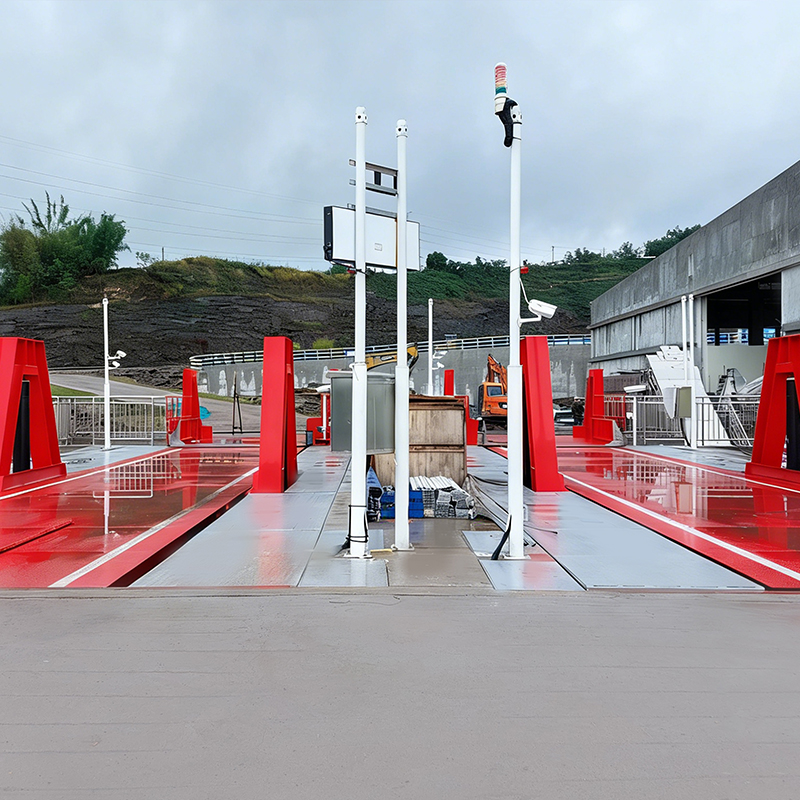
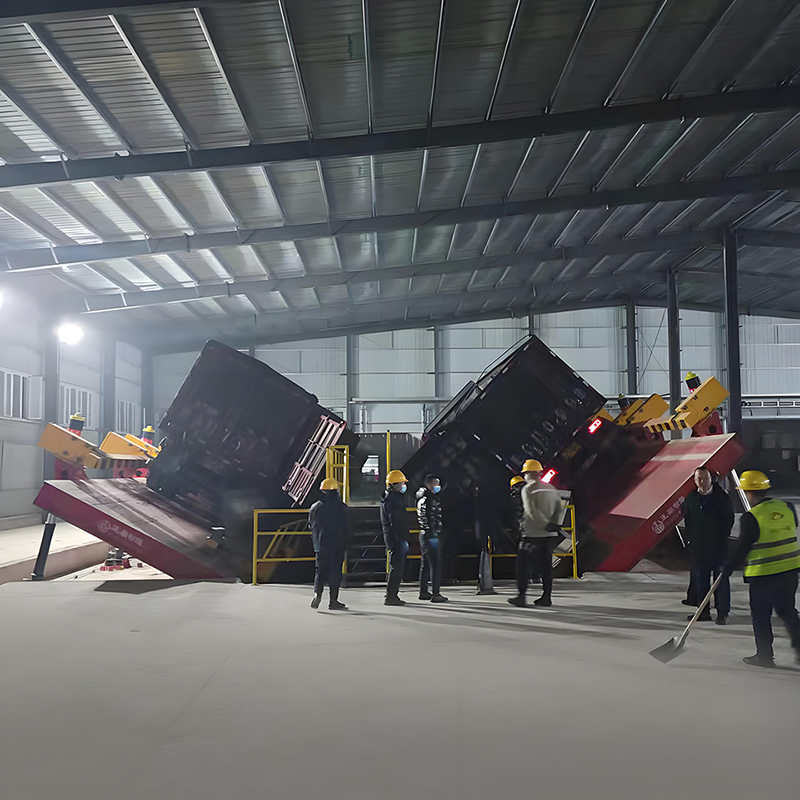
Unattended Truck Dumpers With Integrated Weighing System
1. What Is an Unattended Truck Dumper with an Integrated Weighing System?
An unattended truck dumper with an integrated weighing system is an automated unloading platform that performs two primary functions: it weighs a truck and its load, and it tilts the truck to discharge the material. The weighing system is incorporated into the dumper structure rather than being treated as an entirely separate process.
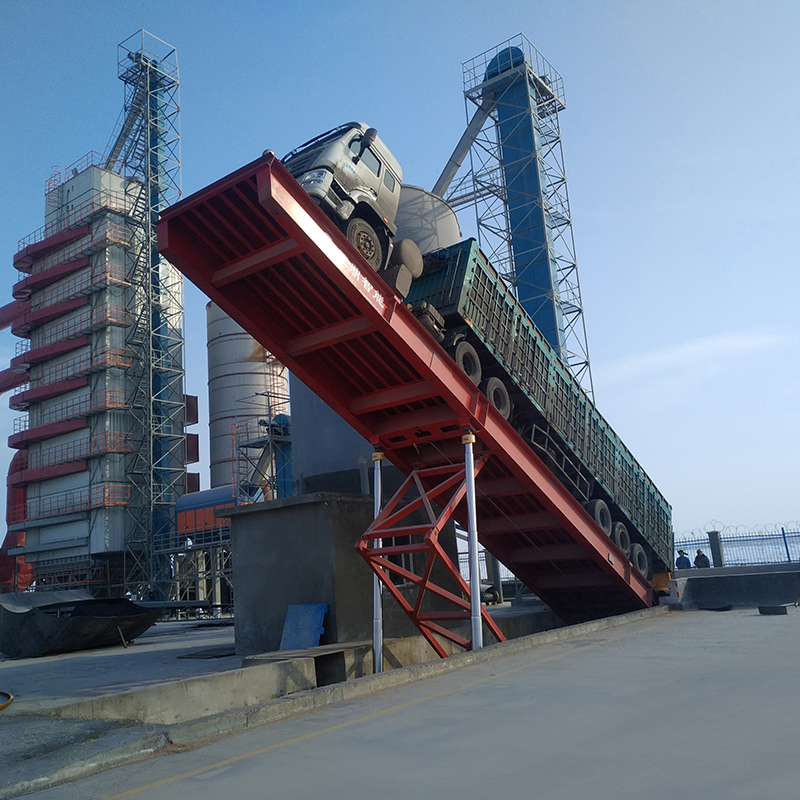
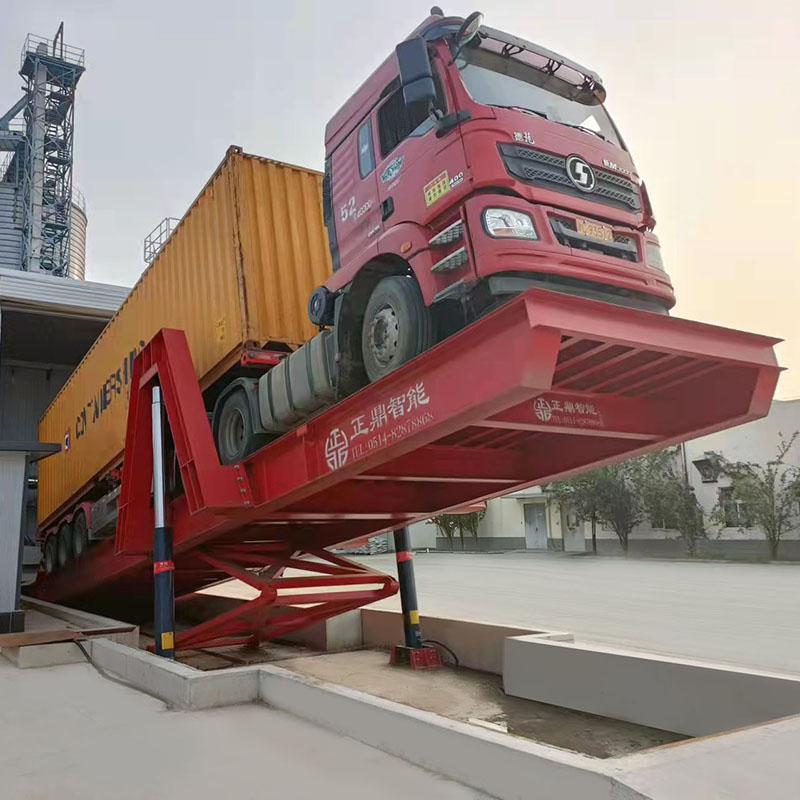
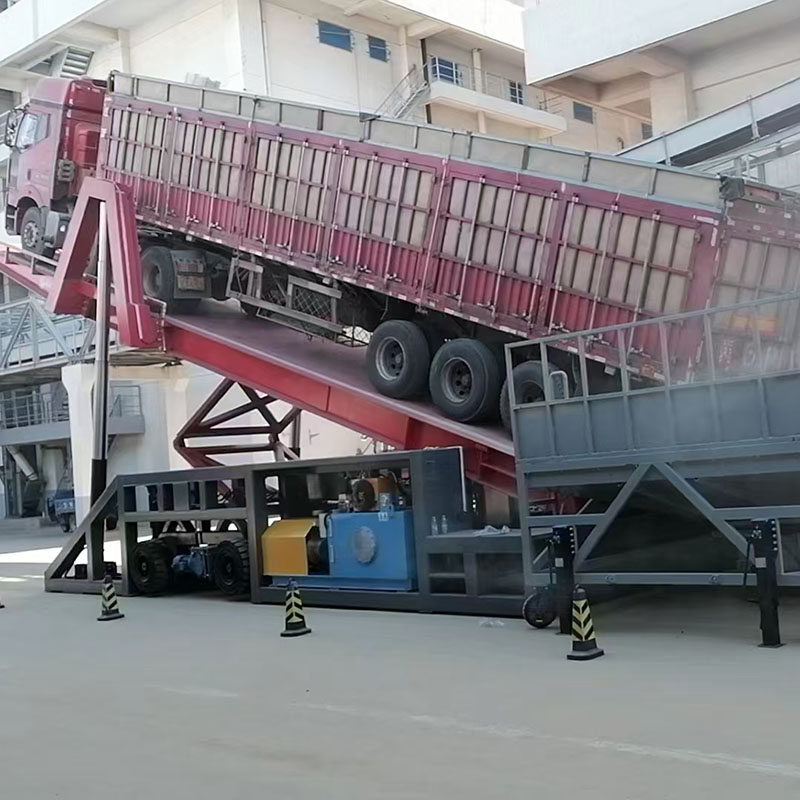
During a normal operating cycle, the loaded truck enters the dumper platform and is identified through a configured access system. The vehicle is weighed to determine its gross weight. Once the system confirms that the vehicle is correctly positioned and the safety conditions are satisfied, hydraulic cylinders lift and rotate the platform. Depending on the model and application, the maximum lifting angle can reach approximately 45 or 55 degrees, allowing the contents of the truck body to flow into a receiving hopper, pit, conveyor, or other downstream handling system.
After unloading, the platform returns to its horizontal position. The empty truck is weighed again, and the control system calculates the net material weight by subtracting the tare weight from the gross weight. The result can be stored locally, printed as a ticket, or transferred to a plant management, enterprise resource planning, or logistics platform.
Unlike a conventional truck dumper that relies on a separate weighbridge and manual records, the integrated arrangement keeps unloading and measurement within one coordinated workflow. This minimizes unnecessary vehicle movement and reduces the possibility that the wrong truck, wrong load, or wrong weight record will be associated with a transaction.
Typical Operating Sequence
The operating sequence can be configured to suit the customer’s site conditions, traffic controls, and material-handling process. A typical sequence includes the following stages:
1. The driver approaches the entrance and is identified by a vehicle card, RFID device, license plate recognition system, barcode, or another approved method.
2. The traffic signal or access barrier confirms that the dumper is available and directs the truck onto the platform.
3. Position sensors, wheel stops, or an optional automatic wheel-locking device confirm that the vehicle is correctly positioned.
4. The loaded vehicle is weighed to obtain the gross weight.
5. The control system checks the safety interlocks, hydraulic conditions, platform position, and discharge area.
6. The hydraulic cylinders raise and tilt the platform to the programmed unloading angle.
7. The bulk material is discharged into the receiving system.
8. The platform returns to its original position and the vehicle exits or is weighed again for tare verification.
9. The system calculates the net weight and automatically stores the transaction.
10. The record is transferred to the site database or enterprise management platform, and a digital or printed ticket can be generated.
This sequence can be completed without an operator standing beside the dumper. Remote supervision remains available for maintenance, alarms, unusual loads, and emergency intervention.
2. Why Integrate Weighing and Unloading?
Separate unloading and weighing operations create additional vehicle movements, increase waiting time, and require more land. A truck may first need to pass over a weighbridge, proceed to a dumper, return for a second weighing, and then visit a ticket office. Every additional movement adds traffic complexity and increases the risk of incorrect data entry.
Integration simplifies the workflow. The vehicle remains within one controlled unloading area while gross weight, unloading, tare weight, and net weight are handled by a single system. This arrangement can be particularly useful for grain terminals, feed mills, cement plants, coal yards, chemical depots, ports, and other facilities where large numbers of trucks arrive continuously.
The integrated structure also helps reduce installation space. A conventional site may require a separate weighbridge, scale house, traffic lane, ticket office, and operator station. An integrated truck dumper can combine many of these functions in one location. The actual layout depends on the vehicle dimensions, unloading pit, material flow, local regulations, and required throughput, but the potential space savings are significant for facilities with limited land.
Measurement integrity is another important advantage. Manual records can be affected by incorrect vehicle numbers, transcription mistakes, misread displays, or deliberate alteration. An automated system associates the vehicle identity, weighing data, unloading cycle, and transaction time in one digital record. Access rights, data backups, audit trails, and remote monitoring can further strengthen control over the weighing process.
Advantages Compared with Conventional Truck Dumping
| Operating Factor | Conventional Arrangement | Unattended Dumper with Integrated Weighing |
|---|---|---|
| Vehicle identification | Often performed manually or through separate systems | Can be linked to RFID, license plate recognition, or digital access control |
| Weighing process | Separate weighbridge and additional vehicle movement | Integrated into the dumper platform and unloading sequence |
| Operator requirement | Personnel commonly required at the scale or dumper | Driver-operated cycle with remote supervision |
| Data entry | Manual tickets and manual transfer are common | Automatic calculation, storage, and transmission of records |
| Space requirement | Separate weighing and unloading areas may be required | Combined functions can simplify the site layout |
| Fraud prevention | More opportunities for manual intervention | Digital records, access control, and traceable weighing data |
| Operation in dusty environments | Operators may need to work close to the truck | Remote or driver-controlled operation reduces exposure |
| Scalability | Additional labor and infrastructure may be needed | Multiple automated units can be managed through one supervision system |
3. Main Product Features
High-Precision Cylinder Synchronization and Stability
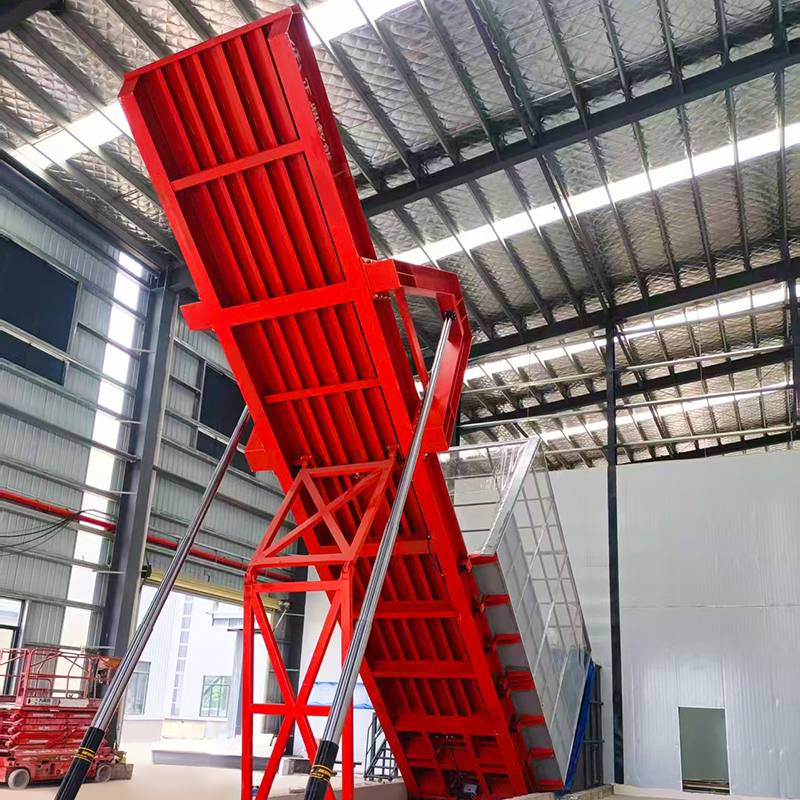
The hydraulic lifting system is one of the most important parts of a truck dumper. If the cylinders do not extend at a consistent rate, the platform may twist, vibrate, or experience uneven loading. Such conditions can increase stress on the frame, hinges, cylinder mounts, and hydraulic components.
The equipment uses a proprietary high-precision cylinder synchronization and stability system to coordinate hydraulic movement. This system is designed to maintain balanced platform lifting and reduce vibration during operation. Smoother movement improves safety and helps protect the cylinders from shock loads and uneven forces. Reduced mechanical impact can also extend component service life and lower long-term maintenance requirements.
Stable lifting is particularly important when handling long vehicles, unevenly distributed loads, or materials that may shift during the initial stage of tilting. The control system can be configured with position monitoring, limit protection, and emergency stop functions to ensure that the lifting cycle remains within the specified operating envelope.
Automatic Wheel-Stop and Wheel-Locking Options
Correct vehicle positioning is essential for both safe unloading and accurate weighing. The system can be equipped with a fully automatic wheel-stop or wheel-locking device. This option helps prevent the truck from moving during platform lifting and reduces the need for an operator to guide the vehicle with a remote control.
Automatic wheel positioning is especially useful in coal yards, grain terminals, cement plants, and other dusty or noisy environments. Drivers can complete the positioning process independently after following the traffic lights and control prompts. The result is a simpler operating procedure, improved safety, and greater unloading consistency.
The wheel-stop arrangement must be selected according to the truck type, axle configuration, platform dimensions, local safety requirements, and expected operating frequency. Properly designed wheel restraints should work together with vehicle identification, platform sensors, emergency stops, and hydraulic interlocks.
International-Quality Hydraulic and Electrical Components
Reliable hydraulic components are essential because the dumper operates under high loads and repeated lifting cycles. The cylinders and pumps used in these systems are primarily sourced from established international brands or selected according to strict technical requirements. Component selection focuses on pressure rating, sealing performance, service life, availability of replacement parts, and compatibility with the control system.
The electrical and automation package can include programmable logic controllers, position sensors, pressure monitoring, safety relays, traffic lights, vehicle identification equipment, communication modules, and remote diagnostic functions. These components are arranged to support stable operation, alarm management, and controlled access.
Using suitable premium components does not eliminate the need for maintenance, but it can improve reliability and make service planning more predictable. Standardized component selection also assists customers that operate several units across different sites because maintenance teams can use familiar spare parts and procedures.
Fully Unattended Operation
The unattended design allows the truck driver to complete the main unloading cycle through a one-button or guided control procedure. The system can automatically verify vehicle identity, confirm platform position, activate the wheel-stop device, complete weighing, initiate hydraulic lifting, return the platform, and generate the transaction record.
Unattended operation is not simply the removal of an operator. It is a coordinated combination of mechanical automation, safety logic, access control, data management, and remote supervision. The equipment must be able to identify abnormal conditions, stop safely, issue clear instructions, and record the status of every transaction.
For facilities with multiple truck dumpers, unattended operation can produce substantial organizational benefits. One remote supervisor may be able to monitor several stations, while maintenance personnel are called only when a genuine technical issue occurs. This helps reduce labor costs without sacrificing the ability to supervise equipment performance.
Digital Data and Remote Management
Integrated weighing records can include the vehicle identity, gross weight, tare weight, net weight, time, unloading location, material category, supplier, driver information, and alarm status. These records can be transmitted to a central server or connected to a customer’s enterprise management system through a suitable interface.
Cloud-based reporting dashboards can help managers review total tonnage, average load, unloading frequency, peak periods, vehicle turnaround time, and discrepancies. Automated reports can be generated daily, weekly, or monthly. Data may also be exported in common formats for financial, inventory, purchasing, or production management.
For companies operating multiple facilities, centralized data access can make it easier to compare performance between sites. Supervisors can identify bottlenecks, review equipment utilization, and plan maintenance according to actual operating cycles rather than relying only on fixed calendar intervals.
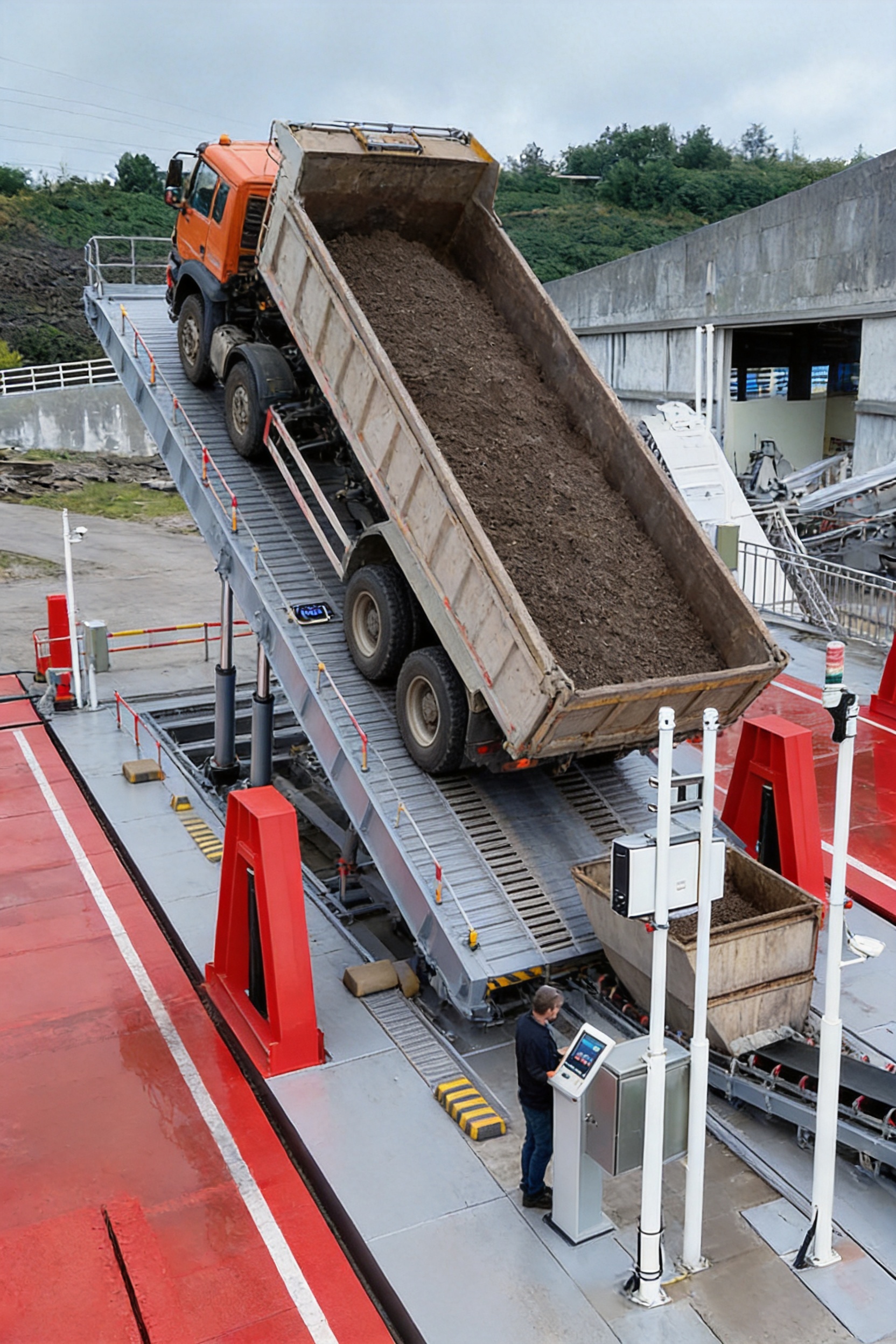
4. How the Integrated Weighing System Works
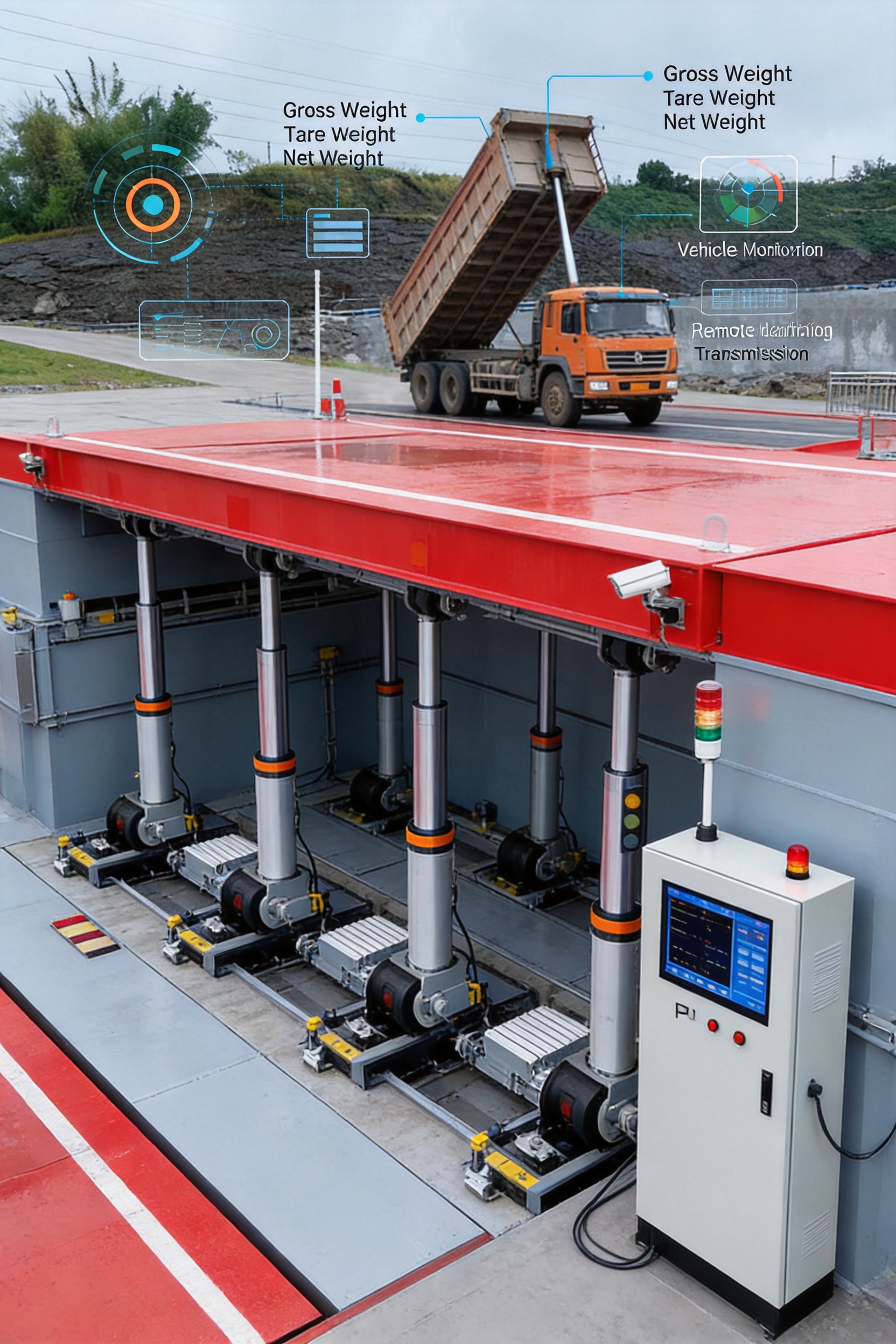
The weighing system generally uses multiple load cells installed beneath or around the dumper platform. These load cells detect the force transferred from the vehicle and load to the supporting structure. The signal is sent to a weighing controller, which filters the measurement, compensates for system conditions, and sends the result to the main PLC or management platform.
Depending on the design, the system may use four to six sealed load cells. Stainless steel construction, hermetic sealing, surge protection, and suitable environmental protection help the sensors operate in dusty, wet, and outdoor conditions. Load cells must be installed and aligned correctly because uneven support, debris, mechanical binding, or platform contact can influence measurement stability.
Gross, Tare, and Net Weight
Gross weight is the total weight of the truck, its body, and the material being carried. Tare weight is the weight of the empty vehicle after unloading. Net material weight is calculated by subtracting tare weight from gross weight.
The basic calculation is:
Net material weight = Gross vehicle weight − Tare vehicle weight
To achieve reliable results, the vehicle should be positioned consistently, the platform should be free from interference, and the weighing cycle should be performed under controlled conditions. The control system can apply stability checks before accepting a measurement. It can also reject readings if the truck is moving, the platform is not level, or the sensor values are outside the configured tolerance range.
Vehicle Identification and Traffic Control
Vehicle identification can be completed through RFID cards, license plate recognition, barcode scanning, driver terminals, or a combination of methods. The selected method depends on the site’s traffic volume, security requirements, environmental conditions, and existing information systems.
Traffic lights and barriers guide the truck through the correct sequence. For example, a red signal can indicate that the dumper is unavailable or that the vehicle must stop. A green signal can authorize entry or exit. Audible alarms, display screens, and driver prompts can provide additional instructions.
Automatic identification reduces the possibility of weighing the wrong vehicle or assigning a transaction to the wrong supplier. It also supports traceability when a customer needs to review a historical record or investigate a discrepancy.
Control Logic and Safety Interlocks
The PLC-based control system coordinates the hydraulic, electrical, weighing, and access-control functions. Before lifting begins, the system can verify that the vehicle is recognized, the platform is correctly loaded, the wheel-stop device is engaged, the discharge area is clear, and no emergency stop is active.
During lifting, position sensors and hydraulic monitoring devices can confirm that the platform is moving within the intended range. If a critical abnormality occurs, the control logic can stop the cycle or return the platform to a safe position according to the configured emergency procedure.
Safety interlocks are essential because a truck dumper contains large moving structures and stores significant hydraulic energy. Site operators must also establish procedures for inspection, lockout and tagout, emergency access, vehicle restrictions, and maintenance work. Automation improves safety, but it must be supported by appropriate training and facility management.
5. Performance and Productivity Benefits
The most visible benefit of an unattended integrated dumper is faster truck processing. By combining vehicle identification, weighing, unloading, and record generation, the system reduces stops and eliminates repeated trips between separate stations.
Actual throughput depends on the vehicle type, load characteristics, unloading material, hydraulic cycle, receiving equipment, traffic arrangement, and driver behavior. Under suitable operating conditions, an automated system can process more trucks per shift than a conventional manual arrangement. The supplied performance data indicates that an unattended dumper with integrated weighing can handle approximately 42 trucks per eight-hour shift in a representative comparison, compared with approximately 28 trucks for a conventional arrangement. The actual result at a specific site should be confirmed through engineering analysis and operational testing.
Shorter cycle time improves more than the number of trucks processed. It can reduce queue length, improve supplier service, lower truck idle time, and help downstream conveyors or storage systems receive material more consistently. In a busy grain or feed terminal, these improvements can influence the utilization of storage bins, cleaning equipment, conveyors, and production lines.
Lower Labor Dependence
Manual unloading stations often require personnel to direct trucks, verify tickets, operate the dumper, record weights, and resolve discrepancies. An unattended station transfers many of these tasks to the control system. Drivers follow automatic instructions, while remote supervisors monitor the overall operation.
The reduction in on-site staffing can be especially valuable where facilities operate several dumpers, use multiple shifts, or face labor shortages. It also reduces the need to place personnel in dusty, noisy, cold, hot, or high-traffic areas.
Labor savings should be evaluated together with training, maintenance, software support, and safety supervision. A well-designed project does not remove human responsibility; it reallocates personnel from repetitive manual tasks to monitoring, maintenance, quality control, and exception management.
Improved Weighing Accuracy and Reduced Disputes
Automated weighing eliminates many manual transcription errors and creates a consistent measurement process. The supplied product information describes typical integrated-system weighing accuracy in the range of approximately ±0.2% to ±0.5% of the applied load, depending on the configuration and operating conditions. Final accuracy must be confirmed through commissioning, calibration, local regulations, and the selected weighing components.
More reliable measurement can reduce commercial disputes between suppliers, carriers, and receiving facilities. A digital record containing the vehicle identity, time, gross weight, tare weight, and net weight provides a clearer basis for reconciliation than a handwritten ticket.
For commodities purchased or sold by weight, even a small recurring discrepancy can create significant annual losses. Improved weighing can therefore contribute directly to inventory control, supplier management, and financial accuracy.
Audit-Ready Digital Records
Every automated transaction can be stored with a time stamp and associated operational information. If a customer needs to investigate a load, the system can provide a complete record rather than relying on separate paper documents.
Digital records support material traceability, supplier analysis, production planning, and regulatory reporting. Data security can be strengthened through access permissions, encrypted communication, redundant storage, and tamper-evident audit trails. Local storage can preserve operation during a temporary network interruption, while later synchronization transfers the records to a central server.
6. Engineering Design and Manufacturing Strengths
The performance of a truck dumper depends not only on its control software but also on structural engineering, hydraulic design, fabrication quality, electrical integration, installation accuracy, and commissioning. Jiangsu Zhengding Intelligent Equipment Co., Ltd. combines equipment research and development with manufacturing and system integration capabilities.
Application-Based Engineering
Truck dumpers are not one-size-fits-all machines. A dumper for grain may have different receiving, dust-control, and cleaning requirements from a dumper for coal, cement, chemicals, or food ingredients. Vehicle wheelbases, body lengths, axle loads, material flow characteristics, unloading speed, and environmental conditions all affect the design.
Engineering begins with an assessment of the customer’s material, truck fleet, required capacity, site layout, foundation conditions, and downstream equipment. The design team can then select the appropriate platform dimensions, lifting capacity, unloading angle, hydraulic configuration, weighing arrangement, traffic controls, and data interfaces.
Heavy-Duty Structural Fabrication
The dumper platform and support frame must withstand repeated loading, lifting, impact, vibration, and environmental exposure. Structural fabrication therefore requires suitable steel selection, accurate cutting, controlled welding, dimensional inspection, and surface treatment.
Critical areas include the platform deck, hinge assemblies, cylinder connection points, wheel-stop supports, load-cell mounting areas, and foundation interfaces. Maintaining dimensional accuracy in these locations is essential for smooth movement and reliable weighing.
Welded structures should be checked for defects, deformation, and alignment. Machined or fitted components must be assembled according to engineering tolerances. Protective coatings and corrosion-resistant treatment help preserve the structure in outdoor, humid, saline, or chemically aggressive environments.
Hydraulic System Assembly and Testing
Hydraulic assembly involves the installation of pumps, cylinders, valves, pipelines, hoses, filters, pressure gauges, and protective devices. Cleanliness is important because contamination can damage valves, reduce seal life, and cause unstable movement.
Before delivery, the hydraulic system can undergo pressure testing, leakage inspection, movement testing, and synchronization verification. The platform should lift smoothly through the intended angle and return safely to its horizontal position. Abnormal noise, vibration, temperature rise, or pressure fluctuation must be investigated before commissioning.
Electrical and Automation Integration
Electrical integration connects the PLC, control cabinet, weighing controller, sensors, traffic lights, wheel-stop system, communication equipment, and emergency devices. The control logic must distinguish between normal operating states, warning conditions, and emergency conditions.
Factory testing can include input and output verification, sensor simulation, sequence testing, communication checks, alarm testing, and emergency-stop validation. Where required, the control system can be prepared for connection with customer databases, ERP platforms, warehouse management systems, or production-control software.
Factory Acceptance and Site Commissioning
Factory acceptance testing provides an opportunity to inspect the equipment before shipment. The customer or appointed representative can review the structure, hydraulic system, control functions, weighing interface, safety devices, and documentation.
After installation, site commissioning confirms that the equipment works correctly with the customer’s foundation, receiving hopper, conveyors, power supply, communication network, and vehicle fleet. Trial loads and calibration procedures are completed under actual operating conditions. Operator training can cover normal operation, alarm response, basic inspection, emergency procedures, and routine maintenance.
7. Model Range and Technical Parameters
The product range includes models suitable for different truck dimensions and lifting requirements. The following parameters are representative of the supplied model information. Final dimensions, capacity, angle, and configuration should be confirmed during technical design.
| Model | Representative Size Options, Length × Width (m) | Maximum Lifting Weight (t) | Maximum Lifting Angle |
|---|---|---|---|
| TQXHW50 | 14 × 3, 16 × 3, or 17 × 3 | 80 | 45° or 55° |
| TQXHW80 | 16 × 3, 17 × 3, or 18 × 3 | 80 | 45° or 55° |
| TQXHW100 | 17 × 3, 18 × 3, or 20 × 3 | 100 | 45° or 55° |
| TQXHW150 | 17 × 3, 18 × 3, or 20 × 3 | 150 | 45° or 55° |
The maximum lifting weight refers to the rated lifting capacity of the selected configuration and must be evaluated together with the truck’s axle distribution, body design, load center, foundation, and operating environment. Customers should provide detailed vehicle information before finalizing the model.
8. Application Areas
Grain and Feed Processing
Grain terminals, feed mills, flour plants, and agricultural storage facilities handle large numbers of trucks during harvest periods and peak delivery windows. Unattended dumpers can accelerate unloading while maintaining accurate records for farmers, suppliers, carriers, and inventory managers.
Integrated weighing is particularly useful where different grain types, moisture levels, suppliers, or storage destinations must be tracked. The data system can connect each load with a material code, supplier, truck, time, and receiving bin.
Coal and Mineral Handling
Coal yards, mining operations, power plants, and mineral terminals often work in dusty outdoor environments. Automated vehicle operation reduces the need for personnel to stand near moving trucks and can improve traffic organization.
The robust structure and automatic wheel-stop option support repeated operation with heavy vehicles. Dust-resistant electrical enclosures, sealed weighing components, and suitable surface protection should be selected according to the site conditions.
Cement and Building Materials
Cement plants and construction-material facilities require reliable handling of bulk raw materials and finished products. The integrated system can help coordinate incoming raw-material trucks or outgoing bulk deliveries while linking weight information to purchasing and dispatch records.
Chemical and Food Materials
Chemical and food-material facilities often require accurate batch records, controlled access, and traceable material movement. The system can be configured with suitable materials, protective coatings, access procedures, and data controls for the application.
For food-related operations, project specifications may include hygiene, cleanability, contamination control, and compatibility with the handled product. For chemical facilities, engineering may need to consider corrosive materials, hazardous-area classifications, spill management, and emergency procedures.
Ports, Logistics Centers, and Waste-to-Energy Facilities
Ports and logistics centers benefit from faster truck turnaround and improved traffic control. Waste-to-energy facilities can use automated weighing and unloading to track incoming waste by vehicle, supplier, route, or waste category.
In these applications, the system can be integrated with gates, cameras, access management, material identification, and central dispatch software. The resulting digital record supports operational analysis and regulatory reporting.
9. Maintenance and Reliability
Preventive maintenance helps preserve weighing accuracy, hydraulic performance, and mechanical safety. The maintenance plan should be adapted to the operating frequency, environmental conditions, material characteristics, and number of lifting cycles.
Daily and Weekly Inspection
Operators should inspect the platform, wheel-stop system, hydraulic hoses, visible welds, safety barriers, traffic lights, sensors, and emergency-stop devices. Material buildup should be removed from the platform and surrounding area because debris can interfere with vehicle positioning or transmit unintended forces to the weighing system.
Drainage areas, pits, and receiving hoppers should be checked for blockage. Accumulated material can affect unloading performance and create additional loads on the platform or foundation.
Hydraulic Maintenance
Hydraulic oil level, oil condition, filters, seals, hose connections, and cylinder rods should be inspected according to the maintenance schedule. Leaks should be corrected promptly. Hydraulic oil selection must match the operating temperature range and equipment requirements.
In cold climates, low-viscosity oil and integrated heating measures may be required to maintain reliable starting and movement. In hot climates, oil cooling and ventilation may be necessary to control temperature.
Weighing System Calibration
Load-cell calibration and verification should be completed according to legal requirements and the customer’s quality system. The supplied technical information recommends calibration verification every 12 months, although local regulations may require a different interval.
The platform should be checked for mechanical binding, contact with surrounding structures, accumulated debris, and damaged cables. A calibration problem is not always caused by the load cell itself; installation conditions and mechanical interference must also be investigated.
Software and Data Maintenance
Digital systems should be backed up, access permissions reviewed, and communication status monitored. Software updates should be managed through controlled procedures so that changes do not interrupt production or compromise historical records.
Remote monitoring can help identify abnormal cycle times, repeated alarms, communication failures, sensor drift, or unusual weight patterns. Early detection allows maintenance teams to intervene before a minor issue becomes an extended shutdown.
10. Environmental and Extreme-Weather Considerations
Truck dumpers are commonly installed outdoors or in semi-open facilities. The design must therefore account for rain, snow, dust, temperature variation, humidity, wind, and, in coastal locations, salt exposure.
Sealed load cells with appropriate ingress protection can help protect weighing components from water and dust. Electrical cabinets may require heating, cooling, ventilation, or dehumidification. Hydraulic oil and seals should be selected for the local temperature range.
The supplied product information indicates that the weighing components can be configured for a broad operating temperature range, including cold and hot environments. However, the final environmental rating should be verified for each project. Extreme weather does not remove the need for operational limits. Strong winds, flooding, lightning, ice accumulation, or abnormal site conditions may require temporary suspension of lifting operations.
Grounding and surge protection are important for facilities exposed to lightning or unstable power supplies. Drainage design should prevent water from accumulating around foundations, load cells, control cabinets, and hydraulic equipment.
11. Safety, Security, and Fraud Prevention
Safety and measurement security are closely connected in an unattended system. The equipment must ensure that only an authorized vehicle enters the platform, that the vehicle is correctly positioned, and that lifting cannot begin under unsafe conditions.
Digital weighing records can be protected through user permissions, encrypted communication, time-stamped records, local and server-side storage, and tamper-evident audit trails. If a record is changed or deleted, the system should make the event detectable to authorized administrators.
Safety functions may include emergency-stop buttons, platform position sensors, wheel locks, hydraulic pressure monitoring, traffic signals, audible alarms, access barriers, and maintenance lockout provisions. The exact configuration depends on the site risk assessment and applicable regulations.
Customers should also establish procedures for abnormal loads, vehicle breakdowns, sensor faults, power failures, communication interruptions, and emergency evacuation. Operators and drivers must receive clear training before the equipment enters normal service.
12. Selecting the Right System for a Project
A successful truck-dumper project begins with accurate information. Before choosing a model, the customer should review the following factors:
Truck fleet: The length, width, wheelbase, axle number, axle loads, body type, and unloading-door design affect the platform dimensions and lifting requirements.
Material characteristics: Bulk density, moisture, flowability, particle size, temperature, abrasiveness, corrosiveness, and dust generation influence the receiving pit and unloading design.
Required capacity: The expected trucks per hour, daily tonnage, shift pattern, seasonal peaks, and future expansion plans determine the required cycle time and number of units.
Site conditions: Foundation capacity, available space, drainage, power supply, road geometry, traffic flow, climate, and nearby structures must be considered.
Data requirements: The customer should define whether the system needs RFID, license plate recognition, printed tickets, cloud reporting, ERP connectivity, mobile access, or integration with warehouse and production software.
Regulatory requirements: Legal-for-trade weighing, local electrical codes, environmental regulations, safety standards, and hazardous-area classifications may affect the design.
Maintenance resources: The availability of trained technicians, spare parts, remote support, and calibration services should be considered during the procurement stage.
13. Jiangsu Zhengding Intelligent Equipment Co., Ltd. as a System Supplier
Jiangsu Zhengding Intelligent Equipment Co., Ltd. is a China-based manufacturer of intelligent automated loading and unloading equipment. Its product portfolio includes rear truck dumpers, side-turn truck dumpers, automobile loading equipment, container flippers, and other systems for industrial logistics.
The company provides equipment for steel, chemical, cement, coal, grain, oil, food, feed, ports, papermaking, and new energy applications. Its international business covers markets in Japan, Brazil, Egypt, Pakistan, India, the Middle East, and Southeast Asia.
Its manufacturing strength is supported by product research and development, mechanical fabrication, hydraulic integration, electrical automation, weighing-system integration, installation support, and customized engineering. This broad capability is important because customers normally require more than a standard machine. They need an unloading solution that fits their vehicles, material flow, foundation, control system, and operating procedures.
The company’s experience with automated loading and unloading equipment allows it to evaluate the complete logistics process rather than focusing only on the dumper platform. This systems approach can help customers coordinate truck access, unloading, weighing, conveyors, storage, data management, and remote supervision.
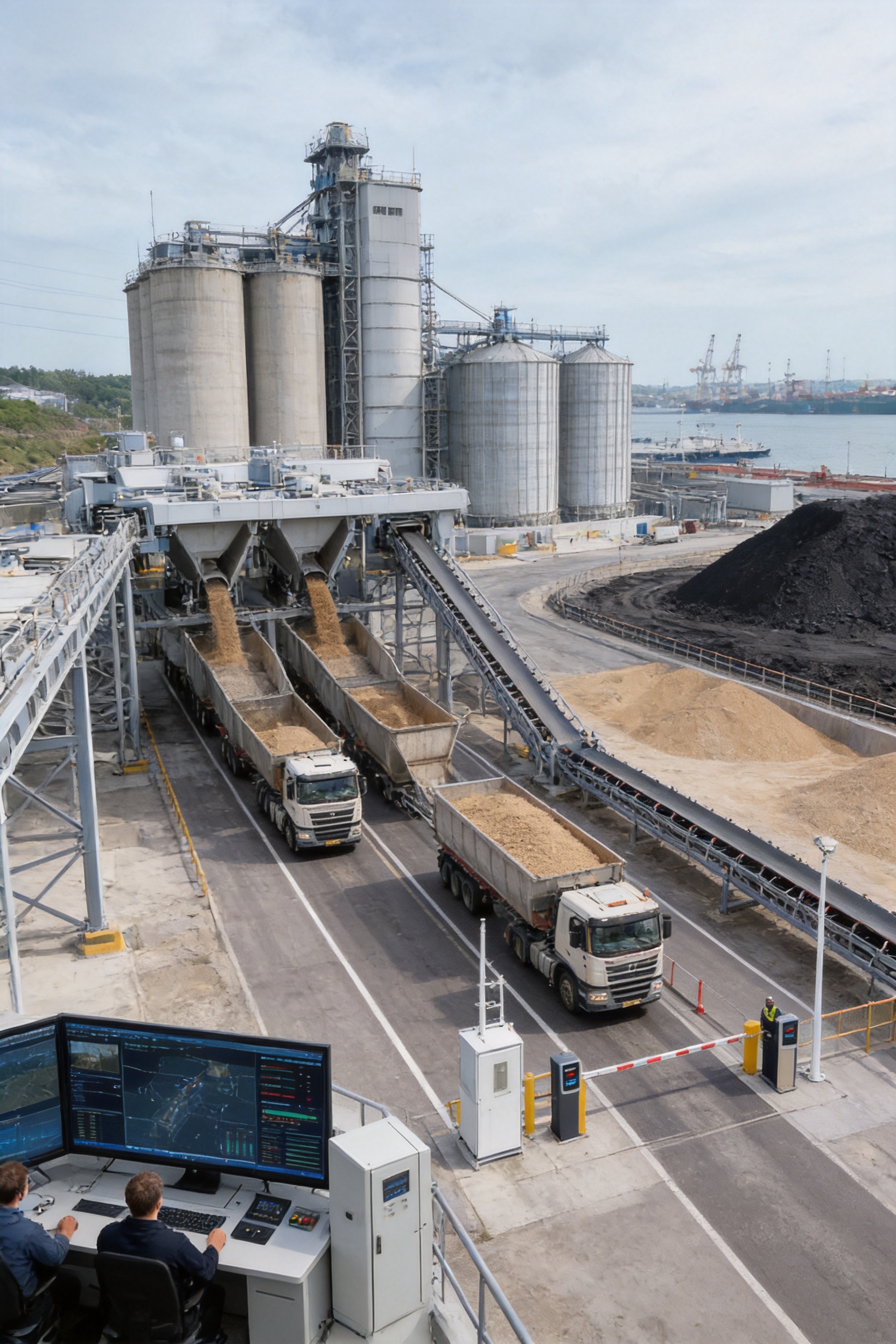
International users associated with the company’s equipment include Budweiser, Heineken, Buhler Group, Wilmar International, Cargill, DuPont, Louis Dreyfus, Charoen Pokphand Group, and Saint-Gobain Group. Customer references should be evaluated according to the specific project, product configuration, and operating conditions.
14. Return on Investment and Total Cost of Ownership
The economic value of an unattended truck dumper comes from several sources: lower labor requirements, shorter truck cycle times, reduced weighing discrepancies, fewer manual records, better equipment utilization, and improved traceability.
A financial evaluation should compare the current operating cost with the expected cost after automation. Important variables include the number of trucks per day, average load weight, working shifts, labor cost, current queue time, value of material losses, cost of manual ticketing, maintenance cost, energy consumption, and the price of production interruptions.
Facilities with high truck volumes generally have a stronger business case because the equipment is used more frequently. Projects with multiple truck dumpers may also benefit from centralized supervision and shared maintenance resources.
The payback period varies substantially by application. The supplied information indicates that some installations may achieve a positive return within approximately 12 to 18 months, while retrofit projects may achieve a shorter payback under favorable conditions. These figures should not be treated as guaranteed results. A site-specific calculation is necessary.
New Installation or Retrofit?
A new installation allows the foundation, pit, platform, weighing system, traffic flow, and data network to be designed together. This approach may provide the best long-term integration and the cleanest layout.
A retrofit can be attractive when an existing truck dumper has sufficient structural condition and useful remaining life. Load cells, a PLC, access control, automatic wheel stops, and digital data functions may be added to the existing equipment. Before a retrofit, the structure, hinges, hydraulic cylinders, foundation, platform flatness, and control cabinet must be inspected carefully.
Retrofit feasibility depends on the original dumper design and the required weighing accuracy. If the structure has excessive deformation, corrosion, mechanical binding, or inadequate capacity, replacement may be more economical than modification.
15. Frequently Asked Questions
Q1. Can a truck dumper operate without a dedicated on-site operator?
Yes. The system is designed for unattended operation. Drivers can complete the standard unloading cycle through an automatic control interface, while a remote supervisor monitors multiple units and responds to alarms or exceptional conditions.
Q2. How does the system calculate the material weight?
The system weighs the loaded vehicle to obtain gross weight and weighs the empty vehicle to obtain tare weight. Net material weight is calculated by subtracting tare weight from gross weight. The data is stored with the vehicle identity and transaction time.
Q3. What lifting angles are available?
The supplied models can be configured for maximum lifting angles of approximately 45 or 55 degrees. The correct angle depends on the truck body, material flowability, receiving equipment, and site requirements.
Q4. Is an automatic wheel-stop device necessary?
It is optional, but it can improve safety and operating efficiency. The device helps prevent truck movement during lifting and reduces the need for manual vehicle guidance, particularly in dusty or high-traffic environments.
Q5. Can the system work in cold climates?
Yes, with appropriate environmental configuration. Cold-climate projects may require low-temperature hydraulic oil, heaters, suitable seals, protected electrical cabinets, and special procedures for snow and ice. The final temperature range must be confirmed during engineering.
Q6. How often should the weighing system be calibrated?
Calibration verification is commonly recommended at least every 12 months, but the required interval depends on local legal requirements, operating frequency, and the customer’s quality system. Mechanical inspection should be performed whenever weighing stability changes.
Q7. Can the equipment connect to an ERP or warehouse management system?
Yes. The system can be configured for data exchange with enterprise platforms, warehouse systems, production systems, or customer databases. Available communication methods and data formats should be agreed during the design stage.
Q8. What happens if the network connection fails?
A properly configured system can store essential transaction data locally and synchronize it with the central server after communication is restored. The exact offline functions depend on the control architecture and customer requirements.
Q9. Can an existing truck dumper be upgraded?
In many cases, an existing dumper can be retrofitted with load cells, a PLC, access control, automatic wheel stops, and digital reporting. A structural and hydraulic inspection is required before determining whether retrofit is practical.
Q10. What types of materials can be unloaded?
The equipment can be used for many bulk materials, including grain, feed, coal, cement-related materials, minerals, chemical products, food ingredients, and waste. The receiving system and safety design must be adapted to the material’s flow, density, temperature, dust, and corrosive characteristics.
Q11. How does unattended operation prevent weighing fraud?
Vehicle identification, automated weighing, digital signatures or audit trails, access permissions, and local and server-side data storage make unauthorized changes more difficult to conceal. The system also reduces manual ticketing and direct operator intervention.
Q12. What information is needed for a quotation?
Important information includes truck dimensions, maximum gross weight, axle configuration, material type, required unloading angle, desired throughput, site layout, foundation conditions, operating temperature, weighing requirements, data interfaces, and local safety regulations.
16. Conclusion
Unattended truck dumpers with integrated weighing systems provide a practical way to modernize bulk-material receiving and unloading. By combining hydraulic truck tipping, automatic weighing, vehicle identification, safety control, and digital reporting, the equipment addresses several weaknesses of conventional manual operations at the same time.
The main advantages include reduced labor dependence, faster truck processing, better use of installation space, improved weighing consistency, lower risk of ticketing errors, stronger fraud prevention, and greater visibility of logistics data. Automatic wheel-stop devices, synchronized hydraulic cylinders, premium components, remote supervision, and configurable communication systems further improve the value of the solution.
The final performance of any installation depends on correct model selection, structural design, weighing calibration, site preparation, driver training, maintenance, and system integration. Jiangsu Zhengding Intelligent Equipment Co., Ltd. combines manufacturing, automation, hydraulic engineering, weighing integration, and application experience to provide customized equipment for different industries and vehicle fleets.
For facilities that handle a high volume of bulk trucks, the transition from separate manual weighing and unloading processes to an integrated unattended system can deliver measurable improvements in productivity, accuracy, safety, and operational control.
References
1. Jiangsu Zhengding Intelligent Equipment Co., Ltd., product information for unattended truck dumpers with integrated weighing systems.
2. Jiangsu Zhengding Intelligent Equipment Co., Ltd., technical information for truck dumpers, side-turn dumpers, container flippers, and automated loading and unloading equipment.
3. International Organization of Legal Metrology, recommendations concerning non-automatic weighing instruments and weighing-system verification.
4. General industrial practice for hydraulic lifting equipment, bulk-material handling systems, programmable logic control, and automated vehicle access management.
5. Customer-specific engineering principles for truck-dumper selection, load-cell installation, foundation design, calibration, safety interlocks, and preventive maintenance.


