

 English
 русский
 Español
 Français
 Português
 عربى
عربى



+86-13588556918
Content
- 1 1. What Is an Enclosed Truck Dumper?
- 2 2. Product Design and Structural Configuration
- 3 3. Main Technical Parameters
- 4 4. Dust Control Technology and Environmental Performance
- 5 5. Advantages Compared with Conventional Open Dumpers
- 6 6. Engineering and Manufacturing Strengths
- 7 7. Application Areas
- 8 8. Operating Sequence and Safety Features
- 9 9. Maintenance and Lifecycle Performance
- 10 10. Selecting the Right Enclosed Truck Dumper
- 11 11. Why an Integrated Supplier Provides Greater Value
- 12 12. Frequently Asked Questions
- 12.1 Q1: What is the main advantage of an enclosed truck dumper?
- 12.2 Q2: Is the dust collection system included with every enclosed dumper?
- 12.3 Q3: What filter type is suitable for cement and mineral dust?
- 12.4 Q4: Can the equipment handle different truck sizes?
- 12.5 Q5: What is the difference between a semi-sealed and fully sealed dumper?
- 12.6 Q6: Can an existing open dumper be upgraded?
- 12.7 Q7: How often does the dust collection system require maintenance?
- 12.8 Q8: Does an enclosed dumper eliminate the need for personal protective equipment?
- 12.9 Q9: What lifting angles are available?
- 12.10 Q10: Which industries use enclosed truck dumpers?
- 12.11 Q11: How does the hydraulic synchronization system improve reliability?
- 12.12 Q12: What information is needed for a quotation?
- 13 13. Conclusion
- 14 References
- 15 Product: Enclosed Truck Dumper with Dust Control System
Modern bulk-material facilities are under increasing pressure to improve unloading efficiency while controlling dust, protecting workers, recovering valuable products, and meeting strict environmental requirements. Truck unloading is often one of the most challenging points in a material-handling process because large quantities of cement, grain, coal, minerals, feed, chemicals, and other bulk products are transferred within a short period. If the unloading area is open, the impact of falling material and the movement of the truck body can create airborne dust, visible emissions, product loss, and difficult working conditions.
An enclosed truck dumper with a dust control system addresses these challenges by combining a robust hydraulic tipping platform with a sealed or semi-sealed containment structure and an integrated extraction system. The design limits uncontrolled air movement, contains dust at the source, and guides contaminated air toward filtration equipment. This approach provides a cleaner, safer, and more efficient unloading environment than conventional open dumping arrangements.
Jiangsu Zhengding Intelligent Equipment Co., Ltd. develops and manufactures enclosed truck dumpers for industrial customers that require reliable automatic loading and unloading solutions. Its equipment is designed for demanding applications in cement, steel, coal, grain, food, feed, chemicals, oil, ports, papermaking, and other industries. The company combines mechanical engineering, hydraulic control, enclosure design, dust extraction, automation, and customized project integration in a single equipment solution.
1. What Is an Enclosed Truck Dumper?
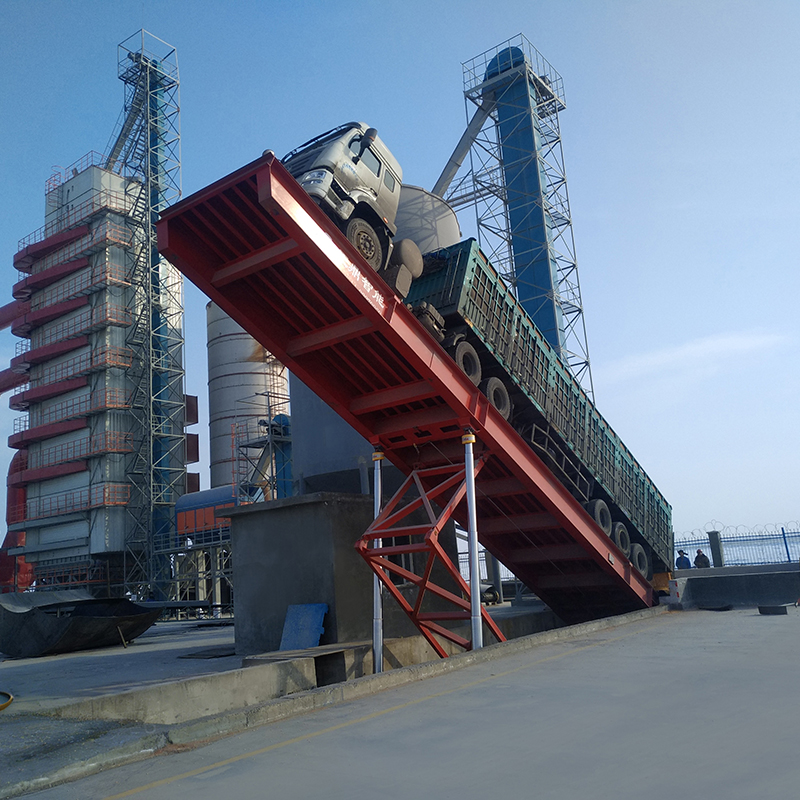
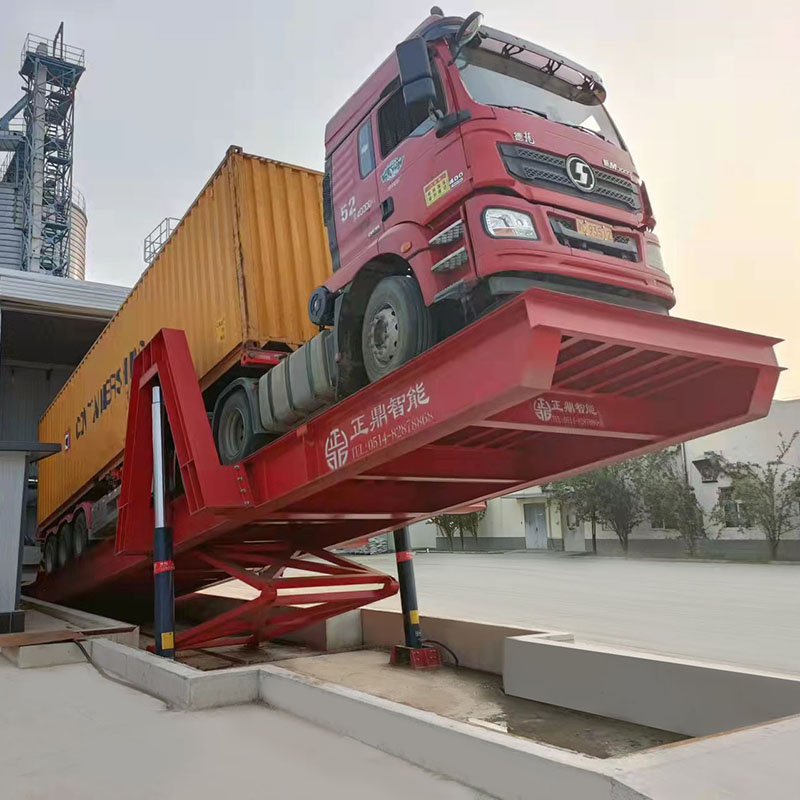
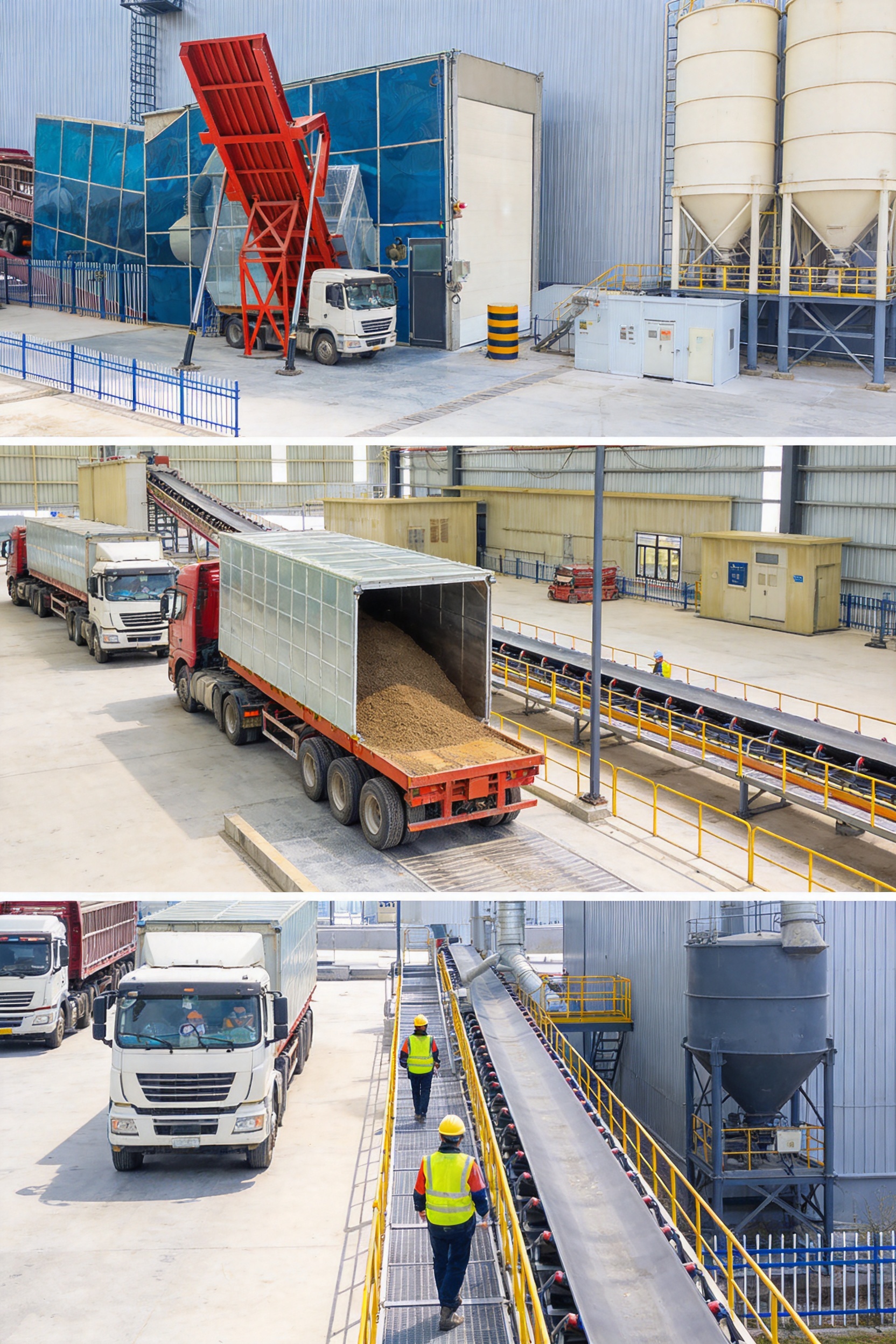
An enclosed truck dumper is a hydraulic unloading machine that raises and tilts a truck, trailer, or similar vehicle inside a containment structure. As the vehicle is lifted, bulk material flows into a receiving hopper, pit, conveyor, or downstream processing system. The enclosure surrounds the main unloading area to prevent dust from escaping into the plant environment.
Unlike an open truck dumper, which exposes the truck body and discharge point to the surrounding atmosphere, an enclosed model uses structural panels, curtains, flexible seals, doors, and extraction ducts to control the movement of air and dust. Depending on the application, the structure may be semi-sealed or fully sealed. A dust collector, fan, filter, and automatic cleaning system can be added to provide active particulate removal.
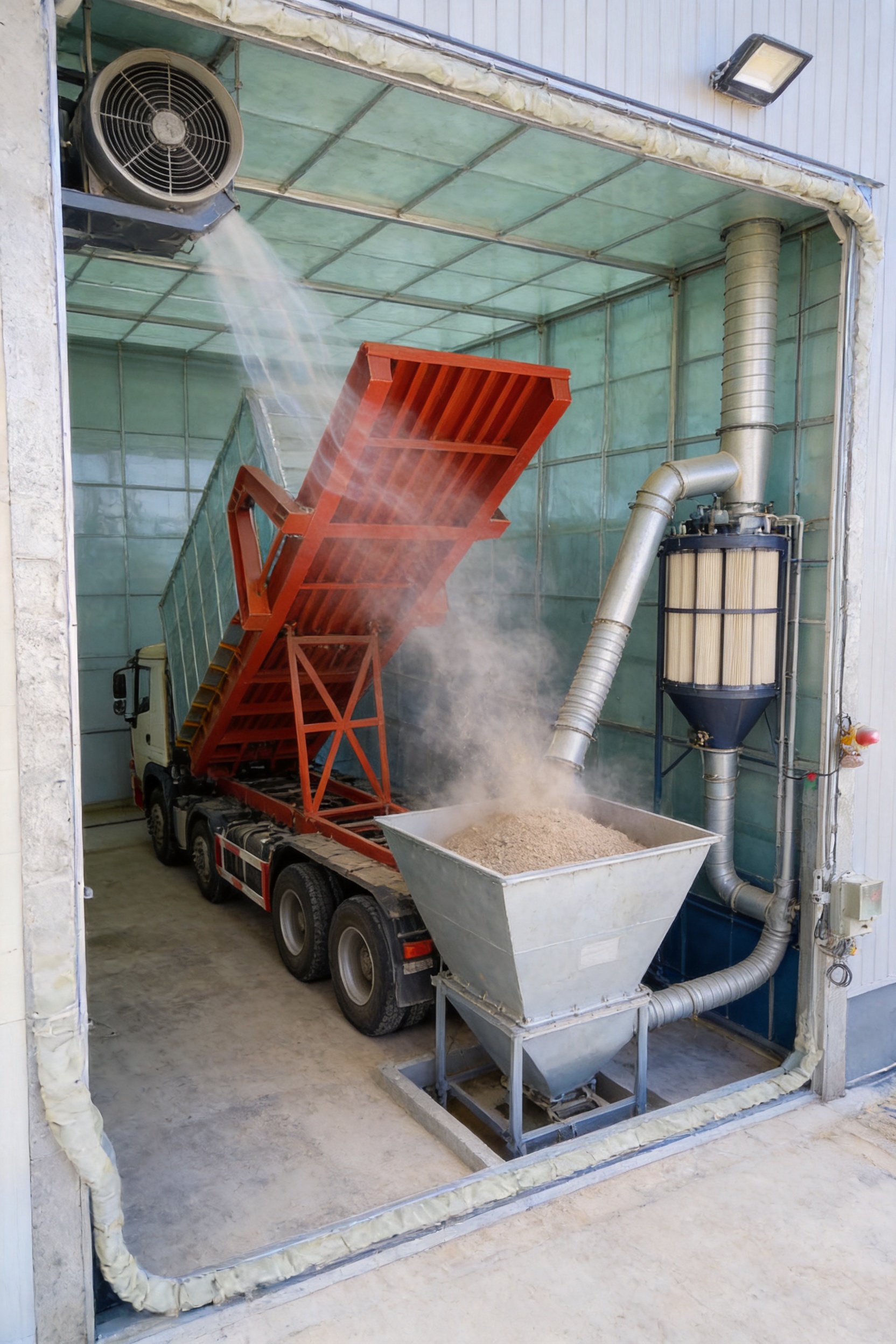
The enclosure is not simply a protective cover. It is part of an integrated airflow-control system. When the truck body is raised and material begins to discharge, the design helps control the air intake area and the inlet wind speed. The dust collection fan then maintains a controlled airflow that draws dusty air away from operators and toward the filtration unit.
This combination of mechanical containment and controlled ventilation is especially important when the material being handled contains fine particles. Cement powder, fly ash, lime, flour, grain dust, mineral concentrates, coal dust, and similar products can become airborne easily. An enclosure reduces the volume of air that must be treated and supports more efficient dust collection system operation.
Key Functions of the Equipment
The main functions of an enclosed truck dumper include:
1. Positioning and securing the truck during unloading.
2. Raising the truck body to the required discharge angle.
3. Directing bulk material into a pit, hopper, conveyor, or processing line.
4. Containing dust and reducing uncontrolled emissions.
5. Maintaining a suitable negative-pressure environment during unloading.
6. Connecting the unloading area to a dust collector or filtration system.
7. Supporting safe, repeatable, and automated operating cycles.
8. Reducing material loss and cleanup requirements.
9. Providing an adaptable platform for different truck dimensions and capacities.
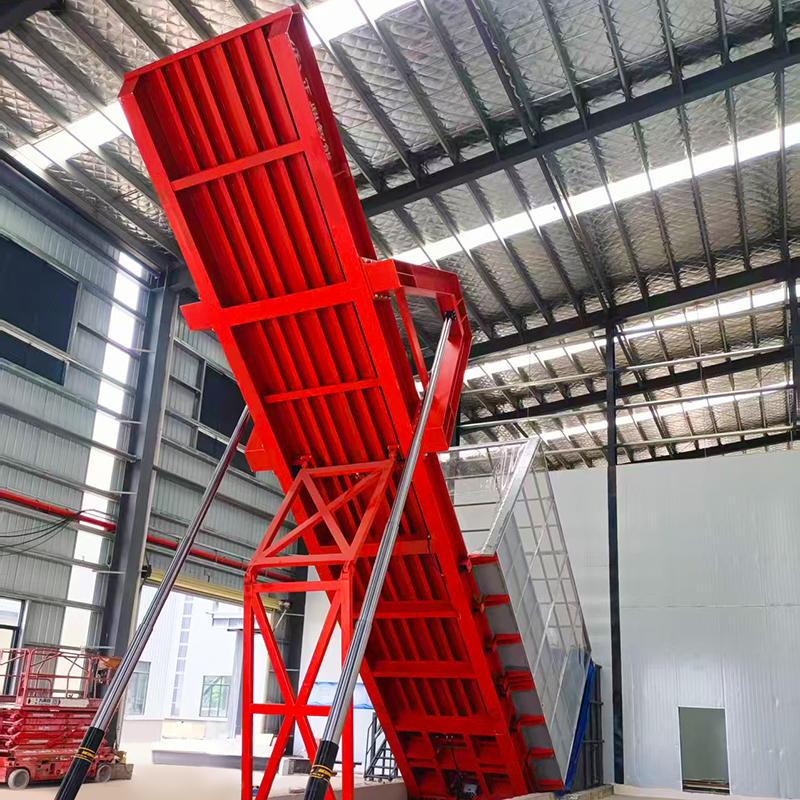
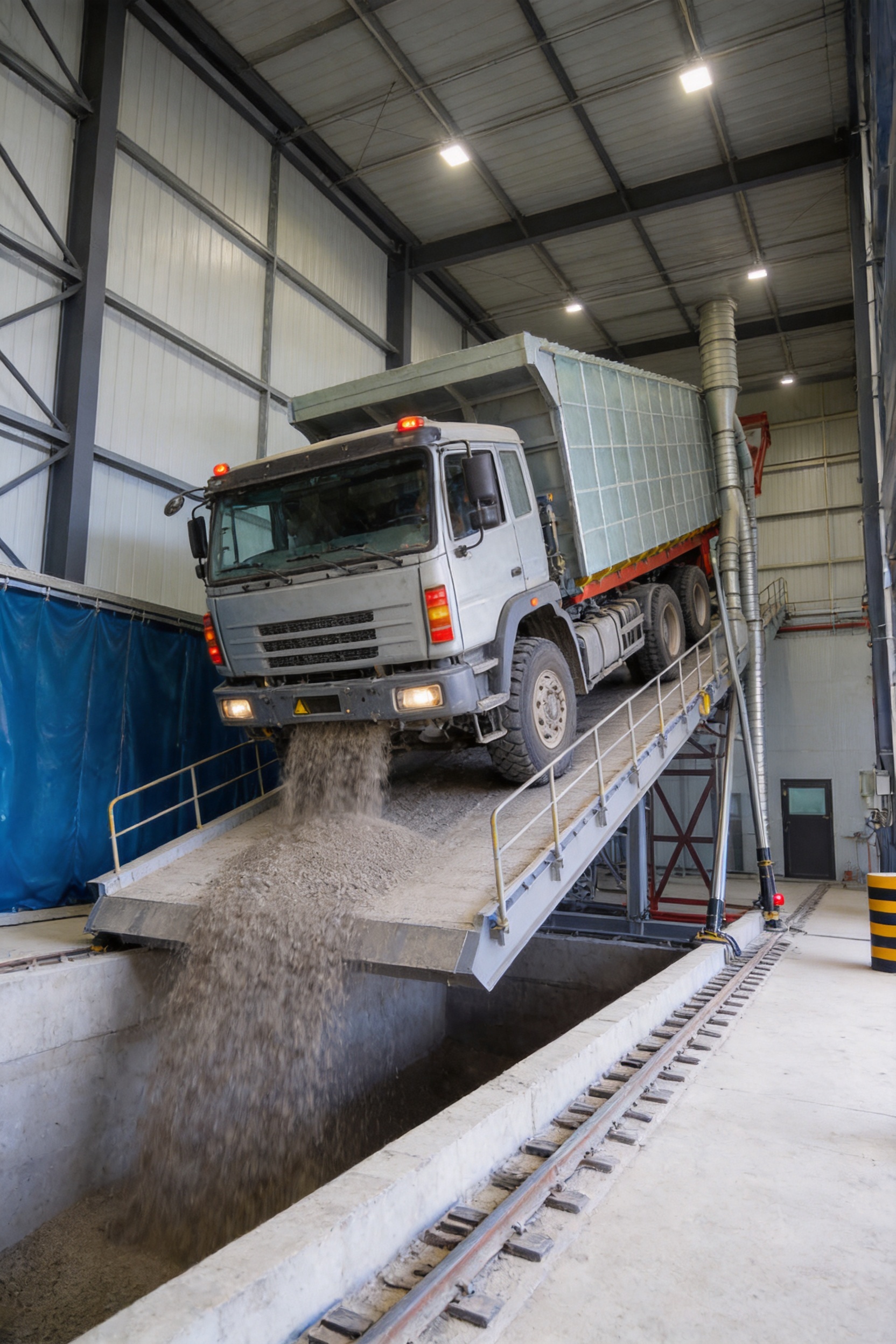
In practical operation, the truck enters the dumper platform, is aligned and secured, and then the hydraulic system raises the platform. The vehicle remains within the enclosure while material is discharged. Once unloading is complete, the platform returns to its original position and the truck exits after the safety system confirms that the cycle is complete.
Enclosed Truck Dumper with Dust Control System
2. Product Design and Structural Configuration
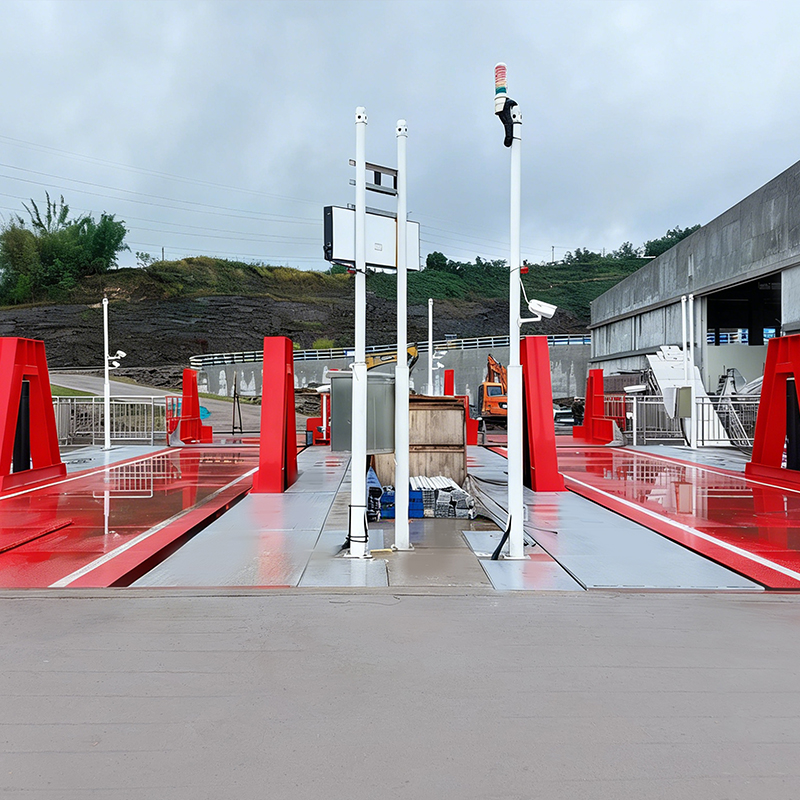
The enclosed truck dumper is built around three cooperating structures: the hydraulic tipping platform, the pit enclosure, and the upper platform enclosure. Together, these components create a combination of dynamic and static sealing.
Hydraulic Tipping Platform
The hydraulic platform supports the vehicle and provides the lifting movement required for unloading. It must withstand the combined weight of the truck, cargo, and dynamic loads created when material shifts during tipping. The platform is therefore designed for high structural strength, controlled deformation, and stable movement.
A high-precision oil-cylinder synchronous stability system is used to coordinate the hydraulic cylinders. Synchronized cylinder movement helps distribute the load evenly and reduces platform twisting. It also minimizes sudden vibration and impact on the cylinders. Smooth movement is important because unstable lifting can damage the truck, platform, hydraulic components, or enclosure.
The synchronous system improves operational safety in several ways. It helps maintain a balanced lifting trajectory, reduces uneven loading of the support structure, and prevents one side of the platform from moving significantly faster than the other. The controlled movement also reduces mechanical shock, which contributes to longer service life for oil cylinders, pins, bearings, guide components, and structural connections.
Pit Enclosure
The pit enclosure surrounds the lower discharge region where bulk material enters the receiving system. This area is exposed to the greatest concentration of dust because material falls rapidly from the truck body into the pit or hopper. The enclosure limits the open area and creates a controlled space for dust extraction.
The pit enclosure can be constructed using steel frames and modular panels selected according to the material, operating environment, and required sealing level. Access points are arranged to permit inspection, maintenance, cleaning, and connection to downstream equipment while minimizing unnecessary openings during operation.
Truck Dumper Platform Enclosure
The platform enclosure surrounds the truck during the lifting and discharge cycle. It provides static containment when the machine is idle and dynamic containment while the truck platform is moving. Flexible sections, curtains, seals, or specially designed interfaces can accommodate movement between the truck, platform, and fixed enclosure.
The upper enclosure also helps isolate the operator and surrounding plant areas from dust generated as the load shifts. Depending on the application, the enclosure may include access doors, inspection windows, lighting, sensors, ventilation connections, and automatic interlocks.
Semi-Sealed and Fully Sealed Designs
The equipment can be configured as a semi-sealed or fully sealed structure. A semi-sealed design provides a practical balance between dust containment, access, cost, and ventilation requirements. It is suitable for applications where the material is moderately dusty or where certain operational openings must remain accessible.
A fully sealed design provides a higher level of environmental control. It is suitable for fine powders, sensitive production areas, facilities near residential zones, and projects with strict environmental protection requirements. The final configuration depends on truck dimensions, product characteristics, dust concentration, unloading speed, site layout, and local regulations.
Both designs can be combined with an independent dust removal system. The dust collector may use cartridge filters, baghouse filters, cyclone pre-separators, or other filtration technologies. The selected system should reflect particle size, moisture, temperature, abrasiveness, combustibility, and the desired air volume.
3. Main Technical Parameters
The available models are designed to support different truck capacities and site requirements. The following table summarizes the principal technical parameters provided for the enclosed truck dumper range.
| Model | Available Size L × W, m | Maximum Lifting Weight, t | Maximum Lifting Angle |
|---|---|---|---|
| TQXHF 50 | 14 × 3; 16 × 3; 17 × 3 | 80 | 45° / 55° |
| TQXHF 80 | 16 × 3; 17 × 3; 18 × 3 | 80 | 45° / 55° |
| TQXHF 100 | 17 × 3; 18 × 3; 20 × 3 | 100 | 45° / 55° |
| TQXHF 150 | 17 × 3; 18 × 3; 20 × 3 | 150 | 45° / 55° |
These parameters provide a starting point for equipment selection. A final technical specification should be confirmed after reviewing the truck fleet, maximum gross vehicle weight, wheelbase, body dimensions, material characteristics, unloading rate, pit geometry, and local installation conditions.
The available lifting angles of 45 degrees and 55 degrees allow the equipment to be adapted to different material-flow requirements. Materials with poor flow characteristics may require a steeper angle or additional vibration and flow-assistance measures. Free-flowing materials may discharge effectively at a lower angle, depending on the truck body and receiving hopper design.
4. Dust Control Technology and Environmental Performance
Dust control is the defining advantage of an enclosed truck dumper. During unloading, dust is generated by several mechanisms: the impact of material on the receiving surface, the displacement of air by falling material, the movement of the truck body, wind entering the enclosure, and the release of fine particles trapped between material layers.
An open dumper allows these particles to disperse freely. A sealed system instead limits uncontrolled air intake and directs dusty air toward a collection point. The enclosure and extraction system therefore work together as one process rather than as separate accessories.
Dynamic and Static Sealing
Static sealing refers to the containment provided when the platform and enclosure are stationary. It is achieved through fixed panels, sealed joints, doors, covers, and carefully designed connections. Dynamic sealing refers to the control of gaps that change during truck entry, platform lifting, body movement, and discharge.
Effective dynamic sealing is essential because a completely rigid enclosure cannot accommodate every truck shape and movement. Flexible seals, curtains, sliding sections, and adaptable interfaces help maintain containment while allowing the machine to operate. The design objective is not necessarily to eliminate every opening, but to control the size and location of openings so that the dust collector can maintain the desired airflow pattern.
Negative-Pressure Operation
The dust collection fan creates a slight negative-pressure condition inside the enclosure. Air therefore tends to flow into the enclosed area rather than out toward operators and the surrounding plant. The extracted air is routed to a filter system where particulate matter is separated from the air stream.
Negative pressure must be carefully balanced. Excessive airflow can increase energy consumption, disturb material flow, or draw unnecessary ambient air into the system. Insufficient airflow may allow dust to escape through gaps and access points. The integrated design approach focuses on controlling the air inlet area and inlet wind speed to achieve effective containment with lower energy demand.
Filter Selection
Cartridge filters with pulse-jet cleaning are commonly used for fine cement, mineral, and powder dusts. They offer a compact footprint and high filtration efficiency when correctly selected and maintained. Baghouse filters are also suitable for many industrial materials and can provide reliable continuous operation in high-dust applications.
Cyclone pre-separators may be added when the material contains a large quantity of coarse particles. Removing heavier particles before they reach the final filter can reduce filter loading and extend the service interval. For grain and organic dusts, the system design should also consider fire and explosion risks, temperature control, grounding, access for cleaning, and appropriate protective devices.
Filter selection should be based on actual process data rather than a general product category. Important factors include particle-size distribution, bulk density, moisture content, material temperature, abrasiveness, chemical composition, required airflow, and discharge method.
Automatic Filter Cleaning
Automatic pulse-jet or shaker cleaning helps maintain filter performance during continuous operation. A pulse-jet system uses short bursts of compressed air to remove accumulated dust from the filter surface. The dust falls into a hopper or discharge system for collection and possible product recovery.
Automatic cleaning reduces manual intervention and helps maintain a stable pressure drop across the filter. However, it does not eliminate the need for inspection. Filter condition, compressed-air quality, pulse timing, hopper discharge, fan performance, and duct integrity should all be monitored as part of a preventive maintenance program.
In a properly designed installation, enclosed truck dumpers can substantially reduce visible emissions and airborne particulate concentrations compared with open unloading systems. Actual performance depends on enclosure integrity, fan capacity, filter selection, truck sealing, operating procedures, material properties, and maintenance quality.
5. Advantages Compared with Conventional Open Dumpers
The most direct comparison is between an open dumper without dust control and an enclosed dumper equipped with extraction and filtration. The enclosed design offers advantages across environmental performance, worker protection, material recovery, operating cleanliness, and regulatory readiness.
Reduced Dust Emissions
Open dumpers release dust directly into the plant environment. Water sprays may reduce some visible dust, but they can introduce moisture into the material, create wastewater, increase housekeeping requirements, and provide inconsistent results in dry or windy conditions.
An enclosed dumper captures dust at the source instead of attempting to suppress it after it has dispersed. The system can maintain a controlled airflow around the discharge point and route collected dust to a filter. This approach is generally more suitable for dry powders and facilities where product contamination or moisture addition is undesirable.
Improved Worker Protection
Workers near open unloading operations may be exposed to dust during truck arrival, tipping, inspection, sampling, and cleanup. Enclosure and extraction reduce the amount of airborne material in operator areas. A control room or remote operating station can further separate personnel from the unloading zone.
Lower dust exposure does not mean that personal protective equipment, industrial hygiene monitoring, or safe operating procedures are no longer necessary. Instead, engineering controls reduce reliance on personal protection and create a stronger overall safety strategy.
Lower Material Loss
Dust that escapes during unloading is often saleable product. In addition to its environmental impact, uncontrolled dust represents a direct loss of material. Collected dust can sometimes be returned to the process, provided that its quality and contamination status are acceptable.
For high-throughput facilities, even a small percentage of product loss can become significant over a year. A plant handling tens or hundreds of thousands of metric tons may recover several tons of material through improved containment, depending on the product, process conditions, and dust collection design.
Cleaner Plant Operation
Dust accumulation on floors, steelwork, equipment, lighting, and electrical components increases housekeeping effort and can create secondary hazards. An enclosed dumper reduces the amount of material that settles outside the unloading zone. This can lower cleaning frequency and improve visibility around truck traffic and inspection areas.
Cleaner surroundings also simplify maintenance. Hydraulic components, sensors, electrical cabinets, and safety devices are less likely to become covered with abrasive or conductive dust. Reduced accumulation can support longer service life and more reliable equipment operation.
Better Community Relations
Facilities near residential areas, public roads, offices, or neighboring businesses may receive complaints when visible dust escapes during truck unloading. Enclosed equipment minimizes the visual impact of unloading and supports a cleaner external environment. It can therefore help companies demonstrate responsible operation to employees, customers, inspectors, and nearby communities.
Greater Regulatory Readiness
Environmental requirements vary by location and industry, but the general direction is toward tighter control of particulate emissions. Installing an enclosed dumper during a new project or plant upgrade can provide a stronger basis for meeting current and future requirements.
Because the system combines physical containment, negative pressure, and filtration, it offers multiple layers of control. This is more robust than relying on operator behavior or temporary water spraying alone.
6. Engineering and Manufacturing Strengths
The performance of an enclosed truck dumper depends not only on its concept but also on manufacturing accuracy, component quality, assembly control, and project engineering. Jiangsu Zhengding Intelligent Equipment Co., Ltd. focuses on the development and manufacture of intelligent logistics equipment and provides integrated solutions for automatic vehicle and container loading and unloading.
Integrated Mechanical and Hydraulic Engineering
A truck dumper must handle high loads while moving in a controlled and repeatable way. The design process therefore requires coordination between the platform structure, hydraulic cylinders, pivot points, supports, guides, safety restraints, and control system. The company’s high-precision oil-cylinder synchronous stability system is designed to improve lifting balance, reduce vibration, and protect hydraulic components from shock loading.
Integrated engineering also helps avoid problems that may occur when the dumper, enclosure, and dust system are supplied independently. The platform movement, enclosure clearances, flexible connections, fan operation, and safety interlocks can be designed as a coordinated system from the beginning.
Modular Enclosure Construction
Modular panel construction provides flexibility during manufacturing, transportation, installation, and future expansion. Damaged panels can be replaced more easily than a fully welded enclosure, and the layout can be adapted to different truck lengths, plant clearances, and maintenance requirements.
Modular construction also supports customization. Panel thickness, access arrangements, inspection openings, sealing methods, lighting, ventilation points, and surface treatment can be selected for the operating environment. Steel components may be treated or coated according to indoor, outdoor, humid, corrosive, or heavy-industrial conditions.
Customized Project Design
Truck fleets are not uniform. A facility may receive short rigid trucks, long trailers, multi-axle vehicles, or vehicles with different body shapes. The dumper must be designed around the actual fleet rather than a theoretical vehicle.
Customization may include platform length and width, lifting capacity, lifting angle, wheel guides, restraints, truck positioning systems, entry and exit arrangements, pit depth, receiving hopper connections, dust collector capacity, control logic, and maintenance access. Site-specific design reduces installation conflicts and improves long-term usability.
Automation and Interlocking
Automatic controls can coordinate truck positioning, wheel restraints, door operation, hydraulic lifting, dust collector startup, filter cleaning, discharge equipment, and return-to-level movement. Interlocks prevent unsafe sequences, such as lifting before the truck is correctly positioned or opening access doors while the platform is moving.
Control systems can include local operator stations, remote control panels, emergency-stop circuits, level sensors, position sensors, pressure monitoring, filter differential-pressure monitoring, and fault alarms. These functions improve repeatability and provide operators with clear information about equipment status.
Application Experience
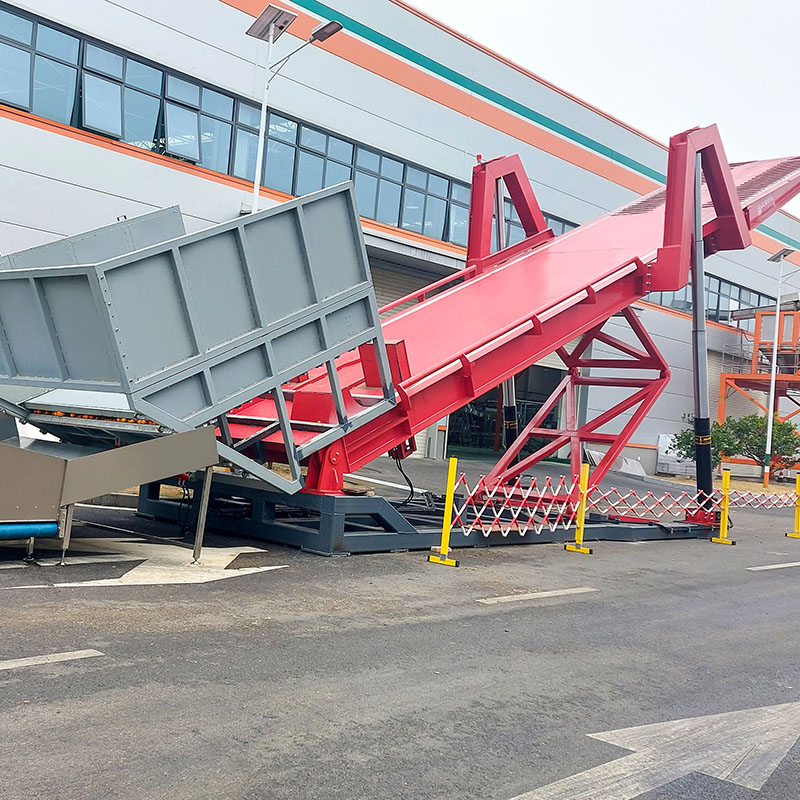
The company provides equipment for steel, chemical, cement, coal, grain, oil, food, feed, ports, papermaking, and new energy industries. Its product range includes rear dumpers, side-turn truck dumpers, car loading equipment, container flippers, and other automated loading and unloading equipment.
This broad application range is valuable because different industries impose different design requirements. Grain and food applications may prioritize hygiene and product protection. Cement and minerals may require high-capacity dust collection and abrasion resistance. Chemical facilities may require special materials, sealing, grounding, or hazardous-area considerations. Port and logistics projects may prioritize throughput, vehicle flexibility, and integration with conveyors or storage systems.
International Project Capability
Equipment from Jiangsu Zhengding has been exported to Japan, Brazil, Egypt, Pakistan, India, the Middle East, and Southeast Asian countries. International projects require attention to different climate conditions, electrical standards, safety expectations, logistics requirements, and installation practices.
The company has supplied equipment to or worked with recognized international users in brewing, grain handling, food, agricultural commodities, chemicals, and building materials. This type of application exposure supports the development of practical equipment solutions for customers with demanding operating requirements.
7. Application Areas
Cement and Building Materials
Cement, fly ash, lime, gypsum, and other mineral powders can generate significant dust during truck unloading. Enclosure and filtration help prevent visible emissions and reduce product loss. A sealed dumper can be connected to a receiving hopper, bucket elevator, screw conveyor, belt conveyor, or pneumatic transfer system.
In cement distribution terminals, dust control is important not only for environmental compliance but also for product cleanliness and plant housekeeping. The dust collector should be selected to handle the material’s fine particle size and abrasive characteristics.
Coal and Mineral Handling
Coal, ore, concentrate, and mineral products may contain both coarse fragments and fine dust. The dumper structure should be designed for impact resistance and abrasion protection. A pre-separation stage may be useful where large particles could overload the final filter.
Coal and organic materials also require careful consideration of ignition sources, static electricity, hot particles, and dust explosion risks. The project design should include appropriate risk assessment, grounding, inspection access, and safety equipment.
Grain, Feed, and Food Products
Grain, flour, soybean meal, feed ingredients, and other agricultural products can create combustible dust and require sanitary handling. Enclosed unloading limits product contamination and helps prevent dust from spreading through storage and processing areas.
Food and feed facilities may require smooth internal surfaces, cleanable structures, corrosion-resistant components, inspection hatches, and carefully controlled product recovery. The dust collection design should avoid conditions that could cause cross-contamination or excessive product degradation.
Chemical and Industrial Powders
Chemical powders may vary widely in particle size, density, toxicity, corrosiveness, and moisture sensitivity. The enclosure, filter media, seals, and ductwork should be selected to suit the specific product. In some cases, the dust collector may require special materials, enhanced containment, or additional monitoring.
Ports and Logistics Terminals
Ports and large logistics terminals often handle high truck volumes and require reliable cycle times. An enclosed dumper can be integrated with storage silos, conveyors, ship-loading systems, rail transfer systems, or automated weighing equipment.
Because terminal operations are continuous and time-sensitive, the hydraulic system, dust collector, controls, and maintenance strategy must be designed for high availability. Fast truck positioning and clear traffic management can help reduce waiting time.
8. Operating Sequence and Safety Features
A typical unloading cycle begins when the truck approaches the dumper and enters the designated platform. Guide rails, wheel stops, cameras, sensors, or operator instructions help the driver position the vehicle correctly. Once the vehicle is in the approved position, the control system confirms that the safety conditions are satisfied.
The truck may then be secured using wheel restraints or other approved devices. The enclosure doors or flexible sealing sections are positioned according to the design. The dust collection fan starts before lifting, establishing the required airflow pattern.
The hydraulic system raises the platform in a controlled manner. Synchronized cylinders maintain stability as the vehicle reaches the selected angle. Material flows from the truck body into the receiving pit or hopper. During discharge, the extraction system captures airborne dust and directs it to the filter.
When unloading is complete, the platform returns to the horizontal position. The control system verifies that the platform is fully lowered before releasing the truck restraints or allowing the exit doors to open. The fan may continue operating for a short period to clear residual dust from the enclosure.
Important Safety Measures
Safety features should be selected according to the site risk assessment and applicable standards. Typical measures may include:
1. Emergency-stop buttons at accessible locations.
2. Mechanical or hydraulic overload protection.
3. Truck wheel restraints and vehicle-position sensors.
4. Platform position and angle monitoring.
5. Access-door interlocks.
6. Hydraulic pressure and leakage monitoring.
7. Guarding around moving parts and pinch points.
8. Audible and visual warning signals.
9. Safe access platforms, ladders, handrails, and lighting.
10. Dust collector differential-pressure alarms.
11. Filter inspection and maintenance access.
12. Grounding and protective measures for combustible dust applications.
Operators should receive training covering truck positioning, emergency procedures, dust collector operation, filter alarms, hydraulic hazards, restricted areas, and maintenance isolation. Lockout and tagout procedures are essential before personnel enter the enclosure, pit, hopper, or hydraulic danger zone.
9. Maintenance and Lifecycle Performance
Preventive maintenance is necessary to preserve both dumper performance and dust control efficiency. The inspection program should cover the hydraulic system, platform structure, enclosure panels, seals, fan, filters, ducts, sensors, controls, and discharge equipment.
Hydraulic System Maintenance
Operators should inspect oil levels, hoses, fittings, cylinder seals, pins, mounting points, and abnormal vibration. Hydraulic oil should be replaced or filtered according to the equipment schedule and operating conditions. Any difference in cylinder movement, platform tilt, or lifting speed should be investigated promptly.
The synchronous stability system helps reduce impact and uneven loading, but it does not remove the need for regular inspection. Early detection of leakage, wear, or misalignment can prevent larger failures and unplanned downtime.
Enclosure Inspection
Panels, flexible curtains, doors, seals, and access covers should be checked for wear, deformation, gaps, and damage caused by truck movement or material impact. A damaged seal can reduce negative-pressure performance and allow dust to escape.
The enclosure should also be cleaned in accordance with the material-handling risk assessment. For combustible dust, cleaning methods should avoid creating suspended dust clouds or ignition hazards. Wet cleaning, industrial vacuum systems, or other approved methods may be required.
Dust Collector Maintenance
Typical dust collection maintenance includes filter inspection every 200 to 400 operating hours, compressed-air system checks, hopper discharge monitoring, fan inspection, and ductwork inspection. Filter elements may last approximately 2,000 to 5,000 operating hours, although actual service life depends on material abrasiveness, moisture, loading, pulse-cleaning performance, and operating conditions.
A rising differential pressure may indicate clogged filters, inadequate cleaning, excessive dust loading, or a problem with the compressed-air system. An unusually low pressure drop may indicate a damaged filter, open access door, air leakage, or fan performance issue.
Spare Parts and Service Planning
Critical spare parts may include filter elements, seals, hydraulic hose assemblies, sensor components, solenoid valves, relay modules, wear plates, and flexible connections. Maintaining an appropriate spare-parts inventory can reduce downtime, especially for facilities operating continuously or located far from service centers.
A lifecycle approach should consider not only the initial equipment price but also energy use, filter replacement, product recovery, cleaning labor, maintenance access, downtime, and future compliance requirements. The enclosed design may provide a higher initial investment than an open platform, but its total operating value can be stronger in dusty or regulated applications.
10. Selecting the Right Enclosed Truck Dumper
Equipment selection should begin with a detailed review of the intended process. Important questions include:
1. What are the maximum and minimum truck dimensions?
2. What is the maximum gross vehicle weight including cargo?
3. What is the required unloading capacity per hour?
4. What material will be handled?
5. What are the material’s moisture, temperature, density, and particle-size characteristics?
6. Is the material abrasive, corrosive, combustible, toxic, or hygroscopic?
7. What lifting angle is needed for reliable discharge?
8. Will the dumper connect to a hopper, conveyor, silo, or processing line?
9. Is a semi-sealed or fully sealed structure required?
10. What are the local environmental and occupational safety requirements?
11. What space is available for the enclosure, fan, filter, ducting, and maintenance access?
12. Will trucks be positioned manually or automatically?
13. What electrical supply, control system, and communication interfaces are available?
14. What cleaning and maintenance methods are permitted?
A proper site survey should also assess ground conditions, foundation design, drainage, vehicle traffic, overhead clearance, weather exposure, fire protection, and the relationship between the dumper and nearby buildings. These factors affect both the equipment layout and the dust collection system.
11. Why an Integrated Supplier Provides Greater Value
Purchasing the dumper, enclosure, dust collector, and automation from an integrated supplier can simplify responsibility for the customer. Instead of coordinating several vendors with different design assumptions, the customer receives a coordinated system with defined interfaces.
An integrated supplier can optimize the relationship between platform movement and enclosure clearances. It can size the extraction system according to the actual opening area and unloading process. It can also coordinate emergency stops, interlocks, control panels, alarms, and commissioning procedures.
Jiangsu Zhengding’s broader product range in truck and container loading and unloading equipment supports this integrated approach. The company manufactures rear dumpers, side-turn truck dumpers, container flippers, car loading equipment, and related automated logistics equipment. This experience allows customers to evaluate truck unloading as part of a complete material-handling system rather than as an isolated machine.
The company’s manufacturing strengths include intelligent equipment development, mechanical and hydraulic integration, modular fabrication, customized engineering, and experience in multiple industrial sectors. Its products are used in China and exported internationally, supporting projects with varied operating conditions and customer expectations.
12. Frequently Asked Questions
Q1: What is the main advantage of an enclosed truck dumper?
The main advantage is source-level dust containment. The enclosure limits the area where dust can escape, while the extraction and filtration system removes airborne particles from the unloading zone. This can improve worker protection, reduce visible emissions, lower product loss, and simplify housekeeping compared with an open dumper.
Q2: Is the dust collection system included with every enclosed dumper?
The enclosure can be supplied with an independent dust removal system, but the final configuration depends on the project. Some customers may connect the dumper to an existing central dust collection system, while others may require a dedicated fan, cartridge filter, baghouse, cyclone, or combination system.
Q3: What filter type is suitable for cement and mineral dust?
Cartridge filters with pulse-jet cleaning are commonly suitable for fine cement and mineral dust, while baghouse filters are also widely used. The selection depends on particle size, airflow, moisture, temperature, abrasiveness, dust loading, and required emission performance.
Q4: Can the equipment handle different truck sizes?
Yes. The platform length, width, enclosure dimensions, positioning devices, and lifting capacity can be designed around the customer’s truck fleet. If multiple truck types are used, the layout should be reviewed to ensure that all vehicles can be positioned safely and sealed effectively.
Q5: What is the difference between a semi-sealed and fully sealed dumper?
A semi-sealed dumper provides substantial containment while retaining selected openings for access, ventilation, or operational flexibility. A fully sealed dumper provides a higher level of containment and is better suited to fine powders, strict environmental requirements, and sensitive production areas. The correct choice depends on material properties and site requirements.
Q6: Can an existing open dumper be upgraded?
Many existing open dumpers can be retrofitted with modular enclosure panels, flexible seals, ductwork, and dust collection equipment. A site assessment is required to check the platform structure, available space, lifting motion, foundation, receiving hopper, and control system. Retrofitting may be more economical than complete replacement in suitable installations.
Q7: How often does the dust collection system require maintenance?
Typical maintenance includes filter inspection every 200 to 400 operating hours, compressed-air checks, hopper discharge inspection, fan inspection, and ductwork checks. Filter elements may last approximately 2,000 to 5,000 operating hours, but actual life varies according to the material and operating conditions.
Q8: Does an enclosed dumper eliminate the need for personal protective equipment?
No. Enclosure and extraction are engineering controls that reduce exposure, but they do not replace site safety procedures, personal protective equipment, industrial hygiene monitoring, or emergency planning. PPE requirements should be established through a site-specific risk assessment.
Q9: What lifting angles are available?
The listed equipment can operate at maximum lifting angles of 45 degrees or 55 degrees, depending on the selected configuration. The correct angle should be determined by the truck body, material flow characteristics, receiving hopper design, and required unloading performance.
Q10: Which industries use enclosed truck dumpers?
Typical industries include cement, steel, coal, minerals, chemicals, grain, food, feed, oil, ports, papermaking, new energy, and general logistics. The system is particularly valuable wherever fine dust, material loss, worker exposure, or strict environmental requirements are concerns.
Q11: How does the hydraulic synchronization system improve reliability?
The high-precision oil-cylinder synchronous stability system coordinates cylinder movement and helps maintain balanced platform lifting. It reduces vibration, limits impact on the cylinders, and lowers uneven mechanical loading. These characteristics can improve safety and extend the service life of hydraulic and structural components.
Q12: What information is needed for a quotation?
A supplier normally needs truck drawings or dimensions, maximum gross weight, material details, unloading rate, required tipping angle, site layout, pit dimensions, dust-control requirements, electrical information, operating temperature, and local standards. Photographs and a site survey can also help identify installation constraints.
13. Conclusion
An enclosed truck dumper with a dust control system is a complete unloading solution for facilities that need more than basic truck tipping. By combining a high-strength hydraulic platform, synchronized cylinder operation, modular enclosure construction, controlled airflow, and efficient filtration, the system addresses the main weaknesses of open dumping.
Its benefits include reduced dust emissions, improved worker protection, lower product loss, cleaner plant conditions, reduced housekeeping demands, greater regulatory readiness, and stronger community relations. The semi-sealed and fully sealed configurations allow the equipment to be matched to different material properties and environmental requirements.
Jiangsu Zhengding Intelligent Equipment Co., Ltd. provides customized truck and container loading and unloading equipment supported by experience in mechanical engineering, hydraulic systems, automation, dust control, and industrial project integration. Its enclosed truck dumpers are suitable for a broad range of applications and can be configured for different vehicle sizes, capacities, lifting angles, dust collection arrangements, and plant layouts.
For customers planning a new unloading station or upgrading an existing open dumper, the most effective approach is to evaluate the complete lifecycle of the system. Initial equipment cost should be considered together with dust compliance, recovered material, cleaning labor, maintenance, energy consumption, worker protection, and future expansion. When these factors are included, an enclosed truck dumper can provide a durable and commercially valuable improvement to bulk-material handling operations.
References
1. Jiangsu Zhengding Intelligent Equipment Co., Ltd., Product Information for Enclosed Truck Dumper with Dust Control System.
2. Jiangsu Zhengding Intelligent Equipment Co., Ltd., Technical Materials for Automated Loading and Unloading Equipment.
3. Industrial Ventilation: A Manual of Recommended Practice for Design, American Conference of Governmental Industrial Hygienists.
4. Air Pollution Control Engineering, particulate collection and industrial filtration principles.
5. Occupational exposure guidance for respirable dust and industrial hygiene management.
6. Bulk Solids Handling Engineering, truck unloading, hopper design, and material-flow considerations.
7. Industrial dust collection maintenance practices for cartridge filters and baghouse systems.
8. General safety principles for hydraulic lifting equipment, vehicle restraints, interlocking, and machinery access.


