

 English
 русский
 Español
 Français
 Português
 عربى
عربى



+86-13588556918
Content
- 1 Introduction
- 2 What Is an Automated Container Loader?
- 3 Core Product Features
- 4 Advantages Compared with Conventional Loading Methods
- 5 Engineering Design for Different Cargo Types
- 6 Manufacturing and Engineering Strengths
- 7 Operational Workflow
- 8 Productivity and Economic Benefits
- 9 Safety, Maintenance, and Reliability
- 10 Applications Across Multiple Industries
- 11
- 12 Why Choose an Experienced Equipment Manufacturer?
- 13 Implementation Recommendations
- 14 Frequently Asked Questions
- 14.1 Q1: What products can an automated container loader handle?
- 14.2 Q2: Can one machine handle both loading and unloading?
- 14.3 Q3: Can the equipment handle both 20-foot and 40-foot containers?
- 14.4 Q4: Does the system include automatic container door operation?
- 14.5 Q5: How does integrated weighing help the operation?
- 14.6 Q6: How much labor can the equipment save?
- 14.7 Q7: How fast can a container be loaded?
- 14.8 Q8: Can the system connect to a factory management system?
- 14.9 Q9: What type of maintenance is required?
- 14.10 Q10: Is customized design available?
- 15 Conclusion
- 16 References
- 17 Product: Container Loaders
Introduction
Container loading and unloading is a critical stage in modern logistics. It directly affects warehouse productivity, transport efficiency, labor requirements, cargo safety, container utilization, and overall supply chain performance. When loading operations depend mainly on forklifts and manual handling, companies may face long cycle times, uneven cargo distribution, higher labor costs, increased product damage, and greater exposure to workplace accidents. These challenges become more serious when facilities process large quantities of bagged goods, cartons, bulk materials, grains, powders, chemicals, food ingredients, or other industrial products.
Automated container loaders provide a practical solution to these challenges by combining mechanical handling, intelligent control, precision positioning, weighing, and container adaptation in one coordinated system. The equipment is designed to support both loading and unloading operations for standard 20-foot and 40-foot containers. Through integrated design, the system allows goods to enter or leave the container quickly, while reducing manual door operation and improving the consistency of cargo placement.
The container loader described in this article is developed for industrial users that require dependable performance, strong lifting capacity, flexible container compatibility, and a high level of operational safety. Its integrated structure, automatic door mechanism, configurable weighing technology, flexible adjustment system, and precision drive control distinguish it from basic loading platforms and conventional manual methods.
In addition to examining the equipment itself, this article explains the manufacturing strengths, engineering capabilities, quality considerations, and application experience of Jiangsu Zhengding Intelligent Equipment Co., Ltd. The company specializes in intelligent loading and unloading systems for automobiles, containers, ships, and related logistics applications. Its product range includes rear dumpers, side-turn truck dumpers, vehicle loading equipment, container flippers, and other automated material-handling solutions.
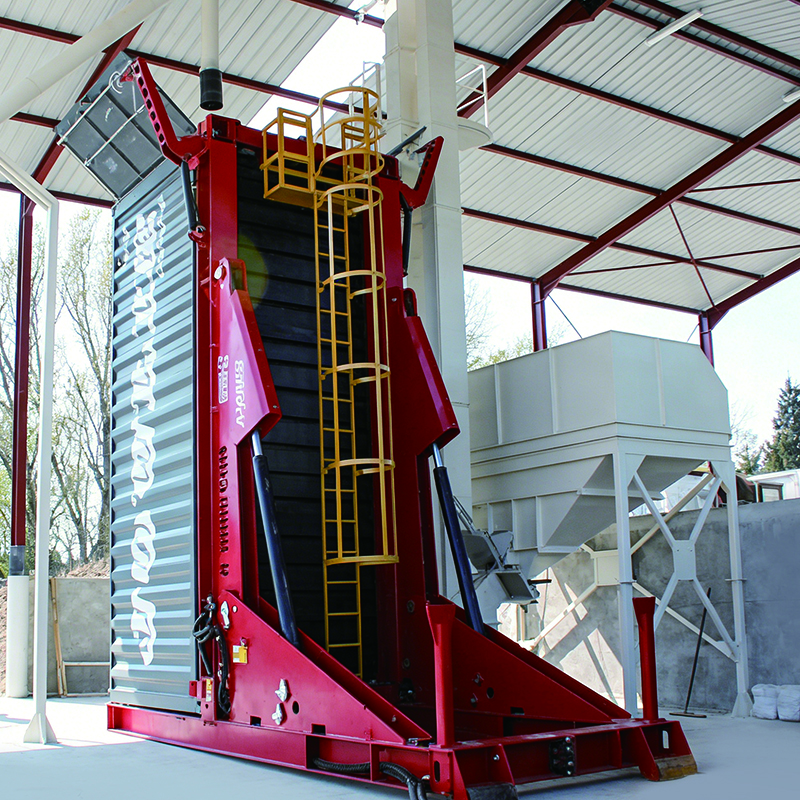
Container Loaders
What Is an Automated Container Loader?
An automated container loader is an integrated mechanical and control system used to move goods into or out of shipping containers with reduced manual intervention. Depending on the material and application, the system may work with conveyors, lifting platforms, telescopic mechanisms, loading structures, positioning components, weighing devices, door-opening equipment, or other customized modules.
The primary purpose of a container loader is to create a faster and more controlled connection between a warehouse, production line, truck, and container. Instead of relying entirely on forklifts and workers inside the container, the equipment supports a planned loading sequence. Products can be transferred, positioned, weighed, and distributed according to programmed operating requirements.
The equipment can be configured for 20-foot and 40-foot standard containers. Its adjustment mechanism enables the main working structure to match different container lengths, allowing one equipment platform to support multiple transport specifications. This flexibility is valuable for logistics centers and production facilities that handle mixed container fleets.
Unlike a simple conveyor extension, an integrated container loader combines several functions within one coordinated system. These functions may include container access, cargo movement, load positioning, lifting, weighing, door operation, and controlled withdrawal after the cycle is complete. By consolidating these operations, the equipment helps reduce transfer points and simplifies daily operation.
Integrated loading and unloading
A major characteristic of this equipment is its ability to perform both loading and unloading. A single system can be used to place goods into a container and later remove goods from the container, depending on the production or distribution requirement.
This dual-purpose design provides several advantages. First, it reduces the need to purchase separate machines for opposite material flows. Second, it simplifies equipment planning in facilities where inbound and outbound cargo share the same loading area. Third, it can improve asset utilization because the machine can support different operating tasks during different shifts.
Integrated loading and unloading is particularly useful for food, grain, chemical, cement, mineral, packaging, and general industrial operations. These industries often manage various product forms and require efficient container turnover. With suitable accessories and process configuration, the equipment can handle packaged products, palletized units, bags, cartons, sacks, granules, powders, and other materials.
One-click rapid entry and exit
The system is designed to simplify the movement of goods and equipment at the container interface. A coordinated control process can support rapid entry into the container, controlled loading, and efficient exit after the operation is completed. This reduces unnecessary manual positioning and shortens the time required between loading stages.
Fast entry and exit are important because container dwell time can affect transportation schedules, dock availability, labor planning, and demurrage exposure. A faster process also allows the same loading bay to handle more containers during a working shift.
Core Product Features
Automatic container door mechanism
Container doors are often heavy, awkward to handle, and located in areas where workers may be exposed to pinch points, uneven surfaces, or moving vehicles. The container loader can be configured with an automatic opening and closing mechanism that reduces or eliminates manual door operation.
Automatic door control improves process consistency because the door-opening sequence can be coordinated with the loading cycle. It also reduces labor intensity and limits the risk of workers being positioned near moving doors or equipment. For facilities with frequent container turnover, this feature can make a meaningful difference in daily operating safety.
Automatic door operation may also improve workflow discipline. When door opening, equipment positioning, loading, and withdrawal follow a defined sequence, operators have fewer manual actions to perform. This makes the process easier to standardize and can help reduce mistakes caused by rushed or inconsistent handling.
Configurable precision weighing
Accurate weight control is essential in container logistics. Overloaded containers can create regulatory, transportation, and safety problems, while underutilized containers increase the cost per unit of cargo. The container loader can integrate a high-precision weighing function to monitor cargo weight during loading and unloading.
Real-time weight information allows operators to observe the load condition as the process continues. This can help prevent overloading before the container leaves the facility. Where required, weighing data can be uploaded to a management system for production records, inventory control, shipment verification, or logistics traceability.
Integrated weighing is more efficient than relying only on a separate weighing station because the measurement function is connected directly to the loading process. This reduces repeated handling and can improve the relationship between cargo movement and shipment documentation.
Adaptation to 20-foot and 40-foot containers
Container fleets commonly include different lengths and configurations. Equipment designed for only one container size can create bottlenecks or require additional machinery. The flexible adjustment mechanism of this loader allows the system to adapt to both 20-foot and 40-foot standard containers.
The TJXH 20 model is designed for a 20-foot container application, with a listed size of approximately 6 meters by 3 meters. The TJXH 40 model is designed for a 40-foot container application, with a listed size of approximately 12 meters by 3 meters. The configuration allows users to select equipment according to their site layout, container mix, and maximum lifting requirements.
| Model | Applicable Container | Approximate Size, Length by Width | Maximum Lifting Weight | Maximum Lifting Angle |
|---|---|---|---|---|
| TJXH 20 | 20-foot container | 6 m by 3 m | 50 tonnes | 45 degrees or 60 degrees |
| TJXH 40 | 40-foot container | 12 m by 3 m | 100 tonnes | 45 degrees or 60 degrees |
Actual performance depends on the final engineering design, cargo characteristics, site conditions, container configuration, operating procedures, and selected options. Technical parameters should therefore be confirmed during project design and before production.
Precision drive control
Goods can be damaged when they are accelerated too quickly, collide with the container wall, or shift abruptly during loading. The precision drive control system is designed to support smooth movement throughout the loading and unloading process.
Controlled movement helps reduce sudden starts, stops, impacts, and uncontrolled sliding. This is especially important for packaged food, fragile cartons, high-value materials, bulk bags, drums, and products whose packaging can be damaged by collision. Smooth drive control also contributes to a more stable working environment for operators.
Precision movement is achieved through the coordinated design of mechanical transmission, drive components, sensors, control logic, and operating procedures. The objective is not simply to move cargo quickly, but to move it at a controlled speed while maintaining reliable positioning.
Advantages Compared with Conventional Loading Methods
Reduced labor dependence
Manual loading often requires several workers to move, position, stack, guide, and inspect products inside a container. Forklift-based operations may reduce some manual work, but they still require skilled drivers, spotters, and workers to arrange cargo in confined spaces.
An automated container loader reduces the amount of physical handling required. Depending on the product, process, and degree of automation, labor requirements may be reduced by approximately 60 to 80 percent compared with fully manual loading. A typical operation may be managed by one or two trained operators instead of four to six workers.
Labor reduction does not mean that human supervision is removed. Operators remain responsible for system monitoring, safety confirmation, product verification, and response to abnormal conditions. However, the physical burden and exposure to repetitive handling are substantially reduced.
Shorter loading cycles
Conventional manual loading may require approximately 18 to 25 minutes per container, depending on product type, packaging, stacking requirements, and the number of workers involved. A semi-automatic process may reduce the cycle to around 8 minutes, while a fully automated configuration may achieve an average cycle of approximately 3 to 6 minutes under suitable conditions.
The exact cycle time depends on cargo weight, product flow rate, container arrangement, loading pattern, equipment configuration, and operator procedures. Nevertheless, the difference between a manual process and an integrated automated process can be substantial.
Faster loading improves dock utilization. If a facility operates multiple loading bays for extended shifts, reducing the average cycle time can significantly increase the number of containers processed each day. Higher throughput may also reduce waiting time for trucks and improve production scheduling.
Improved container fill rate
Manual loading can leave voids, create uneven stacking, or produce excessive gaps between cargo units. These conditions reduce the usable volume of the container and may cause the load to shift during transportation.
Automated equipment can use programmable loading patterns, controlled positioning, sensors, and repeatable movement to distribute goods more evenly. In many applications, this may improve container fill utilization by approximately 5 to 8 percent compared with less controlled manual methods.
Better fill utilization can reduce the number of containers required for a given shipment volume. It may also improve cargo stability by supporting more balanced weight distribution. For high-volume exporters, even a small improvement in average fill rate can produce meaningful annual savings.
Lower product damage risk
Product damage may result from dropping, impact, excessive pressure, unstable stacking, or repeated handling. Manual operations can vary significantly between workers and shifts. Automated systems follow programmed movements and defined loading patterns, creating greater process consistency.
Controlled acceleration and deceleration help reduce impacts. Accurate positioning can protect cartons and bags from being pushed against container walls. Stable distribution can help prevent movement during transport. These benefits are especially relevant for products with strict packaging or quality requirements.
Automation cannot eliminate every source of damage. Product packaging, container condition, loading pattern, moisture, vibration, and transport conditions must also be considered. However, a well-designed loading system can reduce the handling-related causes of damage.
Enhanced workplace safety
Container interiors can be confined, poorly ventilated, hot, dark, or difficult to access. Forklift entry into a container may create collision risks, while manual stacking exposes workers to lifting injuries and repetitive strain.
An automated loader reduces the need for workers to enter the container during normal operation. It can also reduce interaction between pedestrians and forklifts in the loading area. Automatic door operation, controlled equipment movement, and defined safety procedures further improve the working environment.
Safety functions may include emergency stops, limit switches, interlocks, guarding, warning signals, access controls, and operating status indicators. The final safety package should be designed according to the application, local regulations, and site risk assessment.
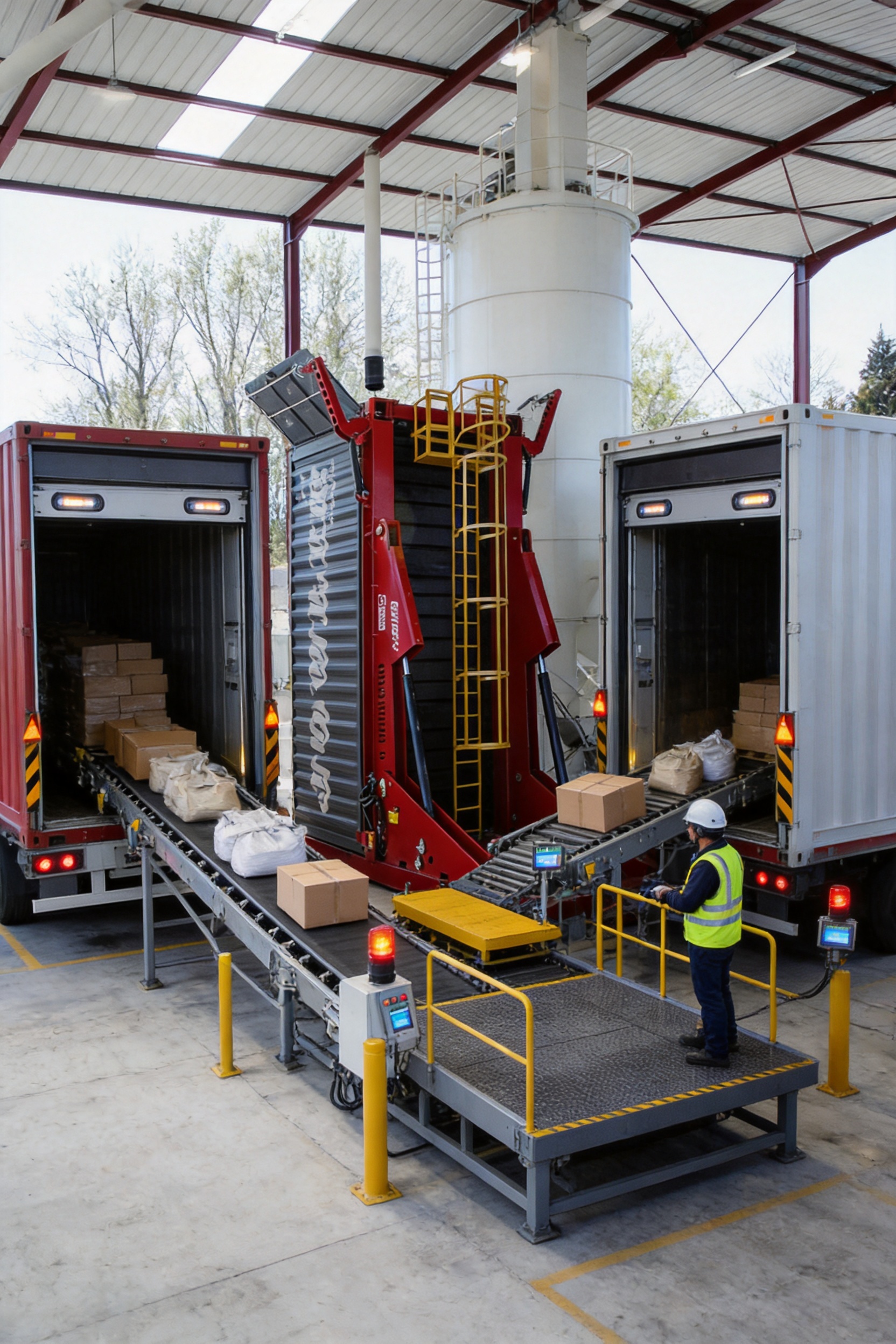
Engineering Design for Different Cargo Types
Container loading equipment must be selected according to the physical characteristics of the cargo. The same configuration cannot be expected to perform optimally with every product. Material density, particle size, packaging strength, moisture content, flowability, surface friction, stacking behavior, and sensitivity to impact all influence the system design.
Bagged and packaged products
Bagged products may include grains, flour, feed, fertilizer, chemicals, food ingredients, and other powder or granular materials. Depending on the package size and handling requirements, belt conveyors, roller conveyors, chain conveyors, slat conveyors, telescopic conveyors, or specialized transfer devices may be used.
The loading pattern should consider bag orientation, stacking height, weight distribution, and the need to avoid excessive compression. A controlled system can help place bags in layers or rows, reducing empty spaces and improving the stability of the completed load.
Cartons and consumer goods
Cartons and packaged consumer goods may require gentle handling and accurate placement. The system can be designed to reduce collision between packages and to support consistent product spacing. Where products have different dimensions, sensors and programmable sequences may be used to accommodate multiple package formats.
For mixed cargo, the equipment design may need to include product identification, sorting, recipe management, or operator confirmation. These functions can help ensure that the correct loading sequence is followed for each shipment.
Bulk granules and powders
Bulk materials may be transferred through chutes, telescopic loading devices, enclosed conveyors, or other systems selected according to flow characteristics. Dust control is an important consideration for cement, minerals, grain, flour, chemical powders, and similar products.
In these applications, the loading system may incorporate dust extraction, sealing, level monitoring, and material flow control. The objective is to protect workers, reduce material loss, improve housekeeping, and maintain a stable loading rate.
Palletized units and heavy cargo
Palletized products and heavy units require careful consideration of lifting capacity, floor loading, container strength, center of gravity, and equipment stability. The listed TJXH 20 and TJXH 40 models offer maximum lifting capacities of 50 tonnes and 100 tonnes respectively, subject to final engineering confirmation.
Heavy cargo loading should be planned with appropriate lifting points, support structures, restraints, and safety margins. The container loader can form part of a larger system that includes cranes, conveyors, pallet handling equipment, or positioning fixtures.
Manufacturing and Engineering Strengths
Integrated design and production capability
Jiangsu Zhengding Intelligent Equipment Co., Ltd. focuses on the research, development, manufacturing, and sales of intelligent loading and unloading equipment. This integrated business structure allows the company to coordinate product design, mechanical fabrication, electrical control, system assembly, testing, installation support, and after-sales service.
For customers, an integrated supplier can reduce the coordination burden associated with multi-vendor projects. Instead of separately managing the mechanical platform, control system, weighing equipment, door mechanism, and installation team, customers can work with one engineering organization responsible for the overall solution.
Integrated responsibility is particularly valuable for customized equipment. Container loading projects often involve unusual site dimensions, different cargo types, limited space, existing conveyors, elevated platforms, or special operational requirements. A supplier with broad in-house capabilities can adjust the design more effectively than a company offering only a standard machine.
Mechanical fabrication and structural reliability
Container loaders are subject to significant static and dynamic loads. Their structural design must account for lifting forces, cargo weight, repeated cycles, vibration, equipment deflection, and uneven operating conditions. Strong structural engineering is therefore essential.
The manufacturing process normally begins with technical confirmation of the application, including container dimensions, maximum load, lifting angle, duty cycle, cargo characteristics, and site arrangement. Engineers then develop the equipment structure, supporting frame, movement mechanism, hydraulic or electric drive arrangement, and safety components.
Fabricated components must be accurately cut, formed, welded, machined, assembled, and inspected. Proper alignment is important because misalignment can increase wear, reduce operating smoothness, and affect weighing accuracy. Surface preparation and protective coating also help extend service life in industrial environments.
Electrical control and automation integration
A modern container loader is more than a steel structure. Its performance depends on the coordination of motors, drives, sensors, switches, weighing devices, control panels, safety circuits, and operator interfaces.
The control system can be configured to manage equipment start-up, movement speed, positioning, door operation, loading sequences, weighing feedback, and emergency shutdown. Clear operating logic helps operators understand the machine status and respond quickly to abnormal conditions.
Where customers require digital management, weighing and operating data can be connected to a plant management system. This may support shipment records, production traceability, inventory management, maintenance planning, and performance analysis.
Quality control and testing
Reliable equipment requires testing at multiple stages. Incoming components should be checked against specifications. Fabricated structures should be inspected for dimensions, weld quality, alignment, and surface condition. Electrical components should be verified for correct installation and signal operation.
Before delivery, the assembled system should undergo functional testing. Depending on the project, testing may include no-load movement, loaded movement, lifting tests, weighing verification, door mechanism operation, emergency stop checks, limit switch checks, control sequence testing, and communication testing.
Factory testing helps identify problems before installation at the customer site. It also gives operators and service personnel a clear understanding of the equipment's normal operating behavior.
Customization and site adaptation
Every logistics facility has different requirements. The available space may be restricted by columns, walls, conveyors, truck lanes, warehouse doors, drainage channels, or existing production equipment. Container heights and access directions may also vary.
Jiangsu Zhengding provides engineering support that can include site assessment, system design, installation supervision, commissioning assistance, and operator training. This project-based approach helps ensure that the final equipment is matched to the actual working environment rather than selected only from general catalog specifications.
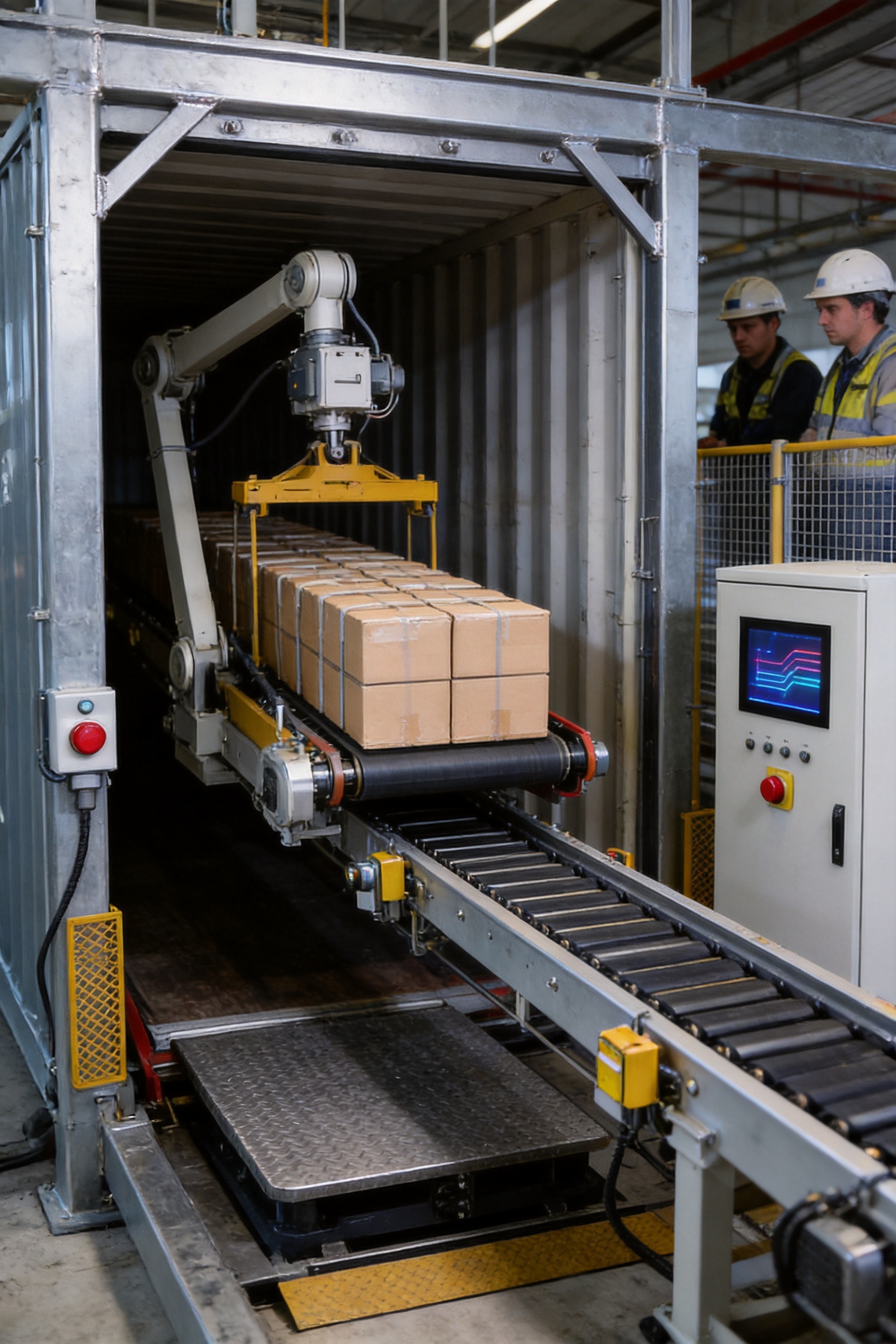
Operational Workflow
Step one: Container positioning
The container is positioned in the designated loading area according to the equipment layout. Correct alignment is important for safe operation and accurate access. Guide devices, sensors, markings, or operator instructions may be used to confirm that the container is correctly located.
Step two: Door opening and safety confirmation
When the automatic door option is installed, the system can open the container doors through a controlled sequence. Before movement begins, the control system and operator should confirm that the access area is clear, the container is stable, and all relevant safety conditions are satisfied.
Step three: Equipment adjustment
The flexible adjustment mechanism is set according to the container length and operating mode. The loader may be configured for a 20-foot or 40-foot container. Correct adjustment helps maintain smooth cargo movement and prevents interference with the container structure.
Step four: Loading or unloading
The goods are transferred through the selected conveyor, lifting structure, chute, or handling mechanism. The precision drive control system regulates movement to reduce sudden impacts. The loading pattern can be selected or programmed according to product type and shipment requirements.
Step five: Weighing and monitoring
When the weighing function is included, cargo weight is monitored during the cycle. Operators can observe the weight in real time and stop or adjust the process when the target or maximum allowable weight is reached. Data may also be transmitted to a management system.
Step six: Withdrawal and door closing
After loading or unloading is complete, the equipment withdraws in a controlled manner. If the automatic door mechanism is installed, the container doors can be closed according to the operating sequence. The container is then ready for inspection, sealing, and dispatch.
Productivity and Economic Benefits
The economic value of an automated container loader is created through several combined improvements rather than one single feature. Faster loading increases dock capacity. Lower labor requirements reduce operating costs. Better fill rates reduce unused container space. Lower damage rates reduce claims and rework. Integrated weighing improves shipment control.
For example, a facility processing approximately 200 containers per week may reduce loading labor from eight workers per shift to two operators after implementing an automated system, depending on the product and operating arrangement. If throughput rises by approximately 35 percent at the same time, the facility can handle greater shipment volume without expanding the loading workforce proportionally.
Facilities with two loading bays operating for extended shifts may also achieve a significant increase in daily capacity when average loading time is reduced from approximately 22 minutes to approximately 4.5 minutes. Actual output depends on truck arrival patterns, product availability, container preparation, inspection, changeover, and other factors outside the equipment cycle itself.
Reduced demurrage exposure is another potential benefit. When containers remain at a facility longer than planned, transportation costs can increase. Faster loading and unloading can improve container turnover and support more predictable dispatch schedules.
Indicative comparison of loading methods
Performance Metric
Manual Loading
Automated Container Loading
Typical Result
Time per container
18 to 25 minutes
3 to 6 minutes
Approximately 70 to 80 percent faster
Workers per shift
4 to 6 people
1 to 2 operators
Approximately 60 to 75 percent less labor
Container fill rate
82 to 88 percent
92 to 96 percent
Approximately 5 to 8 percent better utilization
Product damage rate
2.5 to 4.0 percent
0.5 to 1.2 percent
Approximately 60 to 80 percent reduction
The values in this table are indicative industry ranges and should not be treated as guaranteed results for every facility. Performance depends on product properties, equipment configuration, operator training, site organization, and maintenance quality.
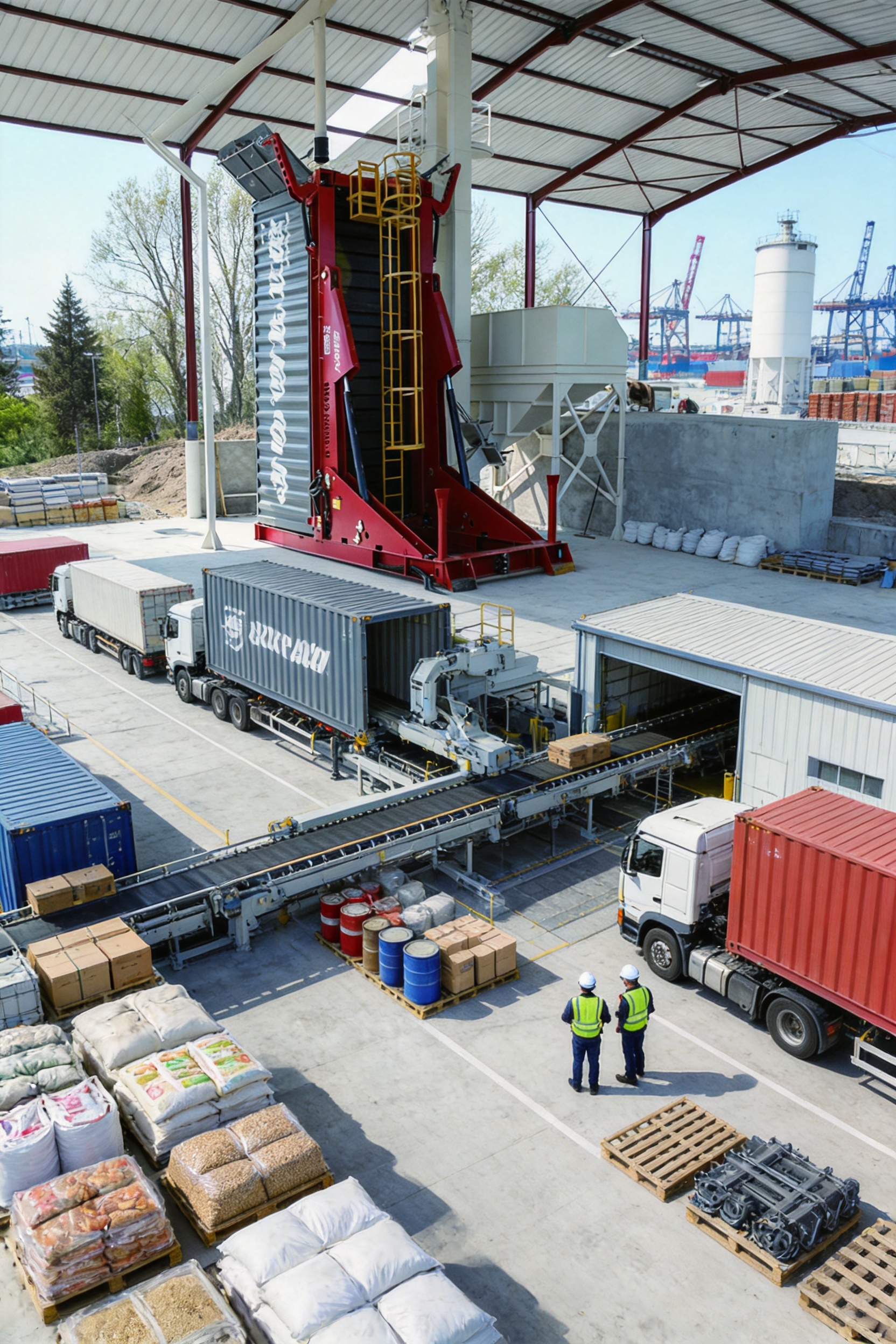
Safety, Maintenance, and Reliability
Safety design
Safety should be considered from the initial engineering stage. The loading zone should be arranged to separate pedestrians, vehicles, containers, and moving machine parts as much as possible. Operators should have clear visibility of the working area and access to emergency stop controls.
Mechanical guarding can protect personnel from rotating, sliding, lifting, or pinching components. Limit switches and position sensors can help prevent movement beyond the designed operating range. Interlocks may be used to prevent specific operations from starting unless the required conditions are met.
Written procedures should cover container positioning, door operation, equipment start-up, loading sequences, emergency response, inspection, and shutdown. Operators should be trained not only in normal operation but also in recognizing abnormal sounds, vibration, movement, weight readings, and warning signals.
Preventive maintenance
Regular maintenance supports reliable performance and helps prevent unplanned downtime. Inspection tasks may include checking structural connections, drive components, bearings, chains, rollers, belts, hydraulic or electrical systems, sensors, safety devices, weighing components, and door mechanisms.
Wear parts should be inspected according to cycle frequency and operating conditions. Dust, moisture, abrasive materials, and corrosive substances may increase maintenance requirements. Cleaning is especially important in food, grain, chemical, and powder-handling applications.
A preventive maintenance schedule should distinguish between daily checks, weekly inspections, monthly service, and periodic major inspection. Maintenance records can help identify recurring problems and support decisions regarding spare parts and component upgrades.
Reliability in demanding industries
The equipment is suitable for industrial sectors where loading operations must continue under demanding conditions. These sectors include steel, chemicals, cement, coal, grain, oil, food, feed, minerals, ports, papermaking, and new energy applications.
Different industries require different approaches. Chemical facilities may prioritize sealing, corrosion resistance, and safe product handling. Grain and food facilities may emphasize cleanliness, dust management, and contamination control. Cement and mineral plants may require abrasion-resistant components. Ports may prioritize high throughput and coordination with transport schedules.
Applications Across Multiple Industries
Food and grain logistics
Food ingredients, grains, feed, flour, and packaged agricultural products are frequently transported in containers. Automated loading can help maintain consistent cargo distribution and reduce manual contact with the product. Weighing integration is also valuable for shipment verification and inventory control.
Food-related applications may require special attention to hygiene, cleanability, material selection, dust management, and product segregation. The final system should be designed according to the facility's sanitation requirements and applicable regulations.
Chemical and fertilizer handling
Chemical materials and fertilizers may be supplied in bags, drums, bulk bags, or other packages. A controlled container loader can reduce manual handling and improve the repeatability of the loading sequence. Dust extraction and enclosure may be considered for powder products.
For hazardous or sensitive materials, the design must address product compatibility, electrical classification, containment, emergency response, and operator protection. These requirements should be defined before equipment selection.
Cement, minerals, and building materials
Cement, minerals, and other construction materials are often heavy, abrasive, or dusty. Equipment used in these environments must be structurally robust and designed for demanding duty cycles. Controlled transfer can reduce product loss and help maintain cleaner working conditions.
The lifting capacity and loading angle should be confirmed according to the cargo and container arrangement. Where large quantities are handled, automated weighing can help prevent shipment errors and improve material accounting.
Steel and industrial manufacturing
Steel products, industrial components, and manufactured goods may vary widely in shape and weight. Some loads are palletized, while others require specialized fixtures or lifting arrangements. A customized container loading system can be integrated with cranes, conveyors, production lines, or warehouse handling systems.
In these applications, the engineering process must consider center of gravity, load restraint, package dimensions, container floor strength, and the sequence required to maintain stability.
Ports and distribution centers
Ports and distribution centers depend on fast container turnover. Automated loading and unloading equipment can help coordinate warehouse operations with truck and container schedules. The ability to handle both 20-foot and 40-foot containers is useful where different container sizes arrive throughout the day.
Remote monitoring and data connection can further support centralized supervision. Operators may use system data to evaluate cycle times, container counts, weight records, equipment status, and maintenance needs.
Why Choose an Experienced Equipment Manufacturer?
Container loading equipment is a project-specific industrial system rather than a simple off-the-shelf machine. Successful implementation depends on correct selection, accurate design, reliable manufacturing, effective installation, and appropriate operator training.
Jiangsu Zhengding Intelligent Equipment Co., Ltd. has developed a broad portfolio of automated loading and unloading systems for vehicles, containers, ships, and logistics applications. This experience allows the company to understand the relationship between container equipment and connected material-handling processes.
The company operates as a national high-tech enterprise focused on intelligent logistics equipment. Its products have been supplied to industries including steel, chemical, cement, coal, grain, oil, food, feed, ports, papermaking, and new energy. The equipment has also been exported to markets in Asia, the Middle East, South America, Africa, and other regions.
Its international user base includes major companies in brewing, food ingredients, agricultural products, chemicals, consumer goods, and industrial materials. Experience with large and diverse customers can help strengthen project execution, documentation, commissioning procedures, and service practices.
Complete product range
The company's product range includes rear dumpers, side-turn truck dumpers, automobile loading equipment, container flippers, container loaders, and other automated handling systems. This broad range creates opportunities for customers to develop a coordinated logistics solution from one supplier.
For example, a project may combine a vehicle dumper for unloading raw materials, a conveyor system for transfer, a weighing system for measurement, and a container loader for export shipment. A supplier that understands each stage can help improve the compatibility of the complete process.
Project support from assessment to training
Engineering support may begin with a review of the customer's cargo, container types, throughput requirements, available space, existing equipment, and safety conditions. The supplier can then develop a preliminary process concept and refine the design after technical discussions.
Support may include site assessment, layout planning, equipment design, manufacturing, factory testing, installation supervision, commissioning, operator training, maintenance guidance, and after-sales service. This complete process reduces the risk of gaps between equipment delivery and actual production use.
Focus on customized solutions
Standardized modules can improve manufacturing efficiency, but customization is often necessary for industrial container loading. The loading pattern, equipment height, conveyor direction, container access, cargo weight, and control requirements may differ from one facility to another.
A customized design can help address these differences while maintaining the benefits of a standardized engineering platform. This balance between modular production and application-specific adaptation is an important advantage for industrial customers.
Implementation Recommendations
Before ordering an automated container loader, customers should prepare detailed technical information. This information allows the manufacturer to confirm the correct model and develop an appropriate solution.
Information required for system design
Important information includes the container sizes to be handled, the maximum cargo weight, the product form, package dimensions, target throughput, average containers per shift, loading and unloading direction, available installation space, floor and foundation conditions, existing conveyors, power supply, environmental conditions, and required data interfaces.
Customers should also describe special requirements such as dust extraction, explosion protection, cleanability, corrosion resistance, food-grade materials, remote monitoring, automatic door operation, or integration with warehouse management software.
Layout and foundation preparation
The site must provide sufficient space for the container, vehicle approach, equipment movement, operator access, inspection, maintenance, and emergency evacuation. The foundation must be able to support the equipment and the expected static and dynamic loads.
Early layout review helps prevent interference with doors, columns, fire equipment, drainage, traffic lanes, or overhead structures. It also allows the customer to plan electrical connections, control cabinets, lighting, ventilation, and safety barriers before installation.
Operator training
Most modern automated loading systems are designed with user-friendly control interfaces. Basic operator training commonly requires approximately two to four days, depending on the equipment complexity and the customer's experience. Advanced programming, troubleshooting, and maintenance may require additional training.
Training should cover normal operation, container positioning, door mechanism use, weighing procedures, safety devices, emergency stops, daily inspection, cleaning, fault reporting, and basic troubleshooting. Clear manuals and operating checklists help maintain consistent procedures across shifts.
Frequently Asked Questions
Q1: What products can an automated container loader handle?
Automated container loaders can be configured for bagged goods, cartons, sacks, palletized products, bulk granules, powders, drums, food ingredients, feed, grain, minerals, cement, chemicals, and selected irregular items. The conveyor, chute, gripping device, lifting structure, and loading pattern must be selected according to the product's size, weight, flowability, packaging strength, and sensitivity to impact.
Q2: Can one machine handle both loading and unloading?
Yes. The integrated design supports both loading and unloading operations. The final operating method depends on the selected configuration, cargo type, container arrangement, and control program. A dual-purpose system can reduce the need for separate machines and improve equipment utilization.
Q3: Can the equipment handle both 20-foot and 40-foot containers?
Yes. The flexible adjustment mechanism is designed to adapt to standard 20-foot and 40-foot containers. The TJXH 20 and TJXH 40 models are listed for these two container sizes respectively. The correct model and configuration should be confirmed according to the site layout, maximum lifting weight, operating angle, and container fleet.
Q4: Does the system include automatic container door operation?
An automatic opening and closing mechanism can be configured as an option. This feature reduces manual door handling, lowers labor intensity, and helps keep operators away from potential pinch points and moving door components.
Q5: How does integrated weighing help the operation?
Integrated weighing monitors cargo weight during loading and unloading. It helps prevent overloading, supports shipment verification, and may provide data for management systems. Real-time weight monitoring is especially useful for facilities that must control shipping weight accurately or maintain detailed material records.
Q6: How much labor can the equipment save?
Actual savings depend on the cargo, process, work schedule, and automation level. Indicative comparisons suggest that automated loading can reduce labor requirements by approximately 60 to 75 percent compared with manual methods. A process that requires four to six workers may be managed by one or two trained operators after automation.
Q7: How fast can a container be loaded?
Typical automated loading cycles may range from approximately three to six minutes per container, while manual loading may take approximately 18 to 25 minutes. Actual cycle time depends on product characteristics, cargo flow, loading pattern, equipment configuration, container preparation, and inspection procedures.
Q8: Can the system connect to a factory management system?
Yes. When specified during the design stage, weighing data and operating information can be connected to a management system. Possible functions include shipment records, production traceability, inventory updates, container counts, weight reports, equipment status, and maintenance data.
Q9: What type of maintenance is required?
Maintenance generally includes inspection of the structure, fasteners, drive system, bearings, belts, chains, rollers, sensors, weighing components, electrical cabinet, safety devices, and automatic door mechanism. Cleaning and lubrication requirements depend on the product and environment. A preventive maintenance schedule should be established during commissioning.
Q10: Is customized design available?
Yes. The equipment can be customized according to container dimensions, cargo characteristics, throughput, site layout, existing conveyors, lifting requirements, weighing needs, environmental conditions, and control system requirements. Site assessment and technical confirmation are recommended before final selection.
Conclusion
Automated container loaders provide a comprehensive solution for facilities seeking faster, safer, and more consistent container logistics. Their value comes from the integration of loading and unloading functions, automatic door operation, precision weighing, flexible adjustment for 20-foot and 40-foot containers, and controlled drive movement.
Compared with manual handling and basic conveyor extensions, integrated container loading equipment can reduce labor requirements, shorten loading cycles, improve container fill utilization, reduce product damage, and support better weight control. These advantages are relevant to food, grain, chemical, cement, mineral, steel, port, agricultural, and general manufacturing applications.
The strength of the solution depends not only on the machine's listed specifications but also on the manufacturer's engineering and manufacturing capability. Jiangsu Zhengding Intelligent Equipment Co., Ltd. combines product development, mechanical manufacturing, automation integration, project support, and application experience to provide complete loading and unloading solutions.
For customers planning a new installation or upgrading an existing loading area, the best results come from early technical cooperation. By evaluating the cargo, container fleet, throughput target, site conditions, safety requirements, and data needs in advance, the final system can be designed for dependable operation and long-term value.
References
1. Jiangsu Zhengding Intelligent Equipment Co., Ltd. Product information for integrated container loaders, including model specifications, lifting capacity, container compatibility, and functional options.
2. Jiangsu Zhengding Intelligent Equipment Co., Ltd. Company information concerning intelligent logistics equipment, automated vehicle and container handling systems, manufacturing capabilities, and industry applications.
3. General industrial guidance on container loading efficiency, material-handling automation, workplace safety, and warehouse throughput improvement.
4. General engineering principles for conveyor systems, lifting equipment, industrial automation, weighing integration, and preventive maintenance.
5. General logistics practices for container utilization, cargo weight control, shipment traceability, and loading damage prevention.
Product: Container Loaders
Operational Workflow
Step one: Container positioning
The container is positioned in the designated loading area according to the equipment layout. Correct alignment is important for safe operation and accurate access. Guide devices, sensors, markings, or operator instructions may be used to confirm that the container is correctly located.
Step two: Door opening and safety confirmation
When the automatic door option is installed, the system can open the container doors through a controlled sequence. Before movement begins, the control system and operator should confirm that the access area is clear, the container is stable, and all relevant safety conditions are satisfied.
Step three: Equipment adjustment
The flexible adjustment mechanism is set according to the container length and operating mode. The loader may be configured for a 20-foot or 40-foot container. Correct adjustment helps maintain smooth cargo movement and prevents interference with the container structure.
Step four: Loading or unloading
The goods are transferred through the selected conveyor, lifting structure, chute, or handling mechanism. The precision drive control system regulates movement to reduce sudden impacts. The loading pattern can be selected or programmed according to product type and shipment requirements.
Step five: Weighing and monitoring
When the weighing function is included, cargo weight is monitored during the cycle. Operators can observe the weight in real time and stop or adjust the process when the target or maximum allowable weight is reached. Data may also be transmitted to a management system.
Step six: Withdrawal and door closing
After loading or unloading is complete, the equipment withdraws in a controlled manner. If the automatic door mechanism is installed, the container doors can be closed according to the operating sequence. The container is then ready for inspection, sealing, and dispatch.
Productivity and Economic Benefits
The economic value of an automated container loader is created through several combined improvements rather than one single feature. Faster loading increases dock capacity. Lower labor requirements reduce operating costs. Better fill rates reduce unused container space. Lower damage rates reduce claims and rework. Integrated weighing improves shipment control.
For example, a facility processing approximately 200 containers per week may reduce loading labor from eight workers per shift to two operators after implementing an automated system, depending on the product and operating arrangement. If throughput rises by approximately 35 percent at the same time, the facility can handle greater shipment volume without expanding the loading workforce proportionally.
Facilities with two loading bays operating for extended shifts may also achieve a significant increase in daily capacity when average loading time is reduced from approximately 22 minutes to approximately 4.5 minutes. Actual output depends on truck arrival patterns, product availability, container preparation, inspection, changeover, and other factors outside the equipment cycle itself.
Reduced demurrage exposure is another potential benefit. When containers remain at a facility longer than planned, transportation costs can increase. Faster loading and unloading can improve container turnover and support more predictable dispatch schedules.
Indicative comparison of loading methods
| Performance Metric | Manual Loading | Automated Container Loading | Typical Result |
|---|---|---|---|
| Time per container | 18 to 25 minutes | 3 to 6 minutes | Approximately 70 to 80 percent faster |
| Workers per shift | 4 to 6 people | 1 to 2 operators | Approximately 60 to 75 percent less labor |
| Container fill rate | 82 to 88 percent | 92 to 96 percent | Approximately 5 to 8 percent better utilization |
| Product damage rate | 2.5 to 4.0 percent | 0.5 to 1.2 percent | Approximately 60 to 80 percent reduction |
The values in this table are indicative industry ranges and should not be treated as guaranteed results for every facility. Performance depends on product properties, equipment configuration, operator training, site organization, and maintenance quality.


