

 English
 русский
 Español
 Français
 Português
 عربى





+86-13588556918
Content
- 1 1. The Role of Dehulling in Modern Oat Processing
- 2 2. Working Principle of the Centrifugal Oat Dehuller
- 3 3. Main Product Advantages
- 4 4. Product Models and Technical Parameters
- 5 5. Comparing the Centrifugal Design with Other Dehulling Methods
- 6 6. Capacity Planning for Farms and Factories
- 7 7. Advanced Manufacturing and Engineering Strengths
- 8 8. Integration with Grain-Handling and Logistics Systems
- 9 9. Installation Requirements
- 10 10. Operating Guidelines for Consistent Results
- 11 11. Maintenance and Wear-Part Management
- 12 12. Quality Control and Performance Verification
- 13 13. Selecting the Correct Model and Configuration
- 14 14. Company Manufacturing and Service Capabilities
- 15 15. Applications in Different Production Environments
- 16 16. Frequently Asked Questions
- 16.1 Q1: What is the main function of an oat dehuller?
- 16.2 Q2: How does the centrifugal design work?
- 16.3 Q3: What is the one-time dehulling rate?
- 16.4 Q4: Can the rotational speed be adjusted?
- 16.5 Q5: Can the machine process grains other than oats?
- 16.6 Q6: Which model is suitable for a small farm?
- 16.7 Q7: Which model provides higher capacity?
- 16.8 Q8: How can groat breakage be reduced?
- 16.9 Q9: How often should wear components be inspected?
- 16.10 Q10: Does the machine require downstream separation equipment?
- 16.11 Q11: Can the dehuller be integrated into an automated line?
- 16.12 Q12: What information should be supplied when requesting a quotation?
- 17 17. Conclusion
- 18 References
- 19 Product: Oat Dehuller
Oat processing begins with a difficult separation task. The oat kernel is protected by a tough outer hull that must be removed without damaging the groat inside. If dehulling is incomplete, excessive hull material enters downstream equipment and reduces product quality. If the dehulling force is too aggressive, the groat may crack, split, or become unsuitable for premium products such as rolled oats, oat flakes, oat flour, and steel-cut oats.
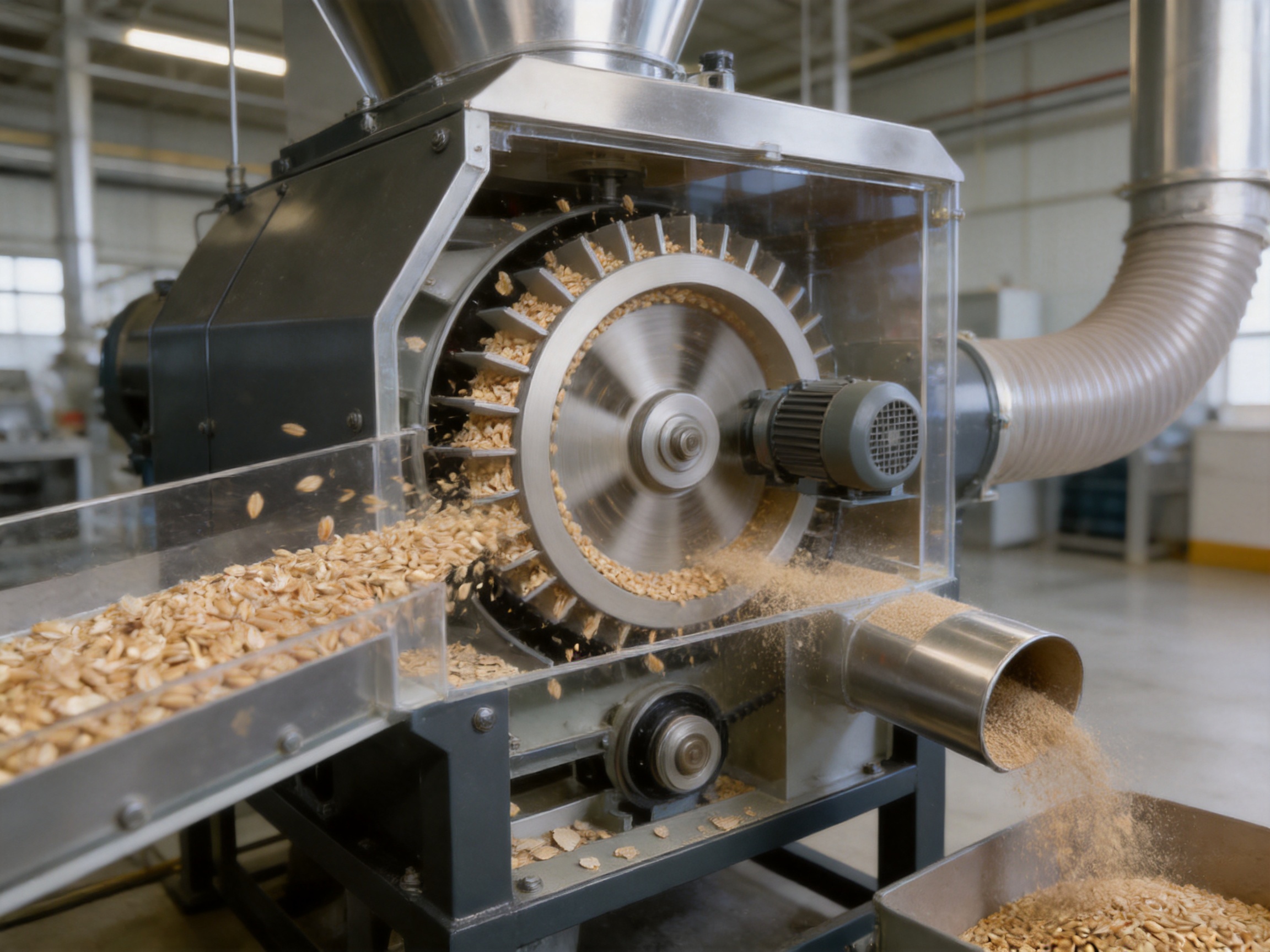
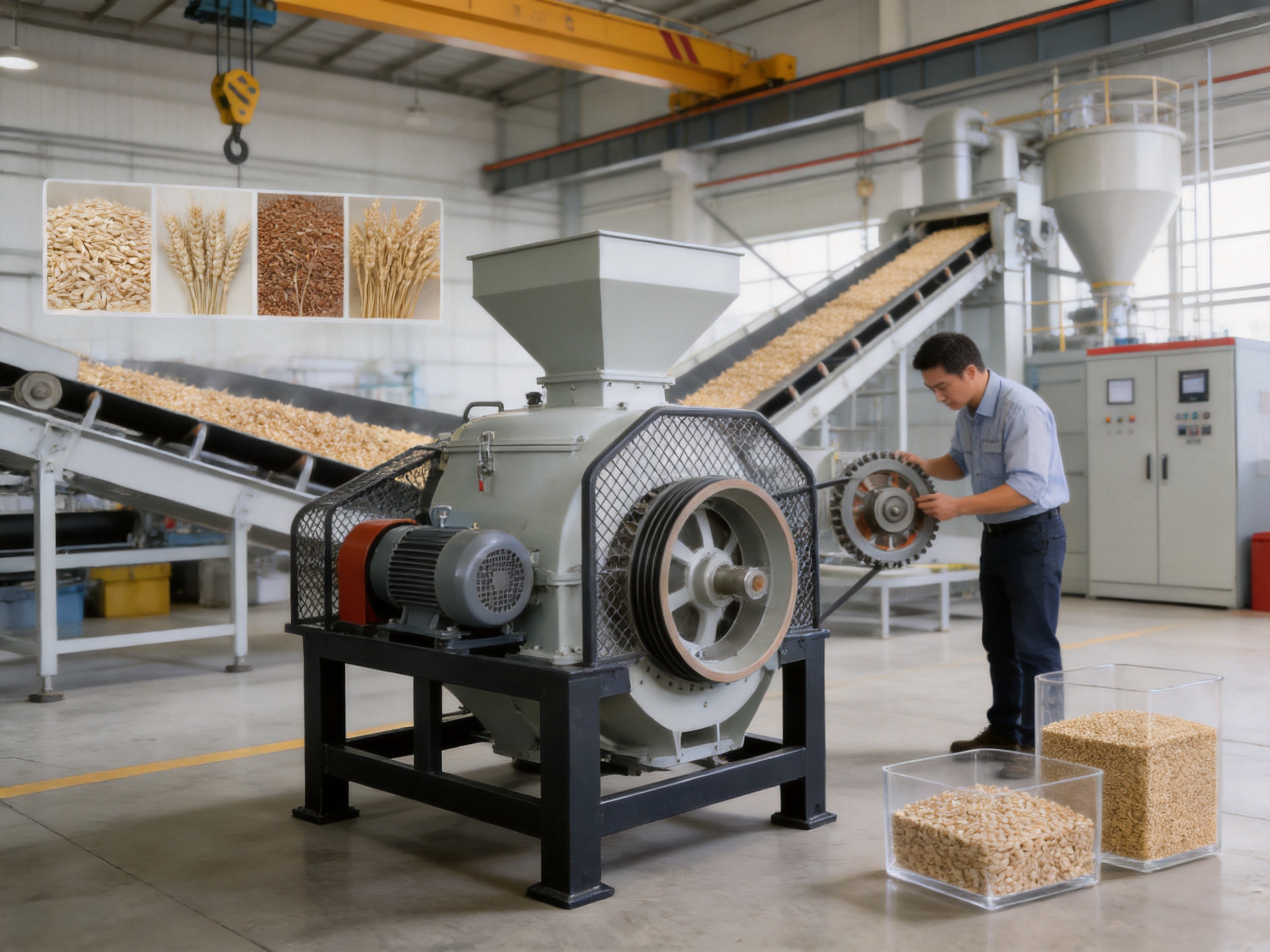
The Oat Dehuller is a centrifugal dehulling machine developed for efficient hull removal, controlled impact, and low groat breakage. It uses a high-speed rotating centrifugal disk to accelerate cleaned oats toward an impact ring. Guide slots inside the disk control the direction of movement so that the kernels strike the ring in a consistent manner. The impact causes the oat hulls to crack and separate from the groats, allowing the dehulled kernels and husk fragments to be separated in the following processing stage.
In addition to oats, the machine can be adapted for other difficult-to-dehull coarse grains, including barley, rye, and broomcorn millet. Its adjustable operating speed allows processors to respond to differences in grain variety, moisture content, kernel size, and hull attachment strength.
The equipment is manufactured by Jiangsu Zhengding Intelligent Equipment Co., Ltd., a national high-tech enterprise engaged in the research, development, manufacturing, and sales of intelligent loading, unloading, and grain-handling equipment. The company combines mechanical engineering, automated conveying technology, industrial manufacturing, and customized system integration to provide equipment for agricultural, food, grain, logistics, and industrial applications.
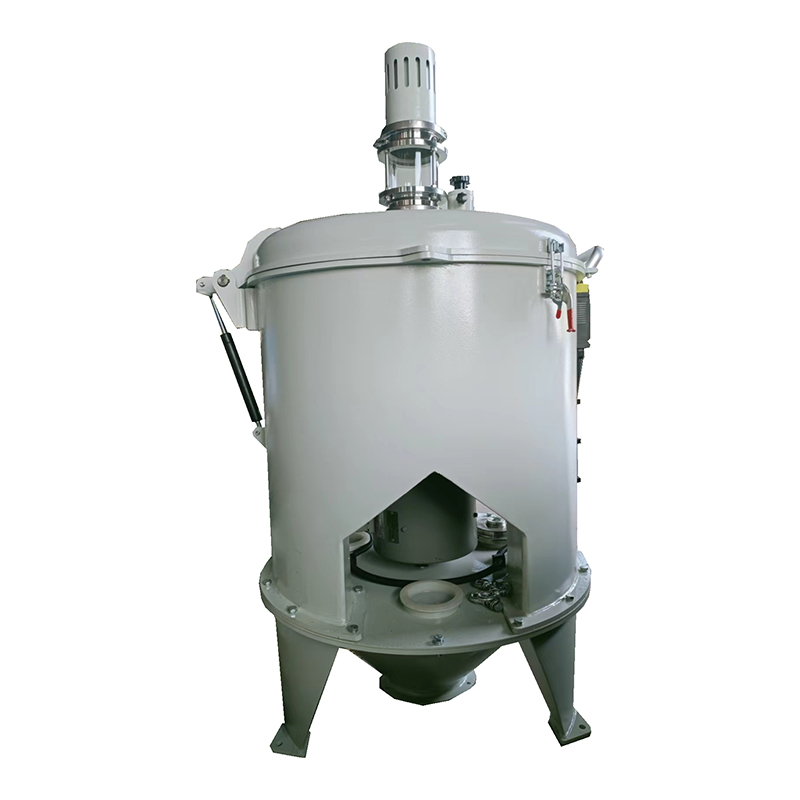
Oat Dehuller
1. The Role of Dehulling in Modern Oat Processing
Oat dehulling is one of the most important preparation stages in an oat processing line. Raw oats arrive with a fibrous outer husk that protects the kernel during cultivation, harvesting, storage, and transportation. Although the hull is useful in the field, it is not normally part of the finished human food product. It has a high fiber content, a tough structure, and a low processing value compared with the groat.
After harvesting, oats are commonly cleaned to remove stones, dust, straw, metal, and other foreign materials. The cleaned oats then pass through a dehuller, where mechanical force separates the hull from the groat. The dehulled material may subsequently be aspirated, screened, graded, stabilized, flaked, milled, or packed depending on the final product.
The dehulling stage directly influences several commercial indicators:
- Whole groat yield.
- Hull removal efficiency.
- Groat breakage rate.
- Appearance and color of the finished product.
- Energy consumption per ton.
- Wear-part consumption.
- Overall line capacity.
- Ease of operation and maintenance.
A machine that removes hulls effectively but produces a high percentage of broken groats may not be suitable for premium oat products. Conversely, equipment that minimizes breakage but leaves a large quantity of hulls attached may require repeated recirculation, increasing energy use and reducing capacity. The most practical solution is therefore a dehuller that balances impact intensity, separation efficiency, throughput, energy use, and product integrity.
The centrifugal design addresses this balance by controlling how the oat kernel moves before impact. Instead of allowing kernels to enter an impact zone randomly, the guide slots in the centrifugal disk help direct the kernels along a consistent trajectory. This improves repeatability and makes it possible to adjust the rotor speed to match the characteristics of the incoming grain.
2. Working Principle of the Centrifugal Oat Dehuller
The Oat Dehuller operates through a sequence of controlled mechanical actions. Prepared oats enter the feeding section and move toward the rotating centrifugal disk. As the disk rotates at high speed, centrifugal force accelerates the kernels outward. The guide slots within the disk maintain the direction of movement and guide the kernels toward the impact ring.
When the oat kernels strike the impact ring, the sudden change in movement creates stress between the hull and the groat. The hull cracks and breaks into several pieces. Because the oat groat is protected by the hull but has a different mechanical response to impact, a suitable combination of rotor speed, feed rate, moisture condition, and impact-ring design can split the hull while limiting damage to the groat.
The resulting mixture normally contains whole or partially dehulled groats, loose hull fragments, and a small amount of material requiring further processing. Air aspiration, screening, or a secondary separation system can then remove the lighter hull material from the heavier groats.
The primary operating stages are as follows:
- Cleaned oats enter the dehuller at a controlled feed rate.
- The rotating centrifugal disk accelerates the kernels.
- Guide slots direct the kernels toward the impact ring.
- The impact ring cracks and breaks the hulls.
- Groats and hull fragments leave the impact area.
- Downstream aspiration and screening separate the dehulled product from waste.
This operating principle offers an important advantage over less adjustable dehulling systems. The operator can vary the centrifugal disk speed according to the actual material condition. Oats with a higher moisture content, stronger hull attachment, or a different variety may require a different speed from dry, mature, easily dehulled oats.
The adjustment also helps processors manage the compromise between dehulling efficiency and groat breakage. A higher speed may improve hull cracking when the material is difficult to dehull, while a lower speed may be preferable when the groat is fragile or when whole-kernel yield is the primary commercial objective.
3. Main Product Advantages
3.1 High Dehulling Efficiency
The machine is designed to provide a high one-time dehulling rate. Under suitable operating conditions, the one-time dehulling rate can reach approximately 80 percent. Actual performance depends on oat variety, moisture content, kernel size distribution, feed uniformity, machine adjustment, and the effectiveness of the upstream cleaning process.
A high first-pass dehulling rate reduces the quantity of material that must be recirculated. This has several benefits. It reduces the load on elevators and conveyors, limits unnecessary handling, lowers energy consumption, and helps maintain a stable production rate. Fewer recirculation passes also reduce the risk that already dehulled groats will be exposed to unnecessary mechanical impact.
In a complete processing line, the performance of the dehuller should be evaluated together with aspiration, screening, feeding, and conveying equipment. A dehuller may achieve excellent results mechanically, but poor feeding or inadequate separation can reduce the overall line efficiency. Jiangsu Zhengding Intelligent Equipment Co., Ltd. provides experience in integrated material-handling systems, allowing the dehuller to be incorporated into a coordinated grain-processing solution.
3.2 Low Groat Breakage
Whole groats generally have greater commercial value than excessive quantities of broken groats. Whole material is suitable for a wider range of products and can provide a better appearance after steaming, rolling, or cutting. The Oat Dehuller is designed to remove hulls while controlling the impact applied to the kernel.
The guide slots in the centrifugal disk help establish a consistent impact path. This controlled path is important because random impacts can create irregular stress and increase the chance of damaging the groat. By adjusting the rotational speed, operators can select an appropriate impact intensity for the raw material.
Low breakage is especially important for processors producing premium rolled oats, instant oat products, whole-groat ingredients, and products marketed according to visible kernel quality. It also helps improve the yield of saleable material from each ton of raw oats.
3.3 Adjustable Rotational Speed
Different oat varieties do not behave identically during dehulling. Their hull attachment strength, moisture content, kernel thickness, and size distribution may vary significantly. A fixed-speed machine can be difficult to optimize when raw material conditions change. The adjustable-speed configuration of this Oat Dehuller provides greater flexibility.
Operators can adjust the centrifugal disk speed according to:
- Oat moisture content.
- Kernel variety and maturity.
- Average kernel size.
- Hull attachment strength.
- Required dehulling rate.
- Acceptable groat breakage.
- Desired processing capacity.
Speed adjustment also supports multi-grain applications. Barley, rye, and broomcorn millet may require different impact conditions from oats. A flexible centrifugal system can be configured for trials and production changes more easily than a machine designed for only one fixed operating condition.
3.4 Low Energy Consumption
Energy use is a major operating cost in grain processing. Dehulling equipment consumes power through the motor, rotor, feeding system, aspiration system, and related conveyors. Unnecessary recirculation, excessive friction, and unstable feeding can increase energy consumption per ton.
The Oat Dehuller is designed to use centrifugal force efficiently. The rotating disk performs both acceleration and directional control, reducing the need for multiple separate impact stages. Its high first-pass dehulling capability can also reduce the energy required for repeated processing.
Low energy consumption is valuable for both small farms and industrial factories. On a farm-scale installation, it reduces the electrical demand and may simplify the selection of the supporting power supply. In a factory, even a modest reduction in energy per ton can produce meaningful annual savings when the machine operates for long hours.
3.5 Wear-Resistant Components
The guide slots and impact ring experience repeated high-speed contact with grain. These areas are exposed to friction, impact, and abrasion from kernels, hull particles, dust, and any remaining mineral contamination. Ordinary materials may wear quickly under these conditions, resulting in changing machine performance and frequent maintenance.
The Oat Dehuller uses specially selected wear-resistant materials for key contact components. The objective is to reduce wear-part replacement frequency, extend the maintenance cycle, and stabilize the machine over its operating life.
Wear resistance provides more than a longer service interval. It helps preserve the original geometry of the guide slots and impact ring. Stable geometry supports consistent impact conditions and helps prevent the dehulling rate or breakage rate from changing rapidly as the machine operates.
3.6 Adaptability to Other Coarse Grains
Although the equipment is designed primarily for oats, its operating principle can also be applied to other grains that are difficult to dehull. Barley, rye, and broomcorn millet can be considered for suitable applications after testing and adjustment.
Each grain should be evaluated separately because differences in shape, hardness, moisture, and hull attachment can affect performance. Operators may need to adjust rotor speed, feed rate, screening conditions, and downstream aspiration. For commercial production, a material test is recommended before finalizing equipment configuration.
| Grain | Primary processing objective | Important adjustment factors | Recommended evaluation |
|---|---|---|---|
| Oats | Remove hulls while preserving whole groats | Moisture, kernel size, rotor speed, feed rate | Measure dehulling rate and groat breakage |
| Barley | Separate hull or outer covering from the kernel | Hull strength, kernel hardness, impact intensity | Check hull removal and product cleanliness |
| Rye | Process a relatively slender coarse grain | Feed uniformity, speed, impact-ring condition | Evaluate kernel damage and material flow |
| Broomcorn millet | Improve separation of tightly attached outer material | Particle size distribution and feeding stability | Conduct small-batch performance testing |
4. Product Models and Technical Parameters
The available product models are designed for different capacity requirements. The TTK56 model uses a 3-kilowatt motor and provides an output of approximately 0.8 to 1.5 tons per hour when processing oats. The TTK60 model uses a 5.5-kilowatt motor and provides an output of approximately 2.5 to 3.2 tons per hour under oat-based operating conditions.
Actual output depends on the condition of the raw material and the complete processing configuration. Capacity should not be determined by motor power alone. Feeding uniformity, cleaning quality, oat moisture, desired dehulling rate, and separation efficiency all affect the practical output of a line.
| Product model | Motor power | Approximate output based on oats | Typical one-time dehulling reference |
|---|---|---|---|
| TTK56 | 3 kilowatts | 0.8 to 1.5 tons per hour | At least 75 percent under stated conditions |
| TTK60 | 5.5 kilowatts | 2.5 to 3.2 tons per hour | At least 75 percent under stated conditions |
The technical figures should be treated as reference values rather than universal guarantees for every oat variety. Before purchase, customers should provide information about annual volume, target hourly capacity, raw material moisture, expected product type, operating hours, and available electrical infrastructure. A sample test can provide a more reliable basis for selecting a model and setting operating conditions.
5. Comparing the Centrifugal Design with Other Dehulling Methods
Traditional stone-based systems may be suitable for certain small-scale applications, but they may offer limited control over impact intensity and may require more manual adjustment. Fixed-speed impact machines can provide a simple operating structure, yet they may be less flexible when the raw material changes.
The centrifugal design offers a combination of high-speed acceleration, directional control, adjustable speed, and replaceable wear components. These features make it suitable for processors that require consistent output across changing raw material conditions.
| Evaluation factor | Traditional stone-type system | Fixed-speed impact system | Adjustable centrifugal system |
|---|---|---|---|
| Speed adjustment | Limited | Usually limited | Flexible |
| Adaptability to oat varieties | Moderate | Moderate | High |
| Control of impact direction | Limited | Moderate | Improved through guide slots |
| Potential for low groat breakage | Dependent on operator adjustment | Dependent on fixed settings | Supported by speed and feed adjustment |
| Wear-part management | Varies by construction | Varies by construction | Wear-resistant guide slots and impact ring |
| Suitability for changing materials | Moderate | Moderate to limited | High after appropriate testing |
The comparison does not mean that one machine type is suitable for every operation. The correct selection depends on the final product, expected throughput, labor availability, raw material characteristics, and budget. However, facilities that process multiple oat varieties or require closer control over groat integrity can benefit from the adjustable centrifugal operating principle.
6. Capacity Planning for Farms and Factories
Capacity planning should begin with the annual raw material volume and the number of operating hours available each year. A facility that processes a seasonal harvest may operate intensively for a limited period, while a factory may run throughout the year. These two operations can have very different hourly capacity requirements even when their annual volumes are similar.
A basic planning formula is:
Required hourly capacity = annual raw material volume divided by annual operating hours, plus a suitable safety margin.
The safety margin allows for maintenance, cleaning, product changeover, temporary interruptions, and variations in raw material supply. A common planning approach is to add approximately 15 percent to the calculated requirement, although the final margin should reflect the facility's production schedule.
A small farm processing approximately 200 tons per year may require a machine with a nominal capacity near 0.3 tons per hour if it operates for a sufficient number of hours. A medium farm handling approximately 500 tons per year may require around 0.8 tons per hour. A larger farm processing approximately 1,200 tons per year may consider capacity near 2 tons per hour.
A small factory processing approximately 3,000 tons per year may require around 5 tons per hour, while a larger factory handling approximately 6,000 tons per year may need capacity near 10 tons per hour or a parallel equipment arrangement. These values are planning references and should be verified against the actual production schedule.
Oversizing a dehuller can increase capital expenditure and may create unstable operation if the machine is continuously underfed. Undersizing creates bottlenecks, increases recirculation, and may force the line to operate beyond the most efficient loading range. Proper capacity matching is therefore essential.
6.1 Farm-Scale Requirements
Farm-scale users often prioritize straightforward operation, moderate investment, low energy consumption, simple cleaning, and easy maintenance. They may process multiple oat varieties during the harvest season and may need flexible settings rather than maximum continuous throughput.
For these users, the ability to adjust rotor speed can be particularly valuable. A single machine may process oats from different fields or suppliers, each with different moisture and hull characteristics. A compact configuration can also be integrated into a small grain-cleaning and packing line.
6.2 Factory-Scale Requirements
Factory-scale users generally focus on stable capacity, consistent product quality, low breakage, automation, data monitoring, and predictable maintenance. They may operate multiple shifts and require the dehuller to integrate with feeding, aspiration, grading, storage, conveying, and packaging systems.
For a factory, the dehuller should be evaluated as part of the complete production line. The upstream cleaner must remove stones and abrasive contaminants as effectively as possible. The feeder must provide a stable material flow. Downstream aspiration and screening must separate the hull fragments without removing excessive groats. Conveyors and elevators must move the product gently enough to preserve quality.
7. Advanced Manufacturing and Engineering Strengths
The performance of a dehuller depends not only on its basic design but also on the precision of its manufacturing process. Rotating equipment requires accurate alignment, balanced components, reliable bearings, stable motor installation, and consistent clearances. Small deviations can create vibration, noise, uneven wear, or irregular impact conditions.
Jiangsu Zhengding Intelligent Equipment Co., Ltd. applies an engineering-oriented manufacturing approach that combines product development, mechanical fabrication, equipment assembly, testing, and system integration. The company has developed experience in intelligent logistics equipment, automated loading and unloading systems, grain-handling equipment, and industrial material-flow solutions.
Important manufacturing strengths include the following:
- Product development based on practical operating requirements.
- Mechanical structure design for continuous industrial use.
- Selection of wear-resistant materials for high-contact components.
- Attention to rotor balance and rotating-component stability.
- Integration of motors, controls, conveyors, feeders, and support equipment.
- Testing and adjustment before delivery.
- Customized solutions for different industries and site conditions.
- Technical support for installation, commissioning, and maintenance.
7.1 Mechanical Design and Structural Reliability
The machine frame must withstand vibration and repeated mechanical loading. A rigid structure helps maintain the relative position of the centrifugal disk, impact ring, motor, and feeding components. Stable structural design also improves maintenance because access panels, inspection points, and replaceable wear components can be positioned more effectively.
The design should provide sufficient protection around rotating components and should support safe operation. Guards, covers, emergency stopping arrangements, and appropriate electrical protection are essential parts of a complete installation. The final safety configuration should be adapted to the applicable site standards and local regulations.
7.2 Rotor and Impact System Manufacturing
The centrifugal disk is the central working component of the machine. Its geometry affects the movement of the oat kernels, while the guide slots influence the direction and consistency of impact. Accurate manufacturing is therefore necessary to maintain uniform processing.
The impact ring must resist repeated contact with high-speed kernels and hull fragments. Its material and surface condition affect the consistency of hull cracking. The use of wear-resistant materials helps maintain the intended working profile for longer periods and reduces the frequency of unscheduled replacement.
7.3 Assembly and Testing
Before a machine is delivered, its rotating assemblies should be checked for alignment, fastening, and balance. Electrical connections, motor operation, bearing condition, protective devices, and access arrangements should also be inspected.
Where possible, performance testing with representative grain helps identify suitable speed and feed settings. Customer-supplied samples can be used to evaluate dehulling behavior, groat breakage, and separation requirements. This approach is more reliable than selecting a machine solely from a nominal capacity figure.
7.4 Intelligent Equipment Integration
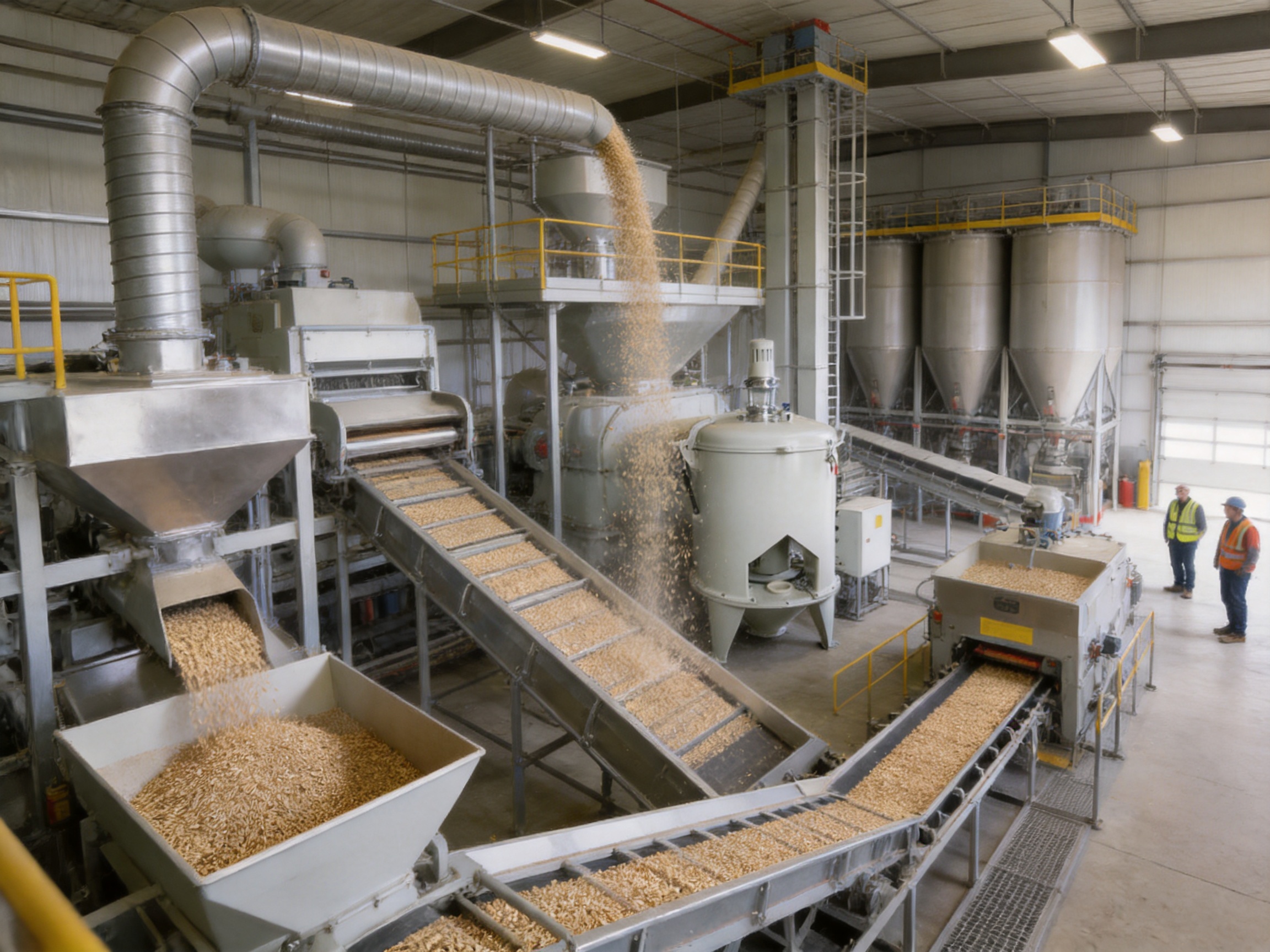
The company's broader experience in intelligent logistics equipment supports the integration of the Oat Dehuller into automated material-handling systems. Depending on the project, a complete grain-processing solution may include receiving hoppers, feeders, belt conveyors, bucket elevators, aspiration units, screening machines, storage bins, packing equipment, and control systems.
Integrated design reduces the risk of mismatched equipment. Conveyor capacity can be matched to the dehuller output. Sensors can monitor material levels and prevent empty or overloaded operation. Control logic can coordinate feeders, motors, aspiration fans, and discharge equipment. These improvements help operators maintain stable production and reduce manual intervention.
8. Integration with Grain-Handling and Logistics Systems
An oat dehuller rarely operates as an isolated machine. It is normally part of a sequence that begins with raw-material receiving and ends with storage, packaging, or shipment. The reliability of the entire process depends on the interaction between the individual machines.
A typical integrated arrangement may include the following stages:
- Raw oat receiving and temporary storage.
- Pre-cleaning and removal of large foreign materials.
- Magnetic separation and stone removal.
- Moisture adjustment or conditioning when required.
- Controlled feeding into the Oat Dehuller.
- Aspiration and screening of groats and hull fragments.
- Recirculation of partially dehulled material.
- Grading by kernel size.
- Stabilization, flaking, milling, or other downstream processing.
- Finished-product conveying, packing, and storage.
The company can also provide related automatic loading and unloading equipment for industrial and logistics applications. Its product range includes rear dumpers, side-turn truck dumpers, car loading equipment, container flippers, and other material-handling systems. This broader manufacturing capability is useful for customers that require both grain-processing equipment and automated bulk-material logistics.
For example, a grain-processing facility may use hoppers and belt conveyors to feed the dehuller, then transfer finished groats to storage or packaging. A larger plant may require container loading systems or automated truck unloading equipment for incoming and outgoing material. Coordinating these systems can reduce manual handling, improve workplace safety, and increase utilization of the facility.
9. Installation Requirements
Before installation, the customer should confirm the available floor area, ceiling height, access routes, foundation condition, power supply, ventilation, dust-control arrangements, and maintenance clearance. The dehuller should be positioned so that operators can inspect the feed point, impact area, discharge point, motor, and wear components safely.
The electrical system must match the motor rating and local power conditions. The customer should confirm whether three-phase power is available and whether the site requires a dedicated control cabinet, variable-speed drive, overload protection, or emergency-stop circuit.
Dust management is particularly important in grain-processing facilities. Oat hull fragments and fine particles may become airborne during dehulling and separation. A suitable aspiration and dust-collection arrangement can improve cleanliness, reduce the risk of accumulation, and support a safer working environment.
Installation should include alignment checks, fastener inspection, rotation-direction confirmation, no-load testing, and gradual introduction of grain. Operators should not immediately run the machine at maximum capacity. A controlled commissioning process allows the team to observe vibration, material flow, noise, and product quality before production is increased.
10. Operating Guidelines for Consistent Results
Stable dehulling performance begins with stable raw material preparation. Oats should be cleaned thoroughly before entering the machine. Stones, metal, and abrasive foreign matter can damage the guide slots, impact ring, and other contact surfaces.
The feed rate should remain as uniform as possible. Sudden surges may overload the impact chamber, while insufficient feeding can produce unstable impact conditions and reduce throughput. A controlled feeder or buffer hopper is recommended for continuous industrial operation.
Operators should adjust the centrifugal disk speed gradually. When changing to a new oat variety, begin with a moderate setting and inspect the product. If hull removal is incomplete, the speed may be increased carefully. If groat breakage is excessive, the speed, feed rate, or material condition should be reviewed.
Important operating observations include:
- Percentage of hulls remaining on the groats.
- Quantity of whole groats.
- Quantity of broken groats.
- Presence of unprocessed kernels.
- Motor load and operating current.
- Unusual vibration or noise.
- Condition of the impact ring and guide slots.
- Material temperature and dust generation.
Operators should keep records of raw material type, moisture, rotor speed, feed rate, output, and product quality. These records make it easier to identify the most effective settings and predict maintenance needs.
11. Maintenance and Wear-Part Management
Preventive maintenance helps preserve dehulling efficiency and reduce unexpected downtime. Inspection frequency should be based on operating hours, throughput, raw material cleanliness, and the abrasiveness of the incoming grain.
At regular intervals, the operator should inspect the centrifugal disk, guide slots, impact ring, bearings, fasteners, motor, protective covers, and discharge passages. Accumulated hull material and dust should be removed according to the facility's cleaning procedures.
Wear parts should be replaced when their profile has changed sufficiently to affect material direction or impact conditions. Waiting until severe wear occurs may increase groat breakage, reduce dehulling efficiency, and place additional stress on other components.
Typical maintenance practices include:
- Inspecting high-contact parts after scheduled operating intervals.
- Checking for abnormal vibration and bearing temperature.
- Verifying that fasteners remain tight.
- Cleaning dust and hull accumulation from accessible areas.
- Checking the motor and electrical protection devices.
- Inspecting the impact ring for uneven wear.
- Checking guide slots for deformation or blockage.
- Keeping replacement wear parts available before peak season.
Wear-part life depends on throughput, operating speed, grain cleanliness, moisture, and the presence of abrasive contaminants. Hardened or specialized wear-resistant components can last substantially longer than ordinary steel components, but no wear part is permanent. A planned replacement program is more economical than emergency maintenance during the harvest or production peak.
12. Quality Control and Performance Verification
Performance should be evaluated using measurable indicators rather than appearance alone. A practical test may include a representative sample of raw oats, a known feed quantity, a defined rotor speed, and a measured operating period.
Useful test indicators include:
- One-time dehulling rate.
- Total dehulling rate after recirculation.
- Whole-groat percentage.
- Broken-groat percentage.
- Residual hull percentage.
- Waste or material loss.
- Energy consumption per ton.
- Hourly throughput.
For a reliable comparison, all tests should use consistent sampling and measurement methods. Results should be recorded separately for different oat varieties or moisture conditions. A machine may perform differently on freshly harvested oats compared with properly conditioned stored oats.
Quality verification should also consider the downstream product. Groats intended for flaking may have different requirements from groats intended for flour milling. A processor may accept a different breakage level depending on the final product and the value of whole kernels.
13. Selecting the Correct Model and Configuration
The correct model depends on more than the desired nominal output. Customers should first determine the volume to be processed, the available operating hours, the required product quality, and the planned expansion capacity.
The TTK56 is suitable for smaller processing requirements and applications where a compact, lower-power machine is preferred. The TTK60 provides a higher reference capacity and may be more suitable for medium-scale operations or facilities that require greater output.
For customers with unusual raw materials or special layout requirements, equipment configuration may be adjusted after technical discussion. The company can evaluate the feeding arrangement, discharge height, conveyor connection, electrical configuration, control requirements, and downstream separation system.
| Selection item | Questions to confirm | Why it matters |
|---|---|---|
| Annual volume | How many tons must be processed each year? | Determines the required production scale |
| Hourly capacity | How many operating hours are available? | Prevents undersizing or unnecessary oversizing |
| Raw material | Which oat varieties and moisture ranges will be processed? | Affects speed, feed rate, and dehulling performance |
| Product target | Are whole groats, flakes, flour, or feed products required? | Determines acceptable breakage and separation quality |
| Power supply | What voltage and phase are available? | Ensures compatibility with the motor and control system |
| Available space | What are the floor, height, and access limitations? | Supports safe installation and maintenance |
| Downstream equipment | How will hulls and groats be separated and conveyed? | Ensures the dehuller operates as part of a complete line |
| Service plan | Are spare parts and technical support available? | Reduces downtime and extends equipment life |
14. Company Manufacturing and Service Capabilities
Jiangsu Zhengding Intelligent Equipment Co., Ltd. is based in Yangzhou, Jiangsu Province, China. The company focuses on the research and development, manufacturing, and sales of intelligent equipment for automated loading, unloading, grain handling, and logistics applications.
Its equipment is used in industries including steel, chemicals, cement, coal, grain, oil, food, feed, ports, papermaking, and new energy. This broad industrial exposure gives the company experience with heavy-duty equipment, continuous material flow, automation, safety requirements, customized layouts, and high-utilization operating environments.
The company provides equipment such as rear dumpers, side-turn truck dumpers, container flippers, car loading systems, and integrated loading and unloading solutions. These products complement grain-processing machinery because modern grain plants require more than a single processing unit. They also need efficient receiving, conveying, storage, loading, dispatch, and container-handling systems.
The company's products have been exported to Japan, Brazil, Egypt, Pakistan, India, the Middle East, and Southeast Asia. Its customer experience includes international users in beverage, brewing, grain, agricultural trading, food, chemical, construction-material, and industrial sectors.
For oat processors, the main value of working with an integrated equipment manufacturer is the possibility of coordinating several systems through one technical project. Equipment layout, material flow, electrical control, safety protection, and maintenance access can be considered together instead of being handled as unrelated purchases.
15. Applications in Different Production Environments
15.1 Small Farms and Agricultural Cooperatives
Small farms and cooperatives may use the Oat Dehuller to add value to locally grown oats. Instead of selling raw oats with limited processing, they can produce cleaned and dehulled groats for local food manufacturers, retailers, bakeries, or direct consumers.
Compact models can be integrated with a small cleaner, aspiration unit, and packing machine. Adjustable speed is useful where raw materials change from one harvest or supplier to another. Simple access to wear components helps reduce dependence on specialized maintenance personnel.
15.2 Regional Grain Centers
Regional grain centers may process oats from multiple farms. They require reliable throughput and the ability to handle variation in kernel size and moisture. A centrifugal dehuller with adjustable operating parameters can provide a practical balance between capacity and flexibility.
Regional facilities may also benefit from integrated hopper, conveyor, storage, and loading systems. Automated material handling reduces the amount of manual labor required to move grain between receiving, processing, storage, and dispatch areas.
15.3 Food Ingredient Factories
Food ingredient factories require consistent groat quality and effective separation of hull material. Their finished products may include oat flakes, oat flour, oat bran, breakfast cereals, nutritional ingredients, and specialty food products.
For these users, whole-groat yield, low breakage, cleanliness, traceability, and stable production are important. The dehuller can be connected with grading, stabilization, flaking, milling, and packing equipment as part of a complete processing line.
15.4 Feed and Industrial Applications
Some processors may use dehulled or partially dehulled oats in animal feed or industrial formulations. The product-quality requirements may differ from food applications, but energy efficiency, capacity, and reliable operation remain important. The dehuller can be evaluated according to the required degree of hull removal and the acceptable particle condition.
16. Frequently Asked Questions
Q1: What is the main function of an oat dehuller?
An oat dehuller removes the tough outer hull from the oat groat. The Oat Dehuller uses a high-speed centrifugal disk and impact ring to crack the hull while controlling damage to the groat.
Q2: How does the centrifugal design work?
Cleaned oats enter a rotating centrifugal disk. Centrifugal force accelerates the kernels outward, while guide slots maintain their direction. The kernels strike an impact ring, causing the hulls to crack and separate from the groats.
Q3: What is the one-time dehulling rate?
Under suitable operating conditions, the one-time dehulling rate can reach approximately 80 percent. Actual results depend on oat variety, moisture content, particle size, feed rate, rotor speed, and upstream cleaning quality.
Q4: Can the rotational speed be adjusted?
Yes. Operators can adjust the centrifugal disk speed according to the material's moisture, variety, size, hull strength, and required product quality. This adjustment helps balance hull removal and groat integrity.
Q5: Can the machine process grains other than oats?
Yes. The machine can also be used for difficult-to-dehull coarse grains such as barley, rye, and broomcorn millet. Each new grain should be tested because operating conditions and achievable efficiency may differ from oats.
Q6: Which model is suitable for a small farm?
The TTK56, with a 3-kilowatt motor and an approximate oat output of 0.8 to 1.5 tons per hour, may be suitable for smaller operations. Final selection should consider annual volume, operating hours, raw material, and required product quality.
Q7: Which model provides higher capacity?
The TTK60 has a 5.5-kilowatt motor and an approximate oat output of 2.5 to 3.2 tons per hour. It may be appropriate for medium-scale facilities or operations with higher hourly requirements.
Q8: How can groat breakage be reduced?
Groat breakage can be controlled by selecting an appropriate rotor speed, maintaining a stable feed rate, preparing the oats properly, avoiding excessive recirculation, and inspecting the impact ring and guide slots. Product testing is recommended when changing raw material.
Q9: How often should wear components be inspected?
Inspection frequency depends on throughput, grain cleanliness, abrasive content, and operating speed. Regular scheduled inspections should be performed, with additional checks during peak production. The impact ring and guide slots should be replaced when wear begins to affect performance.
Q10: Does the machine require downstream separation equipment?
Yes. After dehulling, the material normally contains groats and lighter hull fragments. Aspiration and screening equipment are typically used to separate these materials and improve the cleanliness of the finished product.
Q11: Can the dehuller be integrated into an automated line?
Yes. It can be integrated with hoppers, feeders, belt conveyors, bucket elevators, aspiration units, screening machines, storage systems, packing equipment, and control systems. The company also manufactures automated loading and unloading equipment for broader material-handling projects.
Q12: What information should be supplied when requesting a quotation?
Customers should provide the grain type, annual volume, required hourly capacity, moisture range, target product, acceptable breakage, power supply, installation location, available space, and preferred level of automation. A representative material sample can also support a more accurate evaluation.
17. Conclusion
The Oat Dehuller provides a practical centrifugal solution for removing oat hulls while protecting groat quality. Its high-speed centrifugal disk, directional guide slots, impact ring, adjustable rotational speed, low energy consumption, and wear-resistant components work together to support stable dehulling performance.
The equipment is suitable for farms, cooperatives, regional grain centers, food ingredient factories, and larger processing plants. Its ability to process oats as well as selected coarse grains gives operators additional flexibility, while the available TTK56 and TTK60 models provide options for different capacity requirements.
Successful installation depends on correct capacity selection, stable feeding, suitable raw-material preparation, effective downstream aspiration, and regular maintenance. Customers should evaluate the dehuller as part of the complete processing system rather than as an isolated machine.
With experience in intelligent equipment manufacturing, automated loading and unloading, grain handling, and industrial system integration, Jiangsu Zhengding Intelligent Equipment Co., Ltd. can support customers seeking a coordinated solution. Its manufacturing strengths, international project experience, customized engineering capability, and broad equipment range make it a suitable partner for oat processors that require reliable machinery and integrated material-flow systems.
References
1. General principles of cereal grain cleaning, dehulling, aspiration, and grading.
2. Industrial practices for oat groat production and whole-kernel yield management.
3. Mechanical design principles for centrifugal impact equipment.
4. Preventive maintenance practices for grain-processing machinery and abrasive wear components.
5. Food-processing equipment guidelines for dust control, safe operation, and material handling.
6. Technical product information for centrifugal oat dehulling equipment, including TTK56 and TTK60 model specifications.
7. Industrial equipment manufacturing and system-integration information supplied by Jiangsu Zhengding Intelligent Equipment Co., Ltd.


