

 English
 русский
 Español
 Français
 Português
 عربى




+86-13588556918
Content
- 1 1. What Is a Container Flipping Machine?
- 2 2. Why Container Flipping Technology Is Important
- 3 3. Working Principle and Operating Sequence
- 4 4. Major Advantages Over Conventional Unloading Methods
- 5 5. Engineering and Structural Design
- 6 6. Advanced Manufacturing Processes
- 6.1 6.1 Engineering Review and Application Analysis
- 6.2 6.2 Three-Dimensional Design and Simulation
- 6.3 6.3 Precision Cutting and Component Preparation
- 6.4 6.4 High-Quality Welding
- 6.5 6.5 Surface Treatment and Corrosion Protection
- 6.6 6.6 Hydraulic System Assembly and Testing
- 6.7 6.7 Electrical and Control-System Integration
- 7 7. Customization Options
- 8 8. Typical Applications by Industry
- 9 9. Technical Performance Considerations
- 10 10. Safety Systems and Operator Protection
- 11 11. Maintenance and Serviceability
- 12 12. Manufacturing Strengths of Jiangsu Zhengding Intelligent Equipment
- 13 13. Quality Control and Project Delivery
- 14 14. Selecting the Right Configuration
- 15 15. Economic Value and Return on Investment
- 16 16. Comparison with Alternative Technologies
- 17 17. Frequently Asked Questions
- 17.1 Q1: What container sizes can the equipment handle?
- 17.2 Q2: What is the maximum load capacity?
- 17.3 Q3: Can the machine unload powders and sticky materials?
- 17.4 Q4: How much residual material remains after unloading?
- 17.5 Q5: Can the system be connected to a dust collector?
- 17.6 Q6: Is automatic door operation available?
- 17.7 Q7: Is weighing available?
- 17.8 Q8: Can the machine be moved between workstations?
- 17.9 Q9: What maintenance is normally required?
- 17.10 Q10: Does the operator need special training?
- 17.11 Q11: Can the equipment be integrated into an automated plant?
- 17.12 Q12: What information is needed for a quotation?
- 18 18. Conclusion
- 19 References
- 20 Product: Container Flipping Machine
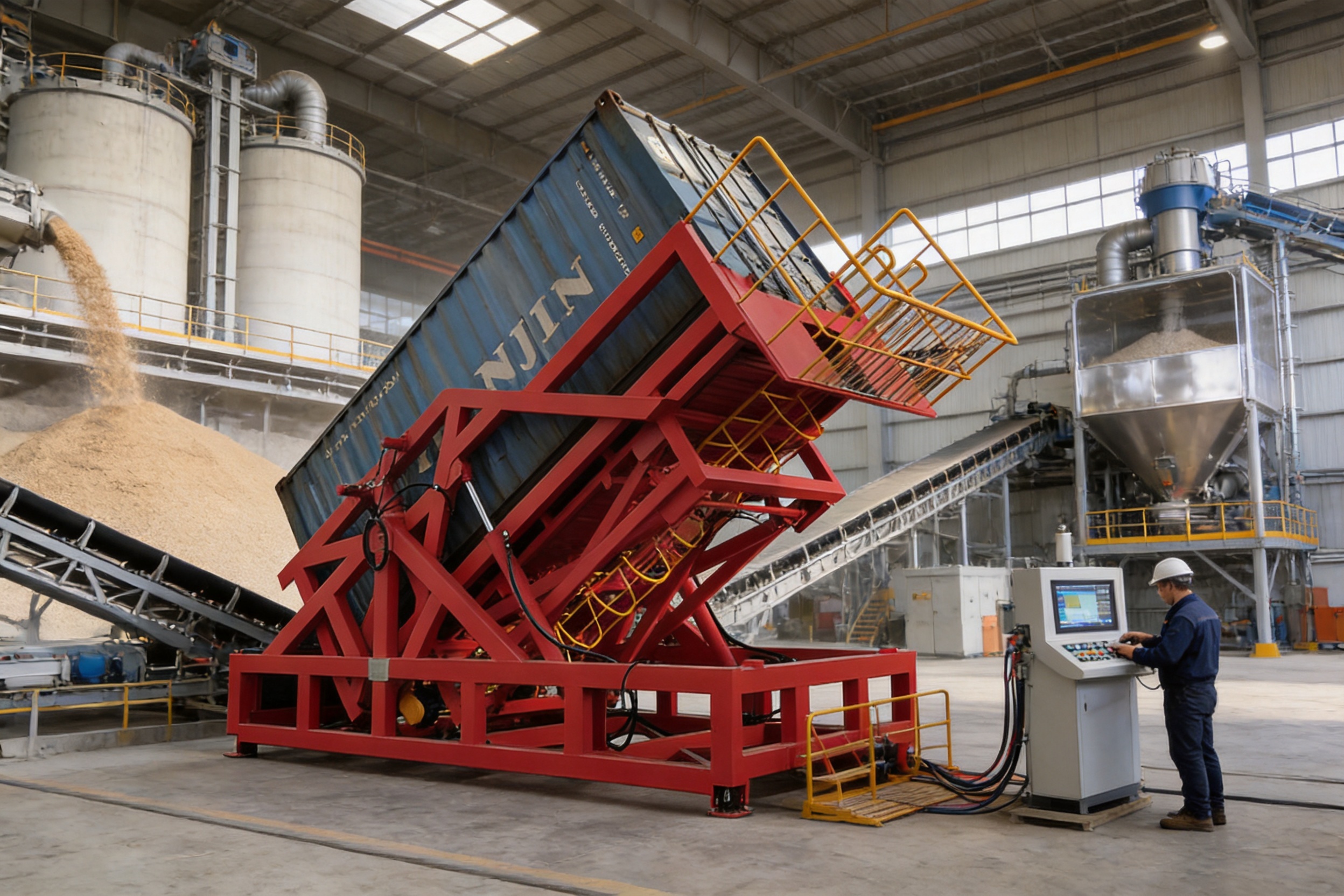
Container logistics is becoming increasingly important as manufacturers, terminals, processors, and distributors move greater quantities of bulk materials across international supply chains. Grain, cement, minerals, powders, food ingredients, recyclable materials, and industrial by-products are frequently transported in standard shipping containers. However, unloading these materials efficiently can be challenging when conventional manual, vacuum, or horizontal discharge methods leave residual material behind, require extensive labor, or create dust and safety concerns.
A container flipping machine provides a practical solution to these challenges. By securely clamping a container and rotating it to a controlled angle, the equipment uses gravity to discharge bulk materials quickly and consistently. The process reduces the need for personnel to enter containers, shortens unloading cycles, improves material recovery, and can be integrated with conveyors, weighing systems, dust collectors, and automated control platforms.
Jiangsu Zhengding Intelligent Equipment Co., Ltd. develops and manufactures container flipping machines as part of a broader portfolio of automated loading and unloading equipment. Its engineering capabilities cover container flippers, rear dumpers, side-turn truck dumpers, car loading equipment, and related systems for industrial logistics. The company combines structural engineering, hydraulic technology, automation, equipment integration, and application-specific customization to provide complete solutions for demanding bulk-handling environments.
This article examines the working principle, technical structure, manufacturing strengths, application advantages, safety systems, customization options, and operating considerations of container flipping machines.
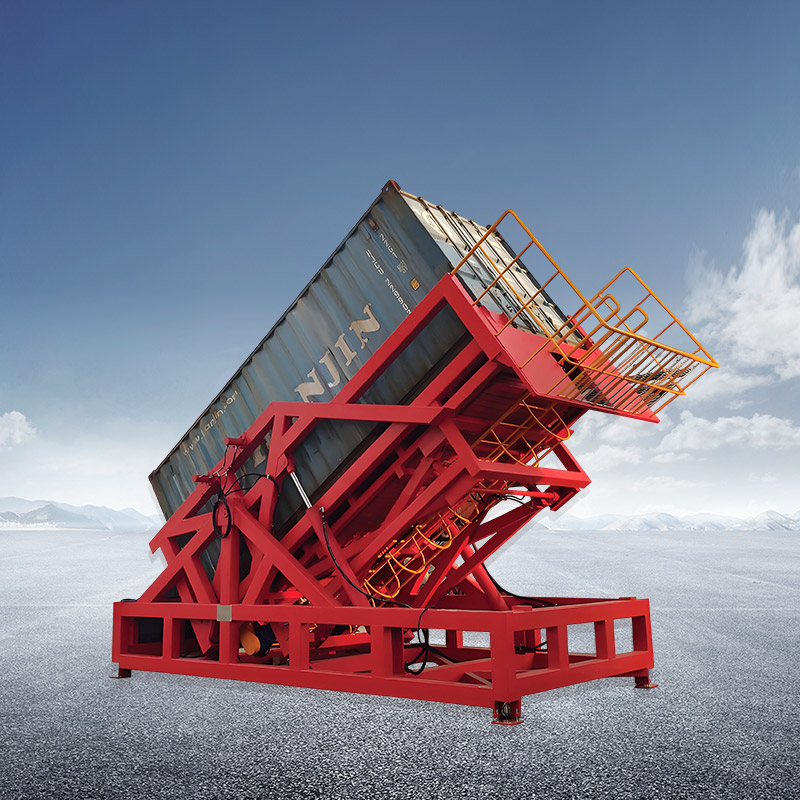
Container Flipping Machine
1. What Is a Container Flipping Machine?
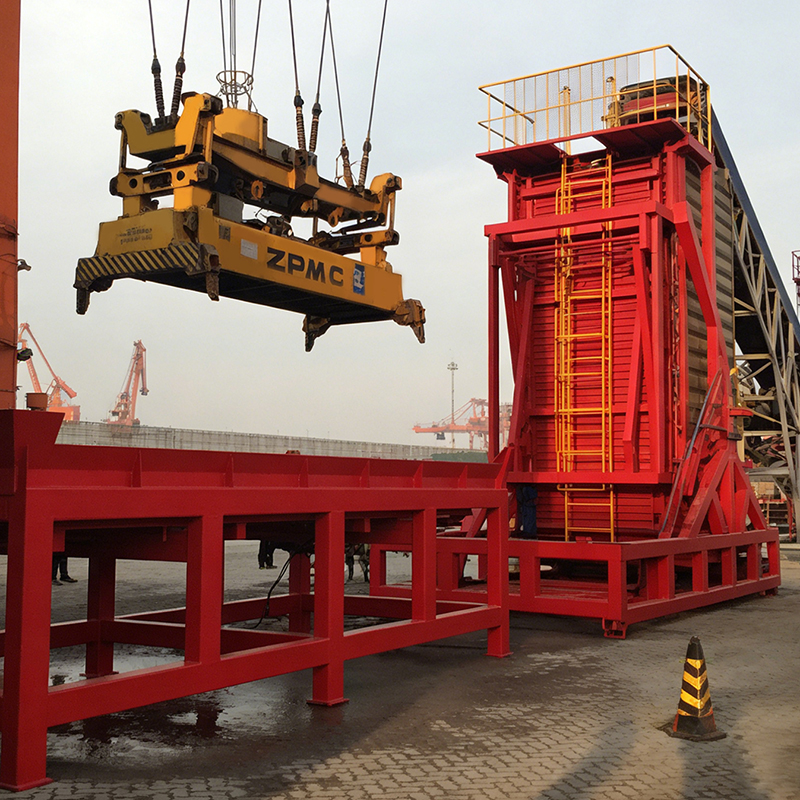
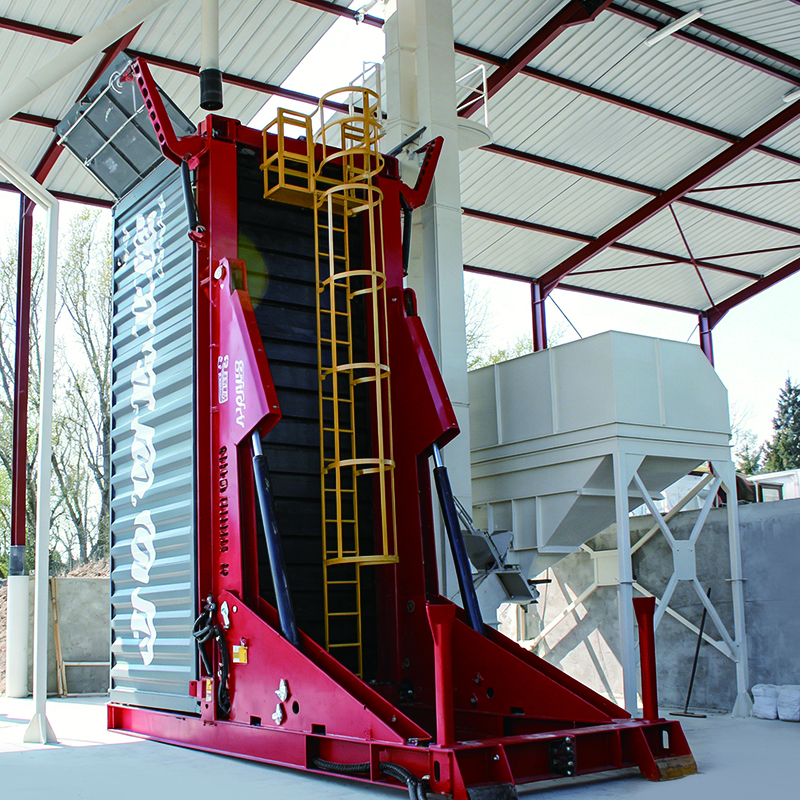
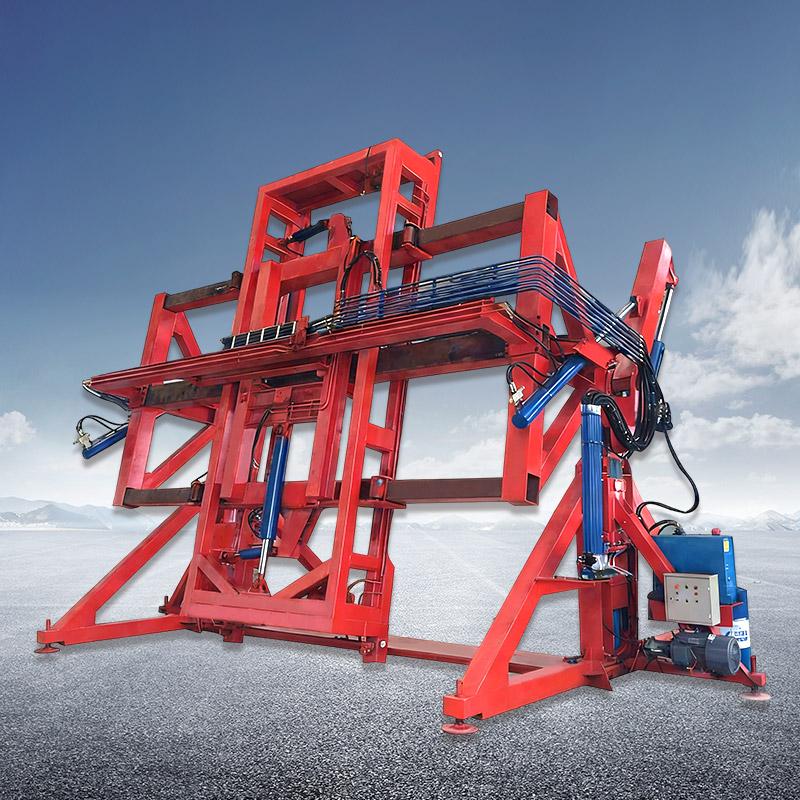
A container flipping machine is a heavy-duty industrial apparatus designed to rotate a shipping container so that its contents can be discharged through the container doors or an engineered discharge opening. Depending on the system design and application, the container may be rotated from its horizontal transport position toward a vertical or near-vertical position. The machine takes advantage of gravity to accelerate the movement of free-flowing bulk materials.
The equipment is also commonly described as a container tilter, container rotator, container dumper, or container unloading machine. In practical use, the names may vary according to the rotation direction, clamping structure, unloading angle, and integration method. The essential function remains the same: hold a loaded container securely, lift and rotate it in a controlled manner, and return it safely to its original position after discharge.
Standard applications generally involve 20-foot and 40-foot containers. The equipment can be engineered for different container dimensions, gross weights, door configurations, and material characteristics. The supplied TJFJ 20 model is intended for 20-foot containers, while the TJFJ 40 model is intended for 40-foot containers. Both listed models have a maximum lifting capacity of 30 or 40 tons, depending on the selected configuration, and a stated maximum lifting angle of 0 to 90 degrees.
| Model | Applicable Container | Maximum Lifting Weight | Maximum Lifting Angle |
|---|---|---|---|
| TJFJ 20 | 20-foot container | 30 or 40 tons | 0–90 degrees |
| TJFJ 40 | 40-foot container | 30 or 40 tons | 0–90 degrees |
For applications requiring greater discharge angles, full inversion, special container formats, or unusual material behavior, the manufacturer can develop customized mechanical and hydraulic configurations. The final operating range should always be confirmed through a project-specific technical review that considers container structure, center of gravity, loading density, discharge layout, and site safety requirements.
2. Why Container Flipping Technology Is Important
Traditional container unloading can involve forklifts, manual shoveling, vacuum equipment, vibratory systems, or fixed tipping arrangements. Each method has a place in industry, but each also has limitations. Manual unloading is labor-intensive and exposes workers to confined spaces, dust, unstable material piles, and difficult working conditions. Vacuum unloading can be effective for selected powders but may require high energy consumption and specialized filtration equipment. Horizontal discharge may leave material in corners or along the container floor, especially when the material is cohesive.
A flipping machine addresses these problems by changing the orientation of the entire container. Once the container is properly secured and rotated, its contents move toward the discharge point under gravity. This creates a direct and repeatable unloading process that can be coordinated with receiving hoppers, conveyors, weighing systems, or downstream processing equipment.
The main operational benefits include shorter unloading cycles, reduced residual material, lower dependence on manual labor, improved operator safety, and more consistent throughput. The enclosed design options also help reduce uncontrolled dust release when the machine is connected to an extraction or collection system.
For high-volume terminals, even a modest reduction in cycle time can create a substantial annual capacity increase. A facility that handles several containers per hour may gain additional production availability without adding a second unloading line. In operations where container demurrage, labor availability, or limited dock space affects profitability, the resulting improvement can be particularly valuable.
3. Working Principle and Operating Sequence
3.1 Container Positioning
The operating cycle begins when a truck, trailer, crane, or other handling system positions the container inside the machine frame. Correct alignment is essential because the container must be supported at its structural corner castings or other approved lifting points. Sensors or visual indicators can assist the operator in confirming that the container is properly positioned.
Container dimensions, gross weight, center of gravity, and door direction are checked before the cycle begins. Some installations use automatic identification or recipe management to select the correct rotation limits and operating speed for a specific container or material type.
3.2 Clamping and Locking
After positioning, the machine activates its clamping mechanism. Heavy-duty clamps or locking assemblies engage the container at the corner castings. The system is designed to distribute forces through appropriate structural points rather than relying on weak panels or door components.
Safety interlocks prevent rotation if the container has not been fully secured. Depending on the configuration, the control system may monitor clamp position, hydraulic pressure, locking pin engagement, door status, and other conditions before permitting the lifting sequence.
3.3 Hydraulic Rotation
Large-tonnage hydraulic cylinders provide the force needed to lift and rotate the loaded container. The hydraulic circuit is designed to coordinate cylinder movement so that the two sides of the machine remain synchronized. Hydraulic locks, counterbalance valves, and explosion-proof or hose-burst protection valves help maintain stability during operation.
The rotation speed can be adjusted according to the material, container load, discharge equipment, and site requirements. A slow initial movement may be used to overcome static resistance, followed by a controlled rotation through the primary discharge zone. The machine can then pause at a selected angle to improve discharge or allow weighing and inspection.
3.4 Material Discharge
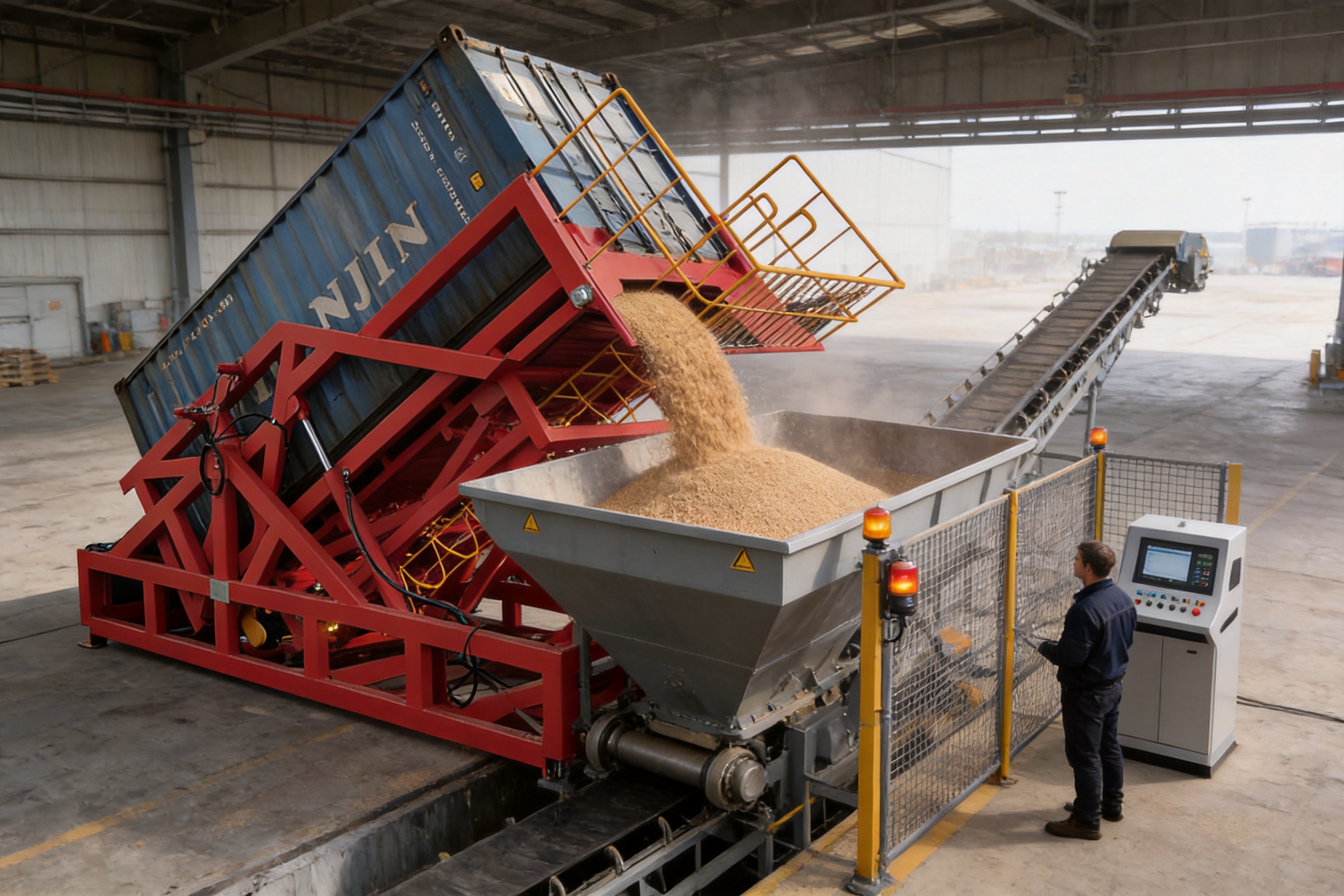
When the container reaches the required angle, its doors are opened manually or through an automatic door control system. Material falls into a receiving hopper, onto a conveyor, or into another collection system. The discharge area may be enclosed with flexible seals or a rigid housing connected to a dust collector.
Free-flowing materials such as grain, pellets, cement, fly ash, sugar, and flour generally discharge efficiently. Cohesive, wet, or compacted materials may require a greater angle, vibration, air assistance, or other material-flow measures. The machine design should therefore be selected according to the actual bulk characteristics rather than only the nominal container size.
3.5 Return to the Loading Position
After discharge, the container is returned to its original horizontal position. The hydraulic system controls the return movement and prevents sudden descent. Once the machine reaches the safe position, the clamps are released and the empty container can be removed.
The entire process may be operated from a local control station, a remote control panel, or an integrated plant automation system. Emergency-stop devices and safety interlocks remain active throughout the cycle.
4. Major Advantages Over Conventional Unloading Methods
4.1 Higher Operational Efficiency
The most direct advantage of container flipping is the reduction in unloading time. Traditional manual operations may require workers to move material repeatedly, use shovels, or enter the container to remove residual product. A controlled rotation uses gravity as the primary unloading force and significantly reduces these activities.
The actual cycle time depends on container weight, material flowability, door operation, receiving equipment, and site traffic. Typical application data indicates that container flipping systems can achieve approximately four to nine containers per hour under suitable operating conditions. Grain, sugar, flour, and other free-flowing materials may achieve higher throughput than wet clay, sticky concentrate, or compacted industrial residues.
Shorter cycles also reduce truck waiting time and improve the utilization of loading bays, hoppers, conveyors, and storage systems. In a facility operating multiple shifts, the accumulated time savings can translate into a meaningful increase in annual capacity.
4.2 Reduced Residual Material
Horizontal unloading methods can leave product in floor channels, corners, and areas near the container doors. A properly selected rotation angle allows gravity to move a much greater proportion of the load toward the discharge point. Field experience indicates that residual material for free-flowing products may commonly remain within a fraction of one percent of the original load, although actual results vary.
Sticky and cohesive materials may leave higher residual quantities. In such cases, vibration devices, air knives, liners, or specialized discharge attachments can be incorporated. The correct solution depends on moisture content, particle size, temperature, bulk density, wall friction, and the tendency of the product to bridge or compact.
4.3 Improved Operator Safety
One of the strongest advantages over manual unloading is the reduction in the need for personnel to enter the container. Container interiors can present confined-space hazards, poor visibility, dust exposure, unstable material surfaces, oxygen-deficient atmospheres, and difficult evacuation conditions.
With a properly automated system, the operator remains outside the container and controls the process from a protected station. Interlocks verify that the container is secured before rotation begins. Emergency braking and hydraulic load-holding functions help prevent uncontrolled movement.
Automation does not eliminate the need for safety procedures. Operators must still be trained in load verification, equipment inspection, emergency stops, exclusion zones, and abnormal-condition response. However, removing unnecessary manual entry can significantly improve the overall safety profile of the operation.
4.4 Better Dust Control
Bulk materials can generate dust when poured, tipped, or transferred. An enclosed container flipping machine can be integrated with flexible seals, extraction ducts, filter units, and negative-pressure systems. This arrangement limits the spread of fugitive dust and helps protect personnel, nearby equipment, and the surrounding environment.
Dust control is especially important for cement, fly ash, flour, starch, mineral powders, and other fine materials. The machine itself is only one part of the dust-control solution; the receiving hopper, transfer points, ventilation capacity, filter selection, and sealing design must also be evaluated as a complete system.
4.5 Flexible Integration
Container flippers can be connected to upstream and downstream systems. Typical integrations include truck positioning equipment, container identification, automatic door mechanisms, weigh modules, conveyors, bucket elevators, storage silos, dust collectors, programmable logic controllers, and supervisory monitoring platforms.
This flexibility allows the machine to function as more than an isolated lifting device. It can become part of an automated logistics line in which loading, unloading, weighing, conveying, and data recording are coordinated through a central control system.
5. Engineering and Structural Design
5.1 Reinforced Steel Frame
The primary frame must withstand the combined effects of container weight, material impact, hydraulic forces, repeated rotation, vibration, and stopping loads. Jiangsu Zhengding uses high-strength structural steel and reinforced welded construction for this type of equipment.
Structural design is supported by finite element analysis. FEA enables engineers to examine stress concentrations, deflection, load distribution, joint areas, cylinder mounting points, and fatigue-sensitive regions before fabrication. The objective is to improve the strength-to-weight balance while ensuring that the machine remains rigid and stable during repeated heavy-duty cycles.
Appropriate reinforcement is particularly important around the container supports, rotation pivots, hydraulic cylinder attachments, clamp assemblies, and base connections. These areas experience concentrated forces and must be designed for both static capacity and long-term fatigue resistance.
5.2 Hydraulic Cylinders and Synchronization
Dual hydraulic cylinders are commonly used to rotate the container. The cylinders must provide sufficient thrust and stroke while maintaining synchronized movement on both sides of the frame. Uneven motion can create undesirable twisting forces, so the hydraulic circuit and mechanical structure must work together carefully.
Hydraulic locks and counterbalance valves help hold the load when the machine pauses. Explosion-proof or hose-burst protection valves can restrict uncontrolled movement if a hydraulic line is damaged. Emergency braking functions provide an additional layer of protection during abnormal events.
The hydraulic power unit is selected according to lifting capacity, rotation speed, duty cycle, ambient temperature, and expected operating frequency. Filtration, oil cooling, pressure monitoring, and access for maintenance are considered during the system design process.
5.3 Container Clamping System
The clamping system is a critical safety component. It must engage the container securely without damaging the corner castings or interfering with doors, fittings, or structural members. The clamping force must remain adequate throughout the rotation, including when the center of gravity shifts as material leaves the container.
Different projects may require fixed clamps, hydraulic clamps, locking pins, adjustable supports, or a combination of these systems. The appropriate design depends on container type, loading tolerance, operating environment, and desired automation level.
5.4 Base and Site Stability
Although the frame is engineered to handle heavy loads, the foundation and installation area are equally important. The site must provide adequate bearing capacity, levelness, drainage, access clearance, and space for trucks, containers, conveyors, and maintenance personnel.
Foundation design should account for dynamic loads, braking forces, wind exposure where applicable, vibration, and the maximum operating position. A complete equipment proposal should therefore include installation requirements rather than focusing only on the machine body.
6. Advanced Manufacturing Processes
6.1 Engineering Review and Application Analysis
Manufacturing begins with a technical review of the customer's operating conditions. Engineers evaluate container dimensions, maximum gross weight, material density, moisture, flowability, required throughput, discharge angle, dust-control expectations, site layout, and automation requirements.
This application analysis helps prevent a common equipment-selection mistake: choosing a machine solely according to container length. Two facilities handling containers of the same size may require different hydraulic capacity, clamping methods, discharge hoppers, dust seals, and control systems because their materials and production rates differ.
6.2 Three-Dimensional Design and Simulation
Three-dimensional modeling is used to coordinate the structural frame, hydraulic cylinders, clamping assemblies, access platforms, doors, guards, electrical cabinets, and external interfaces. Digital design makes it easier to identify interference problems before steel is cut and to verify maintenance access around critical components.
Finite element stress analysis supports the evaluation of primary load-bearing parts. Engineers can model lifting, rotation, braking, and abnormal load cases to identify high-stress areas. The results guide plate thickness, stiffener placement, pivot sizing, weld design, and reinforcement layout.
6.3 Precision Cutting and Component Preparation
Structural components are prepared through controlled cutting, drilling, machining, and fit-up processes. Accurate dimensions are essential because misalignment in the frame or pivot structure may increase wear, produce uneven hydraulic loading, or reduce the service life of bearings and seals.
Machined pivot components and cylinder mounting points require particular attention. These parts transmit high loads and must maintain alignment under repeated operation. Quality checks may include dimensional inspection, hole-position verification, surface examination, and fit testing before assembly.
6.4 High-Quality Welding
The machine frame is fabricated through heavy-duty welding using procedures selected for structural steel thickness, joint type, and service loads. Proper preparation, preheating where required, controlled welding sequences, and post-weld inspection help reduce distortion and residual stress.
Weld quality is important not only for ultimate strength but also for fatigue resistance. A container flipper may repeat thousands of lifting and rotation cycles over its service life. Weld details around corners, brackets, stiffeners, and cylinder mounts must therefore be designed and executed to resist crack initiation.
6.5 Surface Treatment and Corrosion Protection
Equipment used in terminals, chemical plants, grain facilities, coastal locations, and outdoor yards may be exposed to moisture, dust, salt, chemicals, and temperature changes. Surface preparation and protective coating systems help prevent corrosion and preserve structural integrity.
The selected coating system may include cleaning, abrasive preparation, primer application, intermediate coating, and a durable topcoat. The exact specification depends on the environment and customer requirements. Proper coating also improves equipment appearance and makes future inspections easier.
6.6 Hydraulic System Assembly and Testing
Hydraulic components are installed with attention to cleanliness, hose routing, pressure ratings, bend radius, protection from abrasion, and accessibility. Contamination control is essential because particles in the hydraulic circuit can damage valves, pumps, and cylinder seals.
Before shipment, the hydraulic system should be tested for pressure stability, leakage, cylinder synchronization, emergency stopping, load holding, and return movement. Factory testing allows engineers to identify problems before installation at the customer's site.
6.7 Electrical and Control-System Integration
The control system can range from a basic push-button station to a programmable automation platform with sensors, touchscreen interfaces, data recording, remote diagnostics, and plant-level communication. The selected system depends on the degree of automation required.
Safety logic is integrated into the control architecture. Typical functions include clamp confirmation, door status monitoring, overload protection, rotation limit control, emergency stop circuits, hydraulic pressure alarms, and maintenance-mode selection. The goal is to ensure that the machine cannot enter an unsafe sequence because of a missing signal or operator error.
7. Customization Options
7.1 Automatic Door Control
Manual container-door operation may be acceptable for low-throughput applications, but automatic door control improves efficiency and reduces close-range contact with the container. A powered mechanism can open and close the doors according to the operating sequence while the operator remains at a safe control position.
Automatic door systems must be adapted to the container design, door hardware, rotation direction, discharge area, and material behavior. Protective guards and interlocks help ensure that door movement occurs only when the machine is in the correct condition.
7.2 Dynamic Weighing
An optional weighing system can monitor container weight or material discharge in real time. This function supports accurate loading verification, inventory control, shipment documentation, and overload prevention.
Weighing accuracy depends on the load-cell arrangement, structural isolation, calibration method, foundation condition, vibration, and the timing of measurements. For applications requiring certified trade measurement, the complete system should be evaluated and approved according to applicable local requirements.
7.3 Mobile Chassis
A mobile design allows the container flipper to be moved between workstations. This may be useful where several storage areas, unloading points, or temporary production lines share one machine.
Mobility must be designed carefully because the equipment remains heavy and carries substantial loads during operation. The machine should be stabilized and secured before lifting begins. Depending on the project, mobility may be achieved through wheels, rail travel, a towing frame, or another engineered transport arrangement.
7.4 Dust Collection Integration
The discharge zone can be enclosed and connected to a dust collector. Flexible rubber seals accommodate movement while limiting air leakage. The extraction system can be sized according to the container opening, material dustiness, discharge rate, and required environmental performance.
For food, chemical, or sensitive mineral applications, the materials used for seals, liners, hoppers, and contact surfaces may be selected according to hygiene, corrosion, or contamination-control requirements.
7.5 Conveyor and Hopper Interfaces
A container flipper may discharge directly into a hopper, conveyor, bucket elevator, screw conveyor, pneumatic transfer line, or storage bin. The interface should be designed to control material flow and avoid excessive impact, bridging, segregation, or dust generation.
The discharge height, outlet size, material angle of repose, and receiving equipment capacity must be coordinated. A high-capacity flipper connected to an undersized conveyor will not achieve the expected throughput, so system-level engineering is essential.
8. Typical Applications by Industry
8.1 Grain and Agribulk
Grain terminals and agricultural processors use container flipping machines for wheat, corn, rice, soybeans, barley, and similar products. These materials are generally free-flowing and can discharge effectively at moderate rotation angles.
The machine can be connected to receiving pits, bucket elevators, cleaning systems, storage silos, and weighing equipment. Enclosed discharge is valuable because it reduces dust and protects product quality. Food-grade requirements may also influence the selection of coatings, seals, liners, and cleaning procedures.
8.2 Cement and Mineral Powders
Cement, fly ash, lime, mineral powders, and other fine products often require strong dust-control measures. The machine can be integrated with an enclosed hopper and high-efficiency filtration system to reduce uncontrolled emissions.
Powders may compact during transportation, especially under vibration or moisture exposure. Rotation angle, discharge opening, vibration assistance, and hopper geometry should therefore be selected after considering the powder's flow properties.
8.3 Mining and Metallurgy
Mining and metallurgical operations may handle ores, concentrates, pellets, slag, sand, aggregates, and additives. These materials can be abrasive and heavy, placing demanding requirements on wear protection and structural capacity.
Replaceable liners, reinforced discharge zones, abrasion-resistant steel, and accessible maintenance points can extend service life. Hydraulic components and electrical enclosures may also require protection from dust and harsh environmental conditions.
8.4 Recycling and Waste Processing
Recycling centers can use container flippers for shredded plastic, scrap materials, packaging waste, biomass, and other bulk products. The material may be irregular, lightweight, or prone to bridging, so the discharge angle and receiving hopper must be selected carefully.
Safety interlocks are especially important where containers may contain mixed materials or unexpected objects. Operators should verify load conditions and establish procedures for dealing with oversized items or blockages.
8.5 Food Ingredients
Sugar, flour, starch, malt, feed ingredients, and other food-related powders can be unloaded through a controlled container-flipping process. Hygiene, cleanability, dust control, and material segregation are important design considerations.
The system can include stainless-steel contact surfaces, smooth internal geometry, sealed transfer points, and cleaning access. The appropriate design depends on the customer's food-safety program and applicable regulations.
8.6 Chemical and Industrial Materials
Chemical plants may use containers for powders, granules, resins, additives, and other raw materials. The machine may require corrosion-resistant materials, sealed equipment, grounding, specialized electrical components, or explosion-protection measures depending on the product's properties.
A detailed hazard assessment should be completed before final equipment selection. Material safety data, dust explosibility, vapor characteristics, temperature, and cleaning requirements all influence the design.
9. Technical Performance Considerations
Rotation angle is one of the most important operating variables. Grain and other free-flowing products may discharge effectively at approximately 120 to 150 degrees in systems designed for extended rotation. Cement and fly ash may require a larger angle because powders can adhere to surfaces or form compacted layers. Shredded plastic and scrap may also benefit from a high angle, depending on the shape and flexibility of the material.
| Material Type | Typical Bulk Density | Indicative Rotation Angle | Indicative Throughput |
|---|---|---|---|
| Corn, wheat, and soybeans | 0.72–0.78 tons per cubic meter | 135–150 degrees | 5–7 containers per hour |
| Cement and fly ash | 1.1–1.4 tons per cubic meter | 160–175 degrees | 4–6 containers per hour |
| Shredded plastic and scrap | 0.3–0.6 tons per cubic meter | 150–180 degrees | 6–8 containers per hour |
| Sugar, flour, and starch | 0.5–0.8 tons per cubic meter | 120–140 degrees | 7–9 containers per hour |
These figures are indicative rather than guaranteed production values. Actual throughput depends on the complete cycle, including container positioning, clamping, door operation, rotation, material discharge, return movement, release, and container exchange. A detailed application test or engineering assessment is recommended for projects with strict capacity targets.
Material properties are equally important. Bulk density affects the total load, while moisture and particle shape affect flowability. Cohesive materials may require vibration or air assistance. Abrasive materials may require wear plates. Food products may need sanitary surfaces. Hazardous materials may require sealed and explosion-protected designs.
10. Safety Systems and Operator Protection
10.1 Mechanical Safety
Mechanical safety begins with a frame designed for the maximum container weight and the forces created during rotation and braking. Structural supports, pivots, clamps, and hydraulic mounts must be rated for repeated service rather than a single lifting event.
Guards, barriers, and exclusion zones should prevent personnel from entering the rotation envelope while the machine is active. Access gates may be connected to the safety circuit so that rotation is disabled when a gate is open.
10.2 Hydraulic Safety
Hydraulic locks, counterbalance valves, pressure relief valves, and hose-burst protection reduce the risk of uncontrolled movement. The system should also include pressure monitoring and emergency stop functions that place the equipment in a stable condition.
Hydraulic hoses must be routed away from pinch points, hot surfaces, sharp edges, and high-wear areas. Regular inspection is necessary because hoses and fittings are consumable safety components.
10.3 Control-System Safety
The control system should verify that all necessary conditions are met before starting a cycle. These may include correct container position, clamp engagement, door status, safe area clearance, acceptable hydraulic pressure, and readiness of the receiving equipment.
Safety interlocks can be designed according to applicable machinery-safety standards. The supplied technical material identifies automatic interlocking functions and references ISO 13849 performance level “d” for the safety system. The final compliance level should be confirmed according to the specific machine configuration and destination-market requirements.
10.4 Operator Training
Operators should receive structured training covering normal operation, load verification, visual inspection, emergency procedures, communication signals, maintenance isolation, and abnormal material conditions. A training and certification program of approximately six hours is identified as a typical arrangement, although the actual duration should reflect the machine complexity and site risk assessment.
Training should not be limited to the control panel. Operators must understand container condition, maximum load limits, exclusion zones, door hazards, dust exposure, hydraulic warnings, and the correct response to a blocked discharge.
11. Maintenance and Serviceability
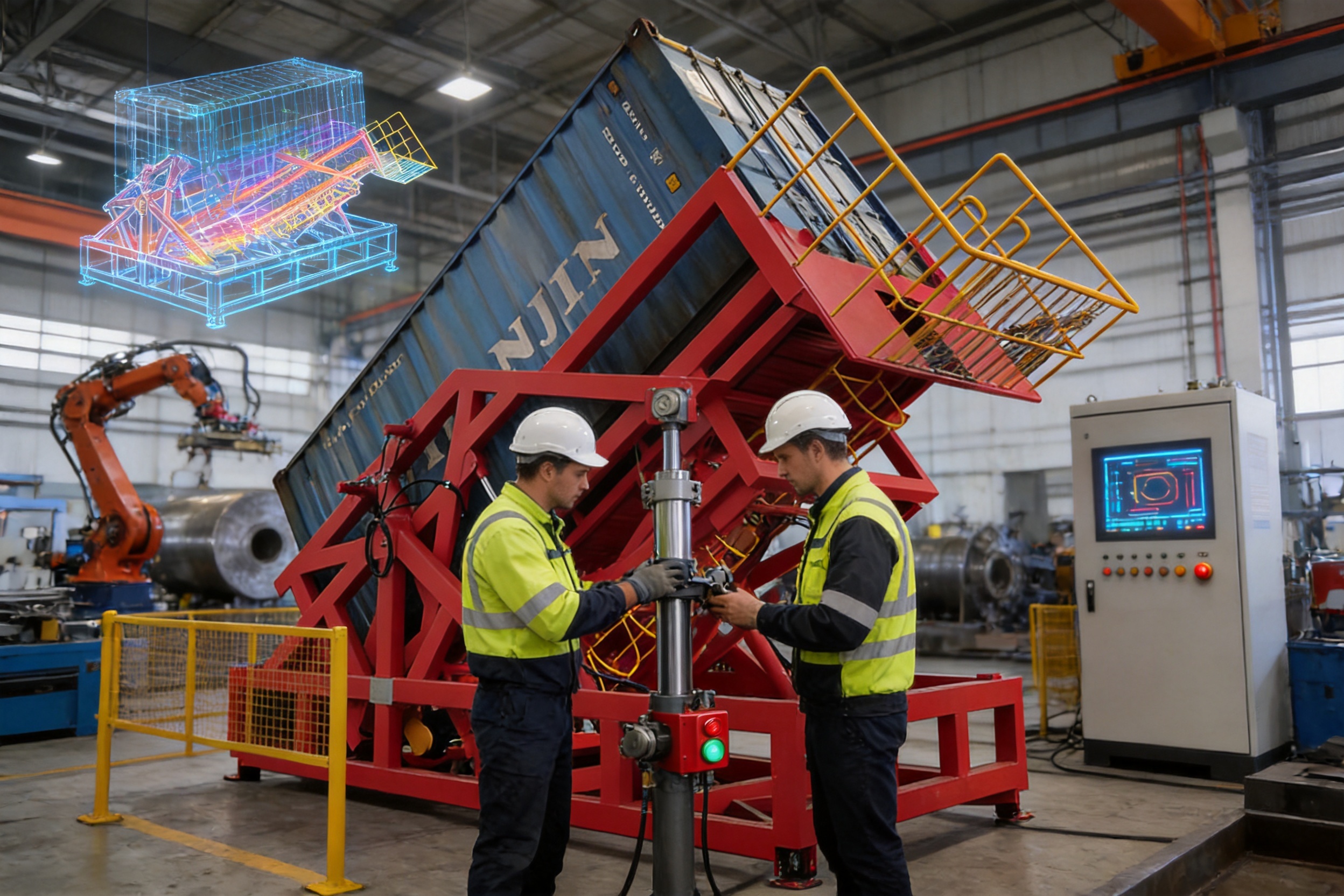
A major advantage of the equipment design is the external location of important lubrication points and maintenance components. This allows routine service to be performed without entering the container or placing personnel in hazardous positions.
Daily inspections should include the frame, clamps, container supports, hydraulic hoses, oil leaks, guards, emergency-stop devices, limit switches, electrical cabinets, and foundation connections. Operators should also check for abnormal noise, vibration, uneven cylinder movement, and changes in rotation speed.
Hydraulic oil condition is important for reliable operation. The supplied maintenance guidance identifies oil replacement at approximately 3,000 operating hours or every 18 months, depending on which condition occurs first. Oil cleanliness, filter condition, ambient temperature, and duty cycle can affect the actual interval, so the manufacturer's maintenance schedule should be followed.
Cylinder seals may have a service life of approximately six to eight years under normal operating conditions, but this depends on pressure, contamination, temperature, alignment, and cycle frequency. Annual inspection of hoses and fittings is recommended to identify wear, cracking, abrasion, or leakage before a failure occurs.
Pivot bearings, locking pins, door mechanisms, clamps, and wear liners should be inspected at planned intervals. Fasteners must be checked for loosening, and structural welds should be examined for cracks or deformation. A preventive-maintenance plan reduces unplanned downtime and helps preserve the machine's long-term fatigue life.
12. Manufacturing Strengths of Jiangsu Zhengding Intelligent Equipment
Jiangsu Zhengding Intelligent Equipment Co., Ltd. is a national high-tech enterprise focused on the research, development, manufacturing, and sales of intelligent loading and unloading equipment. Its product range includes rear dumpers, side-turn truck dumpers, car loading systems, container flippers, and related automated logistics equipment.
The company offers a broader engineering platform than a manufacturer focused on only one type of lifting machine. This broader experience is valuable because container unloading projects often connect with truck unloading, ship loading, storage, conveying, metering, and plant automation. Understanding the full logistics process allows the equipment to be designed as part of a complete material-handling line.
The company serves industries including steel, chemicals, cement, coal, grain, oil, food, feed, ports, papermaking, and new energy. These sectors require equipment with different structural, environmental, hygiene, safety, and automation characteristics. Experience across multiple applications supports the development of adaptable designs rather than one fixed machine format.
Its manufacturing strengths include structural engineering, hydraulic integration, automation control, customized equipment design, system coordination, and project support. The company can integrate container flippers with dust collection systems, conveyor interfaces, weighing modules, automatic doors, and remote monitoring capabilities.
International project experience also provides exposure to different container standards, electrical requirements, operating practices, environmental conditions, and installation expectations. The company's products have been exported to Japan, Brazil, Egypt, Pakistan, India, the Middle East, and Southeast Asian markets.
13. Quality Control and Project Delivery
Quality control should extend through every stage of a container-flipping project. It begins with confirming the operating data and continues through design review, component selection, fabrication, assembly, testing, delivery, installation, and commissioning.
During fabrication, critical dimensions and welds should be inspected. Hydraulic components should be checked for correct pressure ratings and cleanliness. Electrical wiring should be verified against approved drawings. Safety circuits should be tested individually and as part of the complete operating sequence.
Factory acceptance testing can simulate container positioning, clamping, lifting, rotation, stopping, return movement, and emergency response. Where possible, load testing or controlled functional testing should be conducted before shipment. The results provide a baseline for future maintenance and commissioning records.
Site commissioning confirms that the equipment operates correctly with the actual foundation, container fleet, receiving hopper, conveyor, dust collector, electrical supply, and control network. Operator training should be completed during commissioning so that site personnel understand both normal and emergency procedures.
After installation, service support may include spare-parts planning, remote troubleshooting, periodic inspections, software updates, hydraulic maintenance guidance, and engineering modifications. Long-term support is especially important for equipment used in continuous industrial operations.
14. Selecting the Right Configuration
Before purchasing a container flipping machine, the customer should prepare a clear technical specification. Important information includes container length, width, height, tare weight, maximum gross weight, corner-casting condition, door arrangement, material type, bulk density, moisture content, flowability, abrasiveness, temperature, dust characteristics, and required throughput.
The site plan should show truck approach routes, container transfer equipment, foundation dimensions, discharge elevation, hopper location, conveyor direction, maintenance access, electrical room position, and emergency exits. Environmental conditions such as outdoor exposure, corrosive atmosphere, winter temperatures, or coastal salt can affect the materials and coating system.
The required automation level should also be defined. A basic system may use manual door operation and local controls. A more advanced system may require automatic identification, automatic door control, dynamic weighing, recipe selection, data recording, remote monitoring, and integration with a warehouse-management or production-control platform.
Customers should also identify local regulatory requirements. These may relate to lifting machinery, electrical systems, dust emissions, explosion protection, noise, guarding, occupational safety, and weighing certification. Early review of these requirements prevents expensive changes during installation.
15. Economic Value and Return on Investment
The financial benefit of a container flipping machine comes from several sources. Faster cycles can increase throughput without expanding the entire facility. Reduced manual labor can lower operating costs and reduce dependence on difficult-to-recruit personnel. Improved discharge can reduce product loss and the labor required for cleanup.
Safety improvements may also produce economic value by reducing injury risks, downtime, and the operational consequences of confined-space work. Dust control can help protect equipment, improve working conditions, and support environmental compliance.
The investment calculation should include the complete system rather than only the machine price. Relevant items include foundations, conveyors, hoppers, dust collectors, electrical installation, container handling equipment, operator training, spare parts, maintenance, and possible production interruptions during installation.
A practical assessment compares the current unloading cycle, labor requirement, residual material, annual container volume, downtime, and safety exposure with the expected performance of the automated system. Facilities processing large numbers of containers or operating multiple shifts generally have the greatest opportunity to benefit.
16. Comparison with Alternative Technologies
Container flipping machines are not suitable for every material or site, but they offer a strong combination of efficiency, simplicity, and flexibility. Manual unloading may have a low initial equipment cost, but it usually requires more labor and creates greater exposure to dust and confined-space hazards.
Vacuum unloading can provide controlled transfer for selected powders, but it may require substantial energy, filtration, maintenance, and product-specific conveying arrangements. It may also be less suitable for coarse or irregular materials.
Fixed tipping systems can be effective where container traffic follows one permanent route. However, a mobile or configurable container flipper may provide greater flexibility when several workstations or product lines share the same equipment.
Horizontal discharge systems may work well for certain free-flowing products, but they can leave more residual material and may require additional scraping, vibration, or manual cleaning. A flipping machine uses the container's orientation and gravity to improve discharge consistency.
The best choice depends on material behavior, capacity, available space, environmental requirements, and the desired level of automation. A professional equipment supplier should compare the alternatives using actual operating data rather than making a decision based only on headline specifications.
17. Frequently Asked Questions
Q1: What container sizes can the equipment handle?
Standard configurations are available for 20-foot and 40-foot containers. The TJFJ 20 model is designed for 20-foot containers, while the TJFJ 40 model is designed for 40-foot containers. Special frames may be developed for 10-foot, 15-foot, 45-foot, or non-standard containers after confirming dimensions and structural requirements.
Q2: What is the maximum load capacity?
The listed configurations provide maximum lifting weights of 30 or 40 tons, depending on the selected design. The final rated capacity must consider the container tare weight, material load, center of gravity, structural design, hydraulic capacity, site conditions, and applicable safety factors.
Q3: Can the machine unload powders and sticky materials?
Yes, but the design must be matched to the material. Free-flowing powders and grains generally discharge effectively. Sticky, wet, compacted, or cohesive materials may require a greater rotation angle, vibration, air assistance, special liners, or modified discharge geometry.
Q4: How much residual material remains after unloading?
Residual material depends on flowability, moisture, particle size, wall friction, container condition, and rotation angle. Free-flowing materials may leave residual quantities below one percent under suitable conditions. Cohesive materials may leave approximately 1.5 to 2.5 percent or more unless additional discharge-assistance devices are installed.
Q5: Can the system be connected to a dust collector?
Yes. The discharge area can be enclosed with flexible seals and connected to a suitable dust-collection system. Proper performance requires coordination between the flipper, receiving hopper, transfer points, ventilation capacity, filter unit, and material characteristics.
Q6: Is automatic door operation available?
Automatic door control can be configured for applications where operators should not manually open and close container doors near the unloading area. The mechanism must be selected according to the container design, door hardware, material, rotation sequence, and required safety interlocks.
Q7: Is weighing available?
An optional dynamic weighing module can monitor loading weight in real time. It can support overload prevention, shipment verification, inventory records, and outbound data management. The required accuracy and certification should be established before finalizing the weighing system.
Q8: Can the machine be moved between workstations?
A mobile chassis design can be provided where operational flexibility is important. The machine must be stabilized and secured before lifting. The mobility method should be selected according to the machine weight, site floor, travel distance, foundation arrangement, and safety requirements.
Q9: What maintenance is normally required?
Routine maintenance includes hydraulic oil and filter service, hose and fitting inspection, lubrication, clamp inspection, pivot and bearing checks, structural weld examination, electrical inspection, safety-device testing, and cleaning of dust-control components. Hydraulic oil replacement is identified at approximately 3,000 operating hours or 18 months, subject to actual conditions and the manufacturer's recommendations.
Q10: Does the operator need special training?
Operators should receive formal instruction in equipment operation, container verification, emergency procedures, load limits, inspection, dust hazards, exclusion zones, and maintenance isolation. A typical training program may last approximately six hours, but the final program should reflect the machine configuration and site risk assessment.
Q11: Can the equipment be integrated into an automated plant?
Yes. The container flipper can be integrated with conveyors, hoppers, scales, dust collectors, automatic doors, programmable controllers, remote monitoring systems, and plant-management software. The scope of integration should be defined during the engineering stage.
Q12: What information is needed for a quotation?
A supplier normally needs the container size, maximum gross weight, material type, bulk density, moisture, flowability, required throughput, preferred rotation angle, site layout, discharge equipment, dust-control requirements, automation level, local electrical standard, and environmental conditions. Photographs, drawings, and material samples can further improve the accuracy of the proposal.
18. Conclusion
Container flipping machines provide an efficient and safety-focused approach to unloading bulk materials from shipping containers. By combining secure clamping, synchronized hydraulic rotation, gravity-assisted discharge, automatic controls, and optional weighing and dust-control systems, the equipment can improve the performance of grain terminals, mineral plants, cement facilities, recycling centers, food processors, chemical operations, and other industrial sites.
The principal advantages over conventional methods include shorter unloading cycles, reduced manual labor, lower confined-space exposure, improved discharge efficiency, flexible system integration, and better control of dust and operating data. These benefits become more valuable as container volumes increase and facilities seek greater automation.
The quality of the final installation depends on more than the lifting capacity shown on a specification sheet. Structural analysis, weld quality, hydraulic synchronization, clamping safety, foundation design, material testing, dust-control engineering, and control-system integration all influence long-term performance.
Jiangsu Zhengding Intelligent Equipment Co., Ltd. combines intelligent logistics engineering with heavy-duty manufacturing capabilities. Its experience with rear dumpers, side-turn truck dumpers, car loading equipment, container flippers, and integrated loading and unloading systems enables it to develop customized solutions for different industries and operating conditions. Through application analysis, reinforced structural design, finite element evaluation, hydraulic testing, automation integration, and project support, the company provides equipment intended for reliable and repetitive industrial service.
For customers planning a new unloading line or upgrading an existing operation, the most effective approach is to evaluate the complete process: container arrival, positioning, clamping, rotation, discharge, weighing, dust collection, conveying, data management, and empty-container release. When these elements are designed together, a container flipping machine can become a central component of a safer, faster, and more efficient bulk-material logistics system.
References
1. Product technical information for TJFJ series container flipping machines, including model capacities, rotation range, hydraulic safety features, and customization options.
2. Jiangsu Zhengding Intelligent Equipment Co., Ltd. company profile and product portfolio information for automated loading and unloading equipment.
3. General engineering principles for hydraulic lifting equipment, structural steel fabrication, fatigue-resistant welded frames, and industrial machine guarding.
4. ISO 13849, Safety of Machinery—Safety-Related Parts of Control Systems.
5. General industry guidance on bulk-material handling, dust collection, confined-space safety, hydraulic equipment maintenance, and containerized logistics operations.
6. Application data for grain, mineral, cement, recycling, food-powder, and industrial bulk-material unloading systems supplied in the product reference materials.


