

 English
 русский
 Español
 Français
 Português
 عربى
عربى




+86-13588556918
Content
- 1 1. The Role of Enclosed Truck Dumpers in Modern Bulk Handling
- 2 2. Enclosure and Dust Control Principle
- 3 3. Hydraulic Lifting and Mechanical Reliability
- 4 4. Main Technical Parameters
- 5 5. Advantages Over Open and Partially Controlled Dumpers
- 6 6. Performance and Environmental Benefits
- 7 7. Manufacturing Strengths and Engineering Capabilities
- 8 8. Manufacturing and Quality-Control Process
- 9 9. Industrial Applications
- 10 10. Operation, Maintenance, and Safety
- 11 11. Selecting the Correct Configuration
- 12 12. Frequently Asked Questions
- 12.1 Q1: What materials can be unloaded with an enclosed truck dumper?
- 12.2 Q2: Is a fully sealed enclosure always better than a semi-sealed enclosure?
- 12.3 Q3: How does the system reduce dust escape?
- 12.4 Q4: Which filter is suitable for cement or mineral dust?
- 12.5 Q5: Can the equipment handle combustible grain or organic dust?
- 12.6 Q6: Can an existing open dumper be upgraded?
- 12.7 Q7: How much maintenance does the dust collection system require?
- 12.8 Q8: Does enclosure design affect energy consumption?
- 12.9 Q9: What safety features should be included?
- 12.10 Q10: Can the dumper be connected to an automated plant?
- 13 13. Why Integrated Engineering Matters
- 14 14. Conclusion
- 15 References
- 16 Product: Enclosed Truck Dumper with Dust Control System
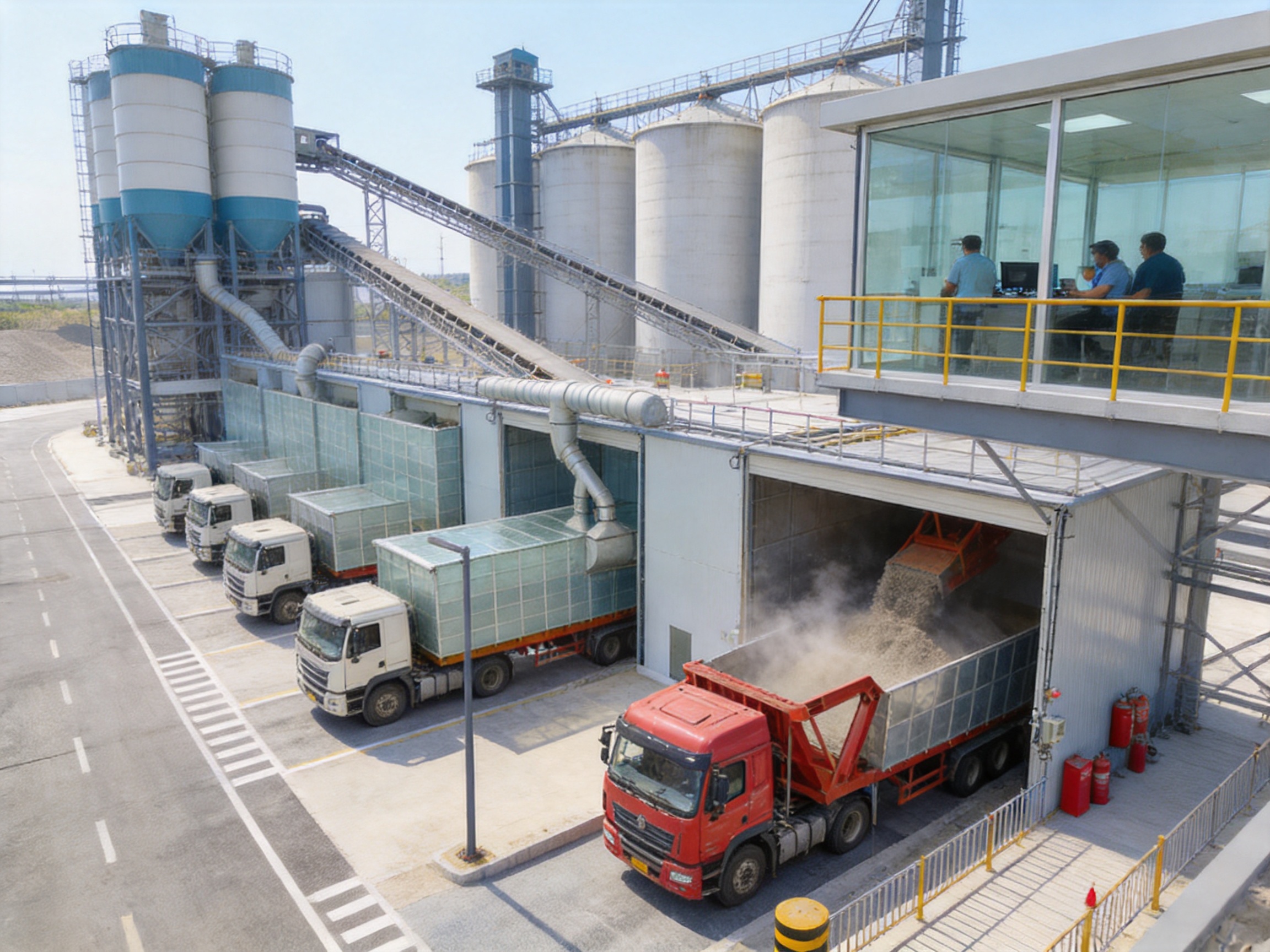
Modern bulk-material facilities are under increasing pressure to unload trucks quickly while controlling dust, protecting workers, recovering valuable product, and meeting demanding environmental requirements. An enclosed truck dumper with a dust control system addresses these needs by combining hydraulic truck tipping technology with a sealed unloading structure and controlled air extraction.
Unlike an open truck dumper, which exposes the unloading point to the surrounding atmosphere, an enclosed design creates a controlled operating zone around the truck, dumper platform, receiving pit, and discharge area. The enclosure limits uncontrolled air movement, while a dedicated dust collection system draws contaminated air toward filters rather than allowing dust to escape into the plant or nearby environment.
This equipment is suitable for cement, grain, feed, coal, minerals, fertilizer, chemicals, lime, fly ash, food ingredients, and other bulk materials that may create dust during unloading. It is particularly valuable at facilities located near offices, residential areas, public roads, production buildings, or other sensitive sites where visible emissions and worker exposure must be minimized.
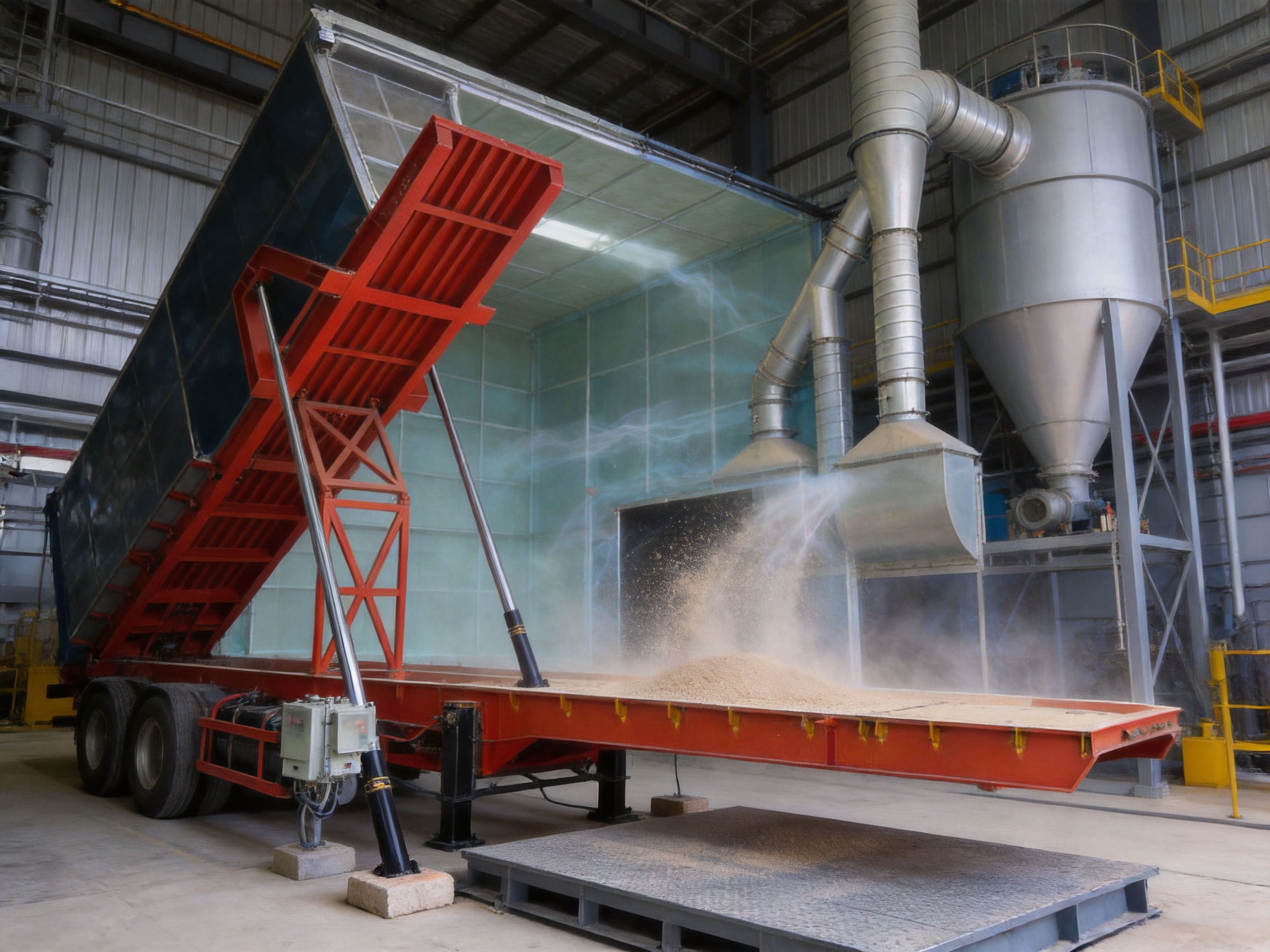
The enclosed truck dumper described in this article uses a combination of dynamic and static sealing. The pit enclosure and truck dumper platform enclosure work together to reduce the effective air intake area. This arrangement improves sealing performance while reducing the energy required by the dust extraction system. The result is a more controlled, efficient, and environmentally responsible unloading process.
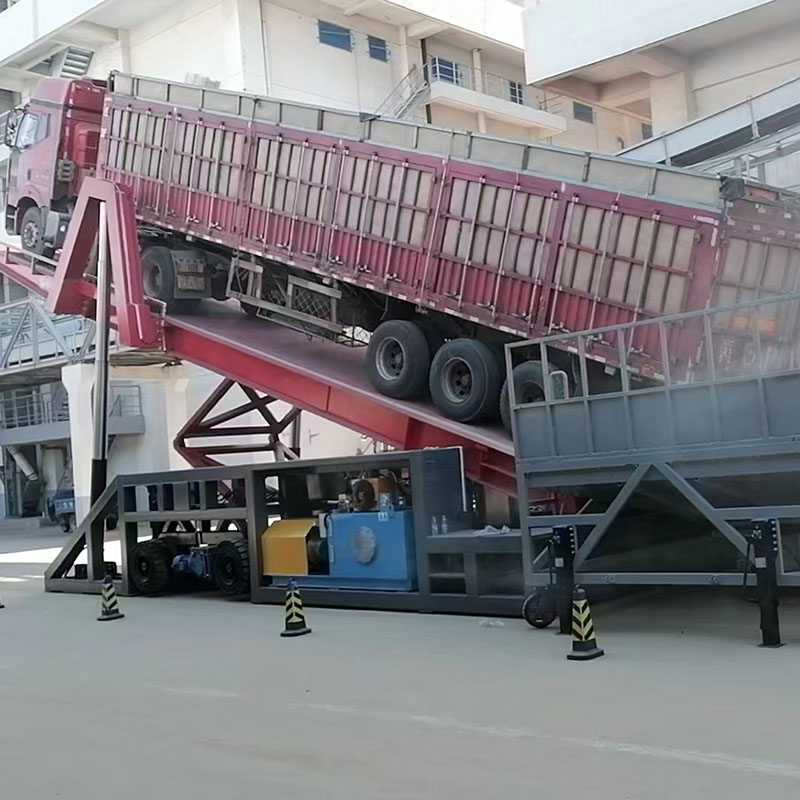
Enclosed Truck Dumper with Dust Control System
1. The Role of Enclosed Truck Dumpers in Modern Bulk Handling
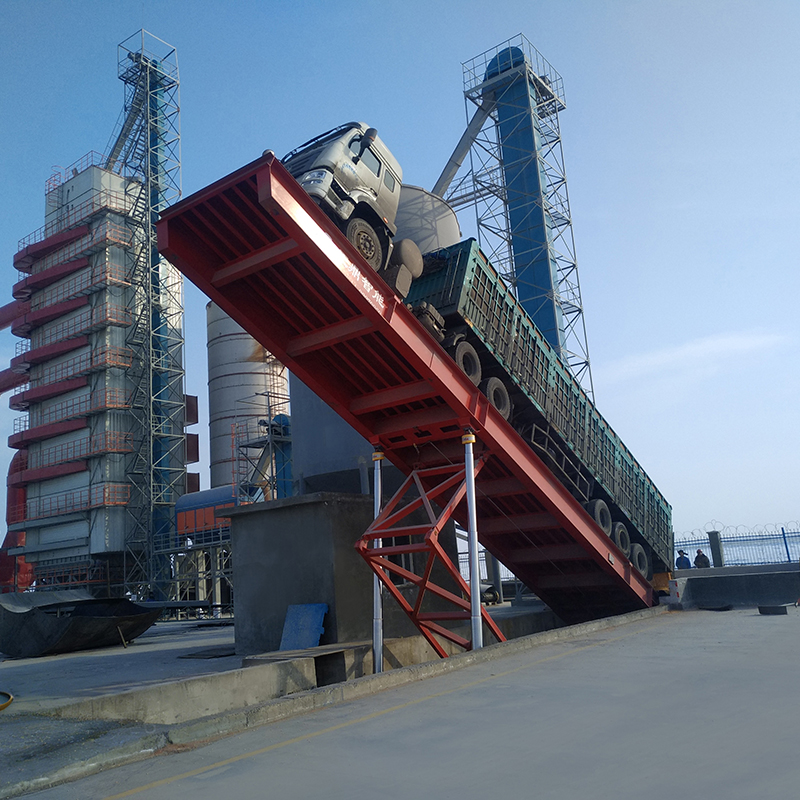
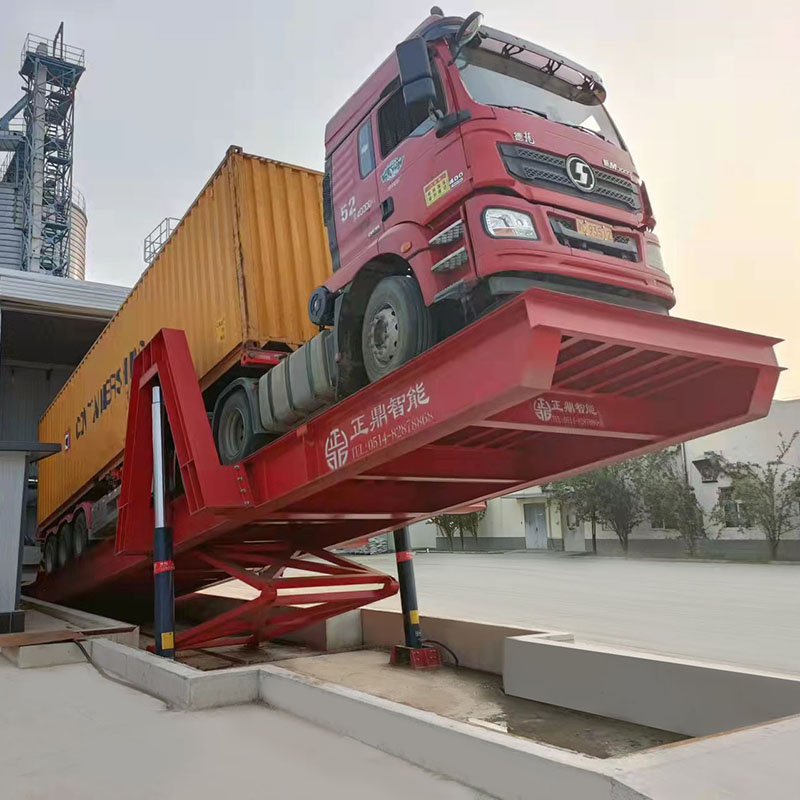
A truck dumper is designed to unload bulk materials by lifting and tilting a truck or trailer until the cargo flows into a receiving pit, hopper, conveyor, or processing system. The principle is simple, but the unloading operation can create strong dust clouds. Material falls from the truck body, impacts the receiving surface, becomes suspended in turbulent air, and may be carried beyond the unloading zone.
Open dumpers rely mainly on natural ventilation, water spraying, operator procedures, or distance from other work areas to manage this problem. These measures may reduce visible dust under certain conditions, but they do not provide the same level of containment as a sealed system. Water spraying can also introduce moisture into materials, create sticky residues, increase cleanup requirements, and interfere with downstream processing.
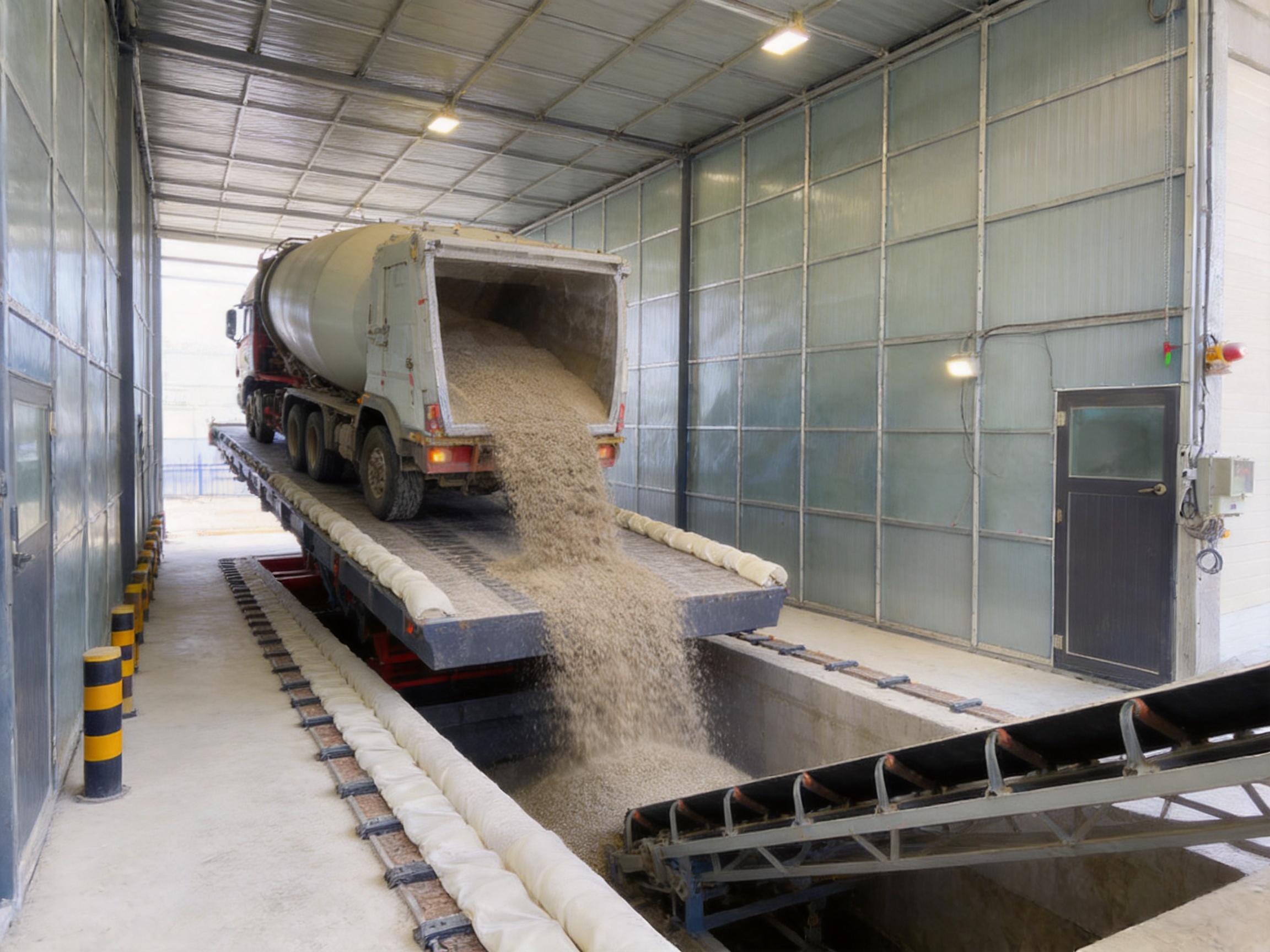
An enclosed truck dumper uses a different approach. Instead of attempting to suppress dust after it has escaped, the equipment contains the dust at its source. The enclosure surrounds the most active dust-generating areas, and the extraction system maintains a carefully managed airflow. Dust-laden air is directed to filter equipment, where particles are separated from the air stream.
This source-control philosophy offers several important advantages:
- Reduced fugitive dust emissions during truck unloading.
- Lower particulate exposure for operators and nearby personnel.
- Improved cleanliness around the unloading station.
- Reduced product loss caused by airborne particles.
- Better alignment with environmental and occupational requirements.
- More consistent operating conditions throughout the year.
- Improved suitability for facilities with strict housekeeping standards.
The system is not limited to one material or one truck configuration. Through appropriate structural dimensions, hydraulic capacity, enclosure design, and filter selection, it can be adapted for different truck sizes, payloads, material characteristics, and plant layouts.
2. Enclosure and Dust Control Principle
The central design feature is the combination of a sealed pit enclosure and a sealed or semi-sealed dumper platform enclosure. These two areas cooperate to prevent dust from escaping through uncontrolled openings.
Static sealing is provided by fixed structural elements such as steel panels, access doors, roof sections, side walls, pit covers, and connection points between the dumper and the receiving system. These components form the physical boundary of the enclosure.
Dynamic sealing is created through controlled airflow. Fans and ductwork draw air into the enclosure and toward the dust collector. By controlling the air inlet area and air velocity, the system reduces outward leakage. The pressure relationship is managed so that air tends to move into the enclosure rather than out of it.
This combination is more effective than relying on structural enclosure alone. A completely sealed structure without planned air extraction may experience pressure fluctuations, difficult access, and uncontrolled leakage around doors or truck interfaces. Conversely, a powerful extraction fan connected to a poorly sealed enclosure may consume excessive energy while still allowing dust to escape through large gaps.
The integrated design therefore seeks a balance between containment, accessibility, airflow, and energy consumption. The enclosure limits the volume of air that must be treated, while the dust collection system removes suspended particles from the controlled air stream.
2.1 Semi-sealed and fully sealed configurations
The equipment can be configured as a semi-sealed or fully sealed structure, depending on the material, site conditions, environmental objectives, and operating requirements.
A semi-sealed configuration provides enclosure around the primary dust-generating areas while leaving selected sections accessible or partially open. This design may be appropriate when the material has moderate dust potential, when the plant has sufficient separation from occupied areas, or when convenient access is a priority.
A fully sealed configuration provides a higher degree of containment. The truck, dumper platform, receiving pit, and discharge interface are enclosed more comprehensively. This arrangement is suitable for fine powders, high-dust materials, strict emissions requirements, or facilities located close to sensitive receptors.
The choice between the two configurations should be based on a complete evaluation of material properties, truck dimensions, unloading frequency, local regulations, filter technology, maintenance access, and the required level of environmental protection.
2.2 Airflow and extraction control
Dust collection performance depends on more than fan capacity. The location of extraction points, the arrangement of ductwork, the size of air inlets, the shape of the enclosure, and the movement of the truck body all influence airflow behavior.
The integrated dust removal design controls both the air inlet area and the inlet wind speed. This helps prevent excessive air turbulence that could re-entrain settled dust or disturb material flow. It also avoids unnecessary extraction volume, which can increase fan power consumption and filter loading.
When properly designed, the system captures dust near the point of generation. The contaminated air is then transported through ductwork to a high-efficiency filter unit, such as a cartridge collector or baghouse. The cleaned air may be discharged according to the plant’s environmental design and applicable regulations.
Automatic filter cleaning, commonly performed by pulse-jet compressed air or another automatic cleaning mechanism, helps maintain airflow and collection efficiency during continuous operation. The collected material can be discharged for recovery, disposal, or controlled return to the process, subject to material safety and plant procedures.
3. Hydraulic Lifting and Mechanical Reliability
Dust control is only one part of truck dumper performance. The lifting system must safely raise heavy truck bodies, maintain stability through the complete tipping cycle, and return the platform to its original position without damaging the hydraulic or structural components.
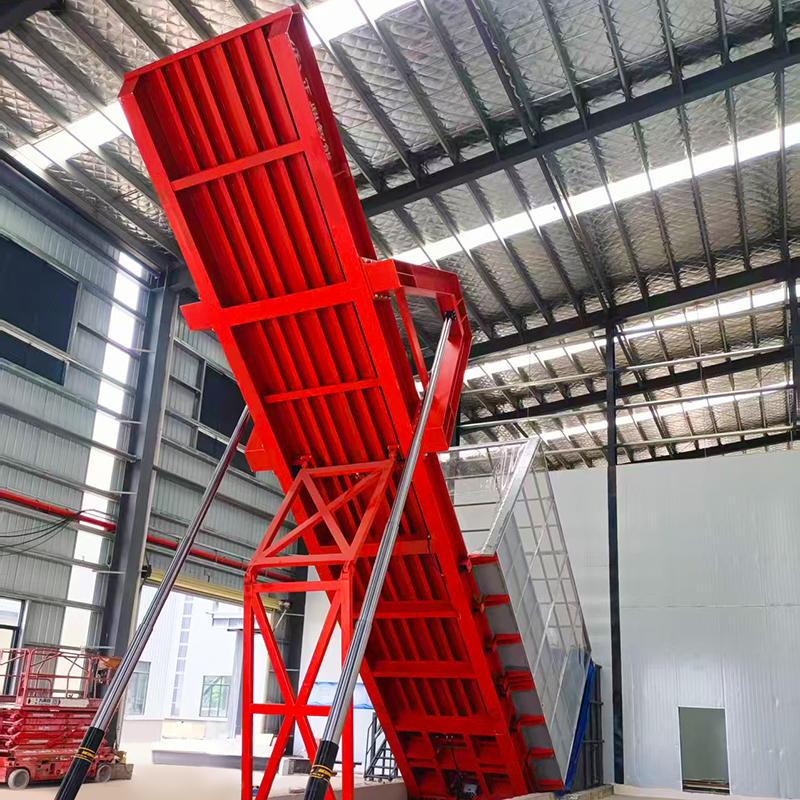
The equipment uses a high-precision hydraulic cylinder synchronous stability system. This system coordinates the movement of the lifting cylinders so that the platform rises evenly and remains stable under load. Synchronized hydraulic motion reduces uneven loading, lateral movement, vibration, and shock during operation.
Stable cylinder synchronization provides several practical benefits:
- Improved operating safety during lifting and lowering.
- Reduced vibration transmitted to the truck and dumper structure.
- Lower impact loads on hydraulic cylinders.
- More uniform stress distribution across the platform.
- Reduced risk of twisting or uneven platform movement.
- Longer service life for cylinders, pins, bearings, and structural members.
- More predictable unloading cycles for automated plant operations.
Hydraulic systems are often exposed to demanding conditions, including dust, vibration, repeated loading, and temperature changes. For this reason, the quality of cylinder synchronization, hose routing, seals, valves, and maintenance access is critical to long-term reliability.
A properly engineered hydraulic circuit should include suitable pressure protection, controlled lowering, emergency stopping capability, and safeguards against unintended movement. Hydraulic components should be selected according to the maximum lifting weight, operating angle, cycle frequency, and environmental conditions.
3.1 Structural stability during tipping
Truck dumpers experience changing loads as the truck body begins to rise and the material shifts toward the receiving pit. The load center moves during the cycle, creating different forces on the platform, hinges, hydraulic cylinders, side restraints, and foundation.
The dumper structure must therefore be designed for more than the static weight of the truck. It must also account for dynamic effects, uneven loading, braking forces, truck positioning, material adhesion, and the possibility that material may discharge asymmetrically.
Structural stability is supported by a rigid platform, properly sized hinge assemblies, reinforced load-bearing sections, accurately positioned cylinders, and a foundation designed for the expected forces. Truck wheel guides, stops, and positioning devices help ensure that vehicles enter the dumper in a repeatable location.
The enclosed structure must be integrated with the dumper without obstructing the lifting motion. Flexible seals, sliding panels, overlapping sections, and carefully designed clearances may be used to maintain enclosure performance as the platform changes angle.
3.2 Lifting angle and unloading performance
The listed product configurations provide maximum lifting angles of 45 degrees or 55 degrees, depending on the selected design. A higher angle can improve the discharge of cohesive or difficult-flowing materials, while a lower angle may be appropriate for free-flowing products or specific truck and pit arrangements.
The correct lifting angle depends on the material’s moisture content, particle size, bulk density, angle of repose, internal friction, and tendency to bridge or adhere to the truck body. Truck body geometry and tailgate design also influence how completely the load discharges.
In applications involving sticky or compacted material, the unloading sequence may require controlled pauses, vibration assistance, or additional inspection procedures. The dumper should not be operated beyond its specified capacity or in a way that causes the truck body to become unstable.
4. Main Technical Parameters
The following table summarizes the principal models and the technical ranges provided for this enclosed truck dumper series. Final dimensions and configuration should be confirmed during engineering design because truck types, enclosure requirements, foundation conditions, and site layout may affect the selected specification.
| Model | Available Size L × W (m) | Maximum Lifting Weight (t) | Maximum Lifting Angle |
|---|---|---|---|
| TQXHF 50 | 14 × 3, 16 × 3, or 17 × 3 | 80 | 45° or 55° |
| TQXHF 80 | 16 × 3, 17 × 3, or 18 × 3 | 80 | 45° or 55° |
| TQXHF 100 | 17 × 3, 18 × 3, or 20 × 3 | 100 | 45° or 55° |
| TQXHF 150 | 17 × 3, 18 × 3, or 20 × 3 | 150 | 45° or 55° |
The model range allows the equipment to serve different truck sizes and material throughput requirements. The maximum lifting weight is an important selection factor, but it should not be considered in isolation. The complete truck weight, cargo distribution, axle arrangement, body dimensions, unloading behavior, and operating cycle must all be reviewed.
The enclosure width and length should also accommodate the truck body, wheel path, safe operator access, inspection points, ventilation requirements, and connection to the receiving hopper or conveyor. A correctly sized enclosure improves dust capture while avoiding unnecessary internal volume.
5. Advantages Over Open and Partially Controlled Dumpers
Open truck dumpers remain suitable for some low-dust applications, outdoor operations, or facilities with limited environmental constraints. However, they expose the unloading process to ambient air movement and generally provide less control over fugitive emissions.
Water-spray systems can suppress some airborne particles, but they may create material-handling problems. Moisture can affect cement, grain, powders, chemicals, and food ingredients. Water also does not necessarily capture the finest respirable particles, and it can increase corrosion, mud formation, drainage requirements, and housekeeping work.
An enclosed truck dumper with dust extraction offers source containment rather than simple suppression. Its advantages include:
5.1 Better containment at the source
The enclosure surrounds the area where dust is generated. This reduces the distance that dust can travel before capture and minimizes the influence of wind, vehicle movement, and building airflow.
5.2 Lower energy consumption than poorly sealed systems
Because the pit and platform enclosures limit uncontrolled air intake, the dust collector does not need to move excessive volumes of air simply to compensate for leakage. Lower extraction volume can reduce fan energy consumption and filter loading when the system is correctly balanced.
5.3 Improved worker protection
Operators and maintenance personnel benefit from reduced exposure to suspended dust around the dumper. A control room or remote operating station can further separate personnel from the unloading area. Personal protective equipment may still be required according to the material and site risk assessment, but the equipment helps reduce the overall exposure burden.
5.4 Greater material recovery
Dust that would otherwise be lost to the atmosphere can be captured by the filter system. Depending on the material and plant procedures, recovered product may be returned to the process or handled as a controlled waste stream.
5.5 Improved housekeeping
Less dust escaping from the unloading point means less buildup on floors, structural steel, conveyors, lighting fixtures, and nearby equipment. Reduced dust accumulation can lower cleaning labor and help prevent secondary dust clouds caused by traffic or maintenance activity.
5.6 Better community and environmental performance
Visible dust emissions can create complaints even when a facility remains technically within a permitted limit. A sealed dumper reduces the visual impact of unloading and supports better relations with neighboring businesses and communities.
6. Performance and Environmental Benefits
Reported performance data for enclosed truck dumper systems indicates that source dust emissions can be reduced substantially compared with open unloading. Depending on the enclosure, filter, material, operating practice, and measurement method, dust capture may reach approximately 90 to 98 percent of fugitive emissions.
Facilities operating enclosed systems may also achieve significant reductions in ambient particulate concentrations around the property boundary. The actual result depends on the existing background concentration, building ventilation, wind direction, traffic, material moisture, loading frequency, and the performance of other dust sources at the site.
It is important to distinguish equipment capability from guaranteed site-wide results. An enclosed dumper can control emissions at the unloading point, but transfer towers, conveyors, stockpiles, truck traffic, and material spills may create additional sources. A complete environmental program should evaluate all of these areas.
6.1 Filter efficiency and dust characteristics
Cartridge filters and baghouse filters are commonly used for industrial dust collection. Filter selection should consider particle size distribution, bulk density, temperature, moisture, abrasiveness, chemical composition, combustibility, and required discharge quality.
Fine mineral or cement dust may require high-efficiency filter media and careful pulse-cleaning control. Grain and organic dust may require additional fire and explosion-risk evaluation, including grounding, spark control, pressure relief, temperature monitoring, and appropriate separation equipment.
Moist or sticky materials can blind filter media and reduce airflow. In such applications, the enclosure, ductwork, hopper, and filter unit should be designed to reduce condensation and prevent buildup. The material’s behavior during unloading should be assessed before finalizing the dust control system.
6.2 Material recovery and operating cost
Dust control can provide an economic benefit as well as an environmental benefit. Product captured by the filter may represent a reduction in material loss. The financial value depends on product price, annual throughput, dust concentration, recovery percentage, and whether the collected material is suitable for reuse.
Enclosure systems can also reduce cleaning frequency, plant shutdowns caused by excessive dust, and maintenance on equipment affected by contamination. These indirect benefits should be included in a life-cycle cost evaluation.
Operating costs include fan electricity, compressed air for filter cleaning, replacement filter elements, inspection labor, hydraulic maintenance, seal replacement, and periodic structural repairs. A well-sealed enclosure and correctly selected filter can help control these costs over the life of the equipment.
7. Manufacturing Strengths and Engineering Capabilities
The performance of an enclosed truck dumper depends heavily on manufacturing accuracy and integration quality. The equipment combines a large load-bearing steel structure, hydraulic lifting equipment, enclosure panels, sealing components, dust extraction, electrical controls, and safety systems. Poor coordination between these subsystems can reduce reliability even when individual components are well designed.
Jiangsu Zhengding Intelligent Equipment Co., Ltd. is a national high-tech enterprise specializing in intelligent logistics equipment and automatic loading and unloading systems. Its product range includes rear dumpers, side-turn truck dumpers, container flippers, car loading equipment, and related automated handling solutions.
The company’s manufacturing and engineering strengths include the ability to develop complete systems rather than supplying only an isolated lifting platform. This system-based approach is important because the dumper must connect properly with the receiving pit, conveyor, dust collector, control system, truck route, foundation, and plant production process.
7.1 Modular structural manufacturing
Modular panel construction allows the enclosure to be adapted to different site layouts and truck dimensions. Panels can be manufactured, transported, installed, inspected, and replaced in a controlled sequence. Modular construction also supports future modification when truck types, material capacity, or environmental requirements change.
Steel fabrication must maintain dimensional accuracy at platform interfaces, cylinder mounting points, hinge assemblies, sealing surfaces, and panel joints. Accurate fabrication helps reduce installation difficulties and supports consistent movement during lifting.
Protective surface treatment should be selected according to the operating environment. Facilities handling salt, chemicals, fertilizers, wet materials, or outdoor unloading may require enhanced corrosion protection. Coating inspection, weld quality, drainage design, and access for repainting all contribute to long-term service life.
7.2 Hydraulic system integration
The company’s high-precision cylinder synchronization concept is intended to produce stable lifting movement, low vibration, and reduced impact on hydraulic components. Integration includes the cylinders, valves, hydraulic power unit, control logic, piping, flexible hoses, emergency functions, and maintenance points.
Hydraulic components should be tested for pressure retention, leakage, movement synchronization, emergency stopping, controlled lowering, and repeated cycle performance. Factory testing can identify installation issues before the equipment reaches the customer’s site.
7.3 Dust-control system integration
The dust collection system is designed as part of the dumper rather than being treated as an unrelated accessory. Enclosure geometry, duct connections, extraction points, filter capacity, access doors, and collected-material discharge must be considered together.
Integrated design helps prevent common problems such as dead zones where dust accumulates, excessive air leakage at platform transitions, undersized ducts, difficult filter access, or interference between moving truck components and stationary enclosure panels.
7.4 Automation and control
Modern truck dumpers can be equipped with automated operating sequences, truck-position confirmation, interlocked gates, hydraulic status monitoring, dust collector start-up logic, filter differential-pressure monitoring, and emergency stop functions.
Automation can prevent the dumper from lifting before the truck is correctly positioned or before the enclosure and receiving system are ready. It can also coordinate the dust collector with the unloading cycle so that extraction begins before tipping and continues after material discharge until airborne dust has been removed.
Control systems may be connected to plant supervisory systems, weighing equipment, access control, traffic signals, and production management software. This supports traceability and helps operators identify abnormal conditions.
7.5 Customized project engineering
Truck dumper projects are rarely identical. Differences may include truck wheelbase, body length, payload, tailgate type, material density, unloading rate, foundation depth, available headroom, climate, electrical standards, and local safety rules.
A customized engineering process should begin with a site survey and operating study. Engineers should review general arrangement drawings, truck data, material test information, receiving equipment, dust collection requirements, utilities, maintenance access, drainage, fire protection, and emergency routes.
The company’s experience with steel, chemical, cement, coal, grain, oil, food, feed, port, papermaking, and new energy applications supports the development of solutions for different industries. Its international market experience also provides familiarity with varied project conditions and customer requirements.
8. Manufacturing and Quality-Control Process
A reliable enclosed dumper requires controlled manufacturing from design through commissioning. The following process represents the main quality areas that should be addressed in a professional project.
8.1 Engineering review
The project begins with confirmation of the truck model, maximum gross weight, cargo type, dimensions, unloading frequency, desired cycle time, maximum lifting angle, and receiving equipment. The enclosure and dust collection requirements are then matched to the material’s dust characteristics and the site’s environmental objectives.
8.2 Structural design verification
Load-bearing structures should be reviewed for static loads, dynamic loads, fatigue, lifting forces, lateral forces, and local stress concentration. Critical welded areas, hinge supports, cylinder brackets, wheel stops, and foundation connections require particular attention.
8.3 Component procurement
Hydraulic cylinders, pumps, valves, motors, fans, filter elements, sensors, electrical components, seals, and structural steel should be selected according to the project specification. Components must be compatible with the intended operating environment and maintenance plan.
8.4 Fabrication and welding
Steel sections are cut, formed, drilled, assembled, and welded according to approved drawings. Dimensional checks are important before and after welding because distortion can affect cylinder alignment, platform movement, and panel installation.
8.5 Surface treatment
After fabrication, surfaces should be cleaned and prepared before coating. The coating system should match the environmental exposure and the customer’s durability expectations. Coating thickness, adhesion, color, and coverage should be inspected before shipment.
8.6 Hydraulic and electrical assembly
Hydraulic piping should be cleaned, correctly routed, supported, and protected from abrasion. Electrical wiring should be identified, secured, and tested. Sensors and control devices should be positioned so that they remain accessible for inspection while being protected from impact and dust.
8.7 Factory testing
Factory acceptance testing may include dimensional inspection, no-load movement, loaded lifting tests, synchronization checks, hydraulic pressure testing, emergency stop testing, fan and filter operation, control-system verification, and inspection of enclosure interfaces.
Where complete assembly is not possible at the factory because of transportation limits, major modules can be preassembled and trial-fitted before shipment. This reduces installation time and helps confirm that interfaces are correctly manufactured.
8.8 Installation and commissioning
On-site commissioning should verify foundation level, anchor connections, platform movement, truck positioning, enclosure clearances, dust extraction airflow, filter pressure drop, interlocks, and emergency functions. Operators and maintenance personnel should receive training before production use.
9. Industrial Applications
9.1 Cement and building materials
Cement, fly ash, gypsum, lime, and other mineral powders can create significant dust during truck unloading. Enclosed dumpers help contain the material at the receiving pit and direct airborne particles to a filter system. Captured material may be recovered where permitted by the process design.
9.2 Grain and feed
Grain and feed facilities require special attention to combustible dust, hygiene, cross-contamination, and material quality. Enclosure panels should be designed for effective cleaning, while dust collection and safety systems should reflect the combustible properties of the handled product.
9.3 Coal and mineral handling
Coal, ore, mineral concentrates, and similar materials may produce dust and require robust structures because of high bulk density and abrasive particles. Wear protection may be necessary at impact zones, chutes, and receiving hoppers.
9.4 Chemical and fertilizer plants
Chemical powders and fertilizers may require corrosion-resistant materials, special coatings, sealed electrical equipment, and carefully selected filter media. The dust collection design must consider chemical compatibility and the consequences of returning captured material to the process.
9.5 Food and oilseed processing
Food and oilseed facilities often require cleanable surfaces, controlled access, and measures to prevent contamination. An enclosed dumper can reduce airborne material migration and support a more hygienic unloading area.
9.6 Ports and logistics terminals
At ports and high-throughput terminals, trucks may arrive continuously and unloading reliability is critical. Automated truck identification, weighing, access control, dumper sequencing, and dust extraction can be integrated into a coordinated logistics system.
10. Operation, Maintenance, and Safety
Correct operation is essential to achieving the designed performance. The truck should be positioned according to the operating procedure, brakes and restraints should be applied where required, and personnel should remain outside restricted areas during lifting.
Before each shift, operators should inspect the platform, wheel stops, hydraulic hoses, cylinder connections, enclosure doors, flexible seals, extraction ducts, filter indicators, emergency stops, and communication equipment.
The dust collector should be operating before unloading begins. If differential pressure rises beyond the recommended range, the filter cleaning system, compressed-air supply, hopper discharge, and filter elements should be inspected.
Routine maintenance commonly includes filter inspection every 200 to 400 operating hours, compressed-air checks, hopper discharge inspection, seal inspection, hydraulic oil examination, lubrication of moving components, and verification of safety interlocks.
Filter elements may last approximately 2,000 to 5,000 operating hours, depending on material abrasiveness, dust loading, moisture, cleaning frequency, and operating conditions. These figures are guidelines rather than guarantees; actual replacement intervals should be based on pressure drop, visual condition, leakage, and collection performance.
Maintenance personnel should isolate hydraulic, electrical, pneumatic, and mechanical energy before entering the enclosure or working beneath the dumper. Confined-space, dust, fall, fire, and explosion hazards should be addressed through the site’s formal safety procedures.
11. Selecting the Correct Configuration
The correct enclosed truck dumper should be selected through a structured evaluation rather than by lifting capacity alone. The following factors are particularly important:
- Maximum truck gross weight and payload.
- Truck body length, width, wheelbase, and height.
- Material density, moisture, temperature, and flowability.
- Dust concentration and particle-size distribution.
- Required unloading cycle time.
- Maximum lifting angle.
- Available foundation depth and overhead clearance.
- Indoor or outdoor installation conditions.
- Required degree of sealing.
- Dust collector type and filter area.
- Material recovery and disposal requirements.
- Electrical, fire, and environmental standards.
- Access requirements for inspection and maintenance.
A semi-sealed system may be adequate for a low-dust material with moderate environmental requirements. A fully sealed system is generally more appropriate when the product is fine, dry, hazardous, combustible, valuable, or handled near occupied areas.
Potential buyers should request a general arrangement drawing, utility list, foundation information, dust collector specification, control philosophy, maintenance schedule, spare-parts list, performance testing procedure, and commissioning plan.
12. Frequently Asked Questions
Q1: What materials can be unloaded with an enclosed truck dumper?
The system can be adapted for cement, grain, feed, coal, minerals, fertilizer, lime, fly ash, chemicals, food ingredients, oilseed products, and other bulk materials. Final design depends on material flowability, abrasiveness, moisture, temperature, chemical properties, and dust behavior.
Q2: Is a fully sealed enclosure always better than a semi-sealed enclosure?
Not necessarily. A fully sealed enclosure provides stronger containment, but it may require greater investment, more complex access arrangements, and additional ventilation design. A semi-sealed configuration may provide sufficient performance for materials and sites with moderate dust-control requirements. The correct choice should follow a site-specific engineering assessment.
Q3: How does the system reduce dust escape?
The pit and platform enclosures reduce uncontrolled openings, while the extraction system controls airflow and directs dust-laden air toward the filter. The integrated design controls the air inlet area and inlet wind speed, helping create a stable containment environment with lower energy consumption.
Q4: Which filter is suitable for cement or mineral dust?
Cartridge filters or baghouse filters are commonly used. The correct selection depends on particle size, temperature, moisture, airflow, required emission performance, and maintenance conditions. Filter media should be selected through a review of the material properties and the intended operating environment.
Q5: Can the equipment handle combustible grain or organic dust?
It can be designed for grain and organic materials, but combustible-dust risks must be assessed separately. The project may require grounding, spark prevention, explosion relief, temperature monitoring, suitable electrical equipment, fire protection, and specialized dust collection arrangements.
Q6: Can an existing open dumper be upgraded?
Many existing dumpers can be retrofitted with modular enclosure panels, sealing components, extraction ductwork, and a dust collector. A site survey is necessary to determine whether the existing platform, foundation, hydraulic system, and clearance dimensions are suitable. In some cases, replacement provides better long-term value than modification.
Q7: How much maintenance does the dust collection system require?
Routine maintenance includes filter inspection, compressed-air checks, hopper discharge monitoring, duct inspection, fan checks, and differential-pressure monitoring. Filter elements generally require replacement based on condition and operating hours. Automated pulse cleaning can reduce manual intervention but does not eliminate inspections.
Q8: Does enclosure design affect energy consumption?
Yes. Poorly sealed systems draw excessive air through unwanted openings, increasing fan demand and filter loading. The combination of static sealing and dynamic airflow control limits unnecessary air intake and can reduce the energy required to maintain effective dust capture.
Q9: What safety features should be included?
Important features may include emergency stops, hydraulic pressure protection, controlled lowering, truck-position interlocks, access-door interlocks, wheel stops, warning lights, audible alarms, maintenance isolation points, and restricted-area controls. The exact arrangement should comply with the applicable local standards and site risk assessment.
Q10: Can the dumper be connected to an automated plant?
Yes. The dumper can be integrated with truck identification, weighing systems, conveyors, receiving hoppers, dust collectors, plant control systems, and traffic management equipment. Automated sequencing can improve throughput and prevent unsafe operation when required conditions have not been met.
13. Why Integrated Engineering Matters
The main difference between a basic lifting platform and a high-performance enclosed truck dumper is the level of system integration. A lifting platform may raise a truck, but it does not necessarily control dust, optimize airflow, coordinate with downstream equipment, or protect the structure from uneven hydraulic movement.
An integrated product considers the complete unloading cycle. It brings the truck into position, confirms operational conditions, starts the dust collector, lifts the platform in a controlled manner, directs material into the receiving system, completes post-unloading extraction, lowers the platform, and returns the equipment to a safe standby condition.
This approach improves reliability because the mechanical, hydraulic, electrical, structural, and environmental functions are engineered together. It also simplifies responsibility for the customer, who can work with one equipment supplier for the core dumper and its associated automation and dust-control functions.
Jiangsu Zhengding Intelligent Equipment Co., Ltd. provides equipment for automatic loading and unloading of automobiles and containers across multiple industries. Its broader experience with rear dumpers, side-turn dumpers, container flippers, car loading systems, and intelligent logistics equipment supports the development of customized solutions for complex material-handling projects.
14. Conclusion
An enclosed truck dumper with a dust control system is a practical solution for facilities that must combine high-capacity truck unloading with environmental protection, worker safety, material recovery, and dependable automation.
Its principal advantage is the coordinated use of enclosure technology and controlled extraction. The pit enclosure and platform enclosure provide static containment, while the dust collection system creates dynamic airflow that directs airborne particles away from occupied areas. Controlling the air inlet area and wind speed helps improve sealing performance and reduce unnecessary energy consumption.
The high-precision hydraulic cylinder synchronization system further strengthens the equipment by providing stable movement, lower vibration, reduced cylinder impact, and longer mechanical service life. Available models support lifting weights from 80 to 150 tons and maximum lifting angles of 45 or 55 degrees, with dimensions that can be selected according to truck and site requirements.
Compared with open dumpers or water-spray-only arrangements, the enclosed system offers more effective source control, better housekeeping, lower worker exposure, improved material recovery, and stronger environmental performance. Its benefits are especially valuable in cement, grain, feed, chemical, mineral, coal, food, fertilizer, and other dusty-material applications.
The success of the project depends on correct customization, professional manufacturing, accurate installation, suitable filter selection, and disciplined maintenance. With integrated structural, hydraulic, dust-control, automation, and commissioning capabilities, the equipment can serve as a central part of a modern, efficient, and environmentally responsible truck unloading operation.
References
1. Jiangsu Zhengding Intelligent Equipment Co., Ltd. Product information for enclosed truck dumpers, hydraulic lifting systems, and automatic loading and unloading equipment.
2. Jiangsu Zhengding Intelligent Equipment Co., Ltd. Technical data for TQXHF series truck dumpers and dust-control configurations.
3. Industrial dust collection engineering principles for cartridge filters, baghouse filters, negative-pressure ventilation, and pulse-jet cleaning systems.
4. Bulk material handling engineering guidance for truck dumpers, receiving pits, hoppers, conveyors, and hydraulic tipping platforms.
5. Occupational hygiene principles for controlling respirable particulate exposure in industrial unloading and transfer operations.
6. Industrial ventilation and source-capture practices for enclosed bulk-material handling systems.
7. Safety engineering guidance for hydraulic lifting equipment, truck positioning, mechanical isolation, and automated material-handling systems.
8. Environmental management practices for fugitive dust control, material recovery, housekeeping, and industrial emissions reduction.


