

 English
 русский
 Español
 Français
 Português
 عربى




+86-13588556918
Content
- 1 1. The Role of Continuous Container Handling in Modern Logistics
- 2 2. Integrated Design for Loading and Unloading
- 3 3. Continuous Handling Compared with Traditional Batch Methods
- 4 4. Product Advantages Over Conventional and Competing Systems
- 5 5. Advanced Manufacturing and Engineering Capabilities
- 6 6. Customization for Different Industries
- 7 7. Safety, Reliability, and Maintenance
- 8 8. Why Choose an Experienced Integrated Equipment Manufacturer
- 9 9. Project Planning and Selection Guide
- 10 10. Frequently Asked Questions
- 10.1 Q1: What is the minimum throughput that can justify a continuous handling system?
- 10.2 Q2: Can an existing batch system be converted to continuous operation?
- 10.3 Q3: Can the equipment handle both 20-foot and 40-foot containers?
- 10.4 Q4: What is the maximum lifting angle?
- 10.5 Q5: Is weighing available as part of the system?
- 10.6 Q6: Does the system include automatic container door operation?
- 10.7 Q7: How does continuous handling affect container damage?
- 10.8 Q8: How is the equipment maintained?
- 10.9 Q9: Can the system be connected to existing warehouse or terminal software?
- 10.10 Q10: What information should be provided when requesting a quotation?
- 11 11. Conclusion
- 12 References
- 13 Product: Continuous Container Handling System
Modern logistics facilities are under constant pressure to move more cargo through the same number of gates, cranes, loading bays, and work shifts. Container volumes continue to increase, while customers expect shorter turnaround times, accurate weighing, safer operations, and more predictable delivery schedules. In this environment, a conventional batch handling process can become a serious limitation. Every container may require separate positioning, securing, loading or unloading, releasing, and removal before the next container can enter the work area.
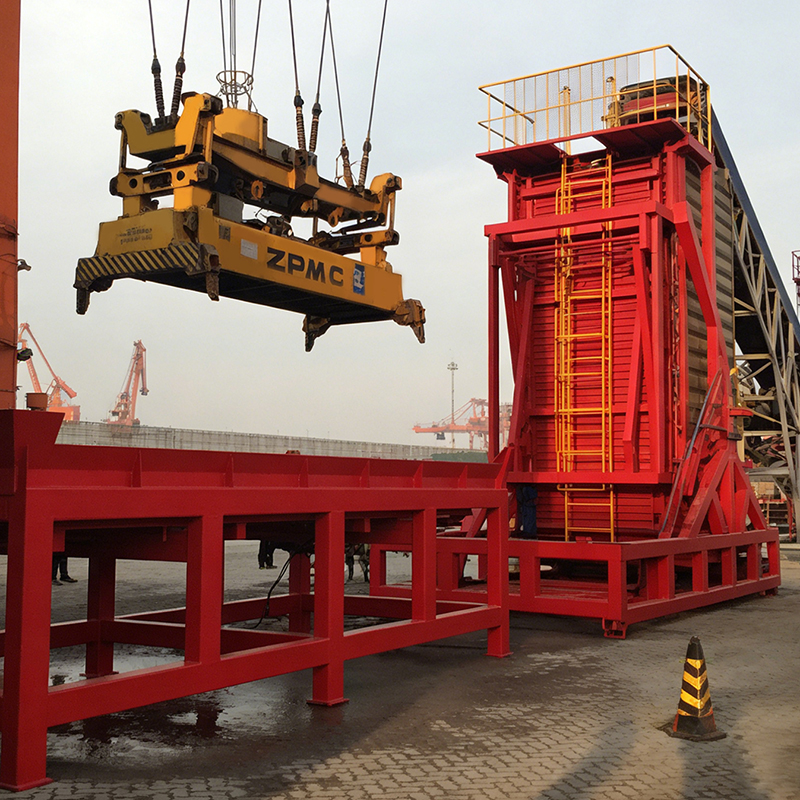
A continuous container handling system is designed to overcome these limitations by integrating container feeding, positioning, tilting, loading, unloading, weighing, door operation, and discharge into one coordinated production line. Instead of treating every container as an isolated operating cycle, the system organizes containers into a controlled flow. This allows individual activities to overlap and substantially reduces waiting time between containers.
The continuous container handling system described in this article is engineered for both 20-foot and 40-foot containers. It is suitable for railway container central stations, inland ports, large logistics parks, industrial warehouses, bulk-material terminals, and other facilities where loading and unloading speed directly affects operating capacity. Its integrated design can support high-throughput operations while reducing manual intervention, improving equipment utilization, and making better use of limited site space.
Continuous Container Handling System
1. The Role of Continuous Container Handling in Modern Logistics
Container handling is often viewed as a simple lifting and transfer task. In practice, it is a sequence of interconnected operations involving heavy loads, strict safety requirements, precise alignment, vehicle scheduling, material flow control, and coordination between mechanical and electrical systems. A delay at one point in the process can affect every subsequent operation.
In a traditional batch process, the handling equipment normally waits until one container has been completely loaded or unloaded. The container must then be secured, released, removed, and replaced by another container. Each changeover may include several minutes of non-productive time. Although no material is being processed during this interval, the crane, loading station, operators, and surrounding infrastructure may remain occupied.
Continuous handling changes this operating pattern. Containers can be introduced through a dedicated feeder while the previous container is being processed. Indexing conveyors, synchronized platforms, transfer mechanisms, and parallel work zones allow the system to maintain a more consistent operating rhythm. The container movement sequence is coordinated by control software, sensors, mechanical stops, and safety interlocks.
The result is not simply a faster lifting motion. The principal improvement comes from reducing unnecessary pauses and eliminating repeated transfers between separate areas. Loading and unloading functions can be incorporated into the same production line, enabling the system to handle different operating requirements without requiring a separate container route for every task.
1.1 Typical applications
Continuous container handling is particularly useful where daily throughput is high or where container arrival times are closely scheduled. Typical applications include railway container terminals, inland ports, intermodal transfer yards, distribution centers, warehouse loading areas, bulk-material handling facilities, grain terminals, chemical plants, cement plants, food ingredient warehouses, and industrial logistics parks.
It is also suitable for facilities where the working site is restricted. A conventional layout may require separate areas for empty-container staging, loaded-container positioning, weighing, door operation, loading, unloading, and final dispatch. An integrated system can combine several of these functions into a more compact arrangement, helping the operator reduce unnecessary internal transport and make better use of available land.
1.2 Supporting 20-foot and 40-foot containers
Container length is a major consideration in system design. A 20-foot container has different load distribution, support-point, and center-of-gravity characteristics from a 40-foot container. The handling equipment must accommodate these differences without compromising stability or operational accuracy.
The system can be configured for both container sizes. The TJXH 20 model has a reference size of 6 by 3 meters, a maximum lifting weight of 50 tons, and maximum lifting angles of 45 or 60 degrees. The TJXH 40 model has a reference size of 12 by 3 meters, a maximum lifting weight of 100 tons, and maximum lifting angles of 45 or 60 degrees.
| Model | Applicable Container Length | Reference Size L × W | Maximum Lifting Weight | Maximum Lifting Angle |
|---|---|---|---|---|
| TJXH 20 | 20-foot container | 6 × 3 meters | 50 tons | 45° or 60° |
| TJXH 40 | 40-foot container | 12 × 3 meters | 100 tons | 45° or 60° |
Actual working capacity depends on the container type, cargo density, load distribution, lifting configuration, site conditions, safety requirements, and customer specifications. A detailed engineering review is therefore necessary before final equipment selection. The published parameters provide a reference for model selection, while the final system should be confirmed through technical design and load analysis.
2. Integrated Design for Loading and Unloading
The central advantage of this equipment is its integrated dual functionality. The same production line can support both container loading and container unloading. This eliminates the need to transfer containers between separate loading and unloading areas and reduces the number of independent machines required to complete a logistics cycle.
In a fragmented layout, containers may need to be moved from a receiving area to a weighing station, then to a tilting platform, and finally to a loading or unloading position. Every transfer introduces additional handling time and additional opportunities for misalignment, impact, equipment congestion, or manual intervention.
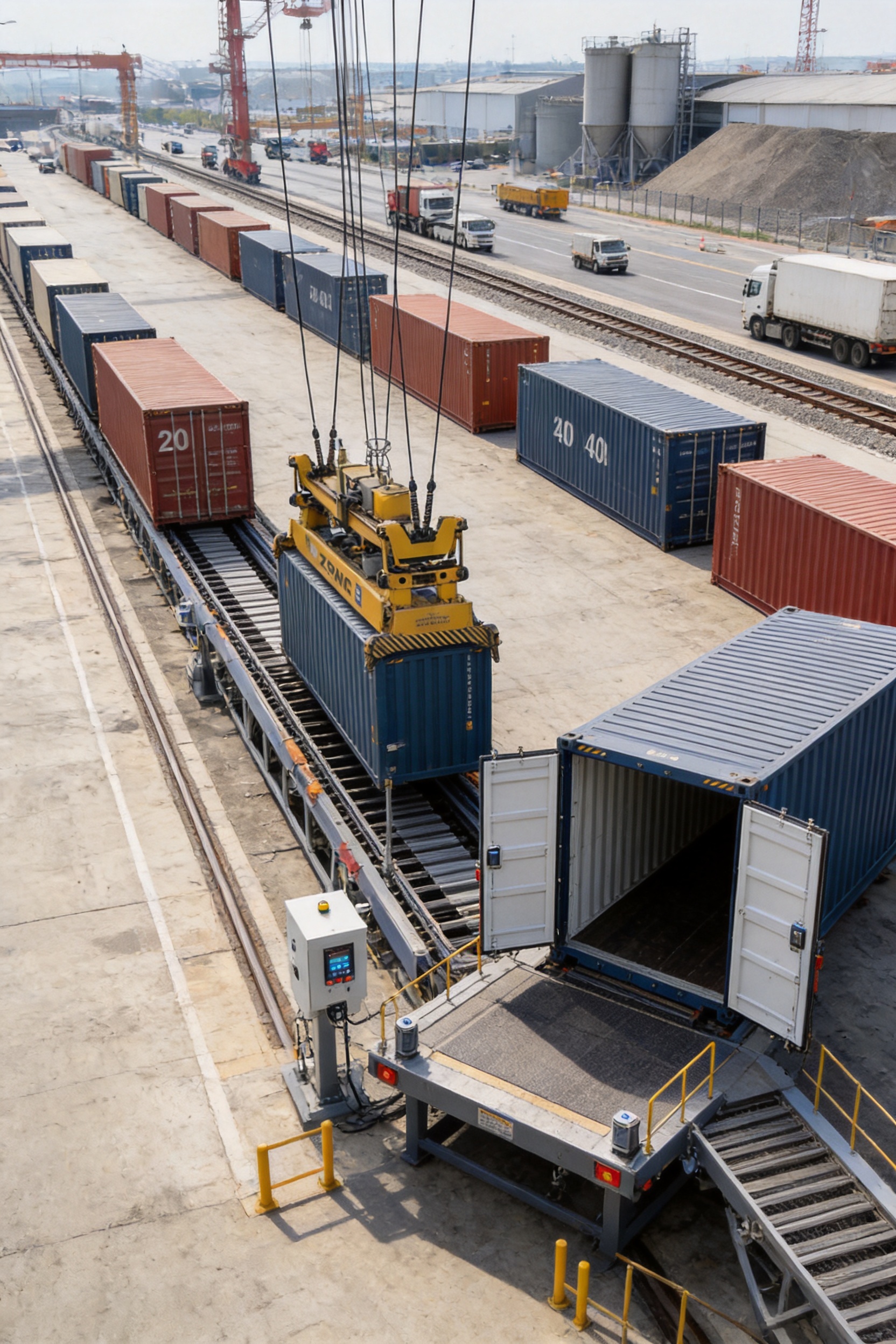
An integrated line coordinates these functions through a planned sequence. A container can be fed into the system, positioned on the tilting platform, weighed if required, processed through the loading or unloading station, and then discharged or transferred to the next logistics stage. The system can be configured according to the material characteristics and the customer’s workflow.
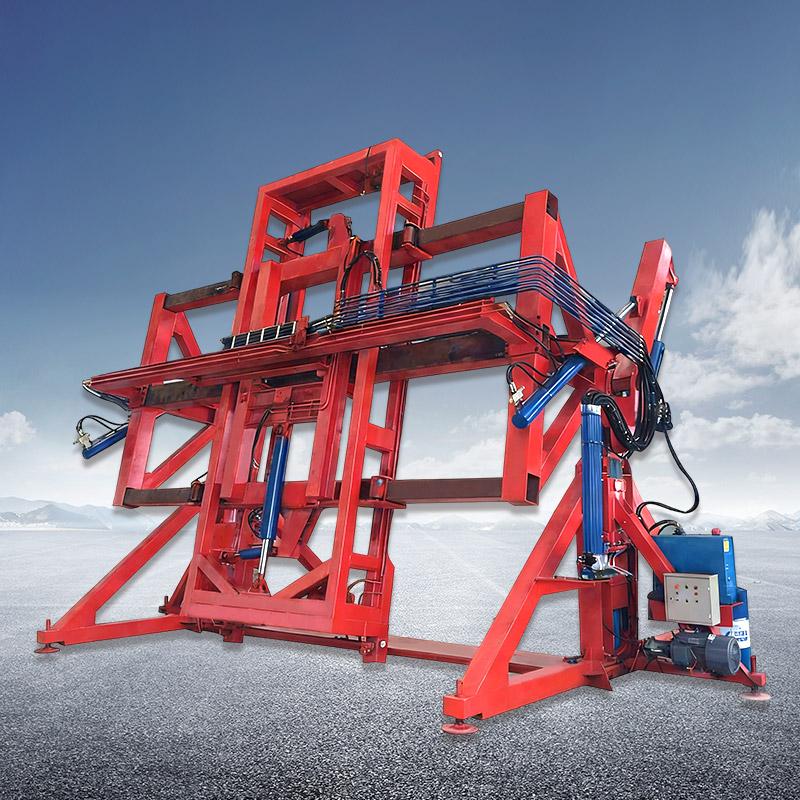
2.1 Dedicated container feeder
The dedicated container feeder automatically delivers containers onto the container tilting platform. This function is important because it reduces dependence on manual crane positioning and helps maintain a stable supply of containers to the main operating station.
In conventional systems, the crane may spend a significant portion of its operating cycle locating, lifting, aligning, and placing each container. The feeder separates the container supply task from the primary loading or unloading task. While one container is being processed, another can be prepared or advanced toward the next operating position, subject to the system’s safety logic and available space.
The feeder can be designed with positioning guides, mechanical stops, sensors, and control interlocks. These components help ensure that the container is correctly located before the tilting operation begins. Accurate positioning is especially important when the system includes automatic door mechanisms, weighing devices, material conveyors, or connections to upstream and downstream equipment.
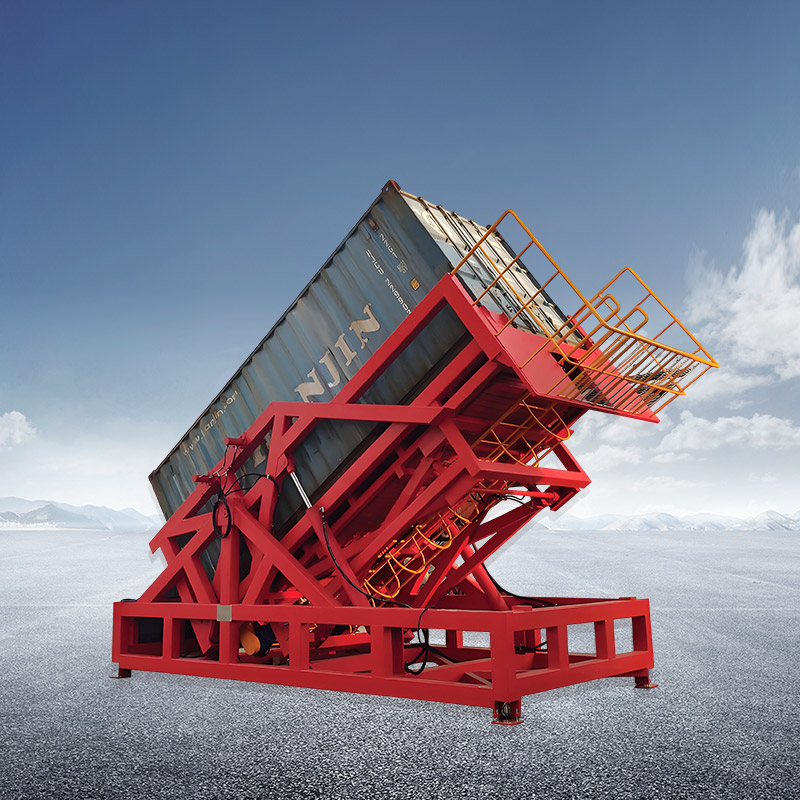
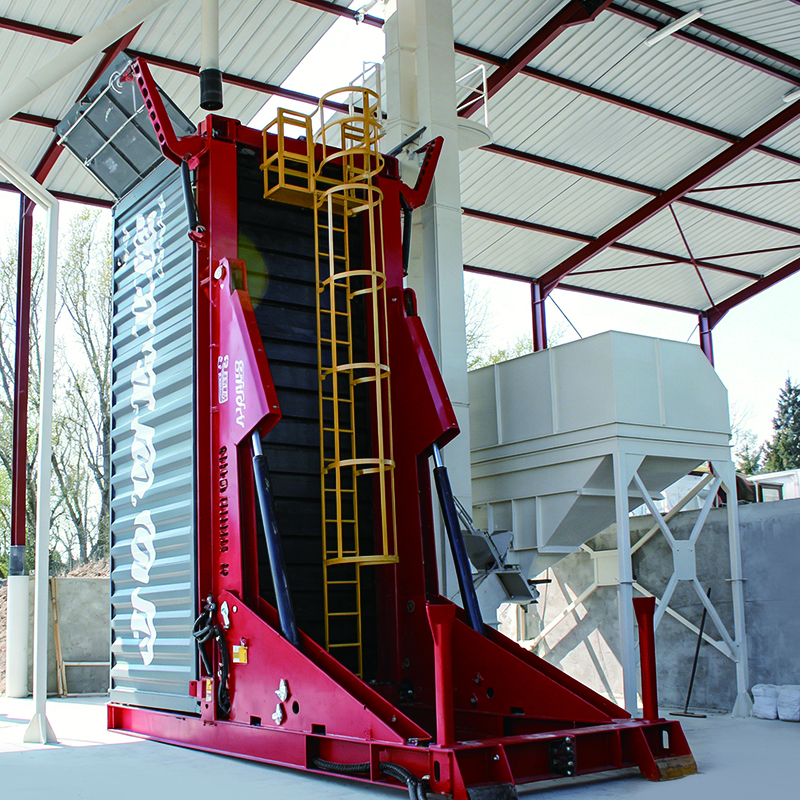
2.2 Container tilting platform
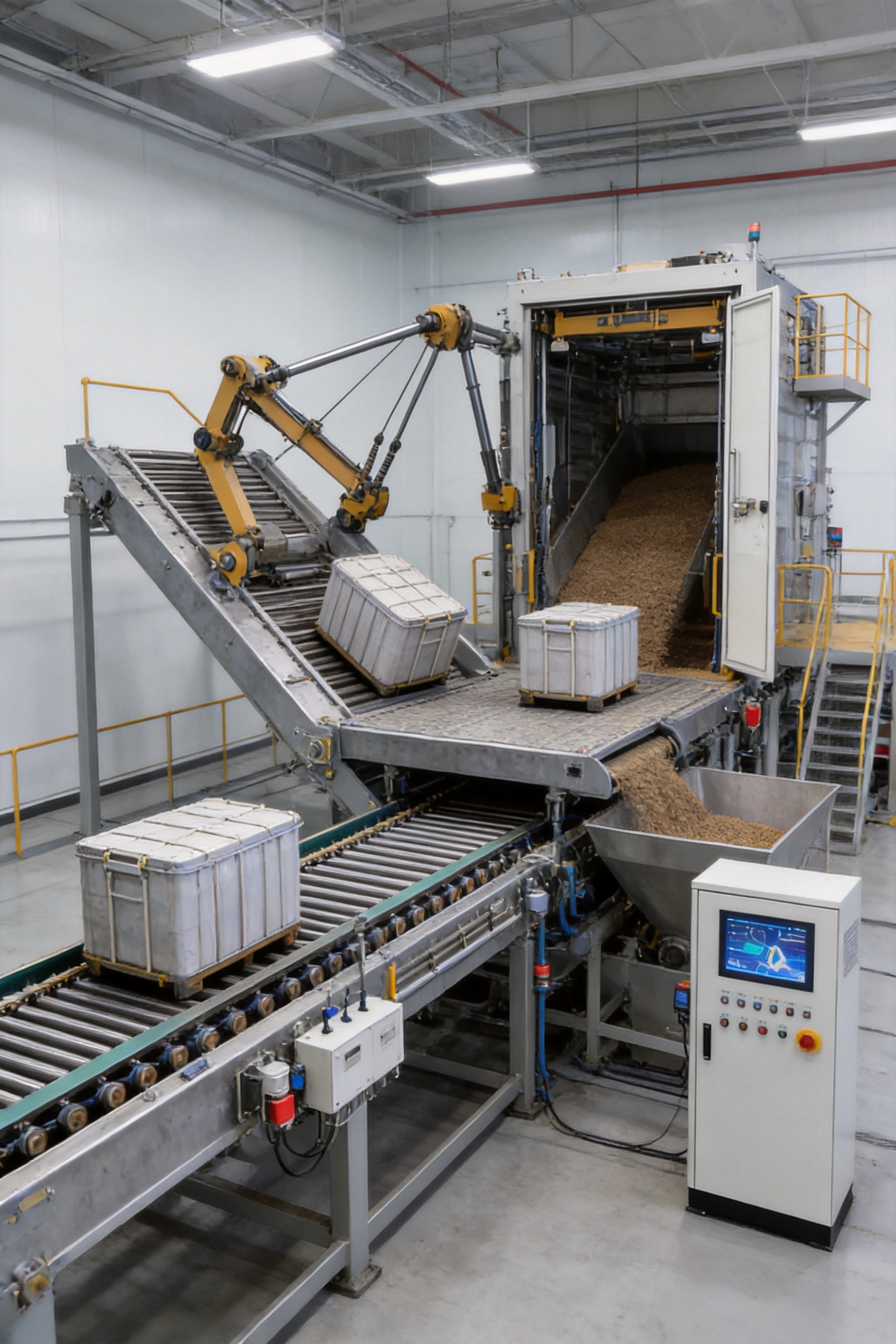
The tilting platform is the central mechanical component for operations that require a controlled change in container angle. Tilting can assist the discharge of bulk materials and can also support specific loading or unloading processes where gravity, controlled material flow, or access to the container interior is required.
A well-designed platform must maintain structural stability throughout the complete motion cycle. It must support the container and its cargo, distribute forces through the supporting frame, control acceleration and deceleration, and prevent uncontrolled movement. The lifting mechanism, hydraulic cylinders, pivot points, locking components, and platform surface must work together as one engineered assembly.
The available 45-degree and 60-degree maximum lifting angles allow the system to be adapted to different material flow characteristics and process requirements. The appropriate angle depends on factors such as bulk density, moisture content, particle size, internal friction, container condition, discharge opening design, and downstream receiving equipment.
2.3 Automatic door opening and closing
The system can be equipped with an automatic mechanism for opening and closing container doors. This option can substantially reduce manual work, particularly where operators would otherwise need to work at height or handle heavy doors repeatedly.
Automatic door operation also contributes to process consistency. Manual door opening may vary according to operator technique, container condition, weather, and workload. A controlled mechanism can apply a repeatable motion and can be integrated with sensors that confirm whether the doors are fully open, partially open, or closed before the next operation begins.
Safety interlocks can prevent the tilting or loading cycle from starting until the door status has been confirmed. Similarly, the system can prevent door closing while material remains in a dangerous position or while personnel access conditions have not been satisfied. The exact safety architecture should be configured according to the applicable regulations and site risk assessment.
2.4 Optional weighing function
A weighing function can be integrated into the container circulation process. This enables the operator to obtain weight information without sending the container to a separate weighing station. Integrating weighing into the handling sequence can reduce duplicate movement, shorten the logistics route, and improve production records.
Weighing can be used for incoming material verification, shipment documentation, inventory control, axle-load management, production reporting, and commercial settlement. The accuracy requirements vary by application. A system intended for internal process control may have different calibration and certification requirements from one used for legal trade transactions.
For reliable results, the weighing structure must be isolated as far as practical from vibration, impact, uneven loading, and external mechanical forces. The control system can record the weight together with container identification, operating time, product type, and process status. This creates a more complete information chain for logistics management.
3. Continuous Handling Compared with Traditional Batch Methods
Traditional batch handling remains suitable for low-volume operations, irregular work schedules, and sites where the equipment investment must be minimized. However, the batch method becomes less competitive as container volume increases. The principal disadvantage is the amount of time lost between completed containers.
Continuous handling is designed to overlap operations. Container feeding can take place while another container is being processed. Door preparation can occur before the main lifting cycle. Weighing can be completed as the container moves through the circulation process. Removal and delivery can be synchronized with the next container entering the line.
3.1 Throughput differences
Industry operating comparisons indicate that facilities transitioning from batch handling to continuous handling may achieve throughput increases of approximately 55 to 85 percent under suitable conditions. The exact result depends on the original equipment, material properties, working hours, container arrival pattern, operator practices, and the number of available loading positions.
Reference comparisons commonly show approximately 4 to 8 containers per hour for traditional batch handling and approximately 10 to 16 containers per hour for continuous handling. These figures should not be treated as universal guarantees. They illustrate the potential effect of reducing changeover time and coordinating several process stages.
| Performance Metric | Traditional Batch Handling | Continuous Handling | Typical Improvement |
|---|---|---|---|
| Containers processed per hour | 4 to 8 | 10 to 16 | Approximately 80% to 120% higher |
| Equipment idle time | Approximately 35% to 45% | Approximately 8% to 15% | Approximately 65% to 75% reduction |
| Container changeover time | 3 to 8 minutes | 20 to 45 seconds | Approximately 85% to 90% faster |
| Labor workload pattern | High peaks and valleys | More consistent steady-state work | Improved workload balance |
| Use of site space | Often requires separated process zones | Integrated process arrangement | Potentially lower internal transfer demand |
The figures in the table represent typical comparative ranges described for continuous handling applications. Actual performance must be established through a project-specific capacity study. A facility with irregular container arrivals may not achieve the same utilization as a facility with a stable inbound schedule and a balanced upstream material supply.
3.2 Reducing non-productive intervals
Non-productive intervals include container positioning, releasing, securing, door preparation, waiting for the next container, and transferring a container from one machine to another. These activities may be necessary, but they do not always need to stop the main loading or unloading process.
The continuous system reduces these intervals through overlapping operations. For example, the dedicated feeder can prepare the next container while the main platform completes the current operation. A container can be weighed during circulation rather than during a separate stop. A synchronized discharge conveyor can receive material as the container tilts, reducing the need for intermediate accumulation.
When each individual saving is small, the total improvement over an entire shift can be substantial. A reduction of only two or three minutes per container may create several additional operating hours over the course of a high-volume day.
3.3 Improved equipment utilization
Equipment utilization measures how much of the available operating time is used for productive processing. Batch equipment often experiences long periods in which the machine is available but waiting for positioning, operator action, crane availability, or the completion of a separate transfer.
Continuous systems are designed to keep the principal equipment active for a greater proportion of the shift. Reference operating comparisons indicate utilization levels of approximately 85% to 92% for well-organized continuous systems, compared with approximately 50% to 65% for traditional batch arrangements. These ranges depend on maintenance, shift planning, upstream supply, downstream receiving capacity, and operator training.
3.4 More stable daily capacity
Batch operations may produce uneven output. The system may process several containers quickly and then experience a long interruption caused by crane scheduling, door problems, vehicle delays, or manual repositioning. Continuous handling produces a more stable operating rhythm, which makes it easier to estimate daily capacity and coordinate transport resources.
Stable capacity is valuable for railway terminals and inland ports because trains and trucks often operate according to fixed schedules. It is also important in production plants where containers must be loaded or unloaded without disrupting manufacturing. Predictable performance helps the operator plan labor, receiving slots, inventory levels, and maintenance windows.
4. Product Advantages Over Conventional and Competing Systems
The continuous container handling system offers several advantages when compared with conventional batch equipment and fragmented multi-machine layouts. These advantages arise from system integration rather than from a single component.
4.1 One line for loading and unloading
The integrated loading and unloading function is a major competitive advantage for sites that handle containers in both directions. A facility does not need to build two completely independent process routes for inbound and outbound operations. The same equipment can be configured to support both functions, reducing transfer points and simplifying operating procedures.
This arrangement can also improve asset utilization. A loading station that would otherwise remain unused during a period of low outbound demand can be used for unloading or another compatible process. The final configuration depends on the material route, process control strategy, and required safety separation.
4.2 Compatibility with high-throughput operation
Many conventional container systems are adequate for occasional handling but become inefficient when the number of containers increases. The dedicated feeder, automatic positioning, synchronized platform, and optional weighing function enable the system to support a more demanding operating rhythm.
High throughput is not achieved by simply increasing motor power. The system must be balanced so that no single stage becomes a bottleneck. Feeder speed, tilting-cycle time, door operation, material discharge, weighing, and container removal must be considered together. This integrated approach differentiates a purpose-designed continuous system from a collection of independently installed machines.
4.3 Reduced manual high-altitude and heavy work
Manual intervention is often necessary in traditional container handling, especially for door operation, positioning checks, securing, and material access. The automatic door mechanism and guided container transfer reduce the amount of physical work required from operators.
Reducing manual work does not mean removing the operator from the process. Instead, the operator’s role can shift toward monitoring, inspection, control-room operation, exception handling, and preventive maintenance. This can improve safety and reduce the risk of repetitive strain, slips, falls, and injuries caused by handling heavy components.
4.4 Better use of limited land
Because the system integrates multiple functions, it can reduce the need for separate equipment zones. A more compact process route can lower internal travel distances and improve the use of the available site area. This is especially important for inland terminals, existing warehouses, railway yards, and industrial plants where expanding the property is difficult or expensive.
4.5 Expandable system architecture
A continuous handling project can be planned in stages. A facility may begin with one loading or unloading line and later add feeder capacity, additional operating lanes, automated identification, extra weighing stations, or a second container route. Modular design makes it easier to adapt the system to changes in cargo volume and process requirements.
Compared with a fixed batch layout, an expandable system offers greater potential for future automation. The control architecture can be prepared for integration with warehouse management systems, transportation management platforms, barcode readers, radio-frequency identification, cameras, and production management software.
4.6 Lower damage risk through controlled movement
Repeated manual repositioning increases the likelihood of impact, skewed placement, and uneven loading on the container structure. A guided continuous system can index the container into position and hold it securely during the main operation. Controlled acceleration and deceleration can further reduce shock loads.
Industry comparisons referenced for continuous handling indicate that container damage incidents may be reduced by approximately 15% to 25% compared with processes involving multiple manual repositioning moves. The actual result depends on container condition, operator behavior, material loading characteristics, and the quality of the safety and control system.
5. Advanced Manufacturing and Engineering Capabilities
The performance of a continuous container handling system depends heavily on manufacturing quality. Heavy-duty equipment must withstand repeated loading cycles, changing center-of-gravity conditions, vibration, dust, impact, and demanding working environments. A strong design concept must therefore be supported by disciplined manufacturing and testing procedures.
Jiangsu Zhengding Intelligent Equipment Co., Ltd. is a national high-tech enterprise focused on the research, development, manufacturing, and sales of intelligent automated loading and unloading equipment. Its product range includes rear dumpers, side-turn truck dumpers, car loading equipment, container flippers, and related logistics systems.
5.1 Application-oriented engineering design
Manufacturing begins with understanding the customer’s complete process rather than selecting an isolated machine. Engineers evaluate container dimensions, cargo type, material flow, loading and unloading direction, target capacity, vehicle or rail access, available space, foundation conditions, weather exposure, dust levels, and operator requirements.
This application-oriented approach enables the equipment to be configured for specific industries. A grain terminal may require dust control and gentle product transfer. A cement or chemical facility may require sealed transfer points and corrosion-resistant materials. A steel or mineral operation may require higher structural strength and wear protection. A logistics warehouse may prioritize rapid changeover, weighing, and data integration.
5.2 Structural design for heavy loads
The frame, platform, support structure, pivot components, and lifting assemblies must be designed for the selected container size and load rating. Engineers consider static load, dynamic load, eccentric loading, braking forces, tilting forces, fatigue cycles, and accidental load variation.
For a 40-foot system with a maximum reference lifting weight of 100 tons, structural design is especially important. The equipment must retain stability through the complete lifting angle range, not only when the platform is horizontal. Stress concentration around pivots, cylinder mounts, weld zones, and support points must be carefully reviewed.
Computer-aided design and engineering analysis can be used to establish load paths, review interference, verify component clearances, and optimize the structure before fabrication. This helps reduce rework and supports a more reliable manufacturing process.
5.3 Precision fabrication and welding
Large equipment frames require controlled fabrication. Cutting, forming, drilling, welding, and assembly must be carried out according to dimensional drawings and quality procedures. Accurate positioning of pivot plates, hydraulic mounts, guide rails, and container stops is essential for smooth movement and long service life.
Welding quality directly affects structural reliability. Appropriate welding procedures, qualified welders, controlled preheating where required, and inspection of critical welds help reduce the risk of cracks, incomplete fusion, distortion, and fatigue-related failures. After welding, key dimensions can be checked against the engineering drawings before the structure proceeds to mechanical assembly.
Surface preparation and coating are also important. Equipment installed outdoors or in dusty industrial environments may be exposed to moisture, chemicals, abrasion, and temperature changes. A suitable coating system can help protect the steel structure and maintain appearance and corrosion resistance throughout the operating life.
5.4 Hydraulic system integration
Hydraulic systems provide high force in a relatively compact arrangement and are well suited to container tilting applications. The hydraulic power unit, cylinders, valves, hoses, piping, pressure protection, and control components must be selected as one system.
Hydraulic design should provide smooth starting, controlled acceleration, stable holding, and safe lowering. Relief valves and other protection devices help prevent excessive pressure. Hose routing must protect against abrasion, sharp edges, heat, and interference with moving parts. Service access should be considered so that filters, seals, valves, and hoses can be inspected or replaced efficiently.
The hydraulic control system can be combined with position sensors and programmable logic controls. This allows the equipment to stop at defined angles, confirm platform position, and prevent unsafe movements when a door, clamp, or container position does not meet the required conditions.
5.5 Electrical and automation manufacturing
Continuous operation requires coordinated electrical control. The control cabinet, sensors, motors, variable-frequency drives, programmable logic controller, human-machine interface, emergency stops, safety circuits, and communication interfaces must operate together.
Automation design begins with the sequence of operations. The system identifies whether a container is present, verifies its position, confirms door status, checks that the working area is clear, starts the relevant feeder or conveyor, activates the lifting cycle, and records completion. If an abnormal condition occurs, the system should stop or enter a safe state according to the risk assessment.
A well-organized control interface can display container status, platform angle, weight, equipment alarms, operating mode, maintenance information, and production records. Operators can use this information to identify problems before they develop into major downtime events.
5.6 Factory testing and commissioning
Factory testing is an important advantage when compared with systems assembled from unrelated equipment suppliers. Before delivery, the manufacturer can inspect the mechanical assembly, run the hydraulic system, test the control sequence, verify sensor signals, check safety interlocks, and simulate operating cycles.
Load testing and no-load testing serve different purposes. No-load testing confirms movement, control logic, noise, vibration, and interference. Load testing verifies structural response, hydraulic stability, platform control, and braking or holding performance under representative conditions. The final testing plan should be established according to the equipment type, customer specification, and applicable standards.
6. Customization for Different Industries
A continuous container handling system should not be treated as a standard machine with only minor dimensional changes. The best results come from adapting the complete system to the customer’s material, facility, and logistics process.
6.1 Grain and food ingredient facilities
Grain, feed, flour, and food ingredients may require careful management of dust, contamination, moisture, and product loss. The container discharge route can be connected to enclosed conveyors, hoppers, filters, or storage systems. Smooth material flow helps reduce blockages and product degradation.
Food-related facilities may also require special attention to cleanability, corrosion resistance, inspection access, and the separation of product-contact surfaces from lubricants or contaminants. The weighing system can support batch records and inventory control.
6.2 Cement, minerals, and bulk construction materials
Cement, minerals, powders, and aggregates can impose high wear and dust loads on handling equipment. Wear-resistant liners, sealed transfer points, dust extraction, and robust structural components may be required. The tilting angle and receiving hopper design should be selected according to the material’s flow characteristics.
In these applications, maintaining reliable operation may be more important than achieving the highest possible movement speed. A balanced cycle with controlled acceleration can help reduce impact and extend the service life of hydraulic and structural components.
6.3 Chemical and industrial materials
Chemical materials require careful evaluation of corrosion, leakage, containment, and operator exposure. The equipment may need compatible coatings, stainless or special alloy components, sealed transfer areas, and additional monitoring devices. The control system can be configured to prevent operation if a cover, door, clamp, or containment condition has not been confirmed.
6.4 Ports, railway terminals, and inland logistics parks
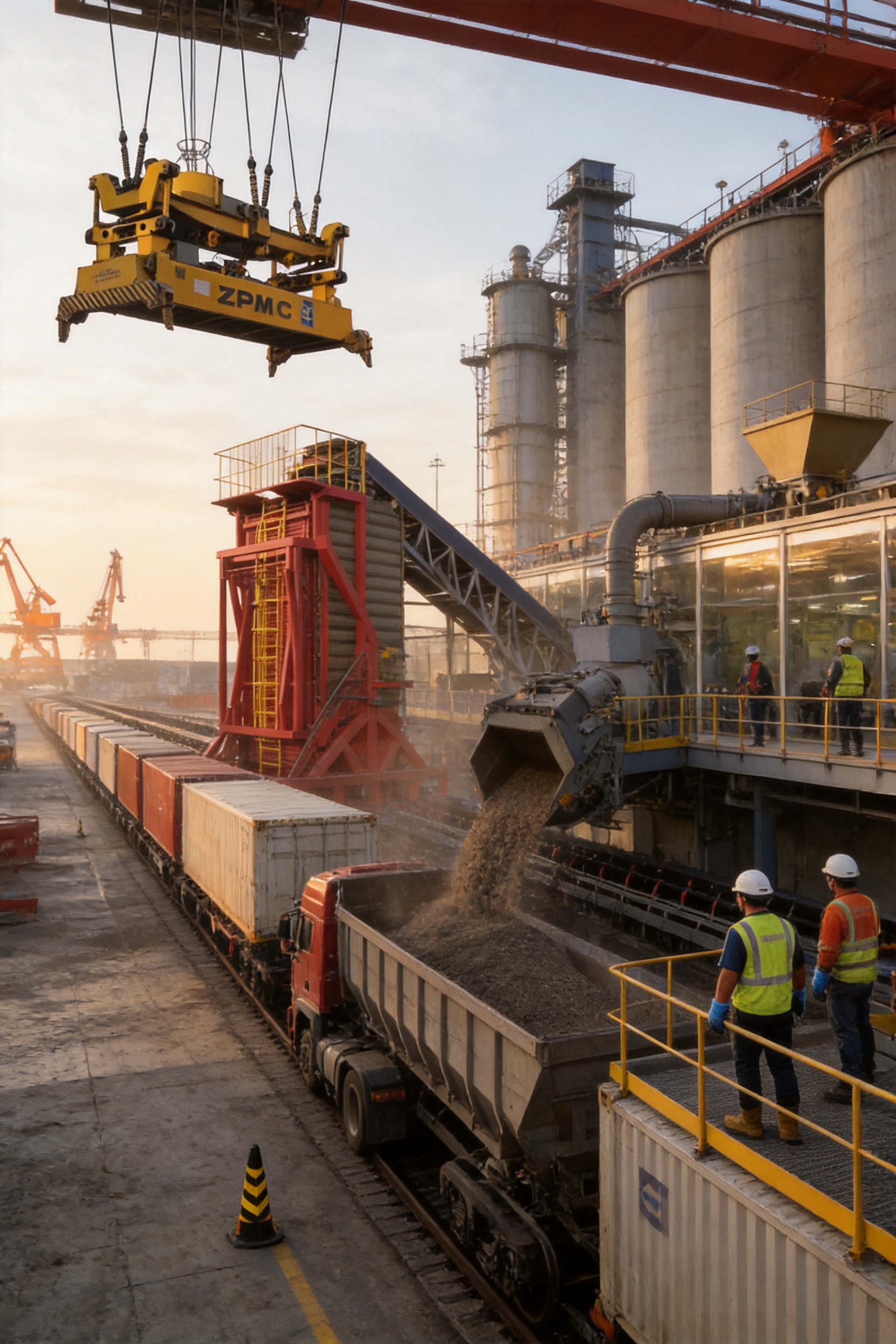
Intermodal facilities require fast container turnover and dependable coordination with trucks, railcars, cranes, and yard management systems. The continuous system can be integrated into an overall container route that includes identification, weighing, loading, unloading, staging, and dispatch.
Because railway and port operations often have strict schedules, stable cycle time is valuable. The system can help reduce queues and improve the use of dock positions. Its ability to handle both 20-foot and 40-foot containers also supports a broader range of transport requirements.
7. Safety, Reliability, and Maintenance
Heavy lifting and tilting equipment must be designed around safety from the beginning. Safety cannot depend solely on operator attention or warning signs. Mechanical protection, control interlocks, access management, emergency stopping, inspection procedures, and training must work together.
7.1 Mechanical safety provisions
Mechanical safety may include container positioning stops, anti-slip surfaces, structural restraints, platform locking devices, guarded moving components, access barriers, and maintenance supports. These devices help prevent container movement or unexpected platform motion during operation.
7.2 Control and interlock functions
Electrical and software interlocks can verify that the container is in position, the doors are in the correct state, the working zone is clear, and the equipment is ready before the next sequence begins. Emergency-stop devices should be located where operators can reach them quickly.
Interlocks should be designed so that an operator can identify the reason for a stop. Clear alarm messages reduce troubleshooting time and discourage unsafe attempts to bypass the protection system.
7.3 Preventive maintenance
Preventive maintenance is essential for continuous equipment. Regular inspection should cover hydraulic oil, hoses, seals, cylinders, pivot pins, bearings, welds, bolts, guide rails, sensors, limit switches, electrical cabinets, emergency stops, and structural coatings.
Maintenance intervals should be adjusted according to operating hours, container weight, working environment, dust concentration, temperature, and cycle frequency. A facility processing a high number of containers every day may require condition monitoring and planned component replacement to avoid unexpected downtime.
7.4 Operator training
Operators should understand the complete process rather than only the start and stop buttons. Training should cover container positioning, load limits, door operation, alarm response, emergency procedures, inspection points, and communication with vehicle or crane operators.
Maintenance personnel should receive additional training in hydraulic isolation, electrical lockout, mechanical support, sensor calibration, and safe access to elevated or confined areas. Clear operating procedures help preserve the performance advantages of continuous handling.
8. Why Choose an Experienced Integrated Equipment Manufacturer
Purchasing a continuous container handling system involves more than buying a tilting platform. The supplier must understand structural design, hydraulic power, electrical automation, container logistics, loading and unloading processes, safety, and after-sales support.
Jiangsu Zhengding Intelligent Equipment Co., Ltd. provides automated loading and unloading solutions for automobiles, containers, ships, and industrial logistics applications. The company has developed equipment for steel, chemical, cement, coal, grain, oil, food, feed, ports, papermaking, and new energy industries.
Its broader product portfolio includes rear dumpers, side-turn truck dumpers, car loading equipment, container flippers, and related systems. This range allows the company to evaluate a container handling project within the wider context of vehicle unloading, material transfer, warehouse receiving, and industrial production.
8.1 Experience across international markets
The company’s equipment has been supplied to markets including Japan, Brazil, Egypt, Pakistan, India, the Middle East, and Southeast Asia. Experience across different regions can help an equipment supplier understand variations in climate, installation conditions, operating customs, safety expectations, and logistics infrastructure.
International users associated with the company’s equipment and services include Budweiser, Heineken, Buhler Group, Wilmar International, Cargill, DuPont, Louis Dreyfus, Charoen Pokphand Group, and Saint-Gobain Group. Such applications reflect the need for reliable handling equipment in food, agriculture, chemicals, materials, and industrial supply chains.
8.2 One-stop project coordination
A supplier that can coordinate mechanical structure, hydraulic components, electrical controls, software logic, weighing, door automation, and feeder systems can reduce communication gaps between multiple vendors. This is valuable during design, installation, commissioning, and troubleshooting.
One-stop coordination also supports clearer responsibility. When a problem occurs, the customer can work with one technical team to determine whether the cause is related to container positioning, hydraulics, controls, weighing, material flow, or downstream equipment.
8.3 Custom engineering rather than fixed catalog selection
Every site has different constraints. The container route may be straight, angled, elevated, enclosed, or connected to an existing conveyor. The available foundation may limit the platform size. The customer may need a specific lifting angle, weighing accuracy, automatic door function, or communication protocol.
Custom engineering allows the equipment to be designed around these conditions. The supplier can review drawings, operating data, container specifications, and process requirements before confirming the final configuration. This approach is generally more effective than modifying a standard machine after delivery.
9. Project Planning and Selection Guide
Before ordering a continuous container handling system, the customer should prepare complete technical information. This allows the manufacturer to select the correct model and avoid under-sizing or unnecessary over-design.
9.1 Required operating information
Important information includes container length, maximum gross weight, cargo density, material type, target containers per hour, daily operating hours, loading and unloading direction, required tilting angle, weighing accuracy, door automation requirements, available site area, foundation conditions, ambient temperature, dust level, and power supply.
The customer should also explain whether containers arrive continuously or in groups, whether trucks or railcars are used, how containers are identified, where empty containers are stored, and what equipment receives the discharged material.
9.2 Throughput study
A throughput study should account for the complete cycle rather than only the lifting time. The cycle includes container arrival, identification, feeder movement, positioning, door operation, weighing, tilting, loading or unloading, return movement, door closing, removal, and preparation of the next container.
The study should also include planned maintenance, shift changes, cleaning, inspection, material interruptions, and container condition. A realistic capacity model helps the customer compare equipment alternatives and establish an achievable production target.
9.3 Site and foundation assessment
The platform and support structure transmit substantial forces to the foundation. The site must be reviewed for load-bearing capacity, drainage, clearance, access, vibration, underground services, and installation space. The arrangement should also provide safe access for operators and maintenance personnel.
For an existing warehouse or terminal, the supplier may need to review building columns, roof height, vehicle turning radius, fire protection, drainage, and electrical distribution. Early site assessment reduces the risk of construction delays and unexpected modification costs.
10. Frequently Asked Questions
Q1: What is the minimum throughput that can justify a continuous handling system?
Continuous handling may become economically attractive at approximately 15 to 20 containers per day per loading bay, depending on labor costs, demurrage charges, dock limitations, and the existing equipment. Facilities processing more than 50 containers per day may achieve a particularly strong return because the reduction in changeover time is used repeatedly throughout the shift. A project-specific financial model should be prepared before investment approval.
Q2: Can an existing batch system be converted to continuous operation?
Partial conversion may be possible by adding automated container positioning, feeder equipment, conveyors, weighing devices, or door mechanisms. However, complete continuous operation usually requires equipment designed for overlapping processes. Many facilities begin with one pilot line, measure throughput and operating stability, and then expand the system after confirming the results.
Q3: Can the equipment handle both 20-foot and 40-foot containers?
Yes. The system can be configured for both container lengths. The TJXH 20 reference model is designed for 20-foot containers with a maximum lifting weight of 50 tons, while the TJXH 40 reference model is designed for 40-foot containers with a maximum lifting weight of 100 tons. Final selection depends on container structure, cargo weight, load distribution, site conditions, and required process capacity.
Q4: What is the maximum lifting angle?
The reference equipment can be configured for a maximum lifting angle of 45 or 60 degrees. The correct angle depends on the material being discharged, container condition, receiving equipment, and the required flow rate. The final angle should be confirmed through engineering analysis and process testing.
Q5: Is weighing available as part of the system?
Yes. A weighing function can be integrated into the container circulation process. This allows the operator to weigh containers without transferring them to a separate station. The required accuracy, calibration method, data recording, and certification depend on whether the weighing is intended for internal control or commercial measurement.
Q6: Does the system include automatic container door operation?
An automatic door opening and closing mechanism can be configured. This helps reduce manual high-altitude work and heavy physical labor. Door status sensors and safety interlocks can be included so that the equipment does not start the next stage until the door position has been confirmed.
Q7: How does continuous handling affect container damage?
Controlled movement and reduced repositioning can lower the risk of container impact, skewed placement, and repeated handling. Reference industry comparisons indicate that damage incidents may be reduced by approximately 15% to 25%. Actual performance depends on container condition, operating practices, alignment, load distribution, and maintenance.
Q8: How is the equipment maintained?
Maintenance includes inspection of hydraulic oil, hoses, seals, cylinders, pivot points, bearings, welds, bolts, sensors, limit switches, electrical cabinets, safety devices, and protective coatings. Preventive maintenance intervals should be established according to operating hours, load, environment, and cycle frequency.
Q9: Can the system be connected to existing warehouse or terminal software?
Integration is possible when the control architecture and communication protocols are defined during the engineering stage. The system may exchange information related to container identification, weight, operating status, alarms, production counts, and completed cycles. The customer should provide the requirements of the warehouse, terminal, or enterprise management system before final design.
Q10: What information should be provided when requesting a quotation?
The customer should provide container sizes, maximum gross weights, cargo type, target throughput, daily operating hours, loading and unloading process, required lifting angle, weighing requirements, automatic door requirements, site drawings, foundation information, power supply, environmental conditions, and preferred automation functions. Complete information improves quotation accuracy and reduces later design changes.
11. Conclusion
A continuous container handling system provides a practical solution for logistics facilities that need higher throughput, shorter changeover time, lower manual involvement, and better use of available space. By combining a dedicated container feeder, container tilting platform, optional weighing, automatic door operation, and integrated loading and unloading functions, the system transforms container handling from a series of disconnected batch operations into a coordinated flow.
Its ability to handle both 20-foot and 40-foot containers makes it suitable for a wide range of intermodal and industrial applications. The reference TJXH 20 and TJXH 40 models provide different capacity levels, while the maximum 45-degree or 60-degree tilting configurations allow the equipment to be adapted to different material and process requirements.
Compared with conventional batch equipment, continuous handling can reduce idle time, improve equipment utilization, stabilize daily capacity, reduce repeated container movement, and simplify the overall site layout. The strongest results are achieved when the system is engineered around the customer’s actual container flow, material characteristics, site limitations, safety requirements, and information systems.
Jiangsu Zhengding Intelligent Equipment Co., Ltd. combines intelligent equipment development, heavy-duty fabrication, hydraulic integration, electrical automation, application engineering, and international project experience. Its broader range of automated loading and unloading equipment provides additional value for customers seeking a coordinated solution for containers, trucks, ships, warehouses, and industrial logistics systems.
For high-volume terminals, warehouses, inland ports, railway stations, and industrial plants, the decision to adopt continuous container handling should be based on a complete throughput and lifecycle analysis. When container demand, labor requirements, and site restrictions justify the investment, an integrated system can provide a durable foundation for safer, faster, and more predictable logistics operations.
References
1. Jiangsu Zhengding Intelligent Equipment Co., Ltd., Product Information for Continuous Container Handling Systems.
2. Jiangsu Zhengding Intelligent Equipment Co., Ltd., Technical Parameters for TJXH 20 and TJXH 40 Container Handling Models.
3. International Organization for Standardization, Freight Containers: Dimensions, Ratings, and Handling Considerations.
4. International Labour Organization, Safety and Health in Ports and Cargo-Handling Operations.
5. Occupational Safety and Health Administration, Materials Handling and Heavy Equipment Safety Guidance.
6. International Maritime Organization, Guidelines for Container Handling and Cargo Transport Safety.
7. Industry operating comparisons for continuous and batch container handling, 2025 reference data.
8. General engineering practices for hydraulic lifting systems, industrial automation, structural fabrication, and preventive maintenance.


